


A lot of local business owners are looking at reports that say one thing while the phone log says another. A roofer sees a high-value job come in and the dashboard labels it “direct.” A plumber gets a call after running Google Ads, local SEO, and Google Maps optimization, but nobody can say which step prompted the customer to call. That gap creates bad decisions fast.
For service businesses, the primary goal isn't traffic for its own sake. It's showing up when someone searches transactional terms like “roofer near me,” “dentist near me,” or “air conditioning repair near me.” Those are the searches that come from people ready to spend money now. If you don't know which touchpoints helped generate that call, you can't scale what's working.
Search engine optimization still matters. AI optimization now matters too. More people are using LLM-driven search experiences and AI-generated answers to find local businesses, compare options, and decide who to call. If your brand isn't visible across those discovery paths, you lose buyers before they ever reach your site or Google Business Profile.
Why Your Marketing Reports Are Lying to You
A common scenario goes like this. You invest in Google Ads for emergency repairs, work on local SEO, post content to support visibility, and tighten up your Google Business Profile. Then a customer calls, books a profitable job, and your report gives all the credit to the last thing it could see.
That sounds clean on paper. It isn't how people buy.
A homeowner might first notice your business after searching a service term, then see your map listing later, then come back by typing your brand name directly before calling. The report often grabs the last visible step and acts like that single action created the lead. For a busy owner, that leads to the wrong conclusion about where to cut or increase spend.
What this looks like in real life
Take a roofing company chasing storm repair jobs in a competitive metro. The owner wants to rank for terms that turn into booked work, not vanity traffic. Someone searches “roofer near me,” reads reviews, leaves, comes back through Google Maps, calls from a tracked number, and closes after speaking with the office.
If the system only records the last click, the earlier search visibility and map exposure can disappear from the story. That's how good channels get underfunded.
Your report can be technically accurate and still be commercially wrong.
This gets worse when owners review marketing by channel instead of by journey. Paid search looks expensive. SEO looks slow. Maps looks hard to measure. Direct traffic looks amazing. In practice, those channels often work together to generate the phone call.
A more honest way to evaluate performance is to measure how the pieces connect. If you want a better framework for that, this guide on how to measure marketing effectiveness is a solid starting point.
Why this matters for transactional search
For local businesses, the highest-value search visibility usually comes from high-intent terms. “Roofer near me.” “Plumber near me.” “Dentist near me.” “AC repair near me.” Those searches don't need more awareness campaigns. They need precise tracking so you know what created the call.
When you can't see the full path, you start making decisions off partial truth. You pause the keyword that introduced the buyer. You ignore the map listing that built trust. You overvalue the final click because it's the only thing your report can identify.
That's where a multi-touch attribution model becomes useful. It replaces guesswork with a fuller view of how a lead reached your phone.
Understanding Multi-Touch Attribution
A multi-touch attribution model assigns credit across the interactions that helped produce a lead, instead of handing all the value to the final click or visit.
For a local service business, that matters because the sale usually happens on the phone, not inside your analytics platform. A homeowner may find you through a non-branded search, check your Google Business Profile later, read reviews, come back to a service page, then call from a mobile number on the site. If you only credit the last tracked visit, you miss the touches that created trust and buying intent.
The sports comparison still fits here. A goal comes from the full play, not just the final tap. Marketing works the same way, especially for roofers, plumbers, HVAC companies, and other businesses that win work from high-intent searches.
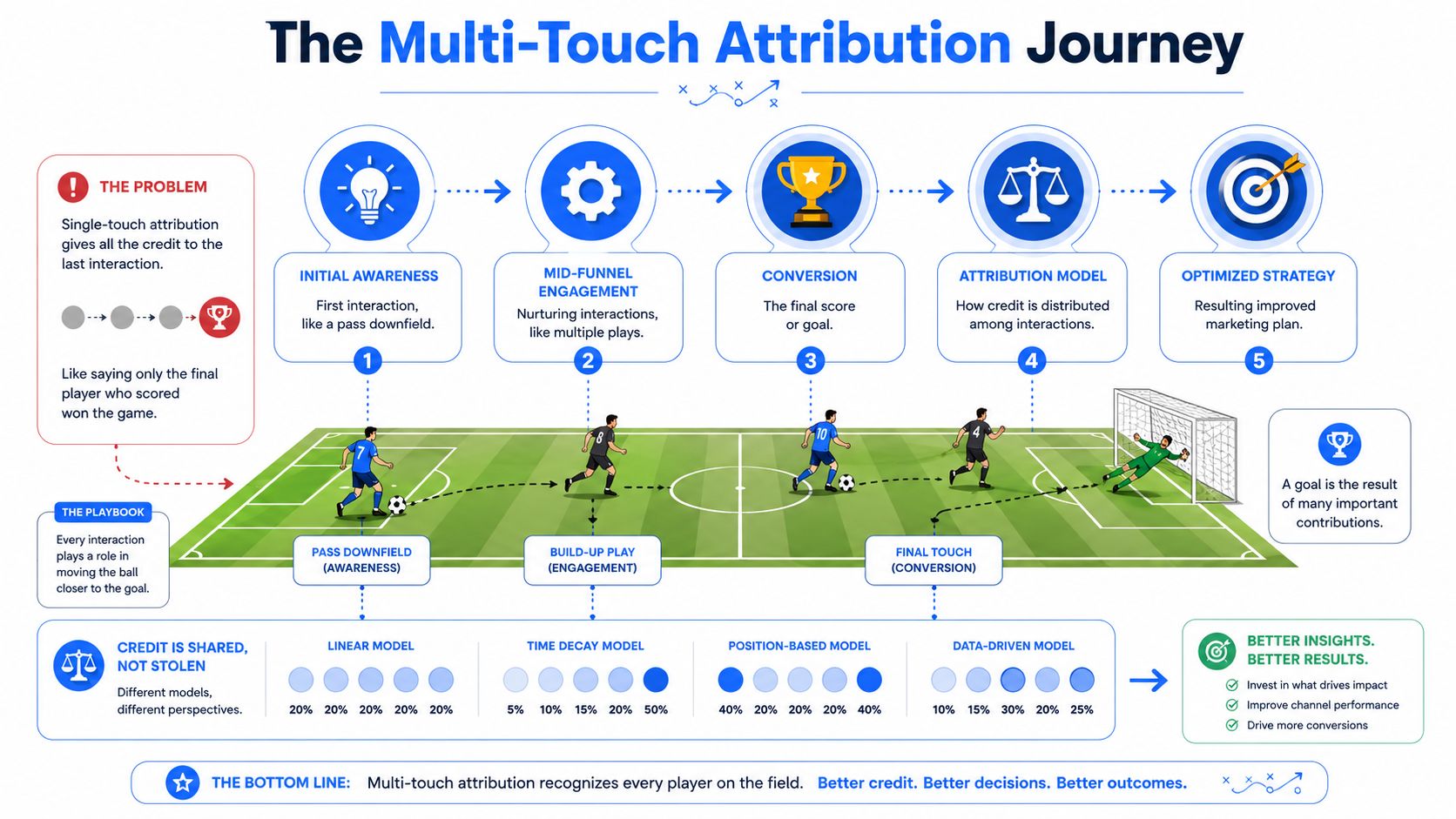
Last-click leaves out the touches that drove the call
Here's a common local search path. Someone searches “plumber near me,” visits your site, gets distracted, later checks your reviews on your Google Business Profile, then returns and calls after one more visit.
A last-click report gives full credit to that final session. That sounds neat in a dashboard, but it does not match how the customer decided.
For service businesses, multi-touch attribution becomes practical instead of theoretical. It helps separate the touch that introduced you, the touch that built trust, and the touch that finally got the phone to ring. That leads to better budget decisions. You stop overvaluing branded search and direct traffic just because they tend to show up late in the journey.
What counts as a touchpoint for a local service business
A touchpoint is any meaningful interaction that moves a buyer closer to calling. In local marketing, those touches often include both digital signals and offline actions.
- Search discovery from terms like “emergency plumber near me” or “roof leak repair”
- Google Business Profile views and map interactions
- Website visits to service pages, location pages, financing pages, or review pages
- Review site checks that help a customer compare options
- Retargeting ads or social reminders that bring the prospect back
- Phone calls from the site, the map listing, or a tracked number
- Form submissions, if your business gets meaningful lead volume that way
That last point gets ignored in a lot of attribution guides. For many local companies, the phone call is the conversion. If your model tracks clicks but not calls, you are only measuring part of the buying process.
After you get the basic idea, this short video makes the concept easier to visualize in plain language.
Why offline attribution changes the quality of your reporting
A roofer does not care which channel won a spreadsheet argument. The roofer cares which mix of visibility produced booked estimates. Same for a plumber trying to keep the board full this week.
That is the gap in a lot of MTA advice. It explains ad clicks well enough, but it stops short of tying those touches to real phone leads. In practice, a map view, a repeat visit, and a tracked call often tell a more useful story than a clean-looking last-click report inside Google Analytics.
Practical rule: If the customer needed several interactions before calling, your reporting should credit several interactions, including the offline call event.
That is the core value of multi-touch attribution for local service businesses. It gives you a fuller picture of what created revenue, not just what happened right before the conversion.
Common Attribution Models for Service Businesses
A homeowner searches "water heater repair near me" at lunch, clicks your site, leaves, sees your Google Business Profile that evening, then calls the next morning after reading reviews. The question is simple. How much credit should each step get?
That is what attribution models do. They assign value across the path instead of handing all the credit to the final click or the final call source.
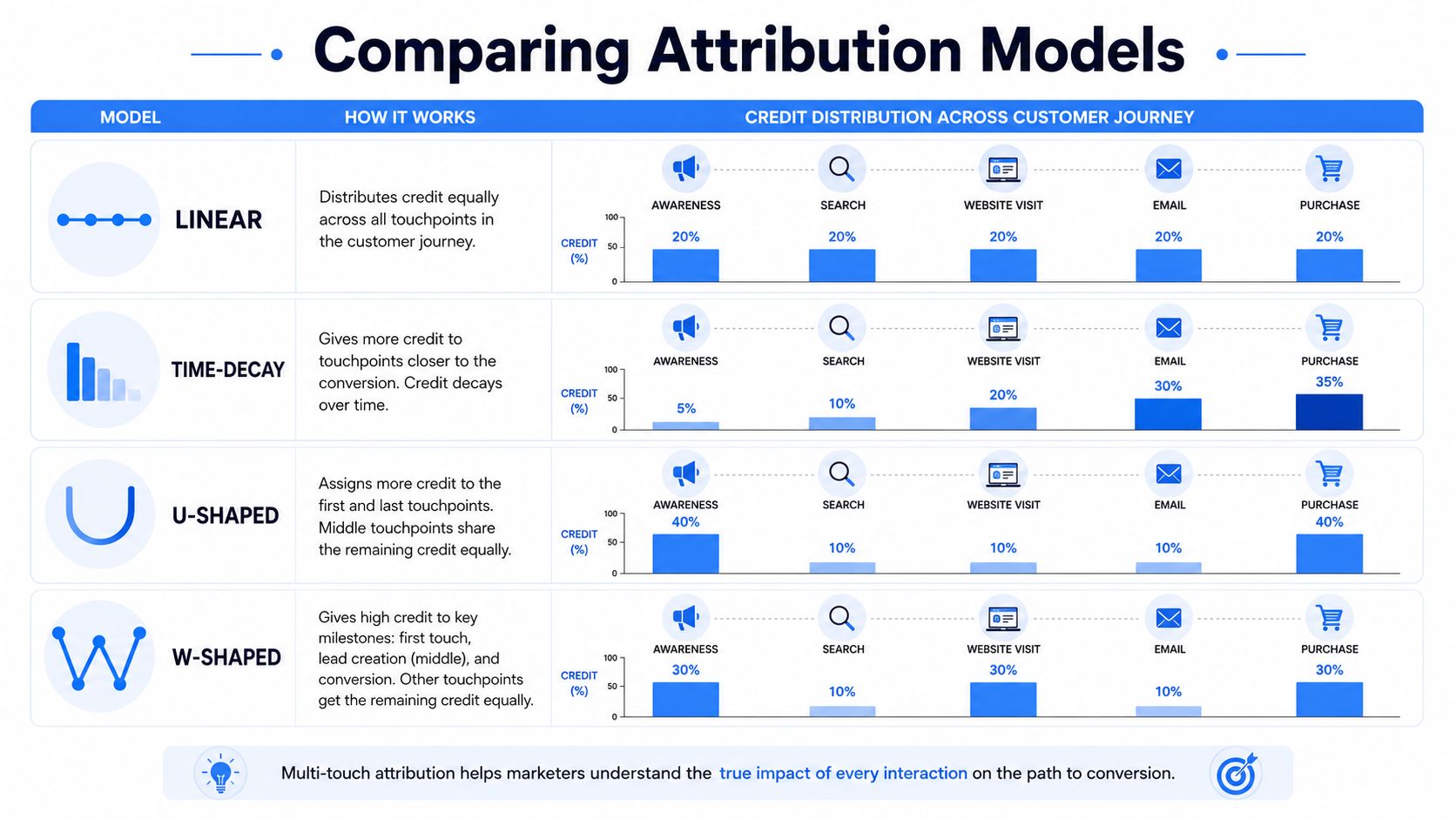
For service businesses, the right model depends on how customers book. A roofer with long sales cycles and insurance work needs a different view than a plumber handling urgent same-day calls. The goal is not to pick the fanciest option. The goal is to choose a model that helps you spend more on the channels that produce booked jobs.
Four common rule-based models
| Model | How it thinks | Best use for a service business | Limitation |
|---|---|---|---|
| Linear | Every touchpoint shares credit evenly | Good starter model when you want a balanced view | It treats weak and strong touches the same |
| Time-decay | Recent interactions get more weight | Useful when buyers move fast and late-stage actions matter more | Early discovery can look less important than it really was |
| U-shaped | Heavier credit goes to the first and last touch | Strong fit for lead generation when discovery and conversion both matter | Mid-journey influence can be understated |
| W-shaped | Extra importance goes to a key middle action too | Helpful when a distinct step in the middle matters | Harder to use if your middle milestone isn't clearly tracked |
How these models work in the field
Linear is the easiest place to start. If a lead touched SEO, Local Services Ads, and your Google Business Profile before calling, linear spreads credit across all three. That alone is a big improvement over a report that gives 100 percent of the win to the last touch.
U-shaped is often a better fit for local service companies. First touch matters because it introduced your business. Last touch matters because it triggered the call. The middle steps still get some credit, but less. For owners trying to judge whether top-of-funnel visibility and bottom-of-funnel conversion points are both pulling their weight, this model is usually easier to trust.
Where time-decay and W-shaped make sense
Time-decay fits urgent jobs. Burst pipes, no-cooling calls, locked-out situations, and emergency electrical work tend to compress the buying window. In those cases, the touches closest to the call often deserve more weight.
W-shaped works better when there is a meaningful middle milestone. That could be a scheduled estimate, a financing-page visit, or a tracked interaction with your Google Business Profile before the call. If you monitor those local actions inside a Google Business Profile performance dashboard, you can define that middle step with more confidence instead of guessing.
The trade-off most owners need to hear
Do not choose a model because it sounds more advanced. Choose the one that matches how your customers move from search to phone call.
I usually recommend that smaller service businesses start with either linear or U-shaped. Both are practical. Both are easier to explain to a team. Both can surface hidden value in SEO, Maps, and paid search before you get into heavier modeling.
The more complex option
Algorithmic attribution uses software to assign credit based on observed patterns rather than fixed rules. That can be useful if you have high lead volume, clean tracking, and enough history to trust the output.
Most local companies are not there yet.
The bigger problem is usually simpler. The model may be fine, but the setup is missing the event that matters most: the phone call. If a customer found you through organic search, came back through Maps, and then called from a tracked number, your attribution model should reflect that full path. If it does not, even a complex model will point budget in the wrong direction.
The Offline Gap Most Marketing Agencies Ignore
Most attribution talk breaks down the digital journey well enough. It tracks ad clicks, page visits, and form submissions. That sounds complete until you look at how local service businesses make money.
For a plumber, HVAC company, dentist, or roofer, the most important conversion often isn't a form. It's a phone call. If your attribution setup can't connect digital discovery to that call, you're running with missing evidence.
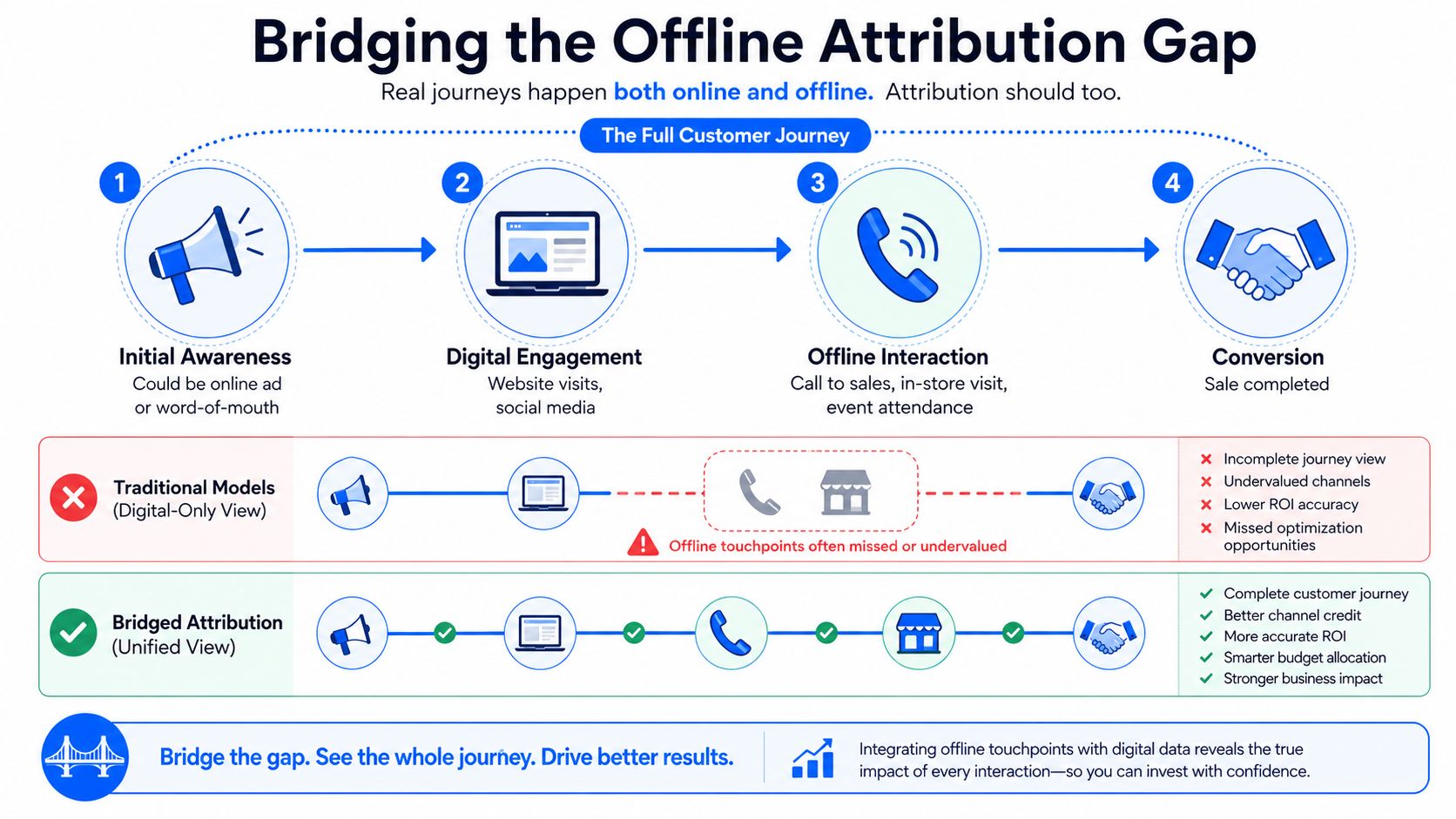
Why digital-only tracking breaks down
A homeowner may find you through a service page, check your reviews in Maps, call from the listing, speak with your office, and book after that conversation. A standard digital report might see the website visit. It might see the map impression. But if the phone call isn't stitched back to the journey, the conversion record is incomplete.
That missing layer causes budget mistakes. Channels that help generate quality calls can look weak. Channels that happen to appear near the end can look stronger than they are.
This is especially important in local search, where map exposure and call actions often carry significant commercial value. If you're serious about local visibility, this walkthrough on tracking Google Business Profile performance in a reporting dashboard shows why map-level reporting matters.
The verified offline problem
The gap isn't minor. According to Improvado's discussion of multi-touch attribution, for service-industry SMBs, 40-60% of conversions originate from offline touchpoints like phone calls, yet most MTA guides fail to provide a framework for integrating this data, leading to brittle models that misallocate budget because the most important conversion event is missing.
That lines up with what local operators see every day. The office answers the phone, qualifies the lead, and books the work. If your system only measures digital actions and not the call that produced revenue, it can't tell you the whole truth.
What a better setup looks like
A useful framework connects the call back to the source path. That usually means:
- Tracking numbers tied to source data so you can tell whether the call came from Google Ads, organic search, Google Maps, or another channel
- Consistent campaign tagging so the click path is readable
- CRM notes or lead outcomes so you know which calls became booked work
- A reporting layer that puts the journey together instead of isolating each platform
The sale doesn't happen because someone visited a page. It happens because the right person called after the right sequence of trust-building steps.
That's the part many agencies skip. They optimize what they can see easily, not what closes.
A Practical MTA Setup Guide for Your Business
You don't need an enterprise analytics team to build a useful multi-touch attribution model. You need a disciplined setup that reflects how a local customer goes from search to booked job.
For most service businesses, the cleanest starting point is a simple journey map, consistent tracking, and one attribution model you can use. If the data is messy, a “smarter” model won't save it.
Step one maps the real journey
Start with the touchpoints that matter in your business. Don't copy a generic ecommerce flow.
For a local service company, the core path usually includes:
- Search entry through a transactional term like “roofer near me” or “AC repair near me”
- Google Maps interaction through your Business Profile
- Website visit to a service page, city page, or trust page
- Phone call through the site or map listing
- Office outcome such as booked estimate, scheduled visit, or lost lead
Write that journey down before touching any dashboard. If your path starts with local intent and ends with a phone conversation, your tracking setup should mirror that.
Step two installs the tracking basics
Many setups often get sloppy. Every digital source should carry clear campaign tags. Every major call source should route through trackable numbers that preserve source visibility.
Use a checklist:
- Add UTM parameters to paid ads, email links, and campaign traffic so source and campaign data are readable
- Use dynamic number insertion on the website when possible so calls can be tied back to the visitor source
- Separate map and website call paths so you can tell whether the lead came from Google Business Profile or on-site activity
- Keep naming conventions clean because inconsistent labels create reporting junk
If you're also running paid search, this guide on setting up a Google Ads campaign helps tighten the campaign side before you layer attribution on top.
Step three picks a model you can operate
A lot of businesses freeze here because they think they need the perfect model. They don't.
A practical starting point is often U-shaped attribution if you care most about the first discovery and the final conversion action. That fits many local service journeys because the initial search matters, and the final call matters.
Linear works if your first goal is to stop over-crediting the last click. Time-decay fits faster buying windows. What matters most is consistency. Use one model long enough to learn from it.
Field note: A usable model with complete call tracking beats an advanced model built on partial data.
Step four centralizes the data
Attribution falls apart when data lives in separate silos. Your analytics platform sees traffic. Your call tracking platform sees calls. Your CRM sees outcomes. None of them helps much if they don't line up.
At minimum, bring these sources together:
| System | What it should tell you |
|---|---|
| Analytics platform | Where visitors came from and what they did |
| Call tracking software | Which source produced the inbound call |
| CRM or job management tool | Whether the call turned into revenue |
That creates a working view of which search terms, map actions, and campaigns drive booked work.
Step five reviews the story, not just the numbers
Don't just ask which channel “won.” Ask what sequence keeps showing up before qualified calls. Sometimes organic search introduces the customer and Google Maps closes. Sometimes paid search starts the path and direct traffic shows up last because the customer came back later.
That's how a multi-touch attribution model becomes useful to an owner. It stops being an analytics exercise and starts telling you which paths lead to real jobs.
Metrics and Tools to Track What Matters
Once the setup is live, the question changes. It's no longer “how many clicks did we get?” It's “which search terms and touchpoint sequences produced qualified calls and booked work?”
That's the right lens for service businesses. Traffic, impressions, and raw sessions can be helpful diagnostics, but they don't pay for trucks, payroll, or chair time. Calls do. Closed jobs do.
The metrics worth your attention
Track metrics that connect visibility to revenue:
- Qualified phone calls instead of total calls, because not every ring is a sales opportunity
- First-touch source by lead quality so you know what introduces valuable customers
- Assisted conversions from channels like Google Maps and organic search that often influence the call without closing it alone
- Booked-job outcomes in your CRM so attribution reflects business value, not just activity
- Keyword-level intent with extra focus on transactional terms like “roofer near me” and “dentist near me”

A simple tool stack that works
Most local businesses need a compact stack, not a bloated one:
- GA4 for traffic paths and event visibility
- Call tracking software for tying phone leads back to source
- CRM or practice management system for lead quality and close status
- A unified reporting view so the owner doesn't have to reconcile four dashboards by hand
If you want cleaner reporting around rankings, maps, and local search movement, these local SEO reporting tools show what useful visibility looks like.
Some businesses also use operational data to strengthen campaign analysis. In hospitality or venue-based environments, for example, guest Wi-Fi data for campaign insights can add context about customer behavior before a conversion. It's a good reminder that better attribution often comes from connecting systems that usually stay separate.
A strong reporting stack doesn't just tell you what happened. It tells you what to stop, what to keep, and what deserves more budget.
What to ignore
Vanity metrics still distract owners every day. A campaign can generate traffic and still produce weak leads. A map listing can generate fewer visible interactions yet drive stronger calls. The point of attribution is to judge marketing by business outcomes, not platform noise.
If you stay focused on transactional search visibility, qualified calls, and booked jobs, the signal gets much clearer.
Stop Guessing and Start Dominating Your Market
Local service businesses don't need more vague reports. They need a reliable way to understand how buyers move from search to phone call. That's what a multi-touch attribution model gives you when it's built around real customer behavior instead of generic digital metrics.
If your company depends on transactional searches like “roofer near me,” “plumber near me,” or “dentist near me,” last-click reporting won't cut it. It hides the role of early discovery, understates Google Maps influence, and often misses the offline call that generated revenue. That leads to bad budget decisions and slower growth.
The fix is practical. Track the path. Tie calls back to source. Use a model that matches how your customers buy. Keep your reporting focused on qualified leads and booked work.
Search engine optimization still drives local demand. AI optimization is now part of the same fight for visibility. Businesses that want to be found in classic search, maps, and AI-influenced results need content, tracking, and attribution that work together.
For owners who want page-one visibility for high-intent local searches, a focused system matters. Target the exact terms buyers use. Measure what produced the call. Then scale the channels that keep generating revenue.
Transactional LLC helps service businesses win the searches that lead to booked jobs. If you want to rank for transactional terms like “air conditioning repair near me,” “roofer near me,” or “dentist near me,” while also improving Google Maps visibility and tying leads back to the channels that produced them, Transactional LLC offers a proven local SEO, Maps optimization, paid ads, and AI-driven content system built for that job. Their process is designed to get businesses showing up on page one, often within 30 to 60 days, and their technology is built to push map locations into the top three in service areas, which can translate into hundreds more phone calls each month and thousands more over the course of a year.