

You're standing in the same spot a lot of local owners are standing in right now. The calendar has gaps, the phones are uneven, and two invoices keep staring back at you, one for Google Ads and one for SEO. The core question isn't which channel is “better.” It's whether you want to rent attention today or build search visibility that keeps paying off when someone types “roofer near me”, “dentist near me”, or “air conditioning repair near me”.
That's why the organic vs paid search debate gets messy fast. For local service businesses, search isn't abstract traffic, it's calls, form fills, booked jobs, and patients. The businesses that win usually stop treating search like a branding exercise and start treating it like a transactional demand capture system. That means showing up when the searcher already has intent and money in hand.
| Criterion | Organic Search | Paid Search | Google Maps / Local Pack |
|---|---|---|---|
| Speed | Slower to build, then compounds | Fastest way to appear | Fast once the profile is strong |
| Cost | Ongoing content and SEO work | Pay per click | Optimization work, not ad spend |
| Control | Lower control over placement | Highest control over bids and messaging | Moderate control through profile and relevance |
| Trust | Often feels more credible | Clearly labeled as sponsored | Strong for local intent |
| Best Use | Long-term demand capture | Immediate lead generation | High-intent local calls |
The Real Choice Behind Organic vs Paid Search
A roofing owner looking at an empty week doesn't need a lecture on channels. He needs phones ringing in the zip codes that matter. A dentist with a new chair to fill doesn't care whether traffic came from a blue link or an ad if the caller books a cleaning. An HVAC company owner staring at a $3,000 budget cares about one thing, which channel gets transactional searchers to act now.
That's the decision behind organic vs paid search. Transactional search terms are the searches where the buyer is already close to action, the classic examples are “roofer near me”, “dentist near me”, and “air conditioning repair near me.” These are not research-only queries. They're the searches people make when they're ready to spend.
What local service owners are really buying
Organic search buys earned visibility. Paid search buys immediate visibility. Google Maps buys local prominence in the place a lot of service buyers look first. The mistake is treating these as interchangeable. They're not.
For an HVAC, dental, or roofing business, the smarter frame is simple. Ask which channel captures the searcher at the exact moment of intent, which channel keeps producing leads after the budget slows, and which channel strengthens the other two. The answer changes by city, by competition, and by service line.
Practical rule: if the query includes a service and a location signal, treat it as a transactional term first, then decide whether organic, paid, or Maps is the best place to win it.
That's the lens Transactional Marketing uses in practice, and it's the right lens for local service businesses. Don't argue about channels in the abstract. Argue about which one gets the right searcher to call, submit, or book.
What Organic Search, Paid Search, and Maps Listings Actually Are
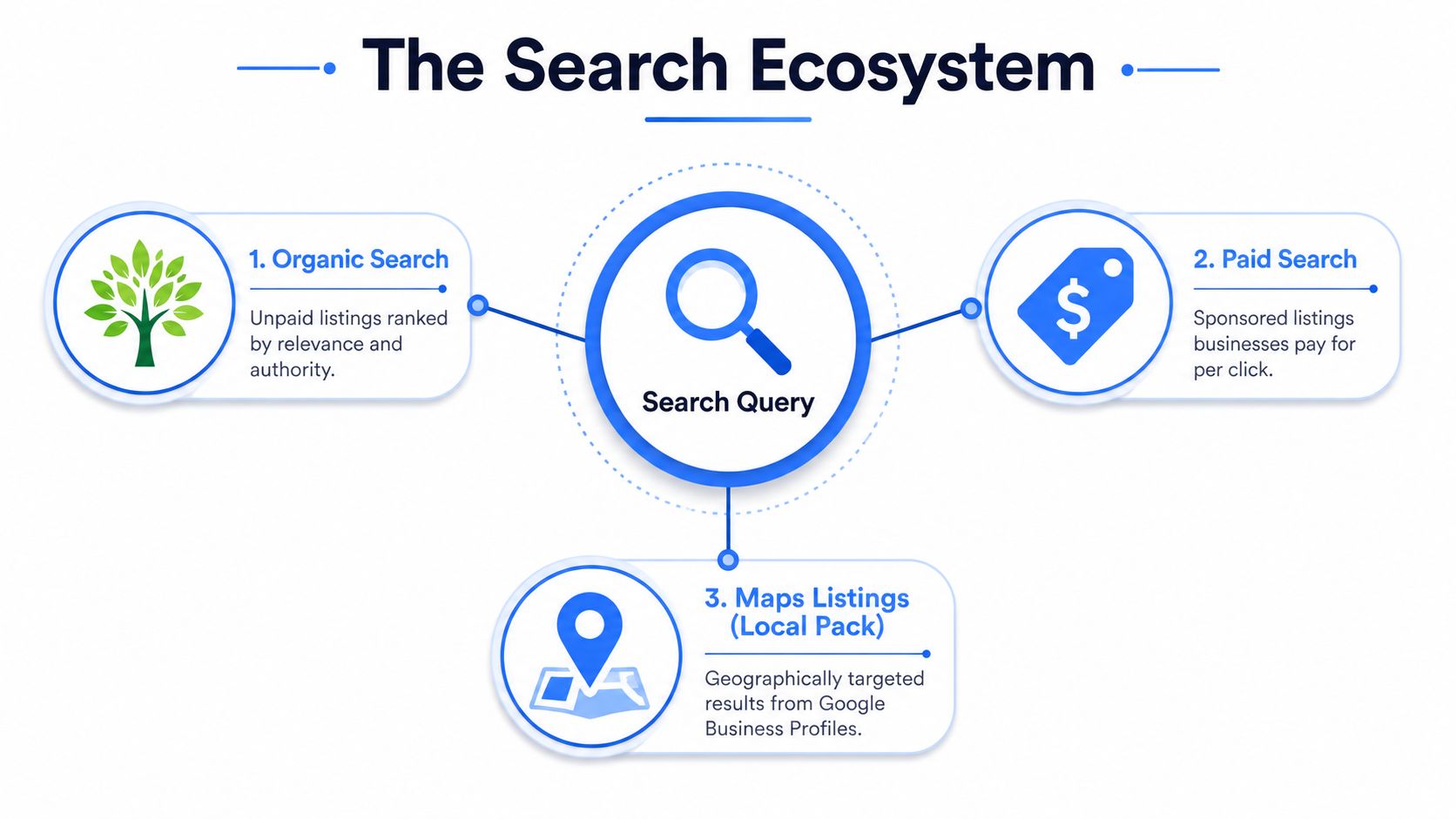
Start with the clean definitions, because a lot of bad marketing talk comes from mixing them up. Organic search is the unpaid result Google shows because it thinks the page matches the query. Paid search is the sponsored placement bought through bidding inside Google Ads. Organic is earned, paid is purchased.
The local pack changes the game
For local service businesses, Google Maps and the local pack often sit above the standard organic blue links. That matters because a homeowner looking for a plumber or roofer usually wants a nearby provider, not a national article. The local pack can capture that intent before the user even scrolls.
If you want the mechanics of the profile itself, the cleanest reference is the guide on Google Business Profile fundamentals. That's the asset that feeds Maps visibility, reviews, categories, and service-area relevance.
Organic and paid also show up differently in the search result page. Organic results are judged by relevance and authority. Paid results are labeled ads and controlled through budget and auction pressure. If you're comparing them for a local business, the question isn't only “what ranks.” It's “what gets found when the query is transactional.”
Why AI summaries matter here
The search results page isn't frozen in time. AI-generated summaries and richer result layouts can change how much attention a blue-link ranking gets, even when the ranking itself doesn't move. That's one reason the old habit of treating organic and paid like separate silos is sloppy now.
For teams thinking about modern search discovery, even tooling around AI web scraping tool comparisons is useful because the broader ecosystem is shifting toward machine-readable, structured discovery. That doesn't replace SEO. It raises the bar on content quality, entity clarity, and local relevance.
Side-by-Side Comparison on the Criteria That Matter
| Criterion | Organic Search | Paid Search | Google Maps / Local Pack |
|---|---|---|---|
| Speed to results | Slower to build | Fastest | Fast once optimized |
| Cost structure | Work up front, less marginal cost later | Continuous spend | Optimization effort, not ad spend |
| Control | Lower control over placement | High control over bids and copy | Moderate control through profile signals |
| Trust | Strong when earned | Clear sponsored label | Very strong for local intent |
| Compounding value | Yes | No, spend stops the clicks | Yes, if the profile stays healthy |
A plumbing page in one city can take time to earn traction, especially if competitors already own the search results. Paid search can go live quickly, but every click comes with cost pressure. Google Maps often wins attention in a way blue links can't, especially when the searcher wants a nearby provider right now.
Speed versus durability
Paid search is the sprint. Organic is the asset. Maps sits in the middle, because it can move faster than traditional SEO while still building on profile strength, reviews, and local relevance. If a business needs leads this week, paid has the edge. If it wants lower marginal cost over time, organic deserves the budget.
Cost versus control
Paid search gives the most control, but control costs money every single day. Organic gives less control over the page itself, but once a page and city combination performs, it can keep sending traffic without a per-click fee. Maps is controlled less by bidding and more by relevance signals, profile quality, and local prominence.
Trust versus compounding value
Organic and Maps usually carry more trust with local buyers than a sponsored slot. That said, trust alone doesn't pay payroll. A strong local strategy uses paid to cover gaps, organic to build authority, and Maps to catch the high-intent searches that are most likely to convert.
The cleanest takeaway is this. Paid search and organic search are not substitutes. They cover different parts of the same buyer journey, and Maps often decides who gets the call first.
Cost, ROI, and Timelines You Can Actually Plan Around
Paid search has real cost pressure. Industry data shows $211.76 billion was spent on search advertising globally in 2024, and average Google Ads CPC reached $4.66 in 2024, up 10% year over year. That's not a cheap environment for a roofer, dentist, or HVAC company trying to buy every lead in a competitive city. GTM 8020's 2024 search ad benchmark makes the spending climate obvious.
Organic SEO is the opposite problem. You're paying for content, technical fixes, and local authority building, then waiting for it to stack. One industry source says organic traction usually takes 6 to 12 months to build meaningfully, while paid campaigns can go live in about 15 minutes to half an hour according to the Digital Marketing Institute's timing comparison.
Timing rule: if you need calls this week, don't pretend SEO will save you. If you want lower marginal cost later, don't pretend paid search is a permanent answer.
The click-share split matters too. Google Ads results have been reported to receive about 65% of clicks on commercial keywords, with organic taking 35% on those same queries, which is why high-intent commercial terms often lean paid when the business needs speed. SearchEngineLand's guide on organic search vs paid search frames that tradeoff clearly.
For budgeting, most owners get it wrong. They look at spend, not booked jobs. A single booked HVAC repair, dental case, or roofing inspection has to be weighed against the cost of getting the click in the first place. If the campaign can't produce profitable calls, cheap traffic doesn't matter.
The same principle applies to the cost side of organic. A useful reference on budgeting is how much it costs to advertise, because service businesses usually need a combined view of content, ads, and local visibility rather than one channel in isolation.
Which KPIs Tell You Each Channel Is Working
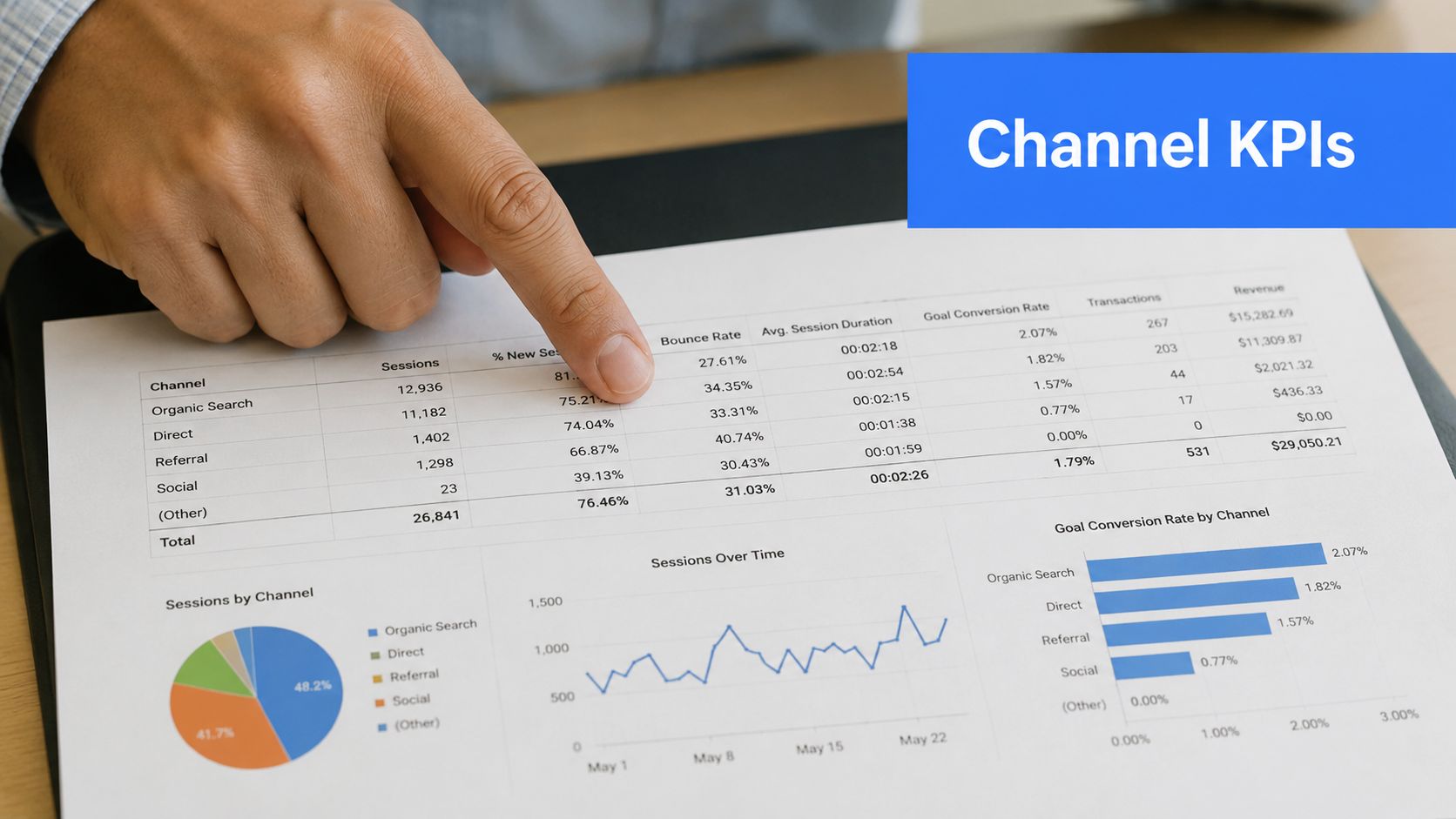
If you only watch total calls, you'll argue about credit forever. Paid search and organic search need different scoreboards. Google's reporting framework separates them for a reason. Paid is built around ad clicks, ad impressions, ad CTR, average CPC, and related unit economics. Organic is tracked with organic clicks, organic queries, organic clicks per query, and organic listings per query. Google Ads reporting documentation makes that split explicit.
Paid search KPIs
For Google Ads, watch the numbers that tell you whether the campaign is buying the right traffic at the right price. If clicks are up but booked calls are flat, the campaign is leaking money. If CPC climbs and CPA follows it up, the account needs a hard reset, not a polite review meeting.
Organic KPIs
Organic search is about visibility and engagement signals. Rankings matter, but rankings alone are lazy reporting. Organic clicks, CTR by position, and conversions from calls and forms are what tell you whether the content is pulling transactional demand. Search Console is the right place to watch queries, clicks, and page performance, not vanity rankings in a spreadsheet.
The metric nobody wants to face
Incrementality is the test. If a paid click just intercepts someone who would have clicked the organic result anyway, that's wasted spend. If a strong organic result gets buried under an AI summary or a dense results page, the ranking number can look fine while calls fall. That gap is why the best owners don't ask which channel “won.” They ask which channel created a new call.
Use a practical reporting rhythm, not a vanity one. Measure calls, booked jobs, and revenue by channel. If a city-level ad set is expensive and the organic page is climbing, shift the budget. If a service line is weak in organic but strong in paid, keep the ad coverage until the page earns its place.
For a deeper operating model, the framework on how to measure marketing effectiveness fits this channel split well because it forces the conversation back to outcomes, not impressions.
How Google Maps and GMB Tie the Two Channels Together
Google Maps is where a lot of local intent turns into phone calls. The local pack matters because it compresses the decision. A searcher sees nearby options, reviews, and proximity in one place, then acts fast. That's why Maps optimization is not a side task. It's a core demand capture channel.
Why Maps compounds with organic
Maps visibility is tied to the same local relevance signals that support organic SEO, things like service pages, citations, backlinks, and clear on-page location context. A strong site helps the profile. A strong profile helps the site. That's the compounding effect most owners miss when they treat GMB like a one-time setup.
Paid search can sit above or around that activity, but it can't buy a Maps placement. It can buy sponsored exposure for high-intent transactional queries, which is useful, but it doesn't replace the local pack. For service businesses with a defined geography, that distinction matters more than most agencies admit.
What to keep tight in the profile
The profile needs real categories, service areas, photos, reviews, and posts that reflect the actual business. If the profile is vague, Maps rankings stay weak. If the service areas are sloppy, the business attracts the wrong traffic. If reviews are thin, trust suffers before the first call.
The tactical reason to care is simple. Strong Maps visibility often drives the first contact in a local search journey, especially when the user is moving fast and doesn't want to scroll. That's why Google Business Profile optimization deserves its own line item, not a buried task inside generic SEO work.
A local search buyer often chooses before the blue links even matter.
For a tighter implementation view, the guide on how to optimize Google Business Profile is the right companion piece because Maps and organic only work together when the profile is built for the same transactional terms as the site.
The Right Budget Split and Reporting Cadence
Start with a three-part budget, not a one-channel fantasy. Put money into Google Maps optimization, organic SEO, and Google Ads at the same time, then rebalance based on call quality and city-level performance. For a local service business, the right split is the one that keeps immediate demand covered while organic visibility builds.
How to run the cadence
Use keyword timelines by service city, Maps heat maps, Search Console queries, and biweekly reporting. That's the dashboard that tells you where the calls are coming from and where the holes are. If a paid campaign is expensive in one city but the page is improving there, pull back. If Maps is weak in another service area, fix the profile and local signals before throwing more ad dollars at the problem.
AI-driven content silos matter here because organic needs a publishing engine that matches the pace of competition. If competitors keep adding service pages, city pages, and transactional content, a static site falls behind even when the budget stays the same. The content system has to be built around the search terms people type, not generic brand language.
Bottom line: paid search rents visibility, organic search earns it, and Google Maps is where both can pay off fastest for local service businesses.
Questions Local Business Owners Ask After Reading This
How long does organic take for a specific city page? Usually longer than people want, and the practical answer is measured in months, not days. If you need immediate calls, paid search should bridge the gap while the organic page earns traction.
Should I pause ads once organic rankings improve? Not automatically. Pause ads only when the organic page and Maps placement are both producing profitable calls, and even then, keep coverage on the most important transactional terms.
Do AI summaries change the organic strategy? Yes. A strong ranking can still lose visibility if the results page steals attention, so local businesses need content that supports relevance, not just a position number.
What budget is reasonable for one location versus multiple locations? The smarter answer is less about a fixed number and more about whether the mix can support Maps, SEO, and paid coverage at the same time. One location can focus tighter on a handful of transactional terms, while multi-location brands need more city-level structure and reporting discipline.
Transactional LLC helps local service businesses show up for the transactional search terms that drive calls, bookings, and patients. If you want a search program built around “roofer near me”, “dentist near me”, Google Maps, and AI-driven content silos, visit Transactional LLC and see how their local SEO system fits your service area.