

A roofing lead can arrive while you're on a ladder. A plumbing call can come in while your best technician is already driving to another job. Meanwhile, your Google Ads campaign may keep spending on searches that have nothing to do with the work you want.
That's the central challenge of pay per click advertising for contractors. PPC can put your company in front of someone searching for a roofer, plumber, or HVAC technician right now, but only if the campaign is built around transactional search terms, accurate service areas, useful landing pages, and conversion data that reflects booked work. Click volume alone won't keep your crews busy. Qualified demand will.
How Pay Per Click Advertising Works for Contractors
PPC lets you bid on searches inside a defined geography. You pay when a person clicks the ad, not just because the ad appeared. For a contractor, that search might be “emergency roof repair [city],” “24/7 plumber near me,” or “same-day HVAC repair.” These are transactional searches because the person is actively looking for help, a quote, or a company to hire.
Google places ads through an auction. Your position depends on more than the bid. Relevance, ad quality, landing-page experience, and the likely usefulness of the result all affect how competitive the click becomes. A broad keyword can attract curiosity, research, employment searches, or DIY traffic. A tightly matched service and city query gives you a much clearer path to a qualified call.
Before spending, compare your trade with available benchmarks. One home-services benchmark found average CPC ranging from $2.94 for pools and spas to $9.03 for roofing and gutters, with plumbing at $8.67 and air conditioning services at $8.94. The same data showed average CPL ranging from $29.08 to $101.49, while CTR varied from 2.87% to 5.71% across categories. Review the home-services PPC benchmarks before accepting a generic vendor forecast.
| Trade | Notes |
|---|---|
| Roofing and gutters | Often requires strict service, project-type, and location segmentation |
| Plumbing | Separate emergency calls from installation and maintenance searches |
| HVAC | Split repair, replacement, installation, and seasonal service intent |
| Electrical | Qualify residential, commercial, emergency, and project-specific demand |
| Pools and spas | Keep service, construction, maintenance, and repair terms distinct |
The broader home-improvement category remains competitive. A 2026 benchmark reported a 6.47% average CTR, $8.33 CPC, and $90.92 CPL, while trade-level median CPCs included $5.31 for construction and contractors, $10.70 for roofing and gutters, $12.18 for electricians and electrical, and $13.74 for paint and painting. Those figures are reported in contractor PPC benchmark coverage, and they show why one budget model shouldn't be copied from one trade to another.
In 2026, contractors can buy visibility through traditional Search Ads, Local Services Ads, and Performance Max. Each channel handles intent, control, and lead quality differently. A useful HVAC-specific resource is this PPC playbook for HVAC companies from Magnitude Marketing, particularly when you're deciding how repair and replacement campaigns should differ.
Building a High-Intent Keyword List by Trade
Start with the jobs you want more of, not with the words that seem popular. A roofer may want replacement projects, storm repairs, inspections, or commercial work. A plumber may need emergency calls during business hours but installations and remodel work during quieter periods. Each service line deserves its own keyword group, landing page, budget, and lead-quality review.
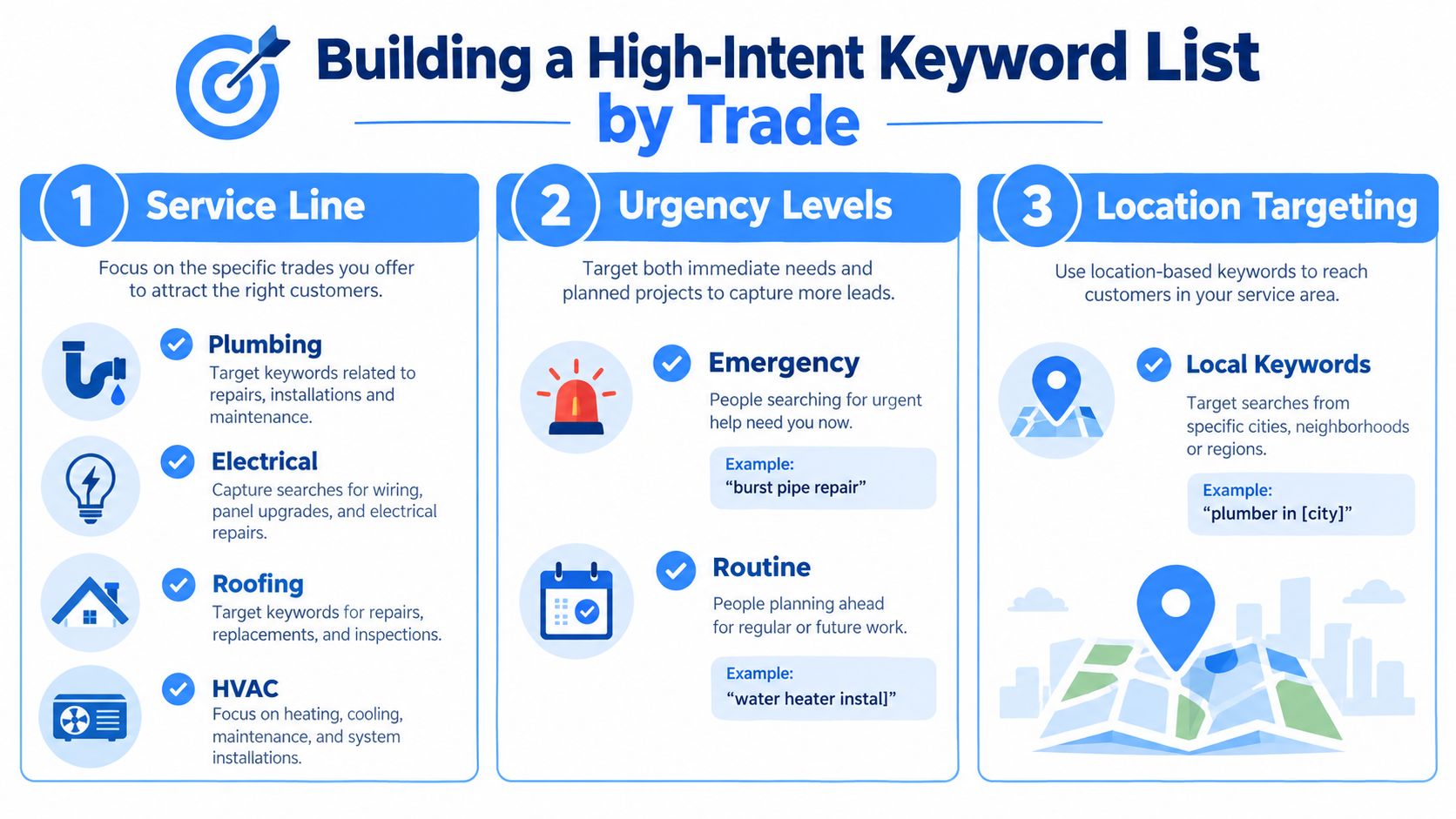
Build the list in three practical buckets:
- Emergency searches: “burst pipe repair,” “no heat repair,” “emergency roof repair [city],” and “24/7 plumber near me.”
- Replacement and installation searches: “roof replacement cost,” “new water heater install,” “commercial roofing contractor,” and “HVAC replacement estimate.”
- Maintenance and inspection searches: “HVAC tune-up,” “gutter cleaning,” “roof inspection,” and electrical inspection terms.
Add location modifiers at the service level. “Plumber in [city]” and “air conditioning repair near me” signal a different opportunity from a generic search for “plumbing.” The same principle applies to commercial buyers. “Commercial roofing contractor” needs different ad language, qualification questions, and follow-up than a homeowner searching for a leaking roof.
Use customer language instead of assumptions
Your best keyword research often sits inside your own business. Review call transcripts, Google Business Profile search-term information, CRM notes, and Google Ads Search Terms reports. Listen for the wording customers use when they describe the problem. “Water coming through ceiling” may reveal a useful repair theme that a generic keyword tool never surfaces.
Match types should reflect risk. Use exact and phrase match for expensive, specialized services such as roof replacement or HVAC installation while you learn which searches produce genuine opportunities. Broad match can expand reach, but it needs Smart Bidding, strong conversion tracking, and an actively maintained negative list.
Exclude terms such as DIY, jobs, salary, course, and meaning. Those words commonly indicate research or employment intent rather than a customer ready to hire. For a deeper framework, review this guide to intent mapping for search ads and keep the high-intent keyword strategy resources available while organizing service and city combinations.
Watch this short video for another visual explanation of paid-search planning.
Structuring Campaigns, Ad Copy, and Landing Pages
Your account should mirror the way your company sells and dispatches jobs. Start with separate campaigns for HVAC, plumbing, roofing, electrical, or another distinct trade. Then divide each trade by service line, such as emergency plumbing, water heater installation, drain cleaning, or commercial plumbing.
That structure gives you control over spend and messaging. If emergency plumbing produces valuable calls while generic plumbing attracts poor-fit inquiries, you can adjust those campaigns independently. A roofer can separate storm repair from full replacement. An HVAC company can separate repair, replacement, maintenance, and commercial service instead of forcing every search into one ad group.
Keep budgets connected to job economics
A campaign budget should support the service line's actual sales capacity. If your team can't answer calls, visit properties, or provide estimates promptly, increasing clicks won't solve the operational problem. Allocate more toward services with healthy margins, available crews, and a follow-up process that turns inquiries into estimates.
Shared budgets can work when campaigns have similar lead values and service priorities. They create problems when one high-volume service consumes budget intended for a more profitable specialty. Review spend by trade, city, search term, qualified call, estimate, and booked job rather than judging performance by clicks alone.
Make the message match exact intent
The searcher's service and city should appear consistently in the ad, landing-page headline, and page content. A person searching “roofer in Denver” shouldn't land on a generic homepage that barely mentions roofing. A search for “air conditioning repair near me” should lead to a repair page that immediately explains service coverage, call options, and what happens next.
This consistency improves the visitor experience and helps prevent wasted clicks. It also gives Google clearer relevance signals. Use this resource on ad copy best practices when writing responsive search ads for different trades and locations.
A strong landing page answers practical questions quickly:
- Service fit: Does the company handle this exact repair, installation, or project?
- Location fit: Does the company serve the searcher's city or property?
- Trust fit: Are credentials, reviews, warranties, and proof of work easy to find?
- Action fit: Can the visitor call, request an estimate, or book without friction?
Tracking Calls, Forms, and Booked Jobs
A contractor campaign can look successful while sending low-quality leads if every form fill and short call counts as a conversion. Smart Bidding learns from the conversion actions you provide, so poor data teaches the platform to seek more poor data.
Begin with call tracking. Use Google Ads call assets for direct reporting, then consider dynamic number insertion through tools such as CallRail or Invoca when you need to connect website sessions with phone outcomes. Set a meaningful call qualification rule based on your business. A missed call, a sales solicitation, and a genuine service conversation shouldn't all carry the same value.
Form tracking needs equal care. Google Tag Manager can record a confirmed submission through a thank-you page or a reliable form event. Test the trigger from a real device, verify that duplicate submissions aren't counted, and make sure spam forms don't enter the primary conversion action.
Import the result that matters
Lead tracking stops too early when it ends at the form or call. Connect booking and customer-management systems such as ServiceTitan, Housecall Pro, or Jobber to the advertising data where possible. Capture the Google Click Identifier, connect it to the lead record, and upload offline outcomes such as qualified opportunity, scheduled job, completed job, and revenue.
Use scheduled job timing rather than treating every initial inquiry as equal. A booked replacement project should teach the campaign more than an unqualified form. Revenue-aware bidding can only work when the CRM records are accurate and the imports are mapped to the correct campaign, keyword, and customer.
Practical rule: If your sales team wouldn't call an inquiry a real opportunity, don't let the ad platform treat it as your primary success signal.
Run a weekly data-hygiene check. Look for duplicate conversions, calls that were never answered, test submissions, spam, canceled appointments, and leads assigned to the wrong service area. For additional context on measuring PPC lead generation ROI, compare platform conversions with booked-job records rather than relying on the advertising dashboard alone. You can also use this guide to track phone calls across campaigns and landing pages.
Choosing Between Search Ads, Local Services Ads, and Performance Max
The right channel depends on how a contractor sells, how much control the team needs, and how reliably the business can qualify leads. Search Ads provide the clearest keyword-level control. Local Services Ads use pay-per-lead pricing for eligible categories and can appear above traditional search ads. Performance Max gives Google broader control across placements, which can help with reach but makes lead-quality diagnosis harder.
Search Ads are usually the starting point for a service line with clear transactional demand. You can separate “emergency plumber near me” from “commercial plumbing contractor,” write distinct copy, and send each searcher to a relevant page. That control matters when roofing, HVAC, and electrical jobs have very different values and sales processes.
Local Services Ads deserve a separate evaluation, not an automatic replacement for PPC. They can be useful for trust-led services where the Google Guaranteed presentation and top-of-page placement influence the decision. Lead costs vary by trade and channel. One recent comparison reported roofing search leads around $228.15, while LSA ranges were often materially lower for several HVAC, plumbing, electrical, and handyman categories. Review the Local Services Ads comparison for home-service companies before moving budget.
| Channel | Best For | Bidding | Trade Fit |
|---|---|---|---|
| Search Ads | Precise service, city, and urgency intent | Pay per click | Strong for roofing, plumbing, HVAC, and electrical segmentation |
| Local Services Ads | Trust-led calls and pay-per-lead acquisition | Pay per lead | Useful for eligible local service categories |
| Performance Max | Broader reach after reliable conversion data exists | Automated across Google inventory | Test cautiously, especially for high-value roofing jobs |
Performance Max should usually follow, rather than replace, a profitable Search foundation. It can support remarketing, brand protection, and incremental reach, but contractors need clean conversion actions and strict budget limits before giving the system more control. Roofers should be especially cautious if the campaign lacks reliable job-value imports, a clear service feed, or enough conversion history to distinguish replacement projects from low-value inquiries.
Use this guide to Google Local Services Ads for home services when comparing channel placement, lead screening, and service-line economics.
Pairing PPC With Google Maps and AI Search Visibility
Paid search and Google Maps serve different purposes, but they meet at the same high-intent moment. A homeowner may click an ad, search the company name again, inspect the Google Business Profile, compare reviews, and then call from Maps. That journey makes profile accuracy and reputation part of paid-lead conversion, even when the profile itself wasn't the original ad destination.
Google publicly identifies relevance, distance, and prominence as local ranking factors. Relevance measures how well a business matches the search, distance reflects proximity to the searcher or location term, and prominence reflects how well-known and trusted the business appears. The explanation of these Google Maps ranking factors is useful because it makes one point clear. Ad spend alone doesn't guarantee a top-three Maps position.
Align the local assets
Choose a primary Google Business Profile category that reflects the core service line, keep service areas accurate, and make sure the business name, phone number, services, and website agree across the profile and landing pages. Publish useful updates tied to genuine offers or seasonal services, answer relevant questions, and request reviews from real customers without scripting claims or manufacturing feedback.
The same entity clarity helps with AI-mediated discovery. Current industry coverage treats LLM optimization as a distinct service category, with businesses working to become recognizable entities in AI search experiences. The discussion of LLM SEO agencies and AI search optimization supports a practical approach for contractors: clearly state who you serve, where you operate, which services you provide, and what evidence supports those claims.
Build separate service and location pages rather than combining roofing, dental, plumbing, and unrelated industries into one generic resource. A roofing company should develop an entity-rich roofing information system. A dental practice needs different services, terminology, proof, and patient questions. That separation helps traditional search and AI systems classify the business more accurately.
A 30-60-90 Day Optimization Plan for Contractor PPC
The first month is for verification, not aggressive expansion. Confirm that phone calls, forms, booked appointments, and service areas are recording correctly. Review Search Terms reports frequently, add irrelevant queries to the negative list, check location settings, and document baseline cost per qualified lead and booked job for each trade.
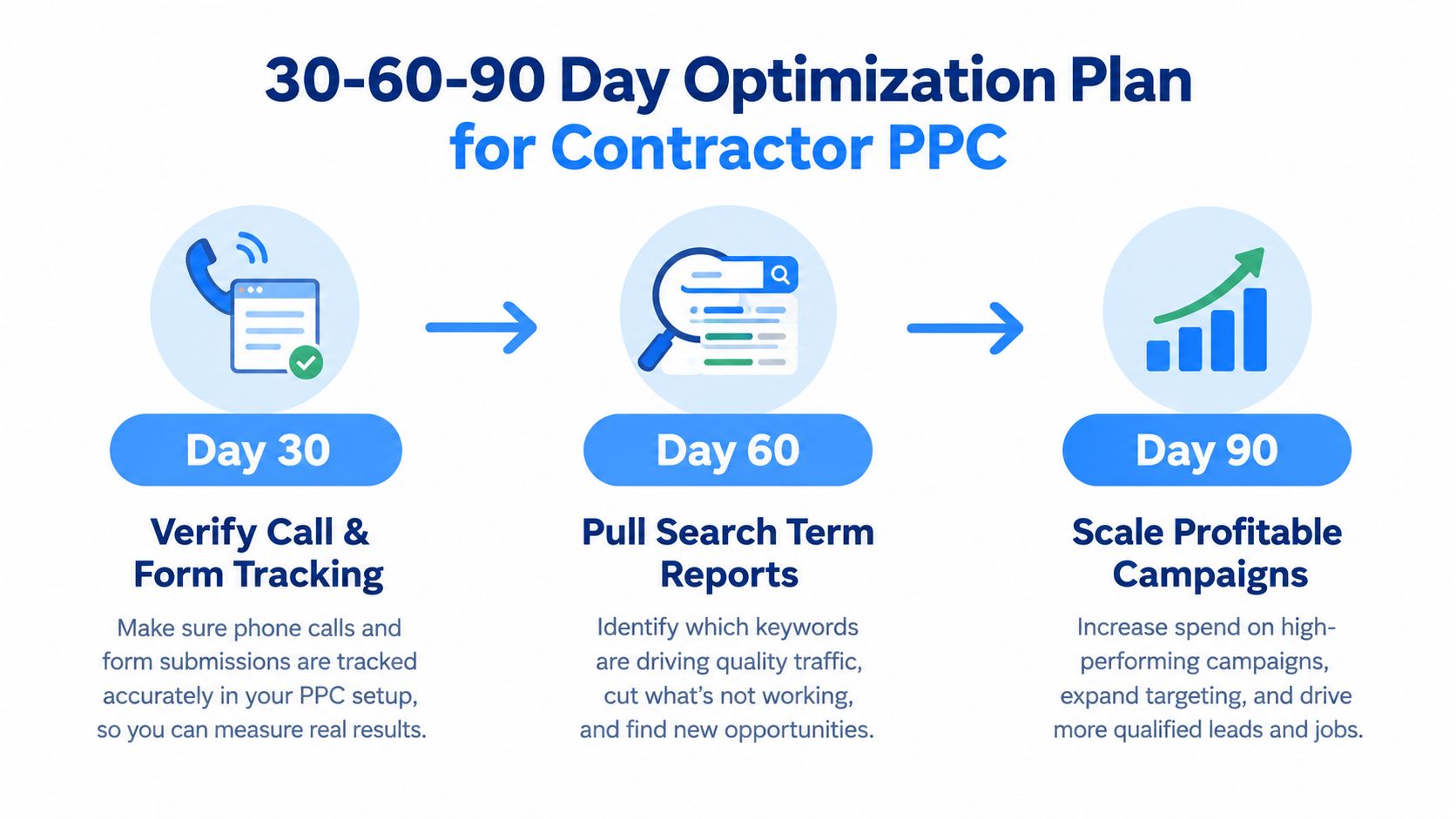
During days 31 through 60, move from cleanup to controlled improvement. Separate search themes that have enough evidence to deserve their own ad groups. Add exact and phrase-match negatives, test several responsive search ad combinations, improve landing-page message match, and shift budget toward campaigns producing qualified conversations and scheduled work.
Don't optimize only for the cheapest lead. A low-cost drain-cleaning inquiry may be less valuable than a properly qualified commercial plumbing opportunity. Your spreadsheet or CRM should show service line, city, lead source, qualification status, appointment status, and job outcome.
By days 61 through 90, expand only what has earned more budget. Test adjacent services, new cities inside the actual service area, Local Services Ads, or Performance Max with controlled spending. Increase bids where booked-job economics support it, and introduce automated bidding only after the account has enough clean conversion history to guide the system.
Use clear kill switches:
- Repeatedly expensive ad groups: Pause or rebuild an ad group that exceeds the acceptable qualified-lead cost for two consecutive review periods.
- No-lead campaigns: Stop campaigns that spend consistently without producing a genuine inquiry, then inspect search terms, geography, offer, and tracking before relaunching.
- Weak landing pages: Rework pages that attract clicks but fail to produce calls or forms.
- Bad lead quality: Remove conversion actions that reward spam, wrong locations, job seekers, or people seeking services you don't provide.
The objective is simple. Get the right contractor in front of the person searching for “roofer near me,” “plumber near me,” or “air conditioning repair near me,” then connect that paid visibility with strong Maps and AI search assets.
Transactional LLC offers contractor-focused Google Search Ads, campaign management, Google Maps optimization, and AI-driven content built around high-intent service and city searches. Visit Transactional LLC to discuss a campaign that tracks calls, quote requests, and booked jobs instead of stopping at clicks.