


64% of pest control website traffic comes from mobile devices, and average sites convert at just 2% to 4% while top performers reach 7% to 10%+. That gap is the whole business case for pest control website design. If your site can't hold attention on a phone, surface the right service fast, and turn a transactional search like “exterminator near me” into a call, it's leaking revenue before a lead even reaches your office.
The best pest control sites don't win because they look polished. They win because they match intent, load fast, and make it easy for someone with a live problem to contact you without hunting through menus. That's why the core design question isn't whether the homepage looks modern, it's whether the site converts transactional search terms and supports Google Maps top three visibility in the service area.
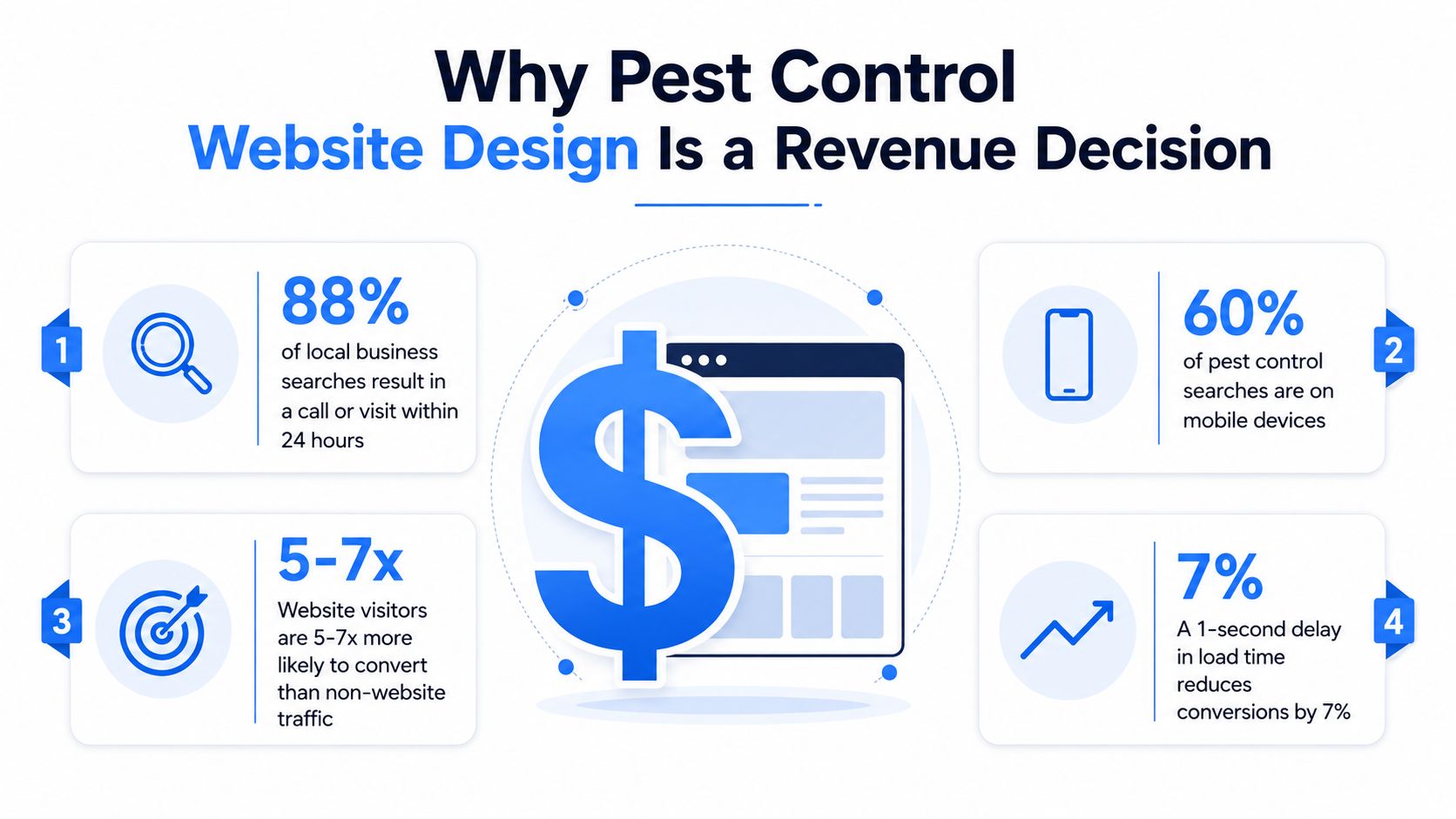
Why Pest Control Website Design Is a Revenue Decision
A pest control website is a sales asset, not a brochure. If the structure cannot turn a local search into a call, the design is costing revenue every day. Site builders and SEO analysts at WebTonic note that WordPress is a common choice for service businesses because it supports flexible page structures and local SEO work, but the platform only matters when the site is set up around intent and geography. The business case is faster pages, clearer paths to contact, and content that matches the problem a visitor is trying to solve.
Pest control searches are usually urgent. A homeowner dealing with ants, termites, or rodents is not shopping around for inspiration, they are trying to fix a problem now. If the page loads slowly, the call button is hard to find, or the copy reads like a general services template, that visitor moves on to the next provider and the next Maps result.
Practical rule: build every high-intent page for someone holding a phone in one hand and dealing with a pest problem in the other.
Mobile behavior raises the stakes. WebTonic's industry snapshot also points out that pest control traffic is heavily mobile, and that mobile conversion lags when layouts are clumsy or call-to-action placement is weak. That makes responsive design, quick load times, and tap-to-call placement part of the revenue setup, not visual polish. A site can still rank and lose the lead if it does not convert the phone session at the moment of need.
The two levers that move the needle are simple. First, a dedicated page architecture that gives each pest, each service type, and each service area its own search signal. Second, Google Maps top three visibility, because many local searchers make a choice from the map pack before they ever compare organic results. A site that supports the map profile with the right pages and clear local intent gets more calls, while a site that treats every offer like one generic service page leaves money on the table.
A separate conversion rate optimization basics for service sites page helps explain the mechanics behind that gap, but the practical takeaway is easy. Design should shorten the path from search to call, show the right service fast, and make it obvious why a pest control company is the best local choice.
Building Dedicated Pages for Every Pest and Service
One service page is too blunt for pest control. It tries to cover termites, bed bugs, rodents, ants, mosquitoes, wildlife, residential plans, and commercial work in one place, and that leaves both search engines and buyers guessing about what the company handles. A cleaner structure uses separate pages for each major pest, each major service type, and each service area, so the site can speak directly to the visitor's intent and give crawlers a clear topical map (Verlua).
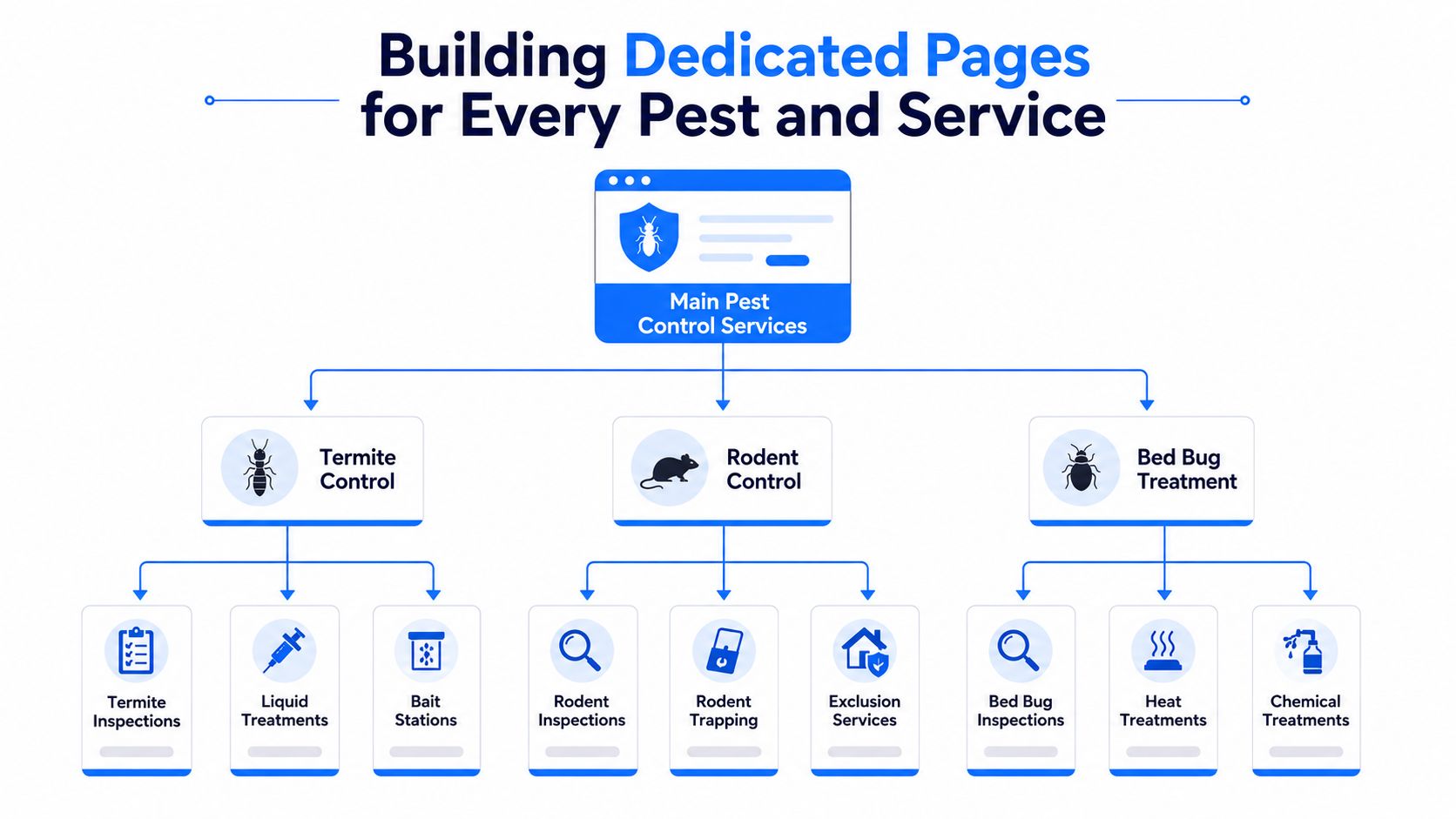
What each core page needs
A termite page should sound like a termite page. A bed bug page should answer bed bug concerns without forcing the user to scroll through unrelated services. The same logic applies to rodents, ants, mosquitoes, and wildlife, plus separate pages for service areas and contact details, with visible licensing information on every page to cut friction in high-intent local searches (Verlua).
The best pages follow the visitor's language, not the company's internal labels. If someone searches “rodent control” or “termite inspection,” the headline, opening paragraph, and supporting details should mirror that phrasing, then move quickly into treatment approach, trust signals, and a clear next step. That is what earns the click and the lead.
For planning and copy structure, a simple rule helps. Build one page for one intent, then let that page do one job well. If you want a practical outline for content ordering and page selection, use SEO content planning for local service pages.
Separate pages beat a bloated menu when the goal is to capture search intent quickly. A search engine can understand a focused page faster, and a homeowner can decide faster.
A good test is whether a page could stand alone in a sales conversation. If it can't explain the pest, the treatment, the trust signals, and the next step without rambling, it is not ready. Strong pest control website design uses structure as strategy, not decoration.
Designing Lead Capture That Converts Mobile Emergency Searches
Mobile emergency searches are the fastest path to a booked pest control call, but only if the page makes contact effortless. Someone standing in a driveway, kitchen, or job site is not browsing for long. They need a visible phone number, a large tap target, and a form that asks for the bare minimum. Page speed matters in that moment too, because slower mobile pages push urgent searchers back to the results and toward a competitor.
Make the first action obvious
Sticky phone and CTA headers work because they keep the next step on screen while the visitor scrolls. Above-the-fold calls to action help when someone lands with clear intent and only wants the shortest route to a conversation. Large tap targets matter because thumbs, not cursors, do the work on mobile.
Quote forms should stay lean. The advice from CI Web Group is to keep forms at 3 to 4 fields or fewer, because shorter forms reduce abandonment when the visitor is trying to get help fast. Name, phone, email or address, and the pest type or service need usually cover what the office needs for the first response. Anything extra can wait until after the call.
Put trust signals near the form, not off to the side of the page. Licensing, reviews, and service guarantees answer objections at the exact moment people decide whether to submit.
The page should also reduce hesitation before the form even appears. Persistent click-to-call placement, strong contrast around buttons, and a clear get-quote action keep the user from hunting. If the site feels like a brochure, conversions slip. If it feels like a direct line to help, calls happen.
For teams running paid and organic traffic together, the same discipline used to create high-converting PPC landing pages applies here. Keep the path short, the offer specific, and the CTA visible for one service and one local intent. The phone number should be easy to spot on every screen, and where to place your phone number on a website is a useful reference when you are deciding how far up the page that number needs to sit.
The Commercial Buyer Path Most Pest Sites Get Wrong
Residential lead capture gets most of the attention, but commercial pest buyers behave differently. Property managers, HOAs, multifamily operators, and facility teams are not just asking whether you can treat ants or rodents. They're asking how you document service, communicate with tenants, manage recurring accounts, and support reporting across multiple locations.
That's where a lot of pest control website design falls short. Agencies often build one broad commercial page and stop there, but the stronger move can be fewer, more specialized pages that speak directly to procurement and operations. A generic service library looks busy. A focused commercial path looks credible.
Build for buying committees, not just homeowners
Commercial pages should answer operational questions fast. Do you support service-level agreements? Can you provide inspection logs? How do you handle tenant communication workflows? Do you offer location-specific reporting and account management? If those answers are buried, the buyer assumes the process will be messy after the contract is signed.
The contrarian point is simple. Adding more pest pages is not always the highest-value move. For B2B pest buyers, specialized pages that address compliance, recurring plans, and service management can outperform a large generic service library because they remove uncertainty before the first call.
A commercial page should also sound different from a residential one. Residential copy can lean on urgency and reassurance. Commercial copy needs structure, accountability, and service consistency. That distinction is often the difference between a form fill and a competitor's callback.
This is also where page hierarchy matters. If the site tries to serve every buyer through the same homepage, the messaging gets diluted. Separate commercial paths keep the site honest about who it serves and what the company can manage well.
Service and City Pages That Capture Transactional Searches
Local intent is where pest control sites either print calls or disappear. A page built around “termite control in [city]” or “bed bug exterminator near me” is doing a very different job from a general brand page, and it needs a structure that signals both the service and the location clearly. A content silo does that by linking the parent service page down to each city variation and linking each city page back up, so the site stays organized instead of cannibalizing itself.
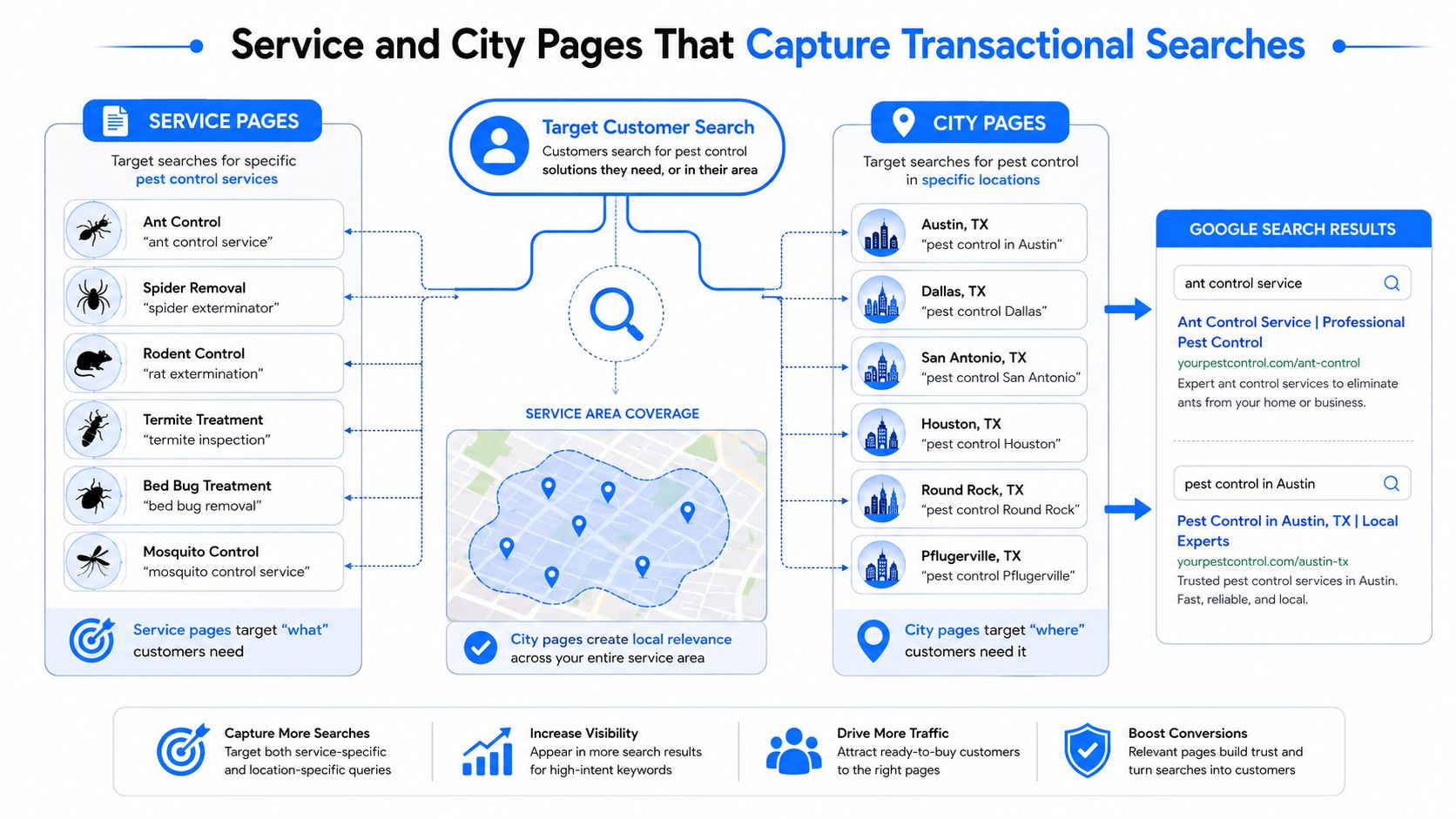
How the silo should behave
Each service page should anchor the topic. The city pages should prove coverage, show local relevance, and make it obvious that the company serves that area. That means a unique opening paragraph for each city, visible NAP consistency, embedded maps, and localized proof instead of recycled template text.
A well-built city page doesn't just swap the town name into a paragraph. It explains service availability in a way that sounds local, then routes the visitor to the exact service they need. If you're targeting service-area visibility, the page has to connect the query to the geography without sounding stitched together.
Search engines read that structure as a set of signals. Users read it as a fast answer. Both matter.
A practical way to think about the internal links is this. The parent page should help the city pages rank for broader service terms, and the city pages should help the parent page show topical depth. That's how you capture transactional searches across a service area without turning the site into a duplicate-content mess.
Connecting the Site to Google Maps Top Three Rankings
A pest control site can rank organically and still miss the most visible local clicks if it doesn't support the Maps pack. For many service searches, the map results are the first thing people see, which means the Google Business Profile and the website have to work together instead of living in separate silos. On-site signals like embedded Maps, location-specific schema, NAP consistency, reviews, and links from city pages back to the GBP listing all reinforce that relationship.
What the site should reinforce
The website should make the business look like the same entity the map profile describes. That means the name, address, and phone details stay aligned, the service areas are clear, and the city pages point users toward the right profile and contact route. If the map listing says one thing and the website says another, trust drops and local visibility gets harder to defend.
This is why many service owners track map performance alongside organic rankings. The question isn't just whether a term is moving, it's whether the service city is producing more calls and route requests after the site changes go live. A visible Maps presence can be the difference between a branded visit and a transactional call.
For operators who want a deeper look at the local ranking side, Google Maps ranking factors for service businesses is a useful reference point. On the reporting side, tools like the OnRoute sales optimization platform are helpful because they connect location intelligence to actual business coverage, which is exactly how map visibility should be managed.
If the site helps the wrong pages rank, the map pack still won't save the lead flow. Local visibility has to point at the pages people can actually convert from.
A good dashboard should track keyword movement by service city, map rankings, Search Console queries, and traffic to each local page. That gives a cleaner read on whether the design is helping the site win the searches that matter most.
Technical Performance, Analytics, and the Launch Checklist
Speed is part of conversion. So is measurement. If the site looks sharp but loads slowly, or if it gets calls but nobody knows which page earned them, the design work is incomplete. That's why launch needs a technical checklist, not just a visual review.
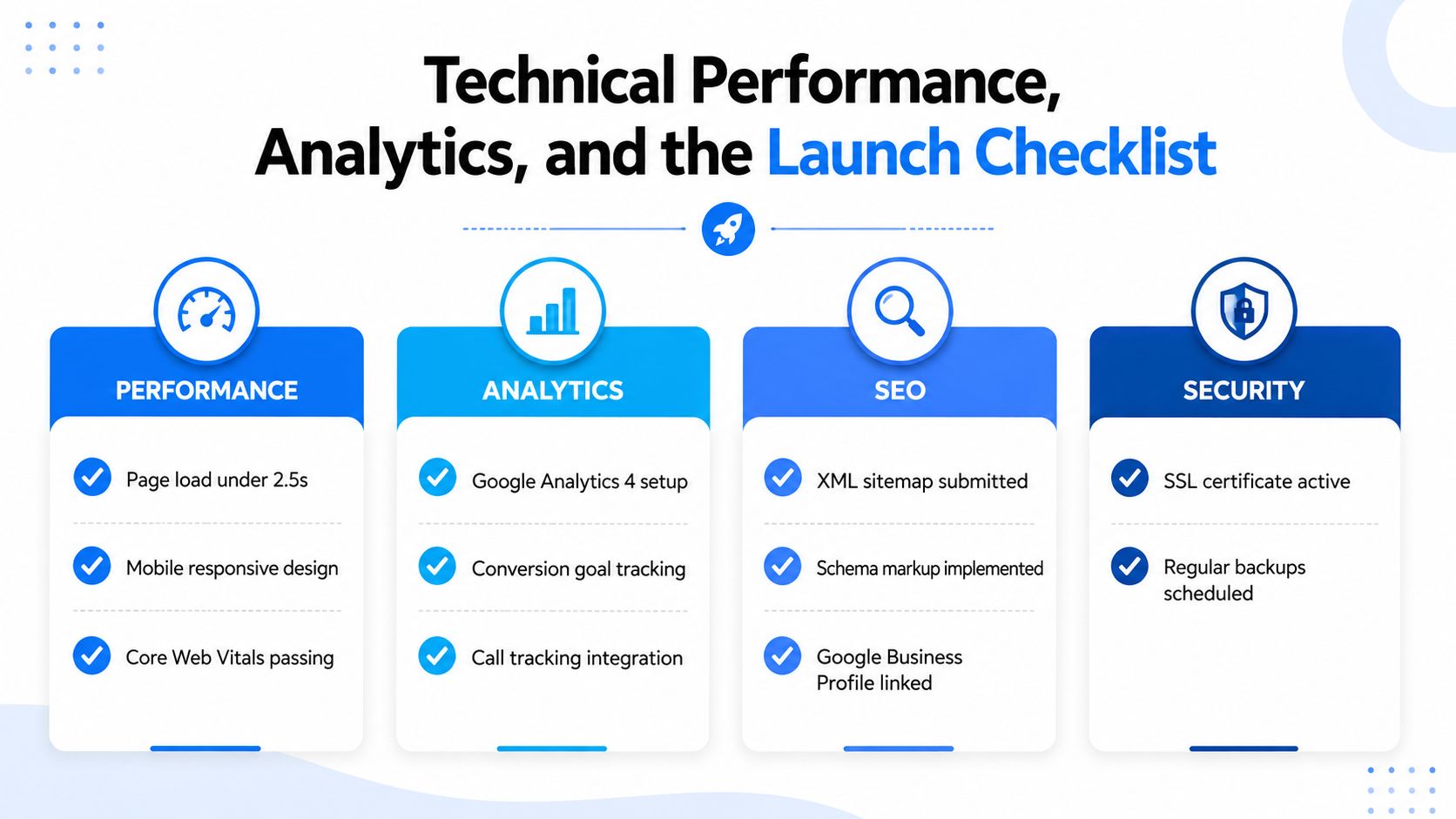
What should be checked before going live
Page speed should stay tight, mobile responsiveness should be tested across real devices, and Core Web Vitals need to pass. The site should also make the phone number easy to tap, because a hidden number defeats the point of high-intent traffic.
On the measurement side, analytics has to be set up to identify calls, form fills, and page-level performance. Search Console should show whether transactional queries are moving in the right direction, and call tracking needs to attribute leads to the correct city and service page. That's the only way to tell whether the design is producing calls or just visits.
For the technical side of launch, AutoSEO technical fixes is a useful resource if you're tightening the backend before a rollout. The point isn't to chase vanity metrics, it's to make sure the site is indexable, fast, and measurable from day one.
A clean launch checklist usually includes these items.
- Performance: page load under 2.5 seconds, mobile responsive design, Core Web Vitals passing.
- Analytics: Google Analytics 4 setup, conversion goal tracking, call tracking integration.
- SEO: XML sitemap submitted, schema markup implemented, Google Business Profile linked.
- Security: SSL certificate active, regular backups scheduled.
Transactional Marketing builds websites and local search systems for service businesses that need to show up for transactional search terms like “pest control near me” and turn that attention into booked jobs. If you want pest control website design that's built around rankings, Google Maps visibility, and real calls, visit Transactional LLC and see how a focused local SEO system can help your company show up where ready-to-buy customers are searching.