


A phone number on a website is not just contact text. For service businesses, it's often the closest thing to a checkout button, because the person who taps it is usually ready to talk, compare, and book now, not later. Google's Ads documentation makes that shift obvious by treating calls from website visits as measurable conversion events, which is why the number now belongs inside the conversion system, not outside it as decoration. Google Ads call conversion documentation
That matters most for transactional search terms, the kind Transactional Marketing targets, where the searcher has intent and money in hand. A homeowner searching for a roofer, a patient looking for a dentist, or a business owner needing emergency HVAC service doesn't need a brand story first. They need a visible number, a tappable path, and a site that makes calling effortless.
The modern approach is a connected system. Placement, click-to-call, NAP consistency, schema, call tracking, A/B testing, and analytics all have to work together if the phone number is going to perform like a revenue asset instead of a static footer line. If a business is missing calls, the fix is usually not one thing. It's usually the whole chain.
A good place to start is missed-call recovery, because a strong phone strategy isn't only about getting more rings. It's also about making sure the calls that do come in are handled well. A practical guide to missed call recovery is useful context before you decide how aggressively to surface your number across the site.
Why the Phone Number Is Your Highest-Intent Conversion Asset
Calls signal immediate intent
A visitor who picks up the phone is already past the browsing stage. On service sites, that usually means the problem is live, the need is urgent, and the user wants a direct answer instead of another page to read. That is why the phone number on website pages should be treated as a conversion mechanism, not a decorative trust signal.
Google's call-conversion setup reflects that reality, because it tracks calls made from website numbers as business events instead of treating them as generic contact attempts. That changes the number from a passive identity marker into a measurable asset tied to analytics and conversion reporting, as outlined in the Google Ads call conversion documentation.
For Transactional Marketing's core markets, that distinction matters. HVAC, roofing, plumbing, dental, and pest control buyers often move fast when the need is immediate. A number that is easy to find and easy to tap can capture that moment before a form, a chat prompt, or a competitor's page gets the first response.
Practical rule: if the visitor is already ready to call, do not make them hunt for a contact page first.
The goal is to make calling frictionless
Many sites still treat the number as a static line in the header or footer. That leaves money on the table. The number should sit where a user naturally decides, “I need to talk to someone now,” especially next to quote, booking, or emergency service prompts.
The best service sites also plan for the calls that do not get answered. If calls are a revenue asset, missed calls matter too, which is why the handoff after the tap deserves attention. A useful guide to missed call recovery helps teams think through what happens when the front desk is busy, a technician is in the field, or the office misses a burst of after-hours calls.
The playbook is a single system
The number performs best when seven pieces line up. Placement gets it seen. Click-to-call gets it dialed. NAP consistency keeps local signals clean. Schema helps machines understand what the number means. Call tracking measures the source. A/B testing compares variants. Analytics shows whether those calls became bookings.
That is the job of a phone number on website pages. It is not a design detail. It is a transactional search asset that can be audited, improved, and measured like any other lead channel.
Placement and Formatting That Actually Earns the Tap
Put the number where the eye already goes
Service sites that get the call usually do one thing well, they place the number where a visitor is already deciding whether to act. Keep it in the header, repeat it on the contact page, keep a footer version as a backup, and place it beside high-intent prompts like “Get a Quote” or “Book Now.” One practical placement rule recommends showing the number 3–5 times on a single-page landing page, and that is not excessive on a page built to convert. Phone number placement guidance
On desktop, the top-right header still works because users expect direct contact there. On mobile, repetition matters even more because people scan fast and rarely scroll back up to hunt for a phone number. If the number is buried, the site loses the call at the exact moment intent is highest.
The contact page should confirm the number, not rescue the visitor who could not find it anywhere else.
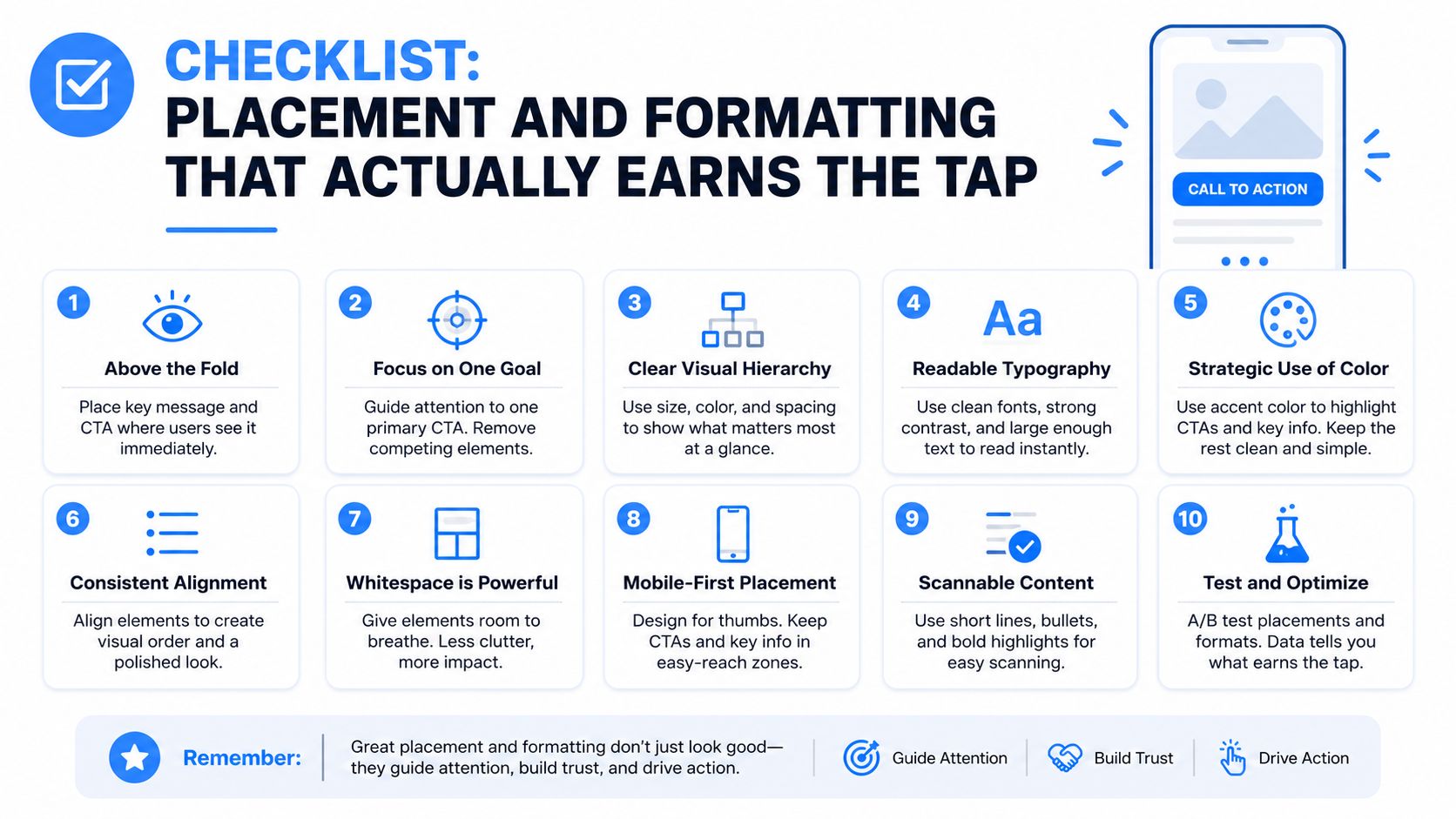
Format for fingers, not just for eyes
Visibility is only half the job. A number that looks clean but is hard to tap on mobile fails the moment a visitor tries to act. For mobile-friendly pages, a practical target is a 44×44 pixel click area for call buttons, with 48px+ font above the fold so the number is easy to read and hit without pinching or zooming. Phone number placement guidance
The display can stay styled for the page, but the link target should stay simple and reliable across devices and locales. The standard pattern uses the full international format in the href, while the visible text can remain formatted for humans. Smashing Magazine on phone numbers for web designers
For a service site, a fast audit usually comes down to a few checks:
- Header presence: the number is visible without opening a menu.
- Footer backup: the number appears again lower on the page.
- CTA adjacency: the number sits near booking or quote prompts.
- Mobile tap size: the target is large enough to tap cleanly.
- International clarity: the format makes sense for the audience served.
That same format choice should also fit the rest of the mobile page experience, which is why mobile-optimized site structure guidance matters here. A number that is present but awkward to use is still a missed call. If you want a practical implementation pattern, see SnapDial's instant click to call guide. The job is to make the phone number on website pages obvious, tappable, and repeated enough that the visitor never has to guess what to do next.
Setting Up Click-to-Call the Right Way

Use tel links with a real international number
The web standard for click-to-call is the tel: URI scheme. In practice, that means the number should be wrapped in a telephone link, not just displayed as text. HTML guidance on telephone links shows the basic pattern, and it's common to place it in the header, footer, or contact page. HTML telephone link guidance
The cleanest form uses the full international format in the link target, such as tel:+13055555555. Smashing Magazine recommends the tel: scheme with a leading + and country code, while keeping spaces and dashes out of the href itself so dialing stays reliable across devices. Smashing Magazine on phone numbers for web designers
Keep accessibility and usability in the same line of code
A clickable number should also be understandable to screen readers. That's where aria-label helps, because it can spell out the number clearly and remove ambiguity for users who rely on assistive tech. A phone icon can help with scanning, but the label still needs to be clear.
A simple pattern looks like this:
<a href="tel:+13055555555" aria-label="Call (305) 555-5555" class="phone-link">📞 (305) 555-5555</a>
The visible text can stay human-friendly, while the underlying target stays technically sound. That separation is what avoids broken behavior on some clients and keeps the design readable.
For a more implementation-focused walkthrough, this instant click to call guide from SnapDial is useful because it stays close to the actual mechanics rather than drifting into generic marketing advice.
Don't let the code look right while acting wrong
The most common mistake is putting punctuation inside the href and assuming the browser will clean it up. Some clients do. Some don't. Another mistake is using a number format that feels local to one office but confuses users in another region.
If the number is going to live on a service-business site, the safest move is to make it clearly dialable, clearly labeled, and consistent with the rest of the page. For teams building for mobile-heavy traffic, the internal mobile optimized sites resource is a natural companion because tap behavior and layout need to support each other.
Aligning On-Site NAP With Google Business Profile
A strong phone number on website pages can still underperform if it fights the business's local signals. The number needs to match the Google Business Profile, the site's citations, and the rest of the NAP footprint. When those details drift, map visibility and trust can stall even if the site looks polished.
Local numbers usually win the trust test
For local business listings and contact info, SOCi recommends using a local phone number rather than a call-center or helpline number, and it says the number should stay under the business's direct control. SOCi phone and website guidelines That matters because the map ecosystem likes consistency and location relevance, not generic routing that hides the actual business location.
If a business serves multiple locations, the cleanest setup is usually one location-specific number per location, paired with matching site pages and matching profile data. The goal is not to force one number everywhere. The goal is to avoid confusing the local system with mismatched signals.
If the site says one number and the profile says another, the user and the platform both have to guess.
Audit the full footprint, not just the homepage
The practical audit is simple. Pull the number and address from the homepage, contact page, footer, and any location pages. Then compare them with the Google Business Profile and the major citation sources. Any difference, even down to a suite number or last digit, deserves attention.
Nielsen Norman Group's contact-page guidance also supports a fuller contact model, including a visible phone number, headquarters address with state or province and ZIP, and separate office numbers when serving multiple countries. Nielsen Norman Group contact page guidance That fits neatly with local SEO, because a contact page should make the business easy to verify, not just easy to browse.
For a naming-and-number consistency refresher, the internal NAP stand for guide is the right place to tighten the basics before a site-wide cleanup.
Handle multi-location reality without muddying the signal
Multi-location businesses need structure. Each location should have its own number where possible, its own localized pages, and its own matching profile data. If a central office number still has to exist, keep it separate from the local conversion number so users don't get routed into a dead end.
The point is simple. A business can absolutely have more than one number, but each number needs a clear role. The phone number on website pages should reinforce the business location the user is trying to reach.
Schema Markup That Reinforces the Visible Number
Schema doesn't replace the visible phone number. It reinforces it. When crawlers and AI systems can read the same number in structured data that users see on the page, the page becomes easier to interpret as a real local business entity.
| Field | What It Marks Up | Why It Matters |
|---|---|---|
telephone |
The main business number | Tells crawlers which number belongs to the business |
contactPoint |
A specific contact route or department | Helps separate sales, support, and location-level numbers |
areaServed |
The cities or regions served | Clarifies service boundaries for local and multi-location businesses |
LocalBusiness |
The business entity itself | Gives context that the number belongs to a local provider |
Organization |
The broader company entity | Useful when the brand has multiple branches or locations |
Keep the schema aligned with what users can see
The visible number and the schema should match. If the page shows one number and the JSON-LD marks up another, the markup loses credibility. The same issue applies when a tracking number is pushed into schema as the primary telephone, which can muddy local signals and create confusion.
A clean service-business block usually starts with LocalBusiness, then adds telephone, and, when needed, areaServed and contactPoint. That structure is enough for most single-location sites and can be extended for location pages when the company operates across several service areas.
Use schema as reinforcement, not decoration
The mistake many sites make is treating schema like a substitute for clear page design. It isn't. Search engines and AI systems still need a visible number, sensible placement, and a clean local footprint before markup helps.
For a business serving distinct cities, areaServed can be especially helpful because it frames the number in the context of the market the business wants to serve. That matters when the phone number on website pages is part of a larger local SEO system, not an isolated snippet.
Keep the markup aligned with the page and the business role of the number. That's the part often skipped, and it's why schema sometimes looks “done” while the page still underperforms.
Call Tracking Without Breaking NAP Consistency
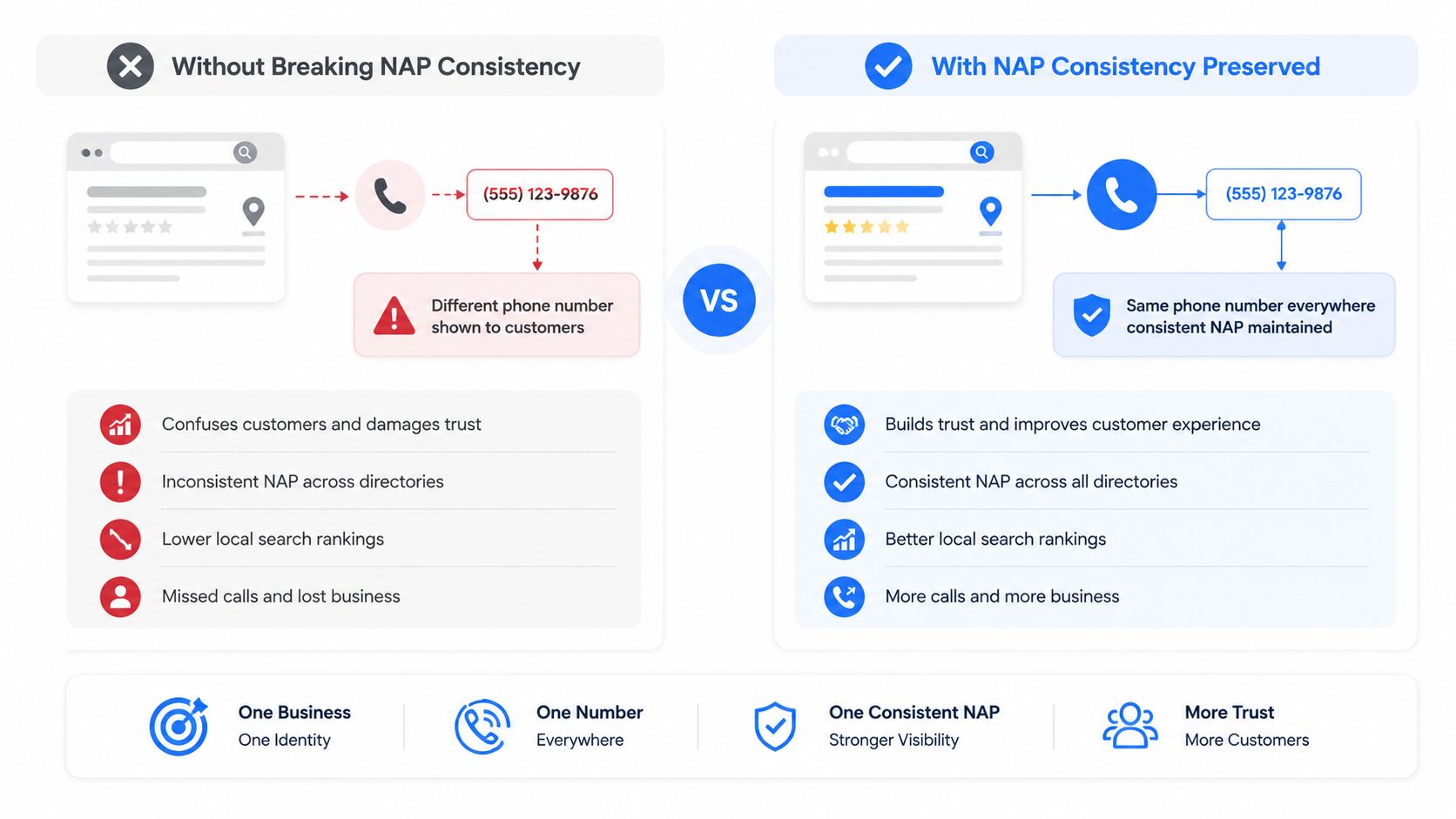
Call tracking is where many local sites get into trouble. The business finally wants attribution, then the tracking vendor replaces the primary number everywhere, and the local footprint starts drifting away from the actual business identity.
Two tracking models, two different trade-offs
The first model is dynamic number insertion, where the visible number changes by session or source. The benefit is cleaner source-level attribution. The risk is that the site can stop presenting a stable NAP if it isn't handled carefully.
The second model is a static first-party tracking number layered on top of the primary business number. That can preserve the core NAP while still giving the team something measurable, especially if the tracking number is kept out of the places where the actual local identity matters most.
A solid how to track phone calls resource is useful here because the implementation details matter more than the marketing label.
Don't let tracking overwrite the real local identity
The biggest mistake is letting a tracking vendor push a toll-free or out-of-region number into the Google Business Profile or primary schema. That can weaken the local signal and make the business look less tied to the actual service area.
A better pattern is to keep the official site number, GBP number, and core citations aligned, then use tracking for source reporting in a way that doesn't contaminate those core identifiers. If the business needs source-level visibility, it should be configured deliberately, not by default.
For teams comparing platforms, this best call tracking software 2026 guide is a practical starting point because it keeps the conversation grounded in actual call measurement instead of vanity metrics.
Watch the handoff, not just the ring
A tracking setup is only useful if the calls can still be matched back to outcomes. That means reconciling call logs with CRM records, booking records, or job records. Raw call volume alone doesn't tell you whether the number is attracting qualified leads or just noise.
The best setups preserve the NAP, keep the tracking layer isolated, and still let the team see which channels produce the calls that become customers. That's the balance worth aiming for.
A/B Testing, Analytics, and the Phone Number Dashboard
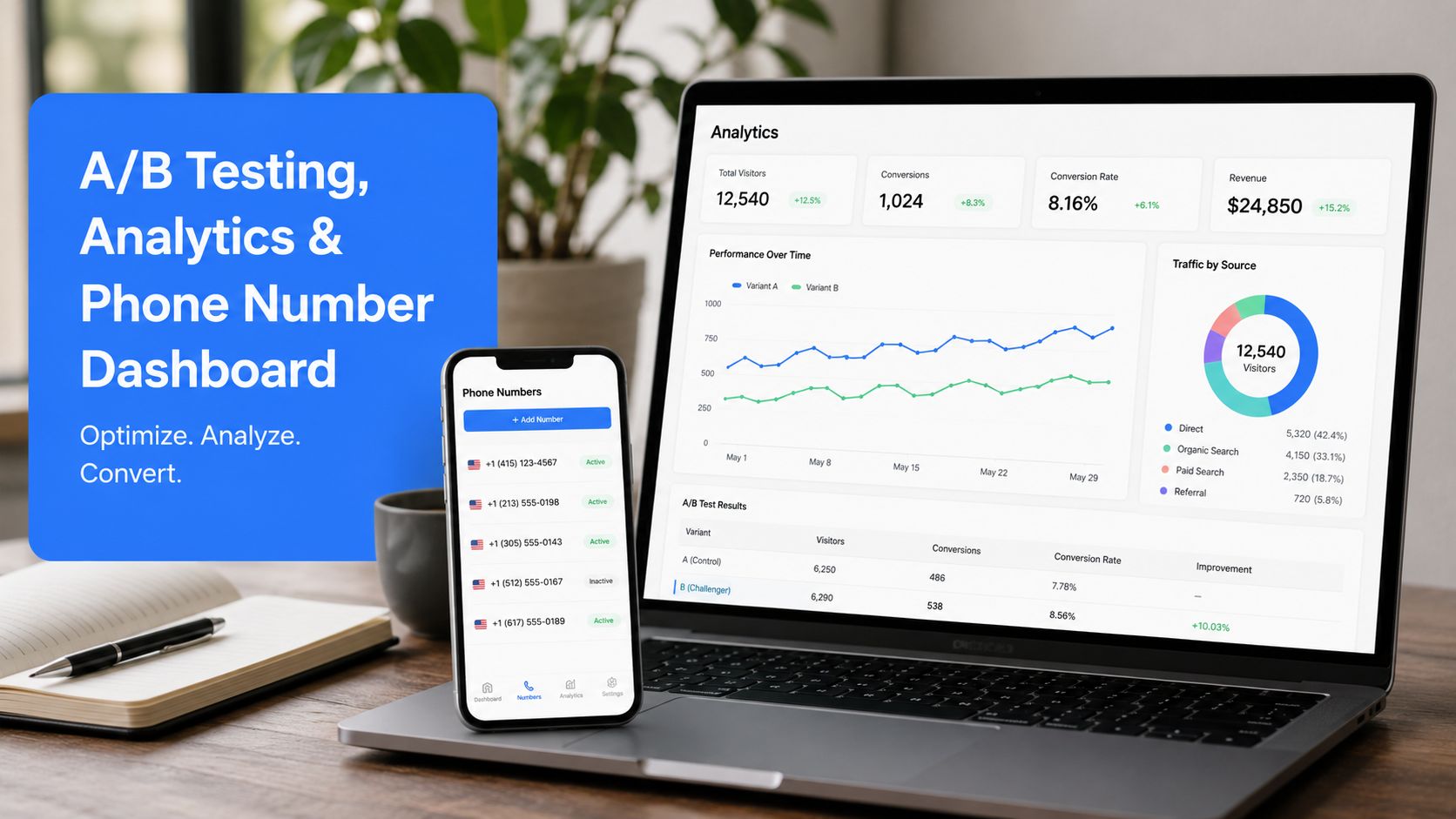
A phone number on website pages should be measured the same way any other conversion asset is measured. If the site is changing the number, changing its placement, or changing the click behavior, the team should know what moved and why.
Test one meaningful change at a time
A clean A/B test usually compares the control number against a variant with a different placement or a different tracking setup. The hypothesis should be simple enough to defend in a meeting, and the success metric should be qualified calls, not just call volume.
That matters because a louder phone number can generate more rings without improving booked jobs. A real test needs to track whether the call led to a real customer, not just a busy office line.
Tag the click, then reconcile the outcome
Google Analytics and Google Tag Manager can track tel: clicks as events. That tells you which pages and which placements are driving action. From there, the useful move is to reconcile those events with call logs and booking data so you can see whether the calls turned into revenue.
For reporting structure, the internal local SEO reporting tools page is a strong companion because phone data shouldn't live in a separate spreadsheet that no one revisits.
A practical dashboard usually centers on three things:
- Call volume by source: where the calls came from.
- Qualified-call rate: which calls were worth the team's time.
- Booked-job rate: which calls became actual customers or patients.
Keep the dashboard tied to service area reality
If the business serves several cities, the dashboard should separate results by location or service area whenever possible. That's the only way to see whether a number is helping the right market, not just producing activity.
Transactional Marketing's style of reporting is built around that same logic, keyword timelines by city, map visibility, traffic, and lead outcomes. The point is to make the phone number part of a measurable revenue line, not a mystery.
A final note for the implementation stack, if you want a broader comparison of platforms and workflows, the right call tracking tool matters less than whether the data lands in one clean view. Once that happens, the phone number becomes something you can manage instead of something you hope is working.
A CTA for Transactional LLC.