
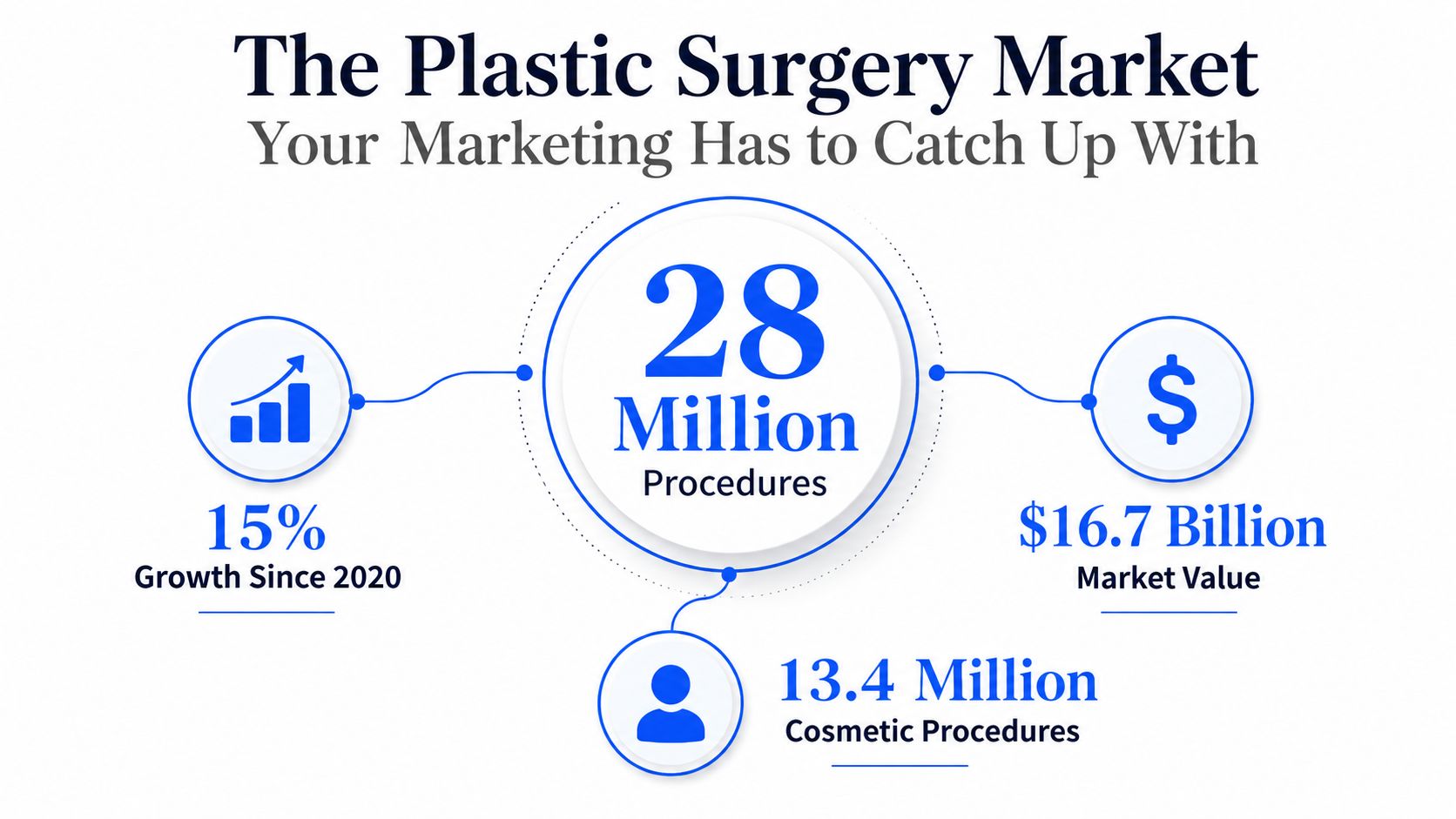
The plastic surgery market isn't waiting for your website to catch up. The American Society of Plastic Surgeons reported more than 28 million reconstructive and cosmetic procedures in the U.S. in 2023, with overall cosmetic surgery up 5% year over year and minimally invasive procedures up 7%. That is a real patient market, and the practices that win are the ones that turn search demand into booked consults, not the ones still treating marketing like a brochure project. American Society of Plastic Surgeons statistics
A clinic can rank and still lose. I've seen practices sit at the top of organic results, then watch the phone stay quiet because the Google Business Profile was thin, the reviews were weak, and the procedure pages didn't answer the exact questions patients were typing. That's the expensive mistake in plastic surgery marketing, and it gets worse when competitors have already built local trust, patient proof, and ad coverage around the same procedures.
The behavior shift isn't new. A peer-reviewed PubMed study found that after April 2012, when Instagram took off, search volume rose significantly for procedures including rhinoplasty, breast reduction, brow lift, hair transplantation, and lip augmentation. In plain English, discovery moved online and stayed there. If your practice isn't built for search visibility, AI visibility, and map-pack visibility, you're not just under-marketing, you're handing demand to the office down the street. PubMed study on Instagram-era search behavior
The Plastic Surgery Market Your Marketing Has to Catch Up With
A lot of practices still market as if plastic surgery demand were niche and slow. It isn't. The market is broad, active, and moving harder into digital channels every year, which means referral-heavy marketing alone is a weak bet.
Demand is already large enough to punish slow marketers
The American Society of Plastic Surgeons reports that U.S. reconstructive and cosmetic procedures topped 28 million in 2023. It also shows 5% growth in overall cosmetic surgery procedures and 7% growth in minimally invasive procedures year over year, with liposuction alone reaching 347,782 procedures. That mix matters because a practice that markets only one hero service while ignoring the rest is leaving money on the table.
Practical rule: if your competitors are active in search, reviews, and local maps, “we've always gotten referrals” is not a strategy. It is a delay tactic.
Plastic surgery marketing has to follow the same logic as any high-intent local service. Patients do not browse forever. They search, compare, check proof, and book when the practice feels credible and easy to contact. That means the opportunity is not traffic alone, it is conversion.
The shift toward digital discovery has been building for years. A PubMed study tied Instagram's rise to significant search-volume changes for aesthetic procedures, which shows that patients now discover services online first and then validate them elsewhere. Discovery starts in search, social, and map results, then turns into a consult only if the practice looks trustworthy fast.
A practice that ignores that reality can still survive, but it will not stay ahead. One office can hold a strong local reputation for years, then lose search share, map visibility, and consult flow once nearby competitors invest in content, reviews, and paid placement. That is the cost of waiting. You are not saving budget, you are buying recovery later at a higher price.
For a parallel example of what high-intent lead generation looks like in another service category, SkipCalls for law firms is a useful comparison because it frames marketing around intent, not vanity traffic. Plastic surgery needs the same mindset, just with different patient questions and trust signals. If you want a practical local ranking reference, this guide on how to rank higher on Google Maps shows the kind of map-pack discipline that belongs in the same acquisition system.
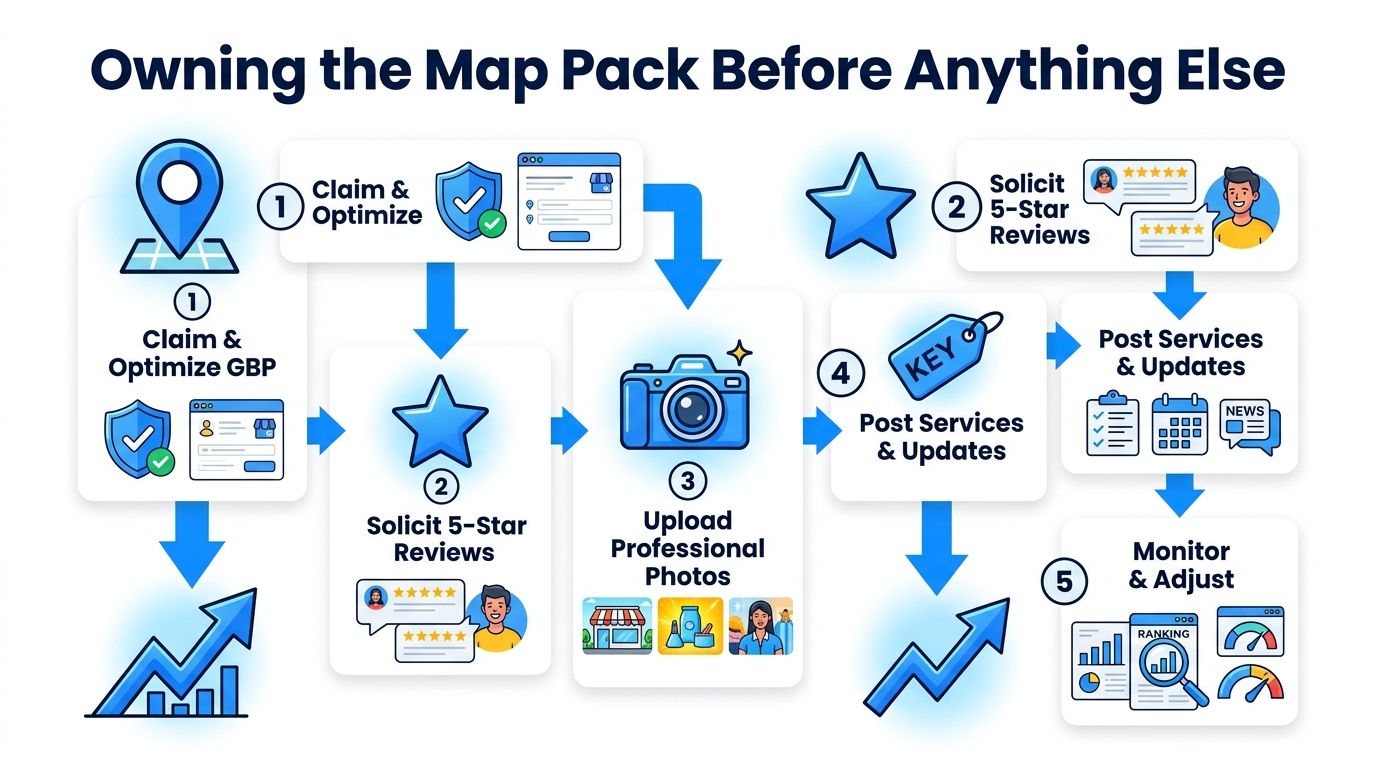
Owning the Map Pack Before Anything Else
If a local patient searches for a procedure and your practice is missing from the map pack, you lose the first trust test before the click even happens. In plastic surgery marketing, the Google Business Profile is the primary entry point for local patients.
The sequence matters more than the tactic
The order that works is direct. Complete the Google Business Profile first. Then get to at least 25 reviews with an average rating of 4.7 stars or higher. After that, publish one dedicated local landing page per procedure, and only then scale Google Ads for high-intent searches. Proven local SEO sequence
That sequence works because each step clears a different objection. A complete profile makes the practice look established. Strong reviews lower fear. Procedure landing pages give the ad click a relevant place to land. Skip the sequence and you pay for traffic before you have earned trust.
A practice with weak review volume can still buy clicks, but it usually pays more per booked consult because the landing experience does not reassure the patient fast enough.
Use your map presence as a local authority signal, not just a pin on a screen. The profile should reflect the procedures you want to sell, the photos should look current, and the review feed should reinforce outcomes, bedside manner, and professionalism. The map pack is where the first trust decision happens, and it should support the same acquisition system as your ads and content, not sit off to the side.
Google Ads needs patience too. The stabilization window is usually about 60 to 90 days, and local SEO or map-pack movement typically shows initial traction in 60 to 90 days with more meaningful ranking gains in 4 to 6 months. Map-pack and ad timing guidance
The internal guide on how to rank higher on Google Maps fits this playbook because it keeps the focus on the surface-level visibility that patients click.
A useful reference point from another visual-service vertical is SEO advice from SendPhoto. The lesson holds here too. Local discovery wins when the business profile is complete, the proof is visible, and the page experience matches the search intent.
Reading the Numbers That Decide Your Budget Split
A lot of practices waste money because they start with a budget, not with the math. In plastic surgery marketing, the budget split should follow channel economics, mobile behavior, and conversion efficiency. Anything else is guesswork.
Start with the channels that already carry demand
A recent benchmark summary shows organic search drives 42% of global traffic in this sector, while paid search accounts for 29% of U.S. traffic. It also shows mobile traffic reaches 76%, average Google Ads CPC is $6.45, search conversion rate is 3.8%, and blended PPC CPA is $98. Those figures point to a market that is mobile-first, search-heavy, and expensive enough that weak landing pages will drain budget fast. Plastic surgery benchmark summary
| Channel | Traffic Share | Avg. CPC | Conversion Rate | Effective CPA |
|---|---|---|---|---|
| Organic Search | 42% global traffic | N/A | N/A | Lower when pages are optimized |
| Paid Search | 29% U.S. traffic | $6.45 | 3.8% search conversion rate | $98 blended PPC CPA |
| PPC Landing Pages | N/A | $6.45 average Google Ads CPC | 5.8% landing-page conversion rate | Lower than the website average |
| Website Average | N/A | N/A | 3.4% conversion rate | Higher than optimized landing pages |
The landing-page gap matters more than most owners realize. Well-optimized plastic surgery websites convert at about 3–5% from traffic to consultation requests, while average sites sit around 0.8–2%. If your site is underperforming, buying more traffic just magnifies the waste.
Run the budget math before you scale spend
Here's the working example. A $2,000 monthly budget may generate about 100–250 clicks. At a 2% site conversion rate, that yields only 2–5 consultation requests. Budget example and click math That is why paid search without conversion work is a trap.
If your landing pages are built for consultation requests, not general browsing, the same spend has a better chance of producing booked activity. If they are not, the clicks are just expensive visitors. Spend on the page before you spend on the click.
Use this before and after examples guide to judge whether your gallery setup is doing real conversion work or just filling space. In plastic surgery, proof sells faster than polished copy, and weak visuals force paid traffic to do too much heavy lifting.
Building Procedure Silos and Before and After Galleries That Convert
Plastic surgery sites lose leads when they lump every service into one generic page. Patients search by procedure, concern, and outcome, so the site has to reflect that behavior exactly.
Build one silo per procedure, not one catch-all services page
A workable silo starts with a pillar page for one procedure, such as rhinoplasty, breast augmentation, or liposuction. Build support content around that page for recovery, candidacy, common concerns, credentials, and consultation questions. That structure gives Google a clear topical map and gives AI systems cleaner entity signals to work with.
Use the same language patients type into search. A systematic review of plastic surgery marketing literature noted that explicit search phrases like “Plastic surgery,” “breast augmentation,” and “nose jobs” were recommended for YouTube, while Instagram content performed better when it stayed visually oriented and nontechnical. Systematic review of platform-specific messaging That is the clue. Do not write for surgeons when the page is meant to attract patients.
A useful silo for one procedure should include:
- Pillar page: clear overview, candidacy, benefits, and consultation CTA.
- Before and after gallery: grouped by procedure with clean labeling and consent.
- Recovery FAQ: pain, downtime, swelling, activity limits, and follow-up.
- Surgeon profile section: credentials, specialty focus, and patient trust points.
- Internal links: connect related questions and nearby procedure pages.
The before and after gallery needs more than attractive images. It needs context, alt text, and a page structure that supports decision-making. If you want a practical visual reference, the internal guide on before-and-after examples shows how tightly those assets should sit next to the page's core call to action.
Write for search intent and consult intent at the same time
Search intent gets the visit. Consult intent gets the lead. The copy has to do both. If the page answers only medical questions, it can rank and still fail to convert. If it pushes too hard on the sale, it can feel thin and trust drops.
Practical rule: every procedure page should remove one fear, answer one practical question, and make one next step obvious.
That is how you build an owned-site system that supports both search and AI optimization. The page should read like a patient decision tool, not a brochure. When the silo is tight, the gallery is credible, and the CTA is obvious, the consult rate has something to work with.
Matching the Channel to the Patient You Actually Want
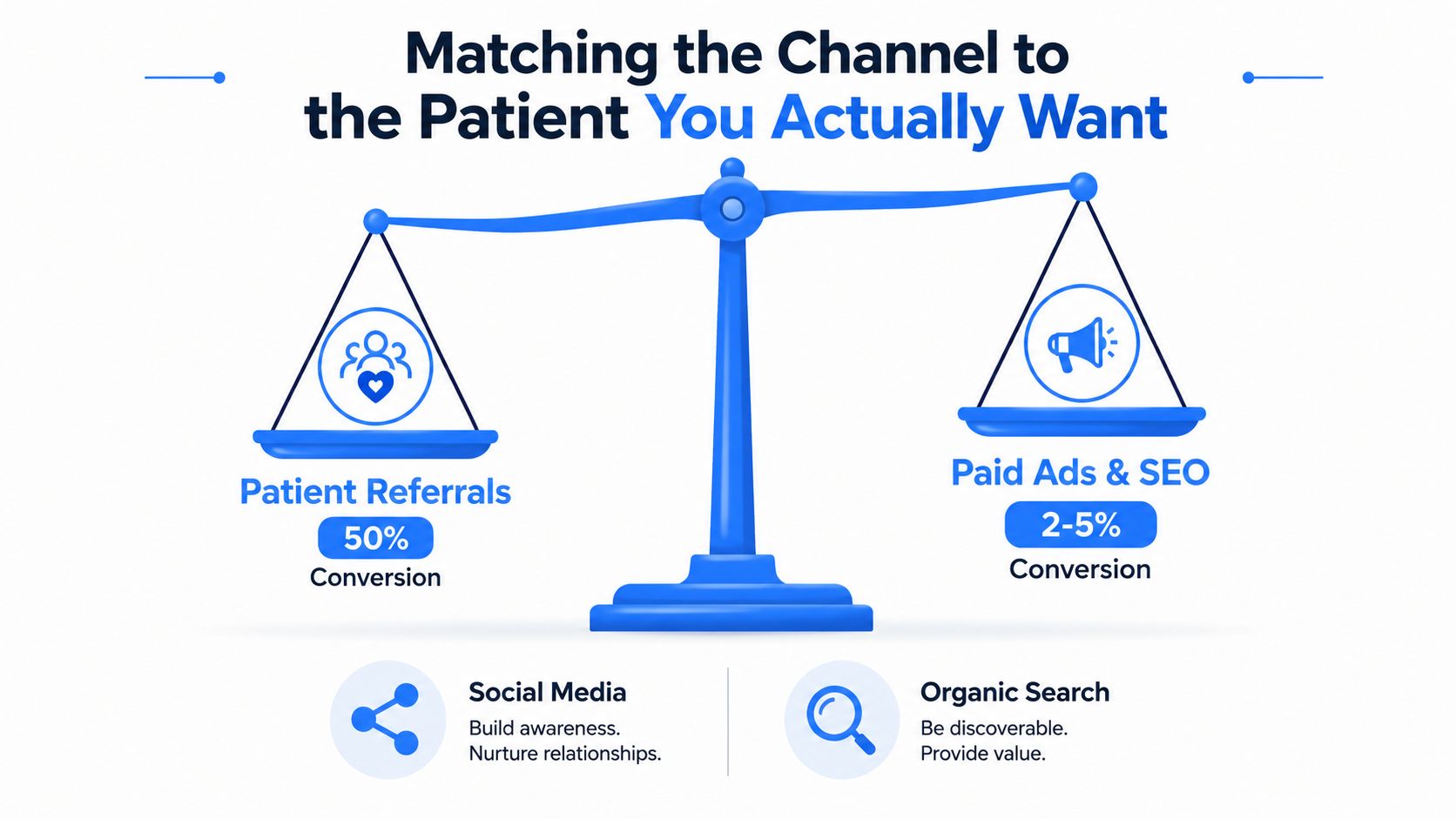
Channel choice is not cosmetic. It changes who books, how fast they book, and how much education you need before they trust the consult. The strongest plastic surgery marketing plans match the channel to the procedure, the patient segment, and the timeline to conversion.
Referrals, search, and social do different jobs
An older facial plastic surgery referral study found that referred patients converted at a much higher rate than other sources, and the patients most likely to schedule surgery were referred by other patients, friends, or family members. It also showed a split by audience and procedure. Women and older patients were more likely to come from magazines, television, and newspapers and pursue facial rejuvenation, while men and younger patients were more likely to come from the website and pursue rhinoplasty. Facial plastic surgery referral study
Use that as a planning rule. Referrals are the fastest trust transfer you can buy without paying for the click. Search catches the patient who is already looking. Social usually does the slow work of familiarity, proof, and repeat exposure before the consult happens.
Men ages 30–50 are a good example of why one-channel thinking wastes money. They are reachable on Google and YouTube, and they respond better to discretion, natural-looking results, and recovery-time messaging. A recent playbook calls this a growing but still underserved segment. Male patient marketing playbook That means your creative cannot be built around the same beauty-first visuals you use for every other audience.
Spend where the patient is already deciding
Referrals should deepen trust, not carry the whole acquisition load. Search should catch intent that already exists. Paid ads should own the exact procedure terms you care about, because that is where you can force visibility instead of waiting for organic momentum. Social media should support proof, education, and follow-up visibility, not act like a standalone sales engine.
Platform behavior matters too. A systematic review of platform engagement in the plastic surgery context reported that Facebook had the greatest patient use and engagement, Instagram ranked second, and Twitter had the least engagement. Systematic review of platform engagement That ranking is a practical sorting tool. It tells you where to put attention first and where not to waste creative cycles.
Build around where the patient segment pays attention, not the platform your team likes posting on.
The internal guide on getting more reviews fits into that same system, because trust signals, search visibility, and channel choice all feed the same consult pipeline.
Reviews, Compliance, and the Trust Signals That Close the Click
The click is never the hard part in plastic surgery marketing. The hard part is making the patient feel safe enough to move from interest to consultation. Reviews, consent, and platform compliance do that work.
Make trust operational, not accidental
A review-generation workflow should start at the front desk and end on the Google Business Profile. Ask consistently, route satisfied patients into a simple review request process, and keep the language natural. Don't wait for reviewers to show up on their own. They usually won't.
The same discipline applies to before-and-after imagery. Use it as evidence, but make sure consent is clear and documented. Don't bury that process in someone's inbox and hope it's fine later. It needs to be part of the practice workflow.
Here's the do and don't list I'd hand to the team:
- Do collect HIPAA-compliant testimonials: keep patient privacy and consent central.
- Do document before-and-after approval: every gallery image should have a clear permission trail.
- Do publish verified reviews: they support both map rankings and trust.
- Do check platform policies before launching creative: ad approval issues waste time and force rewrites.
- Don't make claims the platform can't support: high-risk language gets ads rejected or pages weakened.
A recent guide from Transactional LLC on getting more reviews is worth using as an operational reference if your team needs a repeatable workflow rather than a one-off ask.
Keep ad copy tight and compliant
Google and Meta both scrutinize medical and aesthetic ad copy. That means your creative should lean on education, consults, procedures, and outcomes that can be shown responsibly. Avoid hype. Avoid overpromising. Avoid anything that makes the practice look careless with patient trust.
If your team can't explain the proof behind a claim, don't put it in the ad. If a gallery image isn't consented properly, don't use it. If a testimonial isn't cleanly documented, don't feature it. Compliance isn't a drag on marketing. It's part of the conversion system.
Your 30 60 90 180 Day Rollout and What to Measure at Each Gate
A good plastic surgery marketing plan needs a calendar, not just a strategy deck. The work should be staged so you know what to fix, what to hold, and when to scale.
Days 1 to 30, build the base
Start with the Google Business Profile, review workflow, tracking, and consultation intake. That first month should tell you whether the practice is set up to capture local demand or just to display information. Check review count and average rating first, because those are the trust floor.
Days 31 to 60 should be about procedure silos, gallery architecture, and on-page SEO. The site becomes a conversion asset instead of a generic brochure. Measure indexation, page-level rankings, and whether the procedure pages are attracting the right search queries.
Days 61 to 90 is the Google Ads launch window and the first real test of your paid-search economics. Track cost per consultation, booked consults, and the quality of the leads coming from each procedure page. If the numbers are weak, the page needs work before you buy more traffic.
Days 91 to 180, refine for scale
This is the stage for AI-search optimization, referral-program support, and budget decisions. Use the internal guide on how to measure marketing effectiveness as the reporting backbone, because the practice needs one dashboard that ties activity to booked demand.
Measure assisted revenue here, not just clicks. That tells you whether the map pack, organic pages, and paid ads are reinforcing each other or competing for credit. Feed the best-performing questions, photos, and objections back into the content engine so the next round of pages starts stronger.
If a page answers the same patient objection three different ways and still doesn't convert, the page is the problem, not the traffic.
That's the loop that compounds. Build the local surface, publish procedure-specific content, launch paid demand capture, then let the consult data tell you what to improve next. Do that consistently and the system gets sharper every month.
Transactional LLC builds search systems for service businesses that need local visibility, and the same framework applies here for plastic surgery marketing. If you want map-pack ranking, transactional search-term targeting, and AI-driven content that supports consult bookings, visit Transactional LLC and have the team build the patient-demand system around your procedures and service area.