


You can spot the problem fast. A plumber gets a call from a panicked homeowner, the house is taking on water, and the next stop is a phone search for plumber near me. If the website is slow, hard to read on a phone, or hides the number, that lead is gone before anyone even sees the logo.
That's what plumbing website design is really judged on. Not color palettes. Not stock photos of wrenches. It's judged on whether it gets a stressed, high-intent searcher to call now, book now, or move on to the next contractor in the Map Pack.
Why a Plumbing Website Is Really a Call-Generating Machine
A plumbing site is not a digital brochure. It's a live response system for people who need help right now, usually on a phone, usually while standing in a flooded kitchen. That's why transactional search terms matter so much, because the searcher already has intent and money in hand, and they're looking for a provider who can answer fast.
The local plumbing customer does not want a brand story first. They want to know if you cover their area, whether you handle the exact problem, how fast you answer, and how to reach you. A site that looks polished but buries the phone number is weak. A site that answers the job, the location, and the next step is built to produce calls.
Practical rule: if a homeowner can't find the number, the service area, and the next action in a few seconds on mobile, the page is working against you.
The numbers back that up. One benchmark notes that 70–80% of plumbing website traffic is mobile, a sticky tap-to-call bar can lift conversions by 30%, and 53% of visitors abandon a site that takes longer than 3 seconds to load on mobile, which directly affects Google Map Pack visibility Pipelineon plumbing website benchmark. That's why the actual revenue engine is the website plus Google Maps, not a nice homepage sitting by itself.
If you want a broader lead-gen framework, the Divimode guide to website leads is a useful companion, but for plumbing the core principle is simple. Build for speed, trust, reach, and call volume. My own rule is blunt. If a page doesn't move a visitor toward a call, it's decoration.
For plumbing owners who want a tight lead flow, a visible phone number matters more than another paragraph of brand copy. This phone number on website guide aligns with that same logic, make the number obvious, tappable, and impossible to miss.
The Page Blueprint Every Plumbing Site Needs
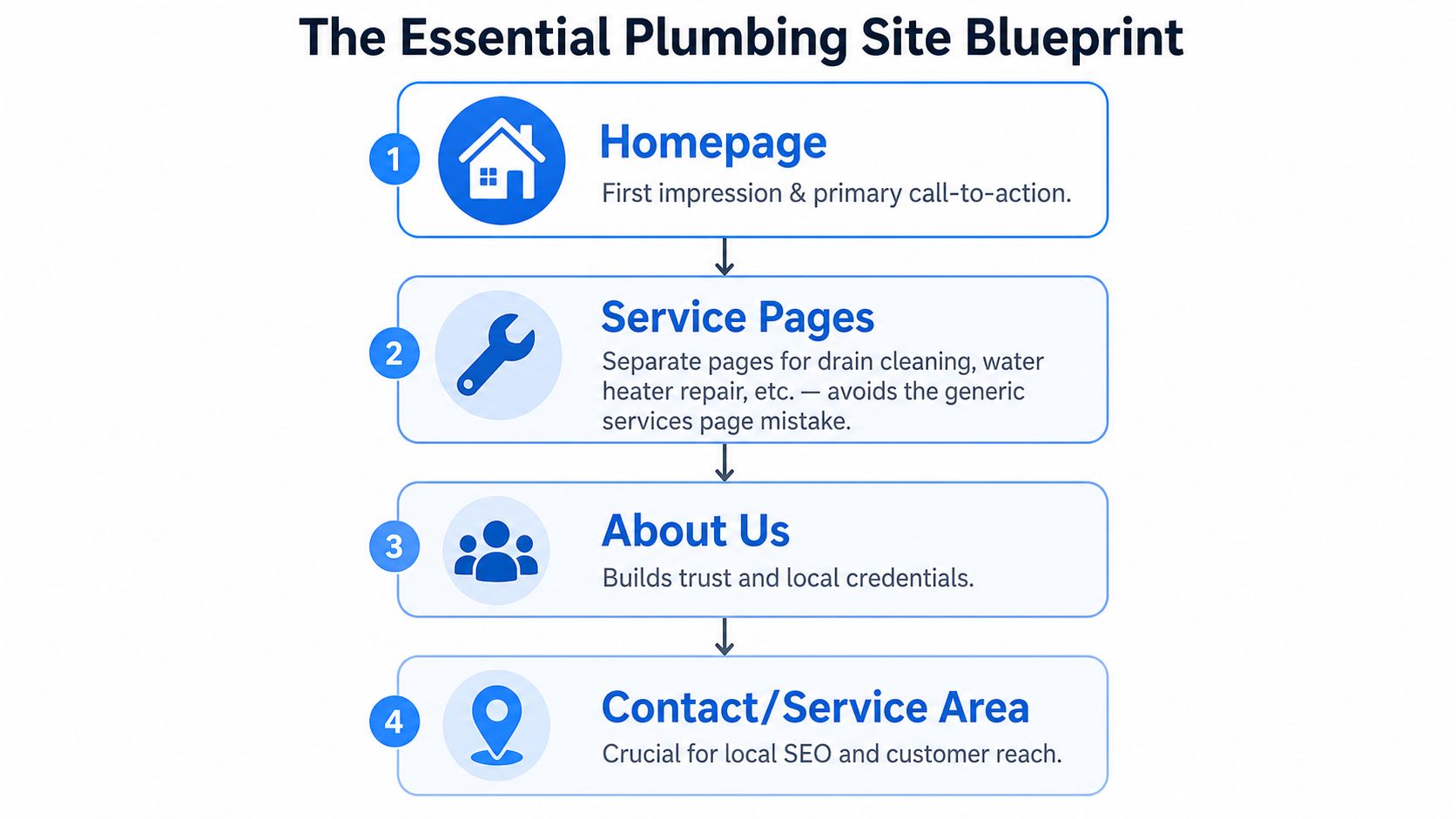
A plumbing website needs a structure that matches how people search. The most common mistake is cramming every service into one generic services page and hoping Google sorts it out. It won't. Separate pages give you more entry points for transactional terms, and they help searchers land on the exact problem they need solved.
Build the site around jobs, not categories
Start with the homepage, About Us, Reviews, Contact, and then individual service pages. The service pages should not be broad buckets. They should cover drain cleaning, sewer, leak detection, gas, water heaters, repiping, fixtures, water quality, and commercial work as distinct pages, because that's how real demand is split on the search side CI Web Group plumbing website guide. That same structure also makes it easier to write clear headlines, answer specific questions, and guide the visitor to a booking form.
A clean navigation path looks like this. A city page attracts the local search, the service page explains the fix, and the contact form closes the loop. That three-step path is what you want, not a maze of vague pages and a single contact link buried in the footer. Internal links should move users from a city page to a service page to a booking form without forcing them to think.
Here's the architecture I'd use on nearly every serious plumbing site:
- Homepage: positions the company, services, service area, and primary call-to-action.
- Service pages: one page for each revenue line, so Google and visitors know exactly what you do.
- City pages: one page per service area, not a giant list of 30 cities on one page.
- About Us: proves who is behind the truck, the license, and the reputation.
- Reviews or testimonials: gives proof that other homeowners trusted the company.
- Contact page: phone, form, map, hours, and service area details in one place.
A dedicated sitemap also makes internal linking easier to manage. If you want a practical reference for how that hierarchy should look, this website sitemap examples guide is the right type of framework to study.
Mobile-First Conversion Stacks That Win Emergency Calls
The phone is the page now. On plumbing traffic, especially emergencies, the desktop mockup barely matters if a visitor cannot tap, call, and submit a request fast. If the mobile version feels cramped or slow, the lead is gone.
The mobile stack that actually converts
Put a clickable phone number in the header. Add a sticky bottom bar with both Call Now and Book Now on every page. Keep the form painfully short, ideally just name, phone, and problem description. That is the stack that gets used when someone is standing over a leak with one hand busy and no patience for a long page.
Performance targets need to be specific. Industry guidance calls for page speed under 3 seconds on 4G, ideally under 2 seconds, with Lighthouse scores of 90+ and all Core Web Vitals in the green Skill Mammoth plumber website design guidance. That same guidance also points to a 2026 analysis of 47 plumber websites that found an average Time to Interactive of 1,660 ms and a median of 1,243 ms, which shows how fast the bar has already moved for plumber sites.
If the form asks for too much, the emergency caller backs out and dials the next plumber.
Large tap targets, strong contrast, clear labels, and readable fonts matter because stressed homeowners do not want to fight the screen. Those choices help them finish the request faster, which is the whole point. If you want a practical checklist for removing friction on small screens, this mobile UX guide for SMBs is worth using.
For plumbing sites, one clean call path beats a homepage full of competing buttons. The mobile optimized sites page supports that same approach, design for the thumb first, not the mouse.
Winning the Google Map Pack and Turning Listings Into Calls
The website doesn't win alone. For plumbing, the Google Business Profile and Map Pack often sit at the front door, and the site backs them up after the click. If your listing is weak, your website has to work harder just to get noticed.
A complete Google Business Profile should be tight and consistent. That means the right primary category, accurate service descriptions, service areas that match where you work, current hours, strong photos, and citations that match the business name, address, and phone everywhere else. The listing should look active, not abandoned. Review generation matters too, because response frequency and steady review activity help reinforce trust and local prominence.
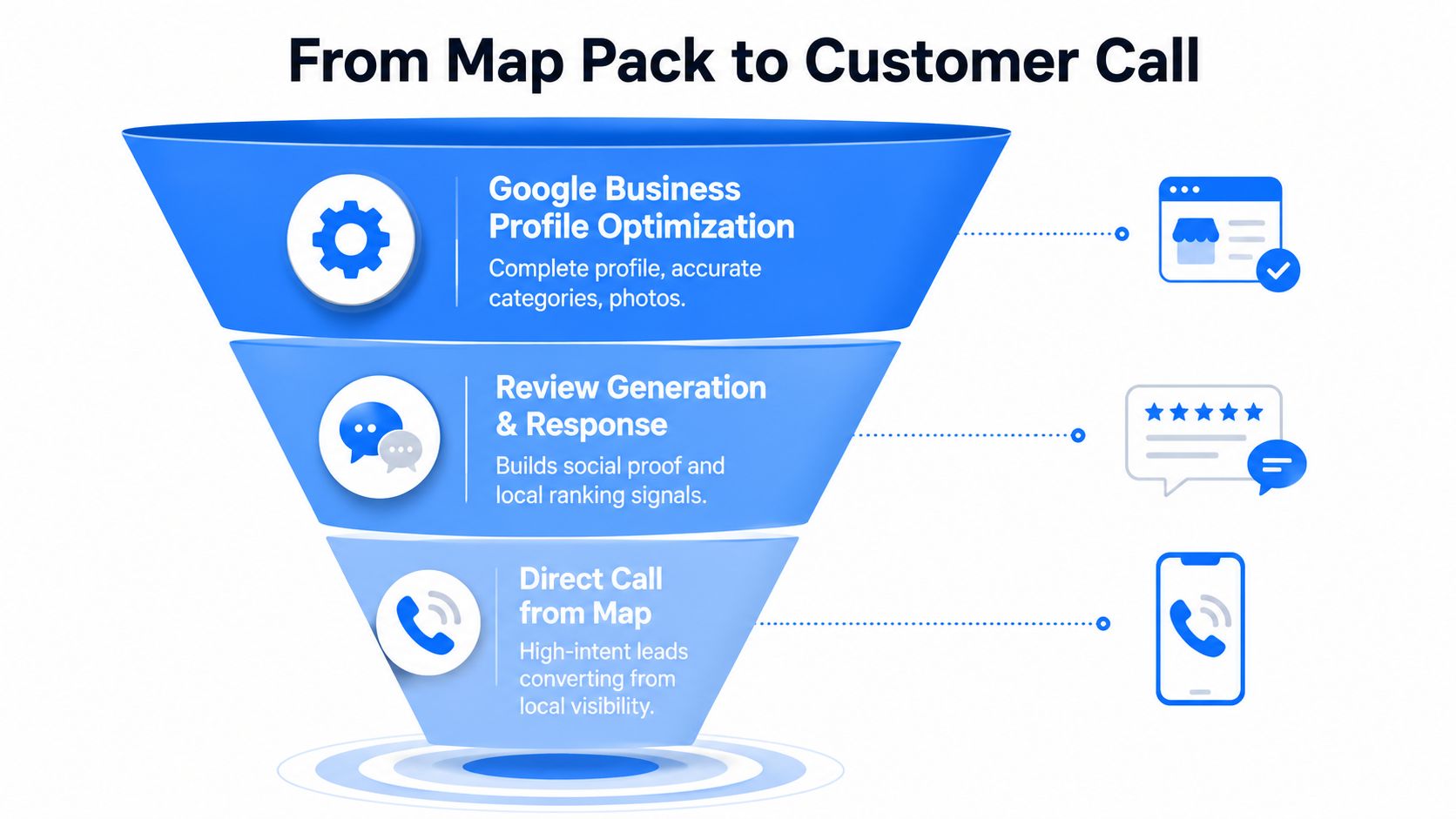
The win is when the map listing and the site support each other. Someone sees the company in the Map Pack, clicks through for proof, then calls from the listing or the site depending on what they need. That's why the Map Pack should be treated as the discovery layer and the site as the conversion layer. If the two are aligned, the path to a call gets shorter.
For teams trying to optimize for conversational and local discovery, the GEO for ChatGPT and Perplexity resource is worth a look because it fits the same broader direction. Search behavior is moving toward answers, and plumbing brands need both map visibility and content that can be surfaced cleanly.
A few listing details matter more than most owners think:
- Photos: show the truck, team, and actual job sites, not generic stock images.
- Hours: keep emergency and after-hours availability clear.
- Service area: match the actual radius, not wishful coverage.
- Reviews: ask for them consistently and reply without sounding scripted.
- Citations: keep every major directory aligned so the trust signal doesn't fracture.
For a deeper map strategy, this Google Maps ranking guide is a solid companion to the site work. If you want the listing to feed the phone, the site and the Map Pack have to pull in the same direction.
Why Pricing Transparency on a Plumbing Site Builds Trust
Most plumbing sites are too coy about money. They show trucks, badges, and testimonials, then hide the actual cost conversation behind a contact form. That feels safe to the business owner, but it creates friction for the homeowner, especially when the problem is urgent and they want a fast decision.
Put the money conversation on the page
Industry guidance recommends including basic pricing information or starting price ranges, plus explanations of what is included and approximate timeframes on service pages, because mobile visitors want fast answers rather than vague marketing copy pricing guidance for plumbing pages. That doesn't mean hard quotes on every job. It means ranges, diagnostic fees, and plain-English explanations that help a buyer decide whether to call.
A good pricing block answers three questions fast. What does the visit include? What's the starting point? What happens after hours? If you can answer those without hiding behind jargon, you qualify the lead before the phone rings. That saves time for both sides.
The picture here is simple. A homeowner who sees nothing on pricing calls three competitors. A homeowner who sees a starting fee, a diagnostic explanation, and a service window is more likely to call the company that feels honest. Transparency doesn't scare away serious leads. It filters out the tire-kickers and makes the buyer more confident.
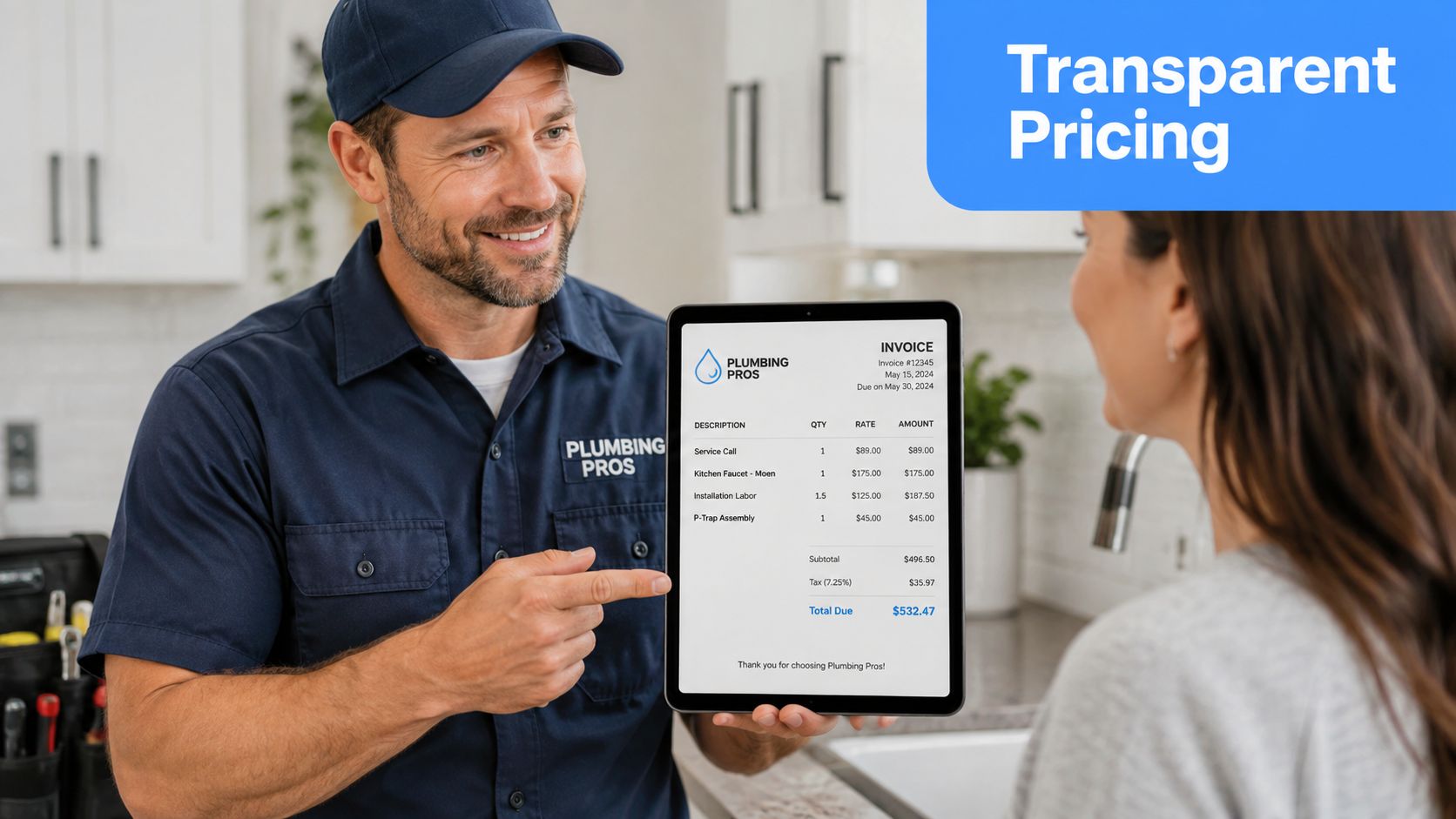
Practical rule: frame pricing as a range or starting point, then say what's included, so the customer understands value before they call.
That structure works especially well on service pages. A drain cleaning page can explain the visit, the starting point, and the typical timeframe. An emergency page can clarify after-hours response. A water heater page can separate diagnostics from replacement. The point is to reduce uncertainty without pretending every job is identical.
If I had to choose between vague copy and honest pricing language, I'd take the honest page every time. It respects the searcher, and it makes the site easier to trust.
AI Optimization and Service Silos for Plumber Search Visibility
The new layer is AI-driven search. People aren't just typing short keywords anymore, they're asking conversational questions, and that means a plumbing site has to be easy for large language models to read, summarize, and trust. Thin pages and broad catch-all services sections don't help much there.
Build the content map like a service silo, not a pile of pages
Each plumbing trade should live in its own content cluster. Drain cleaning gets its own page, its own FAQs, and related internal links. Water heaters get their own cluster. Leak detection gets its own cluster. That structure helps search engines and AI systems see topical depth instead of a scattered collection of keywords.
Clean heading hierarchy matters because it tells both people and machines what the page is about. Structured data helps too, especially for services, locations, reviews, and FAQs. Put those together with clear, local language, and the site becomes much easier to summarize in conversational search results.
AI optimization fits inside a broader local SEO system. Transactional Marketing, for example, builds around transactional search terms and local service visibility, which means the content map is organized around what people type when they're ready to spend. That matters more than stuffing a blog with generic plumbing advice that never turns into a call.
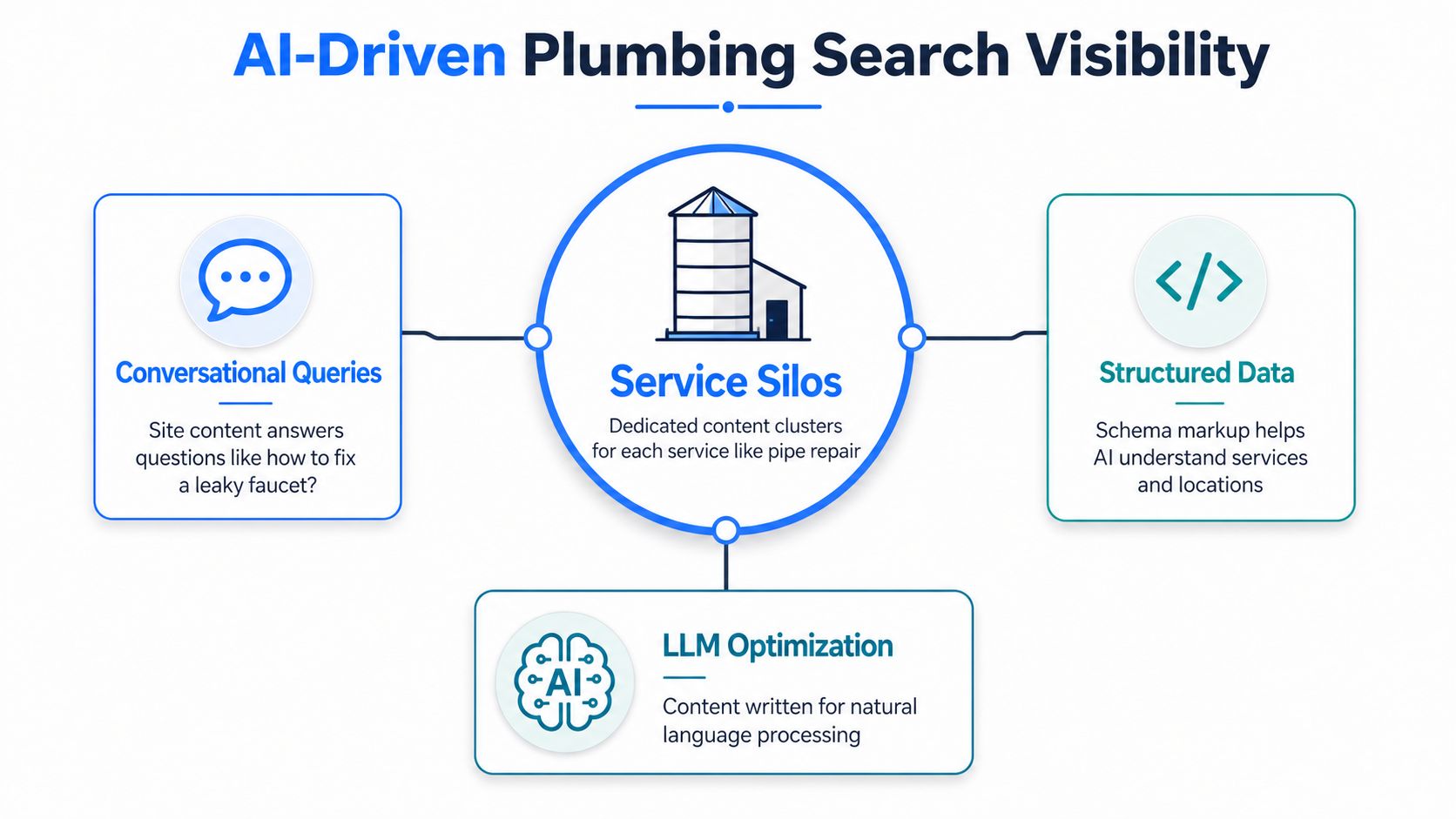
A useful rule is to keep every article and landing page tied to one service and one intent. Don't mix plumbing, roofing, dental, and HVAC into the same content plan if the goal is local visibility for one trade. Separate industries need separate content maps, and each map should point toward a transactional landing page that converts.
For plumbers, that means the site has to answer search questions in a way both humans and AI can use. Service silos, FAQs, structured data, and local pages give you that edge.
Measuring Whether the Plumbing Site Is Actually Producing Jobs
A plumbing site is only successful if it creates booked work. Traffic alone doesn't pay the truck note. I want to see movement in the pages, the city targets, the Map Pack, and the calls.
Start with keyword timelines by service city. Track which terms are climbing, which pages are pulling impressions, and which service areas are turning into actual calls. Then layer in Map Pack heat maps so you can see which zip codes are getting into the top three. Search Console shows which transactional queries are rising, and call tracking tells you which page or listing started the conversation.
Here's the audit I'd run before a redesign:
- Can a visitor call from mobile in one tap?
- Does each core service have its own page?
- Does each service area have its own city page?
- Are pricing ranges or starting fees visible where they should be?
- Are the Google Business Profile and site aligned on service area and phone number?
When those answers are clean, the site starts behaving like a revenue asset instead of a brochure. That's the difference between a plumber who hopes for calls and one who can see where the calls are coming from.
Transactional LLC builds plumbing websites and local SEO systems around transactional search terms, Google Maps visibility, and AI-driven content maps that are designed to produce calls, not vanity traffic. If you want a plumbing site that's structured for map rankings, mobile conversion, and service-area growth, visit Transactional LLC and take a hard look at what your current site is doing for the phone.