


A prospective client searches at 9:30 p.m. after a visa problem, a detention issue, or a missed filing deadline. They are not looking for a general article on immigration law. They are looking for a firm they can contact now, in their language, with confidence that the firm handles their exact case type.
That is the standard your SEO has to meet.
SEO for immigration lawyers works best when it is built around transactions, not vanity traffic. A firm can publish articles, get impressions, and still lose the cases that drive revenue if it does not show up for high-intent searches like "asylum lawyer in Houston," "marriage green card attorney near me," or "immigration lawyer Spanish Miami." The firms that win local markets usually match search intent, service pages, Google Maps visibility, intake flow, and follow-up speed better than their competitors.
Immigration SEO also has a layer many other practice areas do not. Demand is fragmented across languages, case types, and geography. A strong strategy has to cover English and multilingual search behavior, service-specific pages, and AI-assisted content production without turning the site into thin, repetitive content. For firms that want better guidance on Understanding search engine optimization, the basic concept is simple. Get found for the searches tied to hiring decisions, then turn that visit into a consultation.
Local visibility still drives a large share of the opportunity, but local SEO alone is not enough. The firms that pull ahead build a system. Google Maps rankings, transactional keyword targeting, technical cleanup, multilingual pages, review generation, authority links, and conversion tracking all have to work together. If your team needs a clear benchmark for how to rank higher on Google Maps, start there, then connect it to the full pipeline.
The goal is not more traffic. The goal is more retained cases.
The Foundation Mastering Local Search and Google Maps
A prospective client searches "marriage green card lawyer near me" at 9:30 p.m. on a phone. They do not read ten blog posts. They compare three firms in Google Maps, scan reviews, check whether the office speaks their language, and decide who gets the call. That is the primary starting point for SEO for immigration lawyers.

Google Business Profile has to be set up like a client acquisition asset, not a placeholder.
Build the profile for hiring intent
Start with accuracy. Your business name, primary category, secondary categories, address, hours, phone number, website URL, appointment link, services, and description need to match the website and the way the firm is retained. Inconsistent details weaken trust and create ranking friction.
Then tighten relevance. The services listed in the profile should reflect how prospects search when they are ready to hire. Use plain service terms tied to case types and location, such as family immigration attorney, asylum lawyer, deportation defense lawyer, adjustment of status lawyer, and city-level modifiers where appropriate. Generic firm language wastes valuable relevance signals.
One practical test works well. If the phrase sounds like something a stressed client would type into a phone, it belongs in the profile.
Photos also affect performance more than many firms expect. A logo alone is weak. Add office photos, attorney headshots, reception images, exterior signage, and branded visuals that show the firm is real, active, and prepared to serve local clients. For immigration practices serving multilingual communities, visual trust matters before a user ever reaches the site.
Treat GBP like an active intake channel
An inactive profile slips. A maintained one gives Google and prospective clients fresh signals that the firm is operating, responsive, and relevant.
Use posts, Q&A entries, updated service details, and appointment links to reduce hesitation before the first call. Immigration clients often need fast clarity on timing, documents, consultation format, office location, and language support. Put those answers inside the listing where the decision is happening.
The Q&A section is especially useful for transactional friction points:
- Consultation process: Explain what the first call or meeting covers.
- Languages spoken: State this clearly if the office serves Spanish-speaking or other multilingual communities.
- Case types handled: List the specific matters the firm accepts, such as asylum, family petitions, removal defense, visas, or business immigration.
- Service area: Name the cities, neighborhoods, or regions the firm actively serves.
If your team needs a baseline before refining local execution, Understanding search engine optimization provides useful background.
Reviews influence rankings and conversions
In immigration search, reviews do two jobs. They support local visibility and they help a worried prospect decide whether your firm feels credible, responsive, and experienced with cases like theirs.
The firms that generate reviews consistently usually build a process around client milestones. They ask at the right time, make the request easy, and respond to every review with care. That matters even more in immigration law, where trust, empathy, and communication style often decide who gets contacted.
A simple review system is enough:
- Ask after a positive moment: A successful consultation, filing milestone, approval, or resolved issue works better than a random request.
- Use a direct link: Remove extra steps so the client can leave the review immediately.
- Train intake and staff: Give them a short script so requests are consistent.
- Respond to every review: Keep replies professional, human, and privacy-conscious.
- Watch language patterns: Reviews often reveal the exact phrases clients use. Those terms can improve service pages, FAQs, and multilingual copy.
Local landing pages need to validate the Map listing
Google Business Profile can win visibility, but the website still has to confirm local relevance and service depth. Build focused pages for core immigration matters in the cities you want to rank in. A single broad practice-area page rarely does enough work in a competitive market.
For immigration firms, this gets more nuanced because demand is fragmented by language and case type. A strong local architecture may include English pages, Spanish pages, and service-specific city pages, as long as each page is distinct, useful, and tied to real search demand. AI can help scale drafting and research, but publishing repetitive city swaps will not hold up. Human review, legal accuracy, and clear conversion paths still decide whether those pages produce consultations.
If you want a sharper operating model for map visibility, review this guide on how to rank higher on Google Maps.
The firms that win local search make the decision easy. Their listing appears, the reviews support trust, the services match the query, multilingual signals are visible, and the landing page gives the prospect a clear way to contact the office. This approach turns SEO for immigration lawyers into booked consultations, not just empty impressions.
Finding Your Clients With Transactional Keyword Research
A prospective client types "deportation defense attorney near me" at 10:40 p.m. Another searches "what is asylum" during a lunch break. Both searches matter, but they do not carry the same business value. If an immigration firm wants signed cases instead of passive traffic, keyword research has to start with urgency, legal intent, and location.
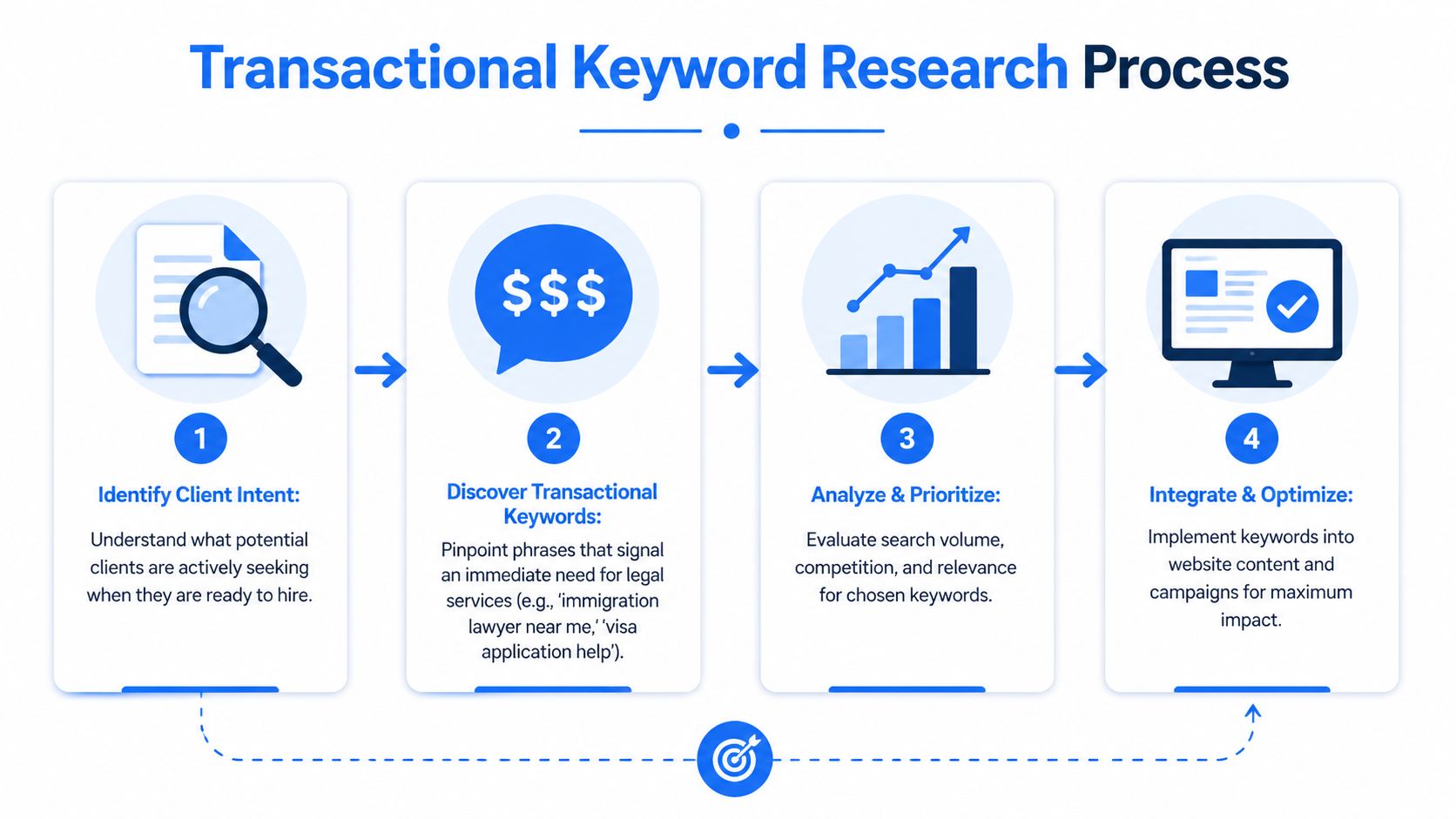
Informational searches vs transactional searches
The distinction is simple. Informational queries come from people gathering facts. Transactional queries come from people looking for legal help now, or close to now.
Immigration firms need both. They should not value them equally.
A search like "how does marriage green card work" can support an article or FAQ. A search like "marriage green card lawyer in Houston" belongs on a service page built to convert. Firms that blur those intents usually end up with traffic reports that look healthy and intake pipelines that do not.
| Practice Area | Informational Keyword | Transactional Long-Tail Keyword | Client Intent |
|---|---|---|---|
| Asylum | what is asylum | asylum lawyer near me | Needs legal representation quickly |
| Family immigration | how does marriage green card work | marriage green card lawyer in [city] | Looking for local legal help |
| Deportation defense | what happens in removal proceedings | deportation defense attorney [city] | Facing an urgent legal problem |
| Employment visas | h-1b visa process | h-1b visa lawyer [city] | Wants professional guidance |
| Naturalization | citizenship requirements | citizenship attorney near me | Ready to start filing process |
| RFEs | what is a request for evidence | rfe response attorney [city] | Needs direct legal support |
The high-intent pattern stays consistent across practice areas. Transactional searches usually include lawyer, attorney, near me, a city name, a visa or case type, or a time-sensitive modifier like urgent or emergency. Those are the terms that deserve the first share of content, optimization, and landing page work.
Prioritize service-plus-location keywords first
Broad phrases such as "immigration lawyer" matter, but they are expensive in time and authority. Newer firms rarely take those positions early, especially in competitive metros. The faster path is usually narrower. Service plus location. Service plus language. Service plus problem stage.
That means phrases like "VAWA lawyer in Queens," "Spanish speaking immigration attorney Chicago," or "H-1B RFE lawyer Dallas" often deserve more attention than generic blog topics with higher raw volume.
This is also where multilingual SEO becomes commercially useful, not cosmetic. Many immigration firms serve clients who search in Spanish, bilingual combinations, or English queries with language modifiers. If those search patterns exist in your market, build for them intentionally. Do not publish translated duplicates and assume they will perform. Each language page should match how real clients search, describe the service accurately, and move the visitor toward a consultation.
Build keyword clusters around matters that produce cases
A lot of law firm keyword plans still follow publishing convenience. One asylum article. One citizenship article. One visa article. Then twenty disconnected blog posts. That structure makes content harder to rank and harder to turn into consultations.
Use matter-based clusters instead.
A removal defense cluster might include a core service page, bond hearing page, cancellation of removal page, ICE detention FAQ, emergency consultation page, and targeted city pages if the firm serves those areas. An employment immigration cluster might cover H-1B petitions, RFEs, cap issues, amendments, transfers, and employer compliance questions. The cluster gives search engines clear topical signals and gives prospects a direct path from question to case evaluation.
AI can help speed up clustering, SERP analysis, and draft development. It should not decide the final keyword map on its own. Immigration search intent is too nuanced for that. Terms that look similar in a tool can lead to very different client expectations, case values, and intake outcomes. Human review is what keeps the strategy tied to revenue instead of page count.
For a practical outside reference on geo-targeted term selection, this local SEO success guide is useful.
Filter every keyword before you build a page
Before a phrase goes into the plan, run it through four checks.
Intent
Does the searcher appear to want legal representation, legal review, or filing help?Business value
Does the matter align with the firm's priorities, margins, and intake capacity?Local fit
Can the firm realistically win in that geography and serve that audience well?Page type
Should this term map to a service page, city page, FAQ, or article?
The fourth point gets missed all the time. Firms often force commercial terms into blog posts because blogging feels easier than building real service pages. That choice limits conversions. A searcher looking for an attorney should land on a page that explains the service, addresses objections, shows trust signals, and asks for the consultation.
If your team is building the keyword map from scratch, these keyword research best practices for local intent and conversion planning give a solid framework.
Good keyword research for immigration SEO is selective. It focuses on terms tied to action, geography, language, and case type. That is how a firm gets found by people who are ready to hire, not just ready to read.
Building Digital Authority With Technical and AI-Driven SEO
Technical SEO, on-page structure, and AI content planning work best when they're treated as one system. If one piece is missing, the whole campaign weakens.
A firm can publish strong articles and still stay invisible if pages aren't structured clearly. It can implement schema and still underperform if the content is stale. It can produce lots of content and still miss conversions if that content isn't tied to local service intent.

Start with page architecture that search engines can parse
Each important page needs a clean title tag, a useful meta description, one clear H1, logical H2s, and copy that matches one search intent. That's basic, but many immigration sites still dilute relevance by mixing several services and several cities onto one page.
A better structure looks like this:
- One primary topic per page: Don't combine asylum, family immigration, and removal defense on the same core page.
- One clear location target where appropriate: If the page is local, make it genuinely local.
- Internal links that reflect service relationships: Link from an H-1B page to a related green card path page if the search journey supports it.
- FAQ sections that answer decision-stage questions: Fees, process, timing expectations, eligibility concerns, and consultation logistics.
These details help Google understand the page. They also help AI-driven discovery systems summarize your content correctly when users ask legal-service questions in conversational search environments.
Schema is where many firms leave easy wins on the table
Structured data turns plain website content into machine-readable context. For immigration firms, the practical starting point is legal-specific schema tied to your firm, attorneys, service pages, FAQs, and local business information.
That matters because only 15% of immigration lawyer sites use legal-specific schema, and correct structured data for non-English queries can yield 2x higher map pack visibility in bilingual markets like Miami, LA, and NYC, according to Matador Solutions' immigration lawyer SEO analysis.
Here are the schema layers worth implementing:
| Schema Type | Best Use | Why It Matters |
|---|---|---|
| LegalService | Main firm and service pages | Clarifies practice type and local relevance |
| Attorney | Lawyer profile pages | Strengthens entity information around attorneys |
| FAQPage | Service and support pages | Improves eligibility for rich results |
| LocalBusiness details | Contact and location signals | Reinforces geographic trust |
| Multilingual page signals | Language-specific content | Helps search engines route users to the right version |
Markup doesn't fix weak content. It helps strong content get understood faster and more accurately.
Multilingual SEO is not just translation
Immigration firms often say they "serve Spanish-speaking clients" because a line on the site says so. That's not multilingual SEO.
Actual multilingual execution means dedicated pages, language-aware internal linking, proper hreflang implementation, and copy written for the way people search in that language. Search behavior changes across languages. So does trust.
For bilingual or multilingual markets, firms should build:
- Dedicated service pages in each target language
- Localized FAQs for common concerns
- Language-specific title tags and headings
- Schema and page structure that match those versions
- Clear conversion paths with the right phone numbers, forms, or intake expectations
A lot of firms skip this because it feels technical. In practice, it's one of the cleaner ways to separate from competitors.
AI content engines work when they're tied to real search demand
The highest-value use of AI in seo for immigration lawyers isn't mass-producing generic blog posts. It's building and updating content clusters around policy-sensitive, high-intent queries.
Emerging 2025-2026 trends show AI tools that generate geo-specific topic clusters boost organic traffic 40% faster than manual blogging. The same source notes that AI can create and update content around fluctuating USCIS processing times, which saw 15-20% changes in 2025, according to Pasha Digital Solutions' immigration SEO research.
That matters because immigration search demand shifts with policy, processing changes, enforcement priorities, and local language patterns. Manual content workflows are often too slow.
AI-assisted planning proves useful:
- Topic clustering: Building supporting pages around one service line and one metro
- Refresh workflows: Updating pages when policy or processing guidance changes
- Search Console analysis: Finding rising query variations and content gaps
- AI optimization for LLM discovery: Writing pages in a way that makes entities, locations, services, and attorney expertise easier to interpret in conversational search
If you're evaluating the broader context, this review of AI solutions for legal practices is a helpful starting point for understanding where legal-specific AI tools fit.
A useful visual breakdown of modern search behavior and AI visibility is below.
For firms leaning into AI-assisted discovery and structured content workflows, this resource on AI search engine optimization gives a strong operational view of how these systems support local service visibility.
The point isn't to automate expertise. It's to publish, structure, and maintain expertise at a speed that matches the market.
Amplifying Your Signal With Citations Reviews and Links
Off-page SEO isn't a bonus layer. In immigration law, it's the trust layer that tells Google your firm is credible beyond its own website.
A firm can have excellent service pages and clean technical SEO and still struggle if the wider web sends weak signals. Search engines look for consistency, reputation, and independent validation. That's what citations, reviews, and links provide.
Citations create local trust consistency
Start with your firm data. Your name, address, phone number, website, and office details have to match across legal directories, local listings, and business profiles. Inconsistencies create doubt. Doubt hurts local rankings.
For immigration firms, legal directories matter because they sit close to the legal search ecosystem. Avvo, Justia, FindLaw, bar profiles, chamber directories, and relevant local listings should all reflect the same business information.
A practical citation checklist should include:
- Core business identity: Firm name, address, phone, hours, website
- Attorney identity: Lawyer names, titles, profile consistency
- Practice descriptions: Similar service language across key listings
- Category alignment: Immigration law should be clearly reflected where directory fields allow it
If your listing footprint is messy, start there. This guide on citation building for local SEO gives a good framework for cleaning and expanding those signals.
Reviews influence both rankings and conversion
Reviews belong in an off-page strategy, but they don't work like links or citations. They affect perception as much as visibility. A law firm with strong local placement but weak review trust will still lose calls.
The best review strategy is operational. Train intake and case managers to ask at the right moments. Make the process easy. Track which attorneys or service lines generate the strongest review language. Use those themes to improve website copy and FAQ wording.
Reviews are often the first proof that your firm's process feels clear, responsive, and professional to real clients.
There's another angle many firms miss. Public responses matter. They show prospects how the office communicates under pressure. A brief, calm, respectful response often does more for trust than the review itself.
Links should come from relevance, not tricks
Most bad link building starts with volume goals. Good link building starts with relevance.
For immigration firms, strong link opportunities usually come from local authority and topical fit:
| Link Source | Why It Helps | Better Than |
|---|---|---|
| Local news mentions | Builds geographic authority | Generic directory spam |
| Community organization partnerships | Aligns with real audience trust | Irrelevant paid blog placements |
| Legal guest articles | Reinforces subject expertise | Random guest post networks |
| Resource pages for immigrant support services | Attracts links and helps users | Thin "SEO content" pages |
If your attorneys comment on policy changes, local enforcement issues, or community resources, those insights can earn mentions and links from local publishers and organizations. If your firm creates a useful guide to local immigrant support services, language access resources, or common filing issues, community sites may reference it naturally.
The strongest off-page campaigns don't look manipulative. They look like a legitimate law firm being cited because its information is worth citing.
One more point matters here. Earlier, the technical section covered the schema gap in the market. Off-page trust works even better when your site can connect those external references to clean entity and local business signals on-site. That's how your authority compounds instead of sitting in disconnected pieces across the web.
Measuring What Matters Tracking ROI and PPC Alignment
A law firm doesn't need more SEO reports. It needs cleaner answers to three questions. Are rankings improving for transactional terms? Are those rankings producing calls and consultations? Is the channel generating profitable client acquisition?
Those are business questions, not vanity metrics.
SEO for immigration lawyers yields a proven 526% average return on investment over three years. This is achieved by converting high-volume searches, including "immigration lawyer" at 60,500 monthly searches, into qualified consultations, according to VIP Marketing's analysis of immigration attorney SEO.

The KPIs that matter for immigration firms
Traffic alone is weak reporting. A spike in blog visits doesn't help if consultations stay flat. Law firms should track metrics that tie directly to intake quality and local visibility.
Focus on this set:
- Organic traffic to service and location pages: Not just overall traffic
- Rankings for transactional keywords: Terms tied to practice area and city
- Google Maps visibility: Especially for core service areas
- Calls and form submissions: The clearest signs of lead flow
- Booked consultations: Better than raw leads
- Retained client patterns by page or keyword theme: This closes the loop between SEO and revenue
A useful dashboard should also separate branded traffic from non-branded traffic. Otherwise, firm name searches can make the campaign look stronger than it is.
Heat maps and query data beat vague ranking reports
Local SEO performance changes by geography. A firm may rank well near the office and weakly in surrounding target areas. That's why map heat tracking and Search Console query review are so important.
Use reporting that shows:
| Metric | What It Tells You | Why It Matters |
|---|---|---|
| Map visibility by service area | Where you appear in local results | Shows true local reach |
| Search Console queries | The phrases driving impressions and clicks | Reveals emerging demand |
| Landing page conversions | Which pages create consultations | Helps prioritize content |
| Call tracking trends | When and where lead volume rises | Connects SEO to intake operations |
If a report can't show which keywords, pages, and locations produced consultations, it's not decision-grade reporting.
SEO and PPC work better together than apart
A strong immigration marketing program doesn't force a choice between SEO and paid search. The channels do different jobs.
SEO builds durable visibility and lowers dependence on paid clicks over time. Paid search gives immediate coverage for priority terms, new locations, or service lines where organic visibility is still developing. When both appear on the same results page for a critical term, your firm occupies more screen space and earns more trust.
This alignment works best when teams share data. PPC search term reports can identify converting phrases for new SEO pages. SEO data can highlight terms worth supporting with ads. Landing pages should also stay aligned so messaging, intake expectations, and service focus remain consistent.
For immigration firms, that usually means one practical rule. Let SEO own the long-term transactional footprint, then use PPC to reinforce or accelerate the highest-value terms.
Frequently Asked Questions About SEO for Immigration Firms
How long does seo for immigration lawyers take to work
Local improvements can appear before broader organic gains, especially when a firm's Google Business Profile, citations, and service pages are underdeveloped. Competitive service terms usually take longer. The firms that progress fastest are the ones that publish consistently, fix structural issues early, and focus on transactional terms instead of broad traffic.
Should an immigration firm prioritize local SEO or national SEO
Most firms should start local unless their intake model, attorney licensing footprint, and case mix clearly support broader targeting. Local intent is usually more actionable because the searcher is looking for a lawyer they can contact right away. National visibility can grow later through strong service silos and specialized content.
Is blogging enough to rank
No. Blogging helps, but random article publishing won't carry the campaign. Rankings usually improve when content supports a larger structure that includes service pages, city pages, internal linking, schema, citation consistency, and a strong Google Business Profile.
Does multilingual SEO really matter for immigration law
Yes. Immigration search behavior often happens across multiple languages. If your market includes bilingual or multilingual communities, English-only pages leave demand on the table. The firms that implement dedicated language pages and structured multilingual signals usually create a better path for both rankings and conversion.
What should a firm measure first
Start with calls, form submissions, booked consultations, transactional keyword rankings, and map visibility in target service areas. Those metrics show whether search visibility is turning into actual client opportunities.
Can AI help without lowering quality
Yes, if it's used for planning, clustering, updating, and organizing content around real search demand. It becomes a problem when firms use it to mass-produce thin pages with no legal insight, no local relevance, and no editorial control.
If your immigration firm wants more than generic marketing advice, Transactional LLC focuses on the part that drives growth: ranking for transactional search terms and showing up where high-intent clients are ready to hire. Their contract-free approach combines Google Maps optimization, local SEO, AI-driven content silos, transparent reporting, and conversion-focused execution built to help service businesses dominate local search.