


Many managing partners recognize a recurring pattern. The website generates traffic. Ranking reports appear solid. A member of the firm suggests marketing is "working." However, intake remains inconsistent, and the cases arriving are not the ones you want.
That gap usually comes from a flawed seo for lawyers strategy. The firm invested in visibility, but not in transactional visibility. In legal search, there's a major difference between a person reading about a legal issue and a person searching for an attorney right now in a specific city. If your SEO program doesn't separate those two groups, it produces activity instead of signed matters.
Why Most Law Firm SEO Fails to Attract New Cases
Many law firm websites are built to look credible, not to convert urgent legal demand into consultations. They publish broad educational posts, chase vanity rankings, and celebrate traffic that never turns into serious inquiries.
That approach misses the business point. A person searching “what is probate” may never hire anyone. A person searching “probate administration lawyer in Phoenix” is much closer to becoming a client. The same goes for “what happens after a DUI” versus “DUI defense lawyer near me.” One is research. The other is a buying signal.
Traffic is not the goal
The hard truth is simple. Generic legal content can bring in visitors who have no intent to hire your firm.
For most firms, the better question isn't “How do we get more traffic?” It's “How do we get more searches from people who are ready to call?” That's where SEO becomes a revenue channel instead of a branding exercise.
SEO for law firms also deserves a bigger seat at the table than many partners give it. SEO has emerged as the highest-return marketing investment for law firms, with an average 3-year ROI of 526%, and organic search accounts for 53% of all website visits to law firm sites in 2024, compared with 14% from paid search according to Rankings.io's research on SEO for lawyers.
Practical rule: If a page can't reasonably attract a prospective client who may hire your firm, it shouldn't dominate your content calendar.
A lot of firms already understand they need broader growth strategies for modern law firms. The mistake is assuming SEO should sit in a separate bucket from intake growth. It shouldn't. Done right, SEO is one of the clearest ways to target demand that already exists.
What usually goes wrong
The common failure points are predictable:
- Wrong keyword targeting. Firms chase high-volume informational terms instead of service-plus-location searches.
- Weak local intent coverage. They build one family law page and expect it to rank across every city they serve.
- No conversion path. Visitors land on a page, but there's no strong call button, no local proof, and no reason to contact the firm now.
- Misread reporting. Marketing reports highlight impressions and traffic, while partners care about consultations and retained cases.
Here's the trade-off. Informational content can help support authority, but it rarely carries the same commercial value as a tightly built transactional page. If your site is full of articles and thin on service pages, you're probably educating the market for competitors who are better at closing local search demand.
What works instead
The firms that win treat search intent as a triage system. They identify high-value practice areas, map those areas to the cities that matter most, and build pages around the searches that indicate urgency, local relevance, and a need to hire counsel.
That's the core of modern seo for lawyers. Not more pages for the sake of more pages. Better pages for the searches that produce cases.
Mastering the Google Maps Trinity for Local Dominance
For most law firms, the battleground isn't buried in page two of organic search. It's the map pack. When someone searches “personal injury lawyer near me” or “divorce attorney in [city],” Google Maps often gets the first serious click.
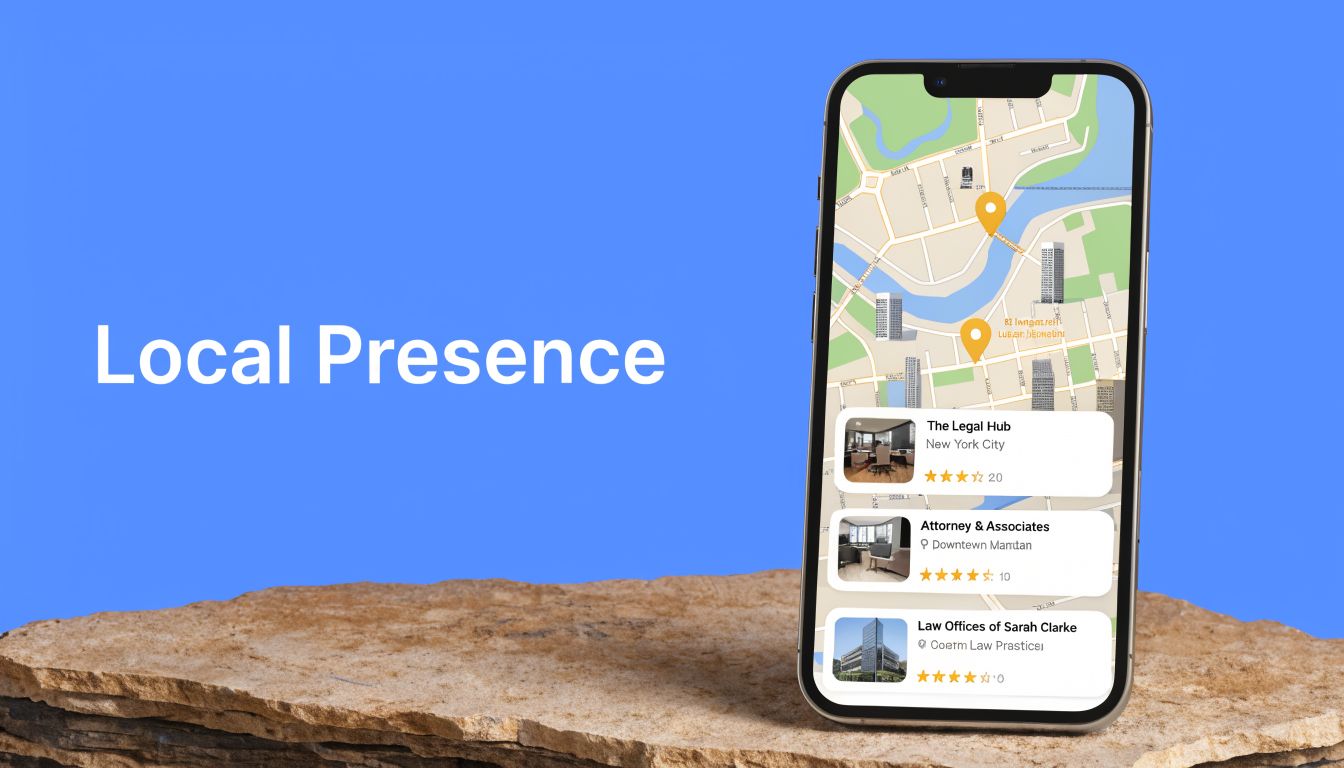
I think of local dominance as a three-part system. If one piece is weak, the whole map strategy underperforms.
Pillar one is a complete Google Business Profile
Your Google Business Profile has to be treated like a money page, not a side listing. Law firms regularly leave value on the table by half-completing it.
At minimum, your profile should have:
- Accurate core business data. Firm name, address, phone number, hours, and website must be consistent with the site.
- Correct categories. Your primary category matters. Secondary categories should reflect real services, not guesswork.
- Service detail. Practice areas, business description, appointment options, and photos should match how clients search.
- Ongoing activity. Reviews, updates, answers to questions, and profile freshness all help reinforce legitimacy.
If you want a practical checklist, the Data Hunters Agency guide to local SEO is useful for seeing how profile fields influence local visibility.
Pillar two is citation consistency
Google doesn't just trust what your website says. It cross-checks your firm across legal directories, local listings, and other business references.
That means your name, address, and phone number need to match across places like legal directories, chamber listings, and local business profiles. A law firm that uses one office format on its website and another across listings creates uncertainty.
The fix isn't glamorous, but it matters. Clean up duplicates. Correct outdated listings. Standardize your business details across all major references.
Most firms don't lose map visibility because of one dramatic mistake. They lose it through dozens of small inconsistencies that make Google less confident in the entity.
Later in your local campaign, it also helps to study focused tactics for ranking higher on Google Maps, especially when you're trying to move from visibility to top-three placement.
Pillar three is review generation
Reviews do two jobs at once. They influence click behavior, and they reinforce local trust.
A review system should be ethical, simple, and consistent. Don't leave it to chance or rely on attorneys to remember it manually. Build a process into client offboarding, resolved matters, or satisfied consultation follow-up where appropriate.
Here's the practical distinction. Random reviews create noise. A repeatable review process creates momentum.
A short walkthrough helps illustrate how map visibility really gets built in practice:
What law firms often misunderstand about Maps
Some firms assume their website alone should carry local rankings. It won't. Google Maps has its own evidence stack.
A strong local presence usually includes:
| Local factor | What Google wants to see |
|---|---|
| Profile quality | A complete, accurate, active listing |
| Citation trust | Consistent firm information across the web |
| Review signals | Ongoing proof that real clients interact with the firm |
| Local relevance | Services and geography clearly tied together |
The reason this matters so much is simple. Map searches tend to skew transactional. People using them often want to call a law office, compare a few options, and make a decision quickly.
A Content Strategy for High-Value Transactional Keywords
Most firms publish content as if every visit has equal value. It doesn't. A visitor reading a general legal explainer is not the same as a visitor searching for a lawyer in a specific city with a pressing legal problem.
That's why a better seo for lawyers strategy starts with transactional content architecture, not random blogging.
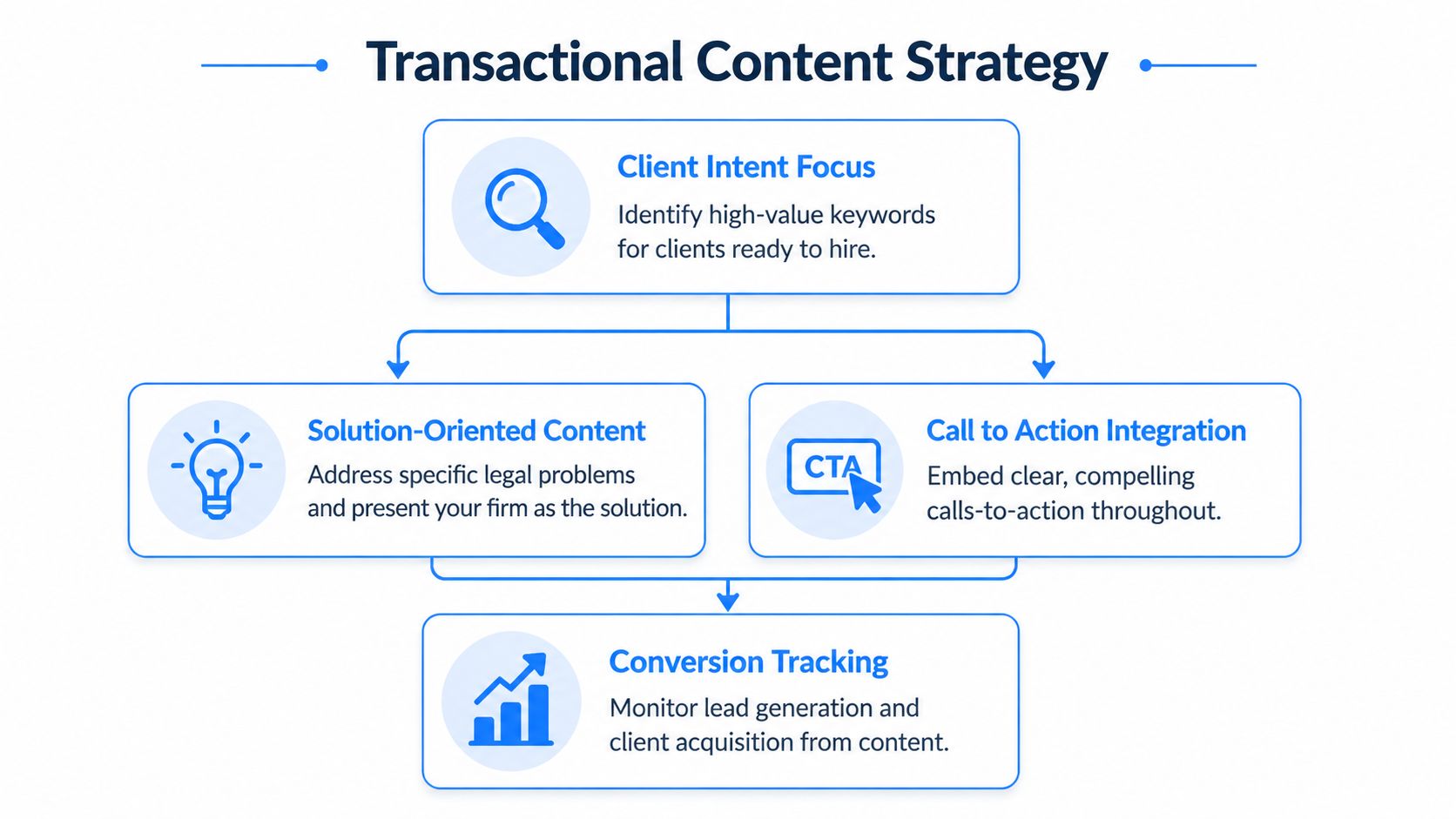
Build around practice area silos
If your firm wants better cases, your site should mirror your most profitable services. That means creating a clean structure around each major practice area, then supporting it with tightly related pages.
A strong silo often includes:
- Primary practice page. Example: Personal Injury Lawyer
- Subservice pages. Example: Car Accident Lawyer, Truck Accident Lawyer, Wrongful Death Attorney
- City-specific transactional pages. Example: Car Accident Lawyer in Scottsdale
- Supporting FAQ or explainer content. Built to assist the commercial pages, not distract from them
Many law firms go wrong in this specific area. They publish “What Is Probate?” and ignore “Probate Administration Lawyer in Mesa.” The first may get broader traffic. The second is much closer to producing a consultation.
Not all content deserves equal investment
One of the clearest blind spots in legal content strategy is treating all content the same. Most SEO guides for professionals treat all content equally and ignore the disconnect between ranking and conversion, offering minimal guidance on using AI-driven content planning to target high-intent transactional keywords as noted in Esquire Interactive's SEO guide.
That matters because legal search behavior has layers. Some users are learning. Others are comparing. Others are ready to hire now. Your content should reflect that difference.
Consider this practical perspective:
| Content type | Likely intent | Business value |
|---|---|---|
| Broad legal explainer | Informational | Supporting role |
| FAQ on a legal issue | Mixed | Moderate |
| Practice area page | Commercial | High |
| Service plus city page | Transactional | Highest |
Use AI to identify the real money terms
AI tools can help surface patterns your team may miss, especially when used with Search Console data and intake feedback. The key isn't letting AI write generic legal filler. The key is using AI to help identify search patterns tied to actual consultations.
Look for terms that signal immediacy, geography, and service need. In legal search, that usually means combinations of:
- Practice area plus city
- Near me searches
- Urgent scenario keywords
- Procedure-related terms tied to hiring
- Queries that mirror intake conversations
“The best legal content strategy doesn't start with what attorneys want to publish. It starts with what prospective clients type when they're ready to act.”
If you're refining this structure internally, it helps to review examples of law firm content marketing built around service intent rather than generic traffic growth.
What works better than the old blog model
The old model says publish more articles and authority will follow. Sometimes it does. But law firms often need more precision than volume.
A better model is this:
- Create strong service pages for core practice areas.
- Create city pages for the markets that matter.
- Support those pages with related articles that answer objections, process questions, and urgency concerns.
- Track which pages generate real inquiries, then expand the winners.
That's how content becomes a case acquisition system instead of a publishing habit.
Scaling Your SEO for Multiple Offices and Service Areas
Once a firm expands beyond one office, SEO gets harder fast. What worked in one city doesn't automatically transfer to five. The usual shortcut is duplicating location pages and swapping city names. That usually creates weak pages, weak local relevance, and weak results.
Each office needs its own local proof
A multi-office law firm has to show Google that each location is real, staffed, and relevant to its community. That means every office needs its own local signals, not a reused template.
A strong location page usually includes:
- Unique office information. Address, phone number, office-specific details, and local contact options.
- Relevant services for that market. Don't list every practice area if the office only pushes a few.
- Community relevance. Local courts, neighborhoods, service area language, and practical references.
- Distinct internal links. Connect that office page to the practice areas and attorneys relevant to the location.
This isn't just a content problem. It's an entity problem. Current SEO guides for lawyers focus on single-practice optimization, but they do not address the specific challenge of managing E-E-A-T signals across multiple service areas simultaneously or building topical authority when a firm serves 5–15 geographic markets according to the DC Bar discussion of SEO fundamentals for lawyers.
Avoid the duplicate content trap
The fastest way to weaken multi-location SEO is to create near-identical pages with only city names changed. Search engines can spot that pattern easily, and users can too.
Instead, vary the content based on what is true in each market. A downtown criminal defense office may emphasize immediate representation, while a suburban estate planning office may emphasize family planning services and appointment convenience.
A location page should answer one question clearly. Why should a client in this city contact this office for this legal need?
If you're building a larger regional footprint, a structured multilocation local SEO framework helps keep architecture, local signals, and page differentiation organized.
A practical scaling model
For firms serving multiple cities, I'd structure the rollout this way:
- Start with core offices. Build the strongest pages for locations with the most business value.
- Map practice areas by office. Not every office needs every service page.
- Create office-specific support content. FAQs, local guides, and attorney associations should reflect that market.
- Support each location with local citations and reviews. Don't assume one firm-wide reputation profile does all the work.
Scaling works when each office earns its own relevance. It fails when the website acts like every city is interchangeable.
Technical SEO Foundations Your Competitors Ignore
A prospective client searches "car accident lawyer near me" from a phone after leaving the ER. Your firm shows up. They tap through. The page loads slowly, the call button shifts, and the visitor goes back to the search results and calls the next firm.
That is technical SEO in a law firm context. It affects whether transactional searches turn into consultations.
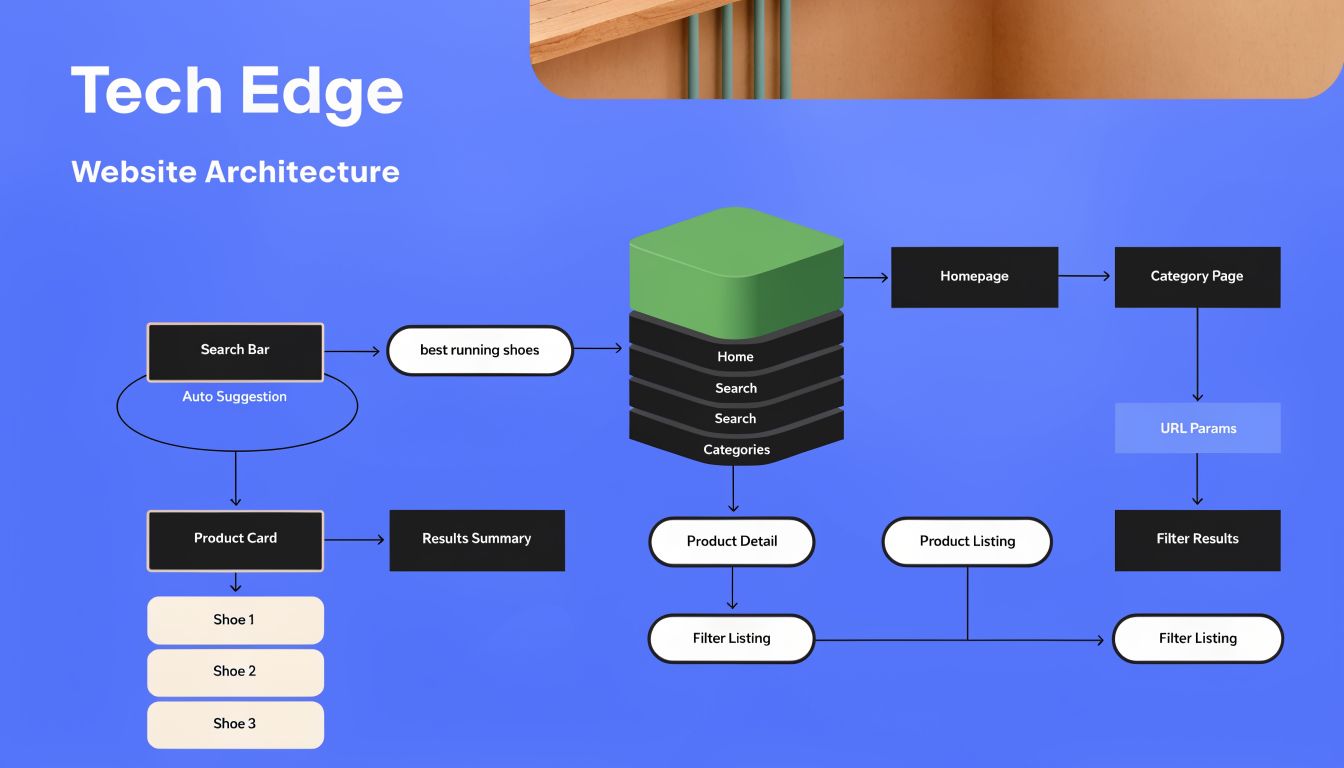
Core Web Vitals affect case intake, not just rankings
Technical performance matters because legal searches often happen under time pressure. If a person needs a defense lawyer, injury lawyer, or divorce attorney now, friction costs cases.
Google explains that Core Web Vitals measure loading performance, interactivity, and visual stability, including a Largest Contentful Paint target of 2.5 seconds or less, in its Core Web Vitals documentation. For law firms, those benchmarks are not academic. They shape whether high-intent visitors stay on the page long enough to call.
The recurring problems are predictable:
- Oversized images that slow the first screen
- Heavy scripts from chat tools, themes, tag managers, and plugins
- Weak hosting or poor caching that delays server response
- Layout shifts that move forms and call buttons on mobile
I see firms spend heavily on content and ignore these basics. Then they wonder why rankings improve but signed cases do not.
Schema helps Google understand your attorneys, offices, and services
Schema markup remains one of the most underused technical advantages in seo for lawyers. It gives search engines cleaner context about who you are, what you do, and where you do it.
For law firms, that usually means marking up attorney profiles, office details, practice areas, FAQs, and reviews where appropriate. Google can process that information more reliably when the site is structured clearly, as explained in Google's structured data guidance. The payoff is better eligibility for enhanced search results and stronger topical alignment on pages targeting transactional terms.
That matters most on pages built to convert. A practice-area page targeting "truck accident lawyer in Dallas" needs more than good copy. It needs clean technical signals that confirm location, service, attorney relevance, and page purpose.
The technical work that produces measurable gains
For most law firms, I would prioritize technical SEO in this order:
| Priority | Why it matters |
|---|---|
| Mobile speed | Transactional legal searches often happen on phones, and slow pages lose urgent inquiries |
| Crawlable architecture | Google needs a clean path to your money pages, especially practice-area and location pages |
| Schema markup | Helps search engines connect attorneys, offices, services, FAQs, and reviews |
| Stable page rendering | Keeps call buttons, forms, and trust signals usable on mobile |
| Internal linking | Strengthens the relationship between service pages, city pages, and conversion paths |
Technical SEO is where many firms can still win. Competitors often chase content volume while their infrastructure limits what can rank and convert.
A polished design does not guarantee performance. In competitive legal SEO, the firms that win technical execution often get more value from the same content, the same market, and the same search demand.
If you want to judge whether this work is paying off, track it against signed-case outcomes, qualified calls, and consultation requests using a business-focused marketing measurement framework.
Measuring What Matters With Business-Centric KPIs
If your SEO report starts with traffic, impressions, and ranking screenshots, it's incomplete. Those metrics can be useful diagnostics, but they don't tell a managing partner what they need to know. Are we generating qualified inquiries from people who want to hire us?
That shift in measurement changes everything. It forces the campaign to align with actual firm growth instead of abstract visibility.
The KPIs that deserve attention
For law firms, the best SEO reporting focuses on commercial outcomes. That usually means tracking:
- Organic consultation requests from high-intent pages
- Phone calls from local and map-driven searches
- Form submissions tied to practice-area and city pages
- Lead quality by practice area
- Retained matters influenced by organic search
A page that ranks well but produces weak inquiries may need a better call to action, stronger trust signals, or different keyword targeting. A page with lower traffic but strong consultation quality may deserve more investment.
Vanity metrics create bad decisions
Many law firms overvalue broad rankings because they are easy to include in a monthly report. However, a top ranking for a low-intent phrase can distract from pages that help the intake team.
The better question is this. Which searches are bringing in people with a legal problem, a local need, and a willingness to contact counsel now?
That's also why conversion tracking matters so much. You need to know which pages generate calls, which forms come from service-plus-city content, and which search themes consistently produce real business.
Don't judge seo for lawyers by how many people visited. Judge it by how many qualified prospects took the next step.
For firms that want cleaner accountability, a framework for how to measure marketing effectiveness can help separate vanity reporting from business reporting.
A better reporting lens for partners
Here's how I'd simplify the reporting stack for leadership:
| Metric type | Keep it | Why |
|---|---|---|
| Traffic | Yes, but secondary | Useful context, not the main goal |
| Rankings | Yes, selectively | Best used for high-intent terms |
| Calls and forms | Absolutely | Direct signal of inquiry volume |
| Lead quality | Essential | Not every lead deserves equal value |
| Retained cases | Essential | Closest measure of SEO business impact |
That's the difference between an SEO campaign and a client acquisition system.
Your 60-Day SEO Implementation Roadmap
A managing partner reviews the monthly marketing report and sees more impressions, more clicks, and no clear lift in signed cases. That usually happens because the first 60 days were spent on scattered SEO tasks instead of the few changes that improve visibility for transactional searches.
The right sequence matters. Start with the pages, signals, and technical fixes that can produce qualified consultations fastest.
Weeks one and two
Run a full audit, then rank the findings by business impact. Check indexation, mobile usability, internal linking, page speed, schema, and your Google Business Profile setup. If your site is slow, hard to crawl, or sends mixed local signals, your best pages will struggle to rank for searches like "car accident lawyer near me" or "divorce attorney in Austin."
At the same time, map your revenue priorities. Identify the practice areas that produce the highest case value, the cities that convert best, and the search terms that show immediate hiring intent. This is also the point to review how AI search features describe your firm and whether your core service pages give clear, consistent answers.
Weeks three and four
Fix the local foundation. Standardize firm name, address, phone, office hours, and attorney information anywhere it appears online. Build a review process your staff can follow every week, because a steady flow of recent reviews supports both Maps visibility and conversion rates once a prospect lands on your profile.
Then audit your existing content with a hard standard. Keep pages that target a real service and location combination. Rewrite pages that are vague, duplicated, or written to chase broad traffic with little case intent.
Weeks five through eight
Now build the assets that drive inquiries. In most firms, that means rewriting the main practice area pages first, then building service plus city pages for the markets that matter, then tightening calls to action so prospects can contact the firm without friction.
Use this stage to clean up site structure as well:
- Build clear hierarchy around core practice areas
- Create city pages only where the firm can credibly compete and intake cases
- Link supporting articles to money pages with relevant anchor text
- Set up tracking for calls, form fills, chat starts, and consultation requests
- Review which pages attract transactional queries, not just general legal research visits
By day 60, the goal is simple. The site should be easier for Google to crawl, stronger in local search, and better aligned with the queries that bring in people ready to hire counsel.
If your firm wants help building a search strategy around high-intent legal searches, Google Maps visibility, and AI-driven content planning, Transactional LLC can help. The focus is qualified case inquiries from transactional searches, not generic traffic.