

You're probably dealing with a familiar problem. Your website gets traffic, your social pages look active, maybe you've even paid for ads, but the phone still isn't ringing the way it should. You're spending money on marketing activity, not buying more booked jobs, appointments, or patients.
That's the core mistake in most service business marketing. Owners get pushed toward visibility that looks good in reports but doesn't translate into revenue. More impressions. More clicks. More “awareness.” None of that pays the crew, fills the schedule, or keeps chairs occupied.
For local service companies, the win is simpler. You need to show up when someone searches with immediate buying intent. Searches like “roofer near me,” “emergency plumber,” “AC repair near me,” or “dentist near me” are where revenue starts. Those are transactional searches. That's where the money is.
Why Most Service Business Marketing Fails
Most campaigns fail because they target the wrong visitor.
A local service business doesn't need random traffic from broad blog posts, vanity social content, or vague brand campaigns that attract people who were never going to call. It needs to capture people who already know what they want and are trying to hire someone now. If your marketing isn't built around that, you're paying to stay busy without getting paid.
Traffic is not the same as demand
A lot of agencies still sell service business marketing like it's a popularity contest. They talk about reach, follower growth, and top-of-funnel engagement. That may sound polished, but it misses how local buyers behave. They search, compare fast, check Maps, scan reviews, and contact the business that looks most credible and easiest to hire.
PostcardMania notes that 81% of SMBs use at least two marketing channels, 55% of small business owners are already using AI tools, 81% of consumers say it's important for businesses to have a website, and 55% want more collaborations between small businesses and more online connections in its small business marketing statistics guide. That doesn't mean you should be everywhere. It means your presence has to work together across search, website, content, and local discovery.
Practical rule: If a channel doesn't help you capture a buyer who is close to booking, that channel should support your core search strategy, not replace it.
Generic marketing creates generic leads
Local service companies lose money when they market like every customer is the same. A homeowner searching late at night for emergency electrical repair isn't the same as someone casually reading “how electrical systems work.” A parent searching for “kids dentist near me” isn't behaving like someone browsing general oral health tips.
That's why generic campaigns underperform. They ignore urgency, location, and buying intent.
A smarter model is to build the whole system around transactional demand. That means targeting exact search behavior, tightening local relevance, and making it easy to call, book, or request a quote. If you want a plain-English breakdown of what that work includes, read what SEO companies do.
The fix is ruthless focus
The fix isn't more marketing. It's better targeting.
Good service business marketing goes after buyers with money in hand. It prioritizes Google Maps, local SEO, service pages, and AI-readable business data. It cuts anything that doesn't move a customer closer to a call or booking.
That's the standard. Everything else is noise.
Adopting the Transactional Marketing Mindset
The right mindset starts with a simple question. What is the person searching trying to do right now?
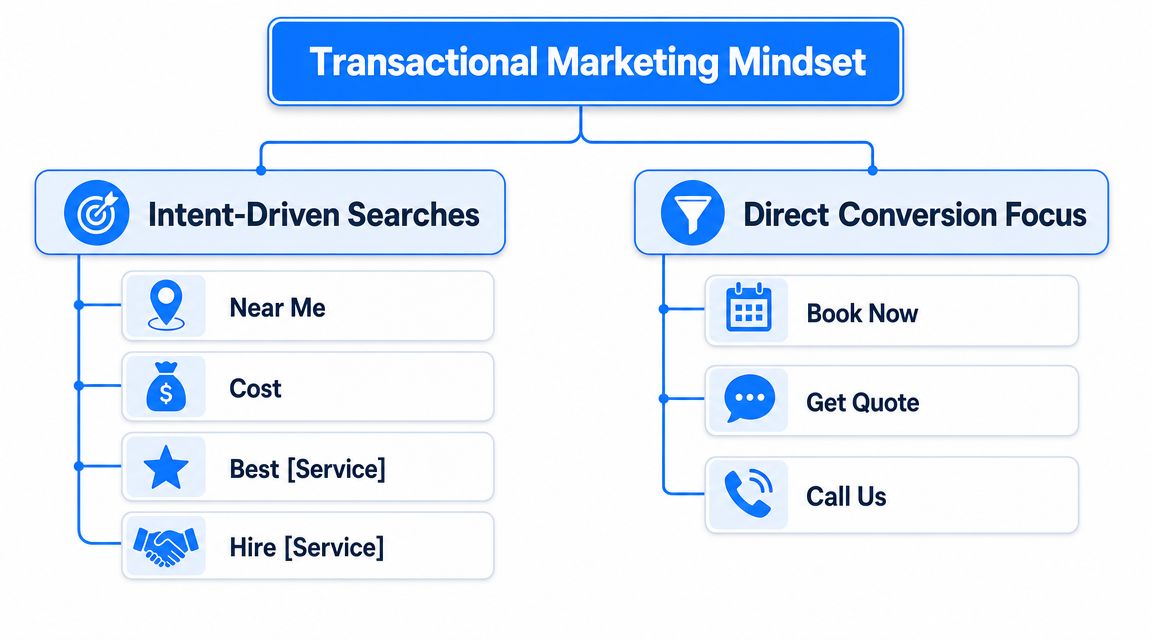
If the answer is “hire,” “book,” “call,” “compare prices,” or “get help today,” that's a transactional search. Those are the terms that deserve your budget, your content, your landing pages, and your optimization work.
What transactional searches look like
Transactional searches usually contain service, urgency, cost, or location signals.
Examples:
- Immediate service terms like “AC repair near me,” “emergency plumber,” or “same day pest control”
- Commercial investigation terms like “dental implants cost” or “best roofer in Dallas”
- Hiring terms like “hire electrician,” “book chiropractor appointment,” or “med spa consultation”
Those searches are worth chasing because the user is close to action.
Informational searches are different. They can support SEO, but they shouldn't be the center of your strategy if you need revenue fast. “How does a furnace work” and “what causes gum recession” may bring visitors, but they often sit much farther from the sale.
The job isn't to attract everyone. The job is to get found by the people ready to spend.
Why AI optimization now matters
Search behavior is shifting. Buyers still use Google, but they also rely on AI-assisted results, summaries, and recommendation layers. That changes what service business marketing needs to do.
If your business information is incomplete, inconsistent, or buried in weak pages, AI systems won't trust it. If your business has clear service pages, strong location signals, complete profile data, and direct answers to commercial questions, you're more likely to be surfaced when people ask AI tools who to hire.
AI optimization is really about structured clarity. You want your business to be easy for search engines, Maps, and large language models to understand.
That means:
- Clear service-location pairings on your site
- Consistent business details across your web presence
- Direct answers to buyer questions about service, pricing, process, and coverage
- Strong local relevance tied to city pages, neighborhoods, and service areas
Small businesses need a dedicated approach
A lot of marketing systems break because they're built too broadly. Bain points out in its analysis of underserved small-business markets that many small-business markets are large but difficult to serve well because providers have to balance segmentation, service levels, acquisition channels, and operating costs. It also notes that the strongest providers often build a dedicated small-business model instead of forcing everyone into one generic system.
That applies directly here. Local service businesses shouldn't run the same playbook as national brands or long-cycle B2B firms. They need a search-first, intent-first system built for speed.
Dominating the Map Pack with Google Business Profile
If you're serious about service business marketing, your Google Business Profile isn't a side asset. It's the front door.
For many local searches, the Map Pack gets checked before the website. That's where buyers compare options fast. They look at proximity, reviews, categories, photos, service descriptions, and whether your listing feels complete. If your profile is weak, you lose before your website gets a chance.

What an optimized profile actually needs
A complete profile does more than satisfy Google. It gives searchers and AI systems a clean, structured record of who you are, what you do, and where you work.
Independent local marketing guidance emphasizes that service businesses need complete Google Business Profiles, local keywords, area-specific content, and conversion-focused sites because customers often discover providers through Maps and local search instead of brand-first journeys, as explained in this local search guidance video.
Here's the essential checklist:
- Primary category selection that matches the main revenue service
- Secondary categories that reflect adjacent core services without getting sloppy
- Service descriptions written around real buying phrases and service areas
- Business hours and special hours kept current
- Photos that show staff, jobs, vehicles, office, equipment, and branded presence
- Review generation and responses done consistently
- Google Posts and service updates used to reinforce relevance
- Accurate service areas that match the markets you want to rank in
If you want a deeper process for setup and refinement, this guide on how to optimize Google Business Profile is worth reviewing.
Reviews are ranking fuel and conversion copy
A lot of owners think reviews are mostly about reputation. They're also about search visibility and buyer confidence.
Reviews help reinforce service keywords, geography, and trust. A review that mentions “fast AC repair in Mesa” is stronger than a generic “great service.” You don't script reviews, but you can ask customers to mention the service and location naturally.
Reply to every review. Not with robotic thank-yous. Use real language, mention the service when appropriate, and keep the business profile active.
A silent profile looks neglected. An active profile looks trusted.
Your profile feeds your broader local system
Your Google Business Profile should line up with your website. If the profile says one thing and the site says another, you create confusion. If the categories, services, cities, and calls to action match, you create confidence.
That consistency matters more now because AI-assisted discovery depends on verifiable signals. Maps data, business details, website content, and user behavior all reinforce each other when they align.
A short walkthrough can help if you want to see how this plays out in practice:
What to fix first
If your profile isn't producing calls, start here:
| Priority | What to check | Why it matters |
|---|---|---|
| First | Primary category and services | They shape relevance for local intent |
| Second | Reviews and review responses | They affect trust and buyer action |
| Third | Photos and business completeness | They improve credibility fast |
| Fourth | Landing page alignment | It helps turn views into calls and forms |
Most businesses don't need more gimmicks. They need a cleaner profile, tighter local signals, and faster conversion paths.
A 30 Day Sprint to Page One for Transactional Keywords
A local website should be built like a revenue machine, not an online brochure.
If you want page-one movement for transactional searches, stop stuffing every service into one generic page. Build dedicated pages for each core service and each meaningful service area. One page for “AC repair in Phoenix.” Another for “furnace repair in Phoenix.” Another for “emergency HVAC service in Scottsdale.” That structure is what gives Google and AI systems something clear to rank.

The page structure that works
A transactional page needs to match the exact query and remove friction.
That means:
- A headline with the service and city
- A strong first screen with click-to-call, form, or booking option
- Specific proof tied to the service
- Coverage details so the visitor knows you serve their area
- Clear next step repeated throughout the page
For example:
- An HVAC company needs pages for repair, replacement, tune-ups, and emergency service by city.
- A dental practice needs separate pages for implants, emergency dentistry, Invisalign, and cosmetic treatments.
- A pest control company needs pages for termite control, rodent removal, ant treatment, and recurring service by area.
The 30-day sprint model
This isn't a long, vague content plan. It's a focused sprint.
Week 1 targets
Start with the terms that signal the strongest commercial intent. Near me terms, city-service terms, emergency terms, and cost-related terms should be first. Pick the service lines that matter most to revenue and assign one primary keyword set per page.
Don't chase broad vanity phrases if a narrower local phrase is more likely to bring a customer.
Week 2 buildout
Publish or rebuild the priority pages. Every page should include:
- Service-specific copy that explains the problem and solution plainly
- City relevance woven into headings and body copy naturally
- Trust elements such as reviews, certifications, guarantees, or financing details if applicable
- Calls to action above the fold and throughout the page
- Schema markup for local business and service information
Week 3 support content
Create supporting pages that answer buyer questions linked to the transactional service page. Good examples include pricing questions, emergency response questions, and service comparisons.
Here, AI optimization is beneficial. When your site answers practical buyer questions in a clean format, AI systems have more usable material to reference.
Week 4 technical cleanup
Check mobile usability, page speed, internal linking, crawlability, and index status. Tighten title tags, meta descriptions, and heading structure. Then monitor rankings and query movement.
If you want a grounded expectation for timing, read how long SEO takes to show results.
Field rule: One page should target one main service intent for one main location. Blended pages usually rank worse and convert worse.
Speed matters, but precision matters more
A fast sprint only works if the targeting is sharp. Publishing ten weak pages won't beat three pages built around exact buying intent and real local relevance.
That's also where tooling matters. Some businesses use in-house workflows, some use standard SEO platforms, and some use providers with local dashboards and service-city tracking. Transactional LLC, for example, offers local SEO, Google Maps work, AI-driven content planning, and reporting around service-city keyword timelines and map visibility. The value of any setup comes down to one thing. Can it connect rankings to booked business?
That's the test.
Using Content and Paid Ads to Accelerate Growth
Content and paid ads work best when they support your transactional search strategy. They shouldn't become separate marketing silos that drain time and budget.
Content should answer the questions buyers ask right before they contact you. Paid ads should put you in front of buyers while your organic rankings build. Both should push toward the same service pages, the same calls to action, and the same local intent.
Content should qualify, not ramble
Most local business blogs are packed with fluff. Broad educational posts, recycled definitions, and generic seasonal advice rarely move the needle.
Write the content that sits closest to the sale:
- Pricing content like “how much does furnace replacement cost”
- Service comparison content like “repair vs replace AC unit”
- Local trust content like neighborhood-specific service pages or project explainers
- Urgency content like “what to do before an emergency plumber arrives”
That kind of content helps in search and AI discovery because it mirrors the language buyers use when they're narrowing options. If you want to keep up with how AI search behavior is evolving, it's smart to explore AI innovations and track how recommendation engines surface local businesses.
For a practical local content angle, this resource on content marketing for local businesses is a useful reference.
Paid search gives you immediate coverage
Paid media still matters because it captures demand right now. Salesforce reports that U.S. paid search spending was projected to reach $124.59 billion in 2024, up 11.1% year over year, and that the reported average conversion rate for paid search campaigns is 2.55% in its marketing statistics roundup. That's enough to make one point clear. Businesses keep investing in search because high-intent traffic is worth paying for.
Use paid campaigns for:
| Use case | Best fit |
|---|---|
| Immediate lead flow | Google Search campaigns on exact high-intent terms |
| Local trust boost | Branded and service-specific local campaigns |
| Gap coverage | Markets or service lines where organic visibility is still building |
Don't run ads to broad junk terms just to inflate click volume. Bid on the searches a customer makes when they're ready to hire.
Email still has a role if you segment it
Email isn't the core lever for most local service purchases, but it can sharpen follow-up and reactivation. HubSpot reports that segmented emails generate 30% more opens and 50% more clickthroughs than unsegmented emails in its marketing statistics page. For service businesses, that matters most when you segment by service interest, urgency, or estimate status.
A person who requested a quote for roof repair should not get the same follow-up as someone asking about annual maintenance. Segmentation is basic discipline.
Measuring What Matters to Prove Your Marketing ROI
If you can't tie marketing to calls, forms, and booked work, you don't have a marketing system. You have activity.
Most business owners get buried in dashboards full of vanity metrics. Total traffic. Impressions. Site time. Broad keyword counts. Those numbers can be useful for diagnosis, but they don't prove revenue. The only scoreboard that matters in service business marketing is whether your search visibility is producing real customer actions.
Build a transactional dashboard
Track the actions that sit closest to money:
- Map Pack visibility for core service terms in target service areas
- Google Business Profile calls and direction requests
- Form submissions from service and city pages
- Call volume by landing page or campaign
- Booked jobs or appointments tied back to source and keyword intent

That gives you something useful. You can see which pages produce customers, which locations are underperforming, and which terms deserve more investment.
Track intent signals, not just totals
TTEC highlights the most decision-useful fields in its article on customer data points for sales success: time of interaction, geographical insight, keywords searched, content consumed, prior page visits, device used, and predicted conversion rate from each source. That's the right way to think about service marketing measurement.
A late-night mobile visit from someone searching an emergency term is not the same as a desktop browse during lunch. One signals urgency. The other may not.
Watch behavior that helps you prioritize follow-up. Raw traffic totals won't tell your staff who needs a call first.
If you want another practical take on campaign evaluation, Call Loop's marketing insights offer a useful framework for thinking about effectiveness without getting distracted by surface-level numbers.
What good reporting should answer
A useful report should tell you:
- Which transactional terms improved
- Which locations are producing calls
- Which pages convert
- Which sources turn into booked revenue
- Where you need tighter targeting, stronger pages, or faster response
Anything less is incomplete.
Your Path to Dominating Your Local Market
The businesses that win local search don't win because they publish the most content or post the most on social media. They win because they build around buyer intent.
That means targeting transactional search terms first. It means owning your Google Business Profile. It means creating service pages for the exact services and cities that matter. It means structuring your site so Google, Maps, and AI systems can understand and trust what you offer. And it means measuring calls, leads, and booked work instead of celebrating empty traffic.
This is what strong service business marketing looks like now. Fast response. Tight targeting. Clean local signals. AI-readable content. Conversion-focused pages. No wasted motion.
If your current marketing isn't producing predictable revenue, don't add more random tactics. Fix the system. Go after the searches that show immediate buying intent. Build your visibility where local customers make decisions. Then track the result all the way to booked jobs and appointments.
If you want help applying this approach to your market, Transactional LLC works with local service businesses on Google Maps optimization, local SEO, AI-focused content, and conversion-driven search strategy built around transactional terms that lead to calls and booked work.