


You search your business name. You search one money term like “roofer near me” or “dentist near me.” Some days you look strong. Other days a competitor shows up above you in Maps, in organic, or both. The problem isn’t only ranking fluctuation. It’s that a few screenshots don’t tell you who owns your market.
That’s why share of voice seo matters more than isolated rankings. A local service business doesn’t win because it ranked once for one keyword. It wins when it repeatedly shows up across the transactional searches that lead to calls, booked jobs, and new patients.
If someone needs a roof repair, emergency HVAC service, or a dentist in town, they’re not conducting a research project. They’re trying to hire. In local SEO, the business that captures the most visibility across those high-intent searches usually captures the most opportunities.
Beyond Rankings Why Share of Voice is the Master Metric
A roofer might rank well for one city term and still lose the market. A dentist might hold a decent organic position while missing the Google Map Pack for the searches that drive appointments. Rank checking alone hides that problem.
Share of voice seo fixes that blind spot. It measures how much of the local search market your business owns compared with competitors. Instead of asking, “Do I rank for this one phrase?” it asks a better question: “How much of the buying traffic in my market belongs to me?”
Rankings are a snapshot. SOV is market share
Single-keyword rankings are easy to obsess over because they’re visible. They’re also incomplete. Local search results shift by device, location, service area, personalization, and the type of result Google decides to show.
SOV pulls those moving parts into one competitive metric. It’s a stronger operating number for any business chasing transactional leads because it tracks visibility across a basket of terms that matter, not one vanity phrase.
Practical rule: If a keyword report makes you feel good but the phones aren’t moving, you’re probably looking at rankings instead of search share.
That difference matters most in local service categories. People searching “emergency roofer near me” or “dentist near me” are ready to act. If competitors own more of those searches across Maps and organic, they’ll intercept demand before your website even gets considered.
Why local businesses need one master metric
A master metric should do three things:
- Reflect buyer intent: It should focus on transactional searches, not random informational phrases.
- Show competitive reality: It should compare your visibility against actual local rivals, not a national average.
- Connect to action: It should help you decide whether to improve pages, Maps visibility, service-area targeting, or content coverage.
That’s why SOV works so well for local SEO. It turns scattered ranking data into a view of market control. If you want a deeper framework for tying visibility to outcomes, this breakdown of how to measure marketing effectiveness is useful because it pushes past vanity metrics and into performance.
The local businesses that grow steadily usually stop asking whether they rank and start asking whether they dominate enough of the right searches.
What Is SEO Share of Voice for Local Businesses
A roofer can rank well for one city term and still lose the market. A dentist can show up for their brand name and still watch competitors take the high-intent searches that drive new patient calls. Local SEO share of voice fixes that blind spot.
SEO share of voice is the percentage of local search visibility your business owns across the keywords that matter in your service area, compared with the businesses you compete with. It measures how often you appear, how prominently you appear, and how much of the available click opportunity you control across organic results and local search features.
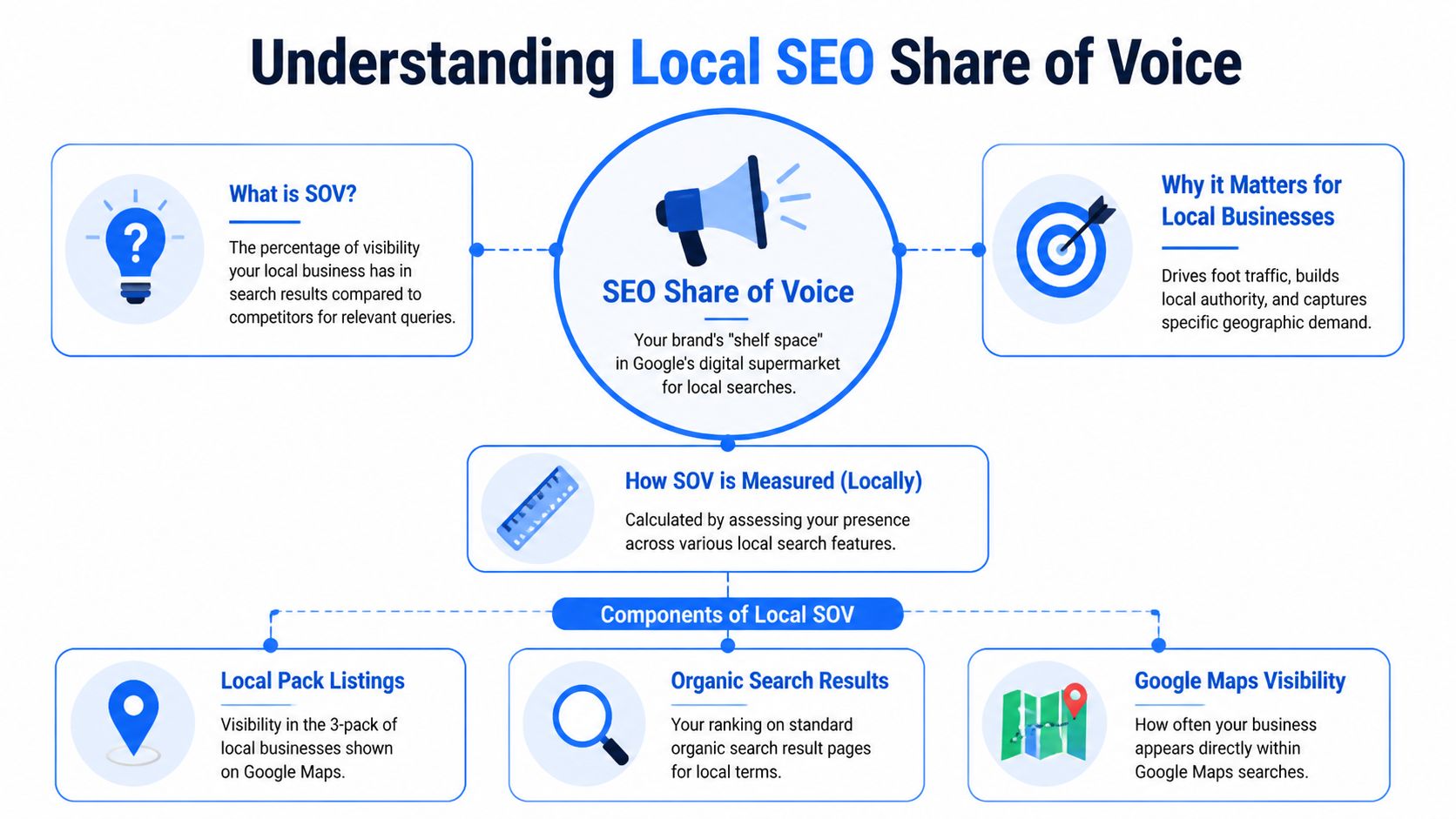
For local service businesses, that definition needs to stay grounded in buyer behavior. The only visibility that matters is visibility for searches with commercial intent in the places you serve. If someone searches “emergency roofer near me,” “roof replacement Dallas,” or “dentist near me,” Google is deciding who gets the first look. SOV measures how much of that decision set belongs to you.
That makes SOV broader than a rank tracker and more useful than a single keyword report.
A local business can rank #1 for one phrase and still have weak market coverage. Another business might appear in the Map Pack, hold strong organic positions for multiple service-city terms, and show up across related modifiers like “same day,” “near me,” or “open now.” That second business usually gets more calls because it owns more of the searches that lead to action.
Traditional share of voice came from advertising. SEO share of voice applies the same competitive idea to search visibility. For a local operator, that means measuring your presence across service keywords, geo modifiers, Google Maps results, and the supporting organic pages that reinforce those local rankings.
Google Business Profile plays a big role here because Maps visibility often captures the highest-intent clicks. If you need a clearer breakdown of how that local entity works, this guide on what a Google Business Profile is explains the mechanics behind local presence.
Transactional keywords are where SOV becomes a real operating metric. A roofer does not need to win broad educational terms to grow replacement and repair revenue. A dentist does not need traffic from every oral health question to fill the schedule. They need strong share of voice for searches that signal purchase intent, local intent, or both.
That is also why local SOV now matters beyond classic Google results. AI search systems pull answers from entities, reviews, service pages, local citations, and trusted brand signals. Businesses that already own strong visibility across Maps and organic service queries are in a better position to stay visible as search interfaces change.
For a broader foundation on local search itself, Ascendly Marketing published an essential guide for local businesses that explains why local visibility depends on more than website rankings alone.
The practical definition is simple. Local SEO share of voice is your share of the searches that produce calls, bookings, and jobs in your market. If you want to dominate a city, this is the number to watch.
How to Calculate Your Local SEO Share of Voice
Most business owners assume SOV is complicated. It isn’t conceptually hard. The hard part is choosing the right inputs and not measuring the wrong market.
The cleanest definition comes from Atropos Digital. SEO Share of Voice is a composite metric estimating a website’s percentage of total organic traffic potential across tracked keywords, calculated as (Your Estimated Organic Traffic / Total Possible Organic Traffic for Keywords) × 100, where estimated traffic is based on keyword search volume and position-specific CTR. Their example CTR curve includes position 1 at 30% and position 2 at 15% in the formula description from Atropos Digital’s SOV explanation.
Method one uses traffic-weighted keyword visibility
This is the method that gives the most useful picture for service businesses.
You start with a keyword set that reflects actual buying behavior in your market. For a dentist, that might include service-and-location phrases, emergency intent terms, treatment modifiers, and “near me” searches. For a roofer, it should center on repair, replacement, leak, storm damage, and city-specific variants.
Then you estimate traffic potential by combining:
- Keyword search volume: Monthly searches for each tracked term.
- Your ranking position: Where your page or local result appears.
- Expected CTR by position: A weighting model that values top positions more heavily than lower ones.
The reason this method works is simple. A number one ranking on a meaningful keyword contributes far more commercial value than a page two ranking on a low-intent phrase. SOV should reflect that reality.
Method two tracks local pack and Maps share
For home services and dental practices, local SEO isn’t only organic. Some of the most important transactional searches trigger a Map Pack or a direct Maps interaction. If you don’t measure that, your SOV model is incomplete.
A practical way to do this is to track whether your business appears in the top local results for each keyword across core service areas. You’re looking for patterns, not just one-point wins. Does your listing show consistently near the city center but disappear in surrounding neighborhoods? Do you dominate branded navigational searches but lose “near me” discovery searches?
Heat maps and geo-grid tracking are useful. They expose whether your visibility is broad across the service area or narrow around your address.
If your map visibility only holds near your office, you don't own the market. You own a pin drop.
Method three separates branded and non-branded SOV
Branded SOV and non-branded SOV serve different purposes.
Branded SOV tells you whether demand for your company is protected. If someone already knows your name, do you control the result set and supporting assets around that brand search? That matters, but it usually isn’t where growth comes from.
Non-branded SOV is the acquisition engine. It shows whether you’re visible when people search for the service but haven’t chosen a company yet. For local businesses, this is usually the more strategic number because it reflects net-new demand capture.
A useful comparison for local teams
| SOV Method | Best For | Required Data |
|---|---|---|
| Traffic-based SOV | Estimating commercial visibility across target keywords | Search volume, ranking positions, CTR model, competitor set |
| Maps or Local Pack SOV | Measuring local transactional presence by service area | Geo-based rankings, Map Pack appearances, service-city keywords |
| Branded vs non-branded SOV | Separating reputation protection from new customer acquisition | Keyword segmentation by brand terms and generic service terms |
What most businesses get wrong
They choose too few keywords, include terms with weak purchase intent, or compare themselves against the wrong competitors. A general marketing dashboard often misses the local operators who take calls away from you every day.
They also confuse presence with performance. A page two ranking still counts as “ranking,” but it often contributes very little to practical visibility. That’s why ongoing reporting matters. If you want a model for how to organize these measurements into something a business owner can read, this collection of local SEO reporting tools is a good reference point.
The best SOV setup is narrow in purpose and broad in coverage. Narrow because it focuses on transactional demand. Broad because it includes enough local keywords and competitors to reflect the actual market.
Essential Tools for Tracking and Visualizing SOV
A roofer can rank well for a handful of terms and still lose the week. A dentist can see traffic go up and still wonder why the phone is quiet. The missing piece is usually visibility across the full set of transactional searches that produce calls, map actions, and booked appointments.
That is why tool choice matters. Once you track several services, cities, and local competitors, SOV stops being a spreadsheet exercise and becomes an operating system for decision-making. You need to see who owns the Map Pack, who is gaining ground in organic results, and which service-area terms are slipping before revenue feels it.
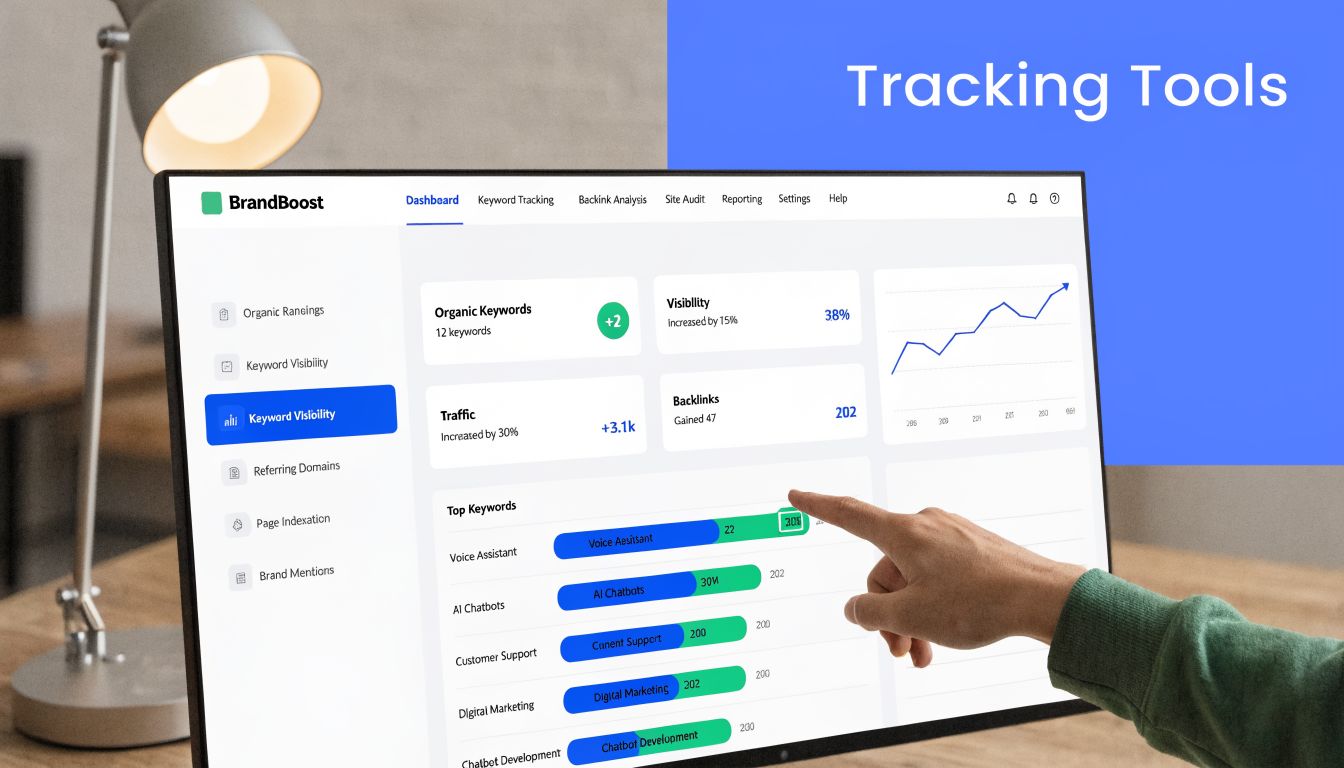
Semrush is strong for day-to-day competitor tracking
Semrush Position Tracking works well for local SOV because it lets you monitor a fixed keyword set, define real competitors, and review visibility changes over time by location and device.
That matters for terms that drive buying behavior, such as “roof repair [city],” “emergency dentist [city],” or “AC repair near me.” A local operator can spot whether the loss is happening in Maps, organic listings, or both. That distinction changes the work plan. A GBP issue, a weak location page, and a competitor content gap do not get solved the same way.
Ahrefs is useful for cleaner trend analysis
Ahrefs has made SOV more visible inside its rank tracking workflow, which helps teams that want a cleaner view of momentum across keyword groups. I like it most when the goal is quarterly planning rather than daily local pack triage.
For example, a multi-location dental group may want to compare implants, emergency, and cosmetic terms across several cities. A roofing company may want to split storm damage, roof replacement, and repair terms by service area. Ahrefs makes those trend lines easier to read, but it is still only as good as the keyword set and competitor list behind it.
Moz still fits smaller local programs
Moz works for businesses that want simpler local tracking and reporting without a heavier setup. That can be enough for a single-location practice or contractor that needs a readable dashboard and basic competitor visibility.
The trade-off is depth. If you need dense geo coverage, side-by-side local competitor analysis, or tighter SOV segmentation by service and city, Semrush or Ahrefs usually give a clearer picture.
Build a dashboard around decisions, not screenshots
A useful local SOV dashboard should answer four practical questions. Where are we losing transactional visibility? Which city-service combinations are weak? Are we getting pushed out of Maps, organic, or both? What do we fix first to get more calls?
The dashboard elements that matter most are:
- SOV trend over time: visibility share against the local businesses that compete for calls
- Keyword-group segmentation: separate views for core services, emergency terms, and city-specific queries
- Map visibility overlays: geo-grid or heat map views that show where Google Business Profile visibility is strong or weak
- Search Console query data: real search language that reveals how customers describe urgent needs
- Competitor gap views: terms and locations where another local business is taking high-intent demand
If a report cannot isolate “service plus city” performance, it is not doing enough for local SOV management.
For teams comparing reporting formats, this overview of a white-label rank tracker for local SEO reporting shows the kind of dashboard structure that makes SOV easier to act on. Smaller teams can also review these 10 free local SEO tools if they need a lower-cost way to start collecting local visibility data before upgrading to a paid platform.
The goal is simple. Use tools that shorten the time between a visibility drop and the fix. That is how SOV becomes more than a chart. It becomes a system for protecting map visibility, expanding transactional keyword coverage, and staying visible as search shifts toward AI-generated answers and fewer traditional clicks.
SOV Benchmarks for Top Service Industries
A “good” share of voice number depends on what kind of business you run and how competitive your market is. A suburban roofer doesn’t face the same search environment as a downtown cosmetic dentist. A chiropractor competing in a dense metro area shouldn’t judge performance by the same benchmark as a contractor covering a smaller service radius.
That’s why broad benchmark talk often misleads local owners. You need a target that fits your vertical, your geography, and the type of search you’re trying to win.

Start with the big benchmark, then narrow fast
Quattr notes in its discussion of local SEO SOV benchmarks that leaders often aim for 25-35% overall SOV, while local SMBs can thrive with 5-15% when that visibility is concentrated in city-specific long-tail terms. The same source gives a niche example where a pest control company with 40% SOV for “bed bugs removal [city]” sees 3x calls versus broader competition, and suggests 8-12% as a realistic range for chiropractors in competitive markets through Map Pack and PAA ownership in Quattr’s benchmark guide.
Those numbers are useful, but only if you apply them to the right keyword layer.
Roofing companies need service-city dominance
Roofing buyers often search with urgent modifiers and location cues. The strongest benchmark for a roofer usually isn’t broad market visibility across every roofing term. It’s concentrated ownership around repair, leak, storm damage, replacement, and “near me” variations in the exact cities that produce jobs.
A roofing company may have modest broad SOV but still perform well if it owns transactional city terms tightly. That’s the kind of SOV that tends to translate into estimate requests and calls.
Dental practices should separate treatment demand
Dental SOV is usually fragmented by service line. General dentistry, emergency dentistry, cosmetic dentistry, implants, and pediatric services often behave like separate micro-markets.
That means a dental practice should judge itself less by one blended number and more by whether it owns the treatment categories that drive patient acquisition. A practice with average broad visibility can still outperform if it consistently appears for high-intent treatment searches in its target neighborhoods.
HVAC and similar home service trades need urgency-weighted visibility
HVAC, plumbing, and electrical categories often have the sharpest difference between informational traffic and transactional demand. If the keyword doesn’t map to a service call, it shouldn’t dominate your SOV strategy.
For these trades, a smaller share around emergency and service-intent terms often matters more than broader awareness. The market leader is usually the company that appears first when the need is immediate.
Here’s the practical benchmark lens:
- Roofing: Prioritize SOV around repair, replacement, storm, and city pages.
- Dental: Track SOV by treatment category, not only by domain-wide visibility.
- HVAC and trades: Weight emergency and near-me intent more heavily than general education content.
If you’re building your own benchmark set before investing in software, these 10 free local SEO tools from VIP TECH CONSULTING can help with baseline visibility checks and local research.
The benchmark that matters isn’t the biggest number. It’s the number that reflects whether you own the searches that bring customers ready to book.
Your Action Plan to Grow Local Share of Voice
Most local businesses don’t lose SOV because they aren’t trying. They lose it because their SEO work is scattered. One blog post here. A few title tag edits there. A half-complete Google Business Profile. No clear map of which competitor owns which transactional terms.
The fix is focus. You grow share of voice seo by tightening your market definition and building assets around the searches that convert.

First, audit the competitors who actually take your calls
Portent’s analysis of traffic-based SOV versus space ownership SOV makes a critical point. Traffic SOV based on search volume and position CTR predicts revenue impact better, while space ownership can overvalue weak positions. The same article advises home service businesses to audit 3 top competitors for estimated traffic gaps and notes that AI content engines have driven 15-30% SOV growth quarterly in dental and pest control examples in Portent’s SOV measurement guide.
That’s the right starting point. Don’t benchmark against whoever looks big online. Benchmark against the businesses repeatedly appearing for your money terms.
Build your first competitor audit around:
- Transactional service keywords: “roofer near me,” “emergency dentist,” “AC repair [city],” and similar phrases.
- Service-city combinations: Every city or neighborhood that produces revenue.
- Maps visibility: Which competitor shows in the top local results where buyers search.
- Content gaps: Missing pages, weak service pages, unanswered service questions.
Next, tighten your website around buyer intent
A lot of local websites are still structured like brochures. They talk about the company, mention a few services, and hope Google figures out the rest.
That usually doesn’t work for SOV growth. You need pages that are unmistakably mapped to transactional intent. One page should target one core service in one location cluster or service theme. If a roofer wants to own “roof leak repair [city],” that page has to exist, be useful, and align with the exact language buyers use.
What usually works:
- Service pages with clear search intent: Separate roof repair from roof replacement. Separate emergency dental from cosmetic dentistry.
- Location support pages: Not thin duplicates, but real local relevance tied to service delivery.
- Conversion-focused page structure: Fast answers, trust elements, clear calls, and direct service framing.
What usually fails is stuffing a homepage with every city and every service and expecting broad dominance.
The businesses that gain SOV fastest usually get narrower before they get broader.
Then, treat your Google Business Profile like a revenue asset
For local service companies, a website without a strong Google Business Profile leaves market share on the table. Many transactional searches trigger local results before a user ever considers an organic listing.
That means your GBP work should align tightly with your SOV strategy. Services, categories, reviews, photos, posts, and local relevance all influence whether you show where it counts. For businesses that want a practical operations checklist, Constructo Marketing's optimization insights offer a helpful local profile framework even though the examples are specific to remodelers.
Build topical depth with AI-aware content, not random blogging
Random blogging rarely expands local SOV. Topical coverage does.
For a dentist, that might mean a content cluster around emergency care, implants, kids dentistry, and location-relevant patient questions. For a roofer, it might mean repair types, insurance-related service questions, storm response, and city-specific issues. The point isn’t to publish more. The point is to publish around the commercial edges of your service lines.
This is also where AI search starts influencing the strategy. Search engines increasingly reward content that answers natural-language questions clearly, uses structured information well, and supports entity understanding. A business that writes stiff, generic pages may still rank somewhere. It won’t be as ready for AI-shaped discovery.
Finally, review SOV on a rhythm that drives decisions
A lot of businesses look at local SEO monthly and react emotionally. That’s too slow for some markets and too unstructured for many organizations.
A better rhythm is to review:
- Core SOV movement across money keywords
- Map visibility patterns by city or grid area
- Competitor gains on newly important terms
- Search query shifts that reveal emerging demand
- Page-level contribution so you know what asset is moving visibility
When you manage local SEO that way, SOV stops being a report metric and becomes a planning system.
Frequently Asked Questions About SOV and AI Search
How are AI Overviews changing share of voice seo
A roofer can rank in the top three, show in Maps, and still lose attention if Google answers part of the question before the click. That is the fundamental SOV shift with AI search. Your visibility now includes who gets cited, summarized, or reinforced inside AI-generated results, not just who holds a blue-link position.
For local businesses, that changes the work on the ground. Strong rankings still matter because they feed discovery and trust. But firms that want more calls also need assets AI systems can parse cleanly and reuse with confidence.
That means tightening the local signals that usually get treated as housekeeping. Make the Google Business Profile service list complete. Keep categories accurate. Match services, service areas, and city references across GBP, core service pages, and citations. Add schema markup for services, FAQs, location details, reviews, and organization data. Structure service pages around clear questions customers ask, such as cost, timing, insurance, urgency, and service availability by city. A dentist should answer queries like “do you take same-day emergency appointments in Plano” directly on the page. A roofer should spell out storm damage inspections, tarp service, insurance claim help, and repair availability by area.
AI search rewards clarity and corroboration. If your GBP says roof repair, your page says residential roofing solutions, and your citations barely mention emergency service, Google has weaker evidence about what you provide. Clean alignment improves your chance of showing up across Maps, organic results, and AI-assisted answers.
What should a new business aim for first
A new local business should start with a narrow set of high-intent terms that can produce jobs or patient bookings now.
For a dentist, that might be “emergency dentist [city],” “dental implants [city],” and “same day dentist [city].” For a roofer, it is usually terms like “roof repair [city],” “roof leak repair [city],” and “storm damage roofer [city].” Build pages for those terms, fully complete the Google Business Profile, and make sure photos, reviews, service descriptions, and primary conversion paths support those searches.
This approach builds SOV where revenue starts. After that base is stable, expand into adjacent services, nearby cities, and supporting question-based pages that strengthen both traditional rankings and AI retrieval.
Should I prioritize branded or non-branded SOV
Prioritize non-branded SOV if the goal is growth. Protect branded SOV because it closes demand you already created.
Non-branded transactional keywords are where local market share changes hands. That is where a homeowner chooses between three roofers and where a patient compares practices before making a call. Branded visibility matters later in the decision process, especially for reviews, reputation checks, directions, and appointment intent, but it rarely creates the first opportunity.
In practice, I want local businesses measuring both separately. If branded SOV is strong and non-branded SOV is weak, the company has awareness but limited reach into new demand. If non-branded SOV is rising while branded terms lag, the SEO program may be generating interest that the brand layer is not converting well enough.
If you want help turning local search visibility into booked jobs and patient calls, Transactional LLC focuses on exactly that. The company helps service businesses grow around transactional search terms, strengthen Google Maps presence, build AI-ready content silos, and track progress with transparent local SEO reporting.