


You hire an SEO company because you want more calls, more booked jobs, and more revenue from searches like “roofer near me” or “emergency dentist open now.” Then the report shows up. It’s packed with impressions, visibility charts, traffic trends, and technical notes, but it still doesn’t answer the one question that matters.
Are you showing up for the searches that bring in customers who are ready to buy?
That gap is where most local SEO reporting fails. A service business owner doesn’t need a pile of vanity metrics. You need proof that your marketing partner is tracking the transactional search terms that produce leads, especially in Google Maps where local buying decisions happen fast. A white label rank tracker is one of the clearest ways to get that proof.
Moving Beyond Vague SEO Reports
A weak SEO report usually has one problem. It reports activity instead of outcomes.
You’ll see general traffic movement, screenshots from third-party tools, and broad keyword buckets that mix informational terms with buyer-intent searches. For a local service business, that muddies the picture. Ranking for “how to fix a leaking pipe” is not the same as ranking for “plumber near me,” and your report should make that difference obvious.
That’s why clear reporting has to start with the right measurements. If you want a good primer on the essential SEO metrics, review that first, then compare it to what your agency sends you each month.
What clarity looks like
A useful report for a home service company or local practice should answer questions like these:
- Which transactional keywords are being tracked for each service and city
- How Google Maps visibility is changing across your service area
- Whether rankings are improving on mobile and local searches
- What happened since the last reporting period, not just a static snapshot
- How the reporting connects to lead generation, not just raw rankings
If your current agency can’t show you that level of detail, you’re being asked to trust a process you can’t verify.
Practical rule: If the report doesn’t separate high-intent local terms from vanity keywords, it’s not built for a business that depends on booked appointments and inbound calls.
A proper client dashboard should also be branded, easy to read, and available without chasing your account manager for updates. That’s the standard modern businesses should expect from client SEO reporting, not a bonus feature.
What Is a White Label Rank Tracker
A white label rank tracker is software your SEO partner uses to monitor search rankings and present the results under their own branding. You see a clean dashboard or report with their logo, colors, and domain, not a cluttered export from a tool built for SEO technicians.
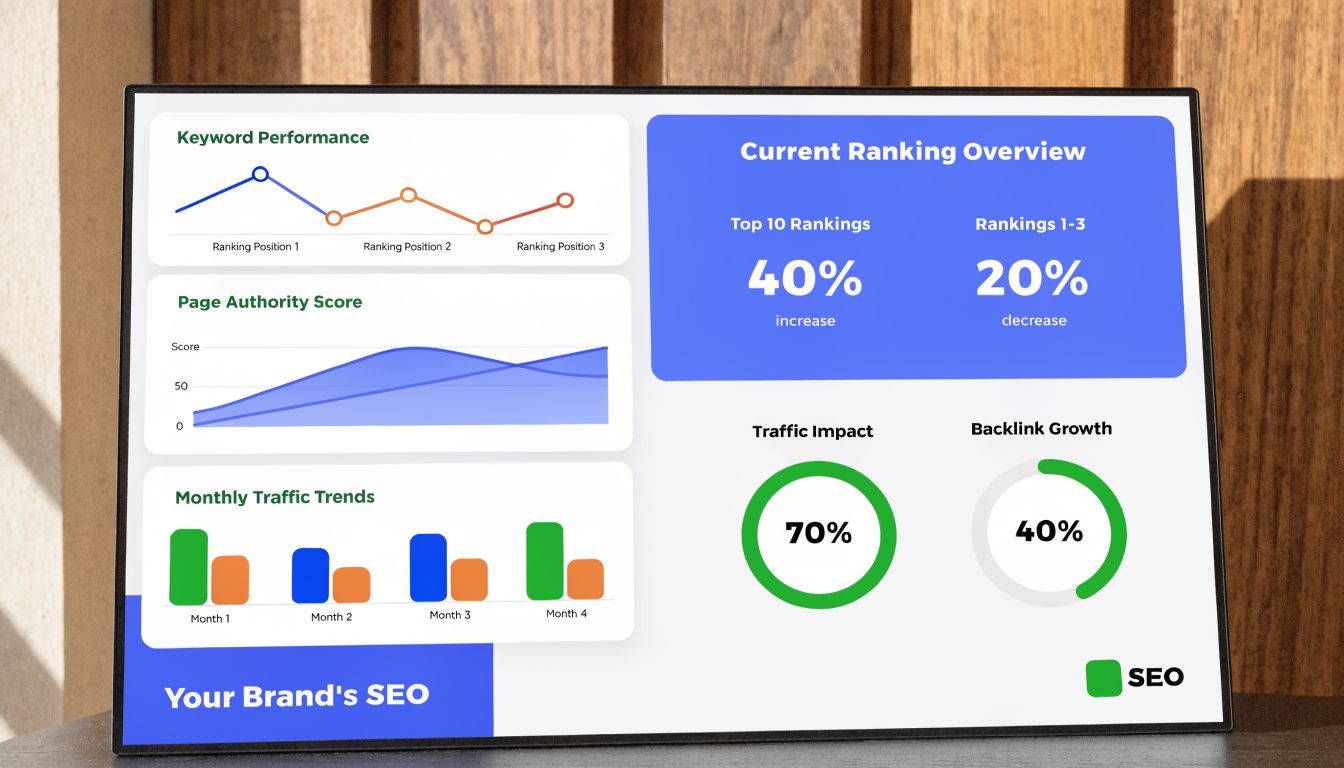
That branding piece matters less than the data structure. Its value is that the report can be organized around what a business owner cares about: the exact keywords, locations, devices, and map positions that drive calls and booked work.
Why generic SEO reports miss the point
Tools like Ahrefs and Semrush can be useful for research, but their default reporting often speaks to SEO professionals, not service business owners. The dashboards are broad because the platforms are broad. They’re built to cover many use cases, from content marketing to backlink analysis to national campaigns.
A local roofing company, plumber, pest control brand, or dental office has a narrower need. You need visibility into transactional search terms. Those are searches that show buying intent, such as “AC repair near me,” “exterminator in [city],” or “dentist near me.” If your reporting doesn’t center those terms, it’s easy to look busy while missing the searches that pay the bills.
A good white label rank tracker solves that by making the report client-facing and goal-focused. It highlights local rankings, map pack movement, city-level keyword trends, and service-area performance.
For businesses comparing their reporting stack across channels, the same logic applies outside SEO too. Teams that want to improve social media client reporting usually find the same pattern: cleaner dashboards create better accountability.
What you should expect to see
A serious white label rank tracker report should include:
- Keyword groups by service line such as roofing repair, roof replacement, or emergency leak repair
- Location segmentation by city or service area
- Google Maps and organic visibility instead of only one or the other
- Competitor comparisons where they help decision-making
- Historical movement so you can see whether progress is real
If you want to see how agencies structure this kind of reporting, review examples of local SEO reporting tools and compare them to what you’re getting now.
A short demo helps make the concept tangible:
Why Tracking Transactional Terms Is a Game Changer
A service business can look strong in an SEO report and still have a quiet phone.
That happens when the report gives equal weight to every keyword instead of separating research terms from buying terms. A homeowner searching "why is my AC blowing warm air" is still diagnosing the problem. A homeowner searching "air conditioning repair near me" is trying to hire someone now. If your SEO partner tracks both phrases the same way, you cannot tell whether the campaign is improving visibility for searches that lead to calls, form fills, and booked jobs.

Buyer intent beats vanity visibility
For a local service business, a long keyword list is not proof of progress. The critical test is whether you are gaining ground on terms tied to revenue.
Three filters matter most:
| Focus area | What it tells you | Why it matters |
|---|---|---|
| Service intent | Whether searches match your highest-value services | "Roof replacement" usually matters more than broad advice queries |
| Location intent | Whether you rank in the cities and neighborhoods you actually serve | Visibility outside your service area does not turn into jobs |
| Urgency intent | Whether you appear when customers need immediate help | Emergency and fast-response searches often convert first |
Good campaigns usually begin with disciplined keyword research best practices. What separates a serious SEO partner from a report vendor is whether they keep measuring the terms that create revenue after the initial research is done.
Maps visibility often decides the lead
For local service queries, customers often choose from the map pack before they ever scroll through standard organic results. That is why rank tracking has to reflect where buying decisions happen.
Google remains the dominant search engine worldwide, as reflected in Google's market share estimates from StatCounter. For local service companies, that means your reporting should show how you rank in Google Maps, the local pack, and traditional organic results for the same transactional terms. If a report only shows one static organic position, it leaves out a large part of the buying journey.
Useful reporting adds context around those rankings. Search volume shows whether demand exists. CPC data helps indicate commercial value. Competitor positions show who is taking market share in the areas you want to win.
A report that tracks broad visibility but ignores map rankings can miss the moment a customer decides who to call.
ROI becomes easier to verify
Once reporting is centered on transactional terms, the conversation gets more honest. You can judge SEO based on whether more of your target searches are becoming visible in the markets you serve.
That makes weak performance easier to diagnose too. If rankings rise for informational terms but leads stay flat, the issue may not be execution. The issue may be keyword selection. I have seen service businesses stay patient with a campaign for months because the report looked active, even though the tracked keywords had little connection to booked work.
Business owners should ask a simple question every month: are we improving on the searches that bring buyers, or are we just measuring motion?
Essential Features Your Business Deserves
If you’re paying for local SEO, you should know what the reporting system must do. Not what it could do. What it must do.
The strongest white label rank tracker setups share a few essential features, especially for service businesses that depend on local visibility across multiple neighborhoods and cities.
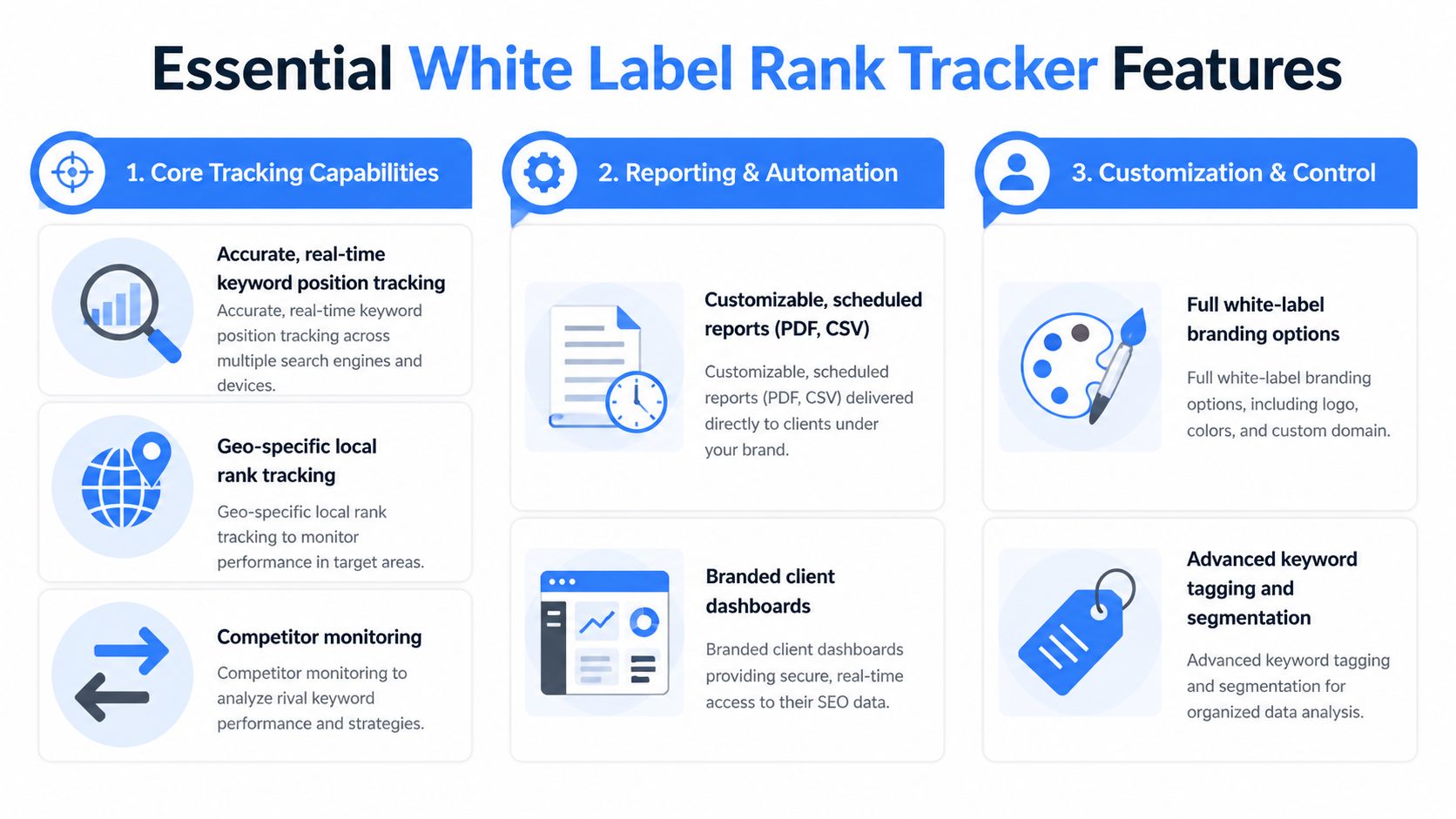
Geo grid tracking for real service areas
The first feature to demand is geo-grid tracking.
Traditional rank tracking can check performance from one GPS point. That’s not enough for a business that serves a whole metro, multiple suburbs, or a spread-out service area. White label rank trackers that use geo-grid technology scan Google Maps rankings across dozens of coordinates in customizable grids, including formats such as 7×7, which helps reveal blind spots across the areas where customers search (EmbedMyReviews).
If you run an HVAC, plumbing, roofing, or pest control business, this matters because your map visibility isn’t uniform. You might rank well near your office and disappear in nearby neighborhoods where you still want calls.
What works:
- Heat maps by service area that show strong and weak zones
- Recurring scans so you can compare movement over time
- Competitor overlays that show who owns the outskirts you want to penetrate
What doesn’t work:
- Single-point ranking checks presented as if they reflect the whole city
- One-city reporting for a business that serves many surrounding towns
Automated reporting and dashboard access
The second feature is consistent reporting without manual assembly.
If an agency still builds reports with screenshots, spreadsheets, and hand-written notes every month, you’re looking at a fragile process. Automated reporting keeps delivery regular and keeps the data current. It also reduces the chance that your reporting depends on one account manager remembering to send it.
Look for these basics:
- Scheduled reports sent automatically on a recurring cadence
- Branded dashboards where you can log in anytime
- Historical keyword timelines so movement is easy to audit
- PDF exports when you want a clean shareable summary
What to ask your agency: “Can I see my rankings by keyword, city, and map coverage without requesting a custom spreadsheet?”
If the answer is no, the system is too limited.
Branding and client-facing presentation
White label isn’t only about appearance, but appearance still matters. A report that carries the agency’s own brand tends to be cleaner and more intentional than a raw export from a third-party SEO suite.
A polished dashboard should include your campaign data in a format that’s easy to review with managers, partners, or franchise stakeholders. The point is simple. You should be able to understand where you stand without needing someone to translate tool jargon.
Segmentation that matches how you sell
A strong white label rank tracker also needs flexible keyword grouping. A local company doesn’t sell one thing in one place. You sell multiple services across multiple cities, often with different levels of urgency and different conversion value.
That means your dashboard should separate:
- Core transactional terms from blog or educational terms
- Map rankings from organic rankings
- Primary cities from secondary service areas
- Brand searches from non-brand searches
When those segments are mixed together, performance looks better than it really is.
Choosing a Partner Who Invests in Accuracy
A local service business can lose ground in a week and not see it in the report until the month is over. By then, the calls have already gone to a competitor.
That is why the partner matters as much as the software. Some agencies build reporting around the cheapest tracker they can get. Others pay for cleaner local data, faster refreshes, better integrations, and tighter quality control because weak rank data leads to weak decisions. If your agency cannot show how it checks ranking movement for the keywords that bring in estimates, bookings, and phone calls, you are being asked to trust a black box.
Fresh rankings support better decisions
Rank tracking only helps if the numbers are current enough to act on. Local search results shift after review velocity changes, GBP edits, new location pages, spam filtering, or a competitor push in the map pack. If your agency is working from delayed snapshots, it may miss why leads dropped or mistake a temporary spike for progress.
Good partners invest in tools and workflows that let them verify changes quickly. They do not wait for a static report to tell them what happened. They check movement, confirm whether the change showed up in organic results, maps, or both, and decide what needs attention before lost visibility turns into lost jobs.
Cheap tools create expensive reporting gaps
Low-cost software is not automatically bad. The problem starts when the agency hides the trade-offs.
Here is what to look for:
| Decision factor | Strong partner behavior | Weak partner behavior |
|---|---|---|
| Update frequency | Verifies rankings often enough to catch meaningful local shifts | Relies on delayed snapshots and monthly summaries |
| Local precision | Tracks by city, device, and search type | Reports one blended average rank |
| Reporting workflow | Uses connected dashboards and repeatable reporting | Builds reports manually when you ask |
| Account growth | Handles more locations, services, and keyword groups without losing clarity | Gets harder to trust as the campaign expands |
Those differences show up in plain business terms. A weak setup can make an agency look organized while hiding that your high-intent terms are slipping in the exact cities you care about.
Integrations reveal how disciplined the operation is
Rankings by themselves are only part of the picture. A mature SEO operation connects rank tracking with reporting systems the team uses, whether that is Looker Studio, a CRM, internal alerts, or a client dashboard. That setup makes it easier to spot sudden drops, compare visibility across locations, and keep reporting consistent from one month to the next.
Service business owners should ask a simple question. Can your agency trace ranking movement back to the service and city combination that is supposed to produce leads? If the answer is vague, the process is probably vague too.
A serious SEO company for local service businesses should be able to explain how it validates local rankings, how often it reviews them, and how it separates signal from noise. That is what lets you verify that your investment is being judged on the terms that drive revenue.
Transactional LLC Workflow A Case Example
Take a hypothetical roofing company serving a main city plus nearby suburbs. The owner wants more calls for “roof repair near me,” “roof replacement [city],” and “emergency roofer [city].” They’ve had SEO before, but every report felt broad and hard to trust.
The first thing a disciplined team does is narrow the campaign to the terms that signal buying intent. Not every roofing keyword matters equally. “How long does a roof last” may support content strategy, but it’s not the search that fills the schedule this week.
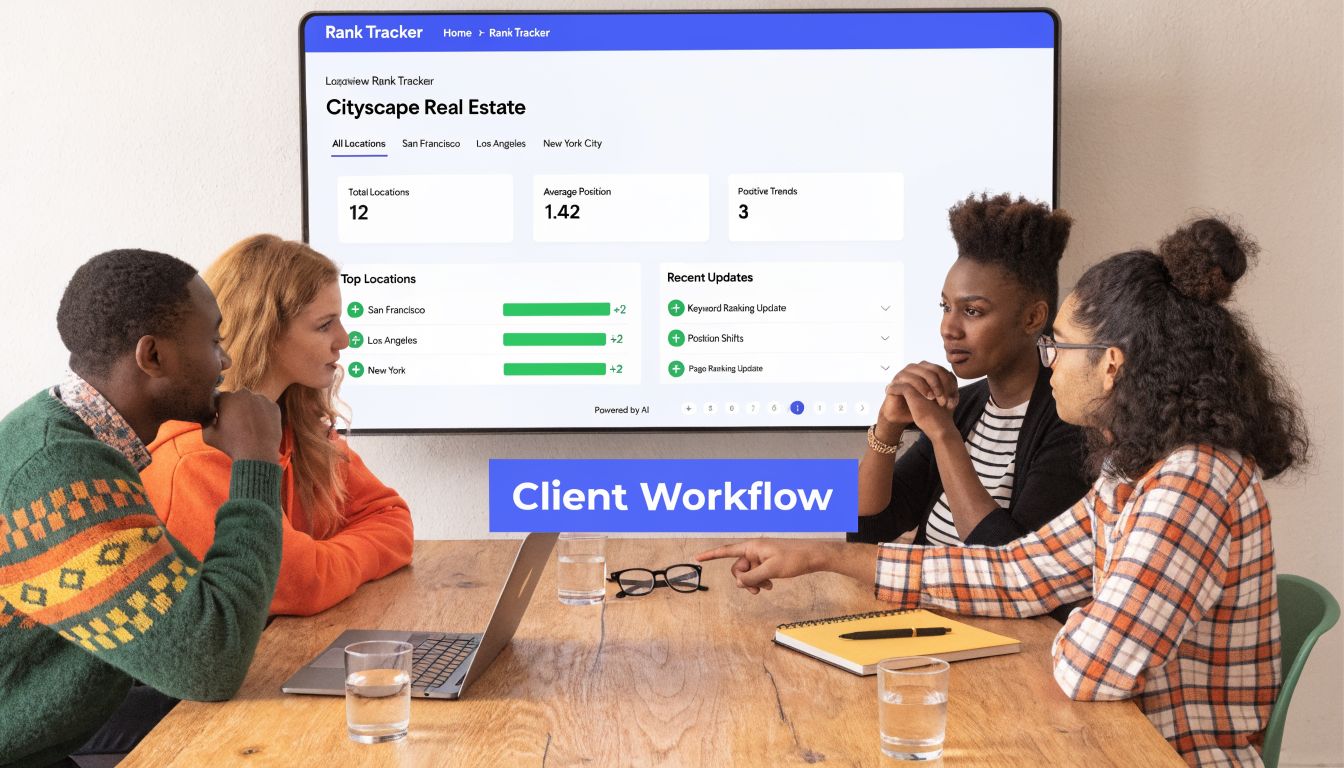
How the setup works
The workflow usually looks like this:
Service and city mapping
The campaign gets organized by core services and target locations. Roofing repair, full replacement, storm damage, and emergency response may each need separate keyword groups.Local tracking configuration
The rank tracker is set to monitor both organic and map visibility for the exact service areas the business covers, not just the address where the office sits.Competitor baselining
Local rivals are added so the owner can see who dominates high-intent terms in each market.Dashboard delivery
The business gets a branded reporting view that makes city-by-city movement easy to review.
What the reporting should show
A good biweekly or monthly report for that roofer would show:
- Movement for transactional keywords by city
- Map heat visualization that reveals stronger and weaker zones
- Wins and losses against local competitors
- Historical trend lines instead of one isolated snapshot
That structure matters because local lead flow is rarely uniform. One suburb may improve first. Another may lag because the Google Business Profile lacks relevance there, or because a competitor has stronger proximity signals.
If your report can’t isolate performance by service area, it can’t explain why one part of your market is generating calls while another stays quiet.
Why the process scales
For agencies managing many local clients, the reporting backbone has to be automated. Blogtec notes that for agencies managing over 50 local service clients, API integration and automated reporting infrastructure can reduce per-client administrative overhead from 2 to 3 hours monthly to near-zero, while keeping white-label brand consistency intact (Blogtec).
That operational efficiency helps the agency, but it helps the client too. Less manual assembly means more time spent on the actual work: improving rankings for the searches that generate revenue.
Demand Transparency Demand Results
A white label rank tracker isn’t a cosmetic add-on. It’s the reporting backbone of a serious local SEO program.
If you run a service business, you should expect your marketing partner to track the transactional keywords that bring in ready-to-buy customers. You should expect map visibility by service area, not one generic city ranking. You should expect clean reporting that shows progress over time and makes underperformance obvious.
That level of transparency protects your budget. It also forces your SEO provider to stay accountable to the metrics that matter most. Not vanity traffic. Not broad visibility. Actual local search presence for terms that lead to calls, appointments, and booked jobs.
The standard is simple. If an agency says it can grow your local visibility, it should be able to prove where you rank, where you don’t, and what it’s doing to close the gap.
If you want that kind of accountability, Transactional LLC helps local service businesses dominate transactional search terms, improve Google Maps visibility, and verify results with transparent reporting built around the keywords that drive real leads.