


Call tracking is the practice of assigning unique phone numbers to different marketing sources so a business can see exactly which channel, ad, or search term produced each inbound call. For local service companies, that closes the attribution gap on a channel that can convert 10 to 15 times more often than web leads and is still hard for many marketers to tie back to revenue, even though 82% of marketers see call insights as a way to expose blind spots and 62% still fail to attribute revenue to inbound calls, according to the Invoca report quoting Forrester data source.
A plumbing truck is parked in the driveway, the phone rings, and the job gets booked. The owner still doesn't know whether that call came from Google Maps, a paid ad, or the organic result for roofer near me or air conditioning repair near me. That's the problem call tracking solves, and it's why it sits between local visibility and actual revenue.
Why Local Businesses Cannot Tell Which Marketing Works
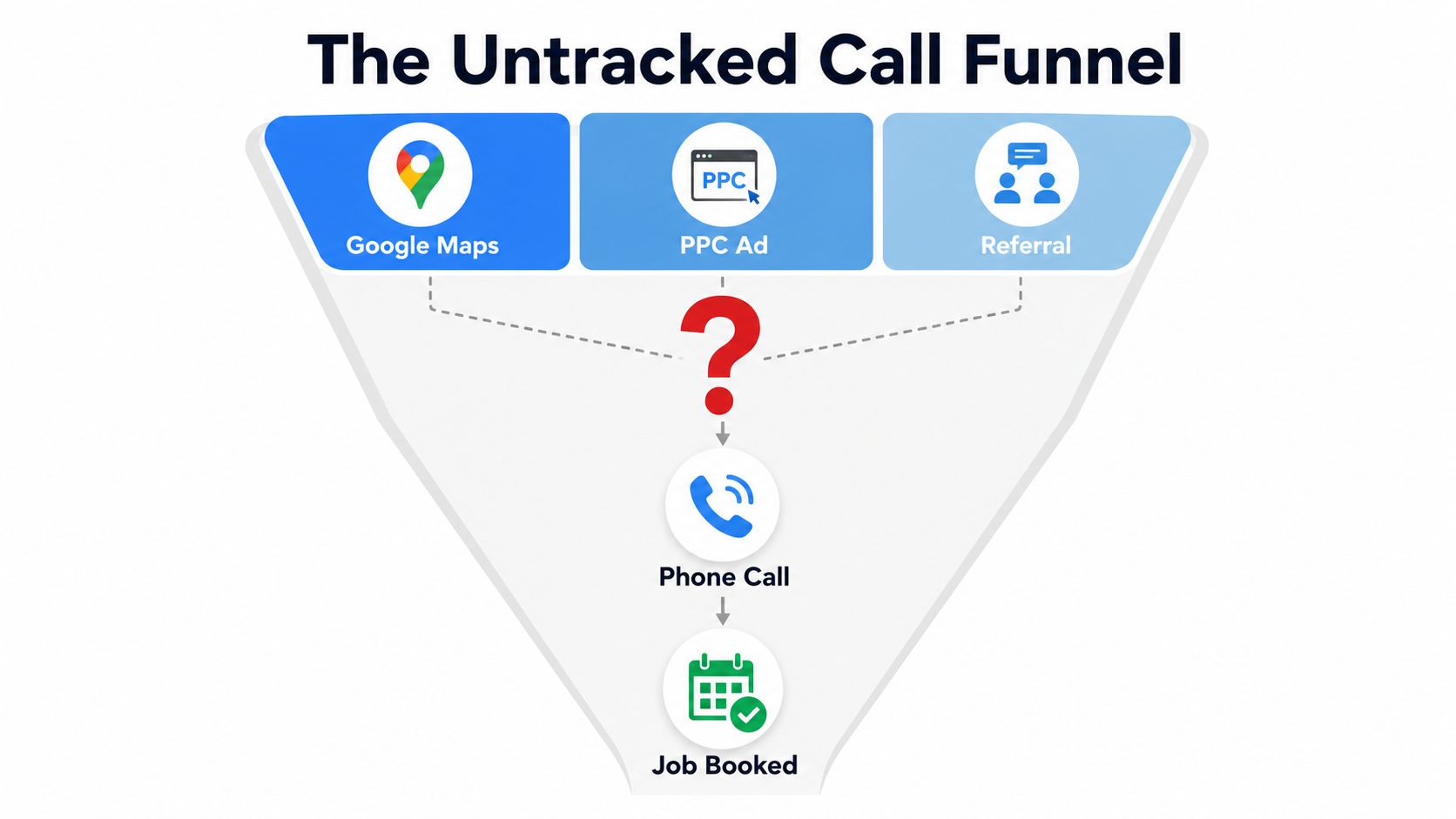
A dental office can rank in the local pack, run search ads, and still have no clear answer on which source filled the calendar before lunch. The phones ring after the click, after the map view, after the page load is gone. By the time the appointment is booked, the source often disappears into one lump of revenue.
That is the measurement gap for service-area businesses. The shop sees a booked call, maybe a recorded lead, and a dashboard full of impressions or clicks, but the actual path from Google Maps to the ringing phone stays fuzzy.
The missing link between visibility and booked work
Google Maps visibility and page-one rankings matter only if they become booked jobs. Most reporting stops at traffic, impressions, or answered calls, then leaves the owner to guess which channel brought in the work. Call tracking fills that gap by connecting the phone call back to the source that generated it.
A service-area business feels this in monthly reporting. One week the calls rise after a local pack push, the next week paid search gets credit, and then referral traffic shows up as the quiet winner. Without source-level data, every channel looks important, and none of them can be ranked with confidence.
Practical rule: if a call cannot be tied back to a channel, campaign, or search term, it cannot be improved with confidence.
That is why operators who care about local SEO need more than vanity rankings. They need to know which search touchpoints led to actual calls, then compare that against the rest of their marketing using how to measure marketing effectiveness.
How Call Tracking Works From Search to Phone
Call tracking is a source-attribution system. It maps an inbound call back to the marketing source, campaign, or keyword that generated it by assigning unique numbers and matching the call to source data. On paper, that sounds simple. In a service-area business, it is the missing measurement layer between the Google local pack and the phone that rings at the shop.
A Google Maps impression does not pay the bills. A booked call does. Call tracking shows which touchpoint sent that call, so an HVAC office, dental front desk, or pest control dispatcher can see whether the ring came from organic search, paid ads, a postcard, or a profile visit that finally turned into a lead.
Static numbers and dynamic number insertion
Static tracking numbers work best for offline sources or fixed placements. If a postcard, flyer, or billboard has its own phone number, that number becomes the label for the campaign. When the phone rings, the source is obvious.
Dynamic number insertion, or DNI, is what makes online tracking practical. A website swaps the displayed number based on the visitor's traffic source or session context, then forwards the call to the business line while logging source, duration, and outcome data for reporting and ROI analysis. A practical setup guide for that workflow is in how to track phone calls and the dynamic number insertion guide.
That matters most when the same visitor may come through organic search, a paid ad, or the Google Business Profile before dialing. Without DNI, those visits blur together. With it, the dashboard can show which source sent the call, how long the call lasted, and whether it led to a useful outcome.
The website is the storefront, and the tracking number is the tag on the service ticket that follows the job through the pipeline. That tag shows who sent the lead and where it came from, while the team still answers the same business line.
Source matching and call logging
Modern call tracking platforms do more than count rings. They usually log the caller number, call duration, date and time, source channel, and sometimes the call outcome before forwarding the call to the business line Bandwidth's call tracking glossary. That turns the call into a data record instead of a mystery event.
If routing is sloppy, the attribution can still look fine while the lead experience falls apart. The controlled ticket-to-call routing model is a useful reminder that the handoff matters as much as the source match. A fast answer to the wrong person still wastes the lead.
For setup and logging details, it helps to follow a practical phone-tracking workflow rather than guessing at the configuration. The point is to know what source paid for the call, what happened after the customer dialed, and whether that ring turned into a booked job.
Metrics That Matter for Local SEO and Maps Performance
The dashboard is only useful if it shows the numbers that affect booked work. For local operators, that usually means total calls, unique callers, missed calls, after-hours calls, call duration, first-time versus repeat callers, and source attribution by channel. Those are the figures that tell you whether your Google Maps work and transactional search visibility are producing demand.
The first numbers to check weekly
The first number I look at is missed calls. In home services, every missed ring can be a lost job, especially when the person calling is already comparing providers and wants an immediate answer. After that, call duration and call outcome tags matter because they separate real opportunities from noise.
The third number is source. If calls are coming from maps, paid search, or organic pages, you need to know which source is responsible for the booked jobs, not just the raw volume. That's how you connect rankings for terms like dentist near me to actual appointments instead of treating visibility as its own win.
| Metric | What It Tells You | Action It Drives |
|---|---|---|
| Total calls | Overall demand coming from tracked sources | Compare campaigns and listings |
| Missed calls | Leads that never reached a live person | Tighten answering, routing, and callbacks |
| Call duration | Whether the conversation had real intent | Separate weak leads from strong ones |
| Source attribution | Which channel or keyword produced the call | Reallocate spend and SEO effort |
How operators use those metrics
A top-three maps placement is good news only if it sends calls that become booked jobs. A ranking jump for a transactional term matters only if the dashboard shows the phone ringing more often from that source. That's where call tracking becomes the measurement layer between local pack visibility and revenue.
Outcome tags do a lot of heavy lifting here. If your team tags calls as booked, missed, wrong number, existing customer, or estimate request, the marketing report starts to resemble the actual business. You're no longer looking at a pile of calls, you're looking at demand quality.
Blunt rule: if the report doesn't help you answer what to answer, when to staff, and where to spend, it's just decoration.
For teams trying to turn this into an internal reporting routine, local SEO reporting tools are only useful when the call data is clean enough to trust. The tool doesn't matter nearly as much as the discipline around the numbers.
Call Tracking Across HVAC, Plumbing, Dental, and Pest Control
HVAC and plumbing are where call tracking gets brutally practical. The caller usually has a problem that can't wait, so the difference between an answered call and a missed one is often the difference between a booked job and a competitor's dispatch board. After-hours call data matters here because emergencies don't respect office time.
HVAC and plumbing
For HVAC, the best source data often comes from emergency-style searches and maps visibility in the service area. For plumbing, the call pattern is similar, but the urgency can be even higher when a burst pipe or backed-up line pushes the caller to pick the first live business. In both cases, call duration and missed-call tags tell you whether the lead was urgent, reachable, and worth following up on fast.
Dental works differently. The call is usually about an appointment, a new patient question, or a return visit, which means repeat callers can be just as important as first-time callers. Call tracking helps separate existing-patient scheduling from new-patient acquisition, and that distinction matters when the office is trying to grow rather than just fill the calendar.
Pest control is its own animal because the value can vary sharply by service line. Termite, rodent, and general pest calls don't carry the same business value, so the call outcome and tagging process needs to reflect that. A termite inquiry might deserve a different follow-up path than a routine spray call, even if both came from the same search campaign.
Why the same setup behaves differently by vertical
The tracking workflow is the same across these industries, but the interpretation changes. A dental practice may care most about appointment intent and repeat patient behavior, while an HVAC contractor may care more about after-hours urgency and dispatch timing. A pest control company may care most about which service line generates the highest-value jobs.
That's why call tracking is useful for local SEO operators, but not in a generic way. It connects a transactional search term to the actual business event that matters in that vertical, whether that event is an estimate, a booked cleaning, an inspection, or an emergency service call.
Operator's takeaway: one dashboard can serve four verticals, but the tags, outcomes, and follow-up rules have to match the way each business sells.
If you want a broader look at how inbound call handling changes with team structure, the call centre software guide is a useful companion read for routing and answer-speed thinking.
Implementation Checklist for a Service-Area Business
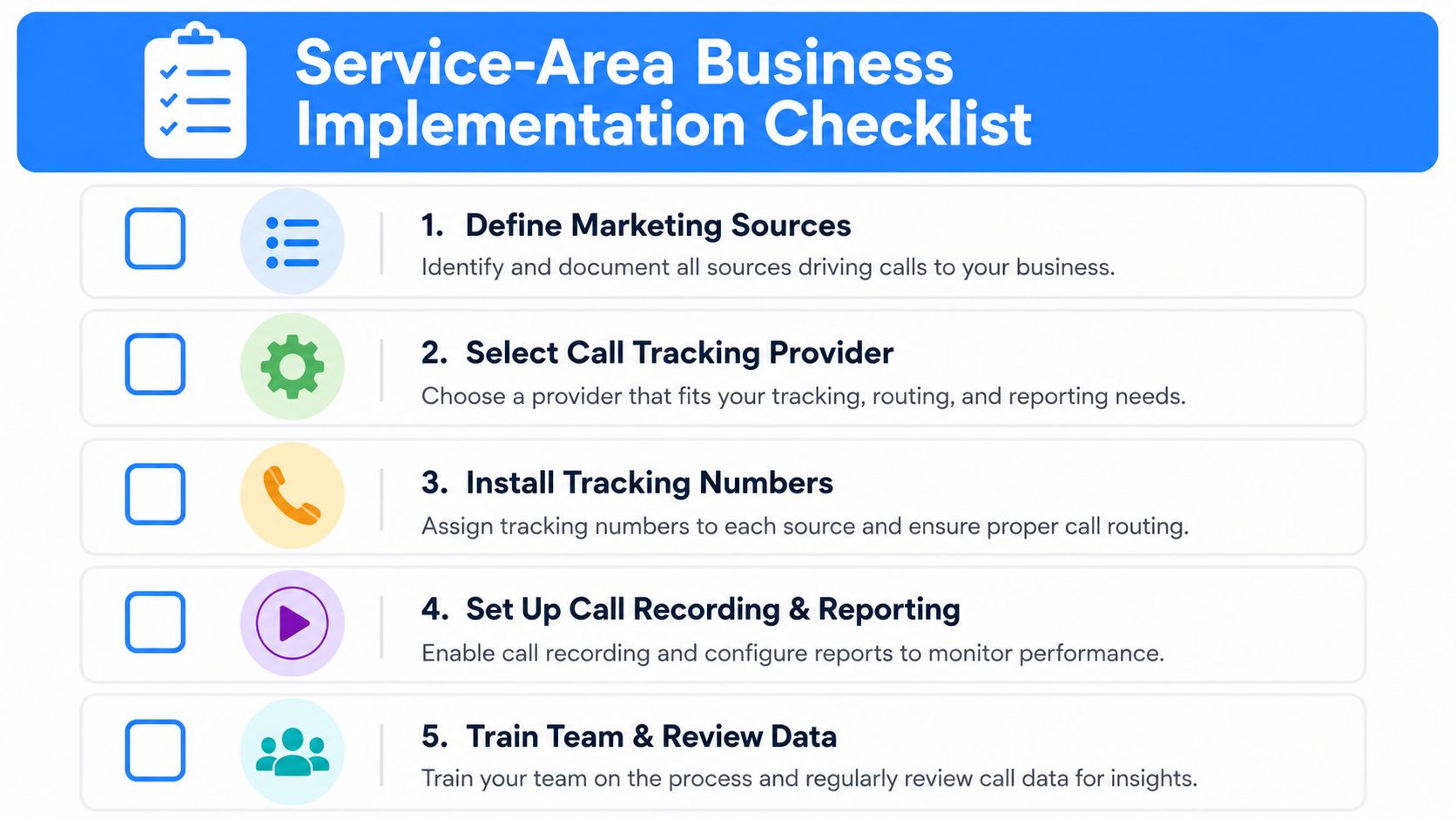
A proper setup starts with deciding which calls deserve a separate number. Google Business Profile landing pages, PPC campaigns, organic SEO pages, and offline sources all need clean attribution if you want the dashboard to tell you anything useful. If everything shares one number, the report gets muddy fast, and you lose the line between the local pack and the phone that rings at the shop.
Rollout steps that matter
Start by assigning local or toll-free tracking numbers to each source you want to measure. Install the DNI script on the website so the displayed number changes based on the visitor's source or session. Then connect call data to Google Analytics, Google Search Console, and the CRM so call activity sits beside the rest of the lead record instead of floating off on its own.
Call outcome tagging comes next. Booked job, missed opportunity, existing customer, estimate request, wrong number, and after-hours callback are the labels that turn a call log into a management tool. Without those tags, you cannot separate marketing performance from staffing problems, and that is the part service-area businesses feel fastest in monthly reporting.
Practical rule: do not launch until the source labels, tags, and routing logic match the way your team answers the phone.
Here is the basic verification sequence I use with service-area clients:
- Test each source separately: Make a call from the map listing, the PPC landing page, and the organic page to confirm each one lands in the right bucket.
- Check the number swap: Confirm the website shows the correct tracking number for the source or session.
- Review the dashboard labels: Make sure the source, duration, and outcome fields match the call that was placed.
- Confirm CRM sync: Verify the call record lands where the sales team will see it.
- Test the follow-up path: Ensure missed calls trigger a callback process instead of dying in the log.
The goal is simple. When an owner opens the dashboard or monthly report, the numbers should show which channel drove the ring, which calls turned into jobs, and where the response process broke down. That is the measurement layer most local businesses never had before call tracking, and it is the part that makes the rest of the reporting worth trusting.
Privacy, Compliance, and the ROI Question
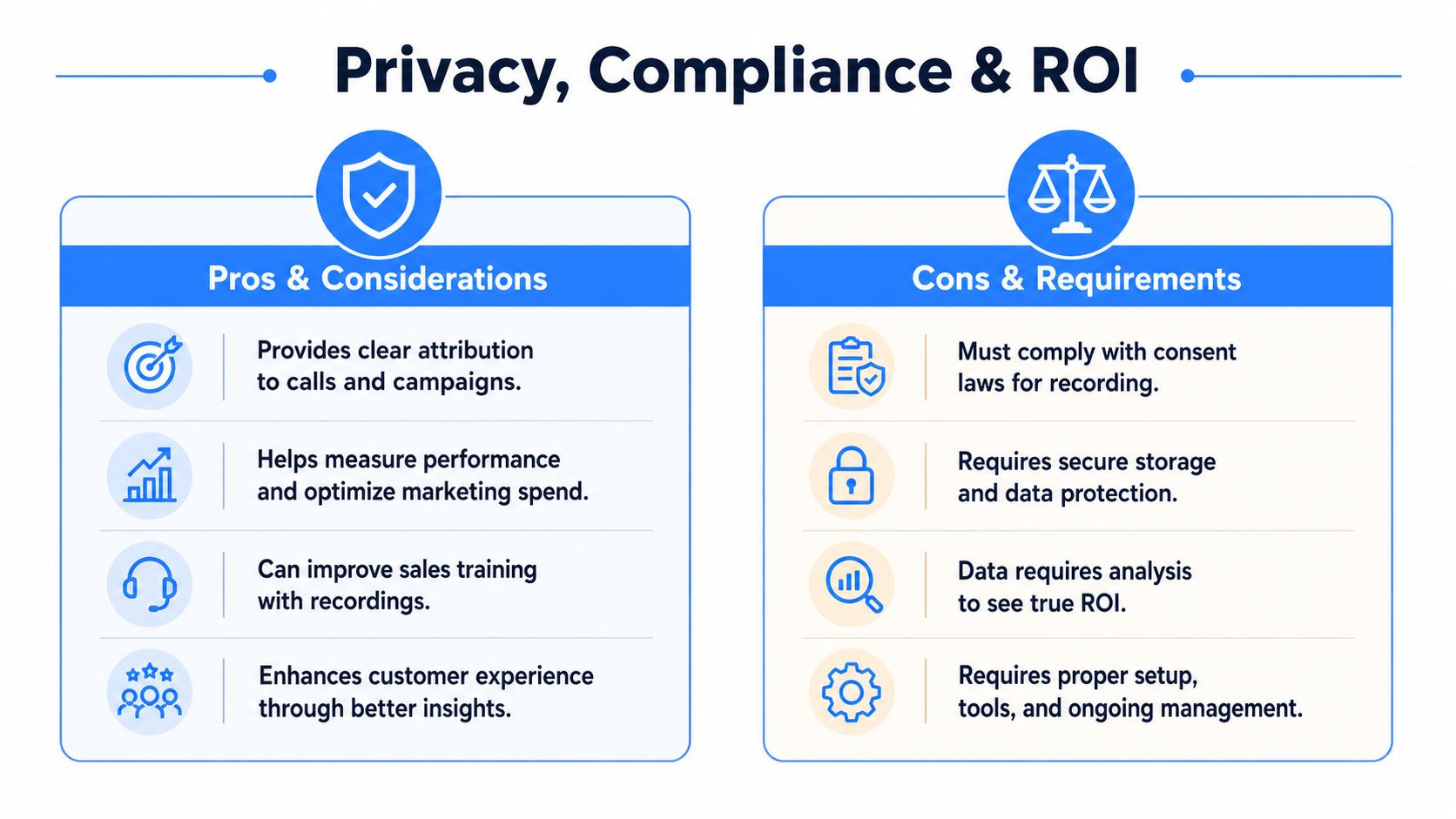
Most basic explainers stop at attribution. That is not enough anymore, because many platforms also record calls, transcribe conversations, and generate AI summaries. Once that happens, the business is not just collecting source data, it is handling customer conversation data too.
Consent and data handling
That changes the compliance conversation fast. Businesses need to think about disclosure at the moment of the call, regional recording consent rules, and basic data-retention hygiene. A system that captures more data is more useful, but it also carries more responsibility, especially if recordings and transcripts are stored for training or analysis.
Twilio's glossary makes the point plainly, call tracking is not only about what number rang, it is also about what data is collected, where it is stored, and what consent is required Twilio's call tracking glossary. That is the part a lot of beginners skip, and it is the part that can create problems later if nobody set expectations early.
Does it improve revenue or only attribution
Call tracking's value is bigger than a prettier attribution report. The ROI question is whether it improves lead quality, missed-call recovery, booking rate, and revenue from calls that used to disappear into a voicemail box. If a platform only tells you where the phone rang, it has not solved the business problem yet.
The category is moving toward conversation intelligence because that is where the sales value lives. Features like transcripts, summaries, and call scoring help teams hear what callers are asking, what objections keep coming up, and where the script breaks down. That turns the tool into a coaching layer, not just a number-swapping system.
A good way to evaluate it is to ask whether the call data helps the team answer these questions:
- Which leads deserve faster follow-up? Use call notes and outcomes to identify hot calls.
- Which calls were wasted? Review missed calls, wrong numbers, and low-intent conversations.
- Which sources produce booked work? Compare source labels to closed jobs, not just call volume.
- What does the team need to hear more often? Use recordings for training and call review.
The budget question becomes clearer when you compare tracked calls against booked work and recurring customers. If the reporting shows better response times, cleaner source data, and more calls that turn into jobs, the platform is doing more than filling a dashboard. It is giving you a way to tighten spend, coach the front desk, and stop guessing which marketing paid off.
Turning Tracked Calls Into Booked Jobs and Repeat Customers
Call tracking matters because it turns visibility work into a measurable stream of phone calls. When a business ranks in the local pack, shows up for air conditioning repair near me, roofer near me, or dentist near me, and those visits become tracked calls, the owner finally has a feedback loop instead of a hunch.
That loop changes bidding, content, and follow-up. PPC spend gets tighter because the team can see which campaigns bring in calls that book. SEO content gets sharper because the pages can be grouped around the transactional terms that trigger the best calls. And the front office gets better at following up because missed and repeat callers are no longer buried in a generic log.
A local service business doesn't need more vanity wins. It needs proof that the map ranking, the ad, or the page produced a real conversation and a real job. Once call tracking is in place, the questions get better, the reporting gets cleaner, and the marketing budget stops floating in the dark.
Review the current call attribution setup, identify which marketing sources are still unmeasured, and fix those gaps before you spend another month guessing where the booked jobs came from.
Transactional LLC builds local SEO systems for service businesses that need more than rankings. If you want Google Maps optimization, transactional search visibility, and a reporting setup that shows which calls came from which source, visit Transactional LLC and see how the team ties search terms to booked jobs.