


SEO for chiropractors isn't just a marketing buzzword; it's the specific process of getting your clinic found online when someone is actively looking for help. Think about it: when a potential patient searches Google for “back pain relief near me” or “chiropractor in [Your City],” a strong SEO strategy is what puts your name at the top of that list. It's about being visible at the exact moment a patient needs care.
Why SEO Is a Game-Changer for Modern Chiropractic Practices
The days of relying solely on word-of-mouth referrals or a Yellow Pages ad are long gone. Your next patient is online, right now, looking for a solution to their pain. The real question is, will they find you or your competitor? This is where a sharp, targeted SEO strategy becomes the backbone of a thriving chiropractic clinic. It's not just about having a website; it's about being found when it matters most.
Here at Transactional Marketing, our entire focus is on ranking our clients for high-value transactional search terms. These are the phrases people type when they have money in hand and are ready to schedule an appointment. A search like "chiropractor near me" isn't just a casual query—it's a clear signal from a patient who is ready to book. Our whole process is built to put your practice front and center for these exact searches.
Connecting With Patients in Their Moment of Need
The modern patient journey almost always starts with a search engine. Someone might be seeking immediate relief from a sports injury or finally looking for a long-term solution to chronic migraines. Your ability to show up in those search results, especially in the coveted Google Maps 3-Pack, is what determines whether you even get a chance to help them.
From the patient's side, the process is simple: they search, they find a local clinic, and they book.
This graphic breaks down that modern patient journey, from the initial search right through to booking an appointment.
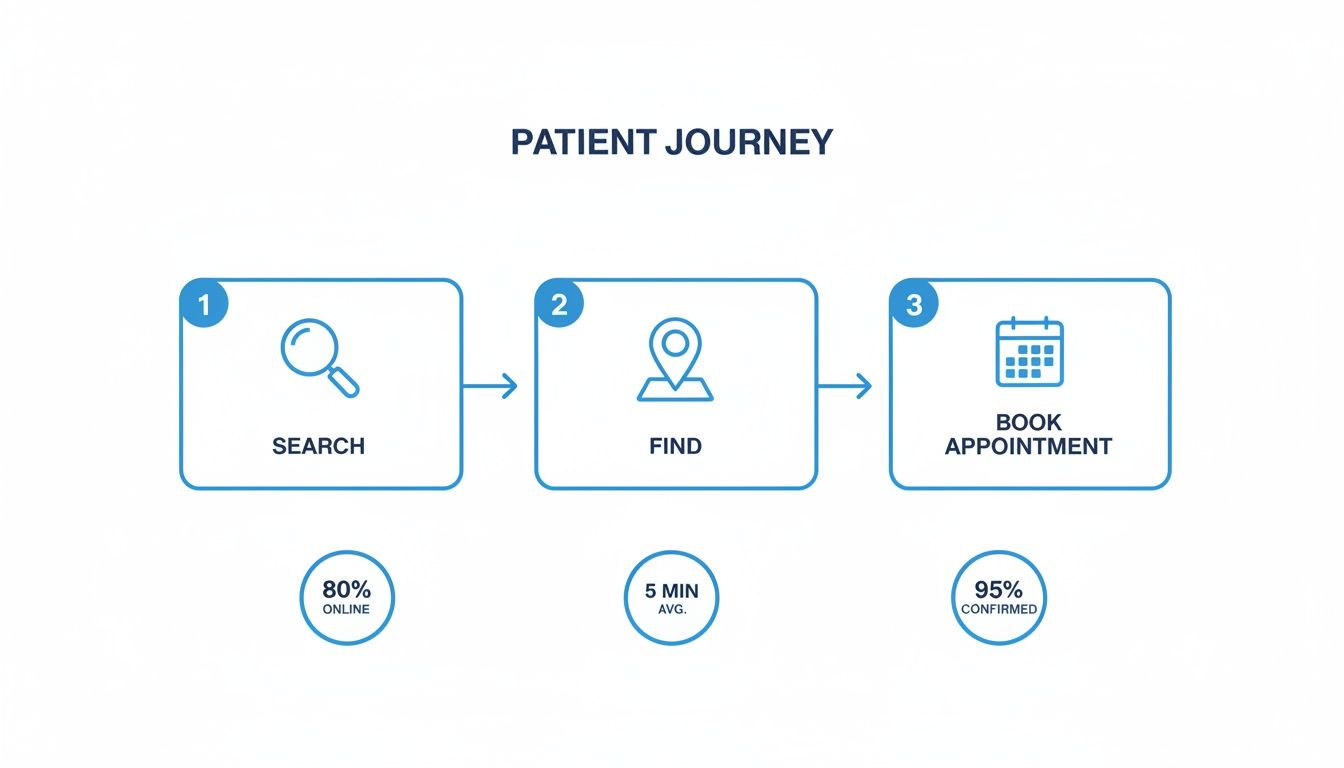
As you can see, visibility in Google Search and Maps isn't just a nice-to-have; it's the critical first step to getting a new patient through your door.
Thriving in a Competitive Market
Let's be honest: the chiropractic field is more competitive than ever. New clinics open constantly, and large healthcare groups are pouring millions into their digital marketing. In this environment, smart SEO is essential for survival.
We've seen it time and again: Google’s algorithm increasingly favors clinics that provide a great user experience, are clearly relevant to the local area, and have strong trust signals. Clinics that secure a spot in the top 3 organic results or the Google Map Pack are the ones that see a consistent flow of calls from patients ready to book.
We have a proven system at Transactional Marketing that gets our clients' websites onto page one of Google, often within 30 to 60 days. We do this by laser-focusing on the transactional keywords that actually drive patient growth.
Beyond just ranking, the real goal of SEO is to expand your patient base. Understanding how to attract more patients for your practice is key, and this means more than just appearing in search results—it means convincing searchers to choose your clinic over all the others.
Our approach combines powerful Google maps optimization with strategic content to ensure you don't just show up—you stand out. This enhanced visibility translates directly into hundreds more phone calls every month and thousands more every year, building a predictable, reliable stream of new patients for your practice.
Master Your Google Business Profile for Maximum Impact
Think about the last time you searched for something like "chiropractor near me." What did you see first? Most likely, it was the Google Maps 3-Pack, and your first real look at any practice was through their Google Business Profile (GBP). This isn't just another online listing; it's your digital storefront. It's the single most powerful tool you have for grabbing the attention of local patients who are in pain and ready to book an appointment.
Leaving your GBP to chance is like leaving your front door locked during business hours. A fully optimized profile, on the other hand, is a patient-generating machine that works for you 24/7. We've seen it time and time again: a well-managed GBP is the key to dominating that all-important 3-Pack, which is where real-world appointments are won.
Nailing the Foundation
Getting your GBP set up correctly from day one is absolutely critical. This isn't just about filling in boxes; it's about feeding Google the precise information it needs to understand what you do, where you do it, and who you help.
Your primary business category, for instance, has to be "Chiropractor." That's non-negotiable. But the real strategy comes in with the secondary categories. These allow you to cast a wider net. You can add things like:
- Pain Control Clinic
- Sports Medicine Clinic
- Wellness Center
- Physical Therapy Clinic
By adding these, you start showing up for more specific, transactional search terms like "sports injury treatment near me." It’s a simple tweak that can bring in a whole new segment of patients ready to spend money on your services.
Why You Can't 'Set It and Forget It'
Here’s a hard truth: a static GBP is an invisible GBP. Google’s algorithm rewards activity because it signals that your practice is open, engaged, and a trustworthy choice for its users. This is why we treat GBP optimization as an ongoing process, not a one-time task.
At Transactional Marketing, we have the technology to turn these map locations into lead-generating assets. We make sure our clients show up in the top three in their service areas, translating directly into hundreds more phone calls every month.
This means a consistent routine of updates. We schedule weekly Google Posts to act as mini-billboards on your profile, showcasing special offers or new services. We also get ahead of patient questions by populating the Q&A section ourselves, answering common queries before they're even asked. This controls the narrative and provides immediate value.
Regularly uploading high-quality photos of your team, your office, and your equipment is another powerful signal. It tells both Google and potential patients that you run a professional, welcoming clinic. For a deeper dive, check out our complete guide on how to optimize your Google Business Profile.
Why GBP Signals Are King for Map Visibility
I can't stress this enough: your Google Business Profile is the absolute center of the local SEO universe. It influences your map rankings more than any other single factor.
The data backs this up completely. Research shows that GBP signals account for a massive 25% of local pack ranking factors. The next biggest piece of the pie? Reviews, at 20%. Together, that’s nearly half of what determines your visibility right there on your profile. Things like on-page SEO and business citations are important, but they’re supporting actors. Your GBP is the star.
To help you get started, we've put together a quick checklist of the most important elements to focus on within your profile.
GBP Optimization Checklist for Chiropractors
This checklist covers the essential optimizations for your Google Business Profile to help you climb the local search rankings and attract more patients.
| Element | Optimization Action | Impact on Ranking |
|---|---|---|
| Business Name | Ensure it's your exact, real-world business name. No keyword stuffing. | High |
| Primary & Secondary Cats | Set Primary to "Chiropractor." Add relevant secondary categories like "Sports Medicine Clinic" or "Pain Control Clinic." | High |
| Address & Service Areas | Verify your physical address and define the specific cities or neighborhoods you serve. | High |
| Hours of Operation | Keep hours accurate, including holidays and special events. Inaccurate hours are a major red flag. | Medium |
| Phone Number & Website | Use a consistent, local phone number and link directly to your website's homepage or location page. | High |
| Photos & Videos | Add high-quality, recent photos of your exterior, interior, team, and services weekly. | Medium |
| Services Menu | List all your chiropractic services with detailed descriptions and pricing (if applicable). | Medium |
| Google Posts | Publish updates, offers, or news weekly to signal activity and engage searchers. | Medium |
| Q&A Section | Proactively add and answer common patient questions to control the narrative and provide value. | Low |
| Reviews | Actively solicit reviews from happy patients and respond to every single one, both positive and negative. | High |
By systematically working through these elements, you send strong trust signals to Google and create a much more compelling profile for prospective patients.
This is exactly why we pour so much of our effort into mastering GBP—it’s the fastest, most direct path to getting your clinic in front of patients who are actively searching for care right now.
Building a Website That Converts Clicks Into Patients
Getting a potential patient to click on your website from a Google search is a huge win, but it's only half the battle. Your website is where the real work begins—its sole purpose is to turn that click into a scheduled appointment. A poorly designed or sluggish site can send a patient packing in seconds, while a smart, high-performance site builds trust and walks them right to your booking page.
This is where your on-page and technical SEO efforts come together to create a powerful conversion engine. It’s not just about looking good. It's about designing a clear, seamless journey for someone who is likely in pain and looking for a fast, reliable solution. Your website has to answer their questions, prove you're the expert, and make scheduling that first visit completely effortless.
Structure Your Site for Transactional Searches
Here at Transactional Marketing, our entire philosophy is built around getting clients to rank for high-intent, "ready-to-book" search terms. That same philosophy needs to be baked directly into your website's architecture. A generic "services" page just isn't going to cut it when a potential patient is searching for something as specific as "sciatica treatment in [Your Town]".
To capture these incredibly valuable searches, your website needs dedicated pages for each major condition you treat and every city you serve. I’ve seen this strategy, often called building "content silos," work wonders for practices.
- Condition-Specific Pages: Create individual, in-depth pages for services like Sciatica, Migraine Relief, Sports Injuries, Neck Pain, and Spinal Decompression.
- Location-Specific Pages: If you serve multiple towns, build out pages like "Chiropractor in [Town A]" and "Back Pain Relief in [Town B]".
Each of these pages should be loaded with content that speaks directly to a person's concerns about that specific problem or location. This laser-focused approach tells Google exactly what you do and where you do it, which dramatically increases your chances of ranking for those critical, transactional terms.
On-Page Essentials for Patient Trust
Once someone lands on one of your pages, you've got just a few seconds to convince them they’re in the right place. Your on-page SEO elements are absolutely vital for building that instant trust and nudging them to take the next step.
Start with your headlines—they must be clear and focus on the benefit to the patient. Instead of a bland "Our Services," try something like "Find Lasting Relief from Back Pain and Sciatica." You're speaking directly to their problem.
Use high-quality photos of your actual clinic, your team, and your treatment rooms. Stock photos feel cold and impersonal, and they can kill trust instantly. Seeing your friendly, professional staff makes your practice feel far more approachable.
Clear, prominent calls-to-action (CTAs) are non-negotiable. Buttons like "Book Your Appointment Now" or "Call Us for a Free Consultation" should be impossible to miss on every single page. You have to make it easy for them to become a patient.
Finally, embed patient testimonials and success stories directly on your service pages. Social proof is incredibly powerful in healthcare. Seeing that you've already helped others with their exact problem is often the final push someone needs to pick up the phone.
The Technical Foundation of a High-Converting Site
The most persuasive content in the world means nothing if your website is slow, broken on mobile, or invisible to search engines. Technical SEO is the critical foundation that allows all your great content and on-page work to actually perform.
Mobile-First Design is Mandatory: The vast majority of local searches for chiropractors are happening on a smartphone, period. Your website must provide a flawless mobile experience. If people have to pinch and zoom to read your content, they’re gone. To dive deeper on this, you can learn about the importance of mobile-optimized sites in our detailed article.
Page Speed is a Ranking Factor: A slow-loading website is a patient-repellent. Studies have shown that even a one-second delay in page load time can tank your conversions. We obsess over site speed for our clients, ensuring patients get the information they need without any frustrating delays.
Chiropractor Schema Markup: This is a bit of code we add to your website's backend that helps search engines understand your content on a deeper level. We implement chiropractor-specific Schema to explicitly tell Google that you're a medical practice, what conditions you treat, and even pull your patient reviews directly into the search results. It’s a small detail that helps you stand out and gives potential patients more reasons to click your listing over a competitor's.
Creating Authoritative Content That Google Trusts
Getting the technical details right and polishing your Google Business Profile is a great start, but it won't land you at the top of the search results on its own. To really dominate the local map pack, Google needs to see your practice as the go-to chiropractic authority in your city. You can't just buy that kind of trust; you have to build it, one piece of high-quality content at a time.
This content has two jobs. First, it must directly answer the questions potential patients are asking. Second, it has to prove your expertise to Google's algorithms. When you nail this, you create a resource that both people and search engines rely on, and you start ranking for those valuable transactional keywords that actually bring new patients through your door.

Answering the Questions Patients Actually Ask
Your content strategy should flow from a single, simple question: what does my ideal patient need to know before they book with me? The answers to this are the foundation for your service pages and blog posts. People aren't just searching "chiropractor near me." They're in pain and have very specific concerns.
- What really happens during that first spinal adjustment?
- Is chiropractic care actually safe for neck pain?
- Can a chiropractor do anything for my migraines?
When you create dedicated pages or posts that tackle these questions head-on, you immediately position your practice as a helpful expert. That builds instant trust with someone who is actively looking for reliable information. It's the core of good SEO for chiropractors because it perfectly matches what the searcher is looking for. For a deeper dive, consider analyzing SEO data with tools like Surfer SEO to really dial in your content structure and keywords.
The Immense Value of Patient Reviews
The content you write is only one side of the coin. The other, equally powerful side is the content your patients create for you in the form of online reviews. Positive reviews are one of the most powerful trust signals you can send to Google, providing the social proof that validates your expertise.
A steady stream of 4- and 5-star reviews is non-negotiable for ranking in the Google Maps 3-Pack. Think of each positive review as a vote of confidence that elevates your practice in the eyes of both Google and potential patients.
Your front desk needs a simple, repeatable process for asking happy patients to leave a review. This could be as easy as sending a text with a direct link to your Google profile or handing them a card with a QR code. Consistency is everything here. A practice with 150 recent, glowing reviews will almost always beat a competitor with just 20 old ones.
Solidifying Credibility with Local Link Building
The final piece of the authority puzzle is earning backlinks from other reputable, local websites. A backlink is just a link from another site to yours, but in Google's world, it acts as a powerful endorsement—a vote of confidence in your practice.
The magic word here is relevance. A link from the local Chamber of Commerce, a wellness blog in your town, or the website for a 5K race you sponsored is worth far more than a hundred links from random online directories.
Here are a few ideas to get you started:
- Sponsor a local youth sports team and ask for a link from their site.
- Partner with a nearby gym or yoga studio for a cross-promotional event and get featured on their blog.
- Write a guest article for a local health and wellness publication.
Actions like these don't just build links; they weave your practice into the fabric of the community, reinforcing your status as the trusted local expert.
Getting Ahead of the Curve: Preparing Your Clinic for AI Search
How patients find you is changing, and it's happening fast. We're moving beyond the classic "ten blue links" on a Google page. The future of search is conversational, driven by technologies like Google's AI Overviews and the voice assistants people use every day. This is the new frontier of how businesses get found, known as AI optimization.
At the heart of this change are Large Language Models (LLMs)—the brains behind tools like ChatGPT and Google's evolving search results. These systems don't just match keywords anymore. They understand context and aim to give a single, direct answer. For your practice to be that answer, your online information needs to be incredibly clear, structured, and easy for an AI to digest.
How to Structure Your Content for AI and LLMs
Think of your website as a direct line of communication with these AI systems. If your content is confusing, buried in long paragraphs, or poorly organized, the AI will skip right over you and pull information from a competitor whose site is easier to understand. You need to make your information clean and direct.
Your main goal is to structure your Google Business Profile and service pages to answer questions a potential patient would ask. Forget long, winding paragraphs about the philosophy of chiropractic care. Instead, get straight to the point.
Here’s how to do it:
- Frame Headings as Patient Questions: Instead of a generic "Sciatica Treatment" heading, use something like, "What Are the Most Common Causes of Sciatica?" or "How Does Spinal Decompression Help a Herniated Disc?" This mirrors how real people search.
- Give Direct Answers Immediately: Right below that question-based heading, provide a concise, two-to-three-sentence answer. This is the exact kind of "snackable" content that LLMs love to feature.
- Use Bullet Points and Lists: When explaining conditions, symptoms, or treatment steps, break the information down. Lists are perfect for AI because they are pre-organized and simple to process.
This simple formatting change makes a world of difference. When someone asks their phone, "find a chiropractor who treats migraines near me," you've just made it incredibly easy for the AI to identify your clinic as a perfect match.
Winning the Voice Search Patient
Voice search isn't a fad; it's how busy people find local businesses. Think about it: someone driving in their car isn't typing. They're asking, "Hey Siri, find the best-rated chiropractor near me." These aren't casual browsers—these are people with intent, often looking to book an appointment right now.
At Transactional Marketing, our entire strategy is built around capturing these exact moments. We optimize your practice to be the answer when a patient, speaking or typing, is ready to take action.
To show up in these voice searches, your content needs a conversational tone. It should directly answer the questions people actually ask out loud. By preparing your website for this AI-driven world, you’re not just keeping up with the latest trends. You're building a real competitive advantage and positioning your clinic as the obvious choice for patients for years to come.
If you want to dive deeper into this topic, you can learn more about our approach to AI search engine optimization in our detailed guide.
Measuring SEO Success and Choosing the Right Partner
Let's cut to the chase. Effective SEO for chiropractors boils down to one simple thing: measurable growth for your practice. It’s not about fuzzy metrics or confusing reports. It’s about more new patient calls, more online bookings, and a steady stream of people finding your clinic for the exact problems you solve.
Too many marketing agencies hide behind vanity metrics like "impressions" or "clicks." While those numbers might look impressive on a report, they don't put new patients on your table. The only metrics that truly matter are the ones that lead directly to someone walking through your door and getting the care they need.
At Transactional Marketing, we focus exclusively on these bottom-line results. We zero in on the key performance indicators that show real, tangible progress for a chiropractic clinic.
What Real Success Looks Like
To know if your SEO investment is actually paying off, you have to track the right data. We move beyond the fluff and concentrate on the metrics that directly impact your patient volume and revenue.
This means we're looking at:
- New Patient Phone Calls: We use call tracking software to know exactly how many new patient inquiries are coming directly from your SEO campaign. No guesswork.
- Online Appointment Bookings: By tracking form submissions and online scheduler conversions, we get a clear picture of how many people are booking appointments right from your website.
- Keyword Rankings for Transactional Terms: It’s great to rank for your practice name, but that's not where the growth is. We obsess over your rankings for high-value terms like “sciatica relief near me” or “sports injury chiropractor in [Your City]”.
These are the vital signs of a practice that isn't just visible, but is actively growing. These are the results we deliver.
Our proven system gets our clients’ websites showing up on page one of Google, typically within 30 to 60 days. We laser-focus on specific transactional search terms to get your business in front of customers right when they are searching.
The Importance of Transparent Reporting
You should never have to wonder what your SEO partner is doing or if it’s actually working. A true partnership is built on transparency, with clear, understandable data that empowers you to make informed decisions about your practice’s growth.
We give our clients a straightforward results dashboard. There’s no jargon and no place to hide. You see what we see. A great example of this is our Google Maps heat map tracking, which gives you a visual of exactly where your practice is ranking across your entire service area. You can literally watch your visibility improve block by block.
This level of transparency keeps us accountable and gives you the confidence that your investment is generating a tangible return.
Choosing a Partner Focused on Transactional Results
When you’re vetting an SEO partner, the choice really comes down to their core philosophy. Are they focused on delivering reports, or are they focused on delivering patients?
As our name suggests, Transactional Marketing is obsessed with getting our clients to show up for transactional search terms. These are the searches made by people who have a problem right now and are ready to book an appointment. Our entire process is engineered to capture this high-intent traffic and convert it into real-world growth for your clinic.
If you're looking for a partner to help you achieve market leadership and build a predictable stream of new patients, it's essential to work with an experienced SEO company that understands your goals and has the technology and strategy to make them happen.
Your Chiropractic SEO Questions, Answered
When it comes to SEO, chiropractors often have a lot of the same questions. Let's tackle some of the most common ones we hear from practice owners, clearing up what actually moves the needle for patient growth.
How Long Until My Phone Starts Ringing from SEO?
Everyone wants to know the timeline. While it’s true that ranking for those big, competitive terms like "sciatica relief near me" can take a good 3-6 months of dedicated work, that’s not the whole story.
At Transactional Marketing, we don't believe in waiting around. Our system is built to find and capture the low-hanging fruit first. We focus intensely on your Google Business Profile from day one, which is why we often see our clients hitting page one for specific, high-intent keywords within just 30 to 60 days.
What’s the Single Most Important Thing I Should Focus On?
If you only have time to do one thing, make it your Google Business Profile (GBP). Hands down, this is the most critical piece of the puzzle for a local chiropractor. Your GBP is what gets you seen in the Google Maps 3-Pack, and that's exactly where patients who are ready to book an appointment are looking.
A meticulously optimized GBP, fed by a steady stream of positive patient reviews and consistently accurate business information, will generate more calls and bookings than almost any other single marketing effort you can make.
Can I Just Do My Own SEO?
You absolutely can, and should, handle some of the basics like updating your GBP info or tweaking your website's on-page content. But a full-scale SEO strategy is a different beast entirely. It demands a deep understanding of technical SEO, constant learning to keep up with Google's algorithm updates, and a significant time investment. Honestly, it’s a full-time job.
Working with a specialist gives you access to proven systems, advanced tools, and the expertise needed to get better results, faster. This lets you get back to what you're best at: treating patients.
Should I Do SEO or Just Run Paid Ads?
This isn't an either/or question; it's about understanding their different roles. SEO is a long-term investment. It builds a valuable, sustainable asset for your practice that keeps generating organic traffic and authority over time, delivering an incredible return.
Paid ads, on the other hand, are like renting a billboard. They get you instant visibility, but the moment you stop paying, that visibility vanishes. A rock-solid SEO foundation is absolutely essential for the long-term health and growth of your practice.
Ready to stop wondering and start dominating your local market? Transactional Marketing has the proven system to make your practice the go-to choice for patients actively searching for care. Schedule a consultation with us today and let's turn those searches into new patients.