


You paid for a website. It looks polished. The logo is sharp, the stock photos are clean, and the homepage says all the usual things about quality service and customer care.
But it doesn’t rank for the searches that matter, and it doesn’t turn visitors into calls.
That’s a common problem with most website design for service company brands. The site was built to look respectable, not to win transactional searches like “AC repair near me,” “emergency dentist near me,” or “roof leak repair [city].” A service business doesn’t need a digital brochure. It needs a system that captures buyers with money in hand.
That system starts with design, but not the kind most agencies talk about. The right site architecture, local page structure, conversion flow, mobile behavior, and AI-readable content all need to be built in from day one. If they’re bolted on later, you’re fixing a weak foundation.
Your Website Is a Sales Tool Not a Brochure
A lot of service business owners are stuck with the same bad outcome. They hired a designer, approved mockups, launched the site, and then waited for leads that never came.
The site isn’t broken. It’s just built for the wrong job.
A brochure website tells people you exist. A transactional website gets you found when someone is ready to buy, then moves that person toward a call, form fill, or booking without friction. That difference is where revenue lives.
Pretty design doesn’t pay the bills
If you own an HVAC company, plumbing business, pest control company, dental office, or med spa, your website has one primary job. It must help you win high-intent local searches and convert that traffic into booked work.
That means every page needs a purpose tied to a search term with buying intent. Not vague branding language. Not generic “solutions.” Demand.
The market has already made this clear. The web design industry reached a global valuation of $61.23 billion in 2025, and mobile traffic accounts for nearly two-thirds of online time, which is why a responsive, professionally designed site is now mandatory for local lead generation according to Duda’s web design statistics for 2025.
What a transactional website does
An effective sales-driven website for a service company does four things well:
- Targets buyer searches: It’s built around terms like “emergency electrician near me” and “dental implants [city],” not vanity phrases nobody buys from.
- Matches local intent: It tells searchers where you work, what you do there, and how to contact you fast.
- Removes decision friction: Click-to-call buttons, short forms, trust signals, and obvious next steps do the heavy lifting.
- Supports ongoing execution: The site has to be easy to update, expand, and maintain, which is why professional business website management matters after launch.
Practical rule: If a page can’t be tied to a service, a city, and a conversion action, it probably doesn’t need to exist.
Even niche operators should think this way. If you run a maid service or recurring home cleaning company, a focused guide like this resource on building a better website for cleaning business shows the same core truth. Service websites win when they’re built around customer intent, not design trends.
The shift service companies need to make
Stop asking, “Does the website look modern?”
Start asking:
| Better question | Why it matters |
|---|---|
| Can this page rank for a transactional term? | Ranking for ready-to-buy searches drives leads. |
| Can a mobile visitor take action fast? | Most local customers aren’t browsing casually. |
| Does the page prove local relevance? | Local intent decides who shows up and who gets ignored. |
| Does the layout push toward a call or booking? | Traffic without action is wasted traffic. |
A service website should function like your best CSR. It should answer the problem, confirm the service area, build trust fast, and ask for the appointment.
That’s the standard now. Anything less is just expensive decoration.
The Blueprint for a Transactional Website
Before colors, photos, or page animations, the structure has to be right. Most websites lose here. They start with visual design and never build a clear map for services, locations, authority, and conversions.
That’s backward.
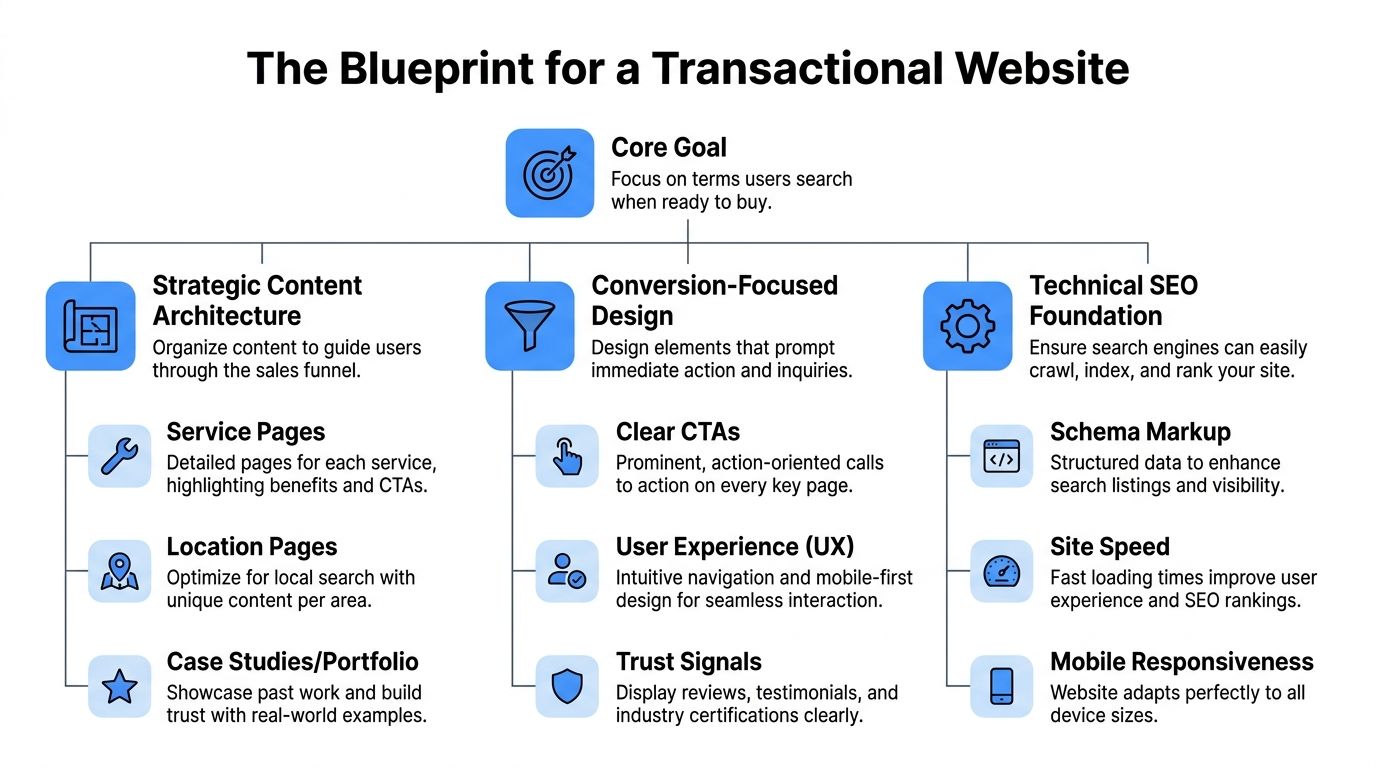
Start with service silos
A transactional website is organized by what people buy, not by how your internal team talks about the business.
If you’re an HVAC company, don’t dump everything under one broad Services page. Build separate service hubs for core revenue lines.
A clean structure looks more like this:
- AC repair
- AC installation
- Furnace repair
- Furnace installation
- Indoor air quality
- Duct cleaning
- Emergency HVAC service
A dental office needs the same discipline:
- Emergency dentistry
- Dental implants
- Invisalign
- Cosmetic dentistry
- Teeth whitening
- Root canal treatment
Each service gets its own page because each service has its own buyer intent, search behavior, and conversion path.
Then map locations with intent
Most agencies botch this part. They either create one generic city page and call it local SEO, or they spin up thin duplicate pages that add no value.
Neither works for long.
Your service pages answer what you do. Your location pages answer where you do it. You need both, and they need to work together.
Here’s a practical model:
| Page type | Job |
|---|---|
| Homepage | Brand overview, core services, primary service area, main conversion paths |
| Service page | Rank for a specific service and convert that traffic |
| Location page | Build local relevance for a city or neighborhood |
| Service plus location page | Capture the most transactional combinations when justified |
| Case study or portfolio page | Support trust and reinforce topical relevance |
Build for AI readability from the start
AI optimization isn’t a separate layer. It starts in the page outline.
Large language models and AI-driven search systems work better with websites that are explicit. That means:
- Clear page purpose
- Straight headings
- Direct service descriptions
- Consistent location references
- Visible business facts
- Logical internal links
If your content rambles, hides key information, or mixes too many topics on one page, traditional search engines struggle with it and AI systems do too.
Write pages so a distracted human and a machine parser can both understand them in seconds.
That means no clever headline that hides the service. “Comfort starts here” is weak. “Emergency AC Repair in Plano” is useful.
Keep the conversion path obvious
A page can rank and still fail if the design doesn’t support action. Every key page needs the same core elements, but not in a rigid template.
Use these essential elements:
Primary call to action above the fold
Phone call, booking request, estimate form, or appointment button.Service-specific proof
Show that you do this exact job, not general business fluff.Local trust signals
Reviews, certifications, local service area mentions, and real photos.Fast next step
Don’t make people hunt for contact details.Internal links to adjacent pages
Service-to-location and location-to-service links help users and crawlers.
Don’t ignore security and site integrity
Service businesses get hacked, forms break, plugins age out, and nobody notices until leads disappear. Security is not a side concern. It protects rankings, lead flow, and trust.
If you want a practical checklist, review these strong website security practices and apply them before launch, not after a problem.
The structure that usually works best
For most local service companies, this architecture is hard to beat:
- Homepage
- Main service category pages
- Detailed individual service pages
- Primary city pages
- Supporting service-area pages where justified
- About page
- Reviews or testimonials page
- Contact page
- Blog built around transactional support topics
- FAQ sections embedded where relevant
That’s not flashy. It’s effective.
A good website design for service company brands doesn’t try to impress other marketers. It makes your site easy to crawl, easy to understand, and easy to convert. That’s how you build a site that can compete for page-one terms instead of sitting online as a dead asset.
Designing Pages That Convert Searchers Into Customers
The visitor landing on your page usually isn’t doing research for fun. They have a problem, they want it fixed, and they’re deciding whether to trust you or call someone else.
That decision happens fast.
Targeted redesigns built around conversion have produced a 156% increase in contact form submissions and a 234% growth in mobile conversion rates through clear problem-first messaging and easier next steps, as shown in Phi Web Studio’s service website design analysis.
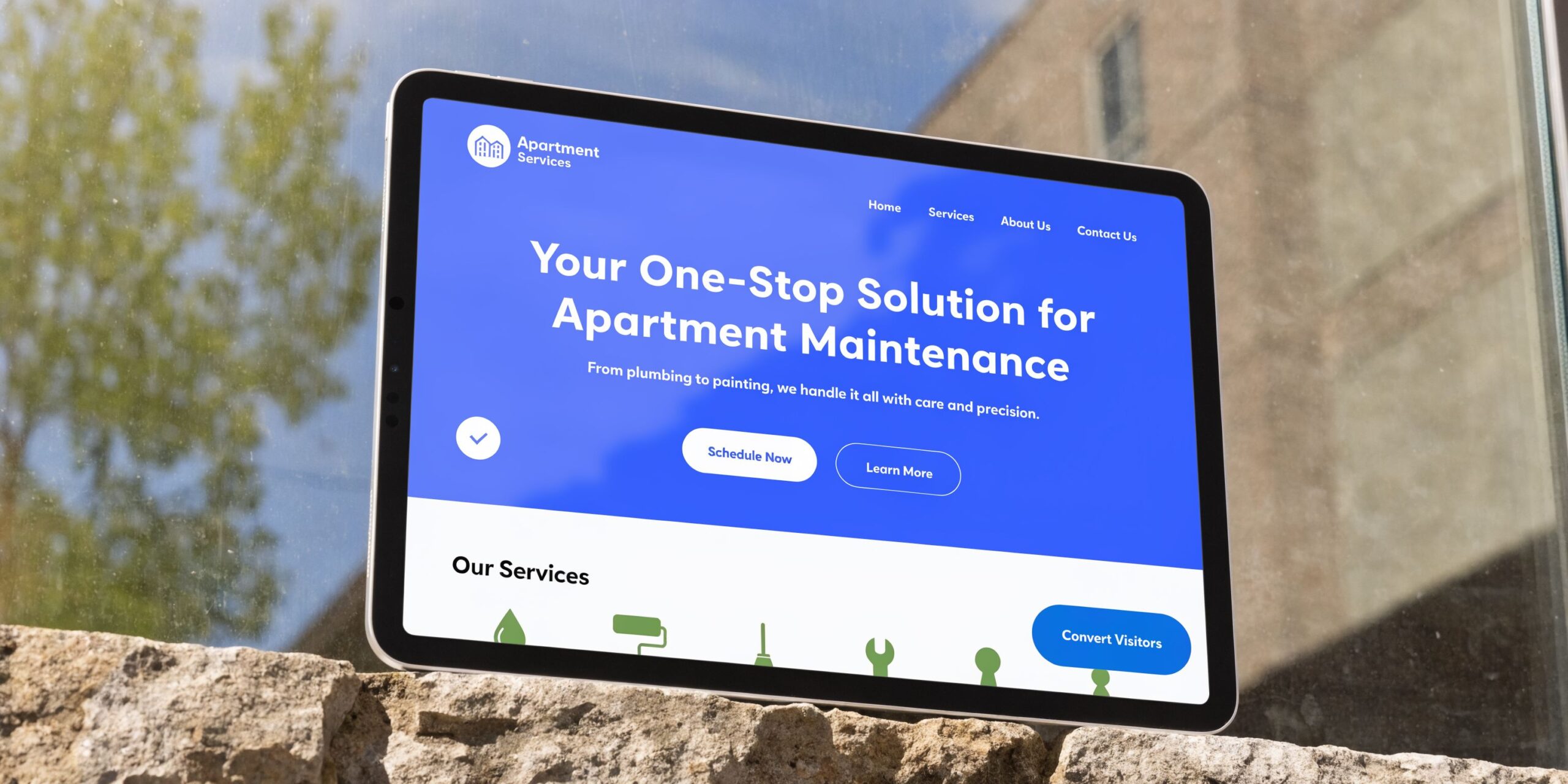
Lead with the problem, not your company history
Most service pages open with weak copy. “Welcome to our family-owned company.” “We’ve proudly served the area.” “Quality service you can trust.”
That’s filler.
A better page opens with the problem the searcher already has in their head.
If the keyword is termite inspection, the page should speak to hidden damage, urgency, and the need for a professional inspection. If the keyword is emergency dentist, the page should address pain, broken teeth, swelling, and immediate availability.
The first screen should answer three things:
- What you do
- Where you do it
- What the visitor should do next
The anatomy of a service page that works
Here’s a reliable structure for high-intent pages.
| Section | What it should do |
|---|---|
| Hero area | Match the search query with a direct headline and immediate CTA |
| Problem section | Show you understand the issue and consequences |
| Solution section | Explain how your service solves that exact problem |
| Trust section | Add reviews, certifications, guarantees, or real project proof |
| Process section | Reduce uncertainty by showing what happens next |
| FAQ section | Handle common objections and support AI readability |
| Bottom CTA | Give one clear next step with no friction |
That’s the base model. You can adapt it by industry, but don’t abandon the sequence.
Home service example
For a plumbing page targeting “water heater repair [city],” your headline shouldn’t be cute. It should be literal.
Use something like:
- Water Heater Repair in [City]
- No Hot Water Call for Fast Water Heater Repair
- Book Water Heater Service Today
Then support it with proof and action:
- Click-to-call button
- Short estimate form
- Service-area mention
- Repair-specific testimonials
- FAQs on repair versus replacement
Dental example
For “emergency dentist [city],” the user is often stressed, in pain, and on mobile.
Your page needs:
- Immediate appointment CTA
- Reassurance about urgent issues
- List of emergency problems treated
- Insurance or payment clarity if applicable
- Visible address, phone, and hours
- A mobile-first layout with no clutter
CTA language matters more than most designers admit
“Learn More” is weak on a transactional page.
Use direct language that matches buying intent:
- Call Now
- Book Your Appointment
- Get Help Today
- Request an Estimate
- Schedule Service
- Talk to a Technician
These aren’t cosmetic choices. They frame action.
Operator mindset: Every button should answer the question, “What does the customer want to do right now?”
Trust signals need to be close to the ask
A lot of websites bury their best proof on separate pages. That’s a mistake.
When a visitor is near a contact form or booking button, that’s exactly where they need reassurance. Put trust signals near the point of conversion.
Use a mix of:
- Local reviews
- Before-and-after project visuals
- Team photos
- Licenses or certifications
- Insurance badges
- Years in business, if you choose to state them without unsupported numbers
- Neighborhood or city references
Keep them real. Generic stock badges and anonymous quotes don’t help.
Mobile design decides whether leads happen
Most service searches happen in moments of need. The visitor is in a driveway, at work, in a waiting room, or standing in a hot house with a broken AC.
That’s why your mobile experience has to do these things well:
- Load fast
- Keep forms short
- Show a sticky call button
- Use readable headings
- Avoid giant text blocks
- Place the CTA before the scroll gets deep
If your mobile page requires pinching, hunting, or patience, you’re losing booked jobs.
A lot of business owners improve conversions by tightening the page structure and removing junk elements. If you want a more detailed breakdown of what to fix, this guide on how to improve website conversion rate is worth reviewing.
What to remove from service pages
Some elements actively hurt conversion.
Cut these first:
- Slider banners: They distract and usually hide the main CTA.
- Long company intros: Visitors care about their problem first.
- Multiple competing buttons: One primary action beats four weak options.
- Generic stock imagery: It lowers trust.
- Paragraph walls: People skim. Design for that reality.
A quick page test
Open one of your service pages and answer these questions in under ten seconds:
| Question | If the answer is no |
|---|---|
| Can I tell what service this page offers? | Your headline is too vague. |
| Can I tell where you offer it? | Local relevance is weak. |
| Can I find the next step instantly? | Your CTA placement is wrong. |
| Can I trust this company quickly? | Your proof is too thin or buried. |
If the page fails that test, redesign it.
The best website design for service company growth is not artistic first. It’s functional first. It meets search intent, removes hesitation, and makes taking action feel obvious.
How Your Website Fuels Google Maps Dominance
A homeowner searches “water heater repair near me,” taps the map pack, compares three listings, then clicks through to the websites. One site shows the exact service, the exact city, proof from local jobs, and a clear way to call. The other two are vague. Google notices the same difference your customer does.
Your website strengthens or weakens your Google Business Profile. It confirms what you do, where you do it, and whether your business deserves visibility for high-intent local searches. If you want map pack rankings that turn into calls, build your site to support transaction-driven local relevance at the page level.
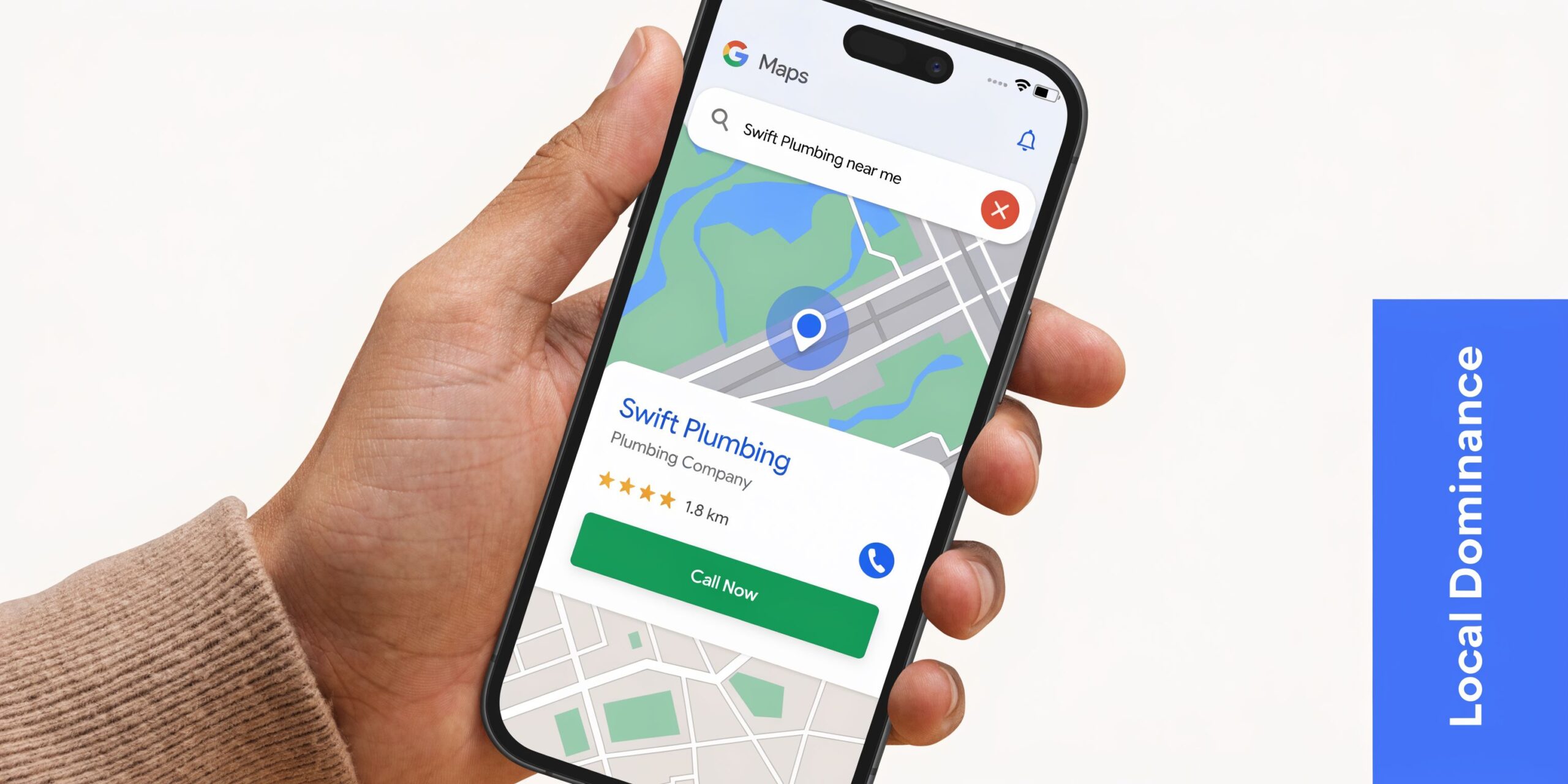
Generic web design advice misses the core issue. Service businesses need a site structure that helps Google connect services, locations, and buyer intent. That matters even more for companies targeting multiple cities or neighborhoods. Design in DC touches on this in its discussion of service business website structure, but the bigger point is simple. Your website has to function like a local ranking system, not a digital brochure.
Your website gives your map listing depth
Your Google Business Profile can get you in the game. Your website helps you win.
Google uses your site to confirm:
- Your primary services
- Your core city and surrounding service areas
- Consistent business identity
- Topical depth around the work you want
- Clear alignment with local buying intent
If your GBP targets “roof repair” but your site barely mentions roof repair in the cities you serve, your local relevance is thin. If your site has dedicated service pages, city pages, internal links, and proof tied to those terms, your listing gets stronger support.
Build location pages with a business case behind them
Location pages work when they reflect real demand and real operations. They fail when owners crank out city clones and hope Google won’t notice.
Create a location page when the city matters to revenue, search volume, or service coverage. Then make that page useful. It should include the target city in the headline, copy tied to problems customers in that area have, links to related services, trust signals, and one clear next step.
A strong city page should also match how people search. If you offer emergency plumbing in three priority cities, connect those city pages to the matching emergency plumbing service page. That is how you build a transactional website. You create page relationships around buying intent, not vanity traffic.
A good local page reads like it was written by a company that works there every week.
Structure wins in multi-area markets
Service businesses that cover many neighborhoods need a clean page hierarchy. Sloppy expansion creates cannibalization, thin pages, and weak local signals.
| Business type | Recommended approach |
|---|---|
| Single-location service business | One strong core site, plus city and service support pages |
| Multi-location brand | Separate location hubs for each office or verified operating base |
| Service-area business without storefront traffic | City-targeted pages connected to service pages and local intent |
Do not force the homepage to rank in every city. Give the homepage a clear primary market. Use service pages, city pages, and service-area combinations to expand intelligently.
Clean up the trust signals on your own site
Bad NAP data still causes avoidable problems.
Check every place your business details appear:
- Header and footer
- Contact page
- Schema markup
- Google Business Profile
- Location pages
- Map embeds
- Citation references
One old phone number or inconsistent suite format might not tank rankings by itself. Repeated inconsistency creates doubt. Google is trying to match entities. Your website should make that easy.
Internal links help Google connect the dots
Local pages should not sit alone.
Use internal links with intent:
- Link service pages to the cities where that service matters most
- Link city pages back to the matching money services
- Link the homepage to priority service areas
- Link supporting content to pages that drive calls and bookings
This structure helps search engines understand which pages support which terms. It also helps AI systems and LLM-driven search features interpret your local service footprint with less guesswork. That matters because the future of local SEO belongs to businesses that build clear, machine-readable topical and geographic relationships from the start.
If Google Maps is a serious lead source for your business, read this guide on how to rank higher on Google Maps.
What local service companies should stop doing
Three habits hold back map visibility:
- Using one generic Services page for everything
- Sending every city visitor to the same Contact page
- Publishing thin location pages with swapped city names and no local proof
Google Maps dominance starts with a website that validates your relevance by service, by location, and by intent. Build that foundation, and your listing has something real behind it.
Future-Proofing Your Site with AI and Technical SEO
A lot of business owners still treat SEO like a plugin, a checklist, or a blog task someone can tack on after the website goes live.
That model is old, and it’s getting weaker.
AI search systems and LLM-driven discovery favor websites that are clear, structured, factual, and technically sound. So if you’re serious about website design for service company growth, AI optimization has to be part of the build itself.

AI visibility starts with clarity
An AI system can’t trust a page that hides the service, muddies the location, or buries the answer under branding fluff.
The sites that tend to be easier for search engines and AI systems to interpret usually share the same traits:
- Plain-language headings
- Clean service definitions
- Specific local references
- FAQ sections tied to real customer questions
- Consistent business facts
- Logical page hierarchy
If you want your business surfaced in AI-assisted results, stop trying to sound clever and start trying to sound precise.
Structured content beats keyword stuffing
Old-school SEO focused too much on repeating phrases. Modern optimization is more about building pages that communicate entities, services, locations, and relationships cleanly.
That means your content should answer questions like:
| Question AI systems look for | What your page should show |
|---|---|
| What does this company do? | A direct service description |
| Where does it operate? | Clear city and service-area references |
| Who is this for? | Homeowners, commercial clients, patients, emergency cases, and so on |
| What action should the user take? | Call, book, request estimate, schedule consultation |
This is one reason FAQ sections matter. They give machines and humans explicit answers.
Technical SEO is not optional
If your site is slow, clunky on mobile, or unstable, your content has less room to win.
From the verified data, page load speeds are very important, and poor performance contributes significantly to global losses from slow-loading sites, as referenced in the earlier source-backed research. That matters for rankings, user patience, and conversion.
What matters most in practice:
- Fast page rendering
- Mobile responsiveness
- Clean code output
- Compressed images
- Secure HTTPS
- Stable navigation
- Reliable indexing structure
The future-proof website is not the fanciest website. It’s the one that search engines, AI systems, and busy customers can all process without friction.
Schema and content formatting help machines trust you
Schema markup won’t save a weak site, but it helps strong pages become easier to classify.
For service businesses, useful structured elements often include:
- Local business information
- Service descriptions
- FAQ content
- Review-related markup where appropriate
- Organization details
This supports traditional search and improves machine readability.
Your design choices affect AI optimization
Design is not separate from discoverability.
If your designer chooses hidden tabs, image-only text, vague section labels, or oversized animated blocks that delay content visibility, that decision affects search performance. It also affects whether an AI system can extract meaning from the page cleanly.
That’s why AI optimization belongs in the design brief, not in a rescue plan six months later.
If you want a deeper view of how search is shifting, study AI search engine optimization. It’s the right lens for where discovery is headed.
The practical standard going forward
A future-ready service site should be built to do these things at once:
- Rank for transactional searches
- Support local map relevance
- Feed clean information to AI systems
- Load quickly on mobile
- Convert attention into inquiries
That’s the new baseline.
If your site was designed only to look modern, it’s already behind. If it was built to communicate clearly, perform technically, and answer buyer intent fast, it has a real chance to keep winning as search changes.
From Launch to Leads Measuring What Matters
Work begins after your site goes live.
A transactional website should produce booked jobs, estimate requests, and qualified calls from people ready to hire. If you cannot see which pages, keywords, and service areas create revenue opportunities, you are guessing.
Plenty of service companies stare at traffic charts while the phone stays quiet. That is wasted attention. Measure buying behavior.
Track the actions tied to revenue
Start with outcomes that connect directly to jobs sold:
- Qualified phone calls from organic search
- Completed estimate, inspection, or appointment forms
- Booked jobs tied to specific service pages
- Ranking movement for transactional keywords
- Lead volume by city or service area
- Call and form conversion rate by landing page
- Mobile conversion rate on high-intent pages
Add source tracking from day one. Use call tracking numbers that preserve local trust, thank-you page tracking for forms, and page-level reporting in GA4 and Google Search Console. If your CRM can record first-touch landing pages, connect it. That closes the loop between rankings and revenue.
Build a scorecard you can act on
Skip the bloated dashboard. Review one monthly scorecard that forces a decision.
| Metric | Why it matters | What to check |
|—|—|
| Organic calls by service page | Shows which pages attract ready-to-book visitors | Which pages drove calls, and which got traffic with no calls |
| Form submissions by landing page | Exposes weak pages fast | High visits with low forms usually means weak copy, weak trust, or a poor CTA |
| Top transactional keyword movement | Tracks visibility where money is made | Terms like "water heater repair," "roof leak repair," or "emergency dentist" by city |
| City-level lead volume | Shows where local demand and page strength meet | Which service areas produce inquiries and which need better local relevance |
| Landing page conversion behavior | Identifies page-level conversion failures | Example: your "AC Repair" page gets 500 visits but only 2 calls, while your "Furnace Repair" page gets 200 visits and 8 calls. Audit the AC page's headline, CTA placement, reviews, and service-area proof |
| Mobile conversion rate | Service buyers often act on their phones | If mobile traffic is strong but calls are weak, check speed, sticky CTAs, and form friction |
| Branded vs non-branded leads | Separates existing demand from SEO growth | A site that only converts branded searches is not expanding market share |
One page can rank and still fail. One city page can get impressions and still produce nothing. That is why raw visibility never belongs at the top of your report.
Read performance like an operator
Patterns matter more than isolated metrics.
If a page gets impressions and clicks but few leads, fix conversion elements first. Tighten the headline, move the call button higher, shorten the form, add review proof near the CTA, and show clear service-area coverage.
If a city page barely earns impressions, address relevance. Add unique local details, connect it to the matching service pages, improve internal anchor text, and strengthen supporting signals from your GBP and citations.
If mobile users bounce on contact-heavy pages, handle the friction. Slow load times, oversized hero sections, hard-to-tap buttons, and long forms kill local conversions.
Good reporting should end with a work order. Page X needs a stronger CTA. City Y needs a better local page. Service Z needs supporting content and stronger internal links.
Fix the pages that change revenue first
Do not spread effort across the whole site. Start where one improvement can produce calls this month.
Use this order:
High-profit service pages with traffic but weak conversion
These are your fastest wins. If "emergency plumbing" gets visits and few calls, rewrite the top section, place the phone CTA above the fold, add financing or response-time info, and insert proof from real customers.Service-city pages ranking on page two or low page one
These pages are close. Improve internal links, tighten title tags and headings around the exact transactional term, and strengthen local trust elements.Pages with strong conversion but low visibility
These deserve more authority and expansion. If a page converts well, build supporting content and related city variants around it.Underperforming mobile pages
Compress images, cut visual clutter, simplify tap paths, and keep the primary CTA visible during scroll.
Use winners to build the next batch
The best service sites grow from repeatable patterns.
If "drain cleaning in [city]" brings qualified calls, build the same structure for "sewer line repair in [city]" and "hydro jetting in [city]." If one implant dentist page drives consultation requests, use that layout, trust stack, and CTA sequence for other high-intent treatments. Keep the template. Change the local proof, service specifics, FAQs, and entities so each page stays distinct.
This matters for AI visibility too. Pages that clearly map service, location, urgency, trust, and next action are easier for search engines and LLMs to interpret. The cleaner the structure, the easier it is to earn mentions, citations, and high-intent clicks from AI-assisted discovery.
Judge the site by booked work
A service company website is a live sales system. Review it every month. Cut weak elements. Expand what produces calls. Tie rankings to leads, and tie leads to pages.
That is how you measure website design for service company growth. By jobs won, not compliments.
If your service business needs a website that’s built to rank for transactional search terms, support Google Maps visibility, and stay discoverable in AI-driven search, Transactional LLC is built for that job. They focus on getting local companies found for the searches that lead to calls and booked work, then tracking the results with clear reporting instead of empty marketing talk.