

A search query is the exact phrase someone types into Google to solve a problem, and Google handles over 8.5 billion queries per day globally. For local service businesses, those words matter because approximately 46% of all Google searches have local intent, which means a huge share of searches are people trying to find a nearby business right now.
If your phone isn't ringing, your issue usually isn't that people don't need your service. It's that your business isn't showing up for the exact words they use when they need help. A homeowner doesn't search "premium exterior restoration solutions." They search "roofer near me", "emergency plumber open now", or "dentist near me".
That's what are search queries in practical application. They are the direct language of customer need.
Most business owners get this wrong because they think about branding first, service categories second, and buyer behavior last. Google works in the opposite order. It rewards relevance to the user's intent. If someone wants a fast answer and a phone number, Google will push map results, business listings, and pages that match that immediate need.
That shift matters more than ever because search is no longer just blue links. Search engines and AI systems interpret meaning, urgency, and location. If your website and Google Business Profile don't line up with the phrases your customers use, your competitors get the calls.
Why Your Phone Isn't Ringing and How Search Queries Can Fix It
A lot of service businesses have the same problem. The website looks decent. The logo is clean. The reviews are solid. But the leads are inconsistent, and the phone stays quiet longer than it should.
That usually comes down to one thing. You're not visible for the searches that signal buying intent.
Your customers are searching on mobile and making fast decisions
Search behavior has shifted hard toward mobile. Mobile devices now account for 71% of all Google search traffic, and 51% of smartphone users discover new companies or products during their searches according to this breakdown of Google search behavior. For a plumber, roofer, dentist, HVAC company, or pest control business, that's not a side channel. That's the main battlefield.
A person with a leaking water heater isn't sitting at a desktop doing academic research. They're on a phone. They're searching with urgency. They're scanning the map pack, reviews, hours, and the call button.
If your business isn't aligned with those searches, Google won't hand you that lead.
A search query is the bridge between demand and revenue
Search queries aren't abstract SEO jargon. They're the phrases real people use when they want something done. Think about these examples:
- Problem-first query like "ac not cooling house"
- Urgent local query like "emergency electrician near me"
- decision-stage query like "best dentist in [city]"
- high-intent action query like "roof repair near me"
Those phrases tell you what the customer needs, how fast they need it, and how close they are to spending money.
Practical rule: Stop building your online presence around what you call your service. Build it around what customers type when they need that service.
Most websites fail because they target broad industry words and ignore intent-rich phrases. Ranking for "roofing" isn't the goal. Ranking for the searches that produce calls is the goal.
If you're trying to understand the mechanics of getting your website on Google Search, start with the query itself. That's the trigger. Everything else follows from there.
Why this matters more than design, slogans, or social posts
Your homepage headline won't rescue a weak search strategy. Neither will random blog posts or a pile of social media updates. Search queries sit closer to revenue because they reveal active demand.
The business owner who understands search queries starts making better decisions fast:
- They build pages around services people request
- They optimize Google Maps for local buying terms
- They stop chasing vanity traffic
- They focus on searches that lead to calls, appointments, and booked jobs
That's the difference between marketing that looks busy and marketing that produces work.
The Language of Your Customer Search Queries Explained
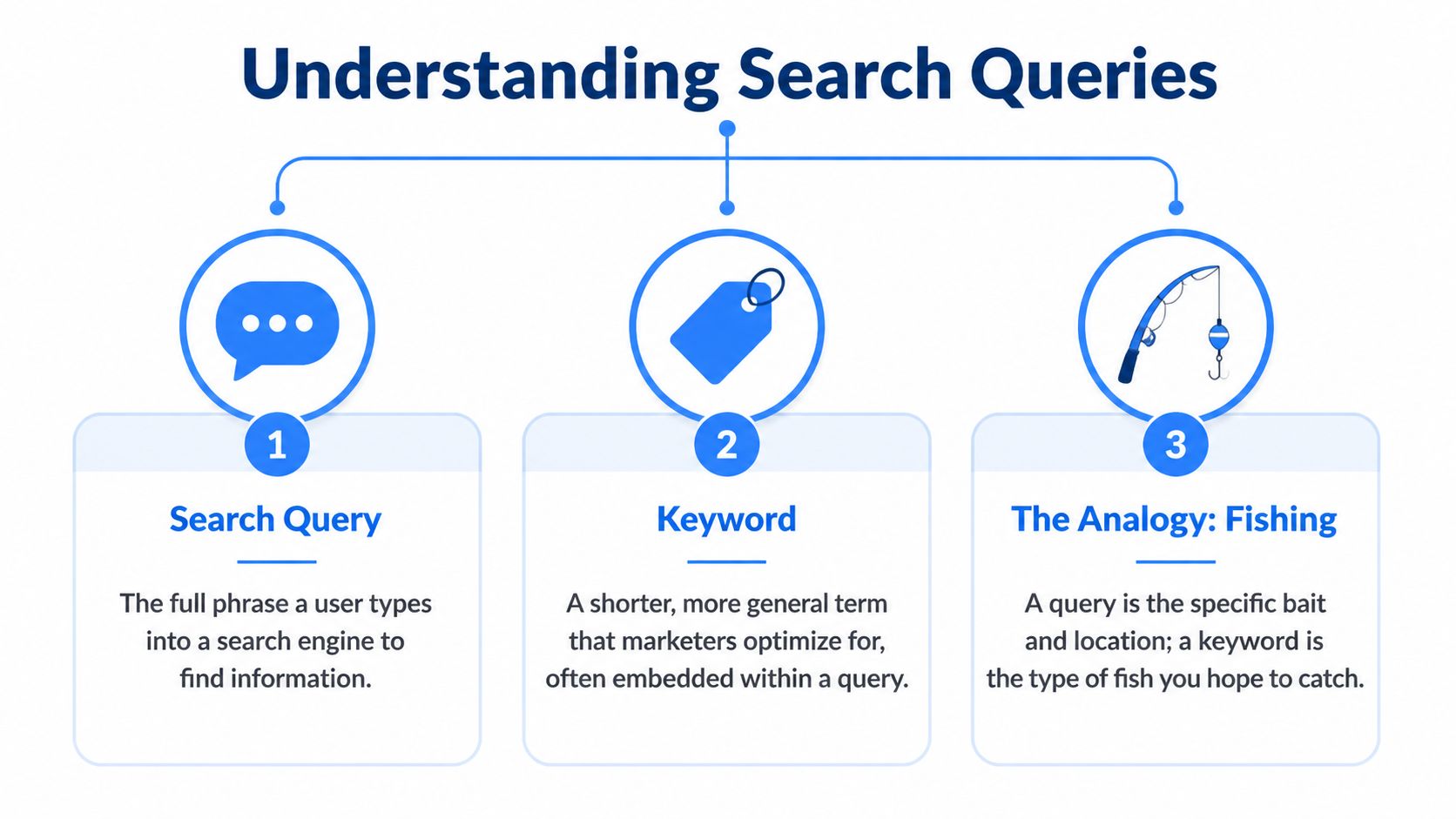
A search query is the full phrase a person types into a search engine. A keyword is usually the shorter concept inside that phrase.
If someone searches "how much does emergency tooth extraction cost", the query is the whole sentence. The keyword might be "emergency tooth extraction" or "tooth extraction cost." That distinction matters because Google doesn't rank pages based only on isolated words anymore. It interprets the full request.
Query versus keyword
The easiest way to understand this is to think like a customer, not like a marketer.
A business owner might say, "I want to rank for plumber." A customer rarely searches that way. They search with context, urgency, and specifics. They type things like:
- "plumber near me open now"
- "how to fix leaking pipe under sink"
- "water heater repair [city]"
- "best plumber for sewer line replacement"
Those are queries. The keyword is just one ingredient in the sentence.
Google reads meaning, not just words
Modern search engines use language processing to break queries into meaningful parts and interpret intent. That's why a page can rank for related searches even if the exact wording changes. Google understands that "fix leaking sink" and "dripping faucet repair" are closely related in meaning.
That matters because most business owners still optimize like it's 2010. They stuff one phrase into a page title and expect results. That approach is outdated.
The better move is to build pages around customer problems and action phrases. If you want a deeper outside perspective on how to boost traffic and revenue, that piece is useful because it connects search strategy to business outcomes instead of treating SEO like a checklist.
Most searches aren't equal in value
Google processes over 8.5 billion queries daily, but the value of those queries isn't evenly distributed. 69.60% are informational, while a smaller share reflects the commercial and transactional intent that local businesses require, according to Uberall's analysis of Google search behavior.
That means one of the biggest mistakes in SEO is chasing traffic without asking a basic question. Does this query bring a buyer, or just a browser?
Here's the working framework I use:
- Informational query means the person wants to learn
- Navigational query means they want a specific brand or site
- Transactional query means they want to act
- Local query means they want someone nearby
If you're serious about ranking the right phrases, this guide to keyword research best practices helps connect the query language people use to the pages you should build.
Search queries are customer language in raw form. If you ignore that language, you force Google to guess what you do. That's a bad strategy.
The businesses that win search don't just target terms. They match intent, location, and urgency.
Decoding the Four Types of Customer Search Intent
Not every search deserves the same attention. Some searches build awareness. Some produce nothing. Some turn into calls within minutes.
If you want revenue, you need to separate curiosity from intent.
The four intent types that matter
Most search queries fall into four practical categories for service businesses.
Informational intent is research. The person wants an answer, not a provider yet. A roofer might see searches like "how long does a roof last" or "signs of hail damage on shingles."
Navigational intent is brand-seeking behavior. The person already knows who they want. They search your business name, a competitor's name, or a branded service page.
Transactional intent is where buying behavior shows up. These searches often include action words, service names, price language, urgency, or strong commercial phrasing.
Local intent overlaps with the others but adds geography or proximity. That's where map pack visibility becomes a lead-generation asset, not just a branding asset.
Search Query Intent Comparison for Service Businesses
| Intent Type | Customer Mindset | Example (for a Roofer) | Business Value |
|---|---|---|---|
| Informational | Learning, comparing, diagnosing a problem | "how to tell if roof has hail damage" | Useful for authority, weaker immediate lead value |
| Navigational | Looking for a specific company or brand | "ABC Roofing reviews" | Valuable for branded demand and reputation control |
| Transactional | Ready to act, book, call, or request service | "roof repair estimate" | High value because the searcher is close to hiring |
| Local | Wants a nearby provider now | "roofer near me" | Highest practical value for map pack calls and fast conversions |
Local intent drives direct contact
This is why local SEO isn't optional for service businesses. Approximately 46% of all Google searches have local intent, and around 60% of smartphone users have contacted a business directly from the search results, often through a Google Business Profile listing, according to the University of Michigan analysis of search query behavior.
Those numbers tell you exactly where calls come from. A big share of searchers want a nearby business, and many of them never visit a website before taking action.
That changes how you should think about your online presence.
- Your Google Business Profile isn't a side listing. It's often the first conversion point.
- Your service pages need local relevance. Generic copy won't win local intent.
- Your reviews, hours, and call options matter. Searchers make decisions fast.
The map pack often acts like the new homepage for a local service business.
Not all traffic deserves equal effort
A lot of SEO campaigns fail because they mix all search intents together and treat them as equal. They aren't.
If you're a dental office, "what causes tooth sensitivity" can help you build trust. But "dentist near me accepting new patients" is closer to revenue. If you're an HVAC company, "how does central air work" has a place. But "air conditioning repair near me" is the one that can turn into a same-day job.
Many business owners waste months publishing educational content, then wonder why traffic doesn't convert. The answer is simple. They built for attention, not action.
If you want a broader reference point on classifying intent, these keyword intent resources are worth reviewing. Then come back to the practical rule that matters most for local service companies: prioritize the searches that signal urgency, location, and willingness to hire.
How to think about intent in plain English
Use this test when you evaluate any query:
- Is the person trying to learn something?
- Are they trying to find a specific company?
- Are they trying to hire someone?
- Do they want that someone nearby?
The more your answer moves toward hiring and proximity, the more valuable the query becomes.
That doesn't mean informational content is useless. It means you shouldn't confuse support content with money pages. The businesses that dominate local search know the difference.
Why Transactional Queries Are Your Business's Goldmine
Transactional queries are where revenue lives. These are the searches people make when they need a solution and are ready to move.
If someone types "air conditioning repair near me", they aren't casually browsing. They have a problem. They want it fixed. They want a company they can call now.

These searches come with money in hand
This is the simplest way to understand transactional intent. The searcher has money in hand. They may not be holding physical cash, but they are ready to spend.
That makes these queries different from educational searches. A person searching "what is a root canal" is gathering information. A person searching "emergency dentist near me" is trying to solve a painful problem immediately.
For local service businesses, the highest-value transactional searches usually include one or more of these elements:
- Service phrase like "roof repair" or "AC replacement"
- Urgency modifier like "emergency," "same day," or "open now"
- buyer language like "cost," "quote," "estimate," or "book"
- location cue like a city name or "near me"
Why near me terms convert so well
The strongest signal in local search is often proximity language. Search queries containing "near me" have a 2.5 times higher conversion rate in home services, and for these high-intent local searches, zero-click searches can exceed 50%, which means many users act straight from the map pack or business profile instead of visiting a website first, based on this search intent and content analysis.
That means top-three map visibility isn't a vanity win. It's a call-generation channel.
If you rank in the map pack for "plumber near me," "dentist near me," or "pest control near me," you're in front of people who want to act now. If you don't, someone else gets the first call.
Bottom-line view: Transactional queries don't just bring traffic. They bring the kind of visitor who is already trying to hire someone.
Google rewards immediate-answer businesses
When Google detects strong buying intent, it doesn't want to send the user on a scavenger hunt. It surfaces listings with clear categories, nearby relevance, reviews, and obvious contact options. That's why Google Business Profile optimization is tied so closely to transactional performance.
A weak profile loses money in quiet ways:
- Wrong category selection
- thin service descriptions
- missing service areas
- poor review velocity
- incomplete hours or phone details
Each of those gaps makes it harder for Google to trust your listing for a high-intent query.
This short video gives a useful look at how search behavior and visibility connect in practice.
Own the decision moment
You don't need to win every search. You need to win the searches that happen right before a decision.
For a roofer, that might be "roof leak repair near me."
For a chiropractor, "chiropractor near me for back pain."
For an orthodontist, "Invisalign consultation [city]."
Those searches are gold because the person isn't asking for theory. They're asking for a provider.
If your website, landing pages, and map listing are built around those exact patterns, your marketing starts acting like a sales system instead of a brochure.
How to Discover the Exact Queries Your Customers Use
You don't need to guess what your customers search. Google already gives you clues. Most business owners just never look in the right places.
The fastest wins usually come from query data you already own.

Start with Google Search Console
Google Search Console is the first tool I check because it shows the actual queries that triggered your site in search. Open the Performance report and review your queries, pages, impressions, clicks, and average position.
You're looking for patterns, not just rankings.
For example, if you own a dental practice and Search Console shows impressions for "emergency dentist saturday [city]" but you don't have a page that directly addresses that need, that's an opportunity. If you're an HVAC company and you keep showing up for "AC repair cost [city]" with weak click-through, your title or page angle probably needs work.
A strong starting point is this walkthrough on how to set up Google Search Console. If you haven't connected it, do that before you spend another dollar on SEO.
Find underserved queries your competitors ignore
One of the best opportunities in local SEO comes from underserved search queries. These are long-tail phrases with clear buying intent that bigger competitors often overlook. A classic example is a query like "emergency dentist open sunday [city]". As explained in this article on underserved queries, tools like Google Search Console can help uncover these niche searches that carry strong lead-generation potential.
These are the queries I like most because they often reveal urgency plus specificity.
Look for combinations like:
- Service plus time such as "after hours," "weekend," or "same day"
- Service plus problem such as "broken tooth," "roof leak," or "no AC"
- Service plus location such as a city, neighborhood, or "near me"
- Service plus qualifier such as "best," "cheap," "open now," or "accepting new patients"
These queries may not look glamorous in a dashboard. They look profitable in real life.
If a query sounds like something a stressed customer would type on a phone, pay attention to it.
Use Keyword Planner and your own listing data
Google Ads Keyword Planner is still useful for expanding your list. You can enter core services like "water heater repair," "pest control," or "Invisalign" and surface related variations. Don't obsess over broad volume terms. Focus on modifiers that reveal urgency and buyer intent.
Then check your Google Business Profile insights. Review how people find your listing and what actions they take. If people discover you through branded searches but not service-led discovery, your profile probably isn't optimized well enough around non-branded transactional phrases.
A practical workflow that works
Use this process every month:
- Pull top queries from Search Console. Identify terms getting impressions without strong clicks.
- Highlight urgent local phrases. Anything with location, service, problem, or scheduling language deserves attention.
- Check if you have a matching page. If not, build one.
- Review your business profile content. Make sure your services and descriptions reflect those phrases naturally.
- Track what leads to calls. Queries are only valuable if they connect to real business outcomes.
A lot of SEO reporting hides the most important truth. The best terms aren't always the biggest terms. They're the ones closest to action.
Turning Query Data into Booked Jobs and Patients
Finding the query is only half the job. The money comes from turning that query into the right page, the right listing signal, and the right conversion path.
Many businesses falter at this point. They collect search data, then do nothing useful with it.
Build service silos around real demand
If you keep seeing related searches around one service category, don't scatter them across random blog posts. Build a proper silo.
Say you're an HVAC company. If query data shows interest around AC repair, refrigerant leaks, frozen coils, and emergency cooling issues, those belong in one connected service cluster. Your main AC repair page should sit at the center, supported by tightly related pages that answer specific problems and link back to the money page.
That structure helps in two ways. It tells Google what your site is authoritative on, and it gives the visitor a cleaner path from problem to action.
Put the same language into your Google Business Profile
Your Google Business Profile needs to reflect the same demand signals your website targets. If customers search "emergency plumber near me," your profile shouldn't read like a generic company brochure.
Use your actual service language in the places that matter most:
- Primary and secondary services should reflect the work you want to win
- Business description should mention core services and location naturally
- Posts and updates should reinforce seasonal or urgent service demand
- Q&A content should answer practical buying questions customers ask before calling
This is especially important for local intent because the business profile often handles the conversion before the website ever gets a chance.
A page can rank and still lose. A profile can show up and still fail. Visibility only matters if the listing makes calling easy.
Rewrite your pages around customer wording
A lot of service pages are written from the owner's point of view. That's a mistake. The page should mirror the customer's wording and decision stage.
Weak page headline: "Climate Control Solutions"
Better page headline: "AC Repair in [City]"
Weak subheading: "Our Experienced Team Delivers Quality Service"
Better subheading: "Fast Help for No-Cool AC Systems, Frozen Units, and Warm Air Problems"
This isn't about dumbing down your copy. It's about matching how people search and how they decide.
On-page updates should include:
- Title tags built around the main service query
- H1 and H2 headings that reflect real customer phrasing
- body copy that answers the problem directly
- clear CTAs with phone-first action language
- internal links that connect related service intent
If your site gets traffic but doesn't convert, this guide on how to improve website conversion rate is a smart next read because rankings alone won't carry the business.
Make AI search and traditional search work together
AI-driven search systems and large language models still rely on clear signals. They pull from pages that are specific, well-structured, and obviously relevant to the query. That means vague service pages are even more dangerous now.
The pages that work best tend to do three things well:
- State the service clearly
- Tie it to a place and a problem
- Make the next action obvious
If your page can answer both a search engine and a stressed homeowner in seconds, you're on the right track.
Your Path to Page One Dominance in 30 Days
What are search queries really? They are buying signals, problem signals, and location signals wrapped into a few words. If you know how to read them, you stop guessing and start building around demand that's already in the market.
That's why a lot of local SEO advice falls flat. It talks about traffic in the abstract. Service businesses don't need abstract traffic. They need calls, appointments, and booked work.
The businesses that win do a few things better
They don't chase every keyword. They focus on high-intent, service-led, local phrases.
They don't treat Google Maps as an afterthought. They treat map visibility like a front-line sales channel.
They don't publish pages because a content calendar says so. They publish pages because search query data shows real demand.
If you want a broader outside framework, this guide to local SEO strategies is a helpful reference. The key is applying that thinking with discipline to the searches that produce revenue.
The practical path is simple
The mechanics aren't mysterious:
- Identify the exact queries customers use
- Separate research intent from buying intent
- Build pages for transactional services
- Optimize your Google Business Profile for local action
- Track calls, clicks, and booked jobs tied to those queries
That's the path to page one visibility and map pack performance. Not hype. Not vanity metrics. Execution.
Businesses that focus on transactional search terms usually see results faster because they align with what Google is already trying to do. Google wants to give users the fastest, most relevant answer. If your business becomes that answer, your visibility improves and your lead flow follows.
You can keep guessing which phrases matter, or you can build around the phrases your customers already type when they need help now.
If you want help turning query data into rankings, map pack visibility, and more booked work, talk to Transactional LLC. They help local service businesses target transactional search terms, strengthen Google Maps performance, and build conversion-focused SEO systems that turn searches into calls.