


Some weeks your schedule is slammed. Other weeks the front desk is staring at a half-empty calendar, hoping old patients rebook and a few referrals trickle in. That feast-or-famine cycle is what happens when a chiropractic practice relies on chance instead of a patient acquisition system.
Most chiropractors don't need “more marketing.” They need better digital marketing for chiropractors, built around one thing: transactional intent. That means showing up when someone searches with money in hand and pain they want solved now. Searches like “chiropractor near me,” “back pain chiropractor in [city],” or “same day chiropractor for neck pain” are not casual browsing. They are buying signals.
Most clinics make a fundamental mistake. They chase likes, post random wellness tips, and celebrate traffic that never turns into calls. None of that matters if the phone doesn't ring and appointments don't get booked.
The right system is simpler than most agencies make it sound. Win local search. Build a site that converts. Create pages around the conditions and symptoms people search. Run paid campaigns only where intent is high. Track calls, forms, and booked visits. Then tighten retention so every new patient is worth more.
The End of Unpredictable Patient Flow
Unpredictable patient flow isn't a branding problem. It's usually a search visibility and conversion problem.
A chiropractor who depends on referrals alone is stuck waiting for demand to appear. A chiropractor who dominates transactional search terms controls more of that demand. That's the difference between hoping people need care and being visible the second they start looking for it.
The clinics that grow consistently don't try to be famous online. They try to be easy to find and easy to book for the exact searches that signal intent. If someone types “chiropractor near me” or “sciatica relief chiropractor [city],” your practice should appear in the map pack, in the organic results, and on a landing page that gives them a fast path to call or schedule.
Practical rule: If a marketing activity doesn't increase qualified calls, appointment requests, or booked visits, it's a distraction.
That no-nonsense view matters even more in healthcare operations. Getting new patients is only half the battle. If billing friction and denied claims slow down cash flow, growth gets messy fast. Practices that want tighter operations should also look at ways to reduce claim denials using RCM, because stronger marketing and cleaner revenue cycle performance work better together.
What transactional intent actually means
Transactional intent is simple. The searcher isn't researching the history of chiropractic care. They want help now, in a location near them, from a provider they can trust enough to contact quickly.
That changes everything about your strategy:
- Your Google Business Profile matters more than your Instagram feed
- Your service pages matter more than generic blog posts
- Your click-to-call setup matters more than website awards
- Your conversion tracking matters more than raw traffic
This is the core shift in digital marketing for chiropractors. Stop treating marketing like awareness theater. Start treating it like a patient acquisition machine.
Dominate Local Search with Google Business Profile
Your Google Business Profile is your most important local asset. It isn't just a listing. It's the profile patients judge before they ever visit your website.
That matters because local search behavior is brutally direct. 76% of people who search for something nearby on their smartphone visit a business within a day, and 28% of those searches result in a purchase, according to Cardinal Digital's summary of Google local search behavior. If you're a chiropractor, that means map visibility can drive action immediately.
Start with the structure below and fix every weak point.

Set the foundation correctly
A weak profile sends mixed signals to Google and to patients. A strong one makes both trust you faster.
- Accurate NAP details. Your business name, address, and phone number need to match everywhere they appear online. Inconsistency creates confusion and weakens local trust signals.
- Primary and secondary categories. Choose the most accurate chiropractic category first, then add supporting categories only if they fit your services.
- Hours and holiday updates. Wrong hours create missed calls, bad reviews, and lost patients.
- Service menu completion. Add condition and treatment-related services so Google has more context about what your practice does.
For a deeper technical walkthrough, use this Google Business Profile optimization guide to tighten the fundamentals.
Write for search intent, not for yourself
Most clinics waste the business description field on bland copy about compassionate care. Patients assume you care. They want to know whether you help with the condition they have.
Use your profile description to mention the types of problems you treat and the areas you serve. Keep it natural. Don't stuff keywords. Focus on real patient language such as back pain, neck pain, sciatica, whiplash, posture issues, and sports injury support if those fit your practice.
A complete profile doesn't win because it's “optimized.” It wins because it answers the patient's silent question: “Can this clinic help me, and can I contact them right now?”
Use visuals and Q&A to remove friction
Photos matter because people judge legitimacy fast. Upload clean exterior photos, lobby photos, treatment room photos, team photos, and branded signage. Patients want proof that the clinic is real, current, and professional.
Use the Q&A section like a conversion asset, not an afterthought. Seed common questions and answer them clearly:
| Patient concern | Better Q&A topic |
|---|---|
| Unsure whether you treat their issue | Do you help with sciatica, neck pain, or headaches? |
| Wants fast access | Do you offer same-day appointments? |
| Hesitates to call | Can I book online? |
| Needs reassurance | What should I expect on my first visit? |
Video also helps clarify what a strong profile looks like in practice.
Reviews and posts are not optional
Reviews build trust and reinforce local relevance. Posts keep the profile active and give you another place to highlight services, promotions, availability, or educational content. Don't overthink them. Consistency beats creativity here.
If you want more calls from local search, your Google Business Profile needs to look alive, accurate, and clearly tied to the transactional terms patients use.
Build a High-Converting Chiropractic Website
Most chiropractic websites are brochures with a booking button taped on. That's not enough.
Your website has one job: turn existing attention into action. If someone lands on your site from Google Maps, organic search, or a paid ad, they should know within seconds what you treat, where you're located, and how to book. Anything that slows that down costs you patients.
With an average chiropractor receiving 500–1,000 website visitors per month, conversion optimization becomes critical, as noted in The Smart Chiropractor's digital marketing guide. When traffic is finite, small gains in call tracking and appointment-form completion can materially change lead volume.
What a chiropractic homepage must do
Forget clever design trends. A chiropractic homepage should act like a receptionist who answers the right questions quickly.
It needs these elements above the fold or close to it:
- A clear headline that says what you do and where
- A visible phone number that's tap-to-call on mobile
- A primary CTA such as Book Appointment or Schedule Consultation
- Trust signals like reviews, credentials, patient testimonials, or short video explainers
- A path to high-intent service pages for conditions and treatments
If you're using a WordPress build, this guide for Elementor users on CRO is a useful reference for tightening layout and call-to-action flow without rebuilding the whole site.
Build for mobile and frictionless action
A lot of chiropractic searches happen on mobile when someone is uncomfortable, busy, or trying to solve a problem quickly. Long forms, cluttered menus, and vague service navigation kill conversion.
Use a practical checklist:
- Tap targets must be obvious. Phone number, booking button, and directions should be easy to hit with one thumb.
- Forms must be short. Ask only for what your front desk needs to respond.
- Service pages must load cleanly. Don't bury core information under sliders and animations.
- Navigation must be simple. Conditions, treatments, locations, and contact should be easy to find.
If your current site looks decent but underperforms, use this website conversion rate improvement resource to audit the flow from visit to call.
Your website doesn't need more pages. It needs fewer dead ends.
What to remove from a low-performing site
Many practices keep adding content while ignoring the obvious leaks. Start cutting what hurts conversion.
- Generic welcome copy. Patients don't care that you're passionate about wellness if they can't tell whether you treat their issue.
- Stock imagery overload. Real clinic photos build more trust than staged lifestyle shots.
- Buried contact options. If the phone number is only on the contact page, you're making people work too hard.
- One-size-fits-all service copy. Separate pages for meaningful conditions and services convert better than one giant “services” page.
Good websites don't impress other marketers. They make the next step obvious for patients.
Create Content Silos for Transactional Patient Queries
Most chiropractic content is too broad to win serious search intent. A generic blog post titled “Benefits of Chiropractic Care” won't dominate the searches that lead to appointments. You need content silos built around conditions, symptoms, and treatment intent.
That's especially important because one of the biggest gaps in digital marketing for chiropractors is patient-intent segmentation. Most advice doesn't separate acute pain searches from wellness searches, even though those patients behave differently, as explained in Your Ideal Patients' chiropractic marketing overview.
Someone searching for same-day relief is not in the same mindset as someone exploring posture improvement. If you send both to the same generic page, you lower your chances of conversion.

Use a condition-first structure
Here's the right way to think about a silo. Pick one major condition category, then build a cluster around the actual ways patients search.
Take sciatica treatment as an example. The silo should include:
- A main pillar page for sciatica treatment
- A local variant such as sciatica chiropractor in your city
- Supporting pages for related concerns like lower back pain with leg pain
- FAQ content around first visit expectations, urgency, and treatment approach
- Symptom-based articles that connect back to the main treatment page
A planning framework helps. This SEO content planning resource is useful for mapping pillar pages, support pages, and internal links without turning your site into a content junk drawer.
Match content to patient intent
Not every query deserves the same page type. That's where most clinics lose the plot.
Acute intent pages
These serve the patient who wants help now.
Examples include:
- Chiropractor for severe neck pain
- Same-day chiropractor for back pain
- Sciatica relief chiropractor near me
- Chiropractor open today in [city]
These pages should be conversion-heavy. Put the phone number high on the page. Use strong CTAs. Include location relevance and immediate booking options.
Research intent pages
These support the patient who is comparing options and needs confidence.
Examples include:
- Can a chiropractor help with sciatica
- What causes lower back pain down the leg
- First chiropractic visit for sciatica
- How long does chiropractic care for sciatica take
These pages should educate clearly, then funnel the visitor toward the main service page or booking path.
Wellness intent pages
These attract patients thinking long term.
Examples include:
- Posture correction chiropractor
- Chiropractic care for mobility
- Wellness chiropractor in [city]
- Preventive chiropractic care near me
These still matter, but they shouldn't dilute your acute-intent strategy.
If every page on your site sounds like it was written for “everyone,” none of it will rank well for the patients who are ready to book.
Write for AI search as well as traditional search
Large language models and AI-assisted search tools don't just look for keywords. They look for clear structure, topical depth, and answerable content. That makes silos even more valuable.
A strong chiropractic silo helps your site in both environments because it creates:
| AI and SEO signal | What that looks like on a chiropractic site |
|---|---|
| Topic depth | Multiple pages around one condition |
| Clear hierarchy | Main condition page supported by symptom and FAQ pages |
| Entity relevance | Repeated association between your clinic, service area, and condition |
| Answer quality | Concise explanations written in patient language |
Voice search fits this model too. Patients don't always type clean keywords. They ask things like, “Who's the best chiropractor near me for sciatica?” or “Can I see a chiropractor today for neck pain?” Your content should answer those natural-language variations.
Launch Paid Ads for Immediate Patient Leads
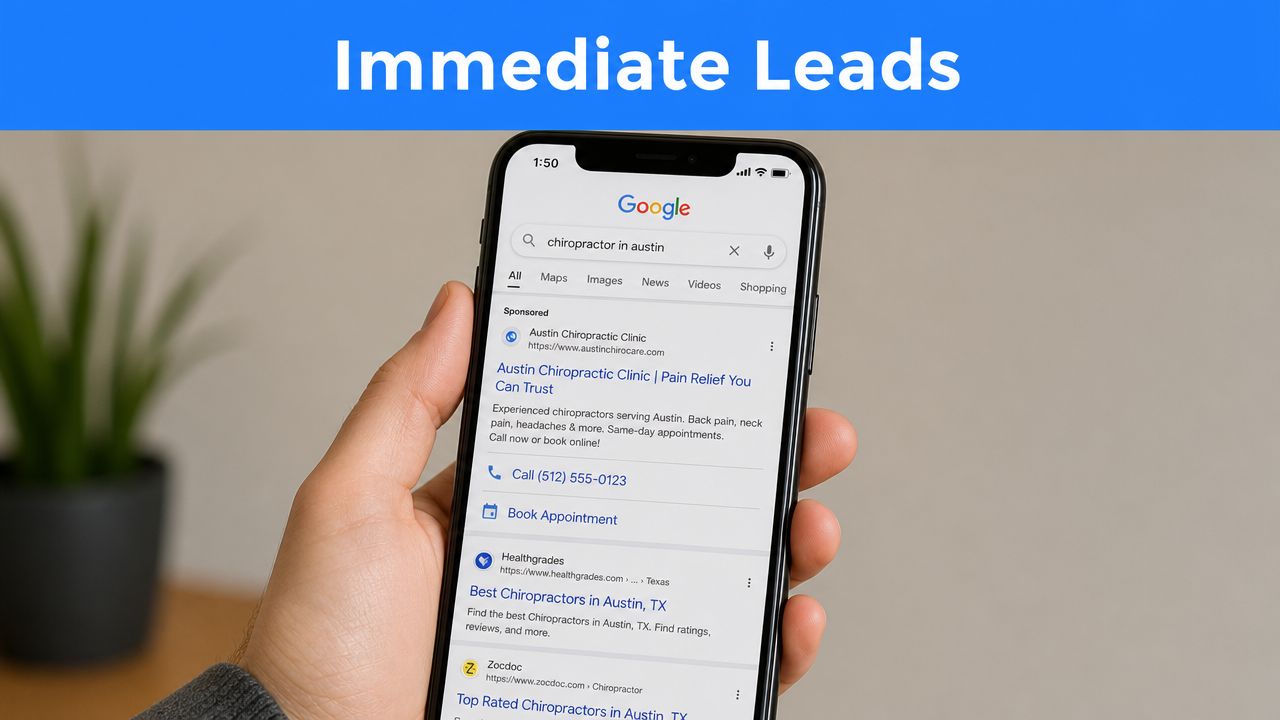
SEO compounds over time. Google Ads can put you in front of high-intent patients now. Used correctly, paid search is the fastest way to test demand, messaging, and landing page quality for your highest-value services.
Used poorly, it burns money on broad terms, weak ad copy, and irrelevant clicks.
The winning structure is straightforward. Segment services into distinct keyword campaigns, pair each with a matching landing page, and track calls and form fills as conversions. Lead quality matters more than traffic volume, as outlined in Chirobasix's chiropractor digital marketing guide.
Build campaigns around search intent
Don't throw every service into one campaign. Break it out by what the patient wants.
A practical setup looks like this:
| Campaign type | Example keyword theme | Landing page focus |
|---|---|---|
| Core local | chiropractor near me, chiropractor in [city] | General booking page with location trust signals |
| Condition-based | sciatica chiropractor, neck pain chiropractor | Page specific to that condition |
| Urgent need | same-day chiropractor, emergency back pain chiropractor | Fast-contact page with click-to-call priority |
| Brand defense | clinic name and provider names | Reputation-focused page that captures branded search |
This is the exact logic behind transactional marketing. You go after the searches that signal money-in-hand demand, not random awareness traffic.
If you need the mechanics, this Google Ads campaign setup guide gives you the framework for campaign structure and conversion tracking.
Align the ad, the page, and the action
A patient clicks because the ad promised relevance. If the landing page changes the message, trust drops immediately.
Here's a better pattern:
- Keyword. “Sciatica chiropractor in [city]”
- Ad copy. Mentions sciatica care, local availability, and booking
- Landing page. Dedicated sciatica page with symptoms addressed, testimonials, clinician credibility, and a booking CTA
- Conversion action. Call, appointment request, or online scheduling
That message match is where ROI gets protected. If the ad says neck pain and the page is a generic homepage, expect wasted spend.
Operator's view: Clicks are not the KPI. Calls, qualified forms, and booked appointments are the KPI.
Call campaigns matter more than most chiropractors think
A lot of prospective patients don't want to fill out a long form. They want to ask, “Do you treat this?” and “Can I come in today?” That's why call-focused experiences matter, especially on mobile.
For paid traffic, that means:
- call extensions
- click-to-call buttons
- landing pages that keep the phone number visible
- front desk processes that answer quickly and book decisively
You don't need complicated funnel theater. You need ads that match intent and make human contact easy.
Manage Reviews and Retain Patients with Email
A patient searches for a chiropractor in your city. They see three clinics with similar services. One has recent reviews that mention back pain relief, friendly staff, and easy scheduling. Another has old reviews and no clear activity. The third has hardly any feedback at all.
Patients won't overanalyze that choice. They'll pick the practice that feels safest and easiest to trust.
That's why review management isn't a side task. It's part of patient acquisition. New patients use reviews to decide whether your clinic is credible before they ever call. Existing patients use follow-up communication to decide whether they stay engaged with care.
Ask for reviews while the positive experience is fresh
Don't leave review generation to chance. Build a simple office routine.
A practical sequence works well:
- The patient finishes a positive visit.
- A staff member asks for feedback in person.
- The office sends a direct review request by text or email.
- The patient lands on the exact profile where you want the review posted.
The request should be polite and short. Don't over-script it. The best review system is the one your front desk will use every day.
What to encourage in reviews
You can't script patient opinions, but you can guide what makes reviews more useful:
- mention the condition or concern they came in for
- mention the city or neighborhood naturally
- mention ease of scheduling
- mention bedside manner or office experience
That gives future patients more confidence and gives Google more contextual relevance.
Use email to retain care and generate referrals
Many clinics spend heavily to get a patient, then go silent after the first visit. That's wasteful.
Email doesn't need to be flashy. It just needs to support the patient journey.
A chiropractic retention sequence can include:
- a welcome email after the first appointment
- appointment reminder and reschedule prompts
- educational follow-up tied to the patient's condition
- periodic wellness check-ins
- reactivation messages for patients who stopped booking
Good retention emails don't “market” to patients. They reduce drop-off and keep treatment plans from fading into the background.
Keep the system simple enough to run
A review and retention process fails when it depends on memory. Use your CRM, scheduling tool, or email platform to automate the obvious steps. Then let staff handle the human parts, especially requests after strong visits and phone follow-up when someone stops responding.
Chiropractic growth isn't just about winning the first click. It's about building enough trust that a patient books, returns, and recommends you.
Your 90-Day Marketing Implementation Blueprint
Most clinics fail because they try to do everything at once. They launch ads before the website converts. They publish content before local pages are solid. They spread budget across too many channels, then can't tell what's working.
A better move is a staged buildout. For budget planning, a common benchmark is to allocate 5% to 10% of gross revenue to marketing, and the stronger sequence is to start with a converting website, then optimize Google Business Profile, then launch high-intent Google Ads, then add retention tactics, according to Omnivance Media's chiropractic growth guide.
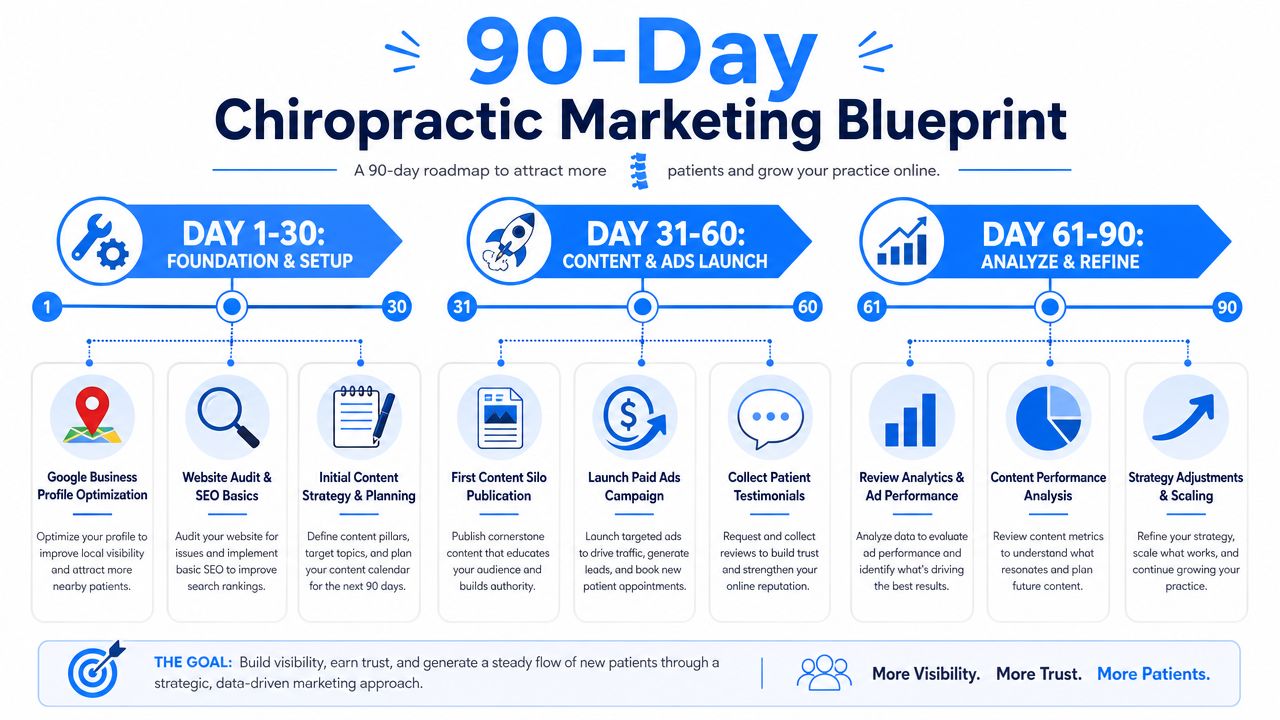
Days 1 through 30 foundation and cleanup
The first month is about fixing the assets you already have so future traffic has somewhere useful to go.
Tighten your local presence
Claim and fully complete your Google Business Profile. Clean up NAP consistency. Add services, photos, business description, Q&A, and review request processes.
Audit the website
Check mobile usability, page speed, click-to-call visibility, booking flow, and service-page coverage. Cut fluff from the homepage and rewrite core pages around patient intent.
Set up tracking
Install call tracking, form tracking, and booked-appointment attribution wherever possible. If you can't see which pages and campaigns produce patients, you can't optimize budget intelligently.
Focus your dashboard on:
- Qualified phone calls
- Appointment requests
- Booked new patients
- No-show patterns
- Top landing pages
- Top search queries
Days 31 through 60 acquisition launch
Now you start pulling in demand.
Publish the first content silo
Don't publish random blogs. Pick one revenue-driving condition and build the main page plus supporting content around it. Make sure every page links logically to the appointment path.
Launch Google Ads
Start with high-intent local and condition-based campaigns. Keep keyword themes tight. Send traffic to dedicated landing pages, not to a generic homepage.
Add call-first experiences
Use call extensions, visible phone numbers, and mobile-first landing pages. A lot of chiropractic prospects want direct contact, not a long digital journey.
You can support this period with lightweight visibility on social as well. If you want a simple scheduling model for that channel, this 90-day social media marketing guide is useful as an operational template. Just don't let social distract from search and maps, which usually carry stronger transactional intent.
The first 60 days should build a machine that captures demand already in your market. Don't waste this phase chasing low-intent attention.
Days 61 through 90 optimization and scale
At this point, most owners either get disciplined or drift back into guessing.
Review actual lead quality
Look beyond click volume. Which campaigns generated calls? Which calls turned into booked visits? Which service pages assisted conversions? Pause what attracts noise and double down on what produces patients.
Push review volume and retention
Now that traffic and leads are moving, tighten trust and lifetime value. Increase review requests. Start email follow-up for onboarding, reminders, education, and reactivation.
Expand only after proof
Once one condition category works, build the next silo. Once one ad group performs, expand nearby intent variations. Once one landing page converts, test improvements one variable at a time.
A compact operating table helps keep the plan grounded:
| Phase | Primary focus | What success looks like |
|---|---|---|
| Days 1 to 30 | Foundation | Clean profile, stronger site, working tracking |
| Days 31 to 60 | Acquisition | Calls and form leads from high-intent search |
| Days 61 to 90 | Optimization | Better lead quality, more bookings, clearer budget decisions |
The point of this blueprint isn't activity. It's control. You want a practice that knows where calls come from, which searches produce appointments, and which assets deserve more investment.
If your marketing still depends on luck after 90 days, the system wasn't built correctly.
If you want a team that focuses on transactional search terms, Google Maps visibility, conversion-focused websites, and local SEO systems built to generate calls and appointments, talk to Transactional LLC. They help local service businesses, including chiropractors, build city-specific visibility and patient acquisition systems without bloated contracts or vague reporting.