


You can feel when your marketing is off. The phone rings, but the calls aren't right. Someone wants a service you don't offer. Someone else is outside your target area. Another caller is “just comparing prices” and never books.
For a local service business, that kind of lead flow wears you down fast. You don't need more random traffic. You need people searching with intent, the kind of searches that usually end in a booked job, an appointment, or a new patient.
That's where automated SEO services make sense. Not as a gimmick. Not as a “push button, get rankings” promise. As a system built to keep your business visible for transactional searches like “air conditioning repair near me,” “plumber open now,” or “dentist near me,” plus the Google Maps results that often drive the call.
Winning the Race for Transactional Customers
A lot of owners make the same mistake at first. They judge marketing by activity instead of outcome. More website visits sound good. More impressions sound good. But if those visits don't turn into calls from people ready to hire, they're noise.
Transactional search terms are different. They come from people who are close to making a decision. If someone searches “emergency electrician near me,” they aren't browsing for fun. They need help now. The business that shows up clearly, locally, and credibly has the advantage.
Old-school marketing often misses this. A broad billboard campaign can create awareness, but it can't match the timing of a person searching with immediate intent. The same goes for generic digital campaigns that target broad interests instead of urgent local need.
SEO has moved far beyond a side tactic. The global SEO services market is estimated at $83.98 billion in 2026, and 74% of small businesses invest in SEO, according to AIOSEO's SEO statistics roundup. That matters because local businesses now treat search visibility like an operating expense, not a nice extra. It's where many measurable clicks and traffic opportunities still come from.
What this looks like in the real world
A plumbing company may think it needs “more online presence.” What it needs is stronger visibility for terms tied to revenue:
- Immediate repair searches like drain cleaning, burst pipe repair, or water heater replacement
- Local intent searches tied to specific cities and service areas
- Google Maps visibility when searchers want a nearby option they can call quickly
That's why automation matters. The goal isn't to chase every keyword in the market. The goal is to build a system that watches the terms that bring buyers, tracks local visibility, and flags problems before rankings slip.
If Google Maps is a big part of your lead flow, this guide on how to rank higher on Google Maps is worth reading alongside your SEO plan.
The right ranking matters less than the right search. A top position for a low-intent phrase won't help as much as solid visibility for terms that signal “I'm ready to hire.”
What Are Automated SEO Services Really
Most business owners hear “automated SEO” and picture software doing everything on autopilot. That's not how good SEO works.
Automated SEO services are a workflow. Software handles the repeatable, data-heavy tasks. People handle the judgment calls. It's similar to an irrigation system. You automate the watering schedule because doing it by hand every day is wasteful. But you still decide what gets planted, where it goes, and what to cut back.
What automation should do
At its best, automation takes over the work that shouldn't require human attention every single day:
- Rank tracking across your core search terms and service areas
- Scheduled reporting so you can see movement without chasing spreadsheets
- Technical monitoring for issues that can hurt visibility
- Pattern detection around competitor movement, content gaps, and local changes
That creates consistency. Your campaign doesn't depend on someone remembering to check everything manually.
What automation should never do alone
It shouldn't replace strategy. It shouldn't decide what your market wants. And it definitely shouldn't publish large batches of weak local pages with only the city name swapped out.
That's where a lot of “fully automated” services break down. They can generate output. They can't reliably judge whether a page matches search intent, reflects your actual expertise, or deserves to rank for a money term.
A useful way to think about it is simple:
| Task type | Best handled by |
|---|---|
| Repetitive checks and alerts | Automation |
| Location strategy and service prioritization | Human SEO lead |
| Content briefs and optimization suggestions | Automation plus review |
| Final page quality and conversion angle | Human editor |
If you've ever wondered where an SEO company adds value beyond software, this breakdown of what SEO companies do helps separate real service from tool access.
The practical definition
For a local service business, automated SEO services should mean this:
- Your main revenue keywords are tracked by city.
- Your website gets checked for technical issues on a recurring basis.
- Your reporting is visible and understandable.
- Your content process becomes faster, but not careless.
- Your Google Business Profile and local presence support the same transactional terms you want to win.
That's the version that helps the phone ring. The rest is packaging.
The Core Components of an Automated SEO Engine
Good automation isn't one tool. It's a connected system. When it's built correctly, each part supports the others. Keyword data informs content. Technical monitoring protects rankings. Local signals reinforce map visibility. Reporting tells you what's turning into leads.
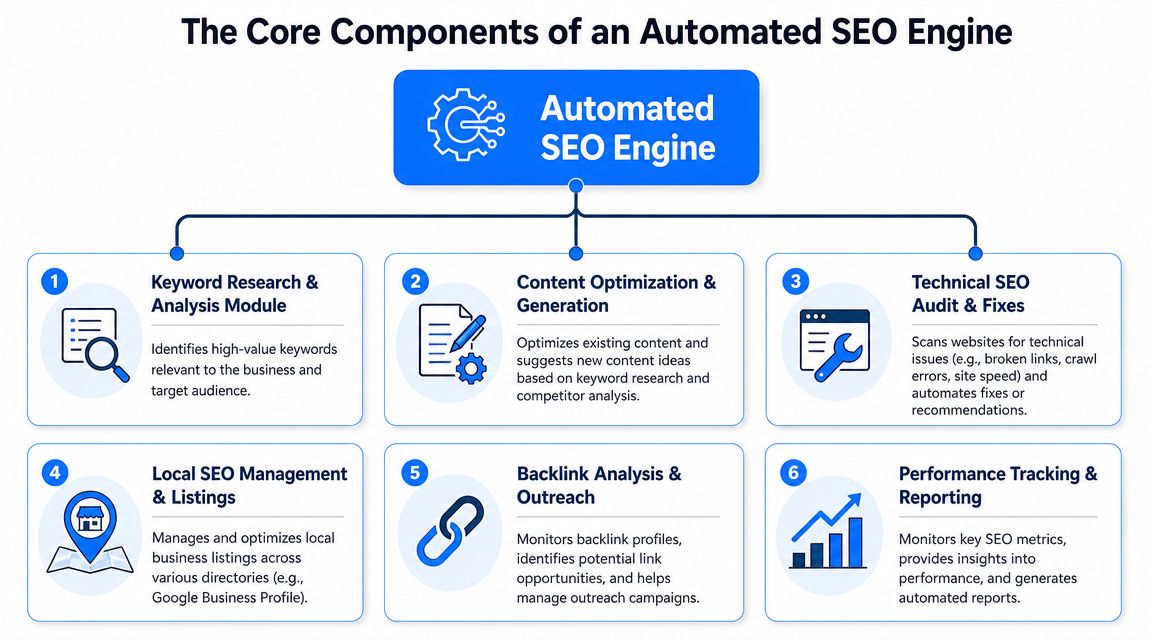
The repeatable tasks that software handles well
Automation is strongest when it focuses on recurring system work. Site crawls, ranking tracking, and technical issue monitoring are the clearest examples. Siteimprove's overview of SEO automation notes that within these recurring processes, teams can catch broken links, slow pages, or ranking drops quickly instead of waiting for a manual review.
For a local business, that matters because invisible problems often become expensive problems. A slow service page, a broken internal link, or a drop on a high-intent term can affect calls before anyone notices.
The six pieces that usually matter most
Keyword tracking by service and city
You want visibility into the exact terms that bring buyers. Not just “HVAC.” More like “AC repair,” “furnace replacement,” or “emergency HVAC” tied to the places you serve.
A useful system should show whether your rankings move by term and by location. That's how you know if a city page is improving or if a competitor just took a valuable spot.
Technical audits and health checks
This is the maintenance layer. Automated crawlers can flag issues like:
- Broken links that waste authority and hurt usability
- Slow pages that can weaken conversions and search performance
- Missing metadata that creates weak search snippets
- Crawl issues that make important pages harder for search engines to process
Content optimization support
Many owners are often misled. Software can identify missing subtopics, suggest internal links, and help organize briefs. That's useful. It can speed up production and reduce guesswork.
What it can't do on its own is produce convincing, locally specific service content every time.
Practical rule: Use automation to improve the content process, not to remove editorial judgment.
Competitor gap analysis
This is often overlooked. A smart system watches which pages competitors are pushing, which local terms they're gaining on, and where your coverage is thin. That gives you a faster response loop.
Local SEO and listings support
For service businesses, this layer matters because website rankings and map visibility often reinforce each other. Category alignment, service relevance, review signals, and local landing page support all need to work together.
Reporting that ties back to business outcomes
If a dashboard only shows vanity metrics, it's not helping you run the business. Reporting should make it easy to connect visibility to calls, form leads, direction requests, and booked work.
What a strong engine feels like operationally
It feels less chaotic. You're not waiting until the end of the month to find out something broke. You're not guessing which city page needs work. You're not publishing content blind.
That's the fundamental value of automated SEO services. They turn SEO from occasional cleanup into an operating system.
The Role of AI Optimization in Driving Local Leads
Automation used to mean checklists. Now it also means pattern recognition. That's where AI optimization changes the game for local businesses.
People still search directly for services. But they also ask broader questions, compare options in new ways, and rely on AI-generated search features that shape what they click next. That changes how businesses need to build content, structure service pages, and support local trust signals.
Why AI now affects local visibility
AI is already part of modern SEO workflows. In 2026, 87% of businesses use AI to create SEO content, 63% use it for content outlines, and 60% use it for keyword research and idea generation, according to We Are Tenet's AI SEO statistics. The same source notes that AI Overviews appeared in up to 47% of search results depending on query type and location.
For a local service company, that means visibility is no longer just about ranking a single page for a single keyword. You're also trying to become the business or resource that search systems treat as relevant, complete, and trustworthy enough to surface in richer search experiences.
If you want a grounded framework for connecting search visibility to actual customers, this practical local lead generation blueprint is a useful companion read because it keeps the focus on leads, not vanity traffic.
Where AI helps local SEO work faster
AI is useful when it handles research at scale. It can group related terms, surface common modifiers, and organize content opportunities faster than a manual pass.
For example, one core service like water heater repair can branch into clusters around urgency, brand issues, replacement vs repair intent, local modifiers, and cost-related questions. That helps a team build stronger service pages and supporting content without guessing.
AI also helps with:
- Outline generation for service pages and supporting articles
- Query clustering so similar intent terms are handled together
- Internal linking suggestions that reinforce page relationships
- Topic coverage checks to spot thin sections before publishing
Where AI still needs a human operator
It doesn't know your crews, your process, or the specifics of your market unless someone gives it that context and checks the result carefully.
That's especially important for local service businesses. The page for “roof repair in one city” can't just be a clone of “roof repair in another city.” If the content sounds templated, weak, or interchangeable, it usually performs that way too.
For businesses trying to understand this shift in plain terms, AI search engine optimization is the right frame. It's not just “use AI to write faster.” It's “use AI to improve how your business is found in evolving search results.”
Search is moving toward answer generation, summary layers, and intent interpretation. Local businesses still win by being specific, credible, and easy to contact.
Benefits and Limitations for Your Service Business
Automation can absolutely improve SEO performance for a service company. It can make the work faster, more consistent, and easier to scale across services or cities. But it also creates risk when owners confuse speed with quality.
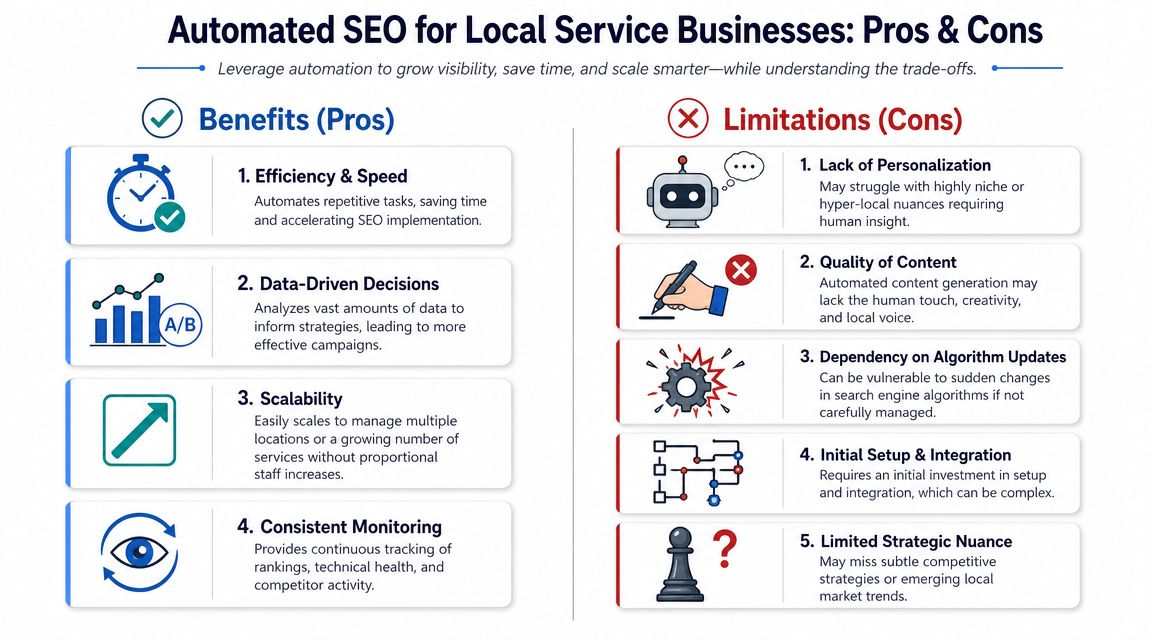
Where automation earns its keep
The biggest advantage is operational. A local business often has more moving parts than its website suggests. Multiple service lines. Multiple cities. Seasonal demand shifts. Competitors changing offers and pages constantly.
Automation helps by making recurring work dependable.
- Monitoring stays active even when your team is busy with jobs and customer service
- Reporting stays visible so you can spot trends instead of waiting for surprises
- Optimization scales better across service pages, blogs, and local landing pages
- Maps support improves when local signals are managed as part of a system, not as an afterthought
A platform can also make collaboration easier. Transactional LLC, for example, offers a dashboard that tracks keyword timelines by city, map heat visibility, Search Console queries, and traffic as part of its local SEO workflow. That's useful because it gives service businesses a clearer view of whether search visibility is moving toward booked work.
Where over-automation causes damage
The most common failure is content. Businesses publish too much, too fast, with too little review. The pages look unique at a glance, but they read like templates and don't say anything meaningful about the business, service, or local market.
Straight North's guidance on what can and can't be automated in SEO makes the line clear. Automation works well for audits, reporting, internal linking suggestions, and bulk metadata. But content strategy, intent analysis, editorial review, and E-E-A-T checks still need human control.
That matters a lot for local pages. If every city page says the same thing with only the place name swapped, you may end up with a larger site and a weaker one.
A balanced standard to use
When evaluating automated SEO services, use this test:
| If the system does this | That's usually good |
|---|---|
| Finds technical issues quickly | Yes |
| Tracks rankings and local movement consistently | Yes |
| Helps organize content briefs | Yes |
| Publishes mass local pages with minimal review | No |
| Replaces human strategy entirely | No |
If you want a broader primer on why organic search matters for smaller companies, DLL Studios' small business SEO guide is a helpful outside resource.
More pages don't automatically mean more leads. Better pages, tied to the right searches and the right locations, are what move the business.
How to Choose the Right Automated SEO Partner
A flashy dashboard doesn't mean much if it doesn't help you win calls from the right searches. The partner you choose should understand local intent, not just software settings.
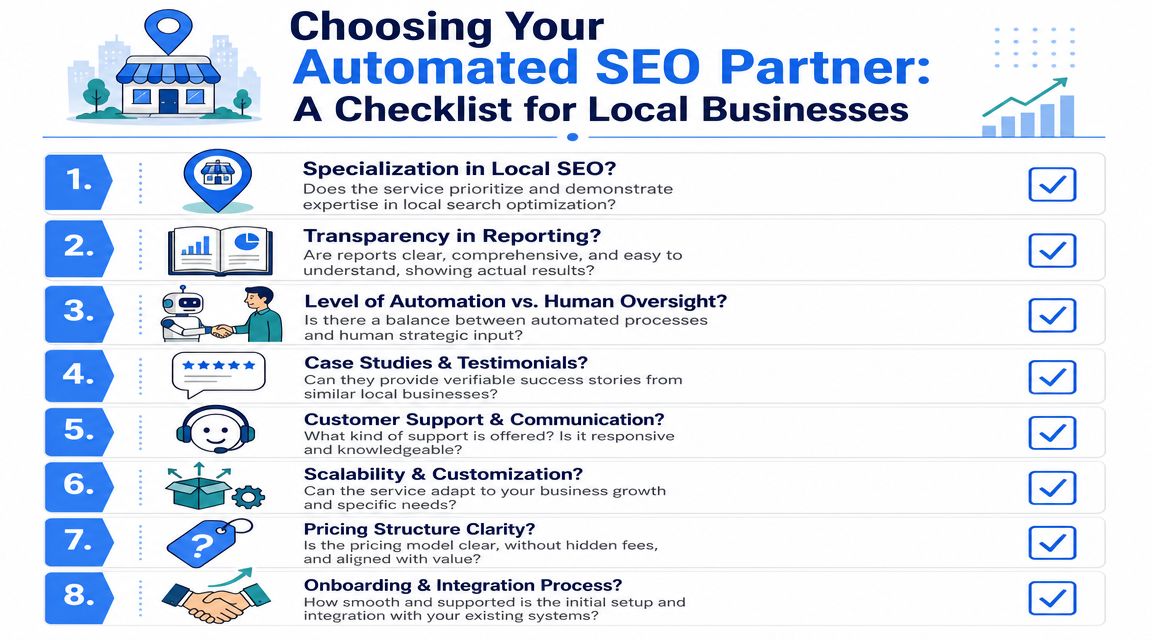
Start with the questions that affect revenue.
Questions worth asking on the first call
- How do you target transactional terms like “near me,” emergency, repair, or city-specific service searches?
- How do you handle Google Maps visibility and Google Business Profile optimization?
- What does your reporting show beyond rankings?
- How much is automated, and where do humans review the work?
- How do you prevent duplicate or templated local content?
- What happens in the first few weeks after onboarding?
A useful provider should answer these directly. If the pitch stays vague, that's a warning sign.
This short video gives a practical lens for evaluating providers and process fit before you sign anything.
What a mature operation usually has
You're not just buying labor. You're buying a repeatable operating model.
That includes clear onboarding, stable reporting, accountability, and a process for turning search data into action. If you want to understand how agencies think about building systems instead of selling disconnected tasks, this guide on how to scale a marketing agency gives useful context.
A good local SEO partner should also be easy to audit. You should be able to see what they're doing, what they're tracking, and how they connect activity to leads. That's why a page like SEO company can be useful as a benchmark when comparing service structure, deliverables, and transparency.
The standard that saves you trouble
Pick the company that talks about:
- Search intent
- Maps visibility
- service-area relevance
- content quality control
- reporting tied to business outcomes
Don't pick the company that talks only about “traffic growth” and automation volume.
A Simple Roadmap to Measurable SEO Results
SEO gets confusing when people describe it as magic. It's more useful to treat it like a buildout. The work becomes manageable when you separate it into stages and judge each stage by what it should produce.

Stage 1 builds the foundation
Start with the terms that matter most to revenue. Not every keyword deserves equal attention. Focus first on the searches that usually bring ready-to-buy leads, then map them to the cities and service areas you want.
This is also where the initial audit belongs. Website structure, existing rankings, Google Business Profile health, and competitor coverage all need to be reviewed before changes start.
Stage 2 installs the system
This is the implementation phase. Tracking gets connected. Core pages get optimized. Local signals get aligned. Reporting becomes visible.
If a provider says they can move quickly, their process should reflect that speed. Transactional Marketing's process is built around targeting specific search terms and local cities, with a stated goal of helping clients reach page one visibility within 30 to 60 days for targeted terms.
Stage 3 watches what actually matters
A serious local SEO campaign should monitor more than rankings. The useful view is broader:
- Keyword movement by service and city
- Google Maps visibility in the areas that produce work
- Search queries that indicate buying intent
- Phone calls and leads generated from that visibility
Stage 4 keeps refining
No local market stays still. Competitors change pages. Search layouts change. New questions show up in search behavior. Your system has to adapt without starting over every month.
That's where automated SEO services are at their best. They keep the operational machine running while human oversight keeps the strategy sharp.
The businesses that win local search usually aren't the ones doing the most. They're the ones doing the right things consistently, then improving them based on real data.
If your business depends on calls from people searching terms like “roofer near me,” “dentist near me,” or “air conditioning repair near me,” you need more than generic SEO. You need a system built around transactional search intent, Google Maps visibility, and measurable local lead flow. Transactional LLC works with service businesses on that exact problem through local SEO, Google Business Profile optimization, AI-driven content planning, transparent reporting, and a contract-free structure designed around turning searches into booked jobs.