
Your med spa can look polished, have a strong team, and still lose bookings every day because your marketing is aimed at attention instead of action. Likes don't pay for injectables, body contouring devices, payroll, or rent. Booked appointments do.
Most owners already feel the problem. You post on Instagram, boost a few posts, maybe run some Meta ads, maybe hire someone to “do SEO,” and nothing feels tied to actual revenue. Meanwhile, a patient nearby is searching “Botox near me” or “laser hair removal [city]” and booking with whoever shows up first, looks credible, and makes the next step easy.
That's the whole point of marketing for med spa businesses. You don't need broad awareness. You need visibility for transactional searches, the searches people make when they're ready to spend money now. That includes Google search, Google Maps, and the growing layer of AI-driven discovery where large language models summarize local options and surface businesses with strong topical relevance, clear service pages, and consistent local signals.
The urgency is real. The med spa market is projected to reach USD 49.4 billion by 2030 with a 15.13% CAGR, and half of med spas already use SEO tactics to improve visibility, according to Brenton Way's med spa marketing stats and trends. More clinics are entering the market. More clinics are competing for the same searches. If you're still treating marketing like content for content's sake, you're already behind.
A strong social presence still matters, but only if it supports conversion. If you need your profiles cleaned up so they reinforce trust instead of looking abandoned, start with a proper Facebook page for business setup. Then focus your energy where high-intent patients decide.
Stop Chasing Likes Start Driving Appointments
A med spa owner usually notices the same pattern. The website gets some traffic. Social media gets some engagement. A few people ask questions in DMs. But the schedule still has gaps, and the marketing reports never explain why.
That happens because most campaigns target weak intent. Someone casually watching a skin care reel is not the same as someone searching “lip filler near me” or “Botox provider in [city].” One is browsing. The other is shopping.
Transactional intent is where the money is
If someone searches for a treatment plus a location, that person is close to booking. That's the search behavior your entire system should be built around.
That means your med spa needs to rank for searches like:
- Service plus city: “CoolSculpting in [city]”
- Service plus neighborhood: “laser hair removal [neighborhood]”
- High-intent local phrasing: “Botox near me”
- Provider-focused searches: “best med spa for fillers [city]”
These are the searches that turn into consultations, calls, form fills, and booked treatments.
Practical rule: If a keyword can realistically lead to a booked appointment this week, it deserves more attention than a post designed to collect vanity engagement.
AI visibility follows the same logic
AI optimization isn't separate from SEO. It's an extension of it. If your site has clear service pages, location relevance, strong entity signals, patient-proof content, and consistent Google Business Profile data, you increase your chances of being surfaced in AI-generated local recommendations too.
LLMs don't reward vague branding. They pull from structured, specific, useful content. A med spa with pages that clearly answer “Who offers Botox in this city?” and “What should I expect after treatment?” is easier for both Google and AI systems to understand.
So stop asking whether your content is “engaging.”
Ask whether it helps you win the patient who's already looking for a med spa right now.
Build Your Digital Front Door for Transactional Searches
Your website should not read like a brochure. It should act like a booking engine for local treatment searches.
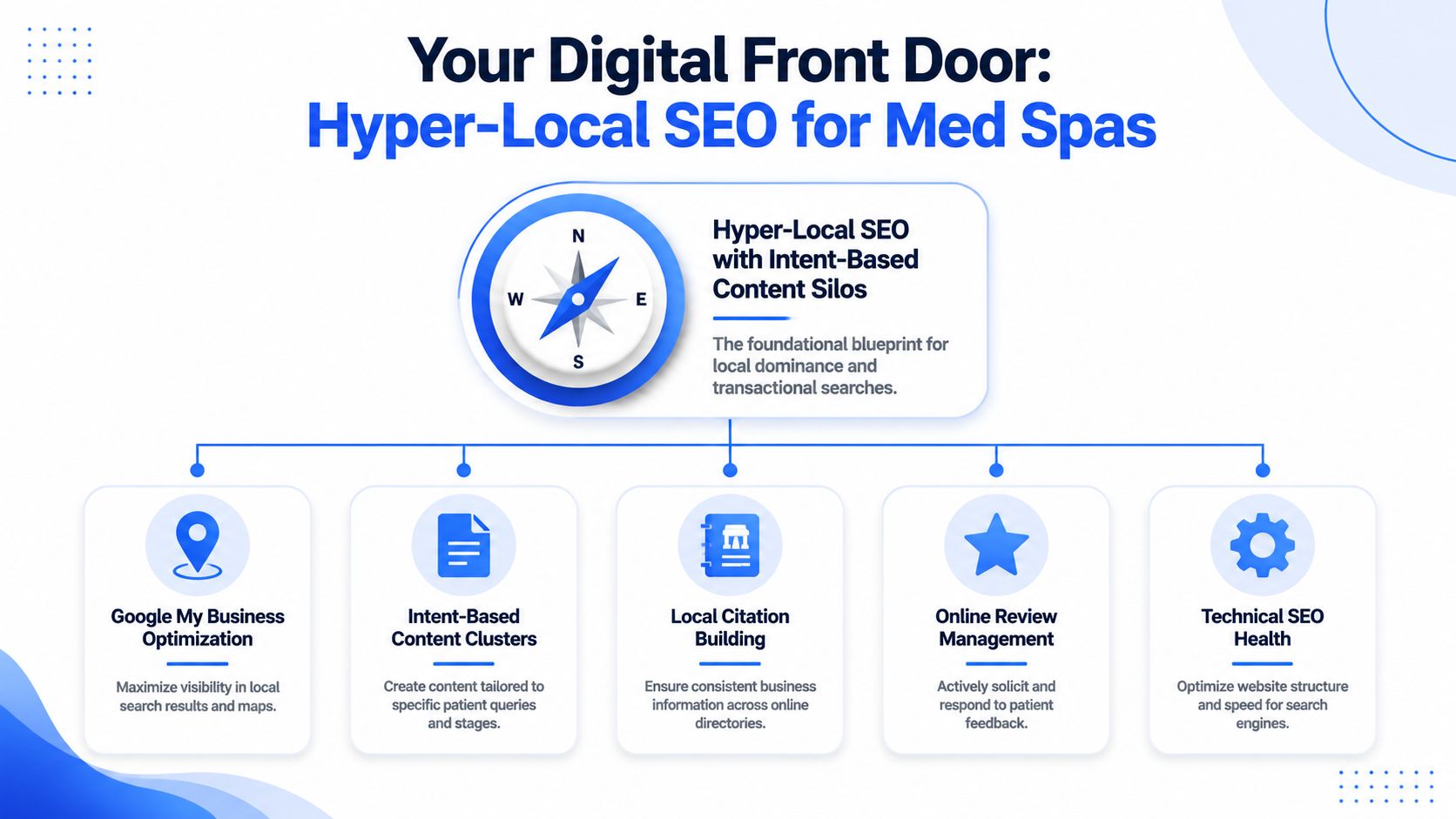
The right structure is hyper-local SEO with intent-based content silos. In plain English, that means you build one conversion-focused page for the service you want to sell in the city you want to rank in, then support it with related informational content that answers the exact questions patients ask before they book.
Build one money page per service and city
If you want to rank for “CoolSculpting in Scottsdale,” create a page specifically for that term. Don't bury that service under a generic treatments page. Don't make users click through a vague menu. Don't force Google to guess what the page is about.
Each transactional page should include:
- A clear treatment heading: State the service and city plainly.
- Service-specific copy: Explain the treatment, ideal candidate, recovery expectations, and booking process.
- Local proof: Mention service areas, neighborhood relevance, and localized trust signals.
- Fast conversion paths: Prominent buttons, click-to-call, short forms, and booking integration.
Then support that page with 5 to 7 informational posts tied to the same service. That silo structure is part of the hyper-local SEO method. The benchmark shared in the verified data says med spas using this model to target high-intent terms and optimize Google Business Profile for mobile, where 78% of local searches happen, see +15% map visibility within 3 months.
Cover informational intent without losing the sale
Informational content matters when it pushes people toward a transactional page. It fails when it becomes disconnected publishing.
Good support topics look like this:
| Informational topic | Transactional page it should support |
|---|---|
| Botox recovery timeline | Botox in [City] |
| How long laser hair removal takes | Laser Hair Removal in [City] |
| What to expect after lip filler | Lip Filler in [City] |
| CoolSculpting candidate guide | CoolSculpting in [City] |
Every post should link back to the service page. Every service page should link out to the support content where useful. This is how you build topical authority around a treatment instead of scattering random blog posts across your site.
Your digital front door is not your homepage. It's the page that appears when a patient searches for the exact treatment they want in the exact place they want it.
Own Google Maps, not just organic listings
For med spas, Google Business Profile is not optional. It's part of the core acquisition system. A searcher looking for “Botox near me” often chooses from the map pack before they ever scroll to regular organic results.
Your profile needs:
- Accurate categories and service naming
- Treatment-focused business description with service-area specificity
- Photos that match real services and clinic quality
- Consistent review generation and responses
- Landing pages aligned to the services listed in the profile
Use heat maps to find where you're weak. If a competitor dominates map visibility in a nearby neighborhood but has thinner treatment pages, that's an opening. Fill the content gap and improve the location relevance.
If you want a deeper breakdown of that process, this guide on local SEO for med spas is worth reviewing.
Technical basics still decide whether you convert
A beautiful med spa site that loads poorly on a phone is a conversion leak. Patients search on mobile, compare quickly, and book the clinic that makes the process easiest.
Check these first:
- Mobile responsiveness: Buttons must work cleanly on smaller screens.
- Page speed: Slow pages create drop-off before the consult form even appears.
- Schema and page clarity: Help search engines understand your services and location.
- Internal links: Point question-based blog posts back to the booking page.
AI optimization also begins with structured service pages, clean local signals, and clear entity relevance, which make your business easier for search engines and LLM-driven systems to interpret.
Dominate Paid Ads with a Retention First Framework
Most med spa ad accounts are built backwards. They chase the cheapest lead and celebrate the first appointment, even when that patient never comes back.
That's bad math.
The better model is a Retention-First Ad Framework. The verified data is blunt. Med spas with a 40% retention rate generate 2.5x the ROI of those with a 20% retention rate, even with the same acquisition cost. That means your ad strategy should optimize for the patient's second visit and long-term value, not just the first conversion.
Stop managing ads by CAC alone
If you only look at cost per lead or cost per booked consult, you'll make bad decisions. Some services attract low-commitment buyers. Some offers bring in deal seekers who disappear after redeeming a discount. Some campaigns fill the pipeline with weak consults that never turn into profitable patients.
The retention-first method starts with a few essential elements:
- Audit patient cohorts: Calculate your six-month retention rate and identify which first-visit offers produce repeat behavior.
- Track days to second visit: Connect your CRM with GA4 so you can see whether new patients do return.
- Judge campaigns by LTV: A more expensive lead can still be the better lead if that patient stays.
Ricky Shockley's point in the verified data gets to the heart of it. If a patient spends on a first visit and never returns, the juice isn't worth the squeeze.
Build offers that create the second appointment
Generic “book now” campaigns are too shallow. You need offers that make follow-up the obvious next move.
Use promotions that tie the first service to a future treatment path. A virtual coupon book is one practical model because it can bundle a first appointment with treatment-specific follow-up incentives that expire on a short timeline.
Think in sequences:
| First visit offer | Better follow-up path |
|---|---|
| Intro Botox consult | Follow-up incentive tied to treatment plan |
| Laser hair removal special | Package structure that encourages the next session |
| Skin treatment promo | Recovery education plus timed rebooking prompt |
Later in the funnel, patient retention content matters just as much as ad targeting. This short video gives a useful frame for thinking about ad management and campaign quality before you pour more budget into paid traffic.
Budget like a business owner, not a hobbyist
Successful med spas typically allocate 5% to 10% of total revenue to marketing, and a spa earning USD 300,000 annually would spend about USD 2,500 per month at that level, according to Growth99's med spa marketing budget manual. Growth-stage spas often move into the 10% to 15% range, while mature spas may invest 15% to 20% to support acquisition and retention.
That doesn't mean you should spend blindly. It means your budget needs to match your growth goal and your tracking needs to be ruthless.
Don't ask whether an ad campaign generated leads. Ask whether it generated patients who came back.
If you're comparing tools or partners for this channel, look for campaign management that supports keyword intent, landing page alignment, call tracking, and actual booked-consult reporting. One option in that category is PPC ad management services, especially if you want paid campaigns tied closely to local search intent rather than broad awareness.
Use Social Proof to Close Transactional Leads
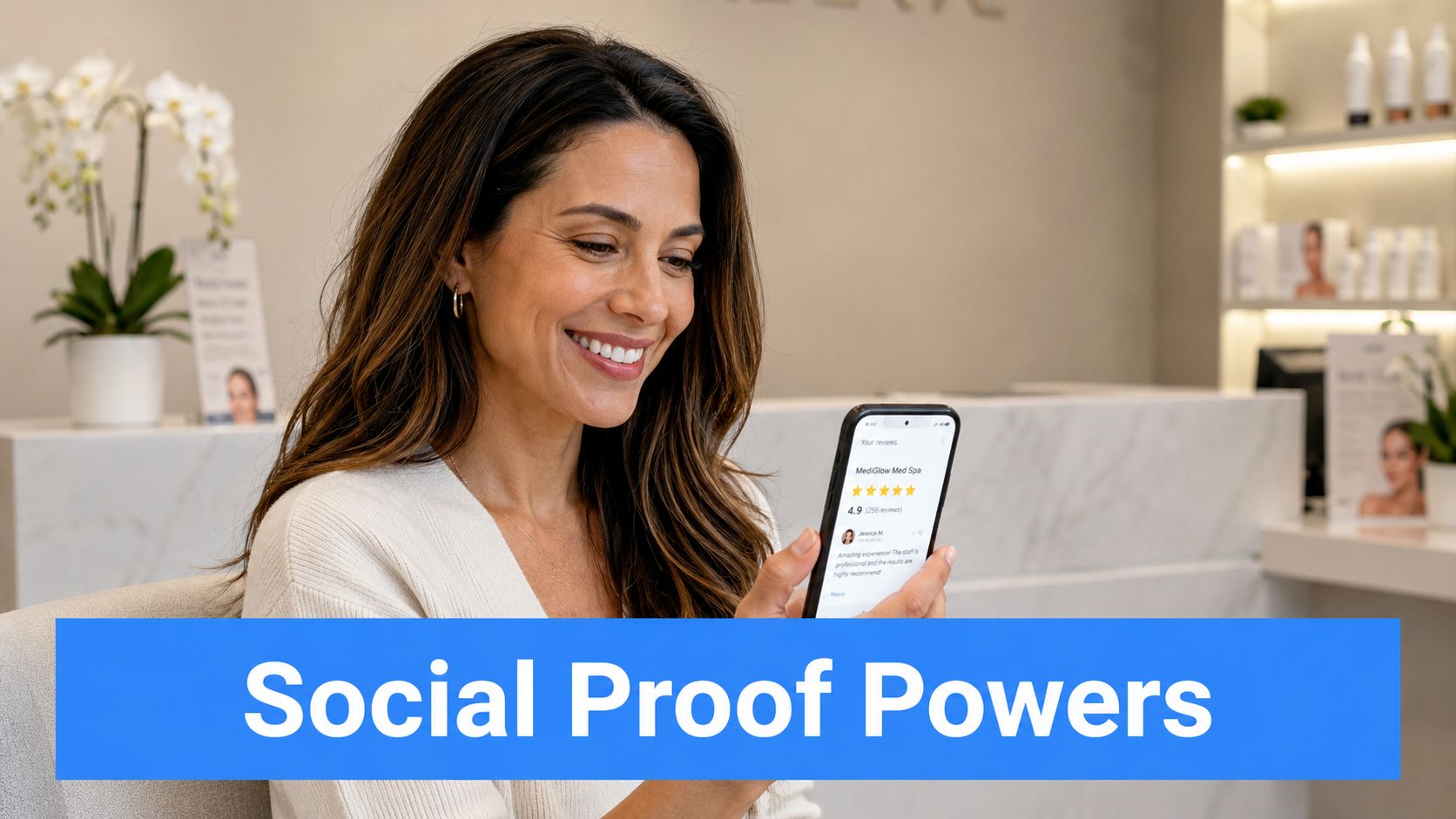
Social media is rarely the first place a high-intent patient starts. It's often where they go right before they decide.
That matters. Someone searches “med spa near me,” sees your Google listing, clicks your website, and then checks Instagram or Facebook to make sure you're legitimate. If those profiles look inactive, generic, or overly polished without substance, trust drops fast.
Treat social like your closing layer
Your profiles should answer one silent question. “Can I trust this place with my face, skin, or body?”
That means your content mix should lean toward proof, not fluff:
- Before-and-after content: Use clean presentation, clear service labeling, and realistic expectations.
- Patient reviews and testimonials: Show outcomes and experience, not just promotions.
- Provider credibility: Feature your team explaining treatments and recovery in plain language.
- FAQ content: Address what people hesitate about before they book.
Don't turn social into a distraction
A lot of med spas waste time trying to manufacture “engagement.” That's usually a dead end. You don't need random local followers who will never book. You need a profile that reassures a ready-to-buy patient that your clinic is active, professional, and results-driven.
A weak social profile usually has one of these problems:
| Problem | What the patient assumes |
|---|---|
| Inconsistent posting | The business may be neglected |
| Only promotional graphics | The clinic feels impersonal |
| No treatment education | The team may not be authoritative |
| No review content | Other patients may not trust them |
A transactional lead doesn't need to be entertained. They need enough proof to feel safe booking.
The best med spa social content supports the searches you already want to win. If your SEO page targets laser hair removal, your social feed should contain real examples, common questions, and visible patient satisfaction around that service. That consistency helps users make the final decision.
Maximize Patient Value with Email and SMS Marketing
Once a patient books, acquisition is over and retention begins. At this point, many med spas leak profit. They work hard to get the first appointment, then go quiet.
That's a mistake because the first visit should trigger a structured follow-up system. Email and SMS keep patients engaged, reduce drop-off, and bring them back for the second treatment, package, or maintenance plan.
Build a simple post-visit sequence
You don't need clever automation. You need useful automation.
A solid new-patient sequence usually includes:
- Immediate confirmation and expectation setting so the patient knows what happens next.
- Post-treatment education that answers common concerns and reduces uncertainty.
- Timed follow-up messaging that invites the second visit while interest is still high.
- Review requests after the experience is fresh.
- Reactivation campaigns for patients who haven't returned.
A practical resource if you want to tighten up your messaging structure is this Complete Email Marketing Guide, especially for thinking through list hygiene, campaign logic, and message consistency.
Match the channel to the task
Email is better for education, treatment explanations, membership offers, and longer-form trust building. SMS is better for reminders, rebooking nudges, and time-sensitive offers.
Use both, but assign them different jobs.
- Email for welcome flows: Explain treatment timelines, introduce complementary services, and answer FAQs.
- SMS for action prompts: Confirm visits, follow up after consults, and prompt rebooking.
- Email for seasonal promotions: Bring back patients whose treatment cycle makes timing relevant.
- SMS for no-show recovery: Catch lost appointments quickly and reopen the booking conversation.
Keep the message tied to patient behavior
Your automation should trigger based on what the patient did.
If they booked injectables, send content around expected results, follow-up timing, and maintenance planning. If they asked about body contouring but didn't book, send educational follow-up that reduces hesitation. If they disappeared after one appointment, run a re-engagement sequence with a specific next step.
For reminder flow inspiration, even though it's built around another healthcare niche, these appointment reminder templates are useful because the logic applies well to med spas too. The format matters more than the industry label.
What matters is consistency. Email and SMS are not side tools. They're the systems that turn an expensive first booking into a patient relationship.
Track the Metrics That Actually Grow Your Revenue
If you can't tie a channel to booked appointments, you don't have marketing data. You have activity logs.
That's the core attribution problem in med spa marketing. Industry commentary notes that med spas in moderately competitive markets often spend $3,000 to $6,000 monthly on ads without knowing which channel produces patient bookings, as discussed in Tebra's guide to digital marketing for medical spa practices. That's why channel-level ROI and lead quality matter more than vanity metrics.
What to track instead of vanity metrics
Skip follower counts, reach, and random engagement unless they directly support a booking path.
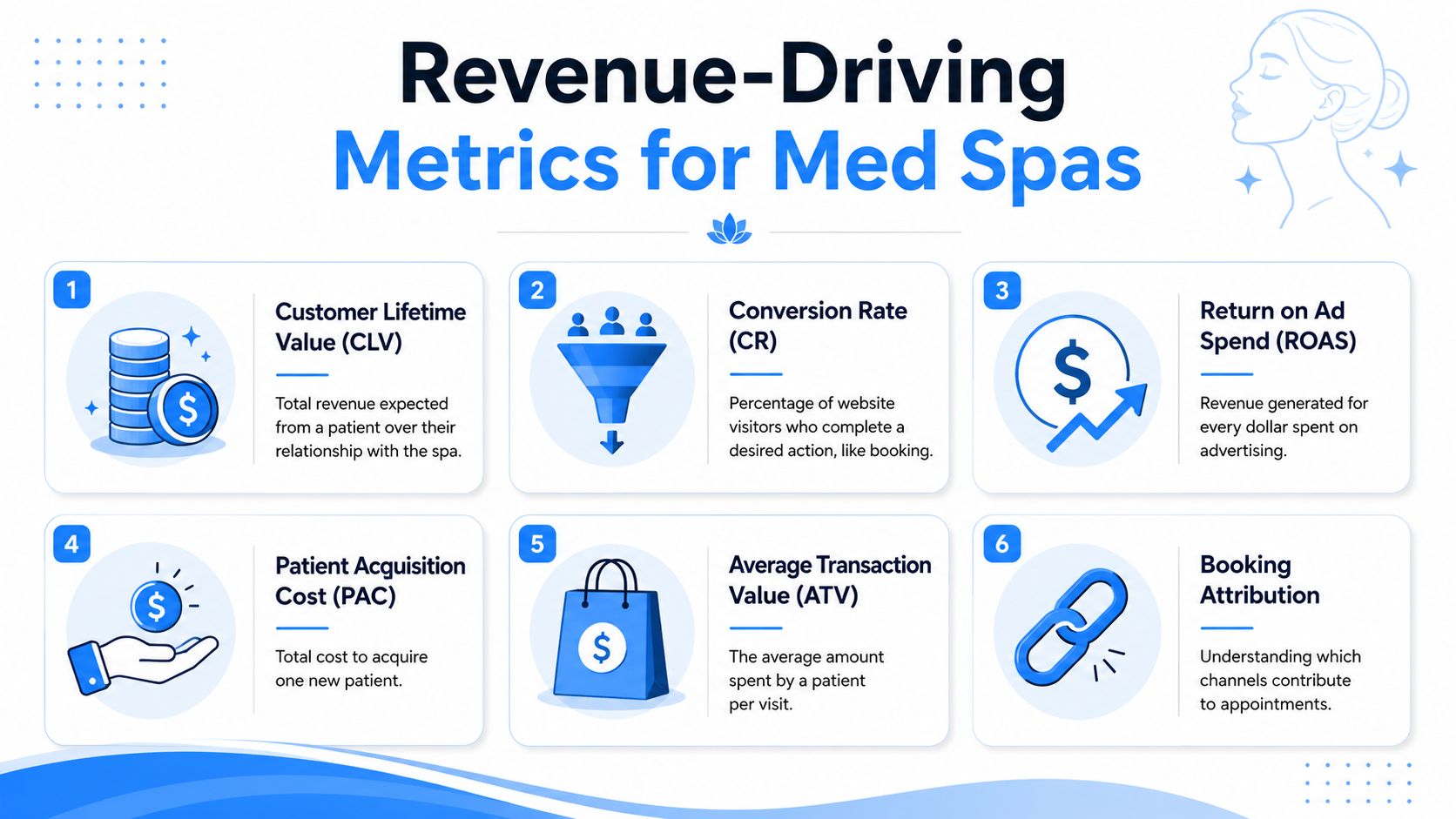
Track metrics like:
- Booked consultations by channel
- Patient acquisition cost
- Return on ad spend
- Average transaction value
- Customer lifetime value
- Booking attribution across search, maps, paid, and referral
A simple rule for better decisions
Use one question for every channel: did this produce profitable patients?
If the answer is unclear, fix your tracking before increasing spend. Connect forms, calls, online booking, CRM records, and source reporting. A med spa that knows where bookings come from can cut waste fast and scale what's working.
Your 90 Day Transactional Marketing Implementation Plan
Most med spa advice fails because it stays generic. It says to post more, run ads, ask for reviews, and improve your website. That's not a plan. The fundamental gap is content structure. Guidance often doesn't explain how to build pages around high-intent service-and-symptom searches, which is exactly what a serious growth plan should prioritize, as noted in Nextdoor's med spa marketing guidance.
A useful rule for the next three months is simple. Build the assets that convert transactional demand before you spend time on broad brand content.
90 day med spa marketing roadmap
| Phase | Key Actions | Primary Goal |
|---|---|---|
| Days 1 to 30 | Audit Google Business Profile, clean NAP consistency, identify top service plus city keywords, build a keyword matrix for informational and transactional intent, review mobile usability, set up conversion tracking | Create a clean local search foundation |
| Days 31 to 60 | Launch core service pages for top treatments, publish the first intent-based content silo, add stronger internal links, improve booking paths, start paid search campaigns using retention-first offers, begin review generation process | Capture high-intent search traffic and convert it |
| Days 61 to 90 | Review call and booking attribution, refine landing pages, adjust ads based on patient quality, launch email and SMS follow-up automations, add additional location or service pages, expand map visibility work with heat map analysis | Improve efficiency and increase repeat bookings |
What to prioritize first
Don't start with random blog topics. Start with the treatments that already make you money and the cities or neighborhoods where you want more booked appointments.
Your early priorities should look like this:
- Primary service pages first: Botox, fillers, laser hair removal, body contouring, or whichever treatments already sell well.
- Support content second: Recovery, candidacy, expectations, comparisons, and FAQ content that feeds those money pages.
- Maps and reviews alongside content: Visibility and trust need to grow together.
- Retention automations after acquisition paths are live: Don't wait until later to build follow-up.
If you need a faster way to produce short-form treatment explainers and local video assets for your pages and profiles, a tool like get your video starter app can help you build supporting media without slowing down implementation.
Where AI optimization fits
AI optimization should sit on top of this system, not replace it. The pages you build for local transactional SEO also give AI systems clearer material to cite, summarize, and surface. Service specificity, local relevance, and consistent entity signals help both traditional search and emerging LLM-based discovery.
A focused local SEO and content system can start moving rankings in a short window when execution is tight and the keyword targets are narrow. That only happens when you stop publishing generic brand content and start building around the exact terms patients use when they're ready to book.
If your med spa needs a system built around transactional searches, Google Maps visibility, AI optimization, and booked appointments instead of vague marketing activity, talk to Transactional LLC. They provide local SEO, Google Business Profile optimization, content silos, web support, and paid campaign management for businesses that want stronger visibility in the cities they serve.