

Most local businesses aren't losing because they offer a bad service. They're losing because they're invisible when buyers search with intent. A homeowner needs an AC repair, a patient wants a dentist nearby, or a property owner needs pest control now. Those searches don't happen at the awareness stage. They happen when someone is ready to call, book, or buy.
That's why generic SEO campaigns keep underperforming for service businesses. Broad blog traffic and vanity rankings don't pay the bills if the phone doesn't ring. The ultimate goal is visibility for exact, local, high-intent queries and a strong presence in Google Maps where buyers make fast decisions.
Private Label SEO Software gives agencies and operators a way to build around that reality instead of fighting it with generic workflows. When the software is customized to the vertical, the city, and the search behavior, it stops being a reporting tool and starts acting like an operating system for booked jobs.
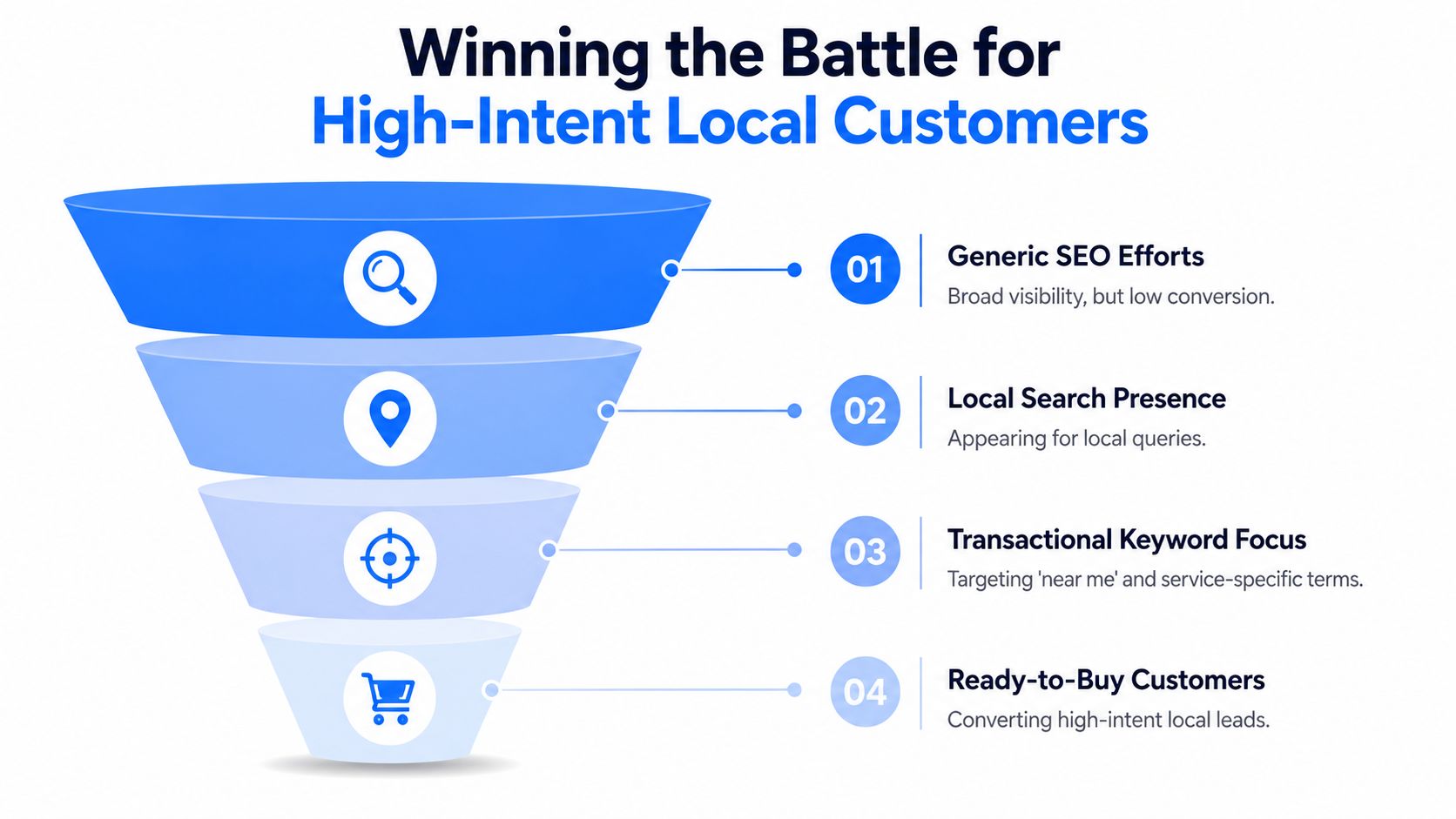
Winning the Battle for High-Intent Local Customers
If your business has been “doing SEO” but still isn't showing up when customers look for the service they need right now, the problem usually isn't effort. It's targeting.
The highest-value searches in local SEO are transactional search terms. These are queries like air conditioning repair near me, roofer near me, and dentist near me. They're not casual searches. They come from people looking for a provider they can contact immediately. According to Google data cited in this private-label SEO software analysis, 76% of users who perform a “near me” search visit a business within 24 hours.
Why generic SEO misses the money terms
A lot of SEO systems still chase broad informational keywords because they're easier to find, easier to publish around, and easier to report on. That approach can build traffic, but it often fails to produce the one thing a local service business needs. Phone calls from ready-to-buy customers.
Generic software usually groups every local campaign into the same playbook:
- Broad keyword buckets that ignore service urgency
- Template content that sounds acceptable but doesn't match the city and service combination
- Weak map strategy that treats Google Business Profile as an add-on instead of a lead source
- Reporting that tracks visibility but doesn't tie that visibility to calls and booked jobs
Practical rule: If the campaign can't tell you how you rank for “service + city” and “service near me,” it isn't built for transactional search.
What specialized software changes
Private Label SEO Software lets teams build a system around exact-match local demand. Instead of accepting whatever a generic platform measures, you define the campaign around the terms that drive revenue.
That means you can prioritize:
- Service-specific keyword sets such as AC repair, emergency plumbing, or dental implants
- Map Pack visibility in the areas where your crews or providers work
- Location pages and content silos designed for purchase intent
- Faster ranking movement on the terms that matter most
This is the difference between being “visible online” and being visible when money is in motion. For service businesses, that difference is everything.
Private Label Versus White Label SEO Software
A lot of people use private label and white label as if they mean the same thing. They don't.
White-label SEO usually means a provider has already built the service, product, or dashboard, and you resell it under your brand. That can work when speed matters more than customization. But the underlying system is still shared. Dozens or even hundreds of agencies may be using the same workflow, same feature set, and same limitations.
Private Label SEO Software is different. As explained in this breakdown of white-label vs. private-label SEO, it refers to proprietary or uniquely customized solutions configured for a single reseller, giving agencies greater control over features, delivery, pricing, KPIs, and proprietary data layers.
The practical difference on the ground
For local SEO, that distinction matters more than most agencies realize.
White-label software is fine if your main goal is to launch fast with a branded dashboard. If your goal is to dominate specific service areas for transactional terms, a shared system usually becomes a ceiling. You can't shape the workflow sufficiently for different verticals, and you can't build a real moat if everyone else has access to the same engine.
Private label works better when you need software to fit the strategy, not the other way around.
Private Label vs. White Label SEO at a Glance
| Attribute | Private Label SEO | White Label SEO |
|---|---|---|
| Exclusivity | Built or customized for one reseller | Shared across many resellers |
| Feature control | High control over features and workflow | Limited to provider's existing setup |
| Data ownership value | Can include proprietary data layers and custom KPIs | Usually limited to usage rights |
| Positioning | Stronger differentiation in the market | Faster to launch, harder to stand apart |
| Best fit | Agencies building a long-term advantage | Agencies prioritizing speed and simplicity |
When white label still makes sense
There's nothing wrong with white label if you're at an earlier stage and need to move quickly. In fact, many agencies start there and then add customization over time. If you're comparing options, this guide to rebrandable SEO solutions is useful for understanding where flexible branding helps and where it still falls short.
Shared software can deliver services. Proprietary software can shape strategy.
For agencies serious about local lead generation, that's the core trade-off. White label gets you to market faster. Private label gives you tighter control over delivery, a sharper offer, and a better chance of owning a niche instead of renting one.
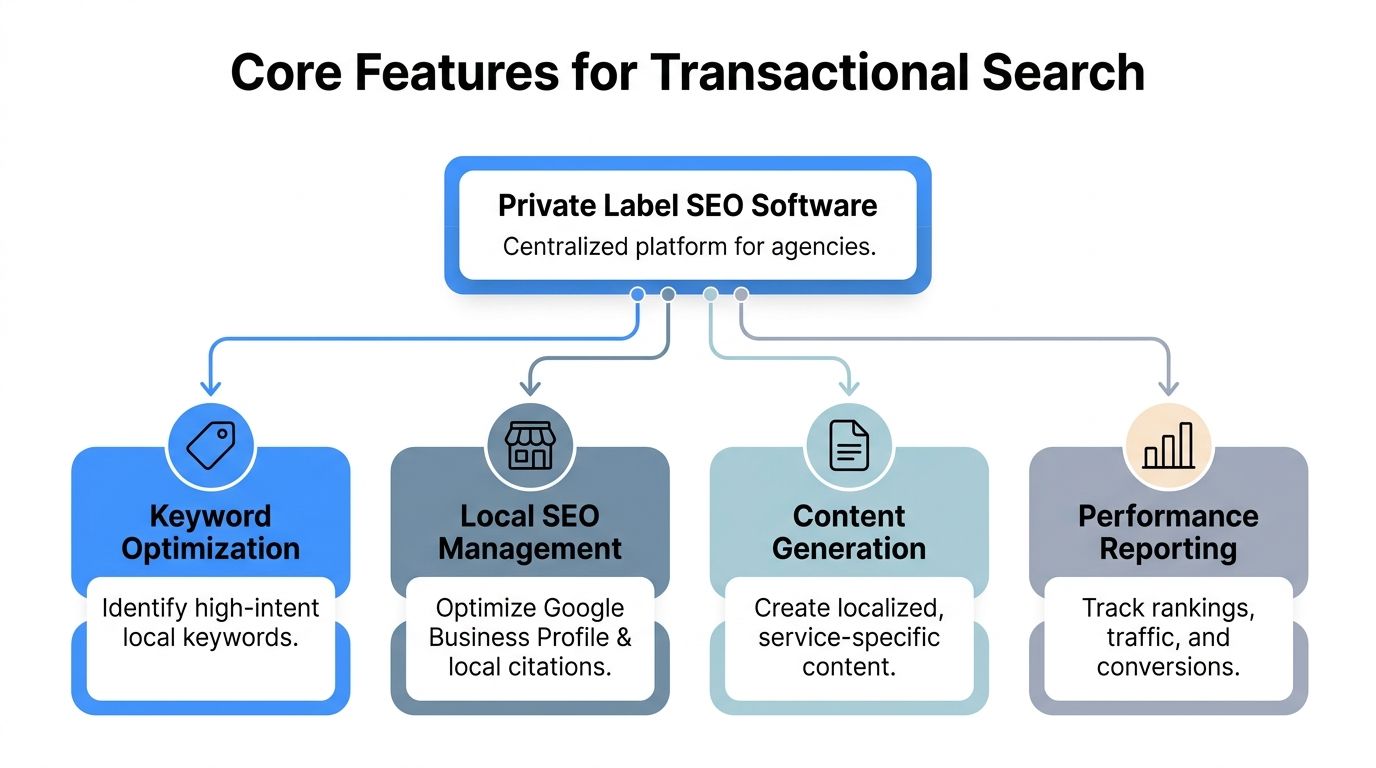
Core Features That Dominate Transactional Search
The right software doesn't need a long feature list. It needs the right stack for local buyer intent. That means tools that support exact-match targeting, map visibility, vertical content, AI discovery, and reporting that connects search presence to revenue activity.
Transactional keyword tracking
The first requirement is precise keyword monitoring. Not broad national phrases. Not generic category terms. You need rank tracking for service-plus-location combinations and “near me” variants that reflect how people search when they need help now.
A strong setup watches movement for terms like:
- Emergency AC repair Phoenix
- Dentist near me
- Termite inspection 85254
- Roof replacement Mesa
If your software can't isolate those terms by city and service line, you won't know what's producing real buying opportunities. Teams that need cleaner visibility into those movements should use a dedicated white label rank tracker built around local positioning rather than broad reporting.
Google Maps and local entity control
For service businesses, the Map Pack often decides who gets the first call. Private label platforms should make Google Business Profile optimization a primary function, not a side module.
That includes operational control over:
- Primary and secondary category alignment
- Service area and city targeting
- Review and reputation workflows
- Citation consistency
- Geo-grid and local ranking heat maps
When a platform treats Maps as an afterthought, the campaign usually stalls where it matters most. Buyers often choose from the top local listings without ever clicking deeper into traditional organic results.
Map visibility isn't a branding win. It's a lead acquisition channel.
AI optimization for LLM discovery
Local search isn't limited to classic blue links anymore. AI-driven discovery is changing how businesses get surfaced. According to Swydo's review of white-label SEO tools, 43% of search queries now trigger AI-generated overviews, which means visibility increasingly depends on semantic relevance and content structure, not just traditional rankings.
That changes content requirements. The software needs to help teams create pages that are:
- Specific to one service and one market
- Semantically aligned with the questions buyers ask
- Structured clearly enough for AI systems to interpret
- Consistent across site content, entity signals, and local profile data
Content generation that matches the vertical
A dental office, an HVAC company, and a pest control brand shouldn't run from the same content template. The software should support industry-specific content silos and service-location pages that speak the language of the buyer.
That means publishing around actual conversion phrases, not generic education content alone. For local operators, a targeted page on emergency AC repair in one city often matters more than a polished article with broad informational traffic.
Reporting that proves business value
The last core feature is reporting that operators can use. Good reporting shows keyword movement, map rankings, and content coverage. Better reporting also helps connect those signals to calls, form fills, and booked work.
If the dashboard looks impressive but can't help a business owner answer “Which service term is producing leads in which city?”, it's decoration, not software.
Strategic Benefits for Agencies and Local SMBs
Private label platforms aren't just a software choice. They change how agencies deliver local SEO and how service businesses measure whether the work is paying off.
That shift is happening inside a fast-growing category. The SEO software market outlook from Precedence Research values the global market at USD 84.94 billion in 2025 and projects it will surpass USD 295.04 billion by 2035, with a 13.26% CAGR from 2026 to 2035. Growth at that scale points to one thing. Businesses want more control, more customization, and tools that fit their operating model.
Why agencies gain leverage
Agencies that rely only on generic SEO software usually end up competing on price, turnaround, or presentation. That's a weak position. The service looks interchangeable because the tooling is interchangeable.
Private label software gives agencies a stronger position because they can shape delivery around a niche.
A local-focused agency can build around:
- Industry-specific workflows for roofing, dental, pest control, or HVAC
- Custom KPIs tied to local rankings, Maps visibility, and service-city coverage
- Unique reporting layers that fit how local clients evaluate performance
- More defensible service packaging than a standard white-label stack
That matters for retention. A client is less likely to replace a partner whose system feels embedded in the business and tuned to its market realities.
Why local SMBs see a different kind of result
Small and mid-sized service businesses don't need another traffic report. They need booked jobs, patient appointments, and a clearer path from search to phone call.
Private label systems support that by narrowing the campaign to what local buyers do:
- Search a service with urgency.
- Compare a handful of local options.
- Call from Maps or the first-page listings.
- Choose the provider that looks most relevant and most available.
That's why targeted, automated execution matters more than broad SEO activity. An automated SEO services stack built around service terms, location intent, and reporting discipline can keep the campaign focused on revenue-producing keywords instead of general visibility.
Where the upside becomes obvious
For agencies, the upside is differentiation and stronger margins.
For local businesses, the upside is simpler. Better placement for transactional terms. Better visibility in the Map Pack. Better odds that the next ready-to-buy search turns into a phone call.
That's the advantage of proprietary local SEO infrastructure. It aligns the software with the transaction, not with vanity metrics.
Your Implementation and Onboarding Checklist
Choosing a provider is where many businesses make the wrong call. The sales demo looks polished, the dashboard looks branded, and the promise sounds familiar. Then the work starts and you discover the provider is running the same recycled campaign structure they use for every industry.
The fix is a tighter onboarding process and better screening criteria.

Questions to ask before you sign
One of the clearest trust issues in this market is AI transparency. Businesses keep asking how AI is used and how client data is protected, but many vendors still avoid direct answers. According to this review of trusted white-label SEO reseller agencies, 65% of providers fail to disclose their AI integration methods or security protocols.
Ask direct questions like these:
- How is AI used in content production and where does human review happen?
- What security controls protect client data inside the platform and reporting environment?
- Can the vendor show examples from your specific vertical instead of generic SEO screenshots?
- How are transactional keywords selected by service, city, and intent level?
- What gets customized versus what stays templated?
If a provider answers vaguely, that usually tells you what onboarding will feel like later.
The onboarding sequence that works
A clean rollout is straightforward when the process is disciplined.
Define the service footprint
List the exact cities, neighborhoods, and service areas that matter. This keeps the campaign tied to revenue territory instead of broad regional noise.Build the keyword map
Assign transactional phrases to each service line and location. An SEO ranking API can help automate visibility tracking at the keyword level once the target set is locked in.Audit the Google Business Profile setup
Check categories, service areas, business details, review signals, and local consistency before content starts rolling out.
Before moving forward, it helps to align the team visually on what implementation should look like.
Map content to buying intent
Don't publish random blog topics. Build pages and articles around exact services and location modifiers.Launch reporting before expansion
Rank tracking, Maps tracking, and lead monitoring should be live early so decisions are based on actual movement, not assumptions.
The best onboarding is boring in the right way. Clear inputs, clear targets, clear tracking.
When that foundation is in place, execution speeds up and wasted effort drops fast.
Proven Use Cases in Key Service Verticals
One-size-fits-all local SEO breaks down fast in service industries. HVAC buyers search differently than dental patients. Pest control leads care about urgency, infestation type, and service area. An electrician competes on trust, response speed, and tight local proximity. The campaign has to reflect that or it won't convert.
That's where vertical-specific private label software pulls away from generic platforms.

HVAC and emergency home service
HVAC is one of the clearest examples of transactional search behavior. A person searching for emergency AC repair usually isn't researching for next quarter. They want help now.
A generic campaign often targets broad terms like air conditioning tips or HVAC maintenance. Those topics have a place, but they don't win the immediate lead. A vertical-specific system should build around emergency terms, seasonal service intent, city pages, and map visibility across the company's actual service footprint.
That means content and tracking should revolve around things like:
- Emergency AC repair plus city
- Furnace repair near me
- Same-day HVAC service
- Repair-specific Google Business Profile categories and review themes
Dental and patient intent
Dental SEO also needs its own architecture. Implant patients, emergency dental patients, cosmetic patients, and general cleaning patients search differently and convert differently. A shared template won't capture that nuance.
The software should let the team segment service lines, local pages, FAQs, and AI-visible content by treatment category. That helps the practice appear for the exact phrase tied to the next appointment opportunity, not just for a broad “dentist” keyword.
Pest control and hyperlocal urgency
Pest control sits even closer to direct-response behavior. Searches like termite inspection or bed bug treatment often carry urgency, fear, and a strong preference for nearby providers. Zip code relevance, neighborhood targeting, and service-specific page structure matter more here than generic educational traffic.
Research published in Hire With Near's article on white-label SEO outsourcing found that agencies using customized, industry-specific campaigns for verticals like HVAC or dental see 3.2x higher client retention rates than those using formulaic approaches. That result makes sense. Vertical campaigns fit how the market behaves.
Generic local SEO usually optimizes categories. Good local SEO optimizes buying situations.
Electrical and trade service precision
Electrical companies offer another useful example. A homeowner searching for panel repair, rewiring, or an emergency electrician isn't looking for broad brand content. They're screening for relevance, service area, and trust. Private label software can support pages, maps targeting, and review strategies around those exact job types.
That's the core pattern across strong vertical campaigns. The software doesn't just manage SEO tasks. It adapts the campaign to the service, the urgency, and the geography.
Measuring Real Success and Avoiding Pitfalls
A local SEO campaign is successful when it produces qualified calls and booked work from the right searches. Everything else is secondary.
That means the best KPIs aren't vanity metrics like broad traffic spikes or random keyword counts. For service businesses, the numbers worth watching are much more practical.
Metrics that deserve attention
Use reporting to answer direct business questions:
- Which transactional keywords are moving up by service and city?
- How strong is Map Pack visibility in the target service area?
- Which landing pages are tied to calls or form submissions
- Which locations are gaining traction, and which ones need more support?
A strong reporting system should make those answers obvious. Tools designed for local SEO reporting are useful because they keep the focus on local rankings, maps movement, and conversion-oriented visibility instead of broad national noise.
Common mistakes that stall growth
The most common problems are operational, not mysterious.
| Pitfall | What it causes |
|---|---|
| Using generic SEO software for every vertical | Flat messaging and weak local relevance |
| Ignoring Google Maps performance | Missed calls from buyers choosing directly in the Map Pack |
| Targeting broad informational terms first | Traffic without strong purchase intent |
| Accepting vague AI workflows | Low trust, inconsistent quality control |
| Reporting on visibility without lead context | Activity that looks good but doesn't guide decisions |
A lot of underperforming campaigns have one thing in common. They measure motion, not progress.
Private label software works when it's treated as a strategic asset. It should help teams own high-intent search terms, map visibility, AI discovery, and the reporting discipline needed to see what's turning into revenue. For local service brands, that's how SEO stops being abstract and starts producing calls from people ready to spend.
If your business depends on local customers searching terms like roofer near me, dentist near me, or air conditioning repair near me, Transactional LLC focuses on the part of SEO that matters most. Transactional terms, Google Maps visibility, AI-driven content, and city-specific rankings that turn searches into phone calls and booked jobs.