


You search your own business on your phone. You type “plumber near me” or “dentist near me,” see yourself near the top, and think the campaign must be working. Then the call volume feels flat, or the wrong neighborhoods keep converting, or your map listing disappears when someone checks from a few miles away.
That disconnect is common in local SEO. Manual checks feel reassuring, but they don't tell you what your actual market sees across devices, service areas, and search layouts. A result on your phone at one moment isn't the same thing as stable visibility for the transactional searches that bring in booked jobs and new patients.
For local service businesses, the problem isn't just ranking. It's proving where you rank for the searches that signal buying intent, then using that data to improve those positions. That's where a SEO ranking API changes the game. It turns local rank tracking from guesswork into a repeatable data pipeline, so you can see what's happening in the map pack, organic listings, and shifting search results without relying on snapshots and hunches.
Stop Guessing Where Your Business Ranks Online
Monday morning looks good on your phone. You search "roof repair near me," your business shows up, and it feels like marketing is working. By Wednesday, calls are still light because homeowners in the next ZIP code are seeing three competitors in the map pack instead of you.
That gap is where local service businesses lose work.
A single manual search cannot show how your rankings hold up across the neighborhoods you serve, the devices your customers use, and the search features crowding the page. For a plumber, roofer, dentist, or HVAC company, that blind spot usually affects the searches closest to revenue. "Water heater repair near me." "Emergency dentist near me." "AC repair near me." Those are not research queries. Those are hiring queries.
Why manual rank checking keeps misleading owners
Manual checks break for a few practical reasons:
- Searcher location changes the result set: A prospect two miles away can get a different map pack than the business owner sees from the office.
- Device type changes visibility: Mobile results often push organic listings lower and give the map pack more screen space.
- SERP features distort position: Ads, Local Services Ads, reviews, and rich results can reduce clicks even if the blue-link ranking looks decent.
- Personalization muddies the picture: Search history, account state, and repeat searches can make your own results look stronger than the market sees.
That is why agencies and in-house teams stop relying on screenshots and start using a white label rank tracker for local SEO reporting. It gives a repeatable view of where a business appears for buyer-intent searches by city, device, and service area, which is what owners need if they want ranking reports tied to booked jobs instead of reassurance.
If someone on your team is still checking rankings by hand, the reporting is already too shallow for local competition.
A More Accurate View of Your Rankings
Service businesses need a ranking view that matches how customers search. That means tracking keyword clusters by city, ZIP-focused service area, and result type, especially map pack versus traditional organic. It also means collecting that information on a schedule, not whenever someone remembers to check.
The API piece matters because it turns rank tracking into a system instead of a habit. Your software can pull the same query across multiple locations, store the results, compare changes over time, and line those changes up with leads from the neighborhoods that matter. If you want to learn MeshBase API usage, their documentation shows how a ranking data request gets structured and returned for use in a reporting workflow.
Once that system is in place, the work gets more useful. You can spot the suburb where your Google Business Profile is carrying the map pack but your service pages are weak. You can see where review strength helps one service line but not another. You can catch the market where you rank well enough organically, yet still lose clicks because local ads and map results push you below the fold.
Those are the details that lead to more calls. The question stops being whether you rank at all. The question becomes where you show up for high-intent searches, where you disappear, and what to fix first.
What Is an SEO Ranking API
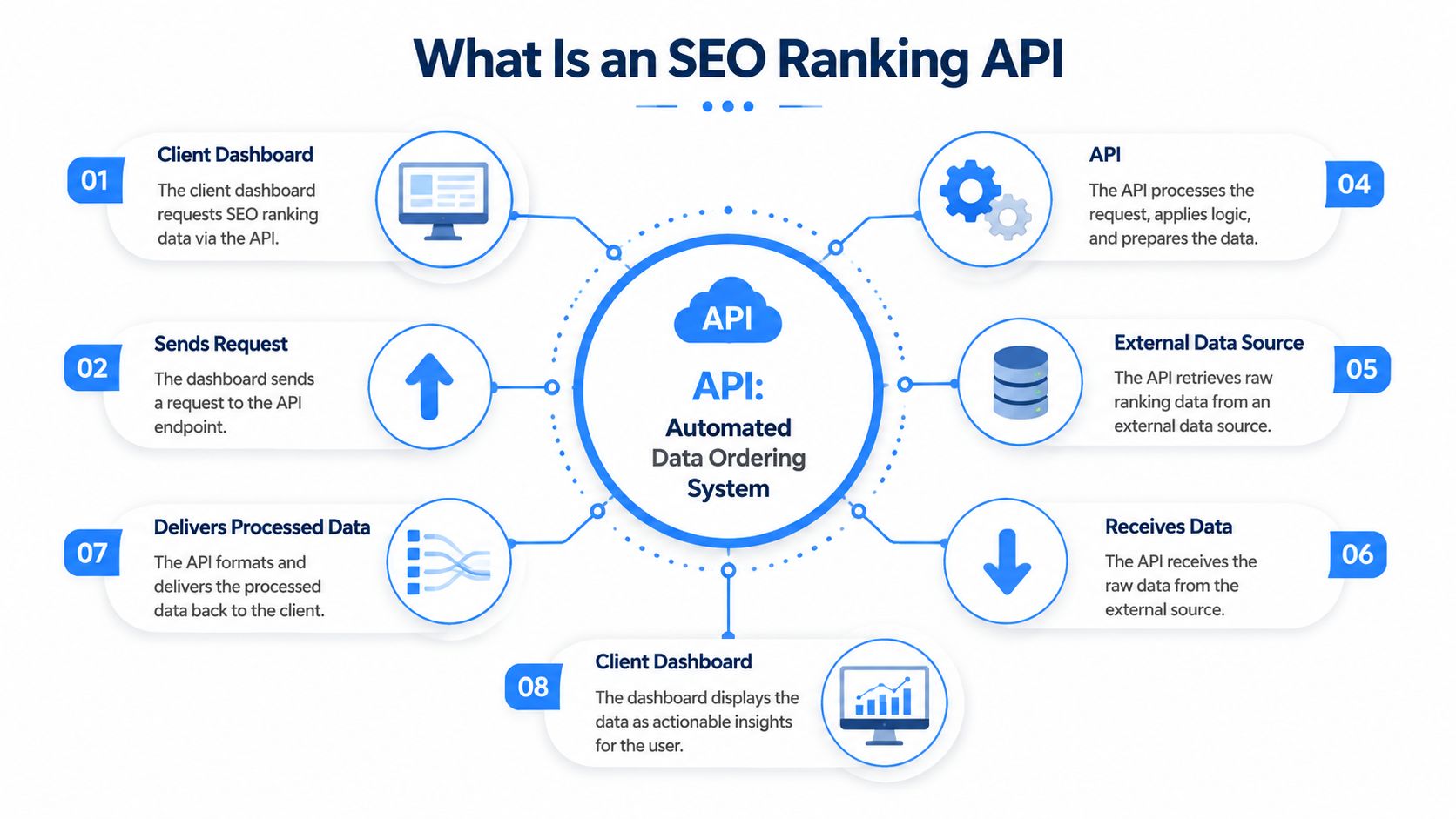
An SEO ranking API is a way for software to ask for search visibility data automatically instead of forcing a person to log into a tool, run a report, and export a file. It functions as an automated parts counter for search data. Your system submits a request for a keyword, location, and device. The API sends back structured results your dashboard can read immediately.
If you want to know where a business ranks for “air conditioning repair near me” in a specific city, the API acts like a dedicated scout. It checks the result set in a standardized way and returns the output in a format your reporting system can store, compare, and visualize.
Why APIs matter more than dashboards alone
A dashboard is the front end. The API is the plumbing behind the wall.
Modern ranking APIs provide programmatic access to structured JSON data for rankings and SERP features, which removes the slow workflow of logging in, generating reports, and exporting files. That lets businesses feed ranking data directly into BI dashboards and internal reporting systems while tracking keyword timelines across service cities and comparing local visibility with lead activity.
For a local business, that changes what's possible:
- You can monitor many service areas at once
- You can separate branded searches from transactional ones
- You can compare maps visibility against organic visibility
- You can react faster when a priority keyword slips
The category grew up
Early rank tracking tools mostly answered one question: where am I positioned?
That's no longer enough. SE Ranking describes its API as split into a Data API for keyword research and related datasets, and a Project API for automating rank tracking and competitor monitoring, showing how the category expanded from simple rank checks into broader reporting and workflow automation (SE Ranking API details).
That shift matters for local SEO because service businesses don't compete in one neat market. They compete city by city, service by service, often with different intent patterns in each place.
If you want to see a technical reference for how developers work with this kind of system, you can learn MeshBase API usage. For businesses that need a client-facing reporting layer, a white label rank tracker setup is the practical next step after the API itself.
A ranking API doesn't create visibility. It creates measurement you can trust, and trusted measurement is what makes optimization possible.
Where AI optimization fits
AI optimization depends on clean inputs. If you're building content around the wrong city-service terms, or if you're missing local ranking drops until weeks later, your AI workflows won't help much. But when ranking data updates continuously, AI systems can flag changes in search behavior, reveal content gaps, and help prioritize the transactional phrases most likely to produce calls.
That's why the API matters even if you never touch code. It feeds the system that decides what to fix next.
Comparing Common Types of Ranking APIs
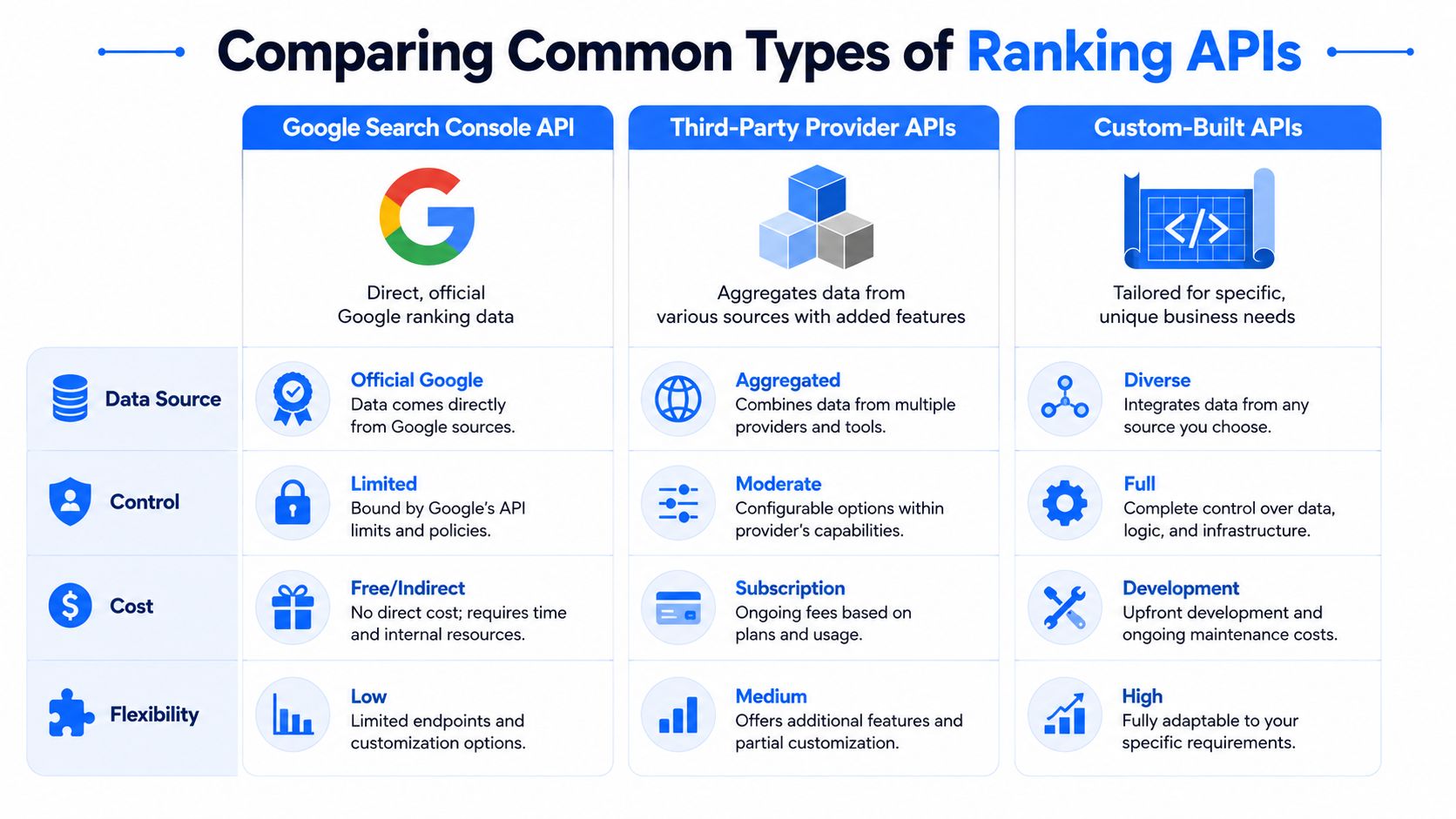
A plumber can rank third in one ZIP code, disappear in the next, and still see a report that looks fine at a glance. That is why API type matters. If the tool cannot reflect how people search by location, device, and result type, it will not help you win more "near me" calls.
Google Search Console API
Google Search Console API is the best starting point for understanding how your site appears in Google's own reporting. It shows queries, impressions, clicks, and average position trends at the page and site level.
For a local service business, that makes it useful for diagnosis, not verification. You can see that an emergency plumbing page gained visibility, but you cannot rely on Search Console alone to confirm how that page or your Google Business Profile appears for a searcher standing in a specific suburb on a phone.
Where it helps
- Query discovery: Find the city and service phrases already generating impressions.
- Page trend analysis: Spot which service pages are gaining or losing search visibility.
- Click behavior: Compare visibility against traffic to see where weak titles or mismatched intent may be costing calls.
Where it falls short
- Average position hides local variation: One blended number can mask strong rankings in one area and weak rankings in another.
- No true map pack monitoring: It does not function as a local 3-pack tracker.
- Limited operational value for fast-moving local campaigns: Owners usually need clearer answers than broad visibility trends.
Third-party SERP APIs
Third-party SERP APIs are built for direct rank retrieval. They pull live or near-live search results, often with controls for city, device, language, and search engine settings. For local SEO, that is much closer to how real customers search.
This is the category I use when a business needs to know whether "HVAC repair near me" ranks in the map pack on mobile in one service area but not another. It is the difference between reading a weather summary and checking the street outside your office.
As noted earlier, industry comparisons regularly point out the same strengths here: wide keyword coverage, automated refreshes, and better visibility into real SERP layouts where ads, local packs, and organic listings compete for attention. The trade-off is workload. Raw SERP data still needs cleanup, storage, and reporting before an owner can use it to make a decision.
Raw API output is like getting a truckload of parts instead of a finished machine. Useful, but only if someone assembles it.
All-in-one rank-tracking provider APIs
All-in-one provider APIs sit between raw SERP infrastructure and a custom-built internal system. They usually bundle API access with rank tracking, dashboards, keyword grouping, and reporting workflows.
That middle ground fits many local agencies and multi-location service businesses. You give up some flexibility, but you gain speed. Teams can monitor priority keywords, compare locations, and push updates into reports without building every layer from scratch.
| API type | Good fit | Main advantage | Main limitation |
|---|---|---|---|
| Google Search Console API | Broad site performance review | Direct Google query and impression data | Limited local ranking precision |
| Third-party SERP API | Custom local tracking systems | Better control over location-specific SERP capture | More setup, storage, and reporting overhead |
| All-in-one provider API | Ongoing client reporting and workflows | Faster deployment with built-in reporting | Less customization than a fully custom stack |
The right choice depends on what decision the data needs to support. If you need to prove map-pack movement by service area, third-party SERP data or an all-in-one provider usually makes more sense than Search Console alone. If you need to explain results to clients or managers every month, these local SEO reporting tools show what useful reporting should look like beyond a rank chart.
There is also a newer layer to consider. As local search shifts toward AI summaries and answer-driven discovery, rank data has to connect with visibility data from those surfaces too. That is part of how to achieve AI search discovery, especially for service businesses that depend on high-intent searches close to the moment of purchase.
How to Select the Right API for Local SEO
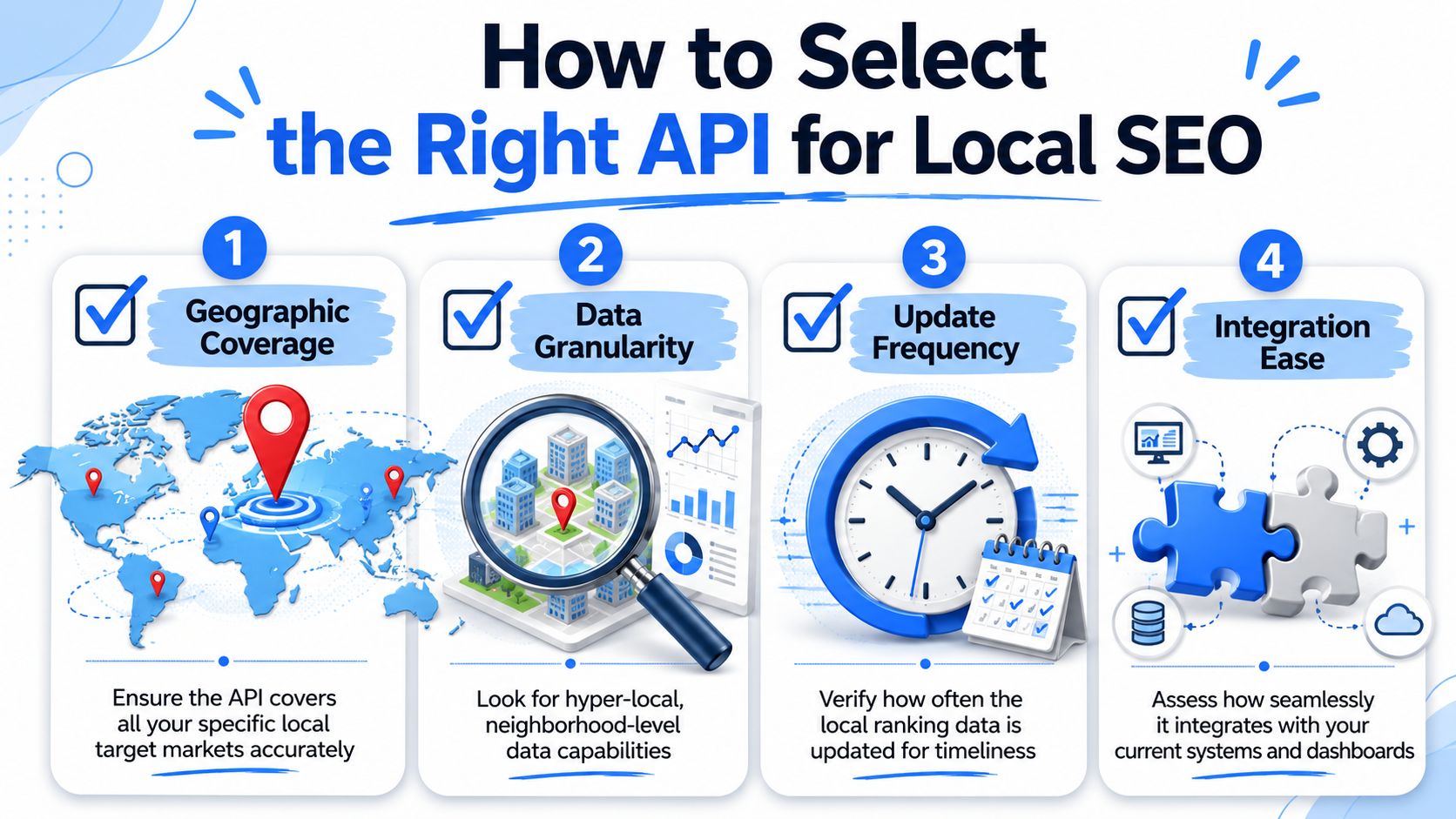
Choosing a ranking API is a business decision disguised as a technical decision. The wrong setup creates misleading reports, slow workflows, and false confidence. The right one gives you trustworthy data for maps, organic visibility, and local service pages.
Geographic precision comes first
Local SEO breaks when the API can't mirror how people search in your target market. You need city, region, country, and language controls at minimum. For many service businesses, neighborhood and zip-focused relevance matters too, especially if calls cluster in certain parts of town.
Modern APIs often support structured JSON outputs, country and language parameters, and developer SDKs such as Python and Node.js. Those features aren't just technical conveniences. They're what enable automated rank tracking, keyword grouping, and AI visibility analysis while moving data retrieval from slow manual workflows to millisecond-level responses.
Freshness beats pretty reports
A polished dashboard with stale data is worse than a plain dashboard with current data. If rankings shift after a Google Business Profile update, review velocity change, or service page launch, you need to see that movement quickly enough to act.
This video gives a useful look at local ranking verification in practice:
A useful checklist looks like this:
- Update cadence: Can you refresh often enough to catch local changes before they become revenue problems?
- SERP depth: Does the API capture enough result context to show whether ads and local features are hiding your organic placement?
- Maps relevance: Can you track what matters for Google Business Profile visibility, not just blue-link rankings?
Scalability and ownership cost
A lot of businesses choose tools based on headline price, then get trapped by hidden labor. Cheap data gets expensive when your team has to clean exports, reconcile city naming, and rebuild dashboards every month.
That's why total cost of ownership matters more than subscription cost alone. If you plan to expand to more locations, more services, or more competitors, the API should support that without forcing a full rebuild.
Selection filter: Don't ask whether an API is affordable. Ask whether it stays usable when you track every high-intent keyword across every service area you care about.
AI visibility is becoming part of the decision
Local search isn't just ten blue links and a map anymore. Businesses also need to think about how they appear in AI-shaped discovery experiences and answer-style results. For a practical introduction to that shift, this piece on how to achieve AI search discovery is worth reading.
If you need to verify rankings across multiple local areas, this guide to verifying local business rankings across multiple zip codes shows the operational side of getting trustworthy local data.
Turning Raw Data into More Phone Calls
Data matters only if it changes what the business does next. For local SEO, that means turning rank data into decisions about pages, map visibility, service-area targeting, and conversion paths.
What useful local SEO data looks like
Raw API output usually arrives as structured JSON. That's great for software, but owners don't make decisions from JSON. They need a dashboard that answers practical questions:
- Which transactional keywords are moving up or down?
- Which cities are improving?
- Are maps rankings and organic rankings moving together or separately?
- Which service pages deserve the next round of work?
When APIs feed real-time data into BI dashboards, businesses can track keyword timelines across service cities and correlate map heat maps with transactional leads. That's where ranking data stops being abstract and starts becoming operating intelligence.
A practical example from local service SEO
Take a pest control company targeting “bed bug exterminator,” “termite treatment,” and “rodent removal” in several nearby cities. The keyword set isn't enough on its own. Each phrase has to be tied to the right landing page, the right service area, and the right reporting segment.
A workable schema often looks like this:
| Keyword group | City or service area | Landing page focus | Primary outcome |
|---|---|---|---|
| Bed bug exterminator | Core urban neighborhoods | Bed bug service page | Call requests |
| Termite treatment | Suburban service zones | Termite treatment page | Inspection leads |
| Rodent removal | Mixed service region | Rodent removal page | Form fills and calls |
Now the reporting means something. If one neighborhood improves in maps visibility but call quality stays weak, the issue may be the page offer, the call-to-action, or the Google Business Profile setup. If organic visibility rises for a service page while maps visibility stalls, the business may need stronger local authority signals and review support rather than more on-page changes.
How teams actually use the pipeline
A good local SEO system doesn't just collect rankings. It compares them against business behavior.
That usually includes:
- Keyword timelines: To spot whether a service-city combination is gaining traction or slipping.
- Map heat maps: To see where a listing is strong, marginal, or invisible inside the target territory.
- Lead correlation: To compare ranking movement with calls, forms, and booked jobs.
- Content prioritization: To decide which service pages, FAQs, and city pages deserve the next edit cycle.
One option in this space is Transactional LLC, which publishes dashboards that track keyword timelines by service city, map heat maps, Search Console queries, and traffic for local service companies. The key point isn't the brand name. It's the operating model. The reporting has to connect ranking movement to commercial outcomes.
Better rank tracking doesn't matter because reports look cleaner. It matters because you can tie local visibility to booked work and stop wasting time on pages that don't move buyer-intent searches.
Where many campaigns break
The failure point usually isn't data collection. It's interpretation.
Some businesses watch a homepage rank improve and assume the campaign is healthy, even while service pages for the money terms stay weak. Others celebrate broad visibility increases but ignore that the gains are concentrated in low-intent searches instead of “near me” and service-specific transactional terms.
That's why rank reporting must sit next to conversion reporting. If the pages bringing in visibility don't convert, you still have a growth problem. Tightening page structure, call-to-action placement, trust signals, and service intent alignment matters just as much as getting the keyword onto page one. Consequently, improving website conversion rate for local service pages becomes part of SEO, not a separate discipline.
Your Next Step to Dominating Local Search
A local owner usually notices the problem the same way. The phone is slower this month, Google searches still show the business in some spots, and nobody can say with confidence whether "water heater repair near me" improved, dropped, or disappeared across the actual service area.
An SEO ranking API fixes that blind spot. It gives a repeatable view of where your business appears in organic results and the map pack by city, ZIP code, or grid point. For a service business, that matters because revenue comes from buyer-intent searches, not vanity visibility. "Plumber near me." "Emergency roofer." "Dentist near me." Those are the searches that turn into calls from people ready to book.
Raw ranking data still needs judgment. Software can pull positions, map coverage, and keyword movement. It cannot choose whether the bigger win is rewriting a weak service page, tightening internal links between location pages, improving your Google Business Profile signals, or fixing a page that ranks but does not persuade anyone to call.
That is why strong local SEO operations connect ranking data to action. If a city page climbs but lead volume stays flat, the issue may be page messaging, trust elements, or offer clarity. If map visibility is patchy across a service area, the next task may be review generation, local landing page depth, or better alignment between the keyword and the page. The API is the instrumentation panel. The strategy is still the driver.
For a broader view of how content planning supports this work, Contesimal's guide to SEO strategy is a useful outside resource.
The service businesses that pull ahead treat local rank tracking like an operating system, not a monthly report. They monitor transactional terms by service area, compare map pack and organic visibility together, and make changes fast enough to win searches before a competitor does. That is how SEO stops being a stack of screenshots and starts producing more booked jobs.
If you want help building that kind of local SEO system, talk to Transactional LLC. They work with service businesses that need clearer visibility reporting, stronger Google Maps performance, and tighter focus on transactional search terms that turn into calls, leads, and booked jobs.