


Most advice on affordable SEO for small business is backwards. It tells owners to buy the cheapest package, publish random content, and wait for miracles, which is how you burn a budget and still miss the phone calls that matter.
Real affordable SEO isn't the lowest sticker price. It's the smallest spend that still covers the work that wins transactional search terms, strengthens Google Maps visibility, and gives a local service business a real shot at the people searching with money in hand. That means queries like roofer near me, dentist near me, and air conditioning repair near me, not just broad informational traffic that never turns into booked jobs.
If you run a plumber, dental practice, HVAC company, or pest control business, the goal is simple. Own the searches that signal buying intent, then make sure your business shows up in the map pack with enough trust signals to get the call.
Redefining Affordable SEO for Local Service Businesses
Cheap SEO and affordable SEO are not the same thing. Cheap SEO usually means a thin set of tasks, weak reporting, and very little control over where the work goes. Affordable SEO means the spend is right-sized for the market, then aimed at the pages and profiles that can generate revenue.
For a local service company, that starts with transactional search terms. These are the searches where a person is already looking for a provider, not reading around for general education. If someone types roofer near me or air conditioning repair near me, they're not window shopping, they're trying to hire.
That's why broad blog volume alone won't save a small business. A pile of generic articles can look productive and still leave your map listing buried while competitors take the calls. The smarter play is to focus budget on the assets that help you appear when buyers are ready to act, especially service pages, your Google Business Profile, and location coverage.
Practical rule: if a tactic doesn't help you rank for a buying query or improve your map visibility, it doesn't belong near the front of the budget.
A useful way to think about this is simple. Affordable means the budget is concentrated on the work with the fastest path to calls, not scattered across a dozen low-impact tasks. That's also why a focused local plan often beats a bigger, vague one.
If you want a clean example of how this mindset applies to a service business, the AI-powered SEO for cleaners article from Estimatty is a useful reference because it keeps the attention on practical local discovery instead of theory. For a broader framework, Transactional's own affordable local SEO approach follows the same logic, prioritize the searches that convert.
The bottom line is blunt. Affordable SEO for small business should mean fewer distractions, more transactional visibility, and a tighter link between search demand and booked work.
Priority Actions That Drive Local Visibility Fast
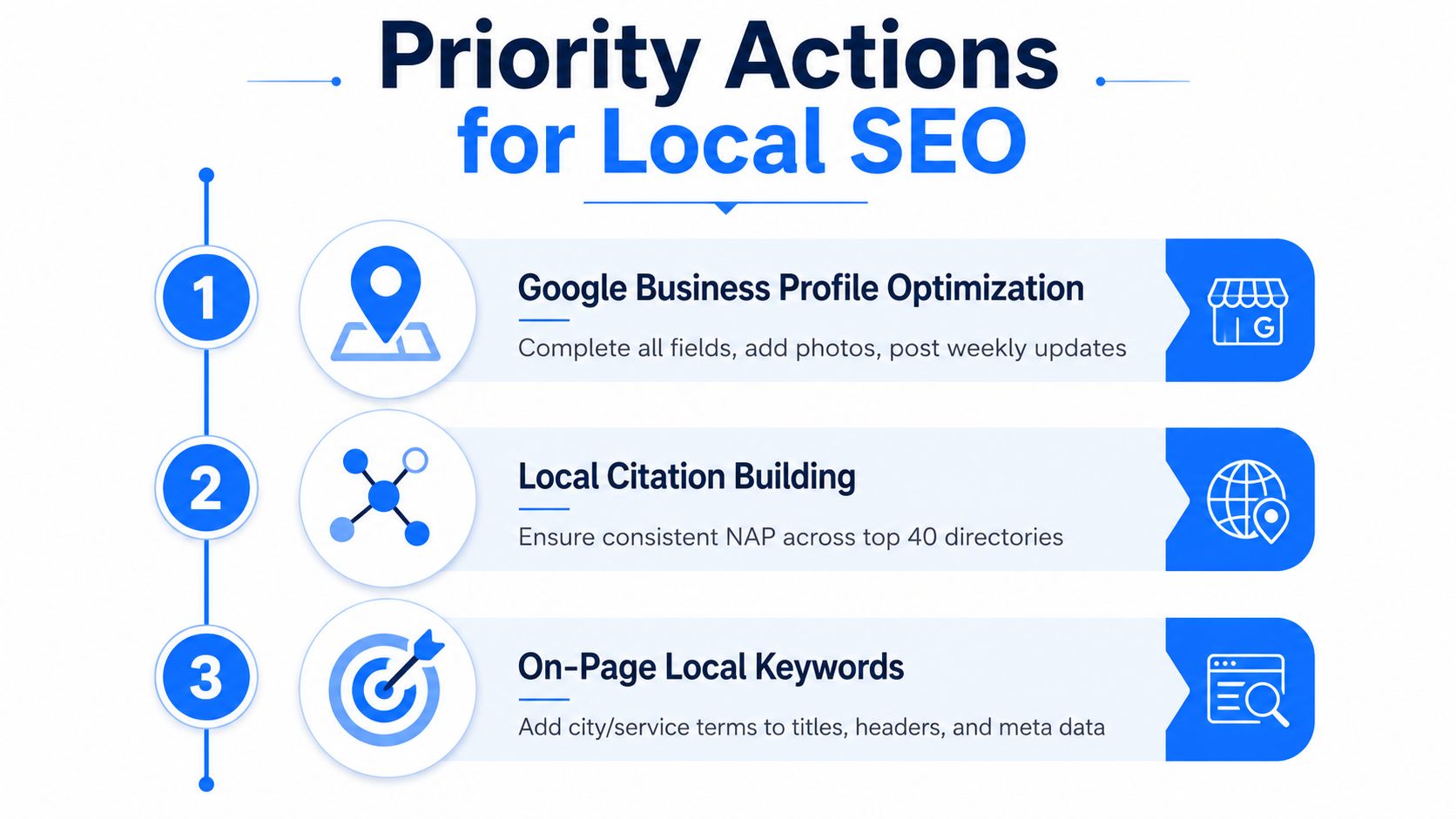
Start with the assets that can move quickly. If the site is technically messy and the Google Business Profile is half-finished, no amount of content marketing will make up for it. The cleanest low-budget sequence is to fix the foundation first, then expand into content and authority.
Month one cleanup
The first pass should include a full site audit, indexing checks, broken-page repair, speed cleanup, and setup inside Google Search Console. At the same time, complete the Google Business Profile with every available field, including name, address, phone, website, hours, services, and a keyword-rich description. A complete profile is basic work, but a lot of local businesses still leave money on the table by skipping it.
The homepage and top conversion pages need attention next. Tighten the title tags, clarify the service area, and make sure the site makes it obvious what the business does and where it serves customers. If the user has to hunt for that information, Google has the same problem.
A local business usually gets more from one clean profile and one strong service page than from five extra blog posts nobody asked for.
Month two and beyond
Once the foundation is in place, expand into pages that match actual service demand. Build internal links between related service pages, clean up local directories so your business data stays consistent, and start a review generation habit that doesn't feel awkward or forced. That combination gives search engines more confidence and gives buyers more reasons to call.
The map pack matters more than most owners admit
Google Maps optimization is not optional for local service companies. When a business reaches the top three map results in its service area, it can turn into a steady stream of calls instead of relying on referrals and paid ads alone. That's why map visibility should be treated as a revenue channel, not a vanity metric.
For a deeper technical checklist, Transactional's GMB optimization checklist is a useful reference point, because it keeps the work tied to map visibility and lead generation instead of generic SEO chores.
Realistic Pricing Benchmarks and What Each Budget Buys
Stop asking for “cheap” SEO and ask what the budget covers. That is the only way to compare proposals. For affordable SEO for small business, a practical monthly budget usually sits in the $500 to $2,500 per month range. DIY setups often mean $200 to $500 per month in tools plus 15 to 20 hours of owner time. Freelancers often fall in the $500 to $1,500 per month range, and agencies usually start around $1,500 to $3,000 per month Cited pricing guide.
Those numbers are not arbitrary. Analysts at SEMrush found that 85.49% of SEO agencies charge $50 to $200 per hour, with the most common range at $100 to $200, and just over 60% require monthly retainers above $1,000 SEMrush agency pricing data. A bargain quote usually means the provider is trimming the work, not finding a smarter way to do it.
The market has also shifted because the work is more technical and more competitive. Backlinko reports that U.S. organizations spent $119.4 billion on SEO and digital marketing consulting in 2025, and it also cites research showing small businesses spent about $497.16 per month on SEO services in 2019 Backlinko SEO services statistics. That gap tells you the old hobby-level budget is not enough for most local service businesses anymore.
My rule of thumb: if a proposal cannot cover technical cleanup, local pages, Google Business Profile work, and reporting, it is too thin to call full SEO.
SEO budget tiers for local service businesses
| Approach | Monthly Cost | Time Required | Expected Timeline to Results |
|---|---|---|---|
| DIY tools and owner-led work | $200 to $500 plus 15 to 20 hours | High owner involvement | Slow unless the site is already in good shape |
| Freelancer | $500 to $1,500 | Moderate oversight | Better for focused local work |
| Agency | $1,500 to $3,000 | Low owner workload | Best for fuller execution and reporting |
For local service companies, the buyer should care less about the label and more about what the money buys. A small retainer that only touches blog content will not move calls. A better spend goes toward the pages and signals that affect transactions, service-area relevance, and map visibility. That usually means fixing the site structure, tightening service pages, cleaning up directory listings, and keeping the Google Business Profile active enough to matter. If you need a provider that understands that mix, a focused local SEO company is a better fit than a generalist that sells broad traffic goals.
The timeline still has to be realistic. Current benchmark guidance says meaningful movement often takes 6 to 12 months, and one pricing benchmark notes that sub-$500 retainers rarely produce results SMB SEO benchmarks. Another guide places basic and local SEO at $1,500 to $3,000 per month and says most small businesses pay $500 to $2,500 per month depending on scope and competition 2026 pricing guide.
The practical takeaway is simple. If the budget sits below the floor where real execution happens, the business is buying hope, not SEO.
Evaluating Low-Cost Agencies and Independent Contractors
A low-cost SEO provider isn't automatically a bad choice. A vague one is. If someone can't explain exactly how they'll help your business show up for the searches that pay, you're the one carrying the risk.
Start the sales conversation with the right question. Ask whether they focus on transactional search terms in your service area, how they handle Google Maps optimization, and how often you'll get reporting that shows real movement. If they dodge those questions and jump straight to “more traffic,” that's a warning sign.
What to compare before you sign
The path matters as much as the price. DIY makes sense when you have more time than cash, but it costs attention and usually slows execution. Freelancers can work well if the scope is narrow and your market is straightforward. Agencies make more sense when the site needs a full cleanup, the service area is competitive, or the owner doesn't have time to manage multiple moving parts.
The red flags are usually easy to spot once you know what to look for:
- Guaranteed rankings: no serious provider should promise a fixed position, because search results move and local competition changes.
- Suspiciously low pricing: if the price seems too low to pay for real labor, the deliverables will be thin.
- No industry context: a provider who treats a roofer, dentist, and chiropractor like the same project doesn't understand local search.
- Vague reporting: if you can't tell what changed, what was done, and what happens next, the relationship will get messy fast.
Industry-specific experience matters more than most owners think. A provider who understands how a dental practice fills appointments is not automatically the right fit for a roofing company or pest control brand. Local SEO is still local SEO, but the service pages, search terms, and call patterns are different.
Transactional's SEO company overview is worth looking at if you want to compare a service model built around local search, maps, and high-intent leads rather than broad brand marketing. That said, the best vendor is the one that can explain the plan in plain language and show you where the work goes.
The right partner should feel transparent, not theatrical. If they can't tell you what gets done in week one, month one, and month three, keep looking.
Adapting Your Strategy for AI Search and Changing Results

AI search is changing how people discover businesses, and ignoring it is a mistake. Recent guidance now includes AI visibility tracking in small-business SEO, and some practitioners are already treating crawler accessibility and assistant discoverability as part of the budget. That doesn't replace local SEO, it adds a new layer on top of it.
The practical move is to keep your business information structured and complete everywhere it appears. Google Business Profile, service pages, contact pages, and directory listings should all say the same thing in the same way. AI systems work better when the information is easy to parse, and customers trust a business more when the details are consistent.
Your service pages also need enough depth to be useful beyond classic blue-link ranking. A thin page with one paragraph and a contact form gives AI systems very little to work with. A page that spells out services, service area, trust signals, and common customer questions gives search systems more material to reference.
Keep this straight: AI optimization doesn't replace local intent. It makes the need for clean, structured, local information even stronger.
For a more technical angle, it's smart to think about page stability too. When a site changes layout, shifts content around, or loads slowly, the user experience gets worse and search performance can suffer. The Cumulative Layout Shift guide from Otter A/B is a useful reminder that stable pages support better engagement, and that matters when you're trying to keep a lead on the page long enough to call.
That's where newer signals like llms.txt enter the conversation. They don't replace the basics, but they can help with crawl clarity as AI-driven systems evolve. The better question for a local business isn't whether AI will change search, it's whether the site is clear enough to be understood by both humans and machines.
For businesses that want to stay visible in both local maps and AI-driven answers, Transactional's AI search engine optimization fits naturally into the same strategy. The priority stays the same, show up for the searches that turn into calls, then make sure the site is structured enough to be found when the format of search changes.
Measurement Checklist and Scaling Your SEO Investment
If you can't measure it, you can't scale it. A local service business should not be obsessing over vanity impressions or loose buzzword dashboards. The numbers that matter are the ones tied to calls, form fills, map visibility, and booked work.
Start with the basics. Track local pack impressions, click-through rate, lead generation, and conversion rate. A simple dashboard should also show search queries from Google Search Console, the city and service term attached to each ranking movement, and which pages are producing actual inquiries.
What to watch every month
- Local Pack Impressions: track weekly visibility in the target area so you know whether map work is moving.
- Click-Through Rate: watch how often searchers choose your listing over nearby competitors.
- Lead Generation: count calls and contact form submissions from organic traffic.
- Conversion Rate: measure how many of those leads become paying customers.
The value comes from comparing those numbers to what you're spending. If organic leads are becoming cheaper while rankings hold or improve, the strategy is working. If the map pack position is flat after a quarter and calls aren't moving, the plan needs adjustment.
The cleanest scaling trigger is simple, increase spend only after the current budget is producing steadier calls, clearer rankings, and lower cost per lead.
That's also the point where many businesses expand into more service areas. Once the primary city is stable, the next step is to build around adjacent suburbs or second-tier locations instead of trying to win everything at once. The budget should follow proof, not optimism.
A transparent results dashboard helps here because it stops the debate from becoming emotional. When the owner, marketer, and provider are all looking at the same search terms, map heat signals, and lead counts, it's easier to tell whether the business needs more content, stronger local pages, or a better maps strategy.
Affordable SEO works when it creates a repeatable system. The first phase gets the site visible, the second phase turns visibility into calls, and the third phase expands into more of the service area once the core market is under control.
Transactional LLC builds local SEO systems for service businesses that need to show up for transactional search terms, win Google Maps visibility, and turn search traffic into calls. If you want a practical plan for your market, visit Transactional LLC and look at how their local search, AI optimization, and map-focused services fit your next growth push.