


You're on a dashboard call, and the numbers look fine until a service manager says the phones are slow in one city, the map pack slipped in another, and nobody can tell whether it's rankings, Maps, or just a bad reporting setup. That's the core problem with local SEO at scale. You don't need prettier charts. You need enterprise rank tracking software that tells you which service area is losing transactional searches, and whether that loss is showing up in Search Console, Maps placement, and booked jobs.
For a local service brand, the wrong tool creates false confidence. A small keyword checker can tell you where a handful of terms sit today, but it won't tell you what's happening across thousands of keywords, multiple cities, devices, and competitors the way enterprise-grade systems are built to do (enterprise rank tracking software). That's the difference between guessing and operating. If you're trying to win searches like “roofer near me”, “dentist near me”, or “air conditioning repair near me”, the visibility layer has to match the way customers search.
Why Local Service Brands Need Enterprise Rank Tracking
A plumbing company with five service areas can't run local SEO off a single screenshot. One city is holding the map pack, another is drifting, and a third is losing calls because the top three local results changed on mobile. If you're managing HVAC, pest control, or dental locations, that kind of drift is the difference between a busy week and a dead one.
The real operational problem
Enterprise rank tracking software exists because service businesses stop making sense when you only look at site-wide averages. These tools are built to watch very large keyword sets across markets, devices, and competitors, and industry guides say that's necessary once you're tracking thousands of keywords instead of a small sample (enterprise rank tracking software). That matters because a national average can look stable while one service city is falling apart.
Practical rule: If your reporting can't answer which city lost the local pack this week, it's not an operations system. It's a vanity report.
The other reason this category matters now is that rankings aren't just blue links anymore. Modern tools have to interpret SERP features, featured snippets, image packs, and Google AI Overviews alongside classic positions (enterprise rank tracking software). That's especially important for local service brands, because transactional searches often end at the map, not the homepage.
If you've ever tried to replace manual keyword tracking with spreadsheets and a weekly check-in, you already know why that breaks down at scale. The moment you add new cities, service lines, or device splits, the manual process turns into noise. The point of enterprise monitoring is to turn that noise into a control layer you can use.
What the dashboard should be tied to
A local operator doesn't care about rank for its own sake. They care about calls, booked estimates, and appointments. That's why enterprise rank tracking belongs closer to revenue ops than content reporting, especially when the search intent is clearly transactional and the customer is ready to spend.
What Enterprise Rank Tracking Software Actually Is
Think of enterprise rank tracking software as a thermostat network for search visibility, not a single thermometer. A single gauge tells you the temperature in one room. A network tells you what's happening across the whole building, and that's the only way local service brands can manage search visibility across dozens of ZIP codes, devices, and competitors.
The technical pillars that separate enterprise tools
At this level, the software isn't just checking positions. It's monitoring ranking position, SERP features, Maps placement, and AI search surfaces across multiple locations, devices, and competitors, while keeping historical data for analysis (enterprise rank tracking software). One enterprise product says it stores 480 days of historical rankings, which is useful because year-over-year reporting needs more than a short trend window (enterprise rank tracking software). Another enterprise tracker is described as supporting up to 10 million pages, 100,000 keywords simultaneously, and 60 months of historical data (enterprise rank tracking software).
That scale matters because service-area SEO is messy. A keyword can rank well in one city and disappear in another. It can perform on desktop and stall on mobile. It can show up in blue links while the map pack is doing all the work.
The engineering requirements are straightforward:
- Geo-locale precision. You need city, ZIP, radius, and device segmentation.
- Fast refresh cadence. Enterprise guides describe daily or faster updates, plus API access and segmentation across countries, devices, and brands (enterprise rank tracking software).
- Long retention. Without history, you can't connect ranking swings to launches, migrations, or Google updates.
- API exposure. If the data can't feed BI tools, call tracking, and CRM reporting, it stays trapped in a dashboard.
- SERP feature visibility. Local packs, Maps, and AI surfaces matter as much as the blue-link position now (enterprise rank tracking software).
For teams already building broader reporting stacks, the practical move is to pair rank tracking with a workflow like the one in this white-label rank tracker, then use the ranking data as one input among several. That's the right mental model. You're not buying a report. You're buying a visibility layer.
Why it feels different from a small-business checker
A small tool answers, “Where are we ranking?” An enterprise system answers, “Where are we ranking, where are we slipping, and what does that mean by city, device, and search surface?” That's the difference between looking at a number and managing a market.
The media layer matters too, because local rank data without context is just a spreadsheet with opinions. Search visibility now moves across Maps, AI surfaces, and local packs, so the software has to reflect that reality.
Later, when you compare vendors, use a local SEO reporting tools mindset instead of a keyword-list mindset. The right question is not whether the platform can show more lines on a chart. The question is whether it can explain service-area performance clearly enough to change decisions.
Core Capabilities That Matter for Multi-Location Service Businesses
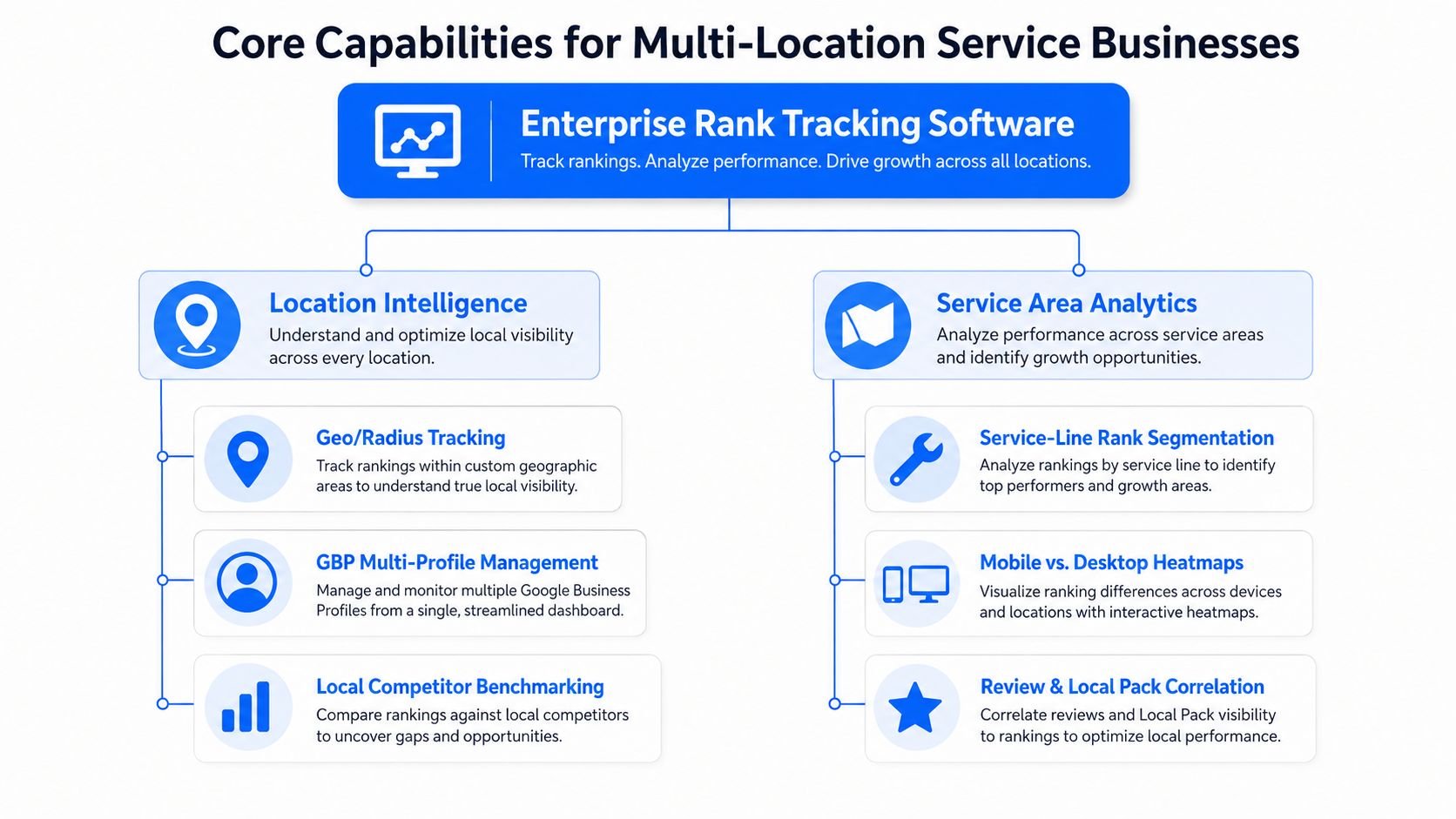
Most buyers get distracted by feature counts. That's a mistake. The features that matter are the ones that answer a local service manager's real questions, like which ZIP code is bleeding map visibility, which location is underperforming on mobile, and whether the report can be trusted by a GM who cares about booked work.
Geo and radius tracking that maps to service areas
For roofing, HVAC, plumbing, and pest control, geo and radius tracking is the core use case. You want to know which ZIP codes are losing local-pack visibility, not whether the brand ranks somewhere nationally. Enterprise-grade platforms are expected to track 50,000 to 500,000+ keywords across many city and ZIP combinations with daily or on-demand updates (enterprise rank tracking software).
That's the only way to catch the pattern where a keyword looks healthy from headquarters but is weak in the service area that pays the bills. If you run multiple branches, the reporting should split by location and by service line. Otherwise, the chart is flattering the wrong office.
Google Business Profile and Maps integration
Maps visibility is not a side note. For local service businesses, the top three map results often do more work than a page-one blue link. Enterprise trackers now monitor visibility across Google, AI engines, and SERP features rather than only standard results (enterprise rank tracking software). That matters because a listing can slide out of the local pack without a dramatic drop in organic rank.
If you're building procurement criteria, use the measurement checks in this SEO guide for Claude to pressure-test accuracy and freshness. A vendor's interface is not proof that the data is clean.
Operational rule: If a tracker can't separate Maps movement from organic movement, it's too blunt for multi-location service work.
Reporting, API, and retention
Automated reporting stops your team from rebuilding the same spreadsheet every week. API access lets you push rank data into call-tracking and CRM systems, which is where the full story lives. Retention matters just as much, because long-history data helps you connect ranking shifts to site changes, content launches, and local events instead of chasing one noisy week at a time.
Attribution and user control
At enterprise level, attribution should reach beyond rank. The best setup links rankings to calls, forms, and booked jobs, then gives each stakeholder the right permissions. That protects the data and makes the dashboard usable for managers who need to act, not admire charts.
The Measurement Validity Check Most Buyers Skip
The biggest mistake in enterprise rank tracking isn't buying too few features. It's buying data that looks advanced and doesn't reconcile with reality. A platform can track a huge keyword set and still mislead you if its numbers drift from live SERPs, Search Console, or repeated manual checks.
The checks that separate useful data from dashboard theater
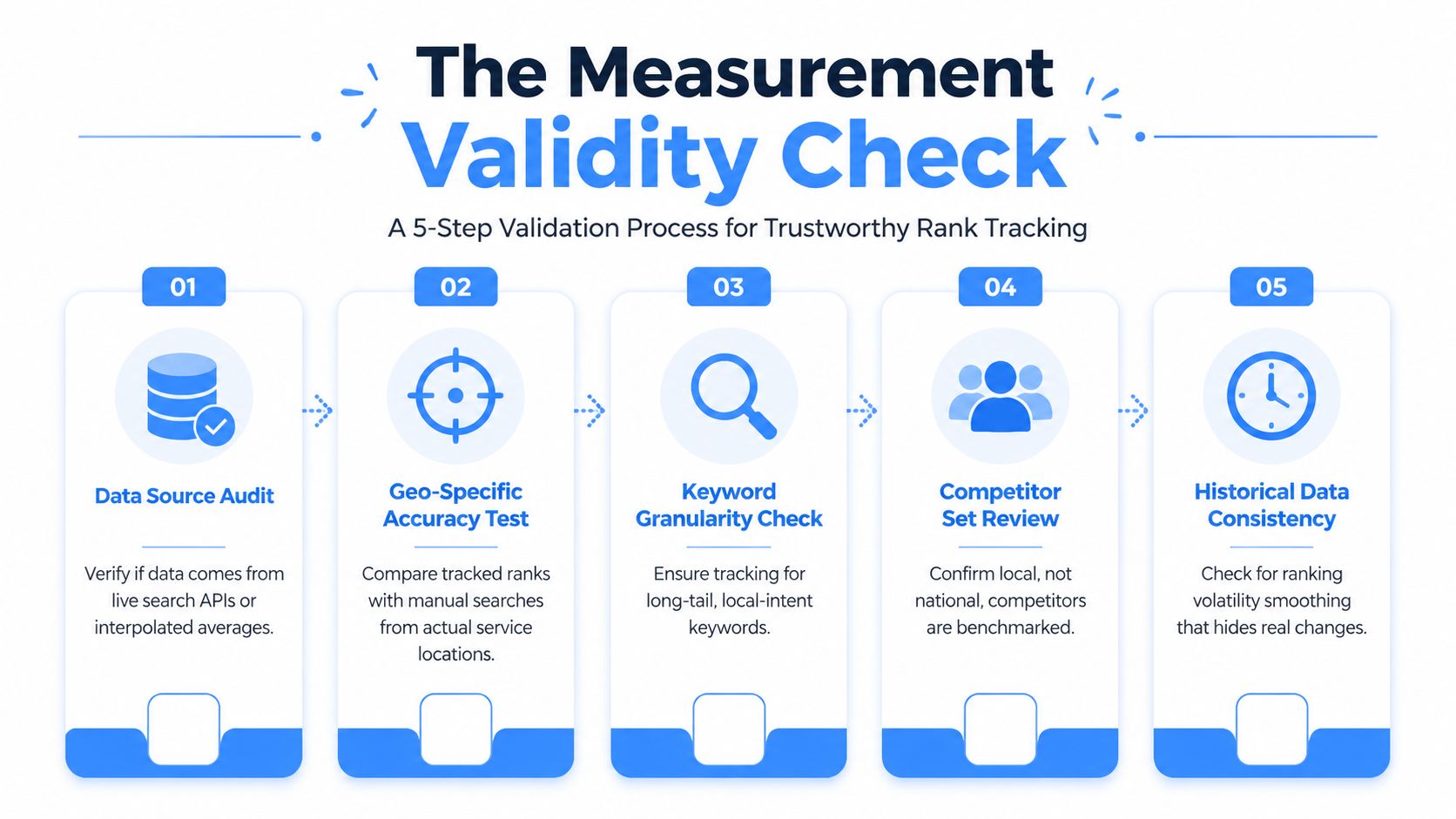
A recent evaluation guide puts the emphasis where it belongs, on measurement validity. Buyers should test whether the tracker matches live SERPs, lines up with Google Search Console averages, and produces consistent results when the same query is run at the same moment, because dashboard numbers can drift even when the underlying SERP hasn't moved (measurement validity guidance). That's the core procurement test.
Use this script before you sign:
- Compare the tool's output to live searches from the actual service location.
- Reconcile the tracker against Search Console averages.
- Repeat the same query more than once at the same time.
- Check whether local competitors are being benchmarked, not just national brands.
- Ask how the crawler handles SERP feature shifts and AI surfaces.
Buying rule: A tool that tracks a million keywords is worse than a tool that tracks fifty thousand accurately.
That sounds harsh, but it's the truth. More coverage doesn't help if the data can't be trusted. For local service brands, bad rank data means bad staffing decisions, bad budget allocation, and bad calls on which cities need attention first.
If you want a practical benchmark for location-based testing, the checklist in top methods for verifying local business rankings across multiple ZIP codes is the right kind of discipline. The point is to remove guesswork before the dashboard gets political.
What a good vendor can explain
Ask the vendor how it handles interpolation, SERP sampling, and location-specific queries. If the answer gets vague, that's your warning sign. The best enterprise rank tracker is boring in one important way, it can explain why the numbers are the numbers.
Implementing Rank Tracking Without Burning the Budget
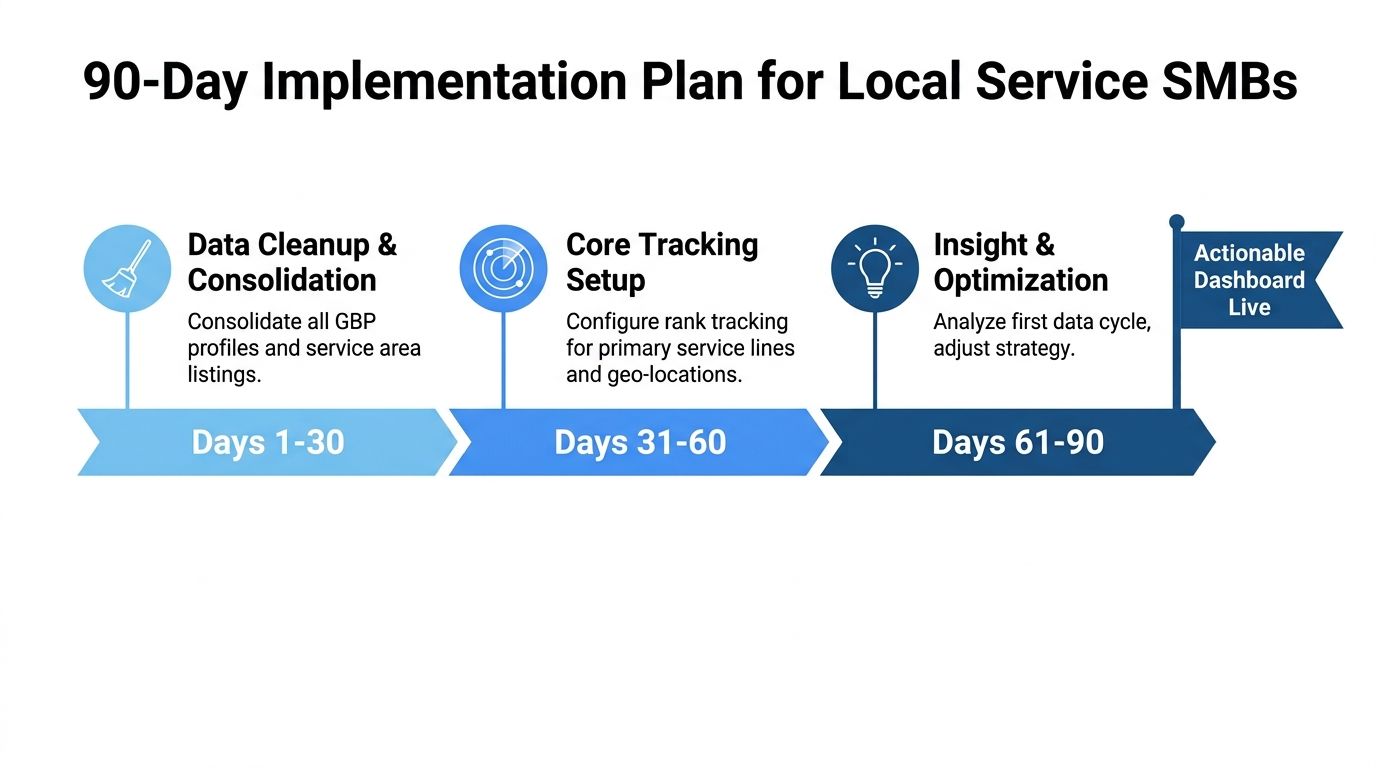
The smartest rollout is staged. Many teams waste money by turning on every keyword, every location, and every report at once, then wondering why nobody trusts the data. That's how you end up with a bloated dashboard and no operational clarity.
Start with cleanup, not tracking
The first move is to consolidate every Google Business Profile, every service area, and every landing page. If your locations are duplicated or your service pages overlap, the tracker will faithfully report a mess. That's not software failure, that's bad input.
Then build keyword groups by intent and by city. Don't throw every phrase into one basket. Track the terms that indicate immediate buying intent first, because those are the ones tied to phone calls and appointment requests.
Turn on the right signals in the right order
Once the structure is clean, configure Maps and local-pack tracking, then wire in call-tracking and CRM attribution. That sequence matters because rank data without outcome data is just commentary. After that, turn on executive dashboards and alert thresholds so managers only see what needs action.
The budget trap is simple. If you start with a huge keyword universe before you've validated accuracy, you'll pay for noise. If you skip Search Console reconciliation, you'll lose trust fast. If you rely on device-default tracking alone, you'll miss the local differences that drive service calls.
Keep the rollout operational
Think in phases rather than a giant launch. The right setup gives you one live dashboard that a GM can read in a minute and one backend data flow that a strategist can use to troubleshoot city-level drops. That's the balance.
For teams that need a cost-sensitive setup, the rollout should prioritize the service areas with the highest call value first. A clean, narrow launch beats an expensive, messy one every time.
KPI and Use-Case Playbook by Industry
Different service lines need different scorecards. If you track every vertical the same way, you'll end up optimizing for the wrong KPI. HVAC and plumbing live on urgency. Pest control lives on route density and seasonality. Dental lives on brand trust and procedure intent.
KPI Weights by Service Vertical
| Vertical | Top KPI Weight | Secondary KPI | Alert Trigger |
|---|---|---|---|
| HVAC | Emergency-intent transactional terms | Map pack placement by service city | Any drop in a primary city's Maps visibility |
| Plumbing | Near-me service terms | Mobile rank by ZIP code | A change in local-pack position for core emergency terms |
| Pest Control | Seasonal service clusters | Route-based geo segments | Weakening visibility in active neighborhoods |
| Dental | Brand vs. non-brand split | Procedure intent and local pack | Branded visibility losing ground to non-brand terms |
For a rank tracking solution to matter in these verticals, it has to reflect how people search. A dental practice doesn't get the same value from generic ranking movement as it does from branded and procedure-based visibility. An HVAC company cares more about whether after-hours intent is holding in a specific city than whether the homepage climbed two positions somewhere broad.
How to read the numbers by vertical
HVAC and plumbing should treat map-pack movement as the strongest operational signal. Those searches turn into calls quickly, so the alert threshold should be strict. Pest control needs a seasonal lens, because the service area changes with route patterns and active pressure zones. Dental and orthodontic practices should watch brand terms closely, because reputation and search visibility are tied together much more tightly than most operators admit.
The mistake is to let the platform define the KPI. You define it by business model. Then the tracker becomes useful instead of decorative.
Turning Visibility Data Into Booked Revenue
Rank tracking only matters when it helps you win jobs and appointments. If it doesn't connect to the phone, the form, and the CRM, it's a marketing report, not a business system. That's especially true for Transactional searches, where the person is already looking for a provider and is ready to spend.
The whole point is to show up for searches like “roofer near me”, “dentist near me”, and “air conditioning repair near me”. Those are not curiosity clicks. They're buying moments. A tracker that watches those terms across Maps, AI surfaces, and organic results gives you the visibility layer, but the money only shows up when the data reaches attribution.
For teams building that bridge, the framework in multi-touch attribution model is useful because it keeps ranking data connected to the rest of the customer journey. That's the right mental model for local service brands. Rank movement is the input. Calls, forms, and booked jobs are the output.
The dashboard that deserves executive attention
Keep the executive view simple. Show keyword timelines by service city, Maps movement, Search Console queries, and the conversion outcomes that matter. If a rank lift didn't produce more calls or more booked work, it's not the win you thought it was.
AI optimization changes the reporting layer, but it doesn't change the business goal. Whether the visibility comes from Google AI Overviews, Maps, or classic blue links, the target is the same. You want the transactional searcher who's ready to hire, not the browser who's still comparing options.
Transactional LLC helps local service companies turn this kind of visibility into real bookings with local SEO, Google Maps optimization, GMB setup, and AI-driven content built around transactional search terms. If you want a rank-tracking strategy that's tied to calls, map placement, and booked jobs, visit Transactional LLC and see how their team builds local search systems for service businesses.