


A plumbing search is rarely casual. A homeowner types “plumber near me”, a burst pipe is still spraying, and the next phone call usually goes to the business that shows up first in Maps or the top organic results. That matters because 46% of all Google searches have local intent, “plumber near me” gets 1.2 million monthly searches in the U.S., and 75–80% of those local plumber searches can turn into a phone call within 24 hours (Webtonic local SEO statistics).
That's why plumbing company SEO is not about chasing broad traffic. It's about winning transactional search terms, the searches that signal money is already in the buyer's hand, and pairing that with Google Maps visibility so your company shows up at the moment of need. For teams that also want fast response handling on those calls, an AI receptionist for HVAC can be useful as a reference point for how urgent service businesses are automating intake, even though plumbing needs its own local search strategy.
For a broader framework on home service visibility, the local SEO approach at Transactional's local SEO guide for home service companies aligns closely with what plumbing firms need, especially when the goal is to convert emergency demand into booked jobs.
Introduction to Local SEO for Plumbing Companies
A plumbing business usually wins by being the clearest answer to a nearby urgent problem. A homeowner who searches late at night for emergency plumber near me is far more valuable than a casual reader looking for general maintenance tips, because that search usually points to a call that needs to happen now.
The click pattern supports that reality. A large share of local search traffic goes to the Google Local 3-Pack, which makes Maps placement a core lead channel rather than a side project (Webtonic local SEO statistics). If your business is not visible there, another plumber gets the call, often within minutes. This forms the critical competition in plumbing company SEO, not broad blog traffic.
The practical test is simple. The winning site matches the searcher's intent, the city, and the service page in the same moment. That is why a plumbing site should be built around transactional queries first, with emergency and high-ticket service pages taking priority before broader city coverage. A homeowner who needs a burst pipe fixed, a water heater replaced, or a drain cleared will respond to a page that speaks directly to that problem, then localizes the offer to the service area.
A clean intake process matters after the click. If you want to see how other service businesses handle after-hours demand, the workflow behind an AI receptionist for HVAC shows how serious local operators are about answering fast when intent is highest. For a broader home-service framework that fits this approach, Transactional's local SEO guide for home service companies lays out the same local-first thinking in a wider context.
Conducting a Plumbing SEO Audit
A real audit starts with competitors, not your own homepage. Pull the top three plumbers that show up for your main services in your service area, then compare their Google Business Profiles, service pages, and review patterns against yours. You're looking for gaps in category choice, service-page depth, city coverage, and NAP consistency, because those are the elements that keep showing up in local search performance.
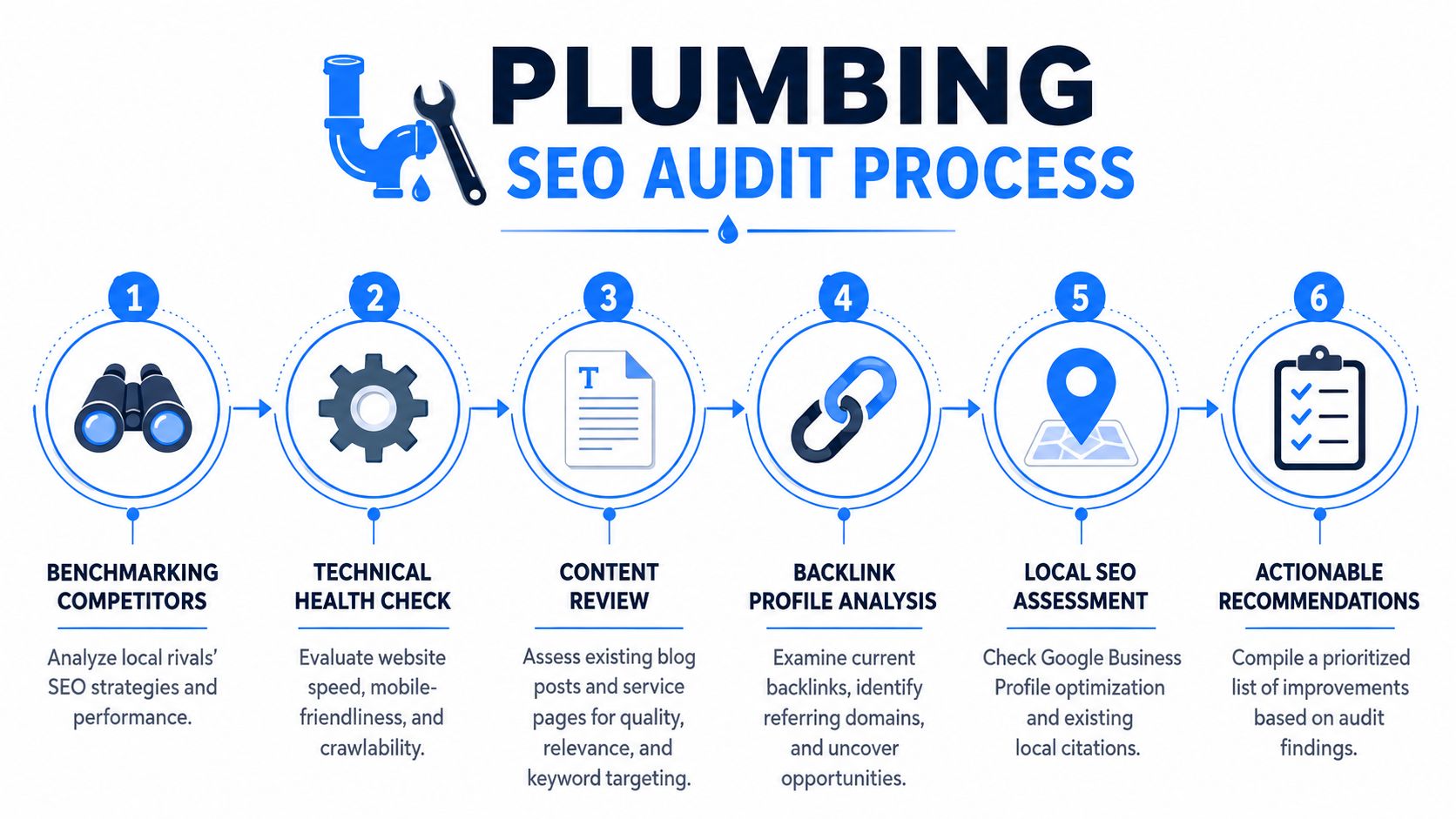
What a practical audit should flag
Start with the site itself, then move to the map listing. Check whether pages load cleanly on mobile, whether title tags are unique, whether the phone number appears above the fold, and whether the site has dedicated pages for the services that drive the most revenue. If the site funnels every service into one generic page, that's a structural issue, not a content issue.
A useful milestone comes from plumbing SEO benchmark data. Long-tail plumbing keywords often show first ranking movement in 6–12 weeks, meaningful organic lead volume usually takes 4–7 months, and Map Pack improvements often show in 2–5 months when the Google Business Profile is actively managed (Authority Specialist plumbing SEO statistics). That timeline tells you whether a site is under-optimized or whether it needs a larger rebuild.
A strong audit should also identify what not to fix first. A company with broken page structure and weak local signals shouldn't spend the first month writing blog posts. It needs the pages and profile that support immediate calls.
Practical rule: fix the pages tied to revenue before you chase broad informational content.
If you want a more formal audit framework, the workflow in Transactional's website audit guide maps well to plumbing companies that need both technical cleanup and local relevance.
Google Business Profile Optimization
A plumbing company's Google Business Profile is often the first place local demand turns into a call, so the details need to be exact. Use the exact business name, one primary phone number, the correct address or service-area setup, accurate hours, and the right categories. When those fields do not match across listings, trust drops and map-pack competition gets harder than it should be.
The profile fields that matter most
Start with the business description. It should say what you do, where you work, and which service area you cover. Housecall Pro's guidance emphasizes using phrases that match transactional local queries, such as “emergency plumber near me”, because the wording has to line up with how people search (Housecall Pro plumbing business SEO). That is not keyword stuffing. It is a practical way to make the profile read like the searcher's intent.
Photos carry more weight than many owners expect. A plumbing checklist recommends adding at least 10 high-quality photos of the team, vehicles, and completed work to the profile (xSquare SEO plumbing checklist). Those images show that the business is active, current, and real, which helps a prospect decide who to call when they are comparing contractors quickly.
Review flow is the other lever. Plumbing SEO guidance commonly points to requesting 3–5 new reviews per month and keeping business details identical across listings to support Google Maps visibility (Scorpion plumbing SEO guidance). That pace is not about manipulating rankings. It keeps the profile from looking stale while competitors continue to collect fresh social proof.
For the setup work itself, Transactional's Google Business Profile guide is a useful reference for service companies that need disciplined local listing management instead of one-time edits.
Local Keyword Research and Creation of Landing Pages
The smartest plumbing sites don't start with city pages. They start with service-intent keywords that are tied to urgent or high-ticket jobs, then localize those pages by city or service area. That's a sharper play because many plumbing sites still lack dedicated pages for emergency plumber and 24-hour plumbing, even though those are often the highest-converting terms in the category (SEO Prospects plumbing SEO gaps).
How to choose the first pages
Build a keyword list around services people book, not just services people read about. Emergency calls, water heaters, drain cleaning, leak detection, and repair work usually deserve priority because the buyer is already close to action. If a term is tied to a complex, expensive job, it usually deserves its own page before a broad city landing page does.
| Example City-Service Keyword Targets | Monthly Searches | Intent Type |
|---|---|---|
| emergency plumber near me | High-intent local search | Transactional |
| 24-hour plumbing [city] | High-intent local search | Transactional |
| water heater repair [city] | Service-intent local search | Transactional |
| drain cleaning [city] | Service-intent local search | Transactional |
| leak detection [city] | Service-intent local search | Transactional |
The page itself should carry one focus. Use a single H1 with the service plus location, then write a clear introduction that says what the service solves and who it helps. Several plumbing SEO guides recommend 400 to 600 words for service pages, along with the problem description, diagnosis, treatment options, approximate cost ranges, and 3 to 5 FAQs with schema markup (Hi Agency plumbing SEO guide). That structure gives both users and search engines enough context to trust the page.
Don't pile five services into one landing page just to save time. You'll blur intent, weaken rankings, and make the page harder to convert.
If you need a place to start, prioritize the pages that can produce calls fastest, then expand city-by-city after the core service pages are live. That's usually a better use of labor than publishing broad location pages that never match a buying query cleanly.
Content Silo Planning and On-Page SEO
A plumbing website gets stronger when every page knows its job. The cleanest structure usually has three layers, a service hub, area pages, and a blog. That gives your site a way to group authority around services, support local search, and answer questions without turning every page into a catch-all.
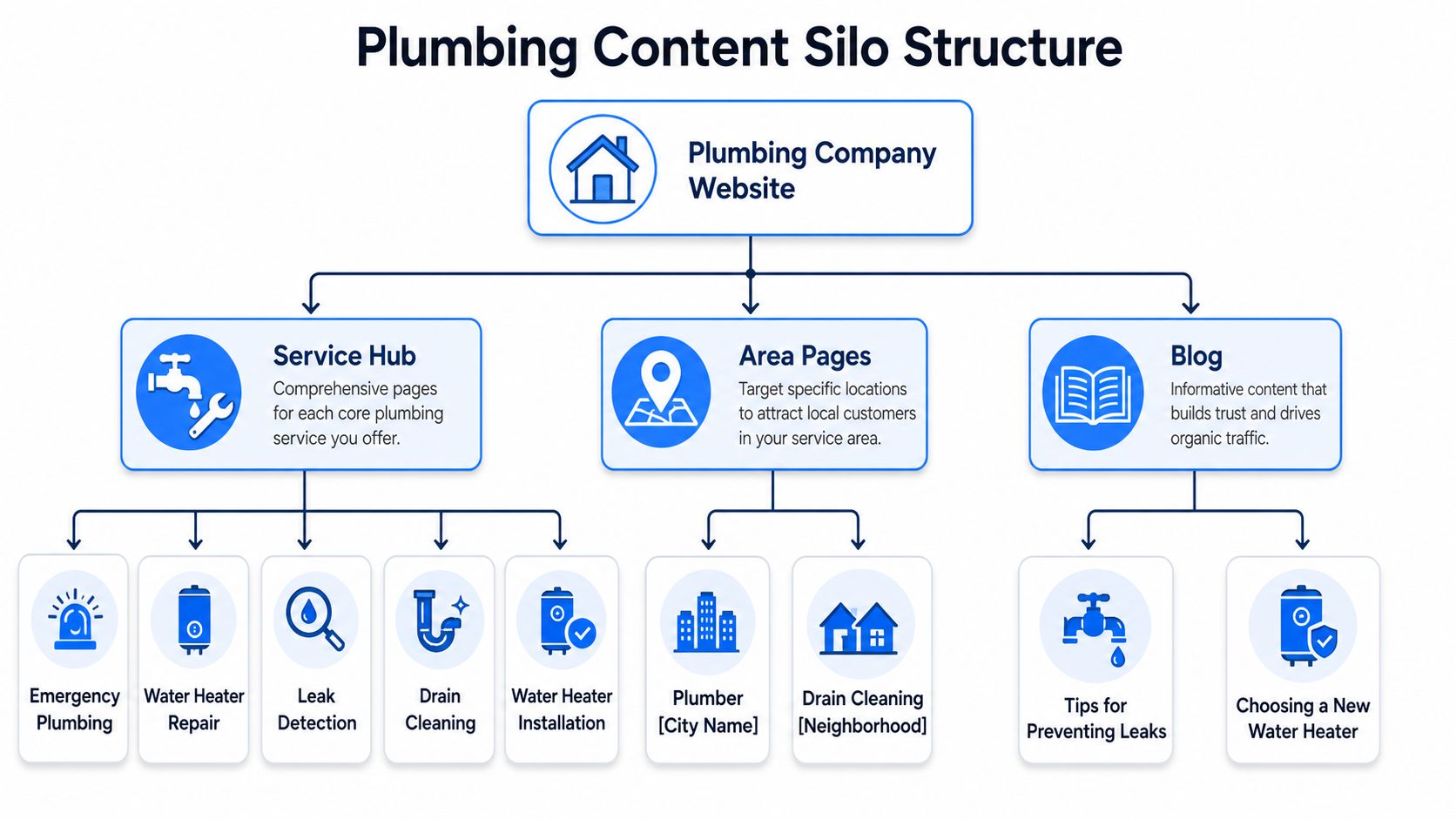
The hierarchy that keeps pages focused
The service hub should connect to the money pages first, things like emergency plumbing, drain cleaning, and water heater installation. Area pages should support the cities and neighborhoods you serve, while the blog should handle education, comparison content, and problem-solving topics. This arrangement keeps the site crawlable and stops one page from competing with another for the same query.
The rule from Hozio's plumbing SEO playbook is simple, one primary keyword per page, with hubs built for services and areas to prevent keyword cannibalization (Hozio plumbing SEO playbook). That matters because the search engine needs a clear signal about which page should rank for which intent. If two pages both try to rank for the same service in the same city, neither one usually wins cleanly.
A plumbing site also benefits from straightforward internal linking. Service pages should link back to the hub, area pages should point to the relevant service pages, and FAQs should link to the contact route or booking path. Keep the copy readable first, but make sure every page has a function in the larger system.
The embedded training below is useful if your team wants a visual reminder of how siloed content works in practice.
Citation Management Review Strategy and Local Linkbuilding
Local pack visibility usually comes down to discipline, not creativity. If your business name, address, and phone number drift across directories, the local signals get muddy. If reviews sit still for months, the profile looks inactive. If the link profile points only to generic sources, the business feels less tied to the area it serves.
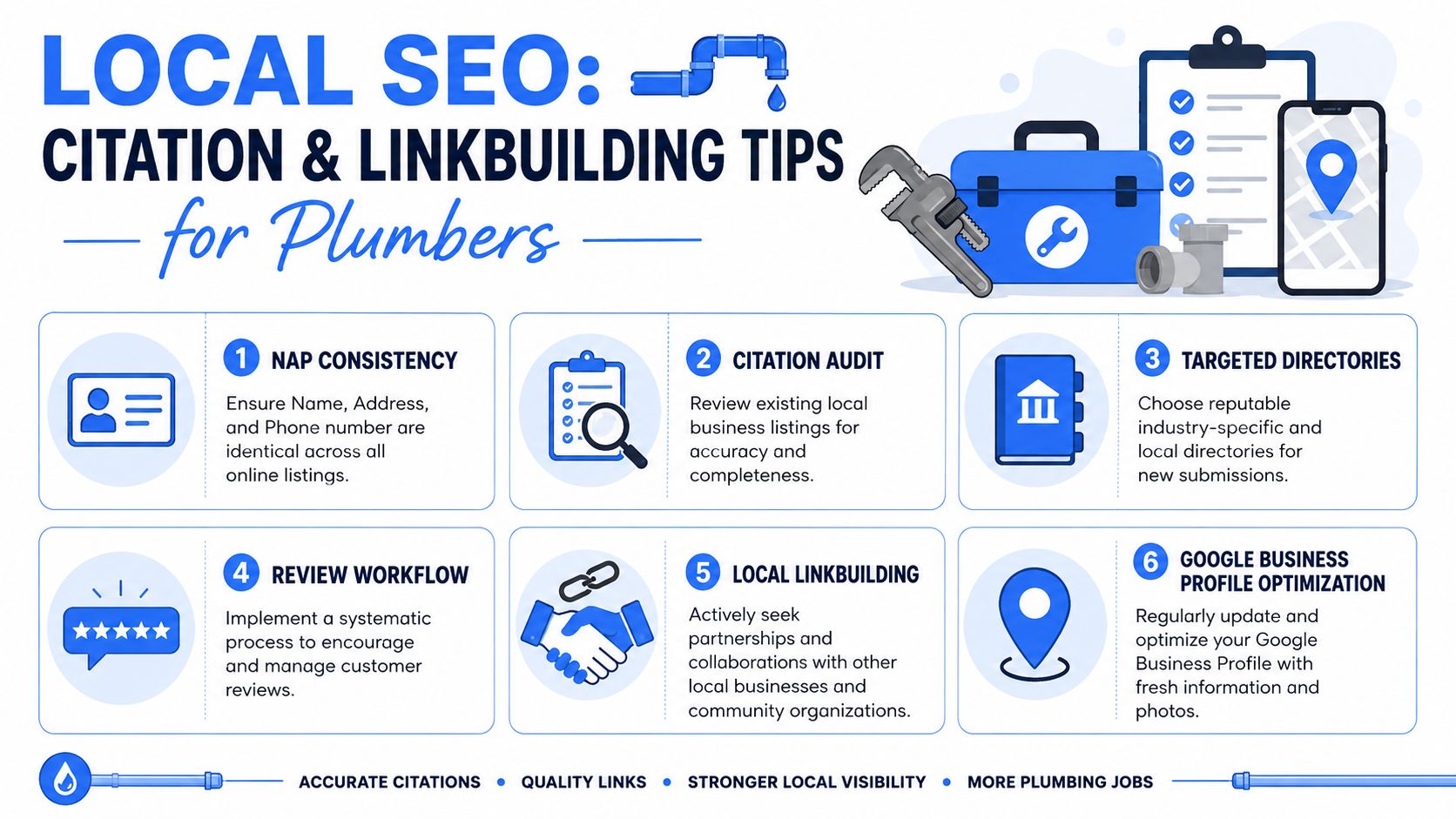
What to clean up first
Start with a citation audit. Check whether your details match on Google Business Profile, Yelp, Bing Places, Apple Maps, and the local directories that matter in your market. Exact consistency matters more than being listed everywhere. Clean citations help customers and search engines read the same business data, which reduces confusion around your location and contact details.
Why review flow matters more than a one-time push
A one-time review request campaign usually fades. A monthly request process is steadier. Ask after successful jobs, send a direct review link, and keep the ask simple enough that the customer can finish it quickly. Reply to reviews promptly so the profile keeps showing active management. For plumbers, this works best after emergency calls, water heater replacements, drain cleanings, and other high-ticket jobs where the customer has a clear outcome to describe.
Where links should come from
Local linkbuilding works best when it reflects real community ties. Trade organizations, supplier relationships, chamber memberships, neighborhood sponsorships, and local news mentions are all more believable than random guest posts on unrelated sites. Prioritize links that match the service area and the work you provide, especially if you want emergency plumbing, drain cleaning, and other call-driving pages to gain local trust faster. The goal is to build a local footprint that supports the rest of the SEO system.
A cleaner way to think about it is this.
A plumbing company does not need more links from the internet at large. It needs more proof that it belongs in the places it serves.
Transactional LLC also offers Google Maps and Google Business Profile management, including setup, optimization, category alignment, and service updates, which fits this kind of local-signals work when a team wants that handled in one place. For teams that need to connect organic and paid lead sources, multi-touch attribution tracking helps show how calls, forms, and ad clicks relate without guessing.
Integrating Paid Advertising Tracking and Next Steps
Paid ads and organic SEO should work as a single pipeline, not separate campaigns. Ads can capture immediate transactional demand while SEO builds durable visibility for the same services and cities. That balance matters because plumbing search behavior changes quickly when someone's pipe bursts or a water heater fails.
Use Google Ads for your highest-intent terms, then align ad copy with the exact service pages that answer the query. If the ad says emergency plumbing, the landing page should say emergency plumbing and make the phone number obvious. That alignment improves the chance that paid traffic turns into calls instead of bounce traffic.
Tracking should be simple enough to use every week. Monitor rankings, map views, calls, and form fills in one dashboard, then review changes biweekly so you can see which services are pulling ahead and which pages need work. If you're evaluating attribution across channels, Transactional's multi-touch attribution model is a useful reference for connecting organic, paid, and call-based lead sources without guessing.
The next moves are straightforward. Tighten your GBP, publish the highest-intent service pages first, clean up citations, and keep review requests moving every month. That's the mix that supports both near-term calls and longer-term local visibility.
Transactional LLC builds plumbing company SEO around the searches that turn into calls, especially transactional terms like plumber near me, emergency service, and city-specific repair pages. If you want help tightening your Google Maps presence, service-page structure, and AI-ready local content system, visit Transactional LLC and see how its local SEO and website support fit your market.