


A lot of local business owners are staring at the same problem right now. The website looks decent, the service is strong, reviews are coming in, but the phone still isn't ringing the way it should. You search your own business, and instead of seeing your company for terms like roofer near me or dentist near me, you see competitors taking the clicks and the calls.
That usually isn't a branding problem. It's an audit problem.
If you want to learn how to audit website performance in a way that effectively drives booked jobs, you can't stop at broken links and page titles. A real audit for a service business has to answer harder questions. Can Google crawl the site? Do the service pages match transactional intent? Does the Google Business Profile deserve a top map position? Can a customer on a phone call you in seconds? Are AI systems surfacing your business when buyers ask for local recommendations?
Why Your Website Isn't Generating Leads
Most service business websites fail for a simple reason. They were built to exist, not to rank for transactional search terms.
A homeowner searching emergency plumber near me is not browsing casually. A patient searching dentist near me open Saturday is not looking for a thought-leadership article. These people are ready to act. If your website isn't built and audited around that kind of intent, you get traffic leaks, weak rankings, and low lead volume.
A proper audit fixes that by exposing the exact reasons your site isn't showing up or converting.
One industry breakdown reports that websites conducting quarterly audits saw up to 61% more organic traffic, 32% higher conversion rates, and 50% lower bounce rates than sites that didn't audit regularly, while 94% of webpages receive no traffic from Google and 79% of sites miss meta descriptions according to SEOmator's statistical breakdown of SEO audits. Those numbers tell you two things fast. Most sites are invisible, and regular auditing creates measurable separation.
What usually goes wrong
Local service sites tend to miss leads for a few repeatable reasons:
- Wrong keyword targeting. The site talks broadly about the company, but it doesn't have pages tightly aligned to searches like roof repair near me or Invisalign dentist in [city].
- Weak local relevance. Service areas, location terms, and entity signals are thin or inconsistent.
- Technical drag. Slow mobile pages, indexing problems, and poor page structure suppress rankings before content even gets a chance.
- Conversion friction. Hidden phone numbers, clunky forms, and weak calls to action waste the traffic you do earn.
Practical rule: If a page can't rank, reassure, and convert in one visit, it isn't doing enough for a local service business.
A lot of generic audit checklists are still useful, and Surnex's guide for modern agencies is a solid example of a broad framework. But for local SEO, the audit has to be stricter. Every finding needs to connect back to one outcome: more visibility for high-intent searches and more calls from people ready to buy.
The standard that matters
A website audit for a local business isn't just a health report. It's the diagnostic layer behind map visibility, local organic rankings, and AI discovery.
That means the audit should look at four things together:
| Focus area | What you're really checking |
|---|---|
| Technical foundation | Can Google access, index, and trust the site? |
| Transactional content | Do pages match what buyers search when they're ready? |
| Local presence | Does the business deserve to rank in Maps and local packs? |
| Conversion path | Can visitors become callers or booked jobs without friction? |
If your site isn't generating leads, start there. Not with another redesign. Not with more blog posts. Start with the audit.
Auditing Your Site's Technical Health and Speed
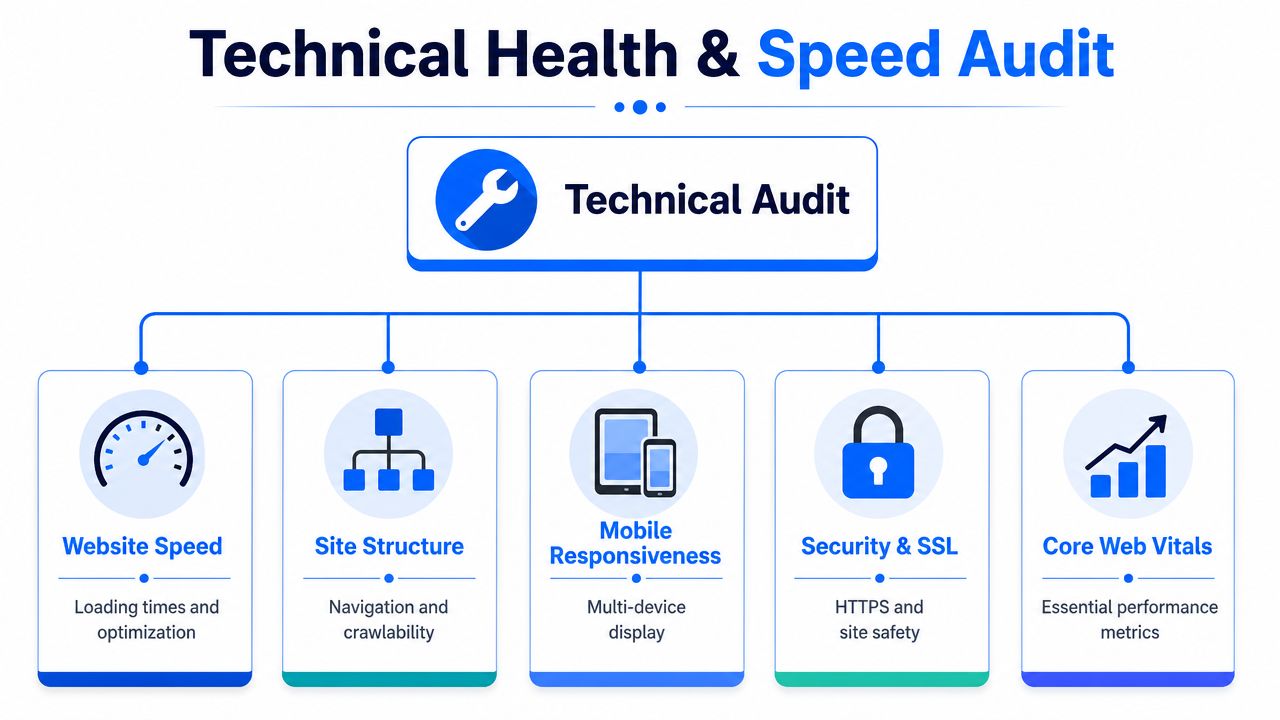
Technical SEO isn't glamorous, but it decides whether your content can compete. If the site loads slowly, breaks on mobile, or gives Google mixed signals about what to index, you won't consistently win local searches.
Start with the infrastructure. Then move upward.
Check speed before anything else
Run the homepage, top service pages, and top location pages through PageSpeed Insights. Don't audit only the homepage. Local leads often land on a service page first.
Google's commonly used thresholds in a website-audit walkthrough put Largest Contentful Paint under 2.5 seconds and Interaction to Next Paint under 200 milliseconds as key targets in Vaulted's website audit process and performance benchmark guide. In plain terms, LCP tells you how fast the main content appears, and INP tells you whether the page responds quickly when someone taps or clicks.
For a roofer or dentist, that matters because mobile users are impatient. If the page stalls while loading a giant hero image or hangs when someone taps the call button, they leave.
A simple way to read the results:
- Bad LCP usually points to oversized images, bloated themes, or slow hosting.
- Bad INP often means scripts, popups, chat widgets, or booking tools are slowing down interaction.
- Bad CLS means buttons, forms, or headings shift while the page loads, which creates trust issues fast.
For a deeper breakdown of common fixes, review these technical SEO issues that often block rankings.
Audit mobile like a customer, not a developer
Most local service searches happen on phones. So don't just resize your browser and call it done. Open the site on an actual mobile device and try to complete the path a stressed customer would take.
Test these actions:
- Load the page on mobile data. This illustrates the speed experience in a practical setting.
- Tap the primary CTA. Make sure tap-to-call works immediately.
- Open the menu. Hidden or broken navigation kills service page discovery.
- Submit a form. Long forms and broken fields suppress leads.
- Scroll to trust signals. Reviews, licensing, warranties, and financing need to be easy to find.
When a local buyer needs urgent help, every extra second and every extra tap helps a competitor.
The short version is simple. If the site is hard to use on a phone, it is hard to rank and hard to convert.
A useful walkthrough on technical audit sequencing sits below. Watch it with your own site open in another tab and test each page as you go.
Verify crawlability and indexability
Now check whether Google can process the site cleanly.
Use Google Search Console, Screaming Frog, or another crawler to review:
- Broken links that send users and bots into dead ends
- Redirect chains that waste crawl efficiency
- HTTP to HTTPS consistency so pages don't split trust signals
- Orphan pages that have no internal links pointing to them
- Noindex mistakes on service or location pages that should rank
A technical website audit should move from infrastructure to content, beginning with page speed, mobile responsiveness, Core Web Vitals, crawl errors, broken links, HTTPS/SSL, and accessibility, then tracking fixes over time with Search Console and analytics, as outlined in Glassbox's website audit checklist.
If you're learning how to audit website performance for lead generation, this is the foundation. No amount of keyword optimization can rescue a site that Google struggles to crawl and users struggle to use.
Aligning Your Content with Transactional Keywords
A lot of businesses publish content that answers questions but never closes the gap between curiosity and contact. That's why traffic can rise while leads stay flat.
For local SEO, the content audit has to separate transactional pages from everything else. Transactional pages target searches from people who want service now. Informational pages support authority, but service pages and location pages drive the calls.
Start with page-level traffic, not opinions
Before touching copy, export your page data from GA4. A rigorous content audit starts with 6 to 12 months of page-level traffic, sorted by pageviews and segmented into meaningful sections like services, products, blog content, and case studies, as recommended in Orbit Media's guide to website content audits.
That matters because owners often guess wrong about what deserves attention. The page you think is important may be getting ignored. The page you forgot about may already have ranking potential.
Group your URLs into buckets such as:
- Service pages like roof replacement, emergency plumbing, teeth whitening
- Location pages tied to cities or service areas
- Support content such as financing, insurance, FAQs
- Blog posts that attract broader traffic
- Low-value pages that don't support ranking or conversion
Score pages by intent and business value
A page doesn't deserve investment just because it exists. It deserves investment if it aligns with the search terms that produce revenue.
Use a simple review table like this:
| Page type | What strong alignment looks like | What weak alignment looks like |
|---|---|---|
| Service page | Targets one core service with clear local relevance and a strong CTA | Talks broadly about the company with no clear keyword target |
| Location page | Connects one service to one city or service area with unique context | Swaps city names on duplicate pages |
| Blog post | Supports internal linking and local authority around a service topic | Chases broad topics with no path to a lead |
| Support page | Removes objections around scheduling, insurance, pricing, or process | Exists in navigation but offers no conversion support |
A plumber should have pages built for searches like water heater repair [city], drain cleaning near me, and emergency plumber [city]. A dentist should have pages for emergency dentist [city], dental implants [city], and same day dental crown [city] if those services are offered.
Those pages need to do three jobs at once:
- Match the exact service intent
- Reinforce local relevance
- Give the visitor a next step immediately
What to keep, improve, or remove
Once the pages are grouped, start making decisions.
Keep pages that already align with service intent and support calls. Improve pages that target the right topic but are thin, outdated, or poorly structured. Remove or consolidate pages that overlap, cannibalize, or contribute nothing to local lead generation.
A strong local site doesn't need more pages. It needs the right pages, aimed at the right searches, with a clear path to action.
The biggest content mistake I see is businesses trying to rank for broad educational phrases while neglecting the pages that should own the money terms. If you want to know how to audit website content the right way, don't start by asking whether the blog is active. Start by asking whether your best service pages deserve to rank for the exact terms buyers use when they are ready to hire.
Mastering Your Google Business Profile Audit
For a local service company, the Google Business Profile is not a side asset. It's the storefront that appears before many people ever reach your website.
When someone searches roof repair near me or dentist near me, Google often pushes the map pack to the top of the page. If your profile is weak, incomplete, or inconsistent, you're giving away some of the highest-intent leads in your market.
Audit the profile like a sales asset
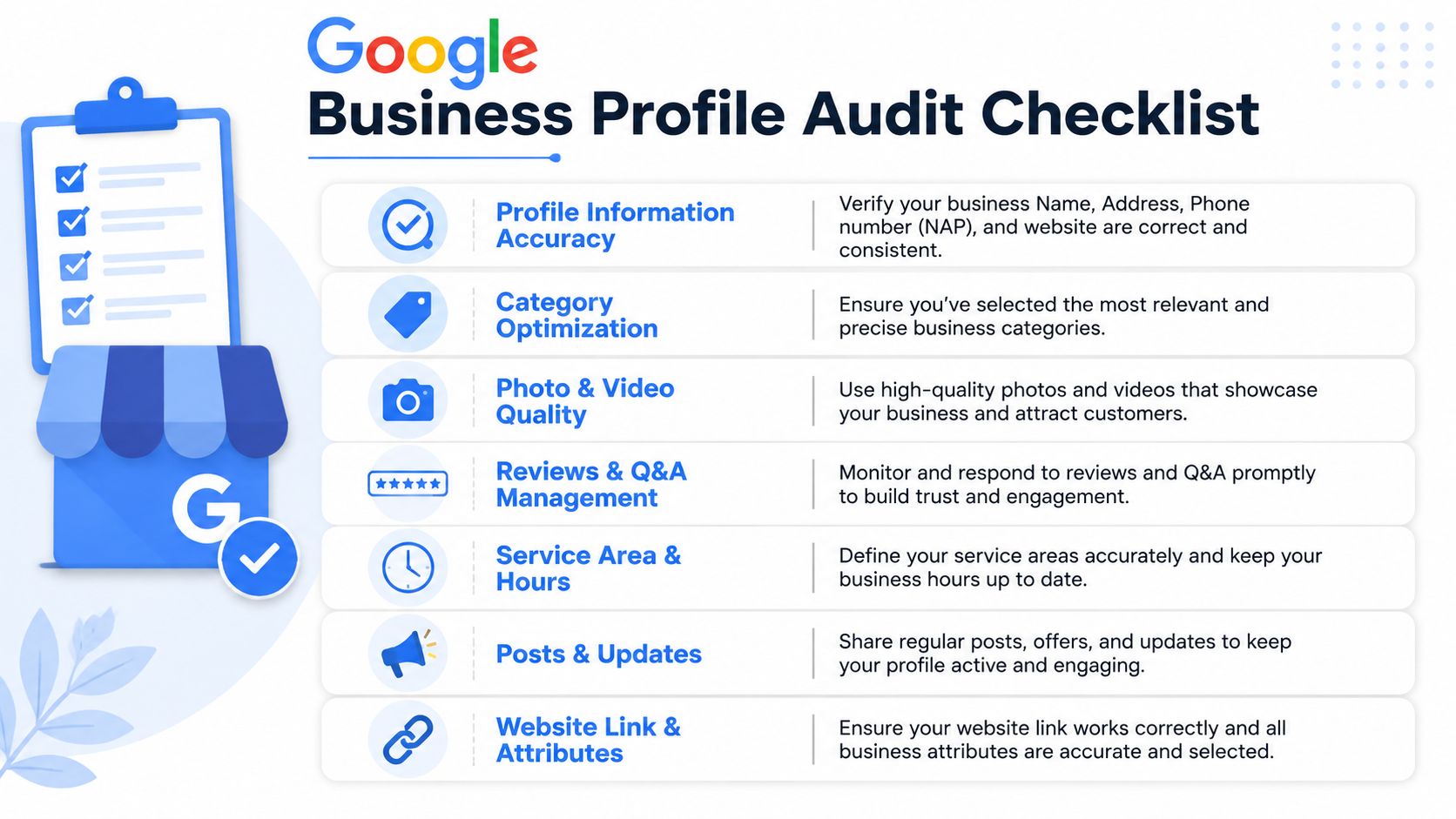
A Google Business Profile audit should be blunt. Does this listing make Google confident enough to show you, and does it make the searcher confident enough to call?
Start with the business fundamentals:
- Business name and primary category must reflect the actual business accurately
- Phone number and website link must send users to the right destination
- Hours and service areas need to match reality
- Business description should reinforce core services and local relevance
- Attributes and services should be fully filled out where applicable
The category choice is one of the most important decisions in the profile. If your primary category is too broad or just wrong, the profile can struggle to appear for your most valuable terms.
Review the proof signals
After the basics, look at the trust layer. Many profiles exhibit deficiencies within it.
Check these areas one by one:
Photos
Fresh, relevant photos help the listing feel active and real. For service companies, use crew photos, vehicles, before-and-after work, exterior office shots, and service-related images.Reviews
Don't just count reviews. Read them. Are customers mentioning the actual services and cities you want to rank for? Strong review language often reinforces local relevance.Questions and answers
This section gets ignored all the time. It shouldn't. Good Q&A entries can address pricing expectations, service areas, emergency availability, insurance, parking, or booking steps.Posts and updates
Posts won't fix a broken profile, but they can support freshness and engagement.
A lot of businesses skip this level of detail and wonder why they sit outside the map pack.
If you want a deeper local listing checklist, this guide on how to optimize Google Business Profile for local rankings is a useful companion.
Compare your profile against the map pack winners
Search your core term in your target area and study the top three profiles that appear. Compare them side by side with your own.
Look for practical differences:
| Element | Your profile | Top competitors |
|---|---|---|
| Primary category accuracy | Check for alignment | Usually tightly aligned |
| Review relevance | Generic praise or service-specific mentions | Often rich in service keywords and local terms |
| Photo quality | Sparse or outdated | Frequent, credible, service-focused |
| Service completeness | Partial | Usually filled out carefully |
| Website landing page | Generic homepage | Often points to a focused service page |
The Google Business Profile and the landing page it links to need to agree with each other. Mismatched intent weakens both.
Local businesses often lose ground. The profile may be decent, but the linked page is generic. Or the page is strong, but the profile lacks depth. Google reads the whole ecosystem.
If you're learning how to audit website performance for local lead flow, include the Google Business Profile every time. For service businesses, that audit is often the shortest path to more calls.
Analyzing Your Website's Conversion Pathways
Rankings matter. Traffic matters. But neither one pays the bills if visitors can't convert quickly.
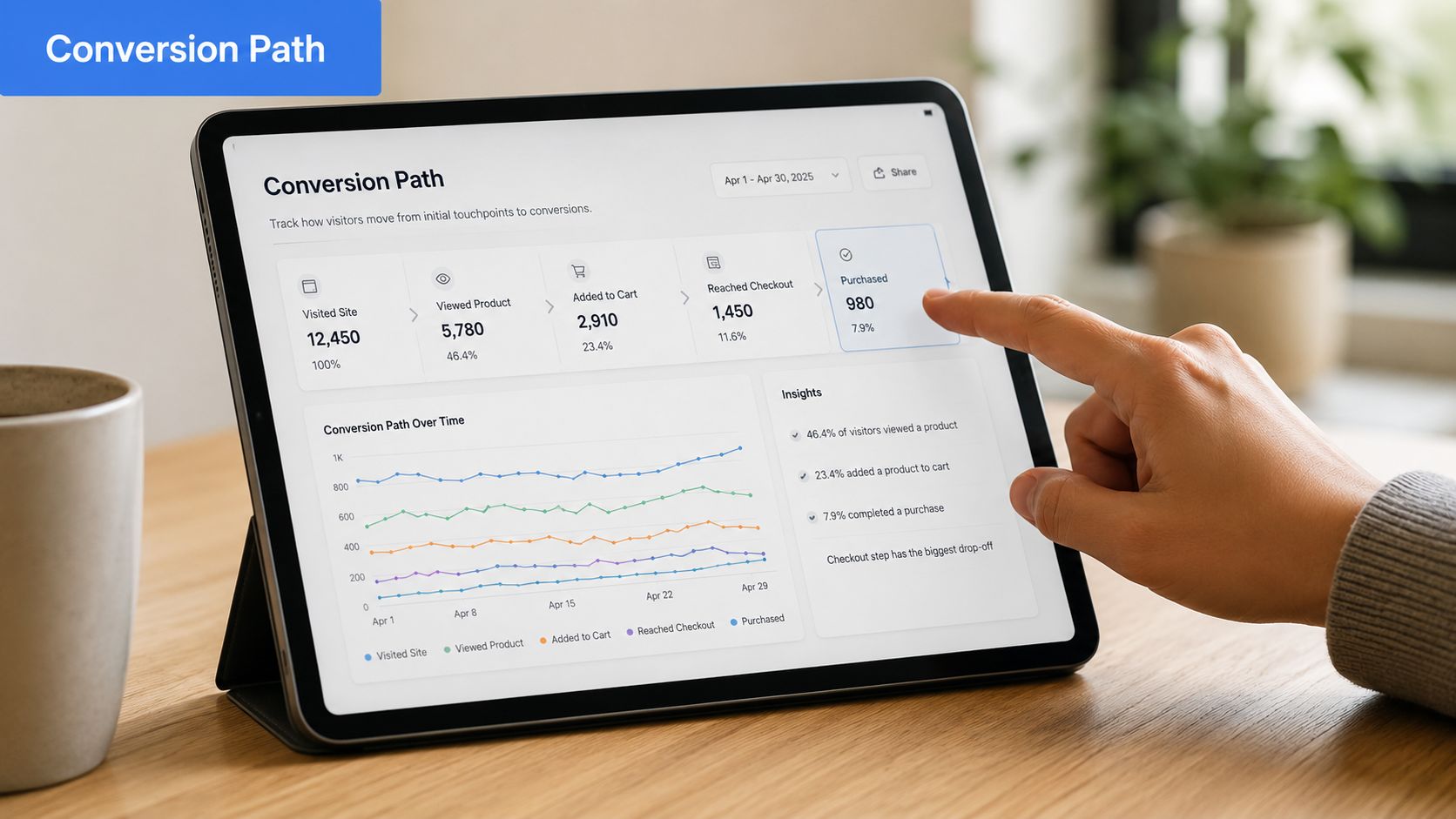
A local service website should feel easy in the first few seconds. The visitor should know what you do, where you work, and how to contact you without searching around. If they have to hunt for the phone number, guess which button to press, or wrestle with a form, you've already introduced friction.
Audit the path from landing to contact
Open your most important service pages on mobile and desktop. Then try to convert like a real customer would.
Check for these blockers:
- Weak primary CTA such as vague buttons like “Learn More” instead of action language
- Hidden phone number especially above the fold on mobile
- No tap-to-call functionality on phones
- Long forms asking for more than a buyer wants to give
- Distracting layouts with too many competing buttons
- Missing trust cues such as reviews, certifications, financing, warranties, or emergency availability
For a roofer, the page should make it obvious how to request an estimate. For a dentist, the page should clearly support appointment booking, insurance questions, and new-patient action.
Accessibility affects conversion more than most owners think
Accessibility isn't a side issue. It directly affects whether people can submit forms, read buttons, and trust the experience.
An accessibility audit should be treated as a conversion audit. Automated tools can catch barriers like missing alt text and poor color contrast, but they often miss user-experience barriers on forms and lead capture elements that block contact, according to AudioEye's review of free website audit tools.
That means you need both automated scans and manual testing.
Try this short manual review:
- Tab through the page using only a keyboard
- Submit the contact form with missing fields
- Check button contrast on mobile outdoors or in bright light
- Read the page without zooming
- Test every CTA click path yourself
If forms error out with vague messages, labels disappear, or buttons blend into the layout, those aren't cosmetic problems. They are lead problems.
For a practical next step, review these methods on how to improve website conversion rate for lead-focused pages.
The local conversion standard
A high-performing local page usually makes these answers obvious within seconds:
| Visitor question | The page should answer it fast |
|---|---|
| Can you help me? | Clear service headline |
| Do you serve my area? | Local service area mention |
| Can I trust you? | Reviews, proof, credentials |
| What do I do now? | Prominent phone and form CTA |
For owners also working on local presence, mastering local business profiles in 2026 is a useful companion read because the listing and the landing page should reinforce each other.
A site doesn't need to be clever to convert. It needs to be clear.
Conducting an AI Visibility and Competitive Audit
A standard SEO audit still matters, but it no longer tells the whole story. Buyers are getting recommendations from AI Overviews, ChatGPT, Claude, and Perplexity before they ever click a traditional result.
If you only track rankings in classic search, you're missing part of the discovery layer.

Test whether AI systems mention your brand
A modern website audit should ask which pages are being surfaced or cited by AI systems, and testing priority queries in AI Overviews and chatbots like ChatGPT is essential for understanding visibility in a zero-click discovery environment, as noted in Ryan Tronier's website audit guide.
For a local business, that means running real transactional prompts such as:
- best emergency plumber near me
- top roofing company in [city]
- who is a good dentist in [city]
- best HVAC repair company open now near me
Then document what happens:
- Does your business appear?
- Are competitors named instead?
- Which page seems to support the mention?
- Is the summary accurate about your services and areas?
This isn't yet a fully standardized discipline, which is exactly why it matters. Most competitors still aren't measuring it carefully.
Review the pages most likely to earn AI visibility
AI systems tend to favor pages that are easy to summarize. That usually means clear page structure, direct answers, strong entity signals, and clean service explanations.
Review your likely candidates:
- Core service pages that answer who you serve and what you do
- Location pages that connect services to cities
- FAQ sections that address common pre-contact questions
- About and trust pages that support brand clarity
If a page buries the answer, uses vague headings, or fails to explain the actual service cleanly, it becomes harder for AI systems to reuse or cite it.
For businesses investing in that frontier, this overview of AI search engine optimization for local brands is a strong next read.
Run a lean competitor audit
Don't overcomplicate this. Pick the top three competitors appearing for your main transactional term and compare what they're doing across search and AI.
Use a checklist like this:
| Audit point | What to compare |
|---|---|
| Google Business Profile strength | Categories, reviews, photos, service clarity |
| Landing page focus | Is the linked page tightly matched to the keyword? |
| Local relevance | City references, service area clarity, trust signals |
| AI mention quality | Does AI describe them more clearly than it describes you? |
If AI can explain your competitor's offer faster and more clearly than yours, that gap will show up in lead volume.
Learning how to audit website visibility now means looking at both classic SERPs and AI-driven recommendations. The businesses that build this habit early will have a cleaner picture of where future leads are coming from.
Turning Your Audit into a 30-Day Action Plan
Most audits fail at the finish line. The report gets built, everyone agrees the issues are real, and nothing gets implemented fast enough to affect calls.
The fix is prioritization.
Don't try to repair everything at once. Organize findings by impact on transactional visibility and lead flow, then move in order.
Use a simple decision framework
Put every issue into one of these buckets:
High impact and quick fix
These usually include broken tap-to-call buttons, wrong title tags on top service pages, missing internal links to money pages, weak Google Business Profile categories, or incorrect website links in key profiles.High impact and requires effort
This bucket often includes rebuilding service pages, improving location pages, cleaning up site speed issues, fixing major mobile UX problems, and tightening the conversion path.Lower priority
Design refinements, minor content polish, and secondary-page enhancements belong here if they don't influence lead generation directly.
What a focused month looks like
A practical 30-day sprint often looks like this:
Week one
Fix technical blockers, indexing issues, and conversion errors on priority pages.Week two
Upgrade core service pages to match transactional keywords and local intent.Week three
Tighten the Google Business Profile and align the linked landing pages.Week four
Run AI visibility checks, compare competitors again, and document what changed.
This is also where broad market changes matter. If you want context on the shifting search environment, impact of Google AI Overviews on SEO gives a useful overview of why click patterns are changing.
Keep the audit alive
The best audit is not the one with the longest spreadsheet. It's the one that becomes an operating rhythm.
Quarterly audits are still the strongest cadence for most businesses, with more frequent checks in competitive markets, as noted earlier. That rhythm keeps small ranking losses from becoming big revenue problems.
The end goal is straightforward. More visibility for searches that signal buying intent. More map exposure. Better conversion on the traffic you already earn. More calls from people ready to book.
If you want help turning this audit process into rankings, Maps visibility, and more booked jobs, talk to Transactional LLC. They specialize in local SEO, Google Business Profile optimization, and AI-focused search visibility for service businesses that want to win transactional terms in their service areas.