


If you're buying calls from Google Local Services Ads for home services, you already know the pain. The leads look clean on paper, the phone rings, and then half your day disappears into missed calls, price shoppers, and jobs that never book. That's why the winning move isn't just “run LSAs,” it's to run them like a transactional search channel, the same way you'd chase roofer near me, dentist near me, or air conditioning repair near me when the buyer is ready to spend.
Why Local Services Ads Matter for Home Service Buyers
A homeowner searching furnace repair near me or emergency plumber near me is not casually browsing. The job is urgent, the intent is high, and Google Local Services Ads sit right in that moment of demand. Google positions these as pay-per-lead placements, charging only when someone calls or messages through the ad. That changes the economics immediately because lead handling becomes the battlefield, not keyword tinkering.
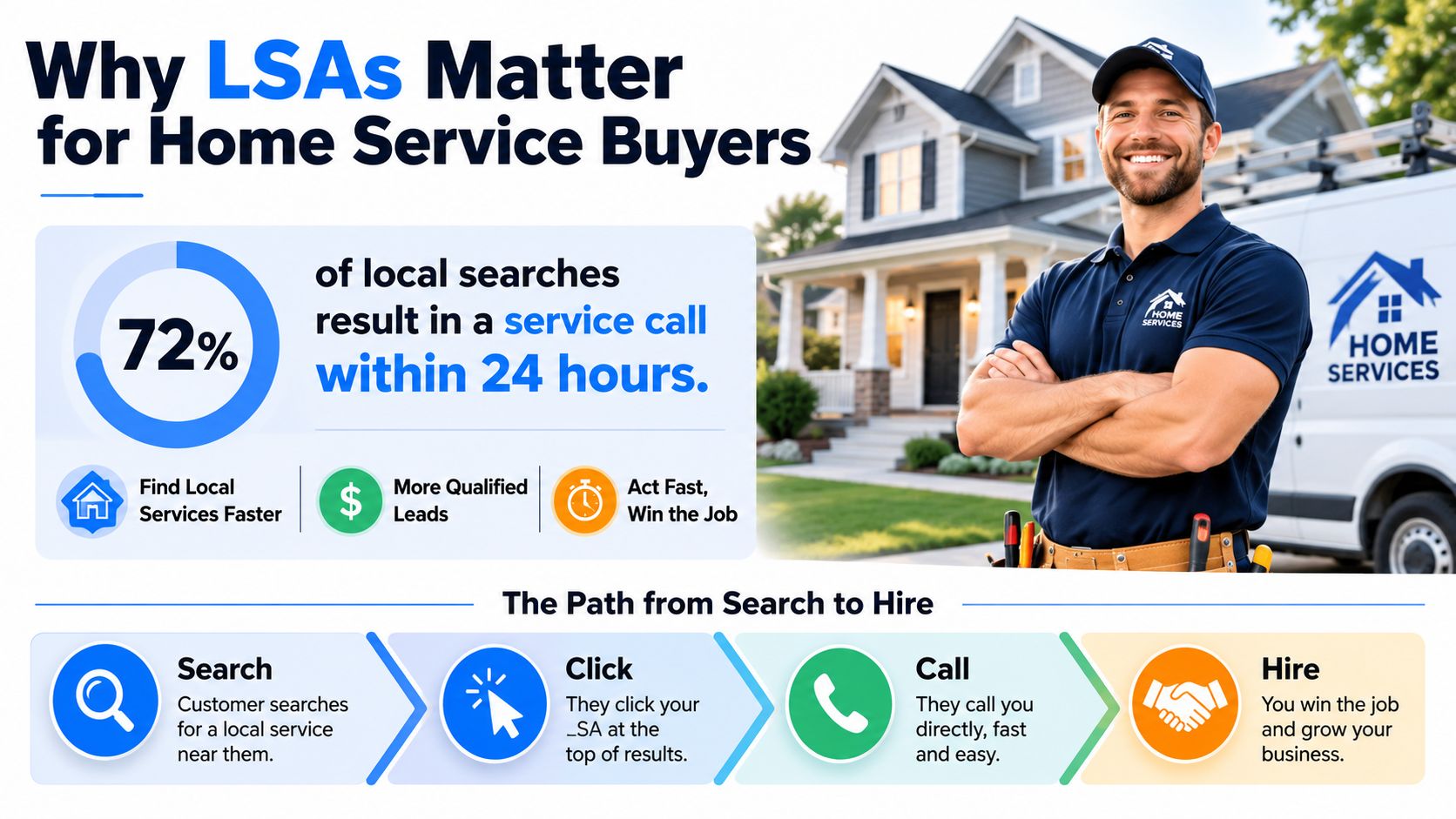
The benchmark that matters most is simple. One independent dataset tracked $6.72 million in spend across 888 contractors and 126,650 leads, with an average cost per lead of $53 for home-service advertisers Searchlight Digital benchmark. That same dataset showed general home-service campaigns accounted for 37.3% of total spend, which tells you the channel is not some narrow experiment for one trade. It is broad enough to matter across multiple local service categories Searchlight Digital benchmark.
Practical rule: treat LSAs like a lead intake system, not a media buy. If the call is missed, the message sits unanswered, or the lead never gets routed fast, the economics fall apart.
The Google Guarantee badge helps, but don't over-romanticize it. It is a trust signal inside a transaction, not a magic conversion button. Buyers still choose the provider who looks responsive, local, and credible. That is why LSAs fit so naturally into a transactional search strategy built around high-intent queries, Google Maps visibility, and organic SEO that catches the same buyer from another angle.
Eligibility, Categories, and the Verification Process
A contractor can be ready to run LSAs and still get blocked by the category rules. Google limits the program to selected service categories, and its business presence guidance explicitly points home-service advertisers to check eligibility in their area, with categories such as plumbing, moving, and general contracting already called out Google business presence article. Its verification guidance also covers providers who serve private residences and businesses, including locksmiths, cleaners, painters, and gardeners Google verification guidance.
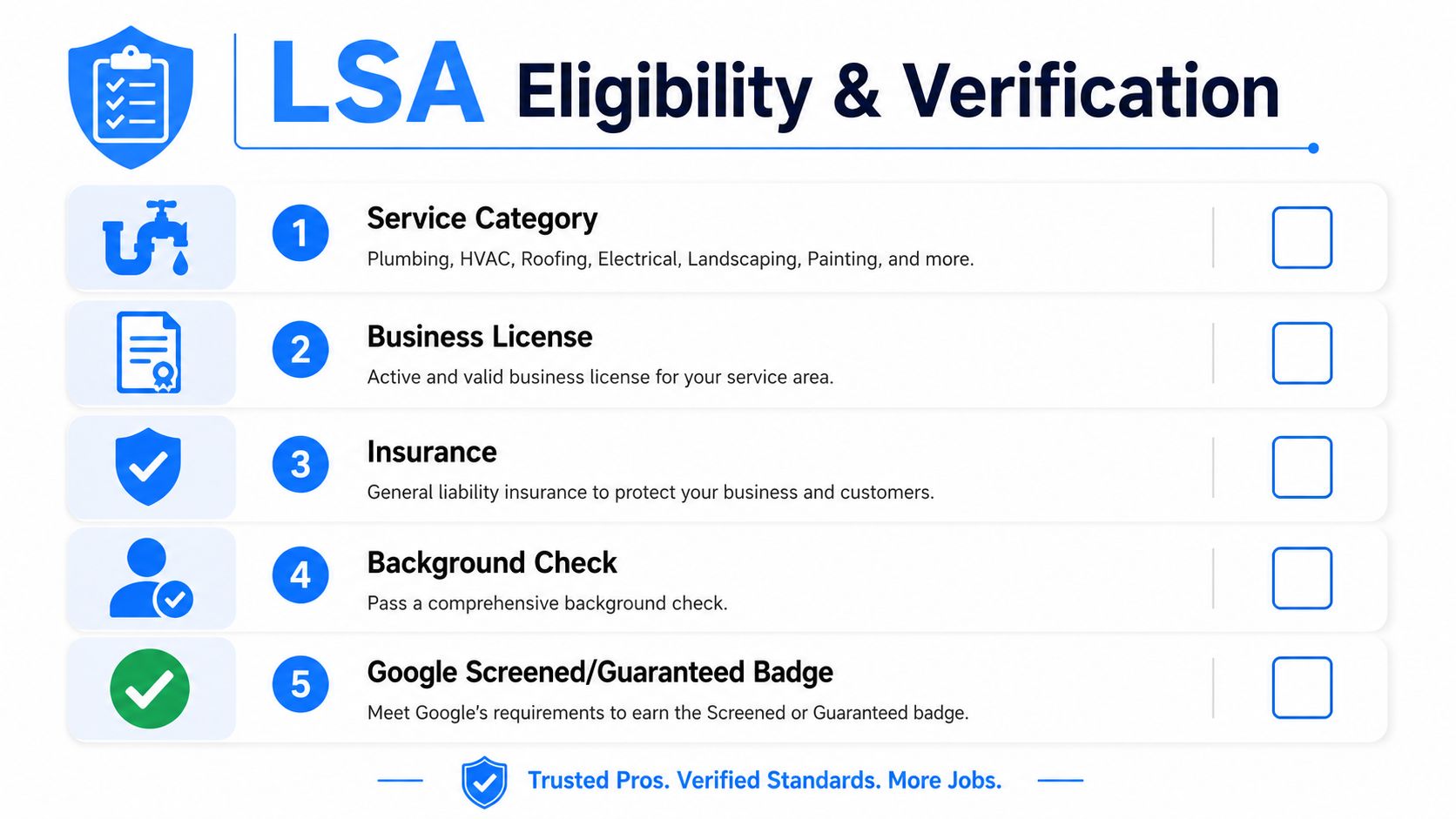
The screening process carries real weight. Google says its platform policies require properly background-checked and qualified workers to provide services referred through the platform Google verification guidance. Get the paperwork clean before launch, because license, insurance, and employee records are eligibility gates, and sloppy account prep turns into delays and disapprovals fast.
For a home-service operator, the sequence matters.
- Confirm category fit first: HVAC, roofing, pest control, and dental do not all sit under the same rules. Google ties campaign structure to the exact service type through LocalServiceIdInfo, so the category choice shapes the rest of the account Google Ads API local service campaigns.
- Gather documents before applying: Business license, insurance, and worker screening records need to be ready, not “almost ready.”
- Keep employee records current: The API exposes read-only reporting resources like local_services_employee and verification artifacts, which makes staff hygiene part of ongoing account management, not a one-time setup task.
If you want the guarantee layer explained in plain English, this internal guide on Google Guarantee Ads is the right place to start. Google leaves plenty of operators on their own here, so verification has to be treated as part of eligibility, ranking, and buyer trust from the start.
Setting Up LSAs Step by Step
A bad launch usually starts with overreach. An HVAC company should not open every category if it only handles certain repair and replacement jobs, and a plumbing business should separate emergency calls from remodel work if the phone team handles them differently. Keep the setup tied to what crews can fulfill, because sloppy category choices send the wrong leads into the pipeline fast.
Lock the geography next. If a truck can only reach certain neighborhoods within an hour, define the service area with the cities or ZIP codes the team can serve reliably. Wide suburban rings are where a lot of accounts go wrong, because dispatch, travel time, and lead cost stop lining up the moment the coverage area gets too loose.
Keep service areas tight. If your dispatcher already knows a ZIP is outside realistic coverage, do not pay for those leads and try to sort it out later.
Then build the account in the right order:
- Choose categories: Match the actual trade and the actual job types you want.
- Define service areas: Use cities or ZIPs your crews can serve reliably.
- Set budget caps: Weekly caps should reflect real close rates, not optimism.
- Upload licenses and insurance: Have them ready before the ad goes live.
- Run employee checks and connect routing: Lead inbox, call routing, and dispatch coverage need to work before launch.
The lead flow matters as much as the setup. Google says advertisers pay when a customer calls or messages directly through the ad, so a broken call path or an inbox nobody watches burns money immediately Google's Local Services Ads overview. If you are building this for a field team, hand the coordinator a checklist and make them test every lead destination before turning on spend.
For examples of how this structure changes by trade, the broader paid media examples resource helps you think in terms of operational fit, not just ad activation.
How the LSA Auction Ranks You
Google says the LSA auction looks at your bid, the likelihood of generating a lead, responsiveness to customer inquiries, and profile quality like reviews, images, and verification checks. That is the ranking mix you need to manage. Smaller operators usually have the easiest time improving responsiveness, because it does not require outspending larger competitors.
What you can move fast
Response speed wins because it signals reliability. If your office staff answers during business hours and your after-hours coverage is real, not a voicemail promise, you give the algorithm fewer reasons to push you down. That matters most in emergency trades, where buyers contact multiple providers in a short window and the first clean response often gets the job.
Reviews and photos matter too, but they build over time. A clean profile with strong imagery and a steady flow of reviews tells Google that real customers are engaging, not just finding a profile with a bigger bid attached. Higher-quality profiles can rank higher and may pay lower costs per lead, so profile work is not cosmetic, it directly affects how hard the account has to work to win calls and messages.
What you can't brute force
Dense metros are where bid pressure gets ugly. You cannot outbid a stronger profile forever, and you cannot fake lead quality or verification status. The auction looks at the whole profile, including bid, lead likelihood, responsiveness, and profile quality, so sloppiness in reviews, images, and inquiry response will drag you down.
A good operating rule is simple:
Answer fast, stay open when competitors close, and keep your profile fresh. That combination does more than a bigger budget alone.
Treat rankings like an operating problem, not a mystery. The winners manage bid, lead likelihood, responsiveness, and profile quality at the same time, and they do it without waiting for a rep to clean up the account for them.
LSAs vs Standard Google Ads for Home Services
LSAs and standard Google Ads solve different problems in the home services funnel. LSAs are built around direct leads and Google's trust layer. Standard Search Ads give you more control over keywords, messaging, and landing pages. If your main goal is phone calls from people ready to buy, LSAs are the cleaner fit. If you need to shape the search journey, standard Search still matters, especially when the same job can start as an emergency call, a quote request, or a research session.
| Dimension | Local Services Ads | Standard Google Ads |
|---|---|---|
| Cost model | Pay per lead | Pay per click |
| Placement | Prominent local lead unit | Search ad formats with more placement options |
| Creative control | Limited | Strong |
| Targeting | Service category and area driven | Keyword and audience driven |
| Reporting | Lead and conversation focused | Click, conversion, and search term focused |
| Trust signal | Google verification badge | No built-in verification badge |
The operating difference is simple. LSAs force you to think about phone coverage, dispatch speed, and lead handling. Google charges on contact, not curiosity. Standard Google Ads give you more testing room, but you still pay for clicks even when the lead is weak. If your team cannot answer quickly, LSAs will expose that fast. If your intake process is sloppy, the channel will waste good demand just as fast.
For an outside audit of standard paid search, the home services Google Ads review is a useful counterpoint because it keeps the focus on call quality, not vanity traffic. That matters when you are deciding whether paid search should chase volume, tighter intent, or better qualification before the phone ever rings.
My rule is blunt. Lead with LSAs for emergency or high-ticket trades where the buyer wants help now. Lead with standard Search when the buyer needs more education, multiple services sit under one roof, or the sale cycle is longer. Run both in parallel when call tracking is clean and your office can handle what each channel sends. Paid media examples that mix local intent with stronger qualification are laid out in this transactional search ad examples guide, and that comparison is useful if you are building a channel mix instead of betting everything on one feed of leads.
Vertical-Specific Playbooks for HVAC, Plumbing, Roofing, Pest Control, and Dental
HVAC and plumbing are the trades where missed calls show up fast in the numbers. If the office is closed at lunch, after 5 p.m., or on weekends, the channel starts bleeding booked work, and Google will not clean that up for you. In those trades, the most important optimization is 24/7 response coverage and tight service-area rules that match where the truck can go.
HVAC also needs clean job separation. Emergency repair should not sit in the same bucket as install work if the team handles those jobs differently, because the lead quality and close rate are not the same. Plumbing needs the same discipline around emergency drain, leak, and backup jobs, so the wrong expectation does not hit the dispatcher before the first call is even answered. If you already run a broader local search play, LSAs belong beside your map rankings, not in place of them.
Roofing, pest control, and dental need a different operating lens. Roofing leans on proof, so project photos, review depth, and a clean service history carry more weight because buyers are comparing contractors on high-value jobs. Pest control usually follows seasonal demand, so spend control matters more than forcing budget to behave the same way every month. Dental sits in its own lane because the newer LSA setup rewards careful compliance language and strong trust cues, and if you are building a patient acquisition plan around organic visibility too, this dental search optimization plan is a solid companion resource.
The same mistake shows up across all five verticals. Service areas overlap, emergency calls get routed to the wrong crew, or the category does not match the job, and then you end up disputing leads you should never have bought in the first place. Google keeps these categories separate on purpose, so the better move is to narrow the setup and keep routing tight.
The trade that answers fastest usually gets the easiest lead. The trade with the cleanest profile usually gets the better one.
Measuring LSA Profit, Lead Quality, and ROI Beyond the Dashboard
The dashboard shows leads and conversations. It does not show whether the channel is profitable after missed calls, spam, no-shows, and unbooked jobs. That gap is where accounts hide weak unit economics behind high lead volumes, because a busy inbox can still mask a bad P&L.
Build your own LSA profit sheet around four numbers, booked jobs, average ticket, disputed leads, and revenue per booked lead. Then compare that against what the LSA inbox says happened. Mature operators also check the underlying lead and conversation records so they are not judging performance from surface metrics alone.
A practical dispute process needs to be formal. Flag leads that are clearly outside your service area, in the wrong category, spam, or not a real service request. Keep notes on call duration, job type, and outcome, because disputes are easier when the evidence is already in front of you.
Clean local data matters too. The guide to NAP for service businesses is a smart companion because consistent business information supports every local channel, not just LSAs. pay per lead only makes sense when you know what a booked job is worth and you can separate real demand from junk.
The best operators do not chase raw lead volume. They track which leads turn into booked revenue, which ones get disputed, and which ones support stronger visibility across Maps and organic results. That is the ROI conversation.
A 30 Day Plan to Stack LSAs With Maps and Organic Wins
Start with the channels that create immediate calls and the channels that build lasting visibility. LSAs can accelerate results while organic and Maps build lasting visibility over time, and the accounts that win treat them as one local-search system instead of separate projects. If your service-area cities are not already pushing toward the top three map results, fix the listing, reviews, and location signals right away, because LSAs perform better when your local footprint looks legitimate. A parallel organic plan should target transactional terms like air conditioning repair near me and dentist near me, not soft informational content that does not convert.
Week one is setup and local proof. Launch LSAs and Google Maps optimization together, then clean up the business profile so the city coverage, categories, and review signals all support the same service areas. If you want a practical framework for the Map side, use how to rank higher on Google Maps as the guide for tightening the parts Google uses. After that, publish the first batch of high-intent pages so the organic side starts pulling its weight instead of waiting for traffic to arrive on its own.
Week two is about lead handling. Tighten the LSA setup, narrow service areas, test call routing, and make sure the office handles every lead source the same way. Then build a simple dashboard that shows calls, booked jobs, disputes, and service-area performance side by side. That matters because Google leaves a lot of the back half to you, and missed-call economics can turn a busy account into a weak one if nobody is watching the handoff.
Week three is where the content stack starts to matter. Publish more high-intent pages, support them with Map Pack work, and keep the pages aligned with the cities and services you want to sell. The local search engine optimization stack starts to pay off here, because LSAs buy speed while organic and Maps build durability over time. The accounts that stay profitable use that mix to reduce dependence on paid leads alone.
Week four is the profit check. Keep the channel if it is producing booked jobs at a sane cost, cut the waste if it is not, and put more attention on the service areas and categories that turn into revenue. That is the point of a transactional strategy, show up when the buyer has money in hand, then make sure your phone, Maps presence, and organic pages all point to the same conversion. Charge-dispute hygiene belongs in this review too, because bad lead classification can make an average account look better than it really is.
Transactional LLC builds local SEO systems that put service businesses in front of transactional search terms, the searches where people are ready to call, book, and buy. If you want LSAs, Google Maps optimization, and high-intent organic content working together instead of competing for attention, visit Transactional LLC and see how their team structures local visibility around real booked jobs.