


A local service business can report an organic CAC of $942 and a paid CAC of $1,907, yet still make the wrong budget decision if it doesn't know which channel produces booked jobs, repeat customers, and fast payback. That benchmark spread, reported in customer acquisition metrics research from Prospeo, is a reminder that acquisition cost isn't a standalone score. It reflects traffic quality, conversion, sales follow-up, service value, and retention.
For a roofer, plumber, HVAC company, dentist, pest control operator, or chiropractor, the most valuable prospect often isn't browsing casually. They're searching “roofer near me,” “dentist near me,” “emergency plumber near me,” or “AC repair in Mesa.” These are transactional search terms. The person searching has a problem, intent, and often a willingness to spend money now.
Transactional Marketing focuses on helping service businesses appear for those high-intent searches across organic Google results, Google Maps, and emerging AI search experiences. The right customer acquisition metrics show whether that visibility is turning into calls, booked appointments, profitable jobs, and durable customer relationships.
Why Most Service Businesses Track the Wrong Acquisition Numbers
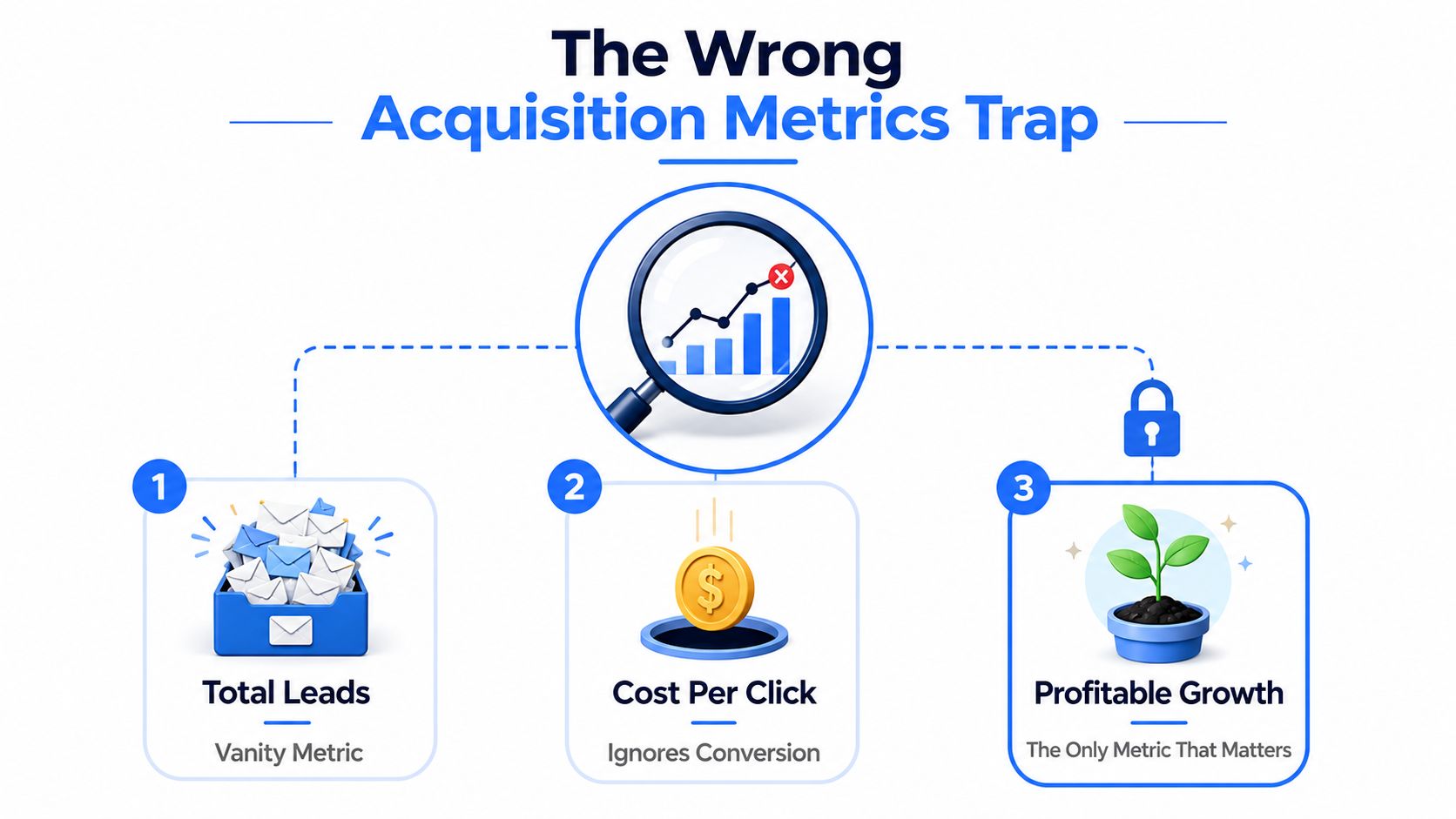
Many local businesses still judge marketing by total leads, impressions, clicks, or cost per click. Those numbers can be useful diagnostics, but they don't answer the question that matters: how much does it cost to acquire a profitable customer?
A plumbing company may celebrate a low cost per lead until the owner discovers that the inquiries came from outside the service area, asked for work the company doesn't offer, or never answered a follow-up call. A dental practice may see website traffic rise while its Google Maps profile generates no meaningful calls. In both cases, the business is measuring activity instead of commercial outcomes.
Customer acquisition cost, or CAC, is calculated by dividing total sales and marketing costs by new customers acquired. HubSpot's customer acquisition analytics guidance describes CAC as a foundational metric, but the calculation only becomes useful when the business defines “customer” correctly. A form submission isn't necessarily a customer. For a local service business, the chain usually looks more like this:
- Search visibility: Did the business appear for a relevant service term?
- Qualified visit or call: Did the prospect have the right location and service need?
- Lead: Did the person submit a form or call?
- Booked appointment: Did the business secure a scheduled job or visit?
- Won customer: Did the appointment produce revenue?
- Repeat value: Did the customer return, renew, refer, or purchase another service?
Why transactional intent changes the calculation
A visitor searching for general roofing ideas isn't equivalent to someone searching “roofer near me.” The latter query contains location and service intent, so the business should evaluate the resulting traffic through calls, booked inspections, estimates, and closed jobs.
The same principle applies to “dentist near me,” “same day,” “24/7,” “quote,” and “emergency plumber near me.” Local keyword research identifies these modifiers as high-buying-intent signals in this analysis of transactional local search. A lead from one of these searches may justify a different acquisition cost than a low-intent inquiry, but only if the business tracks what happens after the lead arrives.
Practical rule: Never approve a channel because it produces cheap leads. Approve it because it produces qualified, booked, profitable customers at an acceptable payback.
Google Maps adds another layer. A dental office can rank organically for a service page and still lose ready-to-book patients if its Business Profile is weak or buried in map results. Local acquisition reporting must therefore combine organic rankings, map visibility, calls, forms, booking completion, close rate, revenue, and retention.
Core Customer Acquisition Metrics and Their Formulas
The formulas are simple. The discipline lies in connecting each formula to a decision.
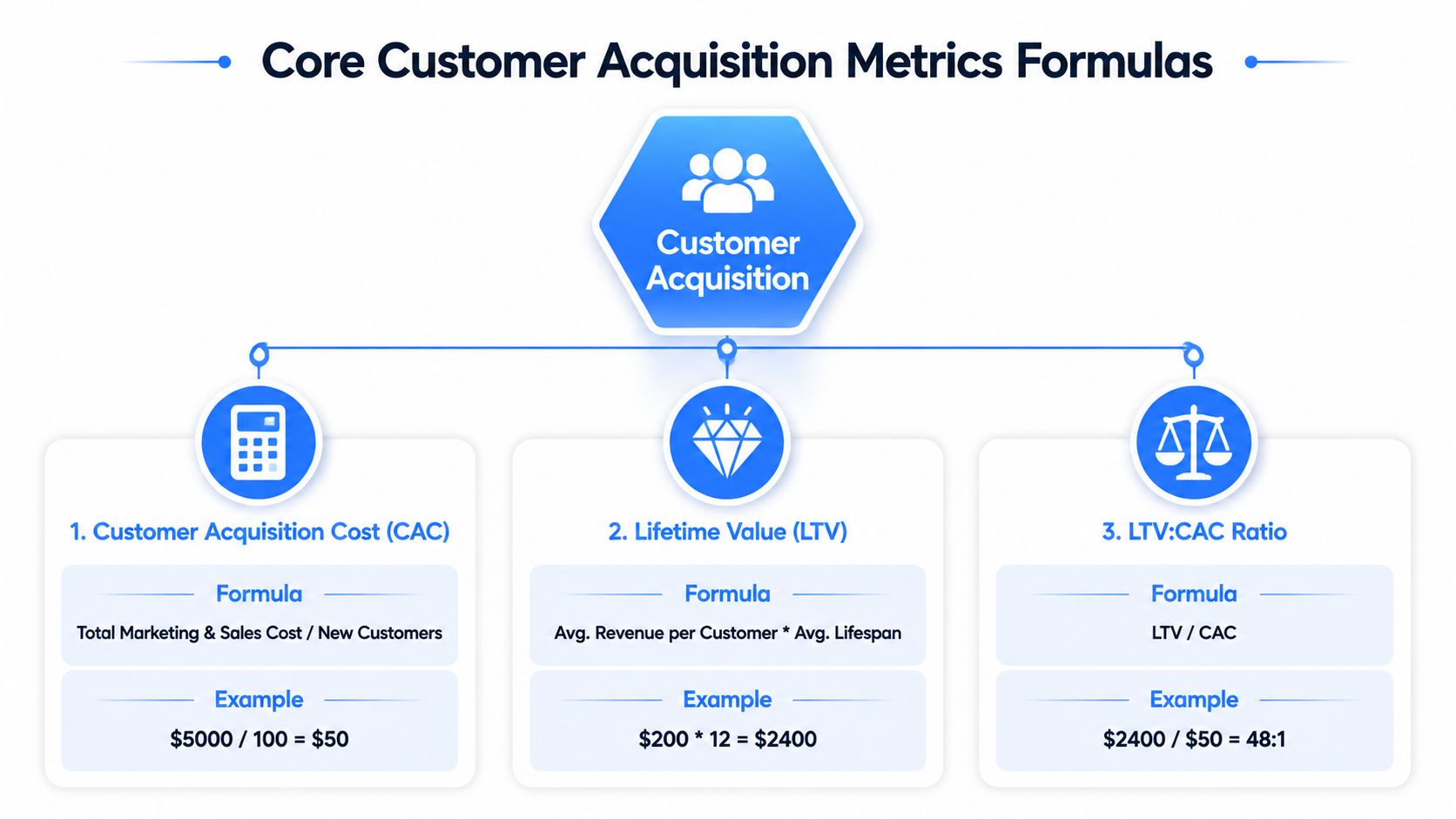
Customer Acquisition Cost, or CAC, equals:
CAC = Total sales and marketing costs ÷ New customers acquired
Suppose an HVAC company spends $5,000 across SEO, ads, sales labor, and marketing software, then wins 10 new customers. Its blended CAC is $500. That number is useful only if the company includes the costs consistently and counts customers at the same stage, such as completed jobs rather than raw inquiries.
Customer Lifetime Value, or LTV, estimates the revenue or gross profit a customer generates over the relationship. A basic service-business version is:
LTV = Average revenue per customer × Average purchase frequency × Average customer lifespan
For a maintenance-based HVAC company, the calculation may include the initial repair, future maintenance visits, replacement work, and related services. For a dental practice, it may include recurring appointments and additional procedures. Use the same revenue basis each period, and don't compare revenue-based LTV with margin-based CAC without recognizing the difference.
LTV:CAC ratio equals:
LTV ÷ CAC
Recent SaaS benchmark summaries place a target around 3:1 to 4:1, while 2:1 or below signals inefficient acquisition economics, as reported by Kona Bayev's CAC benchmark analysis. Local service businesses shouldn't copy SaaS targets mechanically, but the principle holds: customer value must comfortably exceed acquisition cost.
Funnel conversion metrics
Visitor-to-lead conversion rate equals:
Leads ÷ Website visitors × 100
Benchmark reporting places SMB and mid-market SaaS visitor-to-lead conversion around 1.5% to 3%, while stronger B2B-service funnels can reach a 4.3% median, according to ORM Tech's SaaS marketing benchmark overview. Local services vary by urgency, service type, location, and call availability, so use these as directional comparisons rather than promises.
Lead-to-SQL conversion measures how many captured leads meet the business's qualification standard:
Qualified leads ÷ Total leads × 100
The same benchmark source places lead-to-SQL conversion roughly between 15% and 25% in the cited funnel. For a local company, qualification might include service area, job type, budget fit, and genuine buying intent.
Lead-to-booking rate equals:
Booked appointments or jobs ÷ Qualified leads × 100
If a dental practice receives 40 qualified inquiries and books 20 appointments, its lead-to-booking rate is 50%. A weak result usually points to response speed, poor intake questions, unclear scheduling, or inadequate follow-up, not necessarily insufficient traffic.
Payback period estimates how long it takes for customer contribution to recover acquisition cost:
Payback period = CAC ÷ Monthly gross profit or contribution from the customer
For one-time services, use the expected gross profit from the job and evaluate whether the initial transaction recovers acquisition cost. For recurring plans, calculate the months required to recover the cost. This guide to calculating cost per acquisition can help teams establish consistent acquisition reporting before comparing channels.
Channel-Level Benchmarks for Service Businesses
Blended CAC can hide the decisions that matter locally. A referral, Google Maps call, organic service-page visit, and paid search click each carry different intent, staff effort, close rates, and customer value. Compare channels by the outcome they produce, not traffic volume alone.
Published benchmarks report organic CAC at $942 and paid CAC at $1,907. The same benchmark set places blended B2B SaaS CAC around $300, with segment ranges from $50 to $200 for self-serve acquisition, $200 to $600 for SMB, $600 to $1,200 for mid-market, and above $1,200 for enterprise, sometimes reaching $5,000 or more, as reported in Prospeo's customer acquisition metrics benchmarks.
These figures are not price cards for plumbers or dentists. They show how sales process, customer type, competition, service complexity, and retention change acquisition economics. A local operator should use them for directional context, then calculate results from its own calls, bookings, margins, and repeat work.
| Channel | Typical CAC Range | Conversion Rate | Payback Period |
|---|---|---|---|
| Organic search | Varies by content investment and close rate | Track visitor-to-lead and lead-to-booking | Compare labor and content cost with gross profit |
| Google Maps | Varies by profile strength and local competition | Track calls, direction requests, forms, and booked jobs | Often evaluated against booked-job contribution |
| Paid search | Often higher than organic when competition is intense | Track click-to-lead and lead-to-customer conversion | Compare ad cost, sales labor, and job margin |
| Social media | Varies widely by intent and targeting | Usually requires qualification and follow-up analysis | Measure beyond form fills |
| Referrals | Often lower direct acquisition cost | Track referred lead-to-booking and repeat value | Include referral incentives and staff time |
A higher-CAC channel can still be profitable when it brings larger jobs, stronger repeat value, or faster payment. A low-CAC source can lose money when leads cancel, require repeated follow-up, or consume excessive sales time.
For local service businesses, prioritize cost per booked job, cost per completed appointment, and gross profit payback by source. Compare organic and paid search performance using those outcomes, while tracking Google Maps calls and booked jobs separately from website conversions. That view shows whether visibility is creating revenue or merely generating impressions.
How Local Search and AI Visibility Shape Acquisition Costs
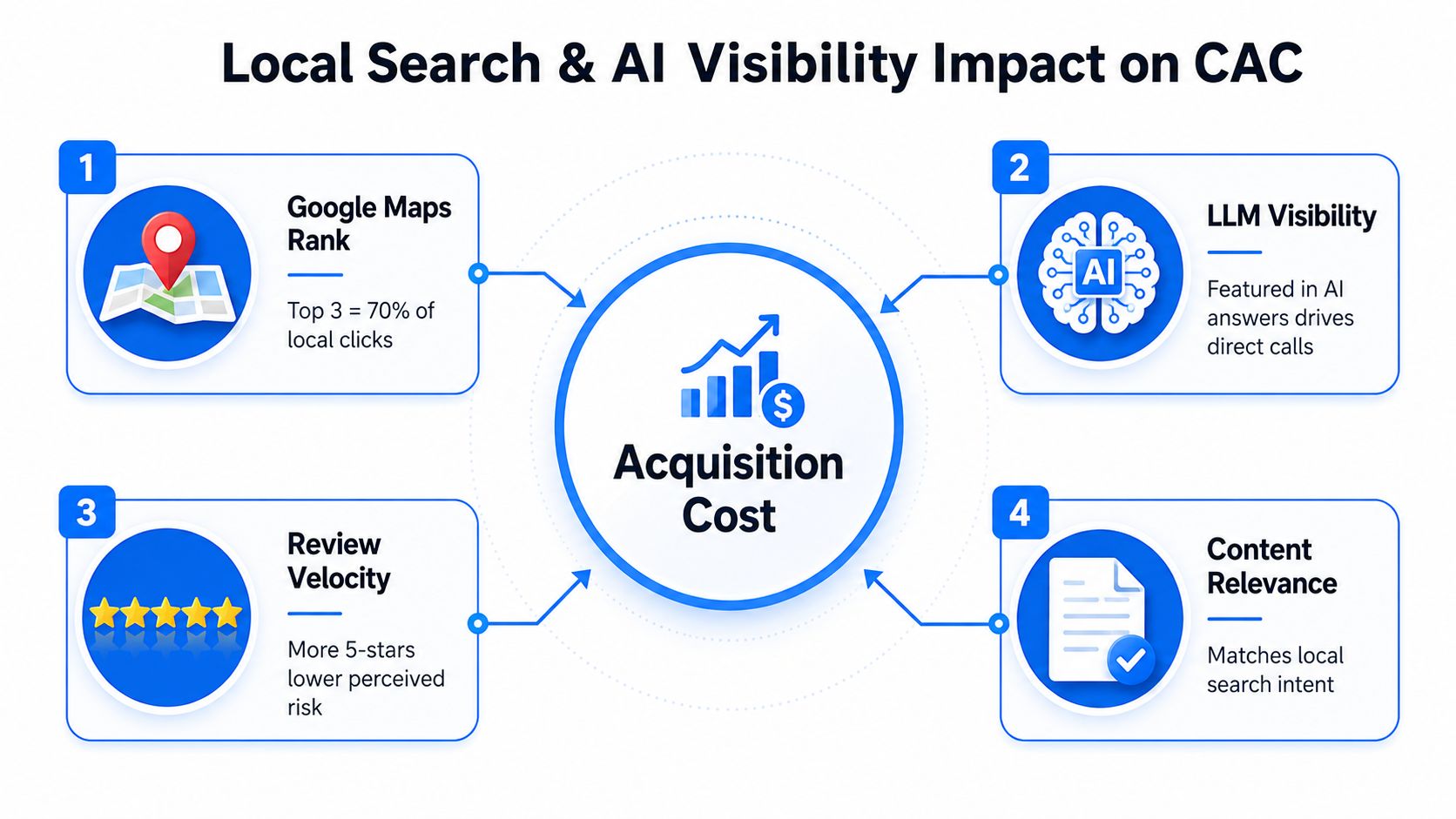
Local visibility changes acquisition economics before a prospect ever fills out a form. Google's official local ranking framework centers on relevance, distance, and prominence, as summarized in Google Maps ranking factor guidance. A profile that matches the service, sits close to the searcher, and demonstrates strong reputation signals has a better chance of earning attention from a ready buyer.
That matters for searches such as “emergency plumber near me,” “AC repair near me,” or “dentist near me.” A business appearing prominently in Google Maps can receive direct calls without paying for every click. A competitor buried below the visible local results may need paid advertising, repeated follow-up, or broader content investment to reach the same prospect.
The 2025 Whitespark Local Search Ranking Factors survey, summarized by Verlua's Google Maps SEO coverage, assigns meaningful influence across several categories. Google Business Profile signals account for about 32%, review signals about 16%, link signals about 16%, behavioral signals about 8%, and citation signals about 7% in the cited summary. On-page influence is reported between 15% and 33%, depending on the summary used. The practical lesson is straightforward: map performance doesn't come from one profile edit.
AI answers add a reputation layer
LLM visibility changes the question from “Where do we rank?” to “Which businesses does the system mention, and what sources support that recommendation?” Current AI-search guidance measures whether models mention a brand and cite its content. One analysis reports that earned media sources are cited 82% of the time when users ask what customers think, according to AirOps' LLM brand citation tracking research.
That makes reviews, local coverage, third-party mentions, service-area relevance, and consistent business information acquisition assets. Businesses can track LLM answer visibility alongside traditional rankings to see whether AI systems surface them for important service questions.
A ranking is an exposure metric. A recommendation that produces a call is an acquisition event.
Use the following video as a practical visual reference for connecting search visibility with acquisition reporting.
For businesses trying to reduce customer acquisition cost through local search, the priority is not chasing a vanity position. It's building relevance, prominence, and conversion paths around the exact transactional searches that generate calls.
Building a Customer Acquisition Dashboard That Drives Decisions
A useful dashboard should let an owner answer three questions quickly:
- Which sources produced qualified opportunities?
- Which opportunities became booked jobs or patients?
- Did the resulting revenue justify the acquisition cost?
Start with one row per channel and consistent attribution. Include organic service pages, Google Maps, paid search, referrals, social campaigns, and direct traffic only when the tracking setup can distinguish them responsibly.
Weekly reporting
Review fast-moving operational metrics every week:
- Search and map visibility: Track priority service terms by city, Google Business Profile actions, calls, and direction requests.
- Lead volume: Separate calls, forms, chats, and booked appointments rather than combining them into one lead total.
- Lead quality: Record service area, requested service, urgency, and qualification status.
- Response performance: Measure missed calls, unanswered forms, response time, and appointment availability.
- Booking outcomes: Compare qualified leads with scheduled jobs, consultations, and completed appointments.
Call tracking matters for HVAC, plumbing, electrical, roofing, and pest control because many high-intent prospects prefer speaking with someone immediately. Record the source, landing page, campaign, caller intent, and final disposition. A call that lasts several minutes isn't automatically a qualified opportunity, so staff should tag outcomes consistently.
Monthly reporting
Monthly reviews should focus on economics rather than activity. Put CAC, cost per qualified lead, cost per booked job, lead-to-booking rate, LTV, payback period, churn, and revenue by channel beside trend charts. Add a funnel visualization from impressions and visits through leads, qualified leads, bookings, completed jobs, and repeat business.
Set alerts for meaningful drift. A sudden rise in missed calls, a fall in booking rate, or an increase in paid leads without corresponding jobs deserves investigation before the next budget cycle.
For broader operational context, businesses can use master customer service reporting to connect service interactions with acquisition and retention signals. A performance view such as Transactional's performance dashboard can also organize keyword timelines, map visibility, Search Console queries, traffic, and conversion outcomes in one reporting environment.
Proven Tactics to Improve Each Acquisition Metric
Measurement only matters when it changes the next action. The strongest improvements usually come from fixing the handoff between search intent and business response, not from buying more untargeted traffic.
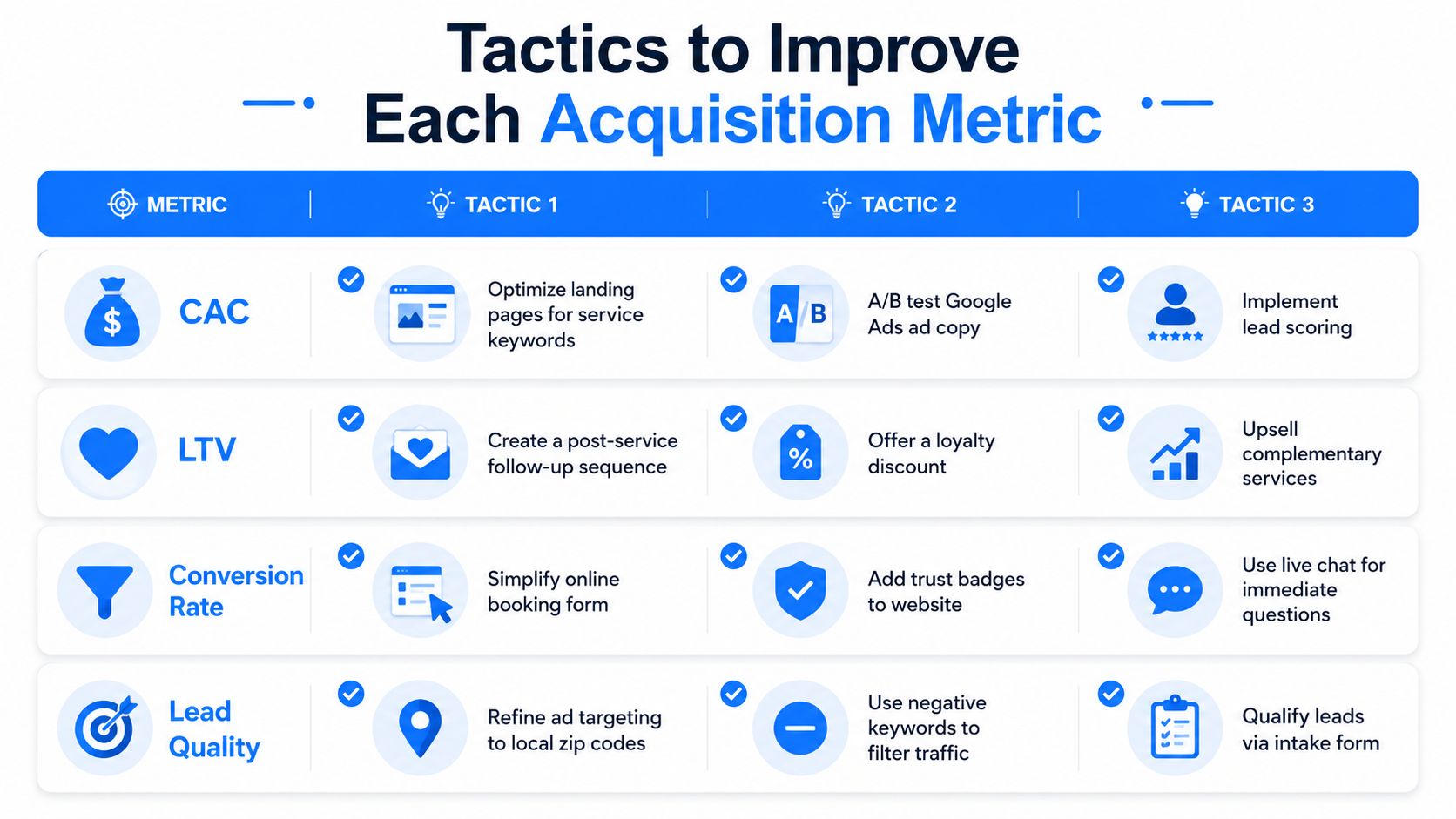
To reduce CAC, build dedicated landing pages for transactional terms. An HVAC page for “AC repair near me” should state the service area, emergency availability, phone number, proof of experience, booking path, and next step immediately. A generic home page forces the visitor to interpret the offer and often creates unnecessary friction.
To improve lead quality, tighten targeting around service areas and exclude irrelevant queries. Lead scoring can prioritize calls involving the right service, location, urgency, and estimated value. The result may be fewer raw leads, but a healthier cost per qualified opportunity.
To improve conversion rate, simplify forms and make phone calls easy. Ask only for information the team needs to route the inquiry, display trust evidence near the call to action, and test whether visitors prefer immediate booking or a callback request. Track both form completion and actual booking, because a completed form that receives no response isn't a successful conversion.
To improve LTV, create a post-service follow-up sequence. A pest control company can remind customers about recurring service, while a dental practice can promote the next appropriate appointment. Bundled services, maintenance plans, and complementary offers can increase value without relying entirely on new customer volume.
Reviews support both conversion and visibility. Ask satisfied customers for feedback after a completed job, follow platform policies, and use genuine service details in responses. Stronger local prominence can help organic, map, and AI discovery, while a better reputation can reduce hesitation after a prospect arrives.
A practical before-and-after comparison should focus on process:
Before: The roofer tracks clicks and total leads.
After: The roofer tracks service-area leads, qualified inspections, estimates, closed jobs, job margin, and source-level CAC.
Before: The dental practice sends every inquiry into the same queue.
After: The practice separates new-patient calls, insurance questions, emergency needs, scheduled appointments, and completed visits.
Common Metric Mistakes That Distort Acquisition Decisions
The first mistake is treating LTV:CAC as a universal health check. A strong ratio can hide a slow payback period, weak cash flow, or a channel that produces value only after extensive sales effort. Review the ratio beside payback, margin, churn, and source attribution.
The second is comparing blended CAC across incompatible channels. Organic search, Google Maps, paid search, and referrals have different cost structures and time horizons. A blended average can make a channel look ordinary when it produces the strongest booked-job economics.
The third is counting every inquiry as a lead of equal value. A spam form, an out-of-area call, a price shopper, and a ready-to-book customer shouldn't share one category. Track qualification and disposition, then calculate cost per qualified lead and cost per opportunity.
The fourth is stopping at top-of-funnel conversion. A page can generate visitors and forms while producing few completed jobs. Local service businesses should connect the first search interaction to the final revenue event whenever their systems allow it.
The fifth is ignoring AI visibility. Traditional rankings remain important, but customers increasingly encounter businesses through answer systems that summarize third-party information. Review signals, local prominence, and credible external mentions can influence whether an AI assistant includes a company in its recommendations.
Transactional LLC provides local SEO, Google Maps optimization, website management, web development, and paid advertising for service businesses that want more visibility for transactional searches such as “roofer near me,” “dentist near me,” and “AC repair near me.” Visit Transactional LLC to discuss a search and acquisition strategy built around qualified calls, booked jobs, and measurable customer acquisition metrics.