


A roofer can rank on page one, run polished ads, and still watch the phone stay quiet. The same problem appears in dental, HVAC, plumbing, and pest-control offices. The business is visible, but a competitor with stronger photos, fresher reviews, clearer service pages, and a more complete Google Business Profile gets chosen.
That gap is where assets in marketing matter. Marketing assets aren't just logos and ad graphics. They're the evidence Google and potential customers use to decide whether a local business matches a high-intent search such as roofer near me, dentist near me, or air conditioning repair near me. Transactional Marketing builds its local SEO process around that connection, with each asset tied to a service, a city, and a searcher who already has money in hand.
Why Service Businesses Need Better Marketing Assets
A roofing owner may have a modern website, a large advertising budget, and a page-one organic result for “roof repair.” Yet when a homeowner searches roofer near me, the map pack appears above the traditional results, and three competitors get the first opportunity to earn the call. The owner isn't losing because the business lacks a campaign. The business is losing because its local marketing assets don't give Google or the customer enough confidence.
The missing pieces are usually practical. The Google Business Profile may have an incomplete service list. The photo gallery may contain only a few outdated images. The website may describe roofing generally but lack focused pages for roof replacement, storm damage, and the cities served. Review responses may be inconsistent, while competitors publish useful service content and show recent completed work.
Practical rule: Visibility gets attention. Assets give people a reason to choose you.
A useful business website still matters, especially when its pages explain services clearly and guide visitors toward contact. This Webtwizz website building guide offers practical context for building a small-business site that supports that job. But a website alone isn't the complete asset system.
The better approach is to treat every marketing asset as part of a local search path. A finished-job photo supports trust. A city service page supports relevance. A review supports reputation. A tracked call connects the asset to revenue. The service business marketing strategy from Transactional Marketing follows this same principle, focusing on the terms that indicate immediate buying intent.
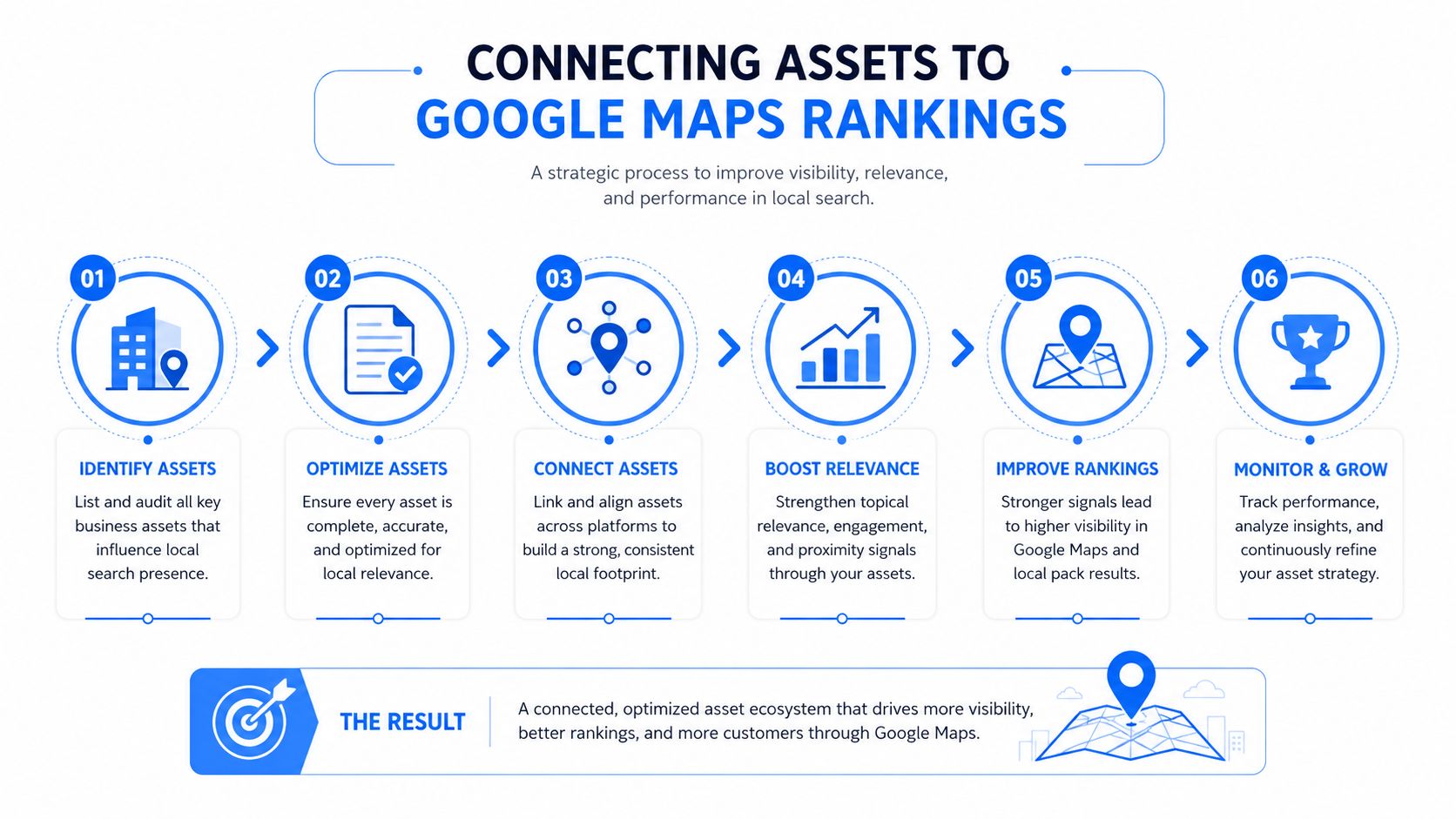
That's why Transactional Marketing treats the asset, not the campaign, as the unit of work. The process is to audit what exists, prioritize the gaps, build assets around transactional queries, organize them by service and city, then measure whether they produce stronger visibility and more booked conversations.
Defining Assets in Marketing for a Local Business
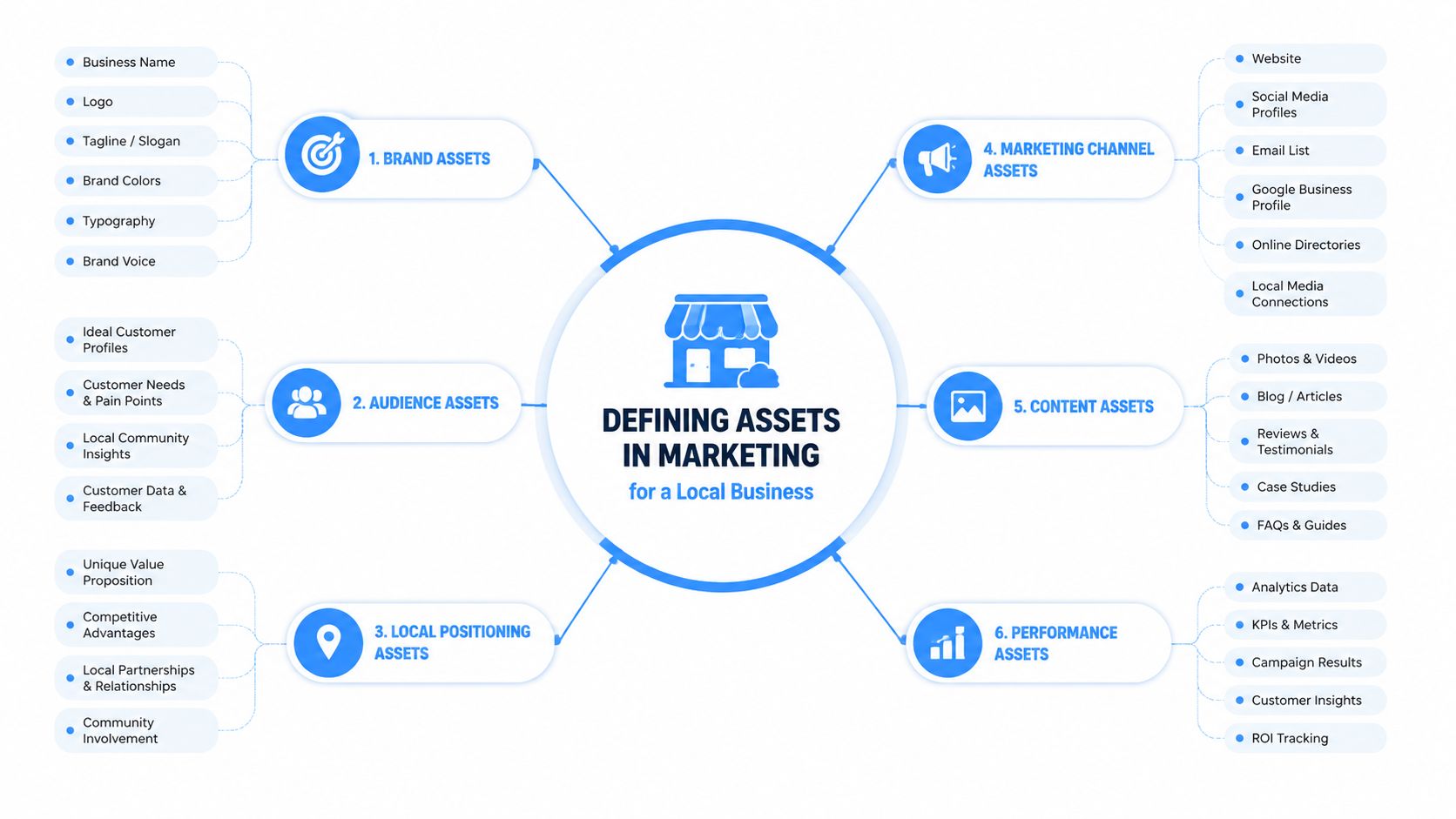
A plumber owns operational assets such as a service van, drain camera, wrench, and water-heater equipment. Those tools help the technician perform the job. Marketing assets help the business get discovered, earn trust, and convert the searcher into a customer.
A practical local-business inventory includes:
- Profile assets, including the Google Business Profile, directory listings, categories, service descriptions, and business details.
- Creative assets, including completed-job photos, technician videos, before-and-after visuals, headlines, and ad copy.
- Content assets, including service pages, city pages, FAQs, blog posts, and emergency-service explanations.
- Reputation assets, including reviews, owner responses, testimonials, and documented customer experiences.
- Data assets, including call records, Search Console queries, ranking observations, and map visibility measurements.
The accounting meaning is narrower and more technical. The 2025 System of National Accounts guidance on marketing assets defines marketing assets as the capitalized value of advertising and promotional expenditures intended to improve the overall impression customers form of a company and its products. It places marketing assets within the wider measurement of intangible capital and treats them as non-produced non-financial assets, with balance-sheet recognition tied to identifiable explicit purchases.
That distinction matters when an owner asks whether a rebrand, internal content library, or video collection can be capitalized. Operationally, those materials may be valuable long-lived assets. Financial reporting requires a separate accounting judgment, and the economic definition doesn't automatically mean every internally produced marketing item belongs on the balance sheet.
For local SEO, the working definition is straightforward: an asset is any reusable business-owned or business-controlled element that supports discovery, credibility, conversion, or measurement. That definition keeps budgeting grounded. A roof-repair photo isn't merely a file. Properly organized, it can support a website page, a Google Business Profile update, a social post, a review response, and an AI-readable explanation of the service.
The Five Asset Categories Every Service Business Owns
Service companies often spend heavily on a logo, branded uniforms, and polished advertisements while neglecting the assets that support local transactional visibility. A more useful taxonomy has five categories.
Profile assets
These establish the business's identity across Google Business Profile, directories, citation sites, and social profiles. For an HVAC company, accurate service categories, phone information, hours, service areas, and equipment photos matter more to local discovery than a redesigned logo that appears nowhere outside the website.
Creative assets
A finished-job photo set can show an HVAC installation, a pest-control treatment, or a dental procedure environment. Short videos can demonstrate preparation, workmanship, or what a customer should expect. Creative quality deserves serious attention because independent industry reporting estimates that creative can account for 47% of ROI, compared with 11% for targeting and 14% for reach, while creative assets can drive up to 56% of sales lift in digital campaigns, as reported by ATDigiAgency's creative asset analysis.
Content assets
A pest-control company may need service-area pages for termite treatment, rodent control, and mosquito management. A plumber may need a same-day emergency page, a water-heater page, and answers to common repair questions. These pages connect the company to specific searches instead of forcing every visitor through a generic homepage.
Reputation assets
Reviews, testimonials, and case documentation show that the company has solved problems for real customers. A review that mentions a service and location can be more useful for local relevance than a general praise statement, provided the wording is natural and genuine.
Data assets
Call logs, Search Console queries, conversion records, and map observations reveal what deserves investment next. They prevent a business from producing more content just because content feels productive.
The strongest asset is usually the one that supports several channels and a clear transactional query. A glossy brand presentation may look impressive, but a well-built emergency plumber page paired with accurate profile information and real job photos has a more direct path to a booked call.
Auditing Your Existing Assets in One Afternoon
An asset audit doesn't require a complex digital asset management platform. A spreadsheet, access to the business profiles, and a clear list of services and cities are enough to identify the highest-value gaps.
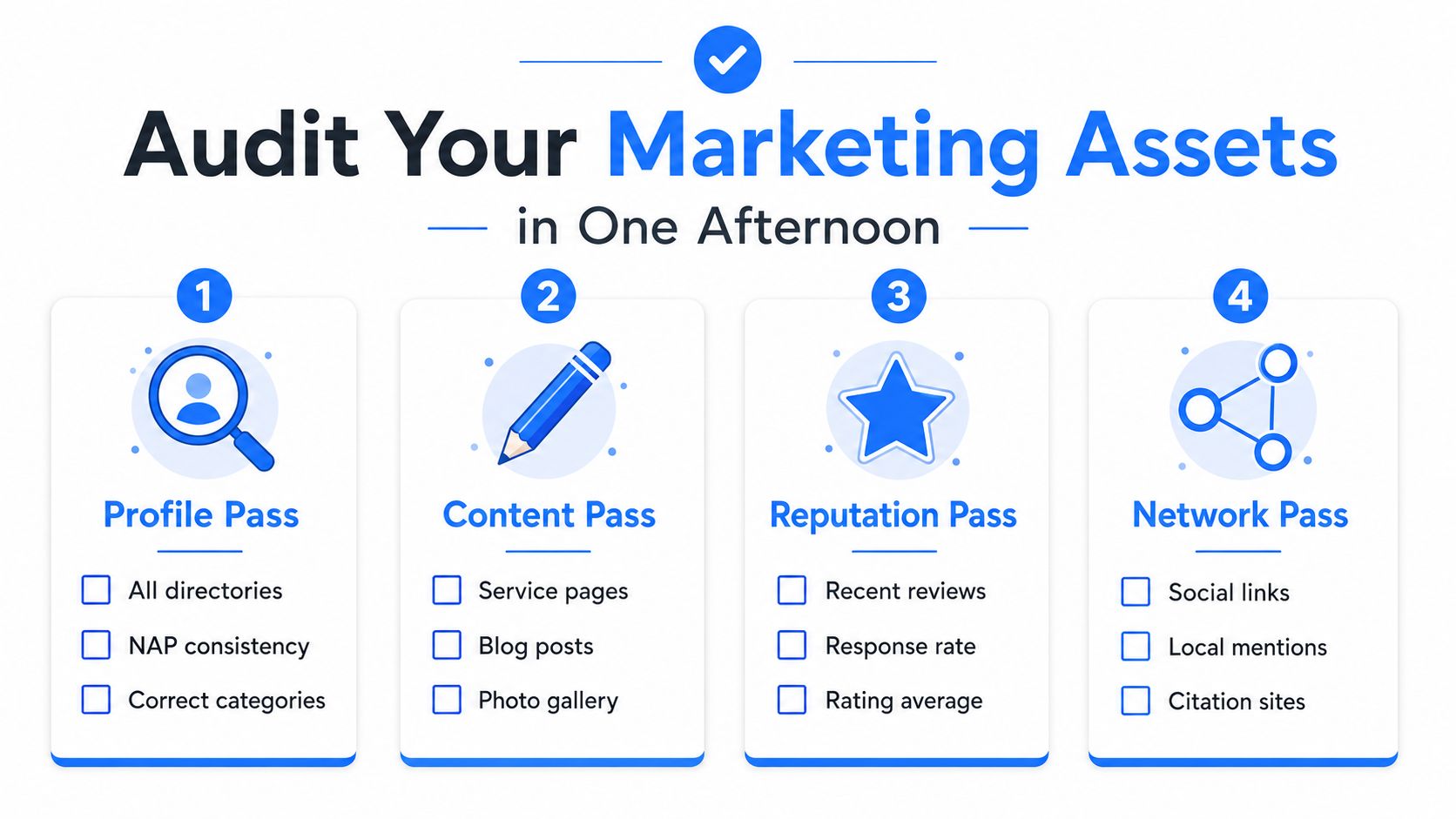
Start with the profile pass. Record every directory listing, the business name, address, phone number, primary category, secondary categories, hours, service areas, and profile URL. Flag duplicate listings, inconsistent contact information, missing categories, and profiles with weak descriptions or little visual evidence.
Move to the creative pass. Inventory the photo and video library, then note what each file shows, where it has been used, whether the file represents a real job, and whether multiple versions exist. A file named IMG_4821.jpg is hard to find and reuse. A descriptive name tied to the service and location makes the library more useful to staff, agencies, and AI-assisted workflows.
Record content gaps before creating anything new
For the content pass, list every important service and every city the company actively serves. Match that list against existing pages. A roofing company may have a roof-repair page but no storm-damage page. A dental practice may explain general dentistry but lack pages for emergency dentistry, implants, or specific locations.
Record each page's purpose, target query, current visibility, calls or form submissions, update date, and internal links. A blog full of general home-maintenance articles doesn't replace a focused service-city page when the commercial need is a search like air conditioning repair near me.
The reputation pass should examine recent reviews, response quality, recurring customer language, and unresolved complaints. Don't reduce this to a star average. Look for the services customers mention, the locations they reference, and the proof points that could inform future pages and profile updates.
Audit signal: A profile with one category and a handful of photos isn't a complete local asset. It's an unfinished storefront.
Prioritize gaps by ranking lever and commercial intent. The Google Business Profile audit service from Transactional Marketing can be one option for businesses that need a structured review, but owners can begin by documenting what Google, customers, and sales staff already see.
A useful audit ends with a short action list. Each item should identify the missing asset, the service or city it supports, the ranking signal it may strengthen, the person responsible, and the evidence that will show whether the work helped.
Connecting Assets to Google Maps Rankings
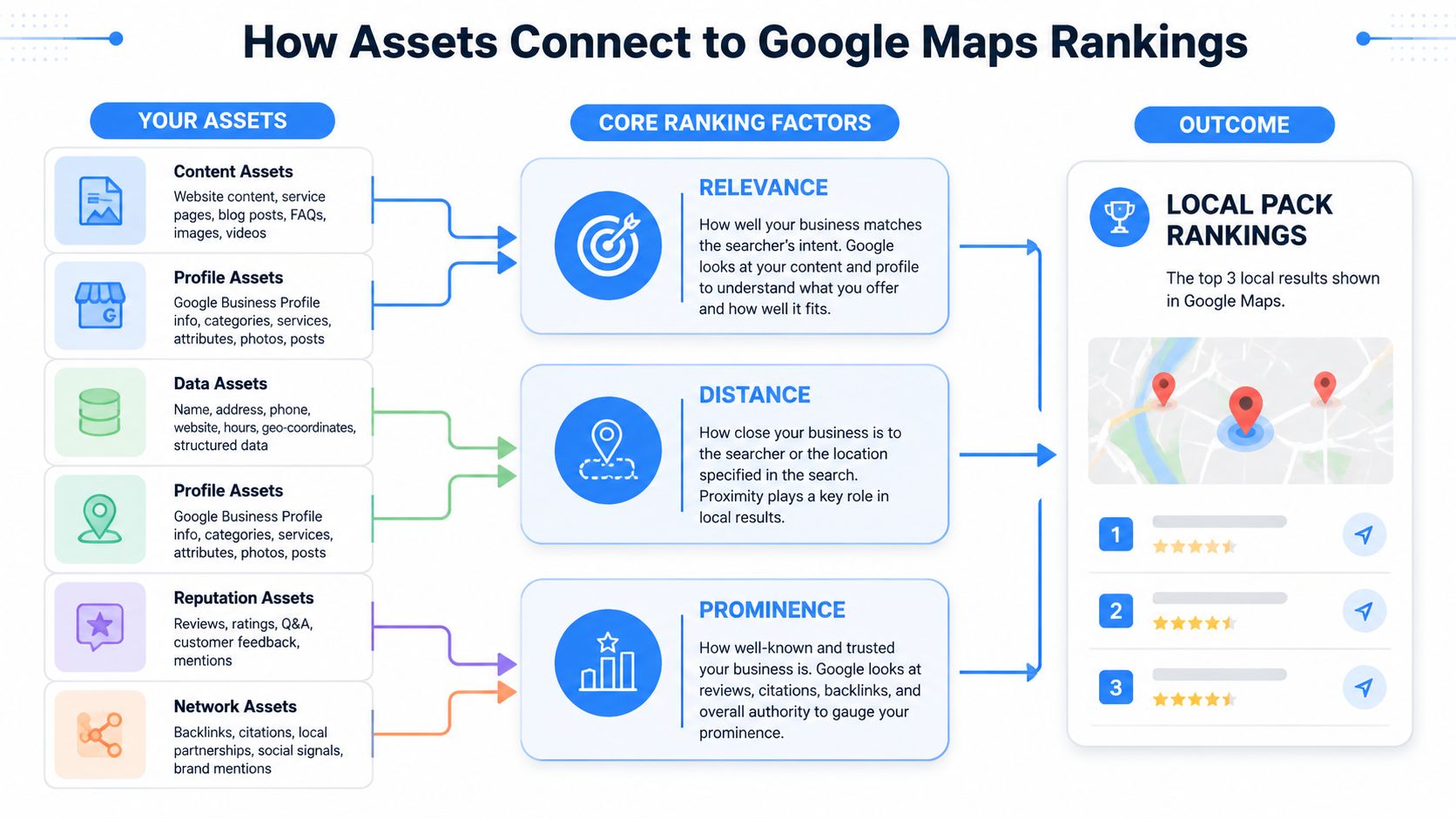
Google explains local ranking through relevance, distance, and prominence, and its guidance connects those factors to profile completeness, reviews, links, and the searcher's location or the location named in the query. The Google Maps ranking factors guide applies that model to the practical assets a service business controls.
Relevance answers whether the business matches the search. The primary Google Business Profile category is important because it tells Google what the company does. Service descriptions, selected services, website service pages, FAQs, and location-specific content reinforce that relationship. A dental office targeting “dentist near me” needs assets that clearly describe dental care, not a profile dominated by unrelated promotional language.
Distance is constrained by the searcher's location and the business location or service context. No asset can make a company physically closer. However, accurate address information, legitimate service-area details, location pages, and consistent local references help Google interpret where the business operates.
Prominence reflects how established and credible the business appears. Reviews, responses, local citations, links, mentions, and engagement-related signals support this layer. A resource such as Surva.ai's discussion of local review signals is useful for thinking about how reputation evidence can be read across modern search experiences.
These signals interact, but they aren't interchangeable. More reviews won't fix a profile built around the wrong category. A well-optimized service page won't eliminate the distance constraint. A large citation list won't compensate for a weak customer experience.
The practical target is the top three map results for transactional searches. Queries such as roofer near me, dentist near me, and emergency plumber near me indicate that the searcher may be ready to call, book, or visit. Transactional Marketing focuses its work on those terms rather than chasing broad visibility that doesn't create a clear next action.
Building and Organizing Assets in Content Silos
A strong local asset system follows the way customers search. Build one silo for each important service in each meaningful service city, then connect the supporting materials so Google and visitors can understand the business's expertise.
Take air conditioning repair as the example. The silo might contain a primary AC repair page, supporting articles about repair symptoms and emergency service, a page for AC repair in each served city, relevant Google Business Profile updates, and a photo set showing technicians, equipment, and completed work. Every piece should support the same service relationship without copying the others.
Use a practical production sequence
During the first phase, confirm the service, city, offer, conversion action, and primary profile category. During the next phase, build or improve the core service page and create the supporting location page. Then add FAQs, real photos, internal links, profile updates, and review prompts that reflect the language customers naturally use.
A 30 to 60 day workflow can be organized around publishing and refinement, not promises of a guaranteed ranking outcome. Transactional Marketing positions its process around getting customer websites onto page one of Google within 30 to 60 days, but results depend on the market, competition, business quality, and implementation.
Use a simple folder structure before buying specialized software:
- 01 Profile, profile copy, categories, directory records, and access notes.
- 02 Services, core pages, supporting articles, FAQs, and schema drafts.
- 03 Cities, location pages, local photos, landmarks, and service notes.
- 04 Creative, original photos, videos, approved crops, and usage rights.
- 05 Reputation, review requests, approved testimonials, and response guidance.
- 06 Measurement, call records, Search Console exports, and ranking observations.
File naming should identify the service, city, date, and subject. Add clear internal links between the core page, city page, and supporting article. Use appropriate structured content, including FAQPage, Article, or HowTo markup where it accurately describes the page, and maintain visible last-updated dates for material that changes.
For planning content pillars and reuse opportunities, the UGC Copilot content planner can help organize ideas before production. The important decision isn't how many assets you publish. It's whether each asset strengthens a specific transactional search path.
Measuring Asset Performance and Iterating
A marketing asset earns continued investment when it helps produce qualified conversations, not merely when it attracts visits. Local operators should connect four views of performance: calls by service, map visibility by city, Search Console query impressions, and AI citation visibility for the same transactional terms.
Call tracking shows whether visibility turns into demand. Break the data down by service line so “roof replacement” doesn't hide weak performance for “storm damage repair.” Listen for missed calls, poor routing, unclear offers, and questions that reveal a mismatch between the landing page and the customer's expectation.
Map observations need location context. A business can appear prominently near its address and weakly across the rest of its service area. Record the city, service query, date, and observed position consistently, then compare movement with calls rather than treating a ranking change as the final outcome.
Read search and AI visibility together
Search Console can reveal queries that trigger impressions even when the business doesn't actively track them. Those queries may uncover useful language for new FAQs, service explanations, or page revisions. The same query set can be used to assess AI visibility.
High Google rankings don't guarantee inclusion in AI-generated answers. Search Engine Land's LLM optimization coverage recommends tracking share of voice across a consistent query set, reviewing which third-party sources AI systems cite, auditing whether your own pages are cited, and using extraction-friendly formats such as bullets, tables, FAQs, dated statistics, schema markup, and visible update dates.
If a city silo climbs in map visibility but calls remain flat, don't immediately create another article. Check the offer, call-to-action, phone handling, landing-page message, and booking process. If impressions rise but AI citations don't, improve clarity, source context, page structure, and direct answers before expanding the content library.
Review performance quarterly, with lighter checks more often. Before creating the next asset, ask three questions:
- What transactional query does this serve?
- Which ranking or conversion lever does it strengthen?
- What evidence will we review after 30 days?
Your Asset Playbook and Quick Answers
A local service business can reduce the entire system to a repeatable operating list:
- Audit the inventory: Review profiles, creative files, service pages, city pages, reviews, and measurement records.
- Prioritize the lever: Fix relevance, distance context, prominence, or conversion friction based on the clearest gap.
- Build one silo: Connect one service, one city, one core page, supporting content, profile updates, and real visual proof.
- Organize for reuse: Use consistent folders, file names, permissions, and update records.
- Repurpose responsibly: Adapt a genuine job photo for the website, Google Business Profile, social content, and a relevant review response without creating duplicate filler.
- Measure outcomes: Compare calls, map positions, Search Console queries, and AI citations against the target transactional terms.
How often should assets be refreshed?
Refresh assets when the service, offer, staff, hours, location, or customer questions change. Replace stale photos with current work, update pages when processes change, and review profile details whenever the business changes its operating information. Don't rewrite useful pages merely to create activity.
Should a small business buy a DAM platform?
Not immediately. A structured shared folder and spreadsheet can handle an organized library while the asset volume remains manageable. A digital asset management platform becomes more practical when several people create content, approvals are difficult, versions cause mistakes, or the company serves multiple locations.
How can one job photo support many assets?
Use the same real image only where it adds context. It might illustrate a service page, support a Google Business Profile post, appear in a project gallery, inform a social update, and accompany a customer story. Change the surrounding explanation for each channel, and don't attach an irrelevant photo only to increase the number of assets.
What should a business do against a long-established map competitor?
Start with a gap analysis, not imitation. Compare categories, services, profile completeness, review themes, location coverage, page quality, local mentions, and conversion paths. Then choose a narrow transactional query where the business can build stronger relevance and proof, such as a specific emergency service, treatment, or repair type, and develop the supporting asset silo around it.
The market infrastructure behind this work is expanding. Estimates place the digital asset management market at USD 7.99 billion in 2026, with a projection of USD 30.03 billion by 2034 and an 18% CAGR, while another forecast estimates USD 6.23 billion in 2025 and USD 14.51 billion by 2031, representing a 15.4% CAGR, according to Mordor Intelligence's digital asset management market analysis. The numbers point to a broader operational reality. Businesses create enough content across channels that storage, governance, reuse, and measurement have become marketing functions.
For a roofer, dentist, HVAC company, or pest-control operator, the next action is simple. List every asset connected to your highest-value transactional search, find the weakest link, and improve that link before producing more general content.
Transactional LLC helps service businesses build industry-specific SEO assets, optimize Google Maps visibility, and organize content silos around high-intent searches such as roofer near me, dentist near me, and air conditioning repair near me. Visit Transactional LLC to review a local search strategy built around your service areas, map rankings, calls, and AI visibility.