


A patient searches “Botox near me” between appointments, scans the Google Maps results, checks recent reviews, and calls the clinic with the clearest profile. That patient may never see your homepage. Another searches how long filler lasts, whether microneedling requires downtime, or whether a treatment is safe, then asks an AI system for a concise explanation before booking. Those are two different journeys, and SEO for med spas has to support both.
Transactional Marketing focuses on the first journey, the searcher with money in hand and a treatment in mind. The strategy targets transactional terms such as “med spa near me,” “Botox near me,” and “laser hair removal [city]”, then connects those searches to Google Maps visibility, treatment pages, calls, and booking actions. The second system builds the authority that helps a clinic appear in AI-generated answers and clinical research results.
Why Med Spa Search Is a Different Game
A polished website doesn't automatically put a med spa in front of the patient ready to book. For local searches, Google says rankings depend on relevance, distance, and prominence, which makes the Google Maps pack a separate battleground from traditional website rankings (Google local ranking guidance via Birdeye).
The distinction matters because local search behavior shows strong map and review dependence. One independent 2026 roundup reports that 42% of all local searches lead to a map pack click, while searches for “med spa near me” have grown by more than 200% over the prior three years (medical spa local SEO statistics). The same source reports that 83% of consumers use Google to research reviews before choosing a medical spa. Those figures point to a practical conclusion: the first conversion asset often isn't your homepage. It's your profile, review record, distance from the searcher, and treatment relevance.
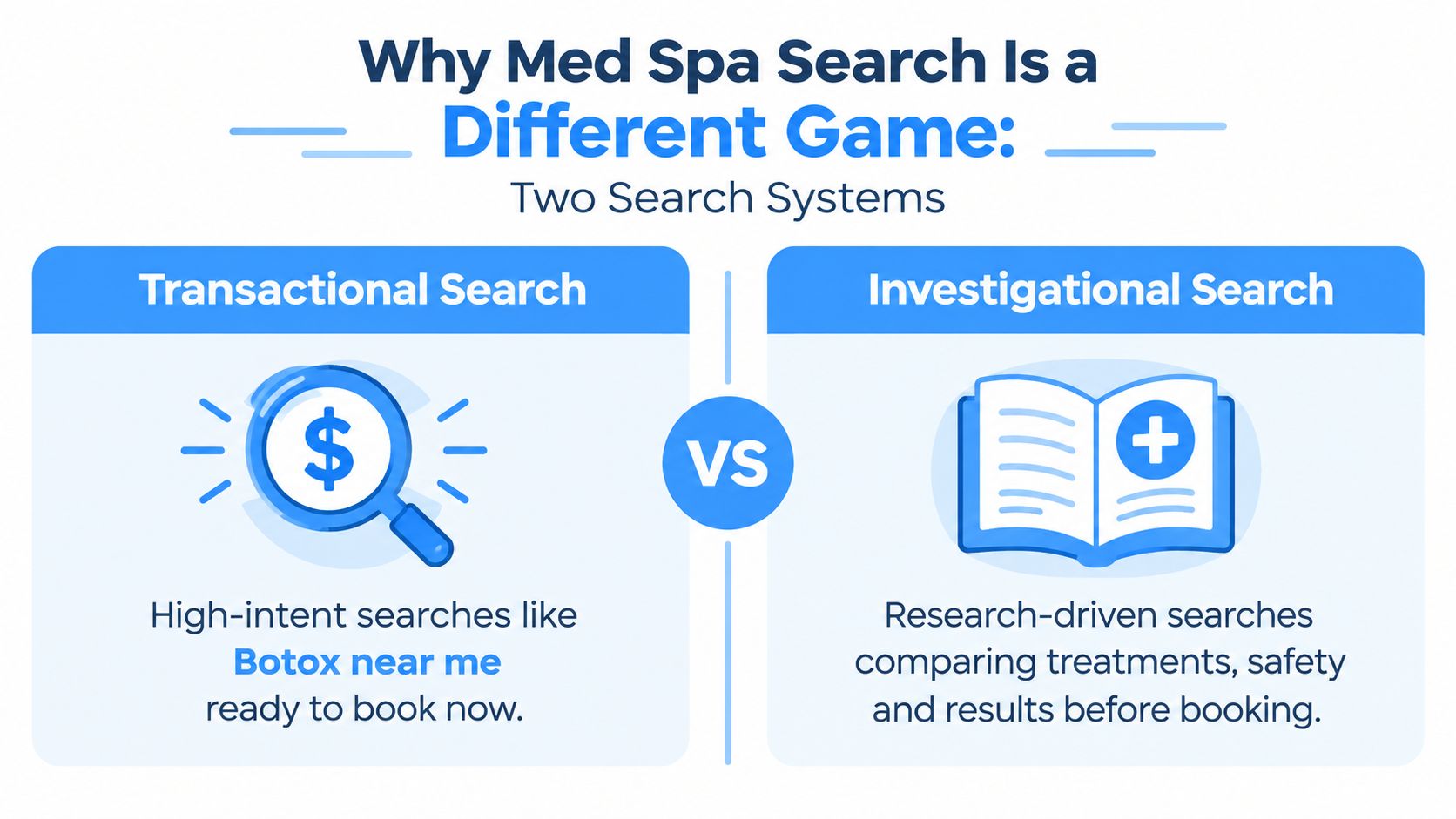
Two systems, two jobs
Transactional search includes queries such as “Botox near me,” “laser hair removal Chandler,” and “med spa near me open Saturday.” These searches usually require a strong Google Business Profile, accurate treatment information, recent reviews, and a frictionless call or booking path.
Investigational search includes questions such as how Botox works, what microneedling recovery involves, and whether PRP is safe. These searches require answer-shaped content, visible practitioner credentials, clear medical review, structured data, and carefully sourced explanations. Recent coverage describes a split in search behavior, with AI Overviews appearing more often for clinical education while local pack results remain central to booking-intent searches (med spa SEO and AI search coverage).
Practical rule: Don't ask one page to rank, educate, reassure, and convert for every possible query. Give each intent a clear destination.
A useful introduction to prioritizing SEO work without turning the campaign into an endless checklist is start SEO without overwhelm. For a med spa, the starting point should be transactional visibility, then clinical authority that supports the decision.
Mapping Transactional Keywords to Treatments and Cities
Keyword research works better when it begins with the appointment rather than a list of broad phrases. Ask what the patient would type immediately before calling, what they would search while comparing options, and what they would ask after developing interest in a treatment.
Build three intent buckets
| Query Pattern | Example | Search Intent | Landing Page Target |
|---|---|---|---|
| Service plus city | “Botox in Scottsdale” | Book | /botox-scottsdale |
| Treatment plus near me | “Botox near me open Saturday” | Book | Google Business Profile and Botox page |
| Cost or comparison | “Botox cost per unit” | Compare | Botox FAQ or cost guide |
| Treatment comparison | “Kybella vs CoolSculpting” | Compare | Comparison article linked to both services |
| City hub | “Best med spa Phoenix” | Learn and compare | Phoenix hub linking to treatments |
Start by exporting treatment and city combinations from Google Keyword Planner, then inspect local demand by target ZIP codes. LocalFalcon and BrightLocal help reveal whether a phrase is visible in the map pack across a service area instead of only at the clinic's address. The point isn't to collect every variation. It's to identify the phrases that connect a specific treatment, location, and action.
For example, “Botox Scottsdale” belongs on /botox-scottsdale, not on a generic services page. “Microneedling cost” can become a focused FAQ block on the microneedling page, with enough context to explain what affects pricing and a nearby consultation action. “Best med spa Phoenix” can support a city hub that links to Botox, fillers, laser hair removal, and other relevant treatment pages.
Make one page responsible for one intent cluster
Avoid creating several URLs that all target “Botox Scottsdale” with slightly different wording. That structure makes it unclear which page should rank and often produces repetitive copy. Instead, assign a primary page, link to it from the city hub and navigation, and use supporting educational content to answer related questions.
The local keyword research resource can support the process of organizing terms by location and intent. Use the final map as an editorial and technical document, not just a spreadsheet. Every priority query should have a destination, a conversion action, and an internal-link path.
Google Maps Optimization That Drives Phone Calls
Google Maps optimization starts with the Google Business Profile, but completion alone isn't a strategy. The profile has to communicate exactly what the clinic does, where it operates, and how a patient can book. Google describes local visibility through relevance, distance, and prominence, so every profile field should strengthen one of those signals without stretching the truth.
Set up the profile for relevance
Choose Med Spa as the primary category when that accurately describes the business. Add three to five secondary categories only when they match real services, such as Skin Care Clinic, Laser Hair Removal Service, or Weight Loss Service. Don't add categories for treatments the clinic doesn't provide.
Populate the Services editor with each actual treatment. Add descriptions, pricing information where appropriate, and a direct booking link when the profile permits it. The website, profile, and booking system should use the same business name, address, phone number, hours, and service language.
Remove operational weaknesses
Use real images of the exterior, reception area, treatment rooms, signage, and named practitioners. Keep holiday hours updated, enable messaging, and publish Google Posts tied to genuine promotions, new equipment, events, or service announcements. Confirm owner access through the practitioner's work email rather than leaving control with a former employee's personal Gmail account.
Exact NAP consistency matters beyond the profile. The name, address, and phone number should match the website footer, appointment software, Yelp, and other directories. A suite number or address abbreviation that changes from listing to listing can make the business harder for platforms to reconcile.
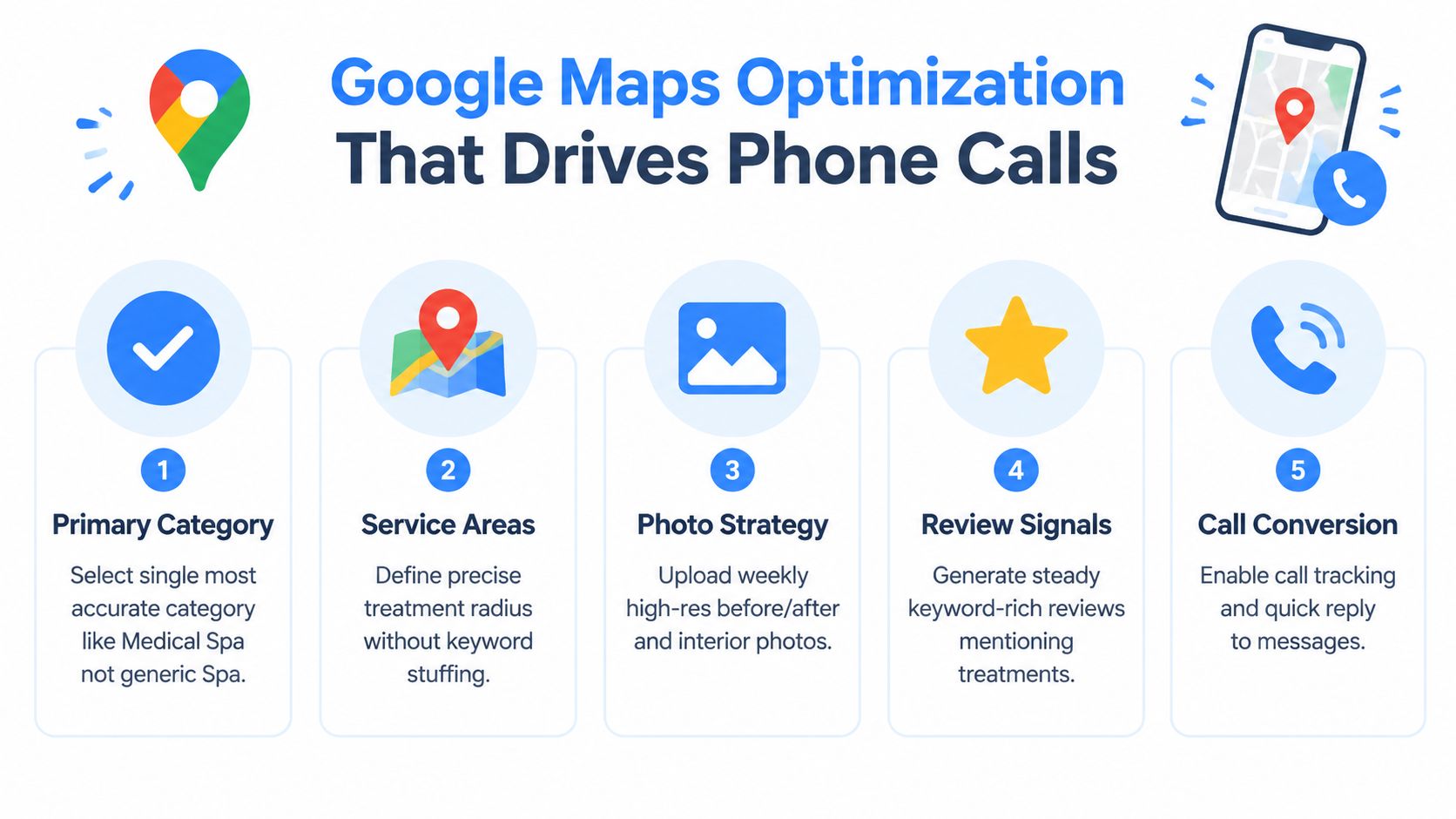
A broader improve local SEO rankings guide offers useful context for maintaining local visibility. For med spas, the implementation should stay tied to calls, directions, messages, and bookings rather than profile activity for its own sake.
The Google Maps ranking guide is another practical reference for turning profile maintenance into a repeatable local process. The priority is simple: make the listing accurate, treatment-specific, active, and easy to contact.
Building Treatment Pages That Convert Bookings
A homepage introduces a clinic. A treatment page answers the question behind a booking search. That difference is why a med spa shouldn't force Botox, fillers, laser hair removal, microneedling, and body contouring into one broad services page.
One 2026 benchmark reports that treatment-specific landing pages convert at 4% to 8%, compared with 1% to 2% for generic med spa pages (med spa landing page statistics). The same benchmark reports that optimized landing pages can reach 12% to 15% in top-performing scenarios. These figures don't guarantee a result for any clinic, but they explain why page-level intent deserves priority.
Use a treatment silo
Build one cornerstone page for each major service, then support it with concern-specific pages where the clinic has real expertise. A Botox page might link to lip flip content, while a filler page might link to under-eye filler. A laser hair removal page could link to beard laser information. Each URL should serve a distinct search need rather than repeat manufacturer language.
A strong treatment page should make the next step obvious:
- Treatment-specific title and heading: Pair the service with the city when local intent is central.
- Pricing context: Use a transparent price or “starting at” explanation where the clinic can support it.
- Provider evidence: Show practitioner names, headshots, credentials, and appropriate medical oversight.
- Patient education: Explain the process, expected recovery, suitability questions, and realistic outcomes.
- Visual proof: Use genuine before-and-after images with consent and model disclaimers.
- Booking access: Place a call, consultation, or booking action near the opening and after key objections.
- Related questions: Link to FAQs and comparisons without creating competing pages for the same intent.
| Element | Generic Homepage | Treatment Landing Page |
|---|---|---|
| Primary focus | Clinic overview | One treatment and its local intent |
| Search match | Broad “med spa” relevance | Specific service plus city or concern |
| Patient questions | General navigation | Price, process, recovery, suitability |
| Trust evidence | Team and brand summary | Relevant provider and treatment proof |
| Conversion path | Find a service first | Call or book from the treatment context |
Near-duplicate manufacturer copy is a common failure. Google needs a reason to rank one page over another, and copied descriptions don't provide local experience, provider context, or useful distinctions. The med spa website design resource is relevant when the site needs an architecture that supports treatment silos and direct booking paths.
Schema, E-E-A-T, and AI Search Visibility
AI optimization isn't traditional SEO with a new label. LLM SEO focuses on making content, entities, and technical signals clear enough for systems such as ChatGPT, Perplexity, Gemini, Claude, and Grok to retrieve, trust, and cite a business (LLM SEO guidance).
For a treatment URL, start with schema that accurately describes the entity and page. MedicalBusiness can clarify the clinic and location, MedicalProcedure can describe a treatment, and MedicalWebPage can identify an authoritative educational page. Use FAQPage schema for genuine question-and-answer content and Review schema only where the visible review content meets the relevant requirements.
Schema is a hint, not a rescue mechanism. It won't make thin or unsupported claims authoritative, and it shouldn't be used to label content that visitors can't see.
Put medical trust on the page
Med spa pages sit close to health decisions, so credentials should be visible rather than hidden in a footer. Use a named practitioner byline, show relevant licensure or NPI information where appropriate, identify a medical director or reviewer, cite clinical sources for efficacy or safety claims, and display a clear last-updated date.
Answer common clinical questions in a concise paragraph before expanding into details. A page about Botox should address questions such as whether Botox is safe during pregnancy without making an unsupported universal promise. A filler page should explain that longevity varies by product, treatment area, patient factors, and clinical assessment rather than presenting a fixed outcome as guaranteed.
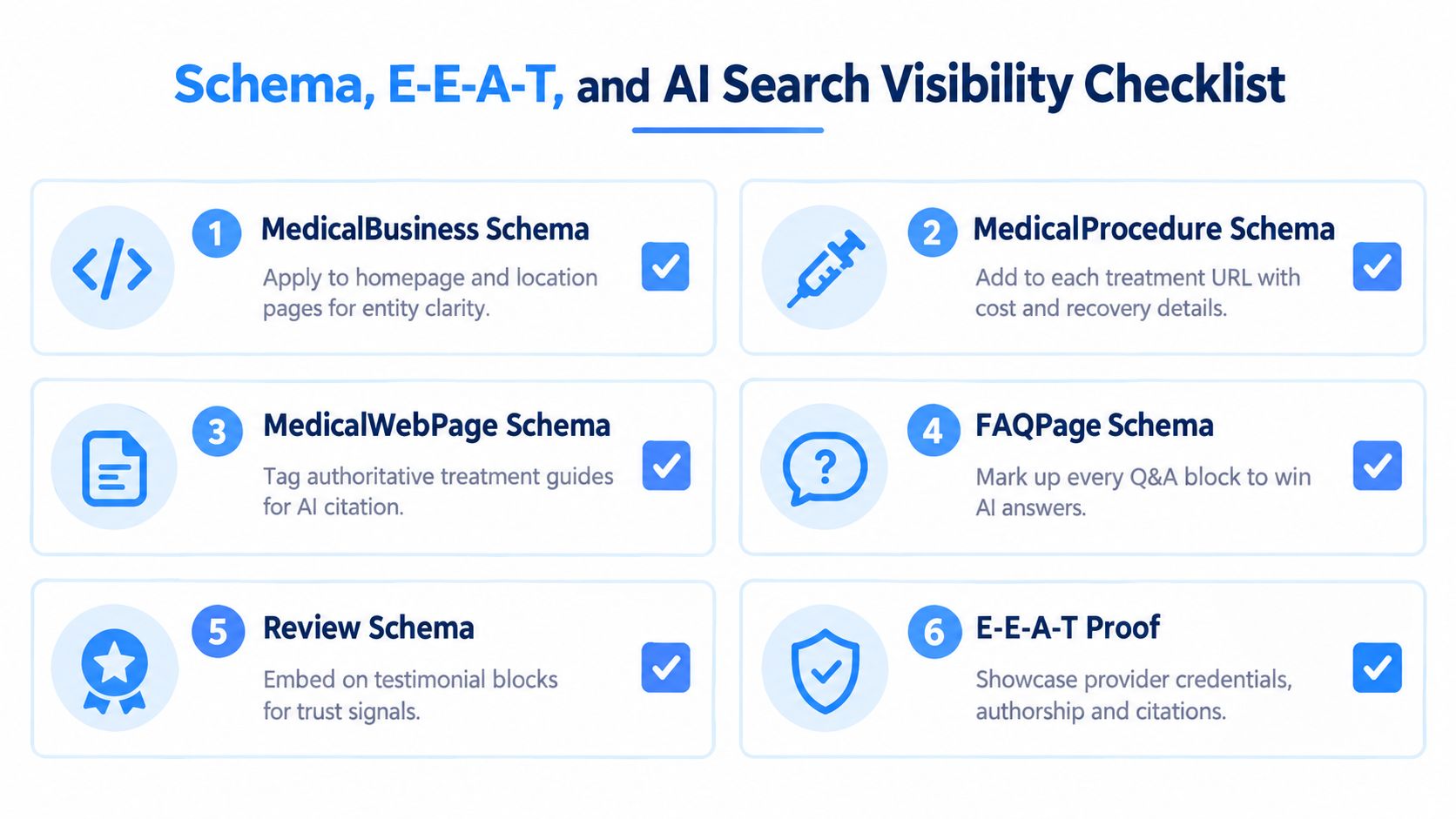
AI systems tend to work better with direct definitions, comparison tables, source citations, current authorship, and consistent business entities across the web. The schema markup for services guide can help a development team translate that structure into implementation without confusing structured data with a ranking guarantee.
Reviews and Local Citations That Build Prominence
A representative clinic in Scottsdale may have a strong treatment page and an accurate profile but still lose the map pack to a nearby competitor with fresher reviews and cleaner directory data. That isn't because the competitor's homepage is prettier. It reflects the prominence side of local search, where public evidence of activity and recognition supports the business entity.
A practical review workflow begins after the appointment, when the experience is still recent. The clinic can send a polite SMS asking for an honest Google review, make the link easy to use, and respond professionally to every review. Review requests shouldn't be limited only to patients expected to leave positive feedback. Review-gating creates compliance and trust problems.
Favor a steady cadence over a stale total
Review recency and velocity are more useful operating measures than a lifetime total viewed in isolation. A clinic with many old reviews may look established, but a competitor receiving fresh feedback from current patients can appear more active and relevant.
Ask patients to describe their actual experience naturally. A review that mentions a treatment and city may provide useful context, but staff shouldn't script or fabricate language. Replies should acknowledge the patient, protect privacy, and avoid confirming medical details in public.
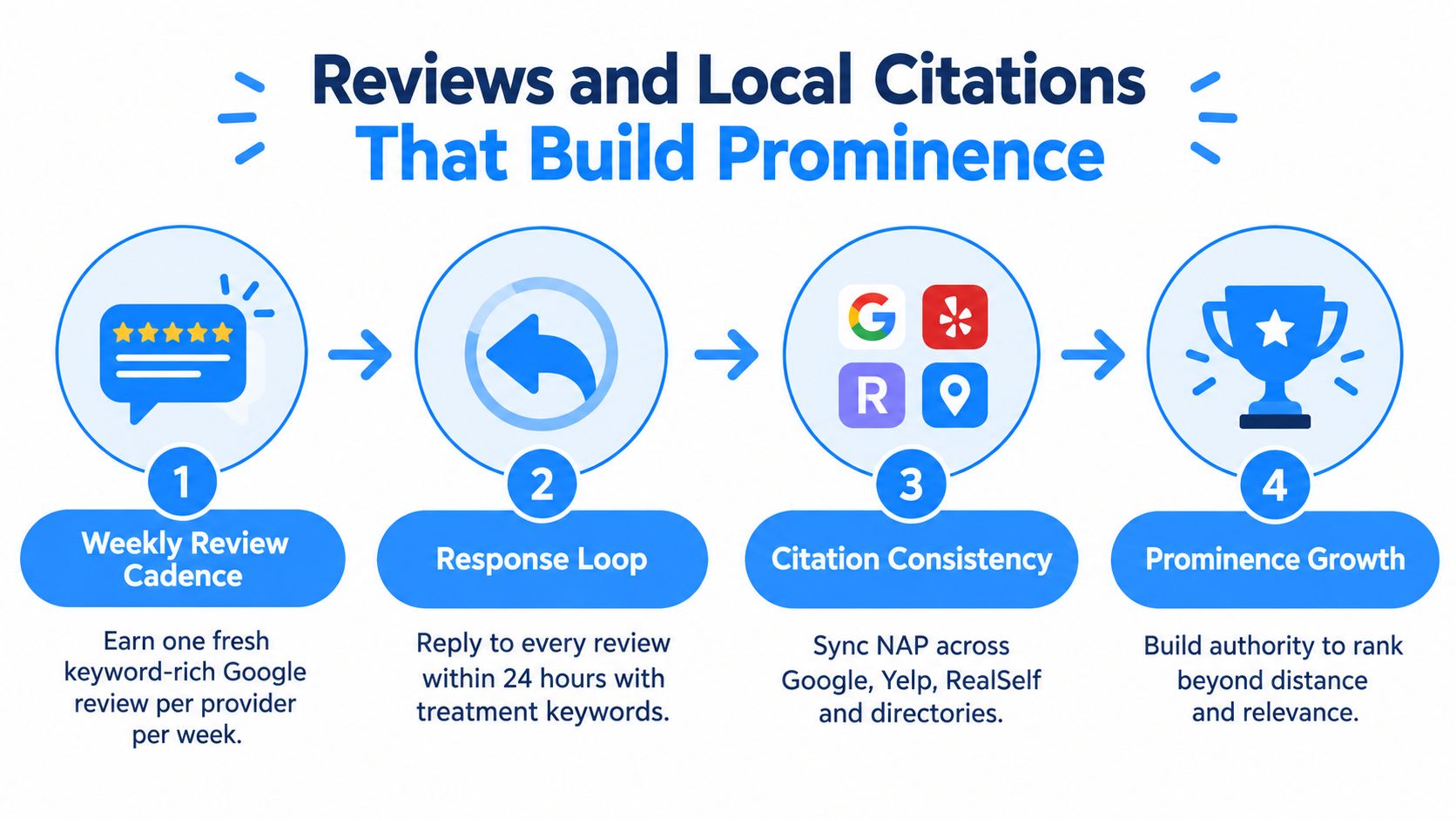
Keep the citation record clean
Use a canonical NAP across Google, Yelp, RealSelf, Healthgrades, WebMD Care, Apple Maps, Bing Places, and relevant industry directories. Check suite formatting, street abbreviations, phone numbers, and practitioner or location names. A citation audit is usually more valuable than adding random low-quality directory listings.
The response workflow should have an owner, a review queue, and a privacy standard. When a patient raises a concern, move the conversation offline rather than discussing treatment details in a public reply. Prominence grows from consistent information and authentic activity, not from stuffing city names into every response.
Your 90-Day Measurement and Reporting Plan
A med spa SEO report should answer one commercial question: did the strategy create more opportunities to book? Traffic and impressions help diagnose visibility, but the operating dashboard needs to connect map placement and treatment-page demand to calls, forms, consultations, and closed appointments.
Use four sources together. LocalFalcon or PlePer can show map visibility across a grid for terms such as “Botox near me” or “laser hair removal [city].” Google Search Console can reveal which treatment queries are gaining impressions and clicks. Call tracking can separate Google Business Profile calls from landing-page calls, while the practice management system records whether those leads became appointments.
Review the signals on a fixed rhythm
Each week, check Google Business Profile insights for calls and direction requests, inspect new transactional queries entering the top 20, and review the freshness of incoming reviews. Read the LocalFalcon grid by ZIP code or neighborhood. A weak outer area may call for a location page, citation cleanup, stronger service relevance, or more realistic expectations about distance.
Don't assign a numeric ranking target where the baseline is unknown. Instead, record the starting grid, query set, call volume, treatment-page impressions, and booked appointments before work begins. Then compare the same terms and areas at each checkpoint.
| Metric | Day 30 Target | Day 60 Target | Day 90 Target |
|---|---|---|---|
| Map grid visibility | Baseline captured and weak areas identified | Movement tracked by treatment and area | Winning and underperforming areas clearly separated |
| Transactional queries | Initial query set documented | New treatment and city queries reviewed | Priority terms assigned to pages or GBP actions |
| Treatment-page impressions | Indexing and baseline confirmed | Growing impressions tied to specific pages | Pages with booking potential prioritized for refinement |
| Calls and messages | Tracking verified | Source and treatment intent reviewed | Lead quality compared with booked consultations |
| Reviews and citations | NAP audit started | Inconsistencies corrected and workflow active | Recency and response process maintained |
The dashboard should make the next decision obvious. If Maps visibility improves but calls don't, inspect the profile's booking path and treatment relevance. If impressions grow without appointments, improve price clarity, provider proof, calls to action, and page speed. If one ZIP remains weak, don't publish another generic blog post. Fix the local signal that explains the gap.
For teams comparing implementation partners, Leaping Lemur Media's service page provides another reference point for evaluating marketing services. Transactional LLC also offers industry-specific SEO, Google Maps optimization, treatment-focused content planning, and reporting that connects local visibility with search and lead activity.
Transactional LLC helps med spas target transactional searches such as “Botox near me,” “med spa near me,” and treatment-plus-city queries, while building the Google Maps and AI-ready content systems that support bookings. Visit Transactional LLC to discuss a med spa SEO plan built around your treatments, cities, calls, and consultation goals.