


A med spa website can attract the same visitor volume and still produce dramatically different business results. Independent 2026 industry benchmarks place average med spa website conversion near 2% to 3%, while stronger sites reach roughly 6% to 10%, or 8% to 12% when clear calls to action, online booking, and social proof work together. Other benchmark data places typical clinic websites closer to 1% to 2%, compared with 4% to 8% for dedicated treatment landing pages. (Webtonic's med spa digital marketing benchmarks)
That gap changes how a practice should approach med spa website design. Luxury colors and polished photography matter, but they don't compensate for a vague service menu, a buried booking button, slow mobile pages, or an intake form that makes patients hesitate. The site has to connect three systems: conversion-focused design, transactional local SEO, and secure patient intake.
Why Conversion Performance Defines Modern Med Spa Website Design
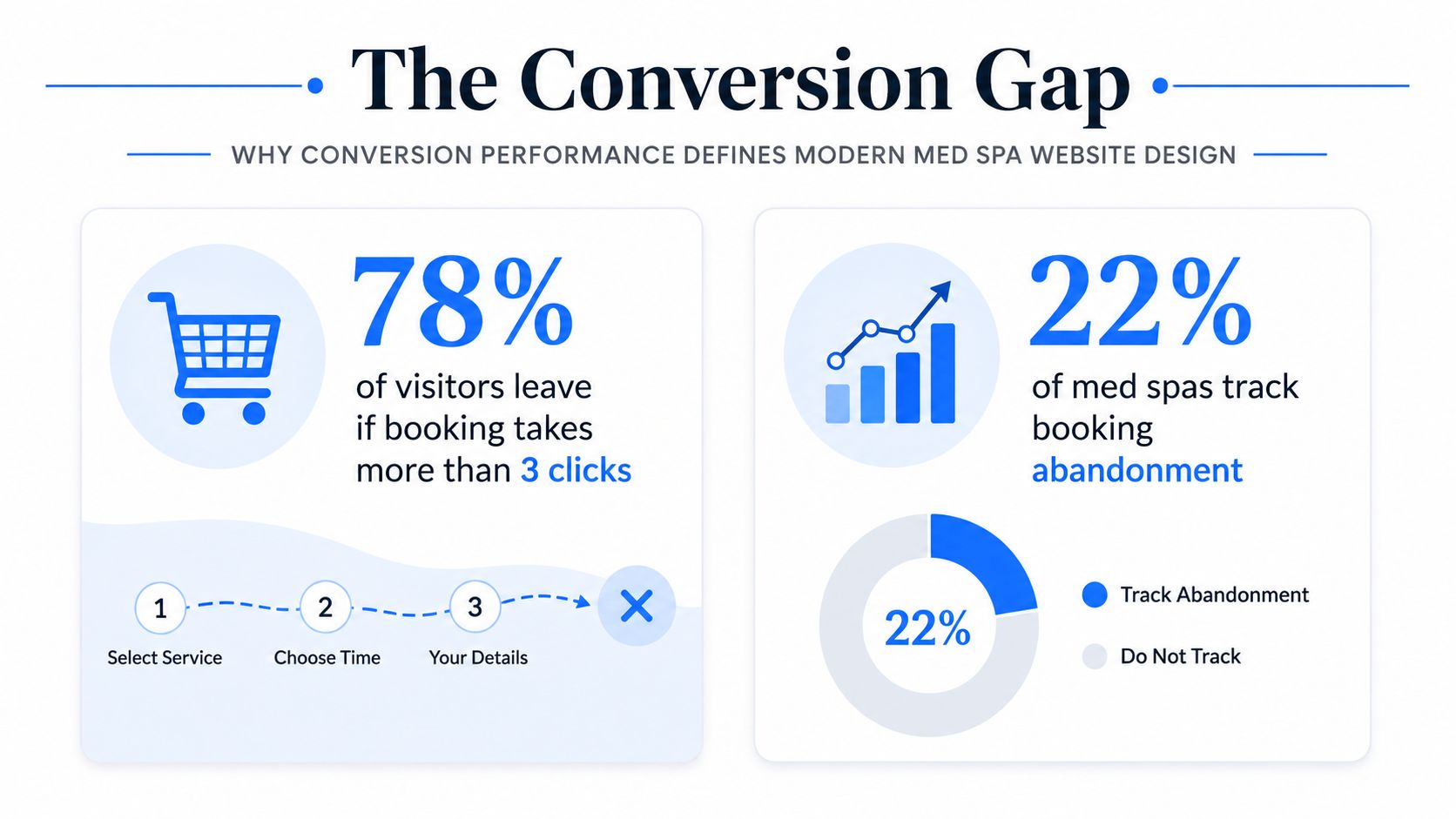
A med spa website earns its keep when a high-intent visitor can move from treatment interest to a credible, protected booking path. The benchmarks cited earlier show that strong and weak sites diverge sharply, and the gap comes from structure, not visual polish.
A refined palette and professional photography can support trust, but they cannot fix a vague service menu, a hidden booking button, slow mobile pages, or an intake form that creates privacy concerns. Design decisions affect revenue because they determine whether visitors request a consultation, complete a booking, call the practice, or leave to compare another provider.
The revenue problem behind the design problem
A generic homepage makes visitors interpret the practice's services on their own. A conversion-focused site answers those questions earlier, then routes someone searching for Botox, laser hair removal, body contouring, or injectables to a page built around that treatment and its next step.
Aesthetic services combine visual consideration with strong purchase intent. Visitors may want to review results, understand the process, evaluate the provider, confirm the location, and decide whether the price fits their expectations. If those answers are scattered across several pages, the visitor must do too much research before contacting the practice.
The booking experience also has to connect with local search and compliant intake. A treatment page that ranks for a nearby service search still underperforms if its call to action is unclear. A fast booking form still creates risk if it requests health information through an unprotected channel.
Practical rule: Measure every design decision against a business action, such as a consultation request, completed booking, phone call, or qualified treatment inquiry.
The pillars of a high-performing site
A strong med spa site brings six systems together:
- Treatment specificity: Individual pages match individual searches and patient concerns.
- Visible action paths: Booking, consultation, and click-to-call options remain easy to find.
- Clinical proof: Provider credentials, reviews, treatment details, and authentic results reduce uncertainty.
- Mobile usability: Pages load quickly, and forms and scheduling remain practical on a phone.
- Secure intake: Health history and treatment information move through appropriate protected systems.
- Local relevance: The practice can be found for searches such as “Botox near me” and “med spa in [city].”
Transactional Marketing approaches this work through transactional search terms, searches made by people close to choosing a provider. The goal is qualified visibility for a specific treatment or nearby med spa, followed by a clear action and an intake process that respects patient privacy.
Building a Page Architecture That Converts Visitors Into Patients
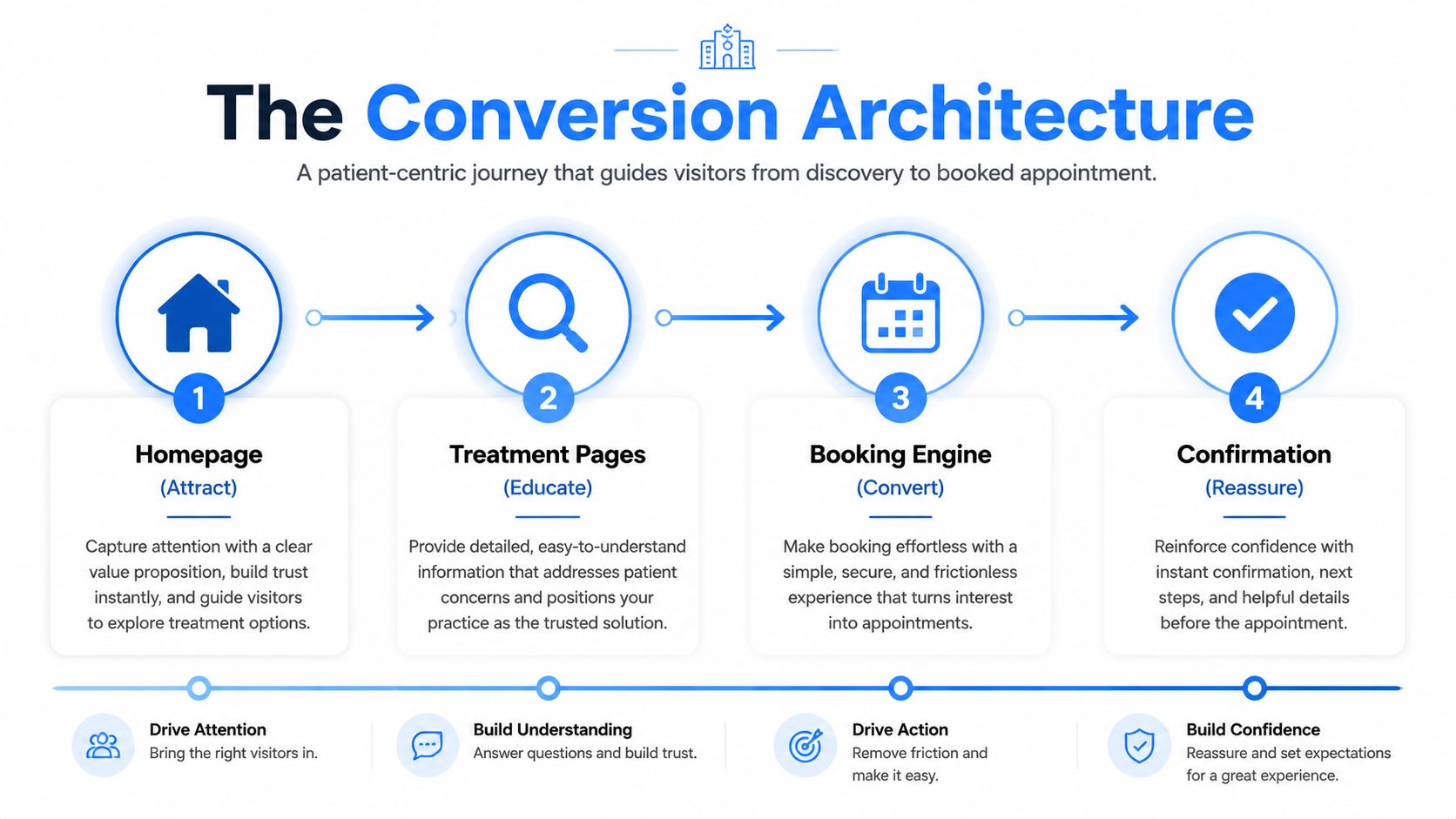
Page architecture determines whether visitors move naturally from discovery to confidence to booking. A homepage can introduce the practice, but it shouldn't force every visitor through the same generic message. Someone looking for lip filler needs a different path from someone comparing laser treatments or seeking a consultation with a specific provider.
A commonly used med spa structure includes a homepage, individual treatment pages, an about or team page, a before-and-after gallery, reviews, pricing or specials, and contact information. (Recommended med spa website structure) That structure works because it follows service intent rather than organizing the site around internal departments.
Start with the journey, not the menu
The homepage should answer three questions quickly: What does the practice offer, where is it located, and what should the visitor do next? Treatment categories can then route visitors toward dedicated pages, while the primary booking action remains visible.
Each important treatment deserves a page with a clear purpose. A useful page should explain the treatment, who may consider it, what the appointment involves, what recovery or results may look like, which provider performs it, and how the visitor can request an evaluation. Avoid stuffing every service into one long overview page. Generic pages dilute both search relevance and the visitor's attention.
The information hierarchy should reflect patient questions:
- Recognition: Name the treatment and location clearly.
- Education: Explain the procedure, candidacy, process, and expectations.
- Proof: Show relevant results, reviews, and provider qualifications.
- Decision support: Present pricing guidance, FAQs, alternatives, and limitations.
- Action: Offer booking, consultation, and phone contact without forcing a return to the top.
Build pages around transactional intent
A person searching “Botox near me” shouldn't land on a general blog post about facial aesthetics. They should reach a Botox page that confirms the practice serves their area, explains the treatment, presents relevant credentials and results, and makes consultation booking obvious.
Location pages can support searches such as “med spa in [city]” when they contain genuine local information and a useful service pathway. Don't create thin pages that swap one city name for another. Include the location, treatment availability, provider information, directions, local proof, and a clear next action.
Internal links should also guide visitors between related treatments. A page about injectables might point to consultation information or complementary treatments, but every link should support a decision rather than create a maze. Search engines can understand the service relationships, and patients can continue researching without losing the booking path.
Designing Booking Flows That Balance Speed With Patient Trust
“Remove every step” is incomplete advice for med spa booking. A visitor seeking a straightforward consultation may appreciate a short scheduling path, while someone considering a higher-cost or more invasive procedure may need clinical context before committing. The right flow removes unnecessary friction without removing the information that creates confidence.
Place the primary action above the fold, but don't make it the only meaningful content above the fold. A strong opening area can combine the treatment name, location, provider or practice credential, a concise value proposition, and a booking or consultation button. Below that, explain what happens next and address the concern most likely to delay action.

Match friction to the treatment
For lower-consideration services, direct scheduling can work well when the patient already knows the treatment and provider. Keep the path focused on selecting the service, choosing an available time, and supplying essential contact details. Avoid requiring account creation before the visitor understands why it's necessary.
For treatments that require evaluation, make the consultation request the primary conversion. The form can ask what the patient is interested in and what they want to discuss, but it shouldn't demand a detailed medical history in a general marketing form. Collect sensitive treatment information only through a secure, appropriate intake process.
Pricing creates another trade-off. Hiding all pricing can send cautious visitors to competitors, but a fixed price may misrepresent a treatment that varies by provider assessment, product, units, or treatment plan. Consider showing a starting point, a consultation explanation, or a clearly labeled range when the practice can do so accurately.
Make human contact easy
Online scheduling shouldn't eliminate phone access. Add a click-to-call option on mobile, identify who responds to consultation requests, and set expectations for follow-up. A visitor who isn't ready to select a time should still have a low-pressure path to ask a question.
For practices reviewing their phone conversion path, phone number placement and website conversion guidance can help connect design decisions to actual contact behavior.
Trust earns the booking that speed alone can't. Show the provider, explain the process, and make the next step feel safe before asking for sensitive information.
Technical Performance Requirements That Directly Impact Patient Volume
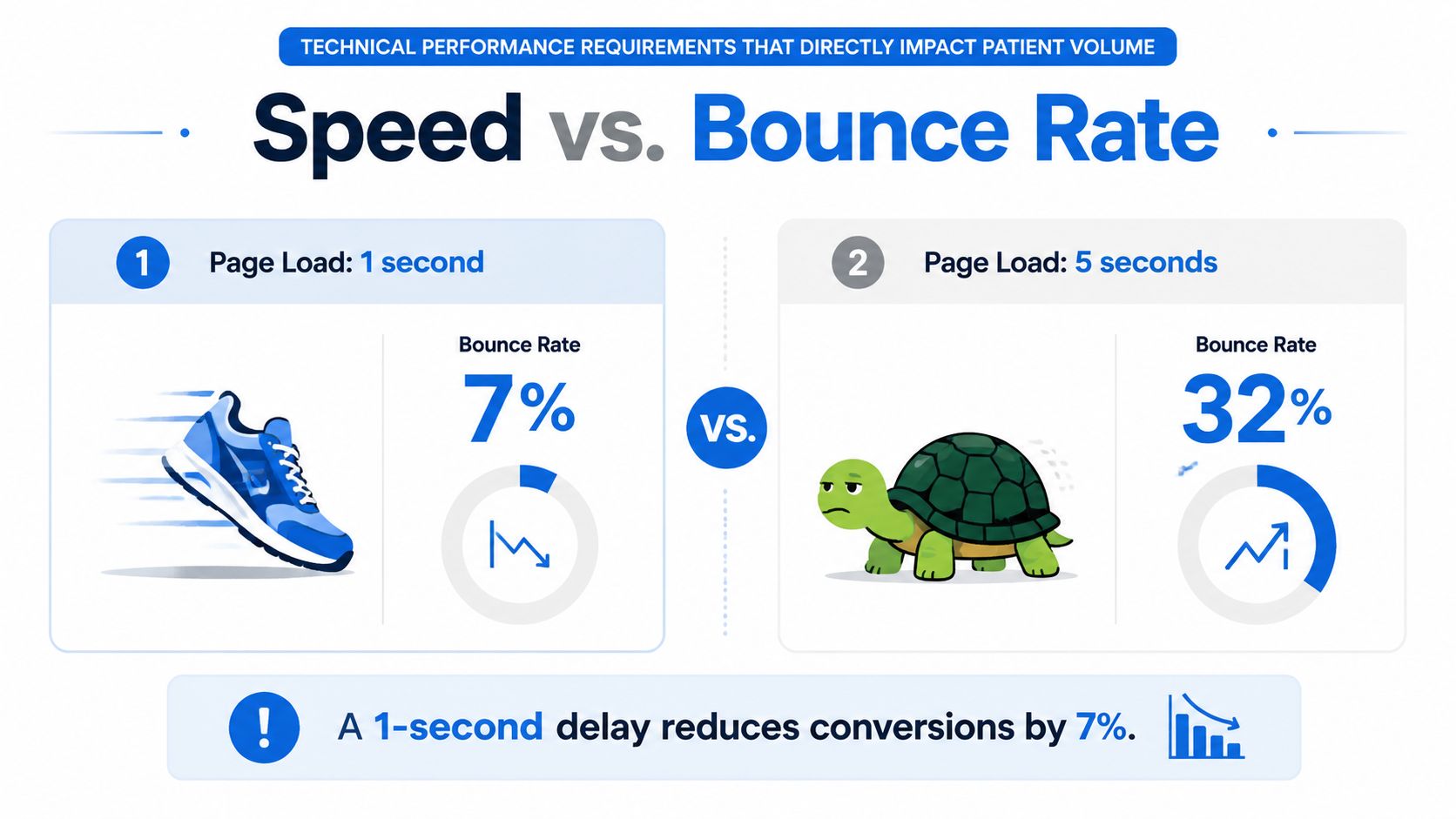
A visually rich site creates a technical challenge. Before-and-after galleries, treatment videos, provider photography, animation, and scheduling widgets can all slow the page if the build team treats them as decoration rather than functional components.
A 2026 industry benchmark reports that roughly 62% of med spa leads originate from mobile devices. In one cited dataset, mobile conversion was 2.4%, compared with 4.1% on desktop. (Mobile med spa website benchmarks) Those figures make responsive design a patient acquisition requirement. A phone visitor shouldn't need to pinch, zoom, hunt for the booking button, or wait for a large hero video to become usable.
Treat Core Web Vitals as design constraints
The same benchmark reports an average Largest Contentful Paint of 15.4 seconds for aesthetic treatment websites, compared with Google's 2.5-second passing threshold. (Performance data for medical spa WordPress sites) Whether the cause is oversized photography, blocking scripts, or an embedded booking tool, the result is the same. Visitors encounter delay before they can evaluate the practice.
The build process should address performance before launch:
- Compress visual assets: Serve appropriately sized WebP or AVIF images while preserving useful treatment detail.
- Prioritize above-the-fold content: Load the primary headline, trust signal, and booking action before secondary galleries and video.
- Control third-party scripts: Review chat tools, pixels, scheduling embeds, and animation libraries instead of adding them without testing.
- Test real devices: Evaluate small screens, ordinary mobile connections, and the complete booking flow, not just a desktop browser.
- Protect layout stability: Set image dimensions and avoid page elements shifting as content loads.
Technical performance also affects search visibility and user experience together. A page that loads quickly but has an unusable booking widget still loses patients. A beautiful gallery that loads slowly on a phone still fails the visitor who searched for a treatment nearby.
This mobile-optimized website service is relevant when the redesign must make speed, responsive layouts, and booking usability part of the same project rather than separate fixes.
Capturing Transactional Searches Through Local SEO and AI Optimization
A med spa website should be designed around the searches that indicate immediate commercial intent. “Botox near me,” “med spa in [city],” and “lip fillers near me” are more actionable than broad awareness queries because the searcher is already narrowing the provider choice.
Transactional Marketing uses this distinction as its operating idea. The business name reflects a focus on searches where someone is looking for a nearby provider and may be ready to spend, not only consume educational content. For a med spa, the website should support that intent with treatment pages, location relevance, clear contact information, and a direct path to consultation.
Google's local ranking system is commonly described through relevance, distance, and prominence. (Google Maps ranking factors explained) Website copy and treatment pages help establish relevance. Accurate location details and service-area information support local matching. Reviews, citations, brand references, and a maintained Google Business Profile contribute to the broader prominence picture.
Design for Maps and organic search together
A Google Business Profile should accurately reflect the practice name, address, phone number, categories, services, hours, photos, and booking destination. The website should reinforce the same information rather than creating conflicting versions of the business.
A location landing page can support local intent when it gives visitors useful information about the clinic, its providers, treatments, accessibility, and next steps. Treatment pages should use natural location references where relevant, but they shouldn't repeat city names mechanically or create near-identical pages.
Transactional Marketing provides local SEO for med spas as a service area that combines treatment-focused search strategy with Google Maps visibility and AI-driven content planning.
Prepare for AI-assisted discovery without abandoning Maps
Large language models can surface local businesses, but current reporting describes inconsistent results, including closed or mismatched businesses. Google Maps and Yelp remain more reliable sources for high-intent local discovery in many situations. (Comparison of LLM and traditional local search accuracy)
That doesn't make AI optimization optional. It changes the implementation. Publish clear, crawlable treatment information; keep provider and location details consistent; explain services in direct language; and organize content so an AI system can identify what the practice offers, where it operates, and how a patient can contact it. AI visibility should strengthen a well-maintained local presence, not replace the Google Maps foundation.
Navigating HIPAA Compliance and Accessibility in Lead Capture Design
Conversion advice often treats every form as a marketing form. Med spas need a sharper distinction. A form that asks for a name and preferred appointment time carries different risk from one that collects health history, medications, prior procedures, or treatment goals tied to medical information.
If a website collects health or treatment history, the practice needs a HIPAA-safe intake flow, not merely a polished embedded form. The form provider, hosting arrangement, data access, transmission method, storage process, and vendor agreements all deserve review by the clinic's compliance and legal teams. A marketing website shouldn't casually route sensitive information into an unapproved inbox or general-purpose spreadsheet.
Separate inquiry from clinical intake
Use a short consultation request for basic contact and scheduling intent. Then direct patients to a secure intake environment for information that requires stronger protection. Make the transition clear so patients know what information belongs in each step and why the practice is asking for it.
Before launch, verify that:
- Form vendors are appropriate: Review security practices and required contractual arrangements with the provider.
- Submissions are protected: Use encrypted transmission and restrict access to authorized staff.
- Embedded schedulers are evaluated: Confirm that third-party booking tools fit the clinic's privacy requirements.
- Consent is documented: Obtain appropriate consent for patient images, testimonials, and marketing communications.
- Retention is controlled: Define how long submitted information remains available and who can delete it.
Accessibility is another part of the service experience. ADA Title III claims increasingly treat public-facing clinic websites as part of access to services, so keyboard navigation, readable contrast, descriptive image text, form labels, focus states, captions, and clear error messages belong in the design review. Accessibility improvements often make booking easier for everyone, but the compliance rationale should remain explicit.
A secure form that users can't complete is still a failed conversion path. Test the page with keyboard navigation, assistive technology where possible, mobile users, and staff members who handle the submissions. Compliance shouldn't be pasted onto the site after the booking flow is finished.
Measuring Performance and Iterating for Continuous Conversion Growth
A launch creates a baseline, not proof of performance. Measure the path from treatment-page visit to completed consultation, attended appointment, and treatment opportunity. Visitor volume matters only when it produces qualified patient actions.
Track the funnel in stages:
- Consultation form start rate: Shows whether the page, offer, and call to action motivate visitors to begin.
- Form completion rate: Exposes friction, unclear questions, privacy concerns, and technical failures.
- Consultation show rate: Separates attractive analytics leads from appointments that occur.
- Consultation-to-treatment conversion rate: Connects acquisition work with the clinic's commercial result.
- Source by page: Identifies whether a treatment page, Google Business Profile, paid campaign, or organic query generated the inquiry.
Review results by treatment and source, not only across the entire site. A page can attract strong organic traffic while producing few consultations, while a lower-volume page may bring patients who attend and proceed to treatment. That distinction determines where design, local SEO, and intake improvements deserve attention.
Improve the highest-impact elements first
Fix blocked actions before polishing visual details. Test the booking widget on mobile, confirm that confirmation messages arrive, verify click-to-call tracking, and inspect forms for errors. Then test treatment-specific headlines, provider proof, pricing language, gallery placement, consultation prompts, and related-treatment links. Change one meaningful variable at a time when possible, and record the effect on completed consultations rather than relying on clicks alone.
Patient feedback explains objections that analytics cannot. Teams seeking structured visitor input can browse 7 feedback form tools and select a method that fits their privacy requirements and workflow. Do not request sensitive health information through a general feedback form unless the tool and process have been approved for that purpose.
Use a launch and maintenance checklist
Before publishing, confirm:
- Technical readiness: Mobile layouts, image performance, Core Web Vitals, redirects, metadata, structured content, and accessibility checks are complete.
- Booking readiness: Every primary CTA reaches the intended scheduler or consultation form, and staff can follow up.
- Compliance readiness: Intake tools, image consent, privacy language, access controls, and vendor arrangements have been reviewed.
- Local readiness: Business details match across the site and profile, service pages identify the correct location, and the Google Business Profile points to the correct booking path.
- Measurement readiness: Analytics, Search Console, call tracking, form events, and source attribution are working.
A performance dashboard for search and conversion reporting can combine rankings, traffic, calls, and lead activity for recurring reviews. Set an optimization meeting, inspect the funnel by treatment and source, and prioritize changes based on observed patient behavior. This connects transactional local SEO with conversion design and HIPAA-conscious intake decisions.
Transactional LLC builds and manages med spa websites around treatment-specific conversion paths, transactional local searches, Google Maps visibility, AI-driven content, and practical intake requirements. Visit Transactional LLC to discuss a med spa website design and local search strategy built to turn nearby treatment searches into qualified consultations.