


You search “roofer near me” after a storm, or “dentist near me” when a tooth starts hurting. Google shows a map, several businesses, review ratings, call buttons, hours, and directions. People don't study every listing. They choose from the businesses that look relevant, close, credible, and ready to help.
That's the commercial purpose behind Google Business Profile optimization. It turns a Google listing into a transactional storefront designed to attract searches from people who are ready to call, book, visit, or request an estimate. Transactional Marketing focuses on those high-intent searches, including “air conditioning repair near me,” “dentist near me,” and “roofer near me,” rather than vanity visibility that never produces a customer.
Understanding Google Business Profile Optimization
What is Google Business Profile optimization? It's the deliberate improvement of every editable part of a Google Business Profile so the listing can appear for relevant local searches, communicate trust, and make it easy for customers to take action in Google Search and Maps.
That includes the business name, primary category, secondary categories, description, services, hours, service area, appointment links, photos, posts, Q&A, attributes, and review activity. It also includes maintaining accurate information after the initial setup. Google's own Business Profile Performance guidance directs owners to measurable interactions such as calls, messages, direction requests, website clicks, and searches.
Traditional on-page SEO generally improves a website's visibility in standard blue-link results. GBP optimization works on a different search surface, the local pack and Google Maps. Google evaluates that surface through relevance, distance, and prominence, so a well-written website alone won't guarantee that a nearby service business appears among the map results.
A storefront with its own conversion path
A profile isn't just a directory entry. It has visual evidence, service information, customer feedback, questions and answers, posts, calls to action, and location data that searchers can review without visiting the website.
For a roofing company, the profile should quickly communicate that the business handles roof repair, inspections, storm damage, and emergency work. For a dental practice, it should make services, hours, appointment options, accessibility details, and patient experience easy to understand. Each field either helps Google interpret the business or helps a prospective customer decide whether to contact it.
The profile also supports AI-oriented discovery. Search systems and large language models need clear, consistent business information to understand what a company does, where it operates, and which customer needs it serves. That makes accurate categories, services, reviews, business descriptions, and operating details useful beyond traditional Maps rankings.
Practical rule: Optimize for the customer's next action, not for a checklist score.
Optimization is ongoing because Google can reassess a listing as the query, searcher location, competitors, reviews, and business information change. Owners who want a structured starting point can review this Google Business Profile setup resource, while practitioners who want deeper local-search process guidance can master local SEO with Data Hunters Agency.
Why GBP Optimization Matters for Local Service Businesses
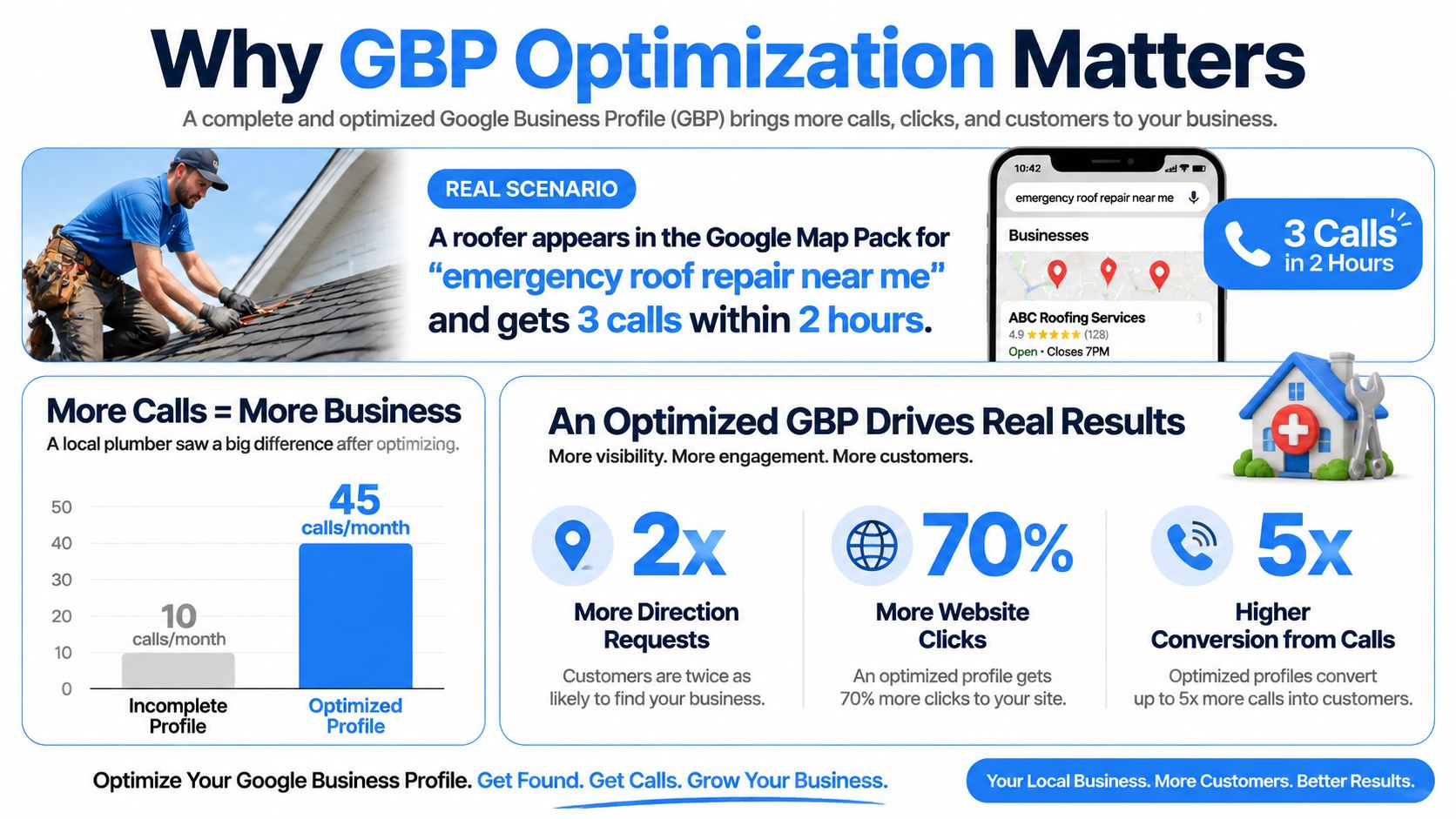
A local service customer often searches with a problem and a location attached. Someone typing “emergency roof repair near me” doesn't want a general roofing article. They want a company that can answer, explain availability, and send help. If one roofer appears prominently with a clear phone button, current hours, credible reviews, and relevant services, that business has a practical advantage over a competitor buried below the visible map results.
The same pattern applies in healthcare. A dental practice with accurate hours, a complete service menu, fresh interior and team photos, appointment options, and relevant attributes gives a new patient enough information to make a decision before visiting the practice website. The listing reduces uncertainty at the point where the patient is comparing providers.
Google says customers are 2.7 times more likely to view a business as reputable when they find a complete Business Profile, 70% more likely to visit, and 50% more likely to consider purchasing from businesses with a complete profile, as reported through Google's local-business guidance summarized by BrightLocal's local SEO statistics. Those figures don't mean every profile will produce the same result, but they show why completeness affects more than appearance.
Build the profile around the transaction
Start with the searches that indicate a customer is ready to act. A plumber may prioritize emergency plumbing, water heater repair, drain cleaning, and location-specific service terms. A dentist may focus on emergency dentistry, cosmetic dentistry, implants, or appointment-related searches, depending on the actual services offered.
Then align the profile:
- Service coverage: Add real services that match what the business delivers.
- Conversion access: Keep phone numbers, hours, booking links, and messaging options accurate.
- Trust evidence: Use real workplace, team, vehicle, treatment, or completed-job photos.
- Reputation activity: Request authentic reviews and respond professionally.
- Local relevance: Keep the service area and location details truthful.
A properly managed profile can function like a high-volume storefront. One recent benchmark cited by BrightLocal reports an average local SMB receives 1,009 searches per month through its profile, including 228 direct views and 781 discovery views. The exact opportunity varies by market, but the principle is consistent. A neglected listing can lose demand that already exists.
Businesses comparing local-search operating models can also review this resource on local SEO lead generation or explore how a local SEO agency in Berlin approaches location-based visibility.
The Three Ranking Factors Behind Every Local Result
Google says local results mainly depend on relevance, distance, and prominence. These factors are not separate switches. They interact whenever Google decides which businesses best answer a local query.
Relevance measures how closely the profile matches the search. A roofing business categorized and described around roofing services has a stronger basis for roofing searches than a profile using vague categories. The primary category matters most because it tells Google what the business is. Secondary categories and the services menu can widen coverage when they accurately represent the company's work.
Distance reflects the relationship between the searcher, the searched location, and the business. A profile can't rewrite its physical position to rank everywhere. Accurate service-area settings, address details, and hours help Google understand where and when the business can serve customers, but they don't eliminate geographic competition.
Prominence reflects how established and well-known the business appears online. Reviews, positive ratings, citations, links, and broader website authority contribute to that picture. The feature-level GBP ranking analysis from Search Atlas is useful because it frames optimization as a set of profile-level inputs rather than a keyword-stuffing exercise.
Match the action to the weakest factor
| Ranking Factor | Profile Inputs That Move It | Priority Action |
|---|---|---|
| Relevance | Primary category, secondary categories, services, description, attributes | Fix the primary category, then complete the services menu |
| Distance | Address, service area, location accuracy, operating hours | Make service coverage and location information truthful |
| Prominence | Reviews, review responses, citations, links, website authority | Build steady review activity, then improve citations |
When a profile is stuck, don't change everything at once. Start with the primary category, complete the services, build a consistent review process, and then expand relevant citations. That sequence helps isolate which change affects visibility and prevents random editing from becoming the operating strategy.
Google's explanation of local ranking factors from SearchScope reinforces the same framework. Businesses can use this local search ranking factors guide to organize audits around the signals Google describes.
Core Elements of a Fully Optimized Profile
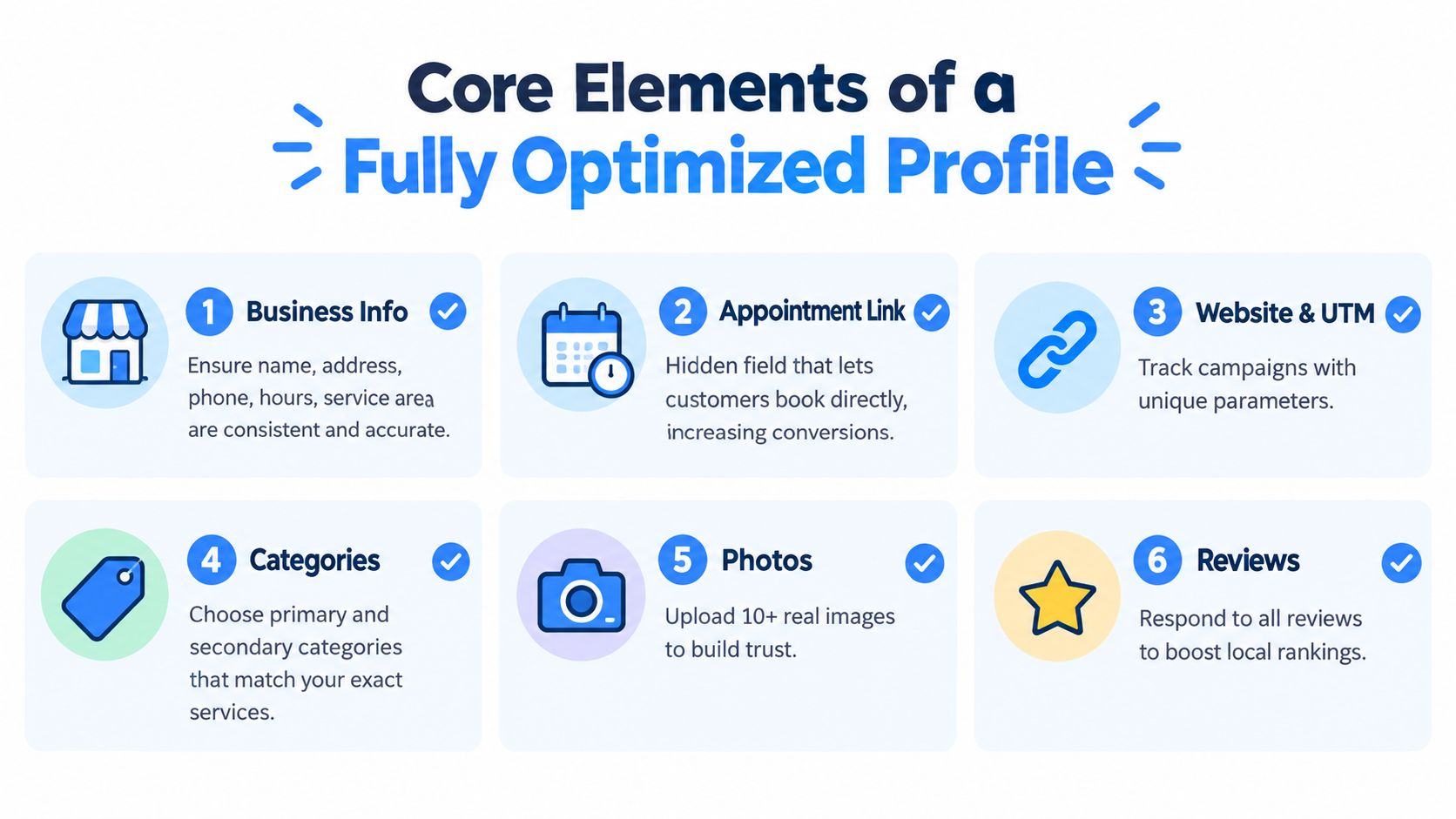
A strong profile gives a searcher enough information to choose the business without hunting through several pages. Start with the business information block. The name should reflect the world business name, while the phone, address, hours, website, and service area must agree with the business's actual operations.
A broken appointment link can waste a high-intent visitor. Incorrect Saturday hours can send a ready-to-buy customer to a competitor. For service-area businesses, inaccurate city coverage creates a mismatch between what the profile promises and where technicians can work.
Prioritize the fields that shape decisions
The primary category sets the basic context for the profile. A dental practice should select the category that best represents the practice itself, then use accurate secondary categories for legitimate specialties. A roofer should avoid choosing broad or unrelated categories because they sound commercially attractive.
The services menu is a separate opportunity. List actual offerings in customer language, such as emergency roof repair, roof inspection, furnace repair, root canal treatment, or teeth whitening. Write descriptions for humans first. Repeating a phrase unnaturally won't make a profile more trustworthy.
Photos should prove that the business exists and serves customers. Use the logo for identity, a cover image for presentation, and location-specific photos of the team, facility, vehicles, equipment, completed work, or patient environment. Stock imagery may look polished, but it rarely provides the same local evidence as real photos.
Posts can support timely communication about new services, seasonal work, availability, or useful updates. Attributes, such as accessibility, service options, or business ownership details, help customers filter choices when those attributes apply.
Make the listing easy to act on
Customers often skim for a few things first:
- Phone access: The number connects to the team that handles new inquiries.
- Availability: Hours and special hours reflect real staffing.
- Appointment path: The booking link opens correctly and works on mobile.
- Message response: Someone monitors and answers messages promptly.
- Recent proof: Reviews, photos, and posts show current activity.
- Clear ownership: Team or owner photos make the business feel identifiable.
A profile should support the exact transactional searches Transactional Marketing targets. Someone searching “air conditioning repair near me” needs immediate evidence that the company provides that service in the relevant area, not a generic description about customer satisfaction.
For a field-by-field process, use this Google Business Profile optimization checklist.
How Reviews, Categories, and Citations Move the Map Pack
Review volume is not a cosmetic trust badge. It contributes to prominence, gives customers evidence of recent activity, and supplies language that can help them understand the business's strengths. The useful objective isn't to manufacture positive feedback. It's to create a reliable process that invites authentic reviews after completed work or real appointments.
An independent study of 16,098 profiles found that top-three visibility rose from 39.3% for businesses with 1 to 5 reviews to 73.0% for businesses with 201 to 500 reviews, according to Localo's research on local SEO ranking factors. That association doesn't mean review count alone controls rankings, but it shows why a profile with a small, aging review base may struggle against an actively reviewed competitor.
The same study found that businesses using six secondary categories reached a 69.1% top-three rate in the analyzed sample. Secondary categories should still be accurate. Adding irrelevant categories can weaken relevance and create a poor customer experience.
Review operations matter more than bursts
A roofer can request a review after a completed repair, while a dental office can ask after an appointment or treatment milestone. The request should be easy to complete and should never require the customer to use specific wording. Owner responses should acknowledge the customer, address concerns calmly, and avoid copying the same sentence onto every review.
Citations support prominence when they consistently identify the same business. A roofing company should prioritize credible home-service and local directories, while a healthcare practice should maintain accurate listings in relevant healthcare and professional directories. A citation with a different phone number, old address, or altered business name can create uncertainty instead of authority.
| Signal | Profile Avg | Top 3 Map Pack Avg | Lift |
|---|---|---|---|
| Review count | 1 to 5 reviews | 201 to 500 reviews | Top-three visibility rose from 39.3% to 73.0% in the 16,098-profile study |
| Secondary categories | Fewer or varied category sets | Six secondary categories in the highest reported group | 69.1% top-three rate in the reported group |
The practical order is straightforward. Establish the right categories, earn reviews through genuine customer interactions, respond consistently, and clean up business information across important directories. Don't buy reviews, add unrelated categories, or treat citation quantity as a substitute for accuracy.
Measuring Results With Calls, Directions, and Conversions
Query visibility is useful, but it isn't a complete measurement system. Google's reporting increasingly emphasizes the most visible queries, while lower-volume searches may not appear clearly in profile or Search Console reporting. The profile can still generate valuable actions even when the exact search phrase is missing from the report.
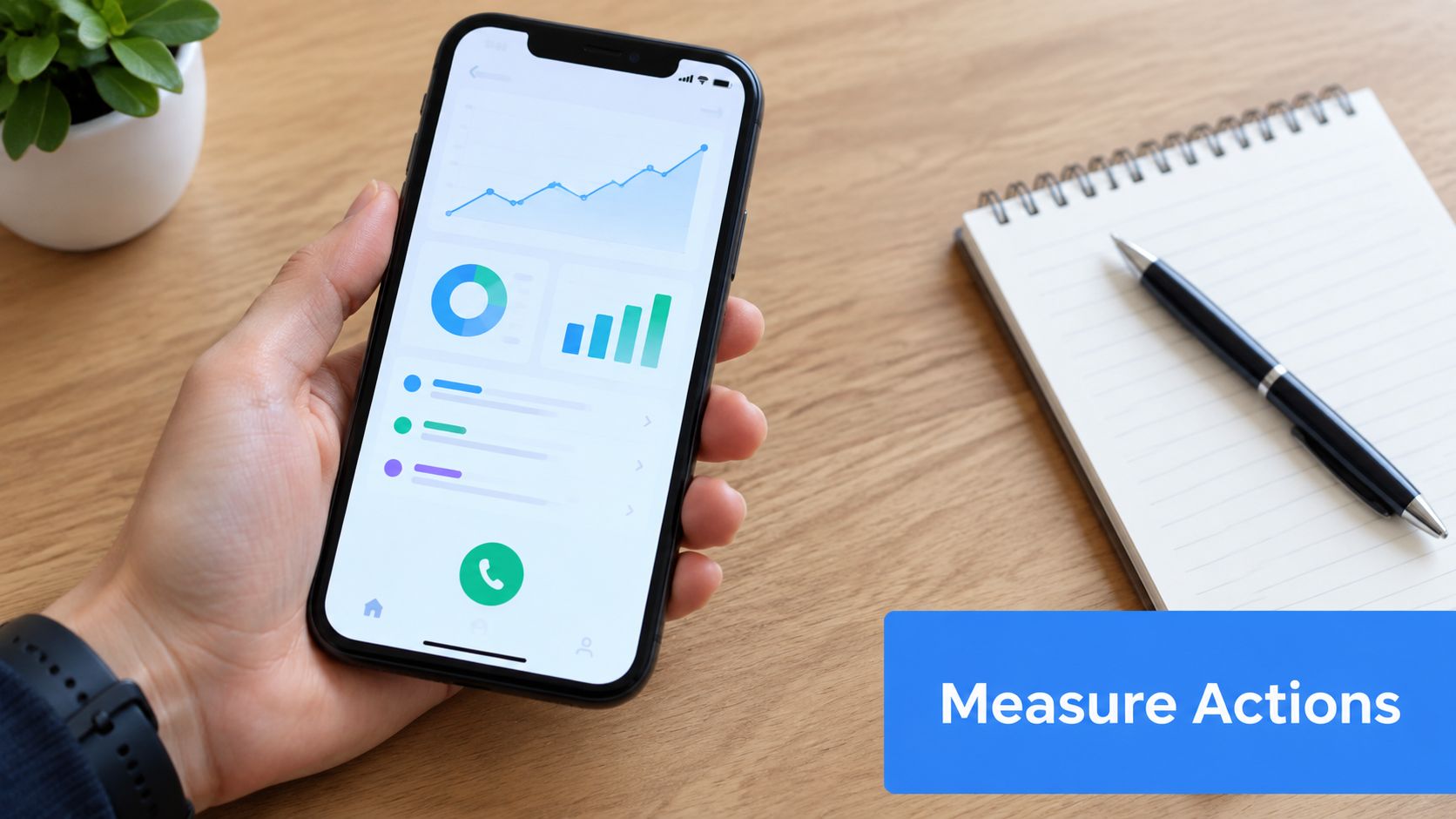
Start with the Google Business Profile Performance section. Track calls, messages, direction requests, website clicks, and searches as separate actions. A roofing business should compare those actions with completed inspections and booked repairs. A dental practice should connect calls and appointment requests with scheduled new-patient visits.
Build a measurement stack
Use several sources together:
- GBP Performance: Review calls, messages, directions, website clicks, and searches.
- Search Console: Compare site queries with the local-intent terms that bring people into the wider search journey.
- Call tracking: Separate map-driven calls from organic website traffic and paid campaigns.
- City-level rank checks: Monitor the actual service terms in the cities the business serves.
- Lead records: Mark whether each inquiry became an estimate, appointment, job, or patient.
Rank tracking should reflect transactional language, not only branded terms. For an HVAC company, that may include “air conditioning repair near me.” For a dentist, it may include “dentist near me.” For a roofer, it may include emergency repair and inspection terms.
A useful operating rhythm is to review changes over a 90-day period, while recognizing that different inputs mature at different speeds. Category edits may affect relevance sooner than citation cleanup. Review acquisition needs consistent activity before it becomes a meaningful prominence signal. Lead outcomes should remain the final test, because a ranking that produces no calls or bookings isn't a business result.
Common Mistakes That Keep Profiles Stuck Off the Map
Many owners assume that adding more information always improves a profile. It doesn't. Relevance depends on accuracy, and excessive or misleading information can make the listing less coherent.
Category stuffing is a common example. An HVAC company that selects a long list of unrelated categories may dilute the profile's central meaning. A roofer that lists cities it doesn't serve creates a service-area mismatch. A dental office that ignores reviews and Q&A leaves potential patients with unanswered concerns while competitors supply fresher evidence.
Fix the cause, not just the visible symptom
Inconsistent name, address, and phone details across the profile, website, and directories can make it harder for Google to connect every citation to the same business. Stale photos can make an active company look abandoned. Incorrect hours can suppress calls because customers assume nobody is available.
Ignored Q&A creates another avoidable problem. Customers may ask whether a roofer offers inspections, whether a dentist accepts a particular insurance plan, or whether a plumber handles weekend emergencies. The business should answer accurately instead of leaving the question to other users.
A quick self-audit can identify the highest-risk issues:
- Business name: Does it match the real-world name?
- Phone number: Does it route to the correct team?
- Hours: Are regular and special hours accurate?
- Address: Does the address match the website and major citations?
- Service area: Are listed cities served?
- Primary category: Does it describe the core business?
- Services: Are the main transactional services present?
- Photos: Do recent, real images represent the location or work?
- Reviews: Are recent reviews receiving professional responses?
- Links: Do the website, booking, and messaging paths work?
When several problems overlap, fix them in this order: inaccurate contact information and hours, wrong primary category, misleading service area, broken conversion links, missing services, review response gaps, then media and posting routines. Don't expect an overnight recovery. Google needs time to process corrections, observe ongoing activity, and reassess prominence.
The goal isn't to force a profile into a position through shortcuts. It's to make the business the clearest, most credible answer for transactional searches in its actual service area. That's how a listing moves from passive directory entry toward a reliable source of calls, bookings, and directions.
Transactional LLC offers Google Business Profile setup and optimization, Google Maps visibility work, industry-specific SEO, and AI-driven content planning for service businesses targeting searches such as “roofer near me,” “dentist near me,” and “air conditioning repair near me.” Visit Transactional LLC to review the local SEO and map optimization services available for turning high-intent searches into booked jobs and patients.