


Google still owns the starting line for local discovery. A 2026 industry summary found that 52% of U.S. consumers began their latest local business search on Google Search, while another 9% started on Google Maps. During the journey, 71% used Google, and 73% of initial queries happened on mobile. (eMarketer's local search summary)
That behavior defines effective local SEO lead generation. You aren't chasing generic traffic or vanity rankings. You're trying to make an HVAC company appear for “air conditioning repair near me,” a dentist appear for “dentist near me,” or a roofer appear when a homeowner is ready to call. The searcher has money in hand and a service problem to solve.
Transactional Marketing is built around that distinction. The work centers on Google Maps optimization, Google Business Profile management, service-city pages, conversion-focused websites, and AI optimization for the systems that increasingly summarize and recommend local businesses. Use the blueprint below to connect visibility with tracked calls, direction requests, booked appointments, and completed forms.
Why Local SEO Is the Transactional Lead Engine for Service Businesses
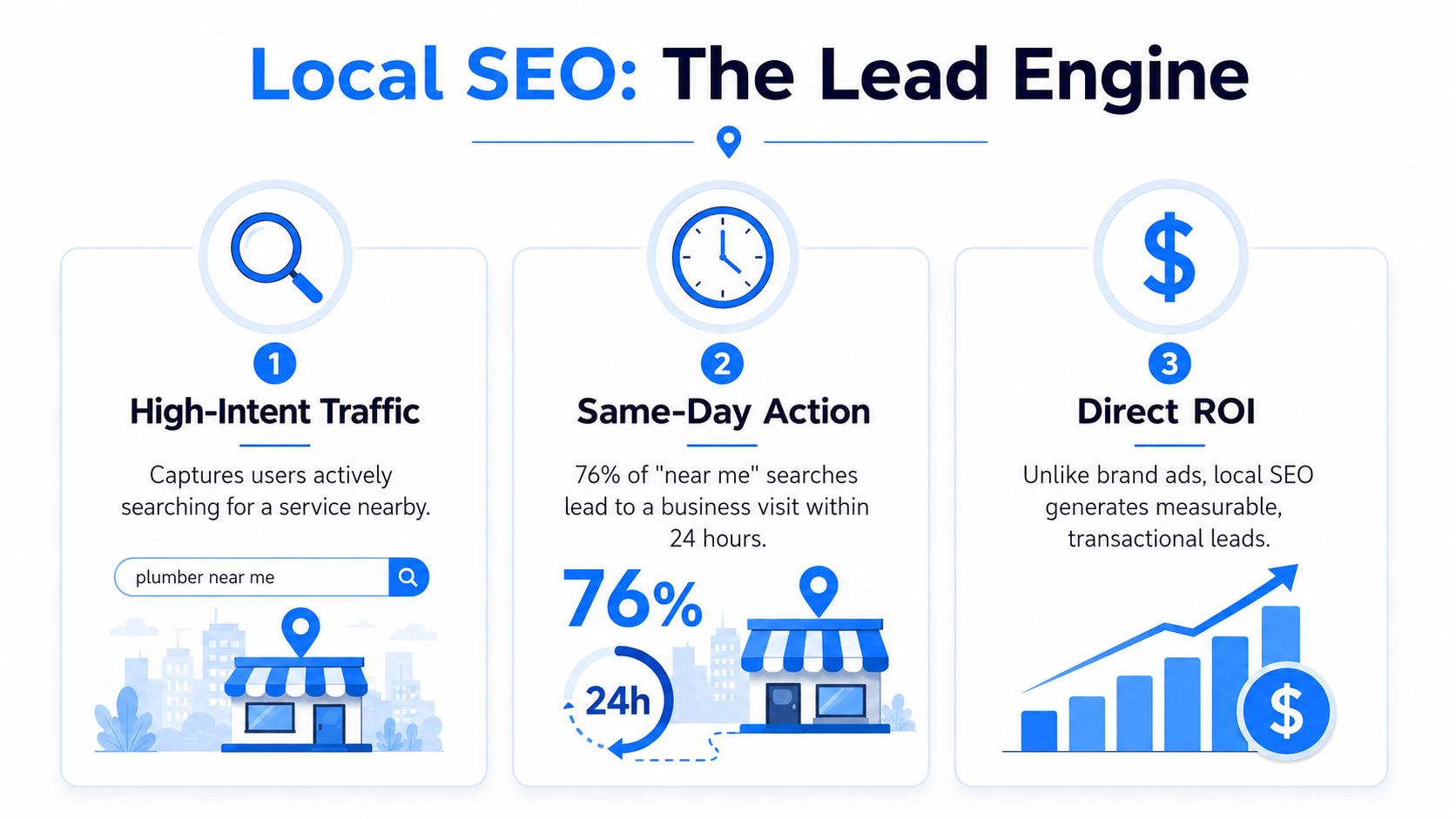
Local SEO works best as a direct-response channel, not a general branding exercise. A person searching for emergency plumbing, a walk-in dentist, or a pest control company nearby has already identified a need. Your job is to remove uncertainty and make the next action obvious.
Historical local-search reporting found that 88% of smartphone users who conduct a local search visit or call a store within 24 hours, while 78% of location-based mobile searches result in an offline purchase. The same reporting says 28% of local searches lead to a purchase, and nearly 46% of Google searches carry local intent. (HubSpot's local SEO statistics)
I separate transactional intent into three practical groups:
- Emergency now: “emergency water heater repair” or “bed bug exterminator near me.” These searches need a fast phone path, availability, and response information.
- Scheduled service: “same-day HVAC tune-up” or “roof inspection near me.” These visitors need a clear service page, booking option, and evidence of competence.
- Comparison shopping: “best dentist near me” or “roofing contractor in Austin.” These prospects need reviews, credentials, photos, transparent service details, and an easy quote request.
The nine-part operating plan is straightforward: presence audit, Google Business Profile build-out, service-city silos, on-site conversion optimization, reviews, links, AI Overview defense, measurement, and a 30-60-90 rollout. The only metrics that justify spending are top-three map visibility in the areas you serve, qualified calls, form fills, and booked work. Traffic matters only when it produces those outcomes.
For a broader look at turning local visibility into inquiries, review lead generation for local businesses. The principle is simple: optimize the search moment and the conversion path together.
Audit Your Local Search Presence Before You Touch Anything
Don't publish another service page until you know what Google and customers already see. A local presence audit should classify each asset as pass, fix, or rebuild across four groups: Google Business Profile, website, citations, and reviews.
Start with the profile. Check the primary and secondary categories, complete service menu, business description, hours, photos, attributes, Q&A, booking link, messaging, and website URL. A profile with an incorrect category or missing service details can't communicate relevance for high-intent searches, even if the company has a polished website.
On the site, inspect name, address, and phone consistency, title tags, city pages, LocalBusiness and service schema, mobile calls to action, and the relationship between each service and location page. Citation work comes next. Search for duplicate listings, wrong phone numbers, old addresses, and inconsistent business names across major platforms. A citation audit is useful only when it leads to cleanup, not when an agency sends a spreadsheet and stops there.
Reviews deserve their own diagnosis. The planning threshold is clear: fewer than 20 citations, review velocity below two reviews per month, or an average rating below 4.3 signals a problem that needs correction before aggressive content or link investment. These thresholds are operating benchmarks for triage, not Google requirements.
Use this scoring rubric before approving new work:
| Signal Group | What to Inspect | Pass Threshold | Rebuild Threshold |
|---|---|---|---|
| Google Business Profile | Categories, services, description, hours, photos, Q&A | Accurate, complete, and aligned with the core service | Wrong category, missing fields, duplicate, or suspended profile |
| On-site | NAP, title tags, city pages, schema, calls to action | Consistent identity and dedicated transactional pages | Conflicting NAP, thin pages, or no conversion path |
| Citations | Core platforms, directories, duplicates, old details | Consistent business data on relevant platforms | Repeated mismatches or uncontrolled duplicates |
| Reviews | Rating, recency, responses, service language | Recent authentic feedback and active responses | Rating below 4.3 or fewer than two new reviews monthly |
Use a dedicated Google Business Profile audit when the profile has changed hands, moved locations, or accumulated years of inconsistent information. Rebuilding a damaged foundation is usually cheaper than adding content to an unreliable entity.
Build a Google Business Profile That Wins the Map Pack
Google identifies relevance, distance, and prominence as the main local ranking factors. Relevance measures how well the profile matches the search, distance reflects the relationship between the searcher and business location, and prominence reflects how well-known the business is online and offline. Google also says that more reviews and positive ratings can help local ranking. (Google's explanation of local ranking)
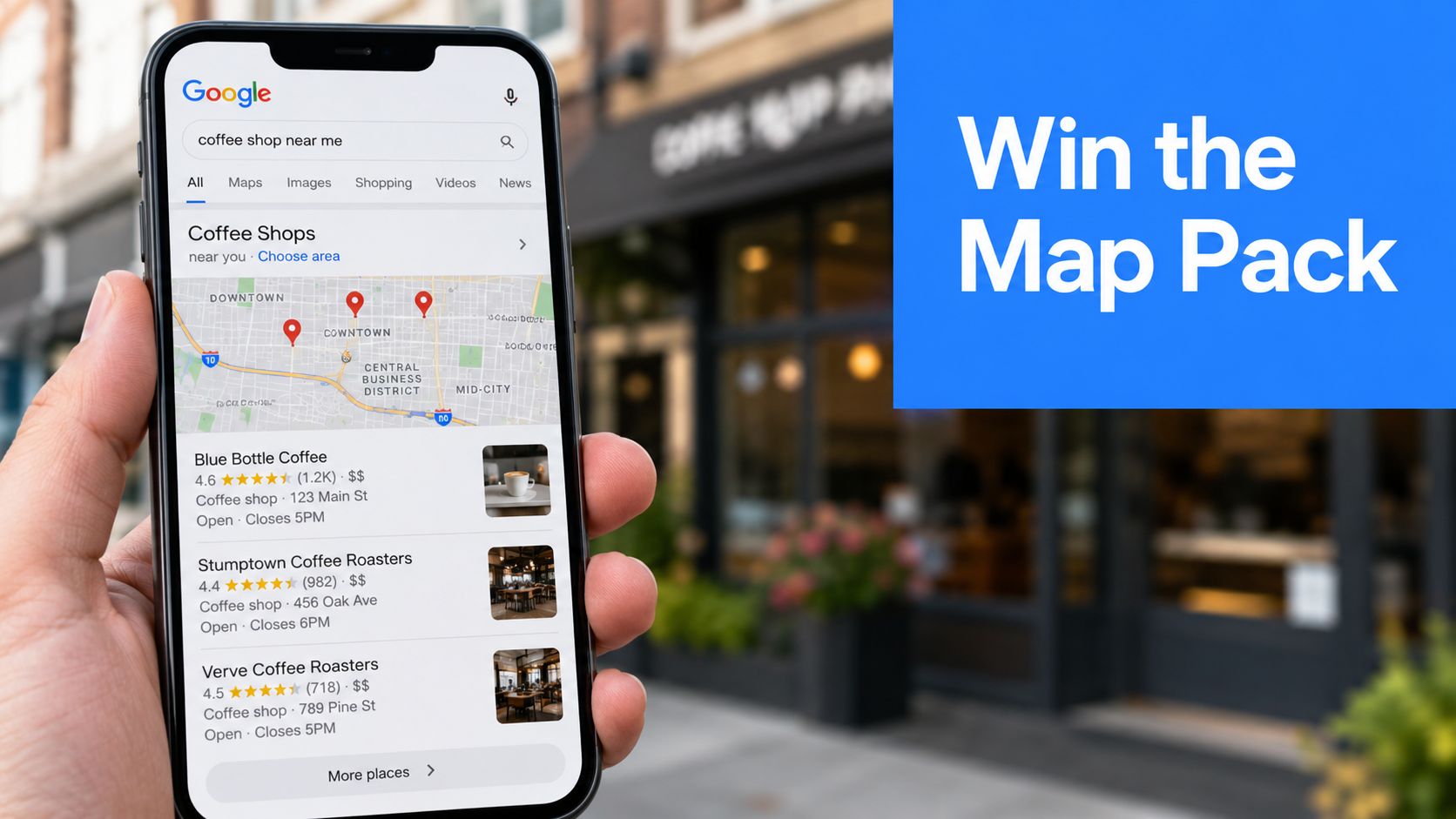
Build the profile in that order. Choose one primary category that matches the highest-value service, then add secondary categories only for genuine adjacencies. A pest control company shouldn't select every home-service category available. A dental practice should make its primary category reflect its core patient demand, then support legitimate specialties with secondary categories.
Complete the service menu with descriptions that mirror real transactional searches. “Air conditioning repair,” “emergency drain cleaning,” and “walk-in dental examination” communicate relevance more clearly than vague marketing language. Write the business description around the service, location, and customer outcome. Keep it specific and factual rather than stuffing city names.
Distance isn't something you can rewrite with keywords. It depends on the actual location and service-area configuration, so don't pretend a profile can rank equally everywhere. Prominence comes from reviews, credible mentions, links, customer photos, and a complete profile that earns engagement. Use accurate attributes, upload original work photos, answer buyer-focused Q&A, and connect messaging, booking, or other legitimate contact options.
Add UTM parameters to the website link and profile posts so analytics can separate profile traffic from other sources. Posts won't rescue a weak category or bad location, but they can support a profile that already gives searchers useful reasons to call.
The profile should function as a 24-hour lead capture asset. A mobile visitor needs one tap to call, request directions, book, or send a message. If the profile makes the buyer hunt for basic information, the ranking win won't become revenue.
Map Transactional Keywords to Service-City Content Silos
Generic service pages create weak local lead generation because they force one URL to compete for every service, city, and urgency level. Build a separate content silo for each core service, then pair that service with the cities, neighborhoods, and ZIP codes the crew can realistically reach.
Start with searches that indicate money-in-hand intent:
- Emergency intent: “emergency water heater repair” and “bed bug exterminator near me.”
- Scheduled intent: “same-day HVAC tune-up” and “walk-in dentist.”
- Diagnostic intent: “roof inspection near me” or “termite inspection in [city].”
Group close variants by the problem the buyer wants solved, not by superficial wording. “AC repair,” “air conditioning repair,” and “air conditioner service” may belong together when the page answers the same need. A maintenance page shouldn't compete against an emergency repair page only because both mention HVAC.
A practical silo contains one service hub and child pages for service areas:
- Hub: Air Conditioning Repair
- Child: Air Conditioning Repair in Phoenix
- Child: Air Conditioning Repair in Tempe
- Child: Air Conditioning Repair in Mesa
Use a title pattern such as Service in City | Brand. The H1, opening copy, FAQs, internal links, and schema should reinforce the same service-location relationship. Link each child page back to the service hub. Avoid indiscriminate sideways linking between city pages, which can blur topical focus and encourage cannibalization.
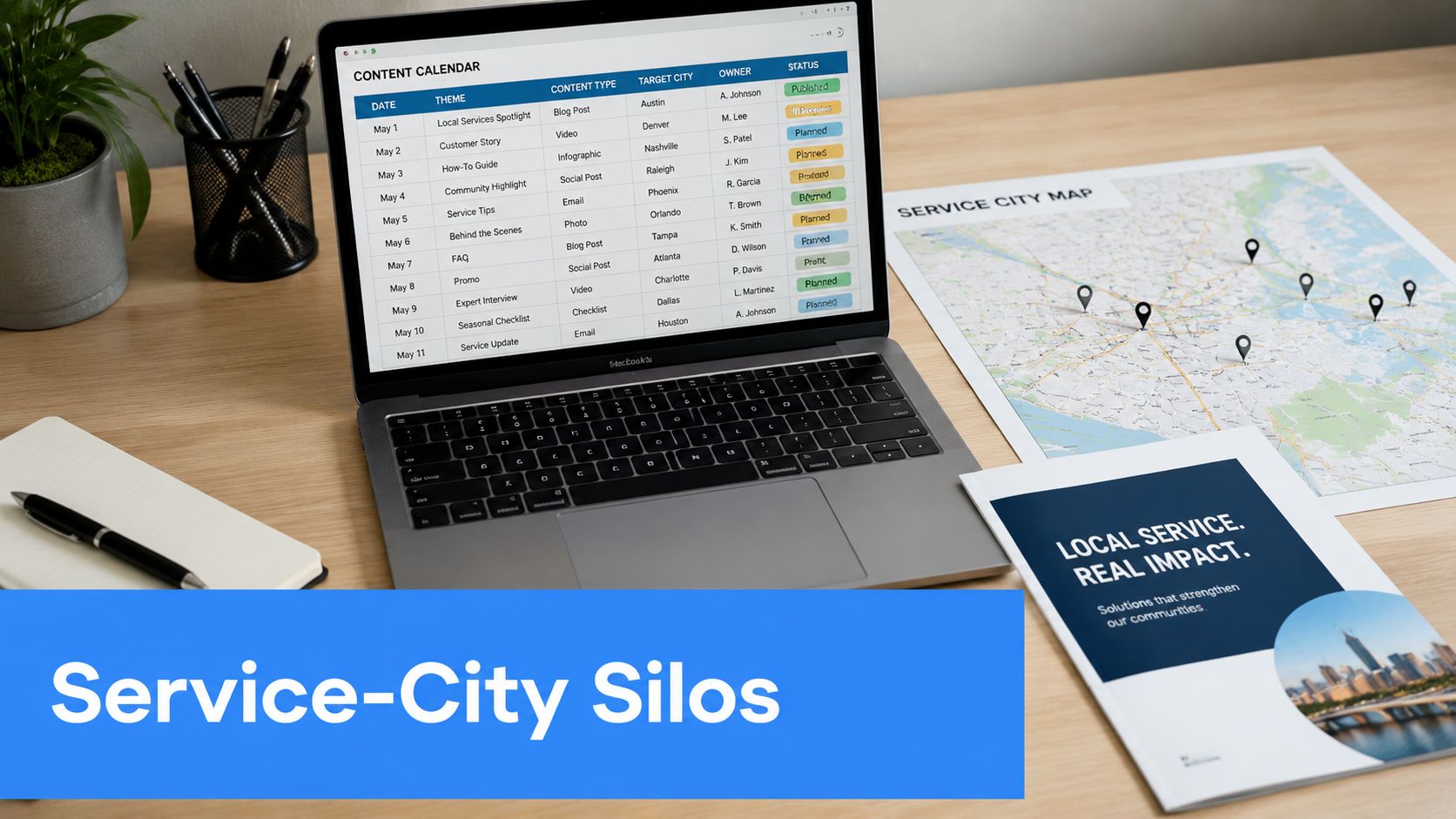
A structured keyword clustering process helps decide whether two queries deserve separate pages or one stronger asset. The test is commercial intent: would the same visitor expect the same service, urgency, proof, and call to action?
Turn the landing page into a sales instrument
A map listing earns attention. The service-city page earns the lead. Above the fold, place the city in the headline, a click-to-call button with a trackable number, and a direct offer tied to availability, such as “Call now, technician dispatched within two hours.” Only make a response-time promise the business can keep.
Continue with local proof:
- Credentials: Show licenses, insurance, certifications, and applicable guarantees.
- Relevant project evidence: Use original before-and-after photos from the service area.
- Customer validation: Feature three authentic local review excerpts where permission and policy allow.
- Contact choices: Add click-to-text, a short quote form, and live chat only when someone is available to answer.
Place a short four-field form midway through the page, after the visitor understands the service. Put a more detailed form after the trust block for buyers who want to provide project information. On mobile, use a sticky call button. Every element should answer the buyer's urgent questions: Can you help me here, how quickly can you arrive, and what happens after I contact you?
Don't build city pages for places the company doesn't serve. Thin location pages with swapped city names add little value and can damage trust when the page makes claims the business can't support. Local SEO lead generation depends on operational truth, not a large folder of nearly identical URLs.
Run a Reviews and Reputation System That Compounds
Reviews are a prominence asset and a conversion asset. They reassure the person comparing three HVAC companies, give a dental patient confidence before booking, and provide language that helps search systems understand the services customers associate with the business.
Request feedback immediately after a successful service interaction. Send a text or email while the technician is still on-site or immediately after the job ticket closes, using a short review link rather than forcing the customer through the profile. Staff can use a simple, honest script:
Practical rule: Ask every satisfied customer for an honest review, but never pressure anyone to provide a particular rating.
Don't gate reviews or offer rewards in exchange for positive feedback. A legitimate process asks for an authentic experience and makes the path easy. Respond to positive and negative reviews with the same care. Reference the service naturally when it fits, but don't stuff city names or keywords into every reply.
Negative feedback needs an operational response. Acknowledge the concern, move the detailed conversation offline, investigate the job, and post a public resolution when the matter is addressed. The customer doesn't need a defensive essay. They need evidence that a real person took ownership.
Track the operating signals that staff can influence:
- Request cadence: Monitor whether the team asks consistently after completed work.
- Freshness: Watch whether new reviews arrive regularly rather than in isolated bursts.
- Response rate: Record whether the owner or manager responds to every review.
- Customer media: Note the arrival of genuine customer-uploaded photos.
- Service language: Identify the services customers mention without asking them to use scripted wording.
Earn links that support local prominence
Links should reinforce the company's real-world presence. They aren't a generic authority score contest. Start with relationships that put the business in front of relevant local buyers, such as a community sponsorship, chamber contribution, property-management partnership, or referral arrangement with a non-competing realtor.
Industry associations and supplier partner pages can support a credible entity when the listing is accurate and editorially justified. For HVAC companies, a relevant trade association may be more useful than a random directory. Core business platforms such as Apple Maps, Yelp, BBB, Facebook, and Nextdoor deserve attention because customers use them and they can contribute to consistent business information.
A useful outreach email is short:
We recently completed a local [service] project and documented the work with before-and-after photos and practical notes. If your audience would find it useful, we'd be glad to provide the images and a concise guide for your resource page.
The linkable asset could be a photo-supported project summary or a neighborhood service-cost guide based on the company's actual work. Don't buy irrelevant links, automate mass submissions, or create pages solely to manipulate rankings. Review referring domains, anchor text, and newly acquired links in Ahrefs or Semrush, then investigate anything that looks unrelated, paid, or deceptive before considering removal or disavowal.
Win Visibility Inside AI Overviews and Map-Centric Results
AI search changes how customers discover local providers, but it doesn't eliminate the need for strong local fundamentals. A 2026 source reported that 40.16% of local business queries triggered AI Overviews, which makes complete entities, credible reviews, and clear service information more important as search interfaces evolve. (SEOPROFY's local SEO statistics)
Google's AI systems need consistent facts to connect a business with a service and area. Keep the business name, address, phone number, service radius, owner information, service pages, and review presence aligned. Add Service, AreaServed, and FAQPage schema to relevant city pages, publish an About page that identifies the business and service coverage, and embed a map that reflects the actual area served.
Map-centric layouts concentrate attention on the businesses that qualify for prominent local placement. Independent analyses discuss proximity as a major influence for many near-me searches, with one 2026 analysis estimating roughly 55% of local-pack influence for proximity and about 32% for Google Business Profile signals. Treat those figures as an analysis model, not an official Google weighting. (MBA Digital's Google Business Profile analysis)
Entity validation also comes from legitimate brand mentions in places such as Reddit, Quora, and trade forums. Participate helpfully, without manufacturing recommendations. For a related explanation of how search engines interpret video content and discoverability, see video SEO explained.
Fragmented NAP data, thin categories, missing photos, and vague service pages undermine both traditional local results and AI-generated recommendations. AI optimization starts with making the business easy to identify, verify, and describe.
Measure Lead Generation With Maps, Keywords, and Call Tracking
Rank reports based on one city-center keyword are poor evidence. Local rankings change across the service area, so use Local Falcon or BrightLocal to create a map-pack heatmap by grid point. A 5×5 grid view can expose areas where the business looks strong near its address but disappears across the outer service territory.
Call tracking connects those visibility patterns to revenue opportunities. CallRail and WhatConverts can assign dedicated numbers to the Google Business Profile landing page and main website, while dynamic number insertion can distinguish city-page visitors from other organic users. Set lead-quality rules with the client. For example, a team might qualify calls longer than 90 seconds for HVAC and 60 seconds for dental, based on the business's own sales process.
Separate the following in the reporting dashboard:
- Map visibility: Grid ranking by service and location.
- Lead source: Calls from GBP, organic pages, direct traffic, and other channels.
- Conversion activity: Form fills by service-city page, booked appointments, and qualified calls.
- Profile actions: GBP phone calls, website clicks, and direction requests.
- Economic outcome: Qualified leads per month and cost per lead compared with Google Ads.
Use the call tracking guide to define numbers, attribution rules, recordings, and privacy practices before the campaign begins. Search Console adds query and page data, but it shouldn't replace call and booking outcomes.
Execute the 30-60-90 rollout
Days 1-30 should cover the presence audit, GBP overhaul, tracking setup, and review-request launch. The owner supplies accurate business details and approves categories, services, and offers. The operator configures tracking and records the starting map heatmap. The KPI is a clean measurement baseline and a functioning review workflow.
Days 31-60 should focus on service-city landing pages, on-site conversion fixes, citation cleanup, and targeted local outreach. The owner provides real project photos, credentials, service boundaries, and sales answers. The operator publishes pages and removes contact friction. The KPI is qualified inquiry activity from the new assets.
Days 61-90 should add a review-velocity push, entity improvements for AI search, and the first performance review against heatmaps and call dashboards. Transactional LLC is one option for businesses seeking Google Maps management, service-city content, website support, and reporting in one operating relationship. The KPI is qualified leads per month, not impressions or visits.
A small team can execute this plan with a disciplined weekly schedule. Assign one owner to approvals, one operator to implementation, and one person to answer calls and forms quickly. Local SEO lead generation becomes predictable only when ranking work, conversion work, and follow-up work operate as one system.
Transactional LLC helps HVAC, plumbing, roofing, pest control, dental, and other service businesses improve Google Maps visibility, build transactional service-city pages, optimize websites for calls and forms, and measure qualified leads. Visit Transactional LLC to request an assessment of your map presence, local landing pages, and current lead-tracking setup.