


An HVAC PPC agency is worth hiring only when it proves booked-job economics, and most owners should expect first-month CPCs in the $15 to $30 range before optimization. The right benchmark isn't lead volume. It's the cost of a booked job and the offline revenue that follows.
You may be dealing with a familiar problem right now. The phones ring when the weather turns brutal, but your paid search report celebrates impressions, clicks, and “conversions” while your dispatch board tells a different story. Some calls are outside your service area, some prospects want free advice, and some leads never become appointments.
That's KPI theater. HVAC advertising is expensive because the searches are urgent and commercial. A 2024 benchmark placed average HVAC keyword CPC at $29.03, with a projected $32.77 in 2025, while another 176-city analysis reported an average of $20.12 and a median of $15.50. You can review the benchmark context in WebFX's HVAC marketing data.
Transactional Marketing is built around the searches that signal immediate buying intent, such as “AC repair near me,” “furnace repair,” and “air conditioning repair near me.” Those searches matter because the person searching usually isn't gathering general information. They want to call, book, or get a technician dispatched.
Why HVAC Search Behaves Like an Emergency Auction
HVAC search isn't a normal lead-generation channel. It behaves more like an emergency auction because a homeowner with no cooling or heat has a short decision window, and several contractors are bidding for the same urgent query.
Searches such as “no heat,” “AC repair near me,” and “furnace won't turn on” carry stronger transactional intent than informational searches about filter replacement or equipment maintenance. Google describes transactional local intent as the action stage, where users search to buy, book, call, or visit. SEOJuice's explanation of local search intent provides useful context for why phrases containing “near me,” “book,” “call,” or “same day” deserve separate campaign treatment.
Demand changes the auction
Weather creates abrupt shifts in buyer behavior. A heat wave can send homeowners searching for cooling repairs at the same time. A cold snap can push furnace and heat-pump searches into the auction. Equipment failures create the same pressure at the individual level, even when broad seasonal demand is stable.
The result is simple. The keyword, location, device, and hour all influence what a click costs. National HVAC Google Ads CPC has been reported around $9.12, while city-level averages in a 176-city analysis reached $20.12, and major competitive metros can reach $35 to $55 or more per click. Those ranges are documented in Webtonic's HVAC Google Ads statistics.
Practical rule: Treat emergency repair, planned replacement, maintenance, and installation as different businesses inside the same account.
A serious agency uses separate campaigns for those intents. It also watches search terms, device performance, hour-of-day patterns, and service-area proximity. Broad targeting during a weather event can burn through a monthly budget before a manager notices the problem.
Geography controls profitability
An HVAC contractor usually has a practical dispatch radius, not an unlimited market. A click from outside that area isn't valuable just because it became a form submission. Radius controls, location exclusions, city segmentation, and service-area landing pages keep the budget pointed at customers a technician can serve.
The agency you hire should explain how it will protect budget during demand spikes. Ask whether it can reduce exposure to low-value informational searches, shift budget toward emergency terms when dispatch capacity exists, and throttle campaigns when your phones or crews are already saturated.
What an HVAC PPC Agency Actually Does for You
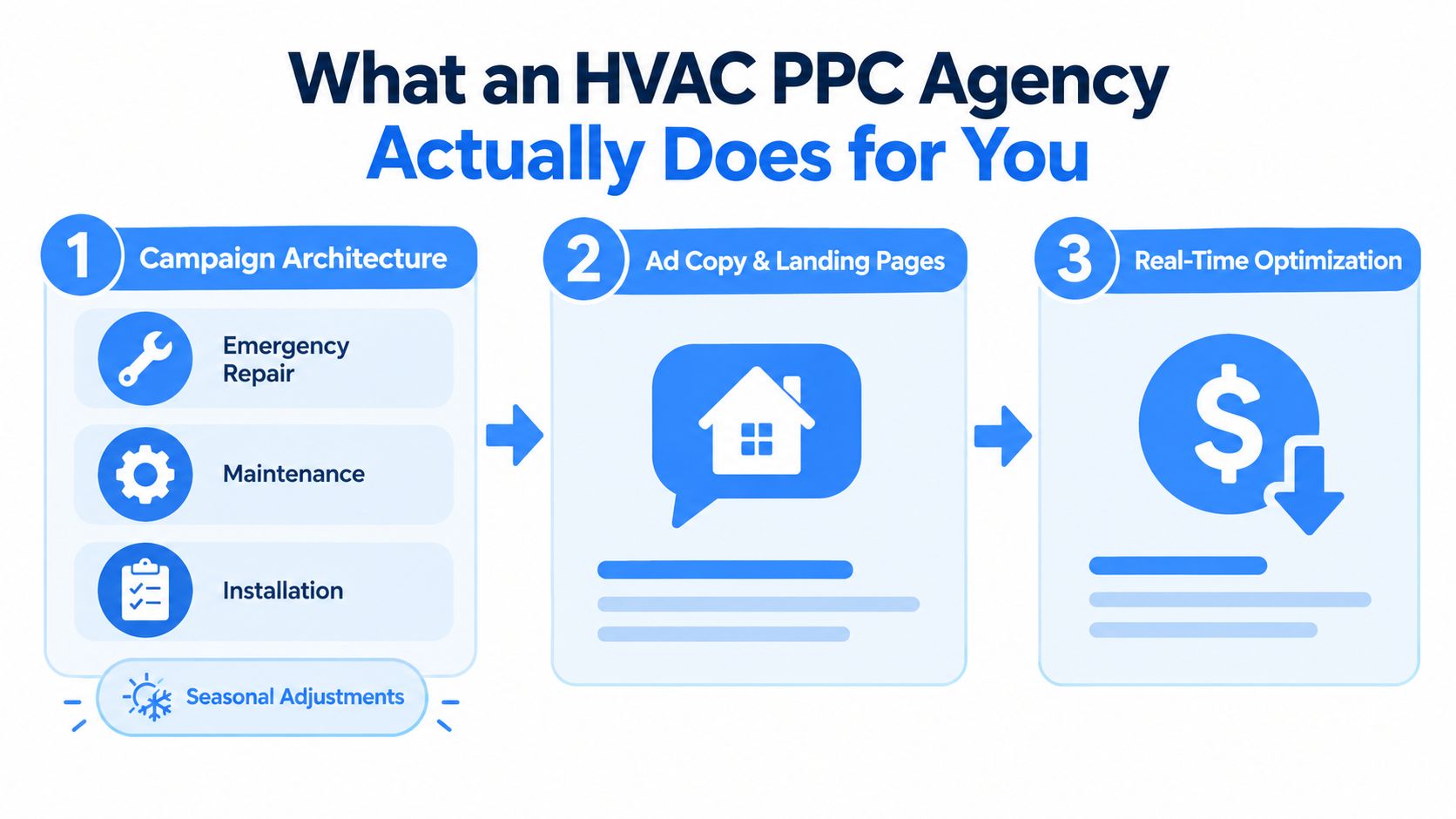
An HVAC PPC agency should perform three separate jobs: build the account correctly, manage the auction intelligently, and connect inquiries to booked work. If it only launches ads and emails a monthly click report, you're buying media administration, not performance management.
Campaign architecture comes first
The account should separate emergency repair, maintenance, installation, replacement, and seasonal tune-ups. Each campaign needs its own keywords, ad language, landing page, budget logic, and negative keyword list.
Negative keywords should filter terms related to DIY instructions, training, employment, parts, manuals, and areas you don't serve. A homeowner looking for instructions on repairing an air conditioner isn't equivalent to someone searching for same-day service. Combining both audiences gives an agency more data, but it gives you worse economics.
The agency should also match landing pages to the query. An emergency repair ad should lead to a page with a clear phone number and immediate service message. An installation campaign needs a different offer, different qualification questions, and a path for estimate requests.
Optimization requires judgment
Day to day, the manager should review search terms, call quality, device results, geographic performance, impression share on valuable queries, and budget pacing. Automated bidding can help, but it shouldn't replace HVAC knowledge. Rules that raise bids on every conversion may reward spam calls, duplicate forms, or low-value service areas.
Use the PPC ad management services from Transactional as a comparison point when evaluating the scope of management, reporting, and conversion tracking an agency offers. You can also review OrderBoosts SEO and reputation when your paid campaigns need stronger local trust signals around the same service area.
Lead qualification closes the loop
Call tracking, dynamic numbers, form routing, CRM tagging, and booked-job imports matter more than another ad variation. Google needs reliable conversion signals, and you need to know whether an inquiry became a scheduled repair, a replacement estimate, or nothing at all.
Many agencies fail. They report every call as a success even when the caller asks for a job in another city. Require recorded-call access where lawful, source-level CRM data, and a clear definition of “booked job.”
Here's a short visual explanation of how these responsibilities fit together:
Pricing Models HVAC Agencies Use and What Each Really Costs
HVAC owners usually encounter three pricing structures: a flat monthly retainer, a percentage of ad spend, or a hybrid performance arrangement. None is automatically good or bad. The contract is only sensible when the agency's compensation and reporting encourage profitable booked work.
A flat retainer is easy to budget, but it can create complacency after the initial build. A percentage model can encourage higher media spend because the agency earns more as the account grows. A hybrid can align incentives, but only if “booked job” has a precise definition that excludes unqualified forms and duplicate calls.
| Pricing Model | Typical Cost Range | Agency Incentive | Owner Risk |
|---|---|---|---|
| Flat monthly retainer | $1,500 to $4,000 for small-to-mid shops | Deliver a defined management service | The agency may protect the retainer without improving job economics |
| Percentage of ad spend | 10% to 20% of media budget | Increase or maintain media spend | You can pay more even when lead quality declines |
| Performance hybrid | Base fee plus per-booked-job bonuses | Improve tracked booking volume | Definitions, exclusions, and attribution can be manipulated |
These ranges are common pricing structures described in the supplied HVAC agency guidance, but they aren't a guarantee of what any particular agency will charge. Market competitiveness, account complexity, landing page work, tracking requirements, and service territory all affect the proposal.
Compare the math, not the sales pitch
Assume a $3,000 monthly ad budget. Under a flat retainer, your total outlay includes the media budget plus the agreed management fee. Under a percentage model, a 10% to 20% fee adds a variable amount to the same media budget. Under a hybrid, you might pay a base fee plus a bonus for each accepted booking.
The missing variable is the number of legitimate booked jobs. An agency can't prove profitability from pricing alone. It must show how each structure handles missed calls, cancellations, duplicate leads, out-of-area inquiries, and jobs that never close.
Don't accept a proposal that hides setup charges, landing page construction, tracking work, platform fees, or minimum commitments. Ask whether the account is month to month, whether ad spend passes through at cost, and whether you own the Google Ads account, landing pages, call data, and conversion history.
For another useful framework around lead acquisition economics, review Transactional's pay-per-lead approach. The important question isn't “Which fee is lowest?” It's “Which arrangement gives me clean data and a reason for the agency to improve booked-job quality?”
How PPC Complements Google Maps and Transactional SEO
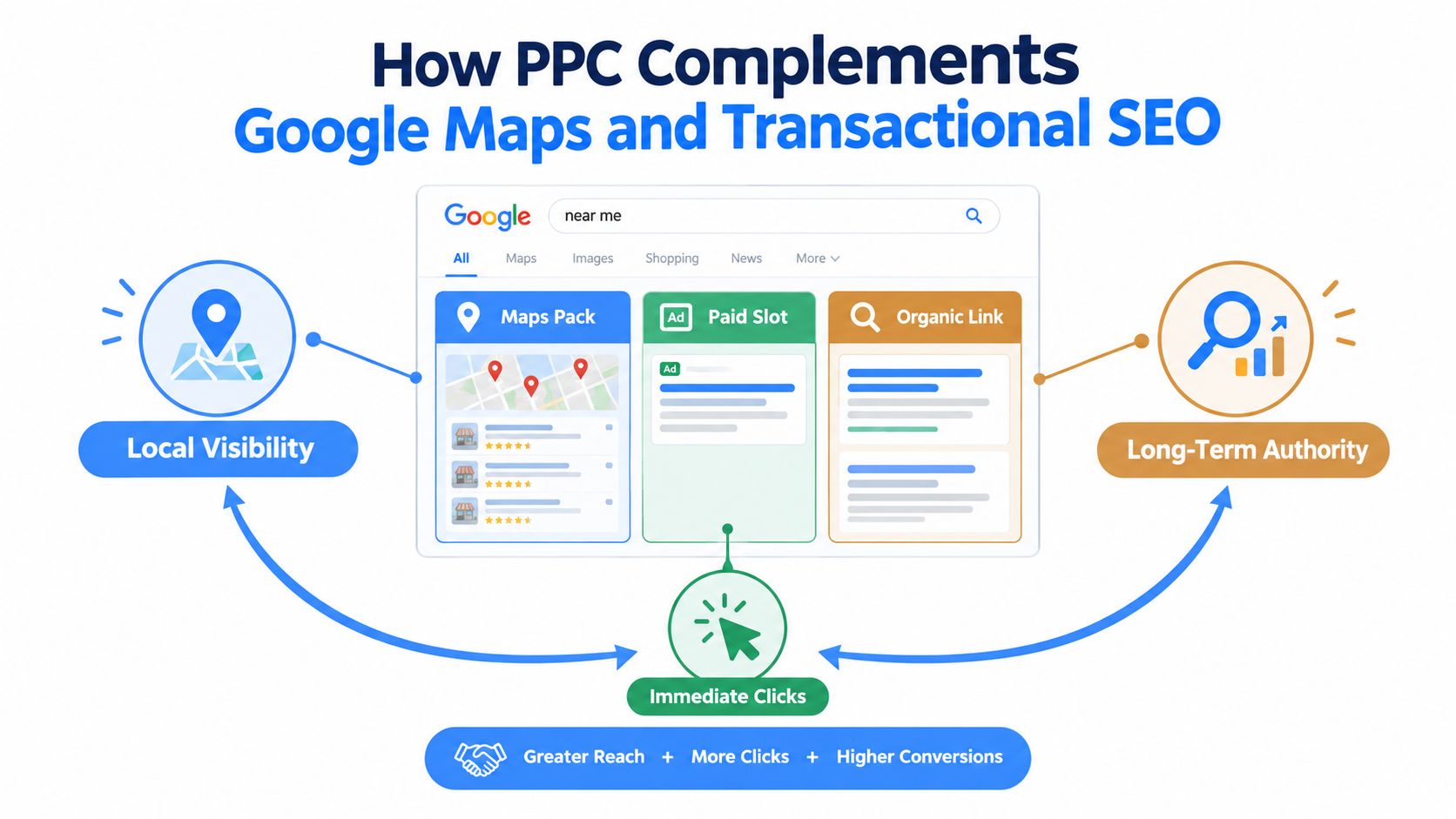
Paid search, Google Maps, organic pages, and AI-driven answers occupy different parts of the same customer journey. An HVAC owner shouldn't treat them as isolated channels because the buyer often sees several of them while searching for one urgent service.
Paid search creates immediate coverage
PPC can place your offer in front of a buyer before organic visibility has matured. That matters for a new service page, a newly expanded territory, or a seasonal campaign that needs demand quickly.
Google Local Services Ads add a different payment model. Google says LSAs help verified local providers get discovered, and HVAC advertisers generally pay when a prospect contacts the business by phone or message rather than for every click. Recent benchmark data reported roughly $51 CPL, a 44% book rate, and 9.55 times closed ROAS for LSAs. The same dataset reported blended HVAC search CPL around $104, with non-branded search near $149 and Performance Max around $72. The platform details are available through Google's Local Services Ads information.
Maps captures local trust
Google Business Profile signals influence local-pack visibility. A 2026 summary attributes 32% of local-pack weighting to GBP signals and identifies proximity, categories, and business-title keywords as important contributors in that model. See the Digital Applied local SEO statistics summary for the cited context.
PPC can't fix a weak profile. If your category, service area, phone number, reviews, and business information are inconsistent, paid traffic may arrive at a business listing that fails to reassure the buyer. A map result and paid listing can appear together, giving the contractor more opportunities to earn the call.
AI visibility needs useful local answers
AI Overviews and LLM-based search experiences are changing how customers discover service providers. An HVAC site should answer practical questions around no cool air, repair urgency, replacement decisions, pricing context, and service-area coverage in clear language. That content can support organic discovery and give search systems stronger evidence about your services.
PPC should still target transactional terms. SEO and AI optimization should make your company understandable and credible when a customer, search engine, or language model evaluates local options. Review Transactional's comparison of organic and paid search for a channel-level view of how these efforts work together.
KPIs That Separate Real Agencies from Lead-Pumps
The only honest primary KPI for an HVAC PPC engagement is cost per booked job, followed by the revenue those jobs produce. Clicks indicate traffic. Leads indicate contact activity. Neither proves that your technicians received profitable work.
Industry reporting places HVAC Google Ads conversion rates around 6.5%, compared with roughly 4.8% across all industries, while blended HVAC CPL is often around $104 and non-branded search can reach about $149. Those figures appear in Webtonic's heating and ventilation advertising benchmarks. They show why a blended account number can conceal very different economics by campaign type.
Build the report around revenue
Your agency should report search-term relevance, qualified-call rate, booking rate, booked-job cost, average ticket, and closed revenue. Impression share on high-value terms can help diagnose coverage, but it isn't a business outcome.
| Campaign Type | Typical CPL | Booking Rate | Cost Per Booked Job | Average Ticket |
|---|---|---|---|---|
| Local Services Ads | About $51 | 44% | Calculate from verified bookings | Not provided |
| Blended HVAC search | About $104 | Not provided | Calculate from verified bookings | Not provided |
| Branded search | About $34 | Not provided | Calculate from verified bookings | Not provided |
| Performance Max | About $72 | Not provided | Calculate from verified bookings | Not provided |
| Non-branded search | About $149 | Not provided | Calculate from verified bookings | Not provided |
The table uses only the supplied benchmark figures. It doesn't assign invented booking costs or ticket values where verified data isn't available. Your agency should calculate those values from your call recordings, CRM, dispatch system, and closed invoices.
Read emergency and replacement campaigns differently
Emergency repair campaigns can produce highly urgent calls, but the account still needs a fast answering process. Missed calls and delayed callbacks undermine the value of an expensive click.
Installation and replacement searches often require more qualification and a longer sales process. A form submission may be useful, but it isn't a booked install. Maintenance campaigns can behave differently again, with lower urgency and a stronger need for follow-up.
Use sales KPI examples for 2026 as a reference when deciding which sales stages belong in your dashboard. Then compare them with Transactional's customer acquisition metrics so your agency report reflects the full path from search term to revenue.
Revenue test: If the agency can't tell you which keywords generated booked work, it hasn't finished measuring the campaign.
Be suspicious of reports dominated by impressions, branded search lift, total leads, or click-through rate. Those figures may be useful diagnostics, but they shouldn't be presented as proof of profitability.
Vetting Checklist Before You Sign With an HVAC PPC Agency
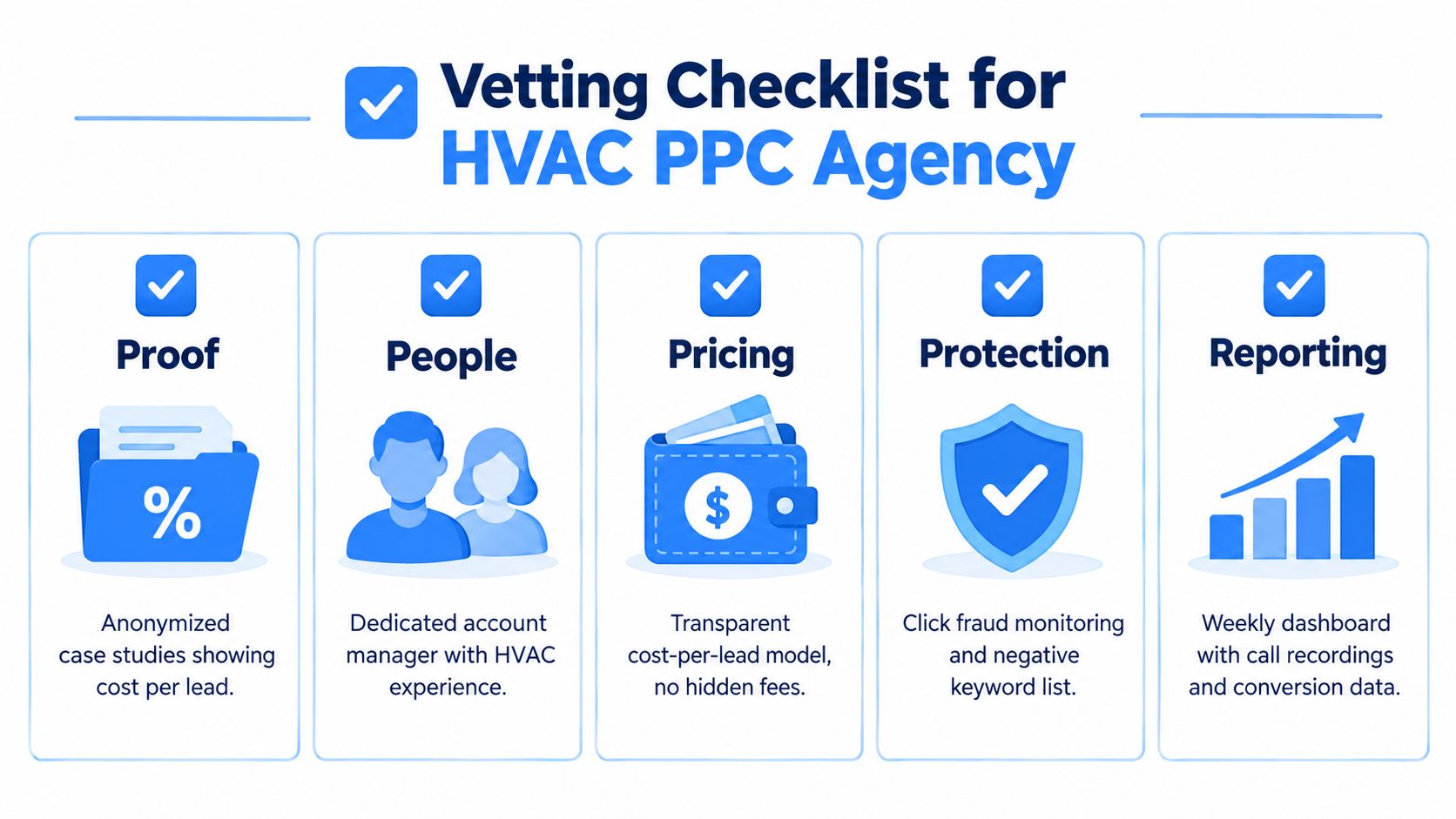
A good agency should make its process easy to audit before you sign. Use five filters: proof, people, pricing, protection, and reporting.
Proof and people
Demand anonymized examples showing cost per booked job by service type. A screenshot of a Google Ads dashboard isn't proof of revenue. Ask for call recordings, CRM exports, booking records, or another form of evidence that connects spend to actual appointments.
Find out who builds the account. A senior search marketer should own the initial architecture within 14 days, and the proposal should state how the team will manage negative keywords, responsive search ad testing, landing pages, and conversion imports.
Pricing and protection
Force the agency to explain whether it charges a flat fee, a percentage of media spend, or a hybrid. Require written treatment of setup work, landing pages, platform fees, minimum commitments, and cancellation rights.
You should own the ad account, website, landing pages, Google Business Profile, analytics, call recordings, and CRM data. Ask for a 30-day opt-out clause, and require caps on concurrent ad-spend commitments while the account is still being evaluated.
Reporting
A weekly readout should show booked jobs, qualified calls, missed calls, service categories, geographic performance, and revenue where available. You should have a live dashboard that lets you audit the data rather than waiting for a polished monthly PDF.
If the agency touches Search Console or organic reporting, confirm that historical data remains accessible when the relationship ends. Guidance on how agencies can preserve Search Console history for clients offers a useful standard for data ownership and continuity.
Ask these three questions before signing:
- Which exact event counts as a booked job, and how do you exclude spam, duplicates, cancellations, and out-of-area calls?
- Can I inspect the call recordings, CRM entries, search terms, and ad account without asking your team for permission?
- What will you change when cost per booked job rises during a weather event or seasonal surge?
A lead-pump usually answers with volume. A serious operator answers with definitions, evidence, and corrective actions.
Your 90-Day Plan to Launch and Judge the Engagement
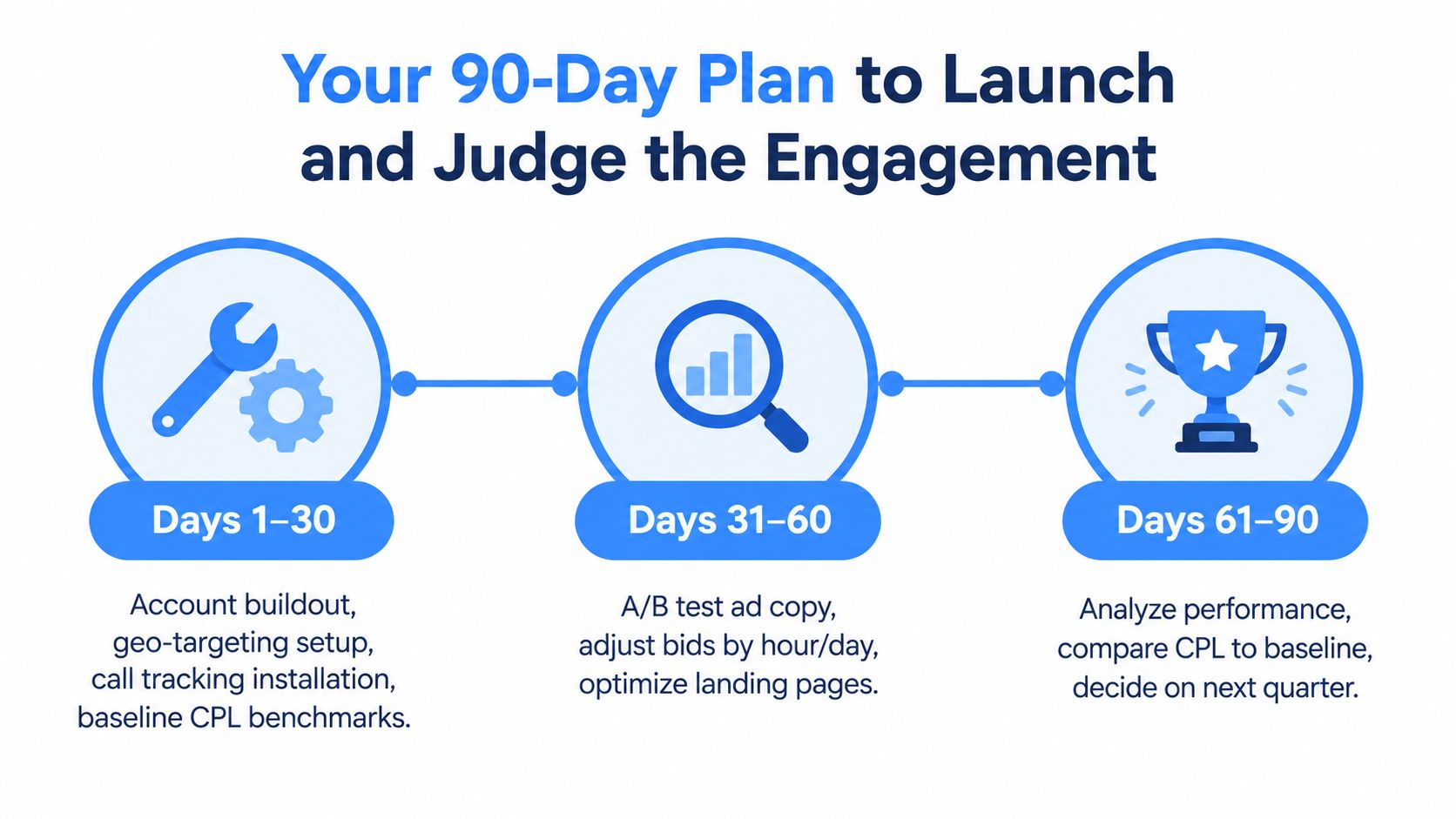
Treat the first 90 days as an evaluation window, not passive onboarding. The agency should earn the right to scale by proving that its tracking, targeting, and optimization decisions improve booked-job economics.
Days 1 to 30 build the foundation
The first month should include account access, campaign architecture, service-area targeting, negative keyword planning, landing page alignment, call tracking, form routing, and baseline CPL measurement. Expect learning-phase CPC inflation while the account collects usable data, but don't accept unexplained spending or conversion definitions.
Confirm that emergency repair, maintenance, installation, and replacement campaigns have separate goals. Make sure missed calls and after-hours inquiries enter a follow-up process rather than disappearing from the report.
Days 31 to 60 remove waste
The second phase should become more selective. The agency should tighten match types, review search terms, add negative keywords, adjust bids by hour and device, and test landing page messages against the intent behind each query.
Seasonal planning belongs here too. Recent HVAC guidance reports that peak heating and cooling periods can inflate CPCs by 20% to 40%, and recommends increasing budgets 30 to 45 days before peak demand. Those figures are discussed in SureShot Systems' HVAC marketing guidance.
Days 61 to 90 decide with closed data
By the third phase, calculate cost per booked job and compare it with your strongest alternative channel. Separate branded, non-branded, local-intent, LSA, maintenance, repair, and installation performance. Decide whether to scale, restructure, or exit.
Keep the agency only if booked-job economics beat the next-best channel after three full billing cycles. If the team resists granular reporting during that period, don't extend the contract to give it more time. Transactional Marketing helps local service businesses connect paid campaigns with transactional search terms, Google Maps visibility, SEO, and lead tracking. Visit Transactional LLC to discuss a campaign built around booked HVAC work rather than vanity metrics.