

The highest-value local lead often comes from the shortest search query. Someone typing “roofer near me,” “dentist near me,” or “air conditioning repair near me” usually isn't browsing for a marketing lesson. They're looking for a provider who can solve a problem, answer the phone, and take payment.
That intent is why organic visibility matters. A widely cited 2026 click-through-rate benchmark reports that the first organic result averages 27% CTR, compared with 15.6% for position two and 10.4% for position three. On 10,000 impressions, that difference represents roughly 2,700 visits at position one, versus 1,560 at position two and 1,040 at position three. For a local service company, those visits can reach a service page, a contact form, or a phone number before the searcher ever considers an ad.
Transactional Marketing is built around that moment. The business name says exactly what the strategy targets, transactional search terms, especially local queries from people with money in hand and a service problem to solve.
Why Organic Lead Generation Wins for Local Service Businesses
A paid ad can put a roofer in front of a searcher, but it can't create the need for a new roof. Organic lead generation works because the customer creates the demand first, then searches for a provider. That distinction matters for plumbers, dentists, roofers, HVAC shops, pest control companies, and every other local business that depends on calls.
Search intent separates a useful visitor from an expensive distraction. “How to fix a leaky faucet” may attract someone determined to do the work themselves. “Water heater repair Mesa” points to a person identifying a problem and looking for help. “Emergency dentist Tampa” signals urgency. “AC tune-up near me” indicates a service decision, not casual research.
Operator rule: Rank for the phrase that describes the job the customer wants to buy, not the topic they might read about someday.
Google remains the central organic discovery channel for local demand, and the economics are clear. A 2026 Ruler Analytics summary reports that 43% of respondents identified organic search as their best lead-generation source, while 27% of marketers said organic search generates the most leads. The same reporting cites a 14.6% close rate for SEO-generated leads compared with 1.7% for outbound leads such as direct mail or print advertising.
Those figures don't mean every local campaign will produce identical results. They do show why intent-driven search deserves priority. A searcher has already named the service, often named the city, and sometimes added an urgency modifier such as “open now” or “emergency.” Your job is to be visible and easy to contact at that exact point.
Organic visibility also builds an asset. A useful service page, a properly managed profile, a legitimate review, and a relevant local reference can continue supporting discovery after publication. Paid campaigns stop producing traffic when the budget stops. SEO still requires maintenance, but the work can accumulate instead of resetting every morning.
Transactional Marketing's approach is deliberately narrow. It doesn't combine roofing, dentistry, HVAC, and every other industry into one generic content plan. A roofing company needs roofing service-and-city pages. A dental practice needs dental treatment and location pages. One vertical, one market, one set of transactional terms, and one conversion path.
What Organic Lead Generation Actually Means
Organic lead generation is the process of attracting unpaid visitors from search engines and online maps, then turning those visitors into calls, form submissions, appointments, or booked jobs. For a local service business, the strongest version usually starts with a query that includes the service and the location.
Compare two searches:
- Informational intent: “how to fix a leaky faucet”
- Transactional intent: “plumber near me open now”
The first search may lead to an article. The second can lead directly to a call. Transactional Marketing focuses on the second category because it reflects a customer who is actively evaluating providers and may need service immediately.
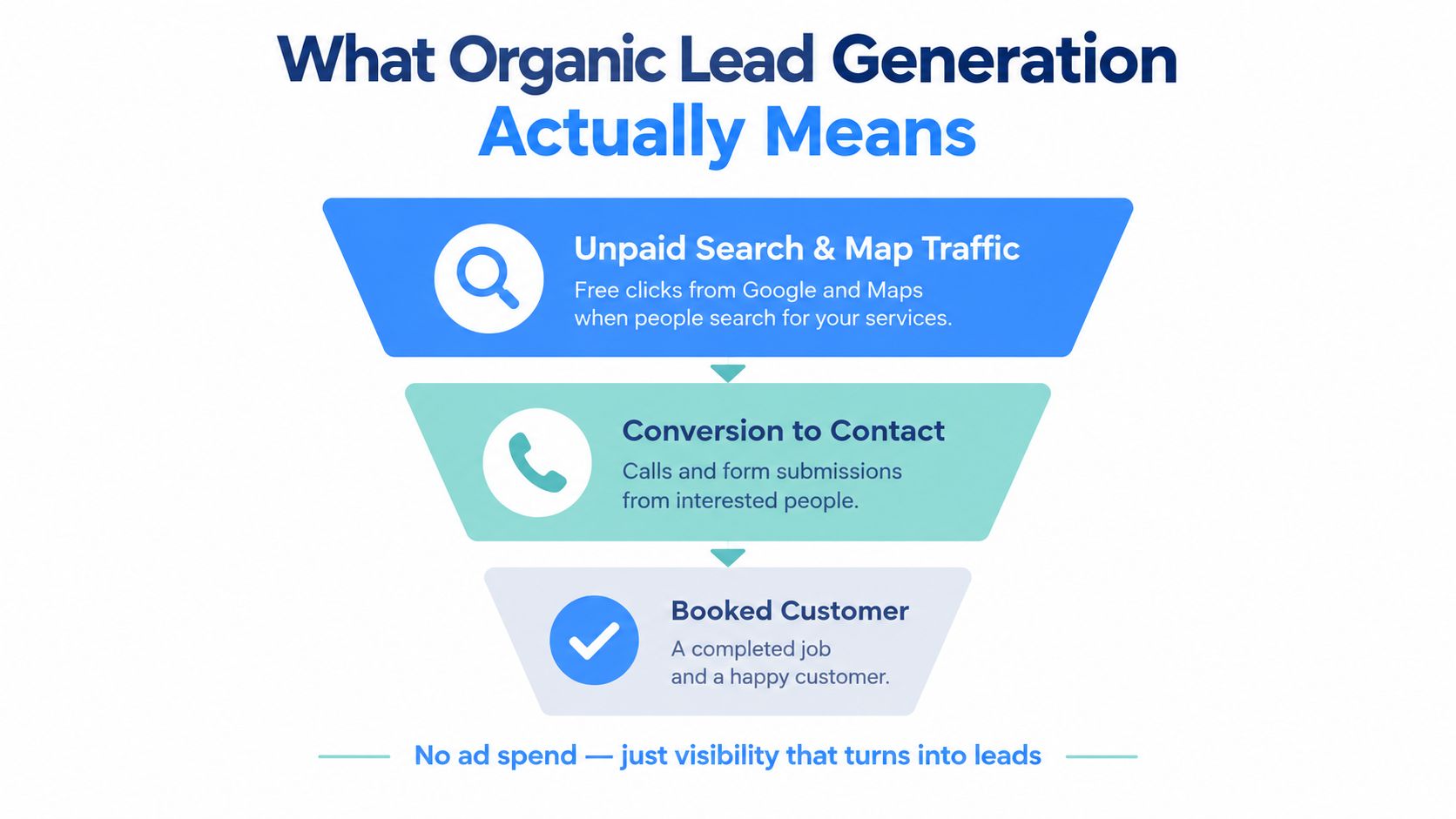
Organic traffic differs from paid, social, and referral traffic in how the customer arrives. Paid search buys placement for a defined budget. Social content interrupts a feed and depends on attention. Referrals rely on another person remembering to recommend you. Organic search captures a customer who has already expressed a problem or purchase need through the query.
The conversion advantage comes from self-selection. The searcher has identified a service, accepted Google as a way to find providers, and reached your listing or page at the moment of need. A 2026 conversion benchmark reports organic conversion rates of 2% to 4% when content closely matches search intent. Its dataset reports organic search at 4.9% overall, with 8.1% for Professional Services, 7.3% for Legal, and 5.7% for Automotive.
That same benchmark cites approximately $34 per lead for SEO and organic traffic, compared with $85 for Google Ads Search. Treat those figures as benchmarks, not promises. The practical lesson is more important than the exact comparison: a well-built organic funnel can reduce dependence on per-click acquisition when the page answers the right local need and makes calling easy.
The one metric that matters is not traffic by itself. It's whether a qualified visitor becomes a conversation, an appointment, or a booked job.
The Six Channels That Drive Local Leads
Local lead generation has six working parts. They don't deserve equal attention, and a business shouldn't spread its budget evenly across them. For most service companies, Google Business Profile and Maps visibility come first, followed by service-city content and reviews.
Google says Business Profile insights include views, searches, and actions from both organic Search and Google Ads, so local operators should evaluate listing activity alongside website traffic rather than treating Maps as a separate universe. A practical guide to finding an ant control service near me also illustrates the kind of service-and-location relevance that makes a local page useful to a buyer.
| Rank | Channel | Typical Call Lift | Time to Results | Compounding Value |
|---|---|---|---|---|
| 1 | Google Business Profile and Maps Pack | High when visibility and listing engagement improve | Medium | High |
| 2 | Service-city content | High for tightly matched transactional queries | Medium | High |
| 2 | Reviews and review management | High when trust and listing activity improve | Medium | High |
| 4 | Local SEO authority | Moderate as relevance and prominence strengthen | Medium to long | High |
| 5 | Referral partnerships | Moderate and dependent on partner activity | Short to medium | Medium |
| 6 | On-site conversion optimization | High when existing traffic is qualified | Short | High |
1. Google Business Profile and Maps
The profile needs accurate categories, services, hours, service areas, photos, and contact information. Maps visibility often produces the shortest route from search to phone call because the call button sits directly beside the business information.
2. Service-city content
A page targeting “HVAC repair in Mesa” has a job to do. It should explain the service, establish local relevance, show proof, and make calling immediate. Generic blog traffic isn't a substitute for pages built around the actual work customers buy.
3. Reviews
Reviews support trust and give customers evidence that the business serves people like them. The request process should run after completed jobs, with responses that address the service provided without manufacturing customer language.
4. Local authority
Citations, locally relevant links, sponsorships, and trade associations help reinforce prominence. They won't rescue a weak service page or incomplete profile, but they can strengthen a focused campaign.
5. Referral partnerships
Realtors, property managers, restoration companies, and complementary trades can send qualified customers. Build real relationships, not artificial link exchanges.
6. Conversion optimization
A ranking is wasted if the visitor can't find the phone number, the form asks too many questions, or nobody answers. The local lead generation framework from Transactional Marketing treats rankings and conversion handling as one operating system.
Ranking in the Google Maps Top Three
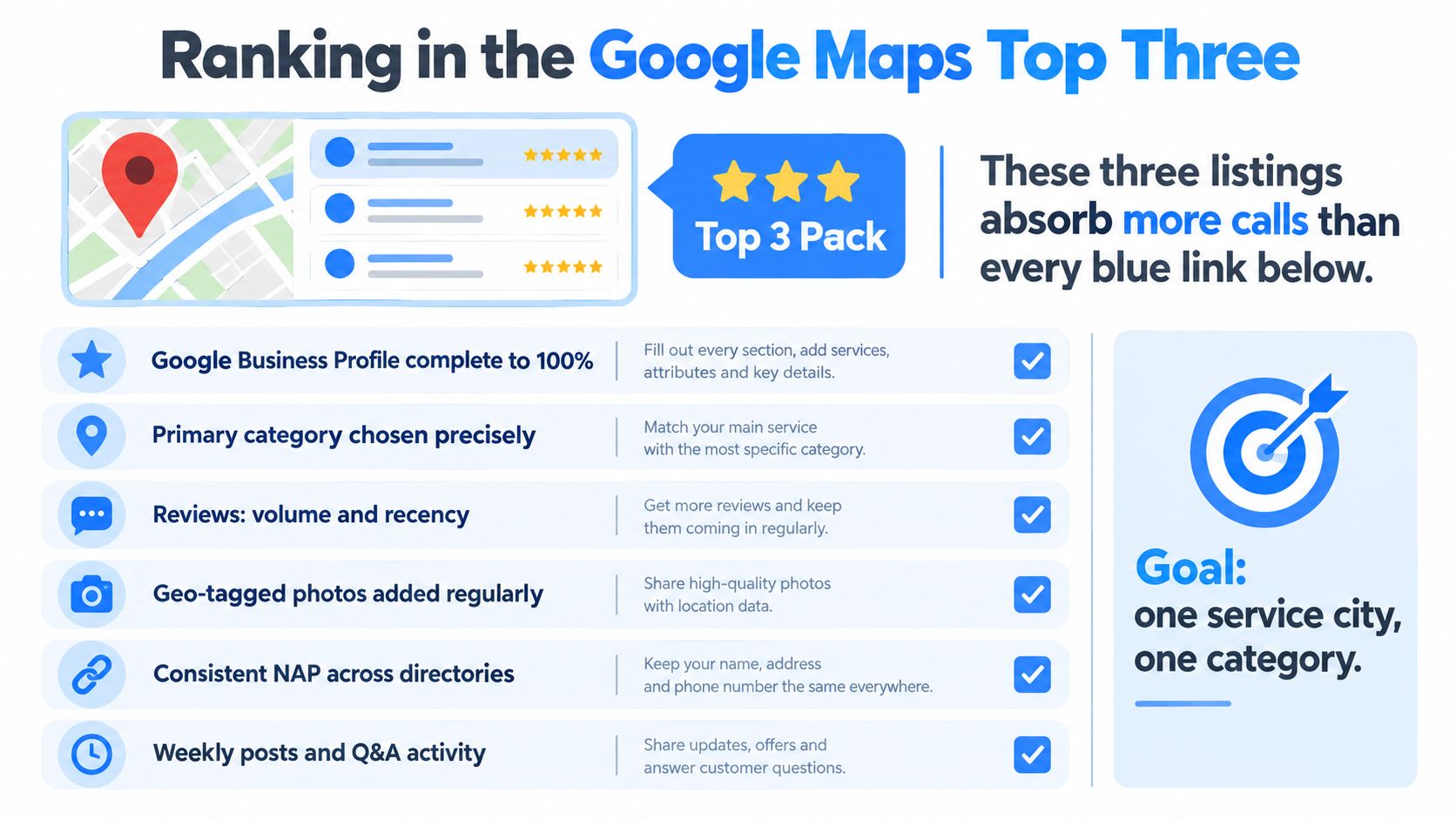
The Maps Pack is a commercial battleground. A large user-behavior study found that 42% of searchers clicking local queries choose a result inside the Google Maps Pack. The study describes the Pack as three results drawn from Google Maps, which makes the top three a meaningful target for searches such as “roofer near me” and “dentist near me.”
Start with the Google Business Profile. Complete every relevant field, choose the most precise primary category, add supporting categories only when they match actual services, and make the service area accurate. Don't use a generic category because it sounds broad. A dental office, HVAC contractor, and roofing company need different primary signals.
The profile should match the business everywhere else. Keep the name, address, and phone information consistent across directories. Add original photographs from actual work and locations, publish useful updates that mention the service and city naturally, and maintain hours that reflect when calls are answered.
The signals that deserve attention
Map visibility depends on proximity, relevance, and prominence. Proximity limits what a listing can accomplish outside its realistic service area. Relevance improves when the category, services, website pages, and customer language all describe the same work. Prominence grows through legitimate reviews, citations, local references, and evidence that the business is active and trusted.
The business name must not become a keyword container. Use a service phrase in the title only when it accurately reflects the actual business name and Google's rules. Manipulated names create risk instead of durable visibility.
Google reports that Business Profile insights include views, searches, and actions from both organic results and Google Ads in its official Business Profile guidance. Track those actions, then compare them with calls and booked work.
A focused sprint should begin with claim and verification, followed by category selection, service details, hours, photos, citations, and review requests. The Google Maps ranking process used by local operators should stay tied to one service city and one primary category instead of trying to rank everywhere at once.
Building a Content Engine Around Service City Pages
Transactional SEO is won page by page. A roofer doesn't need one giant article about home improvement. The roofer needs a page for roof replacement in each important city, a page for leak repair, a page for storm damage, and supporting pages that prove local experience.
Use a consistent architecture, but write each page uniquely. The title can follow a format such as “Roof Repair in Mesa, AZ, Business Name.” The H1 should repeat the service and city naturally. The opening should identify the local market, explain the service problem, and tell the reader what to do next.
| Page Element | Intent Signal |
|---|---|
| Service and city title | Matches the commercial query |
| Clear H1 | Confirms page relevance |
| Local opening | Establishes geographic fit |
| Proof block | Supports trust and decision-making |
| Service area map | Clarifies coverage |
| Click-to-call button | Removes conversion friction |
| FAQ section | Addresses final objections |
| Internal links | Connects related services and locations |
Build silos, not isolated posts
A service page should link to relevant neighborhood pages, project write-ups, and adjacent services. City pages should link back to the main service hub. That structure gives users routes to related answers and gives crawlers a clear understanding of how the site is organized.
The page also needs an AI optimization layer. Google's guidance on generative AI visibility says businesses should continue using a clear technical structure and creating unique, valuable content. It also recommends Google Business Profiles and Merchant Center feeds when relevant, because local businesses and products can appear in both standard Search and AI-driven experiences.
For a service page, that means naming the entities plainly. Include the city, neighborhoods, service type, related problems, business details, and operating area. Use appropriate structured data such as LocalBusiness, Service, and FAQPage when the content qualifies. Don't stuff “near me” into every sentence. Write the page so a search engine or language model can identify who you are, what you do, where you work, and why a customer should contact you.
A practical cadence is one new service-city page each week, supported by one city-specific long-tail article each month. The service-area page framework can help keep locations organized without producing thin copies of the same page.
Tracking the KPIs That Matter for Calls and Bookings
Traffic reports make weak campaigns look busy. A local operator needs to know whether the right service pages and Map listings are producing conversations.
Track the same transactional terms by service and city. A roof repair company might monitor roof leak repair, emergency roof repair, and roofer near me in its target market. An HVAC shop might track AC repair, air conditioning repair near me, and furnace service by city. The exact list depends on the vertical, but the principle doesn't change: measure the phrases customers use when they want service.
| KPI | Source |
|---|---|
| Map Pack position by service and city | Local rank tracker |
| Organic query and page performance | Google Search Console |
| Business Profile calls and actions | Google Business Profile insights |
| Website call volume | Call-tracking platform |
| Form submissions | Analytics and CRM |
| Booked jobs or patients | CRM, scheduling system, or spreadsheet |
| Lead source and service requested | Call notes or intake form |
Read the signals together
A Map Pack listing with impressions but few calls usually indicates a profile, offer, trust, or response problem. A page ranking for the correct service but generating no forms may need a stronger call-to-action, clearer proof, or a simpler form. A page receiving visits for informational queries may be attracting attention without reaching buyers.
Google Search Console should be filtered by service-city page URL. Call tracking should distinguish the website from the Business Profile when possible, while the intake process should record the service and city mentioned by each new lead. The goal isn't perfect attribution. The goal is enough evidence to decide which pages and listings deserve more investment.
Review the dashboard monthly, with weekly checks for urgent ranking or call changes. Three numbers should drive the decision to scale, hold, or pivot: qualified calls, booked work, and cost per acquired customer. If rankings improve but booked jobs don't, don't publish more content until the conversion and intake problems are fixed.
The performance dashboard for local search campaigns should make those relationships visible to the owner, marketing team, and service staff.
A 30 to 60 Day Implementation Roadmap
A focused campaign can move from setup to measurable operating data quickly, but it needs sequence. Don't buy backlinks while the profile is unverified or publish blogs before the service pages exist.
Phase one, days 1 to 15
Claim and verify the Google Business Profile. Select one primary service category, complete the relevant fields, add the first 10 geo-tagged photos, and correct inconsistent business information across the top directories. Set up a review request that sends customers a direct text link after completed work.
The first milestone is operational, not cosmetic. The business must know which calls it can answer, which services it wants most, and which city should receive the initial focus.
Phase two, days 16 to 30
Publish the flagship service-city pages for the three highest-revenue services. Put a click-to-call phone number above the fold and make the form ask only for the information the team needs to respond, such as name, phone, and ZIP code.
Begin a weekly article aimed at a long-tail transactional query. A post about “air conditioning repair near me” should support the core repair page, not compete with it through repetitive wording.
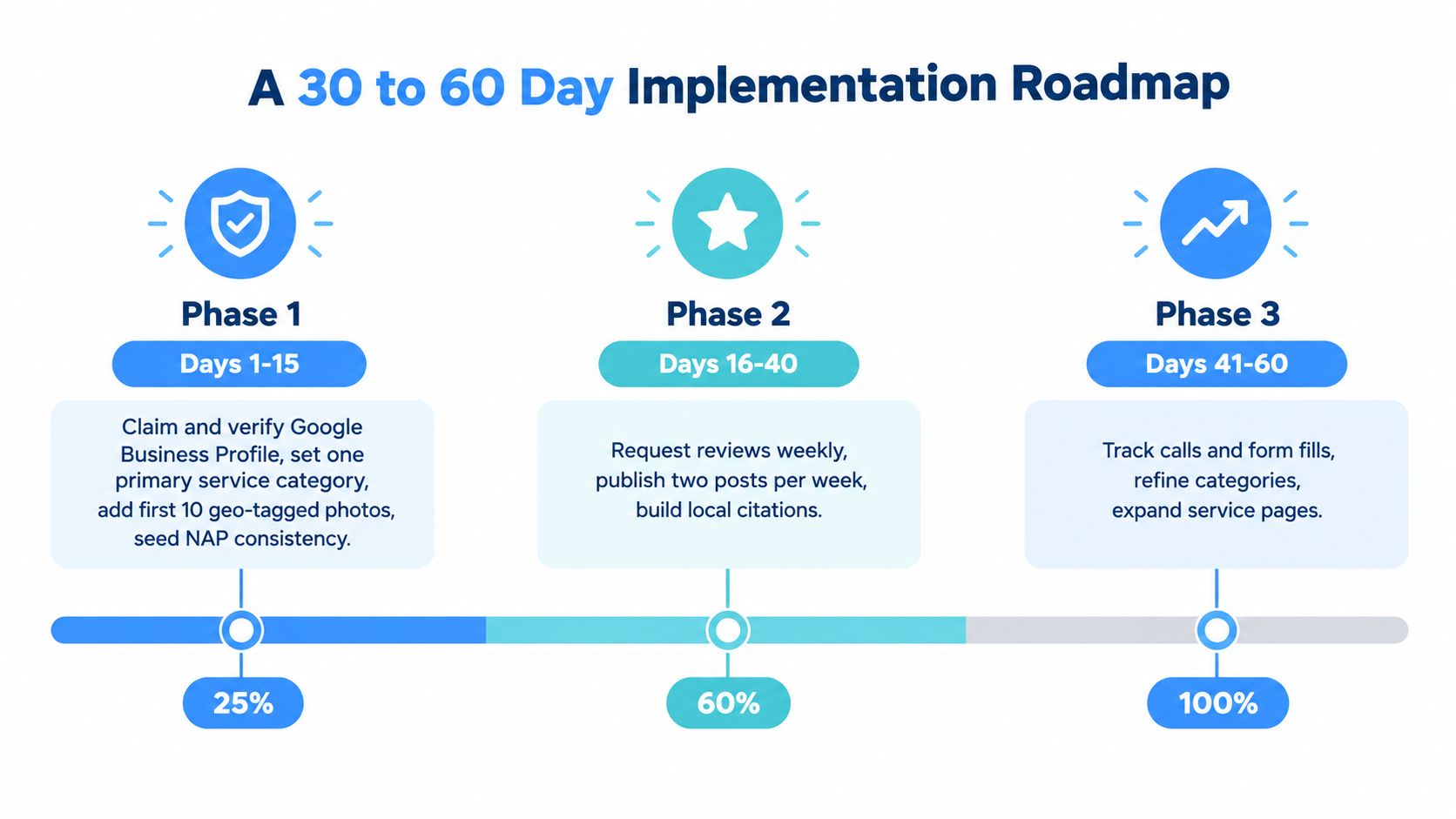
Phase three, days 31 to 60
Activate two referral partners in adjacent trades. Build five supporting city or neighborhood pages, pursue relevant local sponsorships and trade-association links, and connect call and form tracking to the KPI dashboard.
Use five new reviews per week as an internal operating target, not a promise of ranking performance. Measure whether the primary service city enters the Map Pack and establish a baseline for inbound calls before increasing ad spend. Transactional Marketing states that its process is designed to get client websites onto Google's first page within 30 to 60 days, but results depend on the market, competition, site condition, and execution.
Turning Searches Into Booked Jobs and Patients
Organic visibility stops being valuable when the phone rings and nobody answers. Set a real response standard, keep the number consistent with the Google Business Profile, place click-to-call buttons on every service-city page, and keep the contact form short.
The first minute of the call should establish urgency, service location, problem type, and the next available appointment. A roofing office should identify whether the issue is a leak, storm damage, or replacement inquiry. A dental office should identify the treatment need and urgency. An HVAC shop should establish whether the system is down, failing intermittently, or due for maintenance.
The operating flywheel
A better ranking creates more qualified opportunities. Fast answering and clear scheduling turn more opportunities into booked jobs or patients. Completed work creates legitimate review opportunities, and those reviews support future trust and local visibility.
That cycle only works when marketing and operations share information. If the marketing team celebrates calls but the office misses them, the campaign is leaking revenue. If the office books work but never requests reviews, the business loses a compounding asset.
AI optimization belongs in the same system, not in a separate content silo. Businesses that want a practical overview of mastering AI discovery with Busylike can use it alongside foundational work on structured pages, clear business entities, and accurate local profiles. Google's own guidance makes the priority clear, technical accessibility and useful content come before attempts to manipulate language-model visibility.
Organic lead generation isn't a one-time campaign. It's a monthly operating cadence for one local market at a time, with transactional terms, Maps visibility, service-city pages, reviews, response speed, and booked work connected to the same dashboard.
Transactional LLC helps service businesses build organic lead generation systems around high-intent terms such as “roofer near me,” “dentist near me,” and “air conditioning repair near me.” Visit Transactional LLC to discuss Google Maps optimization, service-city SEO, AI-focused content, and call tracking built to turn local searches into booked jobs and patients.