


Most plumbing marketing advice starts with brand awareness, social media, and broad content. That approach can help a national consumer brand, but it often misses the homeowner who is searching “emergency plumber near me” with a leaking pipe, blocked drain, or failed water heater already demanding attention.
A better marketing plumbing business strategy starts with transactional search intent. A transactional search term signals that the user wants to take action, not casually learn. “Plumber near me,” “water heater repair near me,” and “emergency drain cleaning” are valuable because the searcher is looking for a provider in the area and may be ready to call or book.
The U.S. plumbing industry is large and fragmented enough for highly localized visibility to matter. IBISWorld estimates 2026 plumbing industry revenue at $208.1 billion, with roughly 129,000 plumbing businesses employing more than 742,000 people. A small operator doesn't need national recognition to grow. The opportunity is to become the obvious local answer for profitable, ready-to-buy searches, both in traditional search results and in AI-mediated discovery.
Capturing High-Intent Transactional Plumbing Searches
The most popular advice says plumbers need more awareness. They need more followers, more broad educational content, and more exposure across every channel. Those activities aren't automatically useless, but they shouldn't sit at the center of a plumbing marketing budget when the business depends on booked jobs.
The useful question is simpler: which searches can produce a phone call today?
A homeowner searching “how to unclog a sink” may need help eventually, but the intent is uncertain. A homeowner searching “emergency plumber near me” has narrowed the problem, the service, and the geography. That search belongs to a different marketing category. It deserves a faster landing page, stronger call access, more precise ad targeting, and a Google Business Profile that makes choosing your company easy.
LocaliQ reports almost 180,000 monthly U.S. searches for “plumber near me”. The same source places plumbing search advertising at a 3.34% click-through rate within its 2025 home-services benchmark data. Those figures don't mean every impression becomes a customer. They do show why plumbing companies should prioritize the search moments where the customer has already described the need and is looking for a nearby provider.
Practical rule: If a keyword doesn't identify a plumbing service, a local need, or a clear next action, treat it as a supporting term rather than the primary acquisition target.
Separate research traffic from buying traffic
Transactional search terms usually combine a service with a location, urgency, or action. Examples include:
- Emergency terms: “emergency plumber near me,” “burst pipe plumber,” or “24 hour plumbing repair.”
- Service terms: “sewer line repair,” “water heater replacement,” or “tankless water heater installer.”
- Local terms: “plumber in [city],” “drain cleaning [city],” or “commercial plumber near me.”
- Action terms: “plumbing repair quote,” “book water heater service,” or “plumber available today.”
The page, profile, or advertisement targeting each group should match the searcher's expectation. An emergency page needs immediate phone access, service-area clarity, response information, and a concise explanation of what happens after the call. An informational article can answer a question, but it shouldn't consume the budget intended for a customer who is ready to hire.
A useful high-intent keyword framework helps organize these terms by urgency, service value, location, and conversion action. Build the keyword map before producing content. Otherwise, a team can publish dozens of articles that attract attention while leaving the most commercially important service-city searches weakly targeted.
Build the business around the search moment
The same intent should continue through the whole journey. The ad copy should name the service. The landing page should repeat the service and city naturally. The profile should show the correct category, service list, photos, reviews, and phone number. The call handler should know which campaign or service generated the inquiry.
Brand awareness still has a role, especially when a homeowner compares several local businesses. But awareness is a supporting asset. Transactional visibility is the acquisition system. It puts the plumbing company in front of people who are already trying to solve a problem, rather than asking broad audiences to remember the brand someday.
Dominating Google Maps and Local Pack Rankings
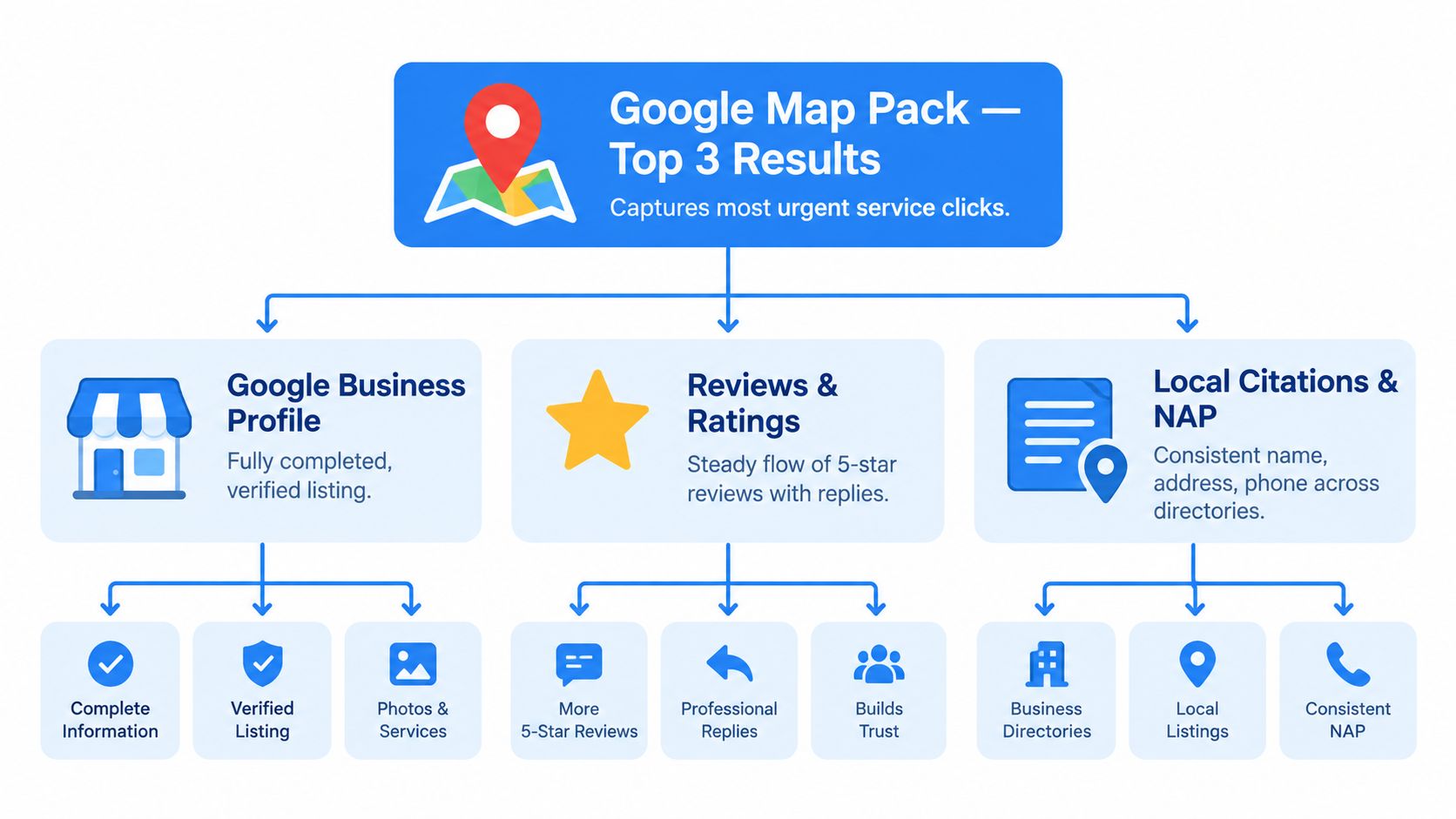
For urgent plumbing searches, Google Maps is not a directory to complete once and forget. It's a primary conversion layer. The local pack puts nearby businesses, phone access, directions, reviews, and service information close to the searcher's next action.
Google's local ranking framework centers on relevance, distance, and prominence, as explained in this overview of Google Maps ranking factors. Relevance measures how closely the profile matches the query. Distance reflects proximity to the searcher or the searched location. Prominence represents how established and trusted the business appears through signals such as reviews, citations, and links.
Improve relevance at the profile level
Start with the primary Google Business Profile category. Choose the category that most accurately describes the core plumbing business, not a loosely related service. Add relevant secondary categories only when they represent services the company actually provides.
Complete the profile carefully:
- Write a specific business description. Explain the primary services and service area in natural language. Avoid keyword stuffing and unsupported claims.
- Add the complete service menu. Include drain cleaning, leak repair, sewer work, water heater services, or other actual offerings.
- Upload authentic photos. Use technicians, branded vehicles, completed work, equipment, and the local team. Stock photography weakens trust.
- Maintain the Q&A area. Answer practical questions about emergency availability, service areas, estimates, payment options, and common repairs.
- Publish useful updates. Highlight seasonal plumbing needs, recent work, service explanations, and booking options without turning every post into an advertisement.
- Verify every contact field. The name, phone number, hours, website, and service-area information must agree with the website and other business listings.
Profile-level optimization matters because the listing itself can win the click before the website appears. A recent local-pack analysis estimates Google Business Profile signals at 32% of local ranking weight, online reviews at 20%, and on-page SEO at 15%. These estimates should guide priorities, not be treated as a universal formula for every market.
Build prominence without shortcuts
Prominence grows when multiple parts of the local presence reinforce one another. Use a consistent business name, address, and phone number across reputable directories, trade associations, local organizations, and relevant industry listings. Remove duplicate or outdated profiles where possible.
Reviews support both credibility and conversion. Ask satisfied customers shortly after the job, make the review process easy, and reply to positive and negative feedback with specific, professional language. Don't offer incentives for positive reviews or create reviews that don't reflect real customer experiences. A steady system is more sustainable than a short burst followed by silence.
Distance can't be rewritten through copy. A business located outside a city won't become physically closer because a page repeats the city name. Relevance and prominence can be improved, but service-area businesses must follow Google's eligibility and representation rules rather than creating misleading locations.
A practical resource for connecting local search advertising decisions to return on ad spend is the CMO local search PPC ROAS insights Note. Use that kind of commercial perspective alongside ranking work, because a map position matters only when it produces profitable calls.
The Google Maps ranking factors guide can serve as a working checklist for profile completeness, local signals, and conversion readiness. The objective isn't merely to appear in the top three. It's to make the listing credible enough that the searcher calls your company instead of opening another result.
Building Service-City Content Silos for AI and SEO
A generic homepage can't target every service and every city well. A thin page titled “Plumbing Services” gives search engines and AI systems little detail about which problem the company solves, where it operates, and why it deserves to be recommended.
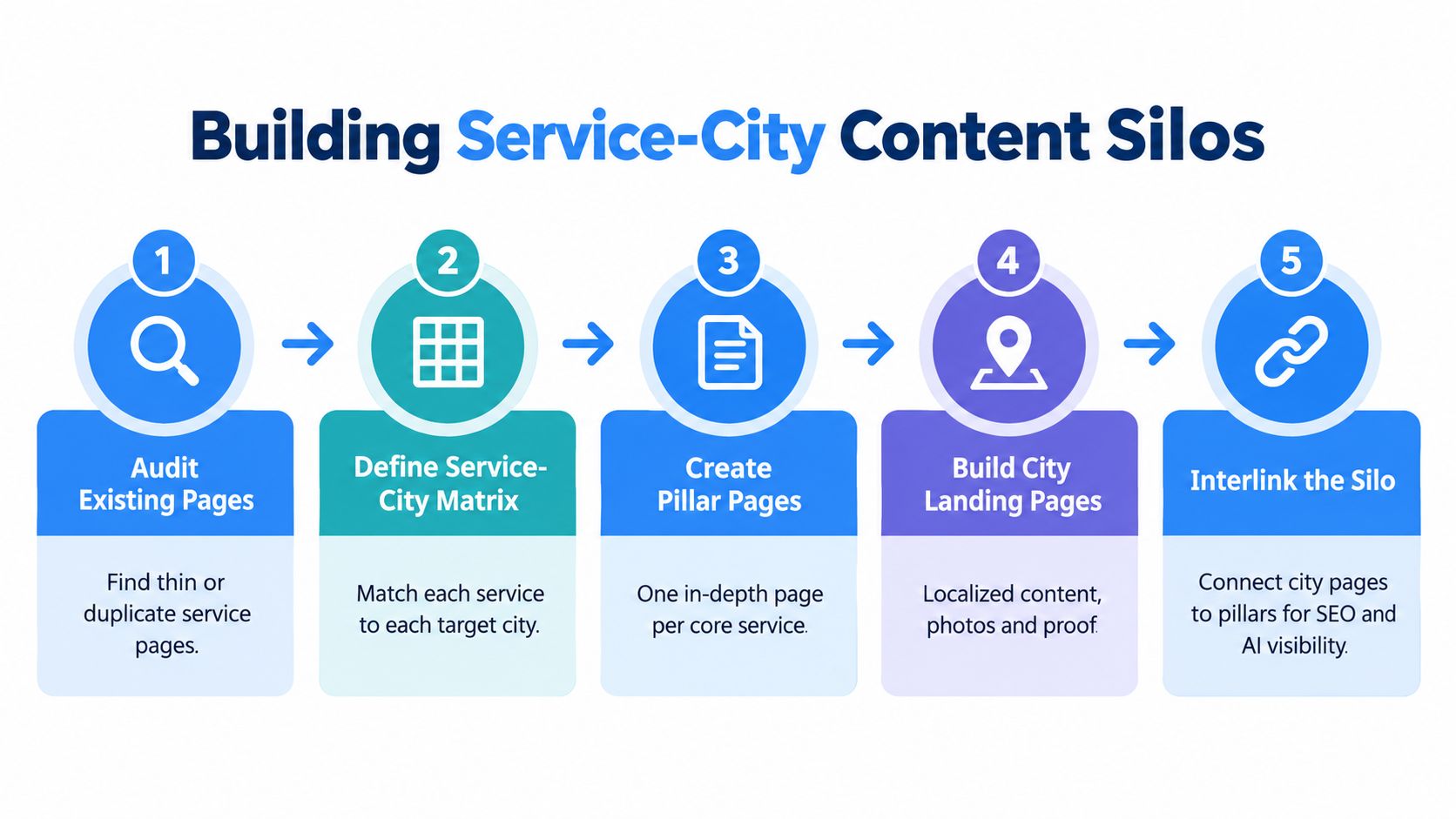
The stronger architecture is a service-city content silo. Each important revenue service gets a dedicated page, and each target city receives localized treatment. “Water heater repair in Austin” should not be a lightly edited duplicate of “water heater repair in Round Rock.” The page needs relevant local proof, service details, customer concerns, and a clear booking path.
This structure serves traditional SEO and AI optimization at the same time. Search systems can identify the relationship between a service, a location, and a business. Large language models and AI search systems can also extract clearer answers when the page uses direct headings, concise explanations, structured facts, and consistent business information.
Map services to cities before writing
Create a matrix with revenue-generating services in one direction and target cities in the other. Start with services that have clear transactional intent, such as emergency repairs, drain cleaning, sewer line work, leak detection, and water heater replacement.
For every service-city combination, define:
- The target query: Match the title tag, H1, URL, and opening copy to the service and city.
- The conversion action: Use a prominent call button, booking form, or estimate request appropriate to the job.
- The local evidence: Add real service-area information, technician coverage, relevant photos, and customer proof where available.
- The supporting questions: Answer what the service involves, when it becomes urgent, and what the customer should do next.
- The internal links: Connect the city page to the core service page, related services, emergency information, and contact path.
A page should earn its existence. If the company doesn't serve a city or doesn't provide the listed service, don't publish the page. Programmatic pages with swapped city names create a poor user experience and give AI systems little trustworthy information to cite.
A useful SEO topic clusters guide provides helpful context for organizing related pages around a central service topic. For plumbing, the pillar might be water heater replacement, with supporting pages for diagnostics, repair versus replacement, common failure signs, and city-specific service access.
Format pages for citation-worthiness
AI Overviews and answer-style results can intercept informational queries before a homeowner visits a website. Recent industry guidance reports that roughly 38% of plumbing informational queries surface an AI Overview, with citations tending toward pages that use FAQ schema and step-by-step formatting. The plumbing content marketing analysis describes this emerging visibility gap and the need to structure content for direct answers.
That doesn't mean abandoning transactional pages. It means adding useful answer blocks that lead naturally to a service action:
- Troubleshooting block: State the immediate safe step, such as locating the shutoff, without encouraging risky repair work.
- Urgency block: Explain which symptoms require prompt professional attention.
- Process block: Outline what the technician will inspect or repair.
- FAQ block: Answer specific questions in short, complete responses.
- Local action block: State the service area and provide a direct call or booking option.
Use FAQ schema only when the visible page contains the same questions and answers. Schema can't compensate for weak content, inaccurate claims, or missing local relevance. The goal is to give search engines and language models clean, verifiable material while keeping the page focused on the transactional action.
A service-area page framework can help keep the service-city relationship clear. The page should answer two questions immediately: Can this plumber solve my problem, and can this plumber reach me?
Managing Citations, Reviews, and Paid Ad Profitability
Paid search can deliver fast visibility, but plumbing clicks are expensive enough to punish imprecise targeting. One 2026 source places the average plumbing-related search CPC at $5.26, and identifies plumbing as one of the more expensive local-search categories. The SEO guidance for plumbers also notes that the Google Map Pack captures 42% of clicks on local plumbing searches.
Those figures point to a practical allocation decision. Use paid ads to capture valuable gaps and urgent demand, while building map and organic assets that can reduce dependence on every individual click. Don't send every service, city, and match type into one campaign and judge it by lead volume alone.
Use citations and reviews as trust infrastructure
Citations reinforce geographic identity. Audit major directories, trade listings, local chambers, manufacturer directories, and other relevant references for consistent business details. Correct old phone numbers, duplicate names, and mismatched addresses. A citation isn't valuable merely because it exists. It should be accurate, relevant, and connected to a legitimate business presence.
Reviews need operational ownership. Assign the request to the office team or technician workflow, send the customer a direct review path, and record whether the request was sent. Reply to reviews with details that show the company understands the work, but don't reveal private customer information.
Segment campaigns by job economics
An emergency pipe repair, a replacement quote, and a maintenance plan have different values and follow-up patterns. Put them in separate campaign groups so the business can compare calls, booked jobs, revenue, and payback by job type.
| Job Type | Primary Channel | Margin Profile | Acquisition Strategy |
|---|---|---|---|
| Emergency repairs | Map visibility and high-intent search ads | Often time-sensitive, with profitability dependent on dispatch efficiency and scope | Target urgent terms, restrict service areas, use call-focused landing pages, and review missed-call handling |
| Replacement quotes | Service-city SEO, map listings, and tightly matched paid search | Can support a higher acquisition cost when the project value and close rate justify it | Separate replacement terms from repair terms, qualify calls, and follow up on unsold estimates |
| Maintenance plans | Existing-customer follow-up, local SEO, and remarketing where appropriate | Recurring value depends on retention and fulfillment costs | Build dedicated plan pages, segment past customers, and measure renewals rather than initial inquiries |
The matrix is a management tool, not a promise that one channel will always outperform another. A maintenance plan may have a slower payback than an emergency call. A replacement campaign may generate fewer calls but deserve more budget if it produces stronger gross profit.
Margin rule: Never optimize a plumbing campaign for the cheapest lead without checking whether those leads become profitable jobs.
Paid campaigns should exclude irrelevant searches, use location controls that reflect actual service coverage, and send each ad to the most specific page available. Organic pages and map listings should carry the durable demand, while ads provide controlled access to urgent or strategically valuable queries.
Tracking KPIs and Building Your Marketing Dashboard
A report filled with impressions and generic traffic can make a weak campaign look busy. Plumbing owners need to know which service-city searches generated calls, which map locations produced visibility, and which calls became booked work.
Start with a dashboard that connects keyword movement to commercial outcomes. The performance dashboard framework should include separate views for organic search, Google Maps, paid acquisition, and phone conversions rather than blending every channel into one headline number.
Track the path from query to booked job
Use Google Search Console to review queries and landing pages, then connect those patterns to call tracking and the booking system. Record the service requested, customer city, lead source, whether the call was answered, whether an appointment was booked, and the eventual job value when available.
For Google Maps, monitor visibility across the actual service area rather than relying on one manual search from the office. A local rank heat map can reveal that a company performs well near its address but weakly in a profitable neighboring area. That difference should influence location pages, profile signals, and budget allocation.
The core dashboard should show:
- Service-city keyword timelines: Track movement for terms such as emergency plumbing, drain cleaning, and water heater services by location.
- Map visibility: Monitor local-pack and Maps performance across a representative set of service areas.
- Qualified calls: Separate new customer inquiries from existing customers, vendors, spam, and wrong numbers.
- Booked-job rate: Measure how many qualified calls become scheduled appointments.
- Cost by source: Compare paid clicks, paid leads, organic leads, map calls, and other acquisition paths.
- Revenue by job type: Keep emergency repairs, replacements, and maintenance plans distinct.
- Missed-call count: A missed call can turn successful visibility into lost revenue, especially during urgent searches.
Establish a review rhythm
A biweekly review is frequent enough to catch wasted spend and weak conversion paths without encouraging daily overreaction. Compare the current period with the previous reporting period, annotate major changes, and assign an owner to each action.
Use the dashboard to make decisions, not decorate presentations. If a service-city page attracts impressions but no qualified calls, inspect its intent match, phone placement, local proof, and offer. If ads generate calls but few bookings, review the call recording, qualification process, and landing-page promise.
The following video can supplement the dashboard review by giving the team a visual reference for performance analysis:
The right reporting question isn't “How much traffic did we get?” It's “Which transactional searches produced profitable plumbing opportunities, and what should we change next?”
Executing Your 90-Day Plumbing Marketing Action Plan
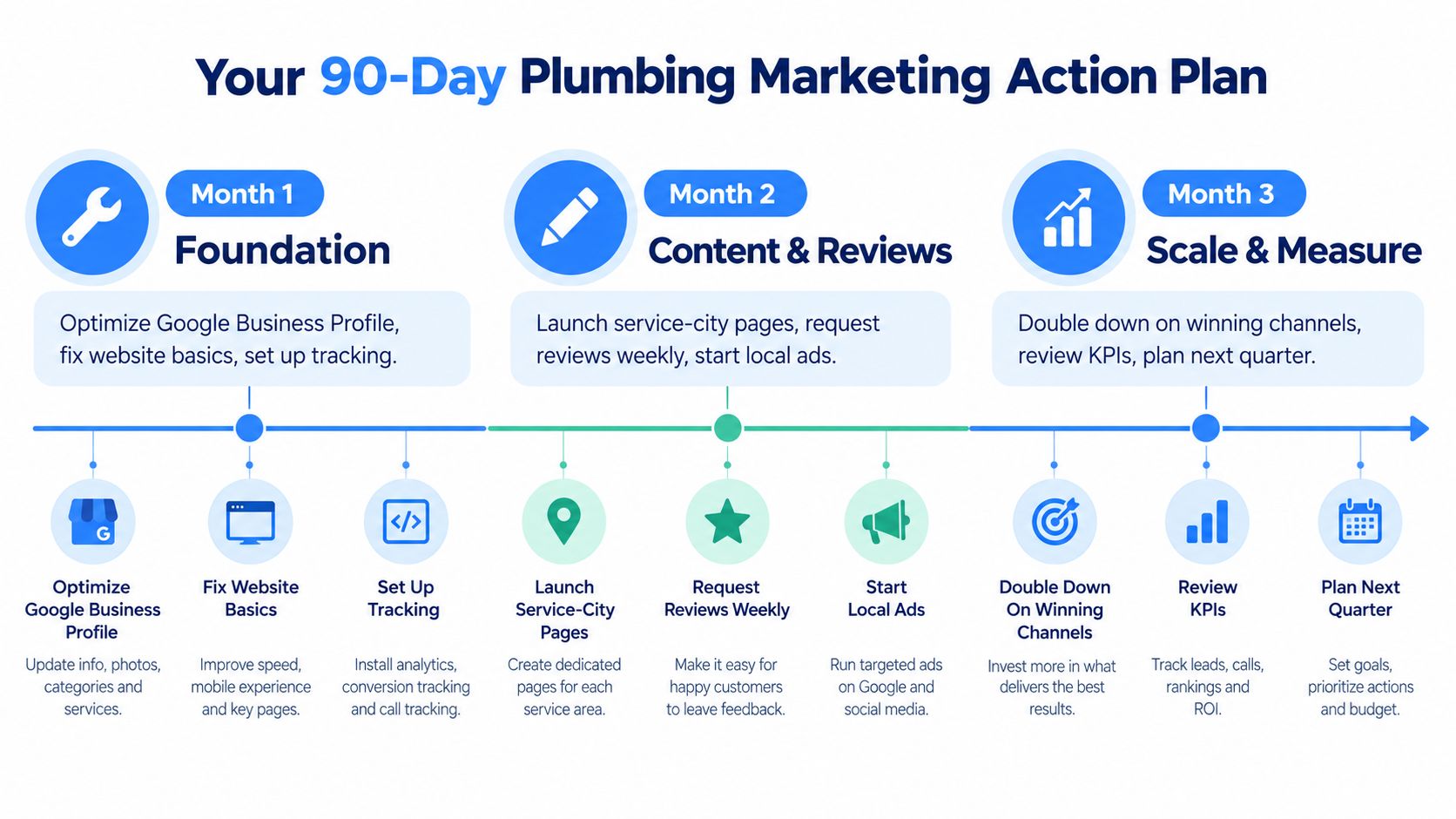
A 90-day rollout works best when the plumbing owner fixes measurement and conversion friction before adding more content or ad spend. The sequence below doesn't guarantee a particular ranking or lead volume. It creates a disciplined operating system for pursuing transactional searches and learning which services can support profitable acquisition.
Days one through thirty build the foundation
Begin with an audit of the Google Business Profile, website, service coverage, tracking, and phone process. Correct the primary category, services, hours, phone number, photos, Q&A, and business information. Check that the website works well on mobile, loads the key service pages clearly, and gives urgent searchers an obvious call action.
Next, create the transactional keyword map. Separate emergency repairs, drain services, sewer work, water heaters, replacements, and maintenance plans. Assign each priority service to a page and each target city to a genuine local service area. Install call tracking and define what counts as a qualified lead before running new campaigns.
Days thirty through sixty publish and strengthen
Launch the core service pages and the most important service-city pages. Each should have a distinct title tag, H1, local context, service explanation, answer blocks, proof, internal links, and a direct conversion path. Add FAQ schema only after checking that the questions and answers appear visibly on the page.
Create a review request workflow that the office can use consistently after completed jobs. At the same time, audit citations and correct inaccurate listings. Paid ads can begin with tightly controlled, high-intent groups, but every call should be classified so the owner knows which job types are consuming budget.
For broader context on social channels that support trust and visibility, the plumber social media marketing 2026 guide can help identify useful proof formats. Keep social media secondary to transactional SEO and Maps work. Job photos, technician introductions, and customer education are valuable when they reinforce local credibility, but they shouldn't replace search intent targeting.
Days sixty through ninety optimize what earns attention
Review ranking movement, map visibility, qualified calls, booked jobs, and job economics. Expand pages and ads where the search intent is strong and the business can serve the area profitably. Rewrite or consolidate pages that attract the wrong searches, duplicate another page, or fail to produce meaningful actions.
Use actual call quality to improve the campaigns. A keyword can rank well and still attract poor-fit inquiries. A modestly visible service page can be more valuable if it produces the right replacement or maintenance opportunity. Keep the dashboard focused on those distinctions.
The final checkpoint is operational. Confirm that the office answers calls promptly, technicians know the source of common inquiries, review requests are sent, and the next quarter has a prioritized service-city content list. Transactional searches create opportunity, but the business still has to answer, schedule, sell, and deliver the work well.
Transactional LLC provides industry-specific local SEO, Google Maps optimization, AI-driven content planning, web development, and paid campaigns built around transactional plumbing searches that lead to calls and booked jobs. Visit Transactional LLC to discuss a service-city SEO and AI visibility system for your plumbing business.