

A homeowner types “pest control near me” after finding ants in the pantry. They aren't browsing for general information. They're trying to book a technician today, which makes the path from search result to answered call more important than a polished click-through-rate report.
This comparison reviews seven Pest Control PPC Agency options through that transactional lens. It looks at where Google Ads, Local Services Ads, and remarketing fit, how each pricing approach may work for a single-location or multi-location operator, and whether an agency's reporting can connect advertising spend to qualified calls and booked jobs. Transactional Marketing focuses on the same high-intent searches that put a customer's budget behind queries such as “pest control near me,” “termite inspection company,” and “exterminator near me.” If you need help routing specific marketing tasks to the right specialist, use route tasks to the best model.
1. Paid Ads by Transactional Marketing
Transactional Marketing's paid ads service is built around local service businesses that need more than a one-time account setup. The team manages Google, Facebook, and LinkedIn campaigns, then adjusts bids, audiences, creative, and landing-page elements as performance data arrives. For a pest-control operator, that means separating urgent searches from broader awareness campaigns and aligning the paid program with the company's Google Maps and organic visibility.
The strongest fit is a company that wants hands-off execution without handing over a black-box account. Transactional Marketing pairs campaign management with A/B testing, conversion-focused landing assets, call and lead tracking, and biweekly reporting. Its dashboard includes keyword timelines, map-ranking visualizations, Search Console connections, and lead data, giving an owner more context than a report that only lists impressions and clicks.
Practical rule: A pest-control campaign should be judged by qualified conversations and booked work, not by cheap clicks.
That focus matters because Google Search is used by 77.6% of consumers as a home-services discovery channel, while Google Maps is used by 51.4%, according to home-services search behavior data. The opportunity is strongest when paid search, Maps optimization, and the landing page deliver the same service-area message.
What works and what needs scrutiny
Transactional Marketing's main advantage is integration. Paid search can target immediate demand while the company's GMB and Maps expertise, AI-driven content silos, and industry-specific networks support longer-term visibility. The approach is also contract-free, which reduces the risk of being locked into a program before call quality becomes clear.
The trade-off is specialization. The service is designed primarily for local and service-industry advertisers, including pest control, home services, and dental practices. That's useful for a local PCO, but a national enterprise with unusual media requirements should confirm whether the team has the scale and governance it needs.
For campaign architecture and account execution, review PPC ad management services. Ask for the exact definition of a qualified lead, the call-answering expectations, and how offline outcomes will be connected back to campaigns. No agency can guarantee a fixed volume of leads because budget, competition, territory, and sales follow-up all affect the result.
2. Coalmarch by WorkWave
Coalmarch is one of the clearest choices for a pest-control company that wants a category specialist rather than a generalist agency. Its work centers on pest control and lawn care, with PPC commonly supported by SEO, conversion-rate optimization, and phone or CRM tracking. That specialization can shorten the learning curve around termite demand, recurring services, seasonal infestations, and the difference between an urgent call and a low-value inquiry.
The agency also publishes pest and lawn resources, develops pest-specific playbooks, and operates within the broader WorkWave ecosystem. A company already using WorkWave or PestPac should ask how campaign data, call records, customer status, and booked work will move between systems. Compatibility can make the reporting more useful, but it shouldn't be assumed.
Coalmarch is strongest when the agency is expected to understand the pest business beyond keywords and landing pages.
For a single-location operator, the main question is scope. A full-funnel program may be valuable, but the owner should confirm which PPC tasks are included, who owns the ad accounts, and whether reporting distinguishes qualified calls from every form submission. For a multi-location operator, ask for location-level reporting and a clear method for handling overlapping service areas.
Pricing is custom and isn't publicly listed. That makes the sales process important. Before signing, request a sample report, the proposed conversion events, and the CRM or phone-tracking workflow. You can also compare the agency's account philosophy with this practical guide to setting up a Google Ads campaign.
Explore Coalmarch if deep pest and lawn experience is more important to you than public pricing. The trade-off is that companies outside the WorkWave ecosystem may need additional technical validation before committing.
3. Scorpion
Scorpion suits larger pest-control organizations that want several paid channels managed by one vendor. Its dedicated pest-control practice covers Google Ads, Local Services Ads, and paid social, while its RevenueMAX and Leads AI platforms are designed to connect marketing activity with lead attribution and revenue intelligence.
That combination is useful when a company operates across multiple ZIP codes or locations and needs more than an account-level average. A serious evaluation should ask whether the reporting can show cost per qualified call, booked-job rate, and revenue by location, service, device, and time of day. Multi-location attribution is valuable only if the sales and dispatch outcomes are reconciled with the advertising data.
Scorpion's broad channel coverage is a practical advantage. A pest-control brand can coordinate search demand with social remarketing and LSA visibility instead of asking separate vendors to explain conflicting numbers. Its scale may also be better suited to franchise or enterprise workflows than a small boutique team.
The trade-off is complexity and cost. Pricing is custom, and enterprise-oriented packages may be more than a small operator needs. Peer feedback is mixed, so the sales process should include specific service-level questions rather than general assurances.
Questions to ask before signing
- Account ownership: Confirm that the business owns its Google Ads, LSA, analytics, call-tracking, and website assets.
- Lead definitions: Ask how Scorpion distinguishes an answered call, a qualified inquiry, a booked appointment, and revenue.
- Response expectations: Verify who handles urgent leads and how missed calls appear in reporting.
- Contract terms: Review minimum commitments, cancellation provisions, technology fees, and data-export rights.
A multi-location PCO should compare the proposed platform view with its own CRM. The dashboard must support operational decisions, not just make marketing data easier to display. For broader paid-search expertise, review these pay-per-click experts.
Visit Scorpion's pest-control marketing solutions if you need a broad platform and multi-market support. Smaller companies should confirm that the service model won't create more layers than their team can use.
4. Blue Corona by RYNO Strategic Solutions
Blue Corona, now part of RYNO Strategic Solutions, brings home-services marketing experience to pest control. Its program covers PPC, Local Services Ads, landing pages, call tracking, and reporting, with account teams familiar with trade businesses. Its pest-control content and service-business case studies also give owners material to review before asking how campaigns will turn searches such as “pest control near me” into booked work.
The practical strength is conversion infrastructure. A click from a termite, rodent, or emergency pest search needs a landing page that matches the service area, problem, and urgency. Dedicated pages, call tracking, and conversion testing give the team more ways to improve lead quality than bid changes alone. See our guide to digital marketing for pest-control companies for related context.
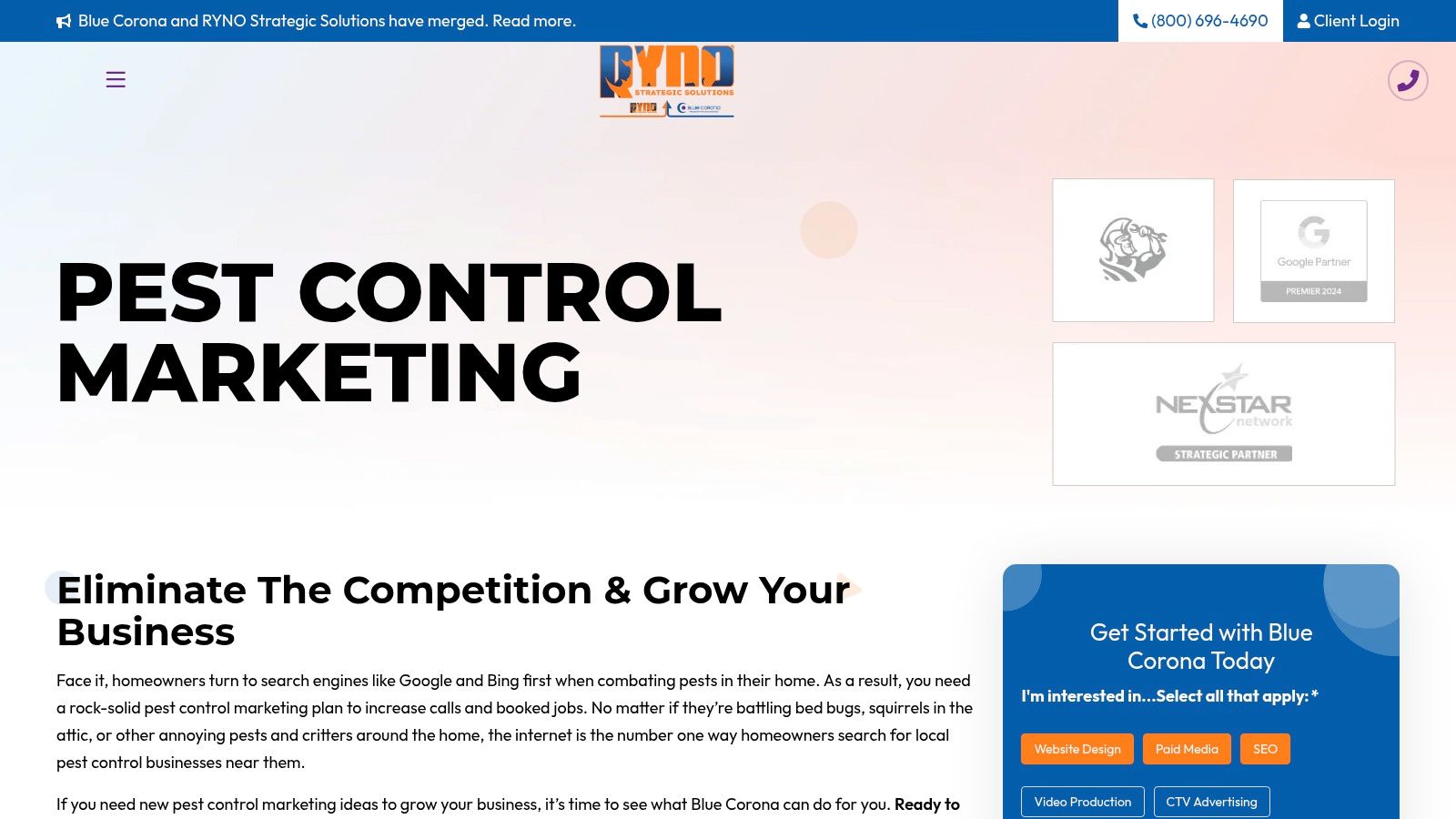
Blue Corona suits an established operator that wants one managed program across multiple funnel stages. A small company seeking only PPC may find the broader service model adds overhead. Its pest-control marketing page indicates that engagement expectations can reach $5,000 or more per month depending on the package. Use that figure for initial scoping, not as a universal quote.
The RYNO relationship deserves specific questions. Organizational changes can affect account ownership, escalation paths, and the day-to-day service experience. Confirm who sets strategy, who handles optimization, and how often the team reviews recorded calls and booked-job outcomes.
Local operators should ask how much attention the package gives each service area. Regional businesses should request location-level reporting and a budget-allocation process that keeps one territory from absorbing another's demand.
Businesses wanting landing pages, LSA, PPC, and call measurement under one vendor may find a fit. Companies seeking a small, founder-led relationship should compare contract terms, reporting access, and the assigned team before signing.
5. WebFX
WebFX is a national performance agency with a dedicated pest-control industry offering. It manages Google Ads and Microsoft Ads, supports geographic and seasonal segmentation, and can build campaigns around different pests, markets, and branches. For franchise or multi-city operators, that structure can be more useful than a single campaign organized around broad “pest control” terms.
Its RevenueCloudFX platform provides centralized reporting and attribution, while landing-page testing supports the conversion side of the account. The agency also publishes starting pricing signals, which makes initial budgeting easier than the common “contact us for everything” approach.
Where WebFX fits best
WebFX is a logical option for a company that needs process, specialist coverage, and multi-location execution. A larger team can handle account builds, landing pages, reporting, and optimization without making one strategist responsible for every task. That structure can support expansion into new service areas, provided the business supplies accurate territory and revenue data.
The trade-off is category depth. WebFX works across industries, so pest-control expertise may come from its process and account team rather than exclusive focus. Ask who has worked on termite, rodent, bed-bug, mosquito, and recurring-service campaigns, and ask how those service groups will be measured differently.
A proprietary platform can also introduce a learning curve for an in-house marketing team. Make sure data can be exported and that your business retains access to core advertising, analytics, CRM, and call records.
See WebFX's pest-control marketing offering if you're scaling across branches or want a larger delivery team. It's less compelling if you only need a compact local campaign and don't plan to use the broader reporting or service stack.
6. Thrive Internet Marketing Agency
Thrive offers a broad digital marketing relationship for pest-control companies that want PPC alongside SEO, social, landing pages, and website support. Its paid program covers Google and Bing, with conversion tracking and ongoing optimization intended to improve lead quality rather than just increase traffic.
The agency's pest-control service pages make it easier to understand the intended scope. A single-location operator can evaluate whether Thrive is prepared to manage service-area campaigns, landing pages, call tracking, and negative-keyword controls without buying a much larger enterprise package.
A broad agency is only a good fit when its account team can explain pest-specific economics, not just general lead generation.
Thrive's main advantage is continuity. One vendor can coordinate paid search with organic content and social campaigns, reducing the chance that every channel uses a different offer or service-area message. That's useful when an operator wants to build visibility for urgent searches while also developing recurring-service demand.
The limitation is that Thrive isn't pest-exclusive. Pricing is custom and isn't posted publicly, so the discovery process should test the depth of relevant experience. Ask for examples of how the team separates termite, rodent, bed-bug, general pest, and employment-related searches. Also ask how it handles LSA leads separately from auction-based Google Ads leads.
Review Thrive's pest-control PPC service if you want one partner for several digital channels. Before signing, get a named account team, a sample dashboard, and a written definition of the first conversion milestone.
7. GrowthBound Marketing
GrowthBound Marketing takes a boutique, pest-control-only approach. Its work emphasizes qualified phone calls, route density, conversion-focused websites, Google Ads, and SEO, with founder-led strategy and published pest-control case studies supporting the positioning.
That specialization can matter when service economics differ sharply by pest. A termite inquiry may deserve a different landing page, call script, budget priority, and follow-up process than a one-time general spray. A smaller team may also be more responsive when the owner wants to discuss call quality directly with the person responsible for strategy.
The boutique trade-off
The advantage is focus. GrowthBound doesn't need to learn the basic shape of the pest-control customer journey from scratch, and its website work is designed around phone leads rather than abstract engagement. For a single-location or focused regional operator, that can be more practical than a large platform built for many industries.
The risk is capacity. A boutique agency may have limited onboarding bandwidth, and founder involvement can become a constraint as the client base grows. Ask who handles optimization when the founder is unavailable, how quickly urgent changes are made, and whether reporting includes booked appointments rather than only call volume.
Pricing isn't publicly listed, so a discovery call is required. Use that conversation to request the proposed campaign structure, lead qualification rules, account-access terms, and a clear explanation of how recurring customers will be valued.
Explore GrowthBound Marketing if pest-only expertise and hands-on strategy are your priorities. It's a weaker fit if you need a large implementation team, many simultaneous locations, or formal enterprise reporting.
Pest Control PPC: 7-Way Comparison
| Provider | Implementation complexity | Resource requirements | Expected outcomes | Ideal use cases | Key advantages |
|---|---|---|---|---|---|
| Paid Ads – Transactional Marketing | Moderate, full-service managed with ongoing A/B testing | Moderate ad spend; GMB/Maps integration; dashboard access; no contract required | Measurable, conversion-focused local lead growth | Single- or multi-location service providers seeking local lead growth without long commitments | Local-first cross-platform management; integrated with SEO/GMB; transparent reporting |
| Coalmarch (WorkWave) | Moderate, pest-specific playbooks with CRM/phone tracking | Custom budget; CRM/phone-tracking integration; benefits from WorkWave ties | Seasonal, benchmark-driven PPC with enhanced lead tracking | Pest and lawn specialists, especially clients in WorkWave/PestPac ecosystem | Deep pest/lawn expertise; industry benchmarks; tight CRM integration |
| Scorpion | High, enterprise platform layers (RevenueMAX, Leads AI) and multi-location setups | Higher budgets; proprietary platform access; complex onboarding | Revenue-attributed leads, multi-zip attribution and scaling | Larger or multi-location PCOs needing attribution and scale | Comprehensive channel coverage; proprietary revenue and lead-quality tools |
| Blue Corona (RYNO) | Moderate, PPC + LSA + landing pages with dedicated teams | Mid-to-high budgets (published floors); call tracking and CRO resources | Consistent lead generation with landing-page and call-tracking optimization | Established trades/home-services firms prepared to invest in full service | Clear budget guidance; long track record in trades lead gen |
| WebFX | Moderate, platform-driven processes and multi-location buildouts | Published starting pricing; centralized reporting (RevenueCloudFX); certified team | Scalable multi-location PPC with centralized attribution | Franchises and multi-city PCOs seeking predictable pricing and scale | Published pricing; process rigor; strong scaling capabilities |
| Thrive Internet Marketing Agency | Moderate, integrated PPC, landing pages, ongoing optimization | Custom/quote-based budgets; cross-channel coordination (PPC+SEO+social) | Integrated lead generation with focus on lead quality | SMBs wanting a single partner for PPC plus SEO/social coordination | Broad service offering; clear pest-control scoping for easier evaluation |
| GrowthBound Marketing | Low–Moderate, founder-led, boutique execution focused on calls | Moderate budget; boutique bandwidth, requires discovery for pricing | Profitable, qualified phone leads and improved route density | Niche pest-control businesses prioritizing phone leads and profitability | Pest-only specialization; hands-on founder involvement; conversion-focused sites |
Shortlist, Test, and Hold Every Agency to Its Numbers
Start with two or three agencies that match your service mix, territory, and budget. Ask each one for a sample dashboard, its call-tracking setup, and the metric it would use to judge the first 60 days. The answer should go beyond impressions, clicks, and form submissions.
A useful evaluation follows the customer from search to revenue. Google states that local visibility depends primarily on relevance, distance, and prominence, so paid media should work alongside accurate Business Profile information, a genuine service area, and a strong reputation. Google also requires businesses to use their real-world name and accurate location or service-area details in Business Profiles, as explained in its Business Profile guidelines.
For PPC, separate channel economics instead of blending everything into one CPL. Published home-services benchmarks place standard Google Search Ads at approximately $90.92 per lead, while the broader home-and-home-improvement category converts at 7.33%, according to 2025 Google Ads benchmark data. These figures are reference points, not promises. Your agency should still optimize toward qualified calls, booked appointments, completed work, and revenue.
Local Services Ads also need separate treatment because they charge for leads rather than clicks. Published pest-control benchmarks place LSA leads at roughly $15 to $55, while termite leads tend to sit toward the upper end, as detailed in this pest-control LSA analysis. The channels aren't directly equivalent, so compare booking rate, contact rate, invalid-lead disputes, cancellations, and revenue per lead.
Choose the partner whose reporting ties ad spend to booked jobs. Keep account ownership clear, insist on call-quality reconciliation, and preserve terms that let you leave if the numbers don't hold up. If you're also investing in content, use a framework for measuring content ROI for creators, then connect those insights to the same service-area and revenue goals.
Transactional Marketing is built for businesses that want to win transactional searches, strengthen Google Maps visibility, and connect paid campaigns with local SEO and AI-driven content. Visit Transactional LLC to discuss a contract-free strategy for turning pest-control searches into qualified calls and booked jobs.