


The Monday morning pattern is familiar. A multi-location HVAC owner opens the inbox to find several new reviews, two complaints about arrival windows, and a customer asking why the phone hasn't been returned. The call log is quieter than last week, and the business has slipped in the Google map results for “air conditioning repair near me.”
That isn't only a customer-service problem. It may be a customer feedback management problem, a local SEO problem, and a revenue problem at the same time. For HVAC, plumbing, roofing, pest control, dental, and other service businesses, feedback creates public evidence about service quality while revealing the exact language customers use when they're ready to hire.
Transactional Marketing focuses on those high-intent searches. A person searching “roofer near me,” “dentist near me,” or “air conditioning repair near me” usually isn't researching the industry for fun. They have a problem, money in hand, and a short list of businesses they might call. Feedback management helps determine whether your business appears credible and relevant at that moment.
Why Customer Feedback Management Matters for Local Service Businesses
A local operator can deliver excellent work and still lose the next call if the public evidence is stale, vague, or unmanaged. A roofing company may have skilled crews, but if its profile has few recent reviews, unanswered complaints, and no clear service language, a searcher may choose another roofer before learning what the company can do.
Google identifies three primary local ranking mechanisms, relevance, distance, and prominence. Relevance reflects how closely a Business Profile matches the searcher's words and intent. Distance reflects the relationship between the searcher and the business location. Prominence reflects how well-known the business is, using signals that can include links, articles, directories, review count, and review ratings. Google also says that more reviews and positive ratings can improve local ranking, without promising a fixed position for any business. (Google Business Profile Help)
The commercial meaning of a review
A review isn't merely a public thank-you or complaint. It can reinforce the services you want to be found for, provide language future customers recognize, and expose a service problem that causes cancellations or lost calls. A response can also show that the company is active, accountable, and familiar with the customer's location and job type.
That doesn't mean adding keywords mechanically to every reply will move a listing into the map pack. In practice, generic responses such as “Thank you for your feedback” create little useful context. A better reply identifies the service naturally, acknowledges the customer's experience, and avoids making claims the business can't verify.
Practical rule: Treat every review as both a customer conversation and a piece of public local-market evidence.
A working system connects review count, review velocity, sentiment, response coverage, complaint recurrence, and business outcomes. It also distinguishes between feedback that demands an operational fix and feedback that confirms the team handled a job well.
For operators who need to create a consistent post-service request process, automated review requests can help trigger asks through established customer touchpoints rather than relying on technicians to remember them. Automation doesn't replace judgment. It creates a reliable opportunity to request honest feedback after completed work.
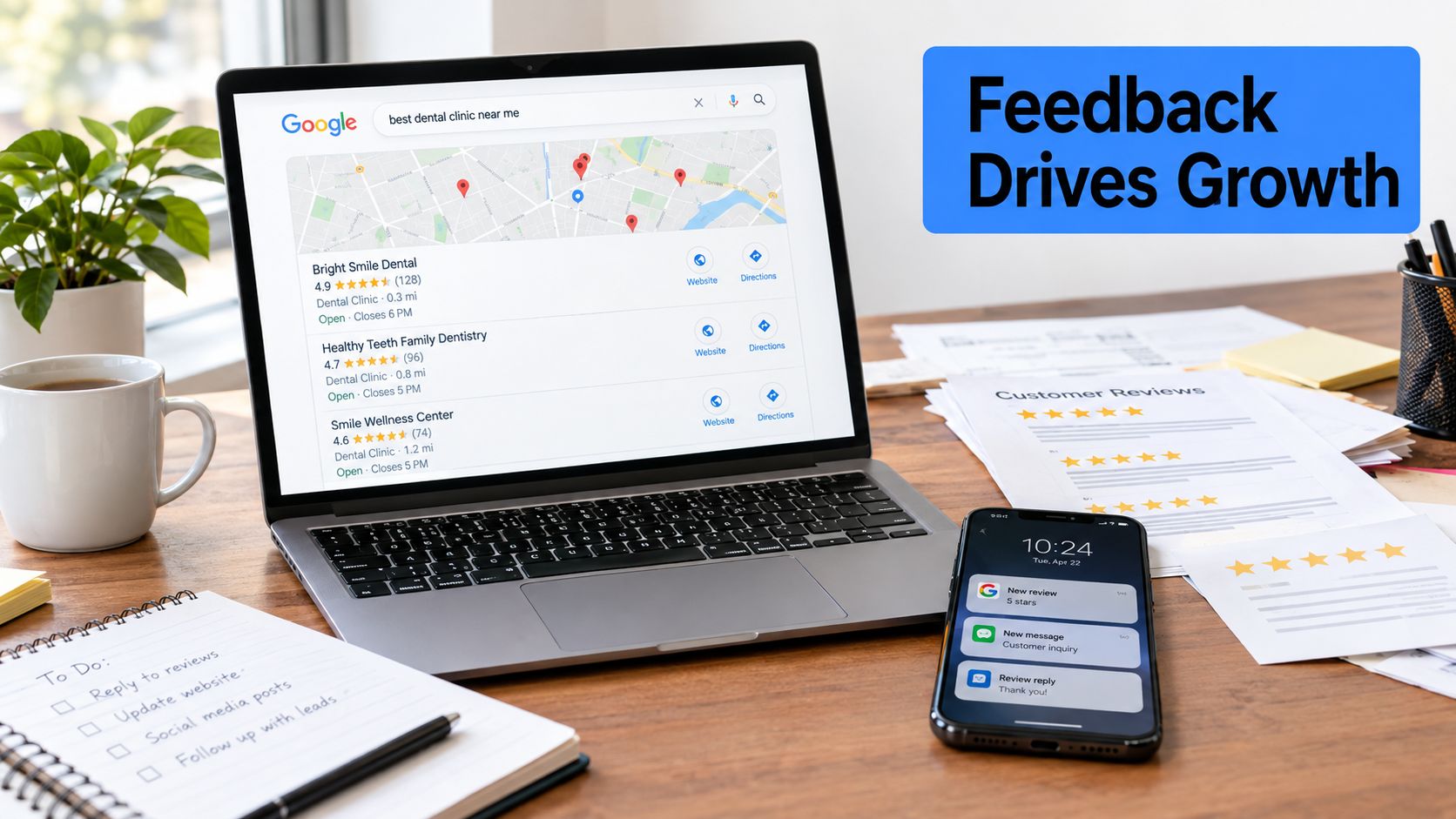
The practical foundation is a clean, actively managed profile. Businesses that want to audit review workflows, profile details, and public responses can use Transactional's Google reviews resource as part of that process. The objective isn't to chase stars in isolation. It's to build enough accurate, recent, service-specific evidence that the next transactional searcher has a reason to call.
What Customer Feedback Management Actually Is
Customer feedback management is the disciplined process of capturing customer signals, organizing them, assigning responsibility, responding appropriately, and changing the operation when the evidence justifies a change.
That definition is broader than asking for reviews. It includes Google reviews, post-job surveys, complaint calls, chat messages, social posts, emails, technician notes, and front-desk observations. A business that collects reviews but never identifies recurring missed appointments has a collection habit, not a management system.
Google says local systems can use publicly available information, including content crawled from a business's official website, when sourcing and using information for local listings. (Google local listings documentation) Your website, service pages, Business Profile, and review responses therefore form a connected public information surface.
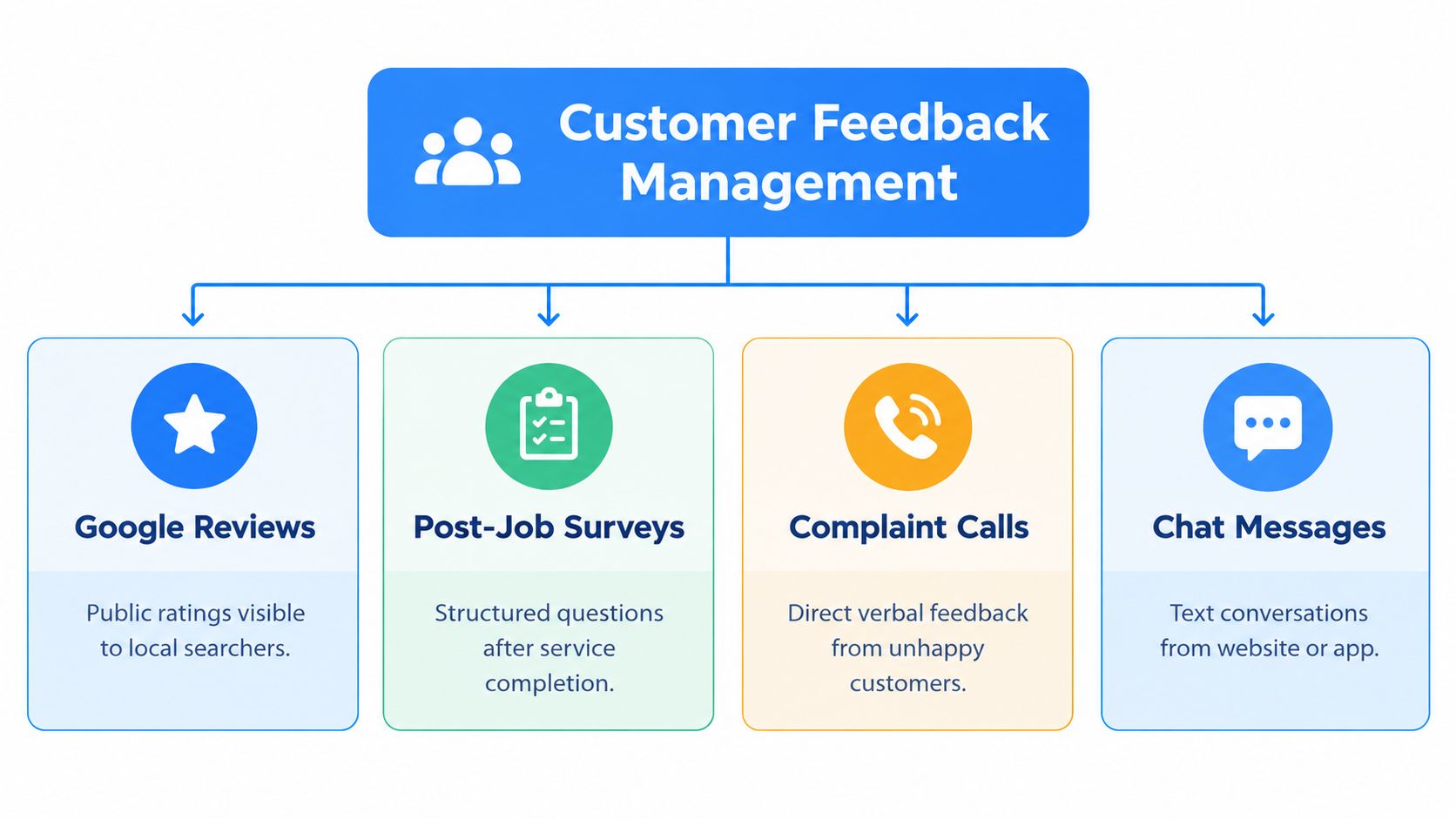
Four audiences need different outcomes
A useful system serves four groups at once:
- The customer: They need acknowledgment, a clear next step, and a resolution that matches the issue.
- The technician or provider: They need specific information about what happened, not a vague low-rating alert.
- The owner or location manager: They need patterns by city, service line, employee, and journey stage.
- Google's local systems: They need consistent, publicly available information that makes the business identity, services, and operating area understandable.
A dental practice, for example, shouldn't combine feedback about emergency appointments, cleanings, insurance billing, and front-desk communication into one undifferentiated score. A pest-control company needs to know whether complaints involve scheduling, treatment effectiveness, recurring infestations, or unclear preparation instructions.
The workflow can stay simple. Tag each item by sentiment, service line, city, technician, issue type, and resolution status. Assign one owner. Record the response. Then decide whether the issue belongs in training, scheduling, pricing, website content, or a public reply.
A profile can have an impressive average rating and still hide a serious operational problem. The essential question is whether the team can connect a complaint to the job, the responsible process, and the next measurable outcome. Businesses looking for a broader reputation workflow can review online review management as one component of that system.
The Four Stages of a Working Feedback Loop
A local feedback loop has four controllable stages: collection, analysis, response, and improvement. The stages only create value when each one produces an action for the next.
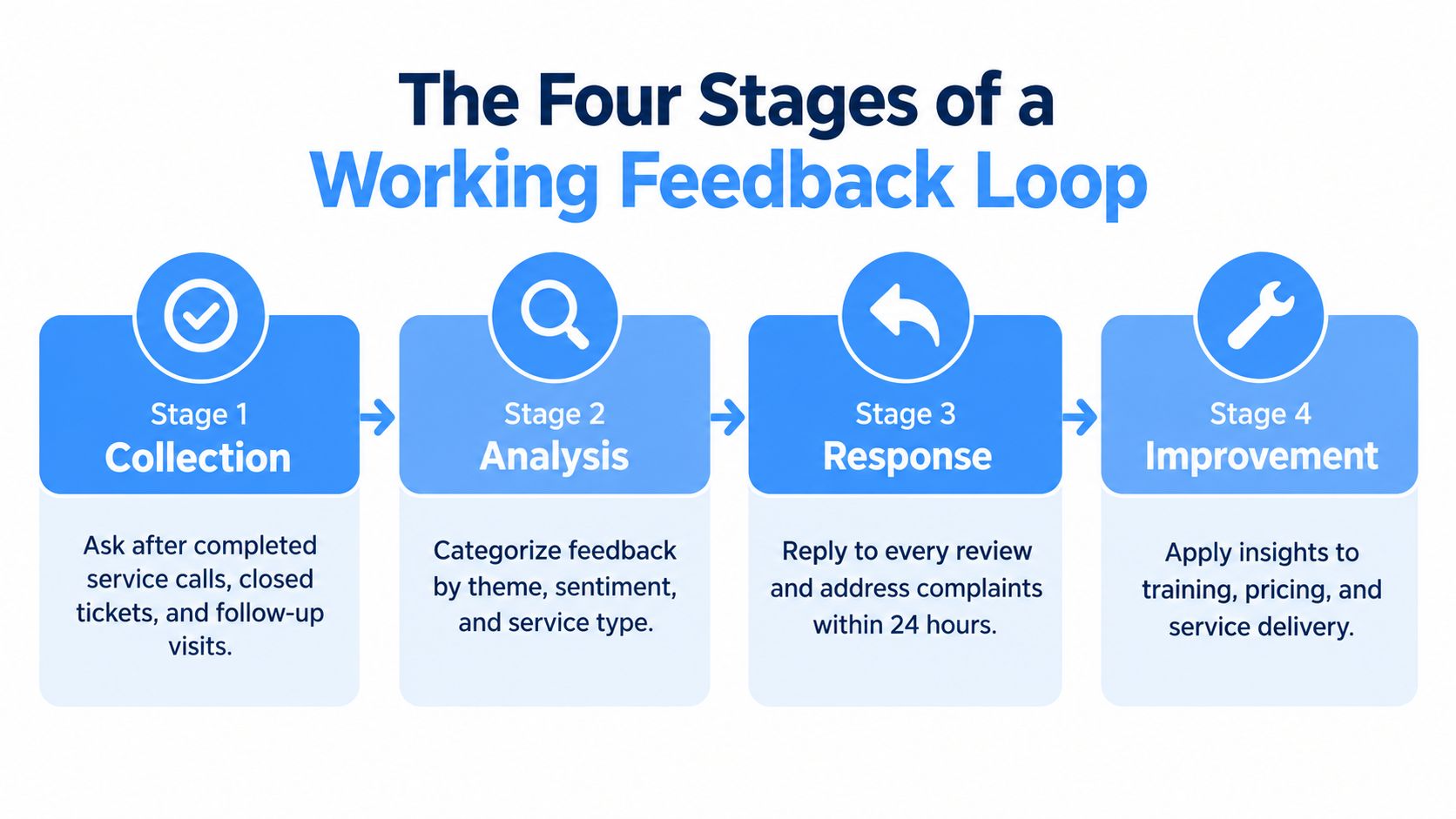
Collection starts at the service event
Ask after a completed HVAC call, a closed plumbing ticket, a finished pest treatment, or a completed dental appointment. The best channel is usually the one already attached to the customer relationship, such as SMS, email, a phone follow-up, or a booking platform. Don't force every customer into a new application just because the marketing team prefers its dashboard.
A request should invite honest feedback rather than pressure a customer to leave a positive review. If the customer raises a problem, route that signal for recovery. If the customer describes a successful experience, provide a clear path to the public review channel.
For healthcare businesses, patient communication tools such as TOOLii's patient engagement software may support structured follow-up across appointment-related touchpoints. The tool is less important than the trigger, ownership, and next action.
Analysis turns scattered comments into operating data
A small business doesn't need a data department. It needs a controlled vocabulary that staff can apply consistently. Useful tags include:
- Sentiment: positive, mixed, negative, or urgent.
- Service: repair, replacement, inspection, emergency visit, cleaning, treatment, or consultation.
- Location: city, branch, service area, or zip code.
- Issue: arrival window, communication, price clarity, workmanship, billing, safety, or outcome.
- Owner: technician, dispatcher, office team, provider, or manager.
Analysis should compare feedback with behavior. If customers complain about late arrivals, check cancellations, rescheduled jobs, missed calls, and repeat bookings in that service area. A single complaint may need a direct response. A repeated theme may justify a scheduling change.
Response has two jobs
Every public review deserves a specific reply. Positive reviews should be acknowledged in a way that sounds human and references the actual experience. Negative reviews need a calm response, a non-defensive explanation when appropriate, and an offline path for resolving account-specific details.
The response isn't an opportunity to reveal private information. Never publish medical details, addresses, payment information, access codes, or other sensitive facts. Move those matters to a private channel and keep the public reply concise.
Improvement closes the loop
A complaint isn't resolved when someone types “handled” into a spreadsheet. Record the issue, assign the owner, document the promised resolution date, confirm the customer's view of the outcome, and check whether the underlying pattern changes.
For local SEO, the improvement may also affect the website. If several HVAC customers use the phrase “same-day AC repair,” that language can inform a service page when it accurately describes the offer. Follow-up automation can help maintain the cadence, but staff still need to decide what the feedback means and which operational change is justified.
How Feedback Signals Feed Google Business Profile and the Map Pack
Google's local model gives operators three practical levers: relevance, distance, and prominence. Feedback work mostly influences prominence and relevance. It can't change the physical distance between a searcher and a branch, but it can help Google and customers understand what the business does and how active it is.
Relevance begins with explicit service information. A roofing profile that clearly describes roofing services is easier to match to a roofing query than a generic profile that only says “construction.” The website should support that clarity with separate, useful pages for roof repair, roof replacement, and storm damage when those are real services.
Distance is location-dependent. A business can't use review responses to become physically closer to every searcher. It can, however, maintain accurate location and service-area information so customers and local systems aren't forced to guess where the company operates.
Prominence reflects public recognition and reputation. Review count, review ratings, review activity, and other web signals contribute to how established a business appears. Google does not promise that a specific review strategy will produce a specific map position, so avoid anyone who guarantees a permanent top-three placement.

Turn customer language into accurate content
Suppose an HVAC owner receives several legitimate reviews describing “air conditioning repair near me,” “frozen condenser,” and “same-day AC service.” The owner can respond specifically, check whether the profile accurately lists air conditioning repair, and update the relevant service page with clear information about the actual service. The change should improve customer understanding, not insert awkward phrases into unrelated copy.
Google's local information ecosystem draws from public web content, so maintaining a consistent business identity across the profile and official website matters. A broader map of public web data can help marketers think about how information moves across the public web, but local operators still need to verify every business detail at the source.
A response such as “We're glad our team could complete your emergency AC repair in Fort Collins” is more useful than a template thanking someone for their feedback. It names the service and location naturally, reflects the customer's experience, and gives future searchers context without pretending that a reply alone guarantees ranking gains.
Businesses can review the fundamentals in what is Google Business Profile before changing categories, services, descriptions, or location details. The map pack is not won by stuffing review responses. It's strengthened by accurate information, genuine customer activity, and an operation that delivers what the profile promises.
Response Rules and KPIs That Actually Move the Phone
A response policy should help a dispatcher, office manager, and owner make the same decision when a review arrives. It must also distinguish public acknowledgment from private service recovery, because a polished reply cannot repair a missed appointment or unresolved billing issue.
Use these operating rules:
- Respond to every review. Thank customers for positive feedback and acknowledge negative experiences professionally.
- Set a documented service level. Record the expected acknowledgment time and the escalation path for unresolved complaints.
- Name the service and city naturally. Include genuine context, never repeated keywords or manufactured wording.
- Protect private information. Move medical, payment, safety, property-damage, and account-specific discussions offline.
- Assign a human owner. A qualified person should receive sensitive complaints within one business day.
- Separate acknowledgment from resolution. A quick public reply is not proof that the customer's problem is fixed.
A peer-reviewed complaint response study found that longer response times were negatively associated with satisfaction and repurchase intent. The study reported a repurchase-intent coefficient of β = -1.625 with p = 0.018. Delays beyond 17 days were associated with a lower likelihood that a customer would use the business again.
A separate study of satisfaction and future business performance found that response behavior can matter beyond the individual complaint. Average satisfaction scores had the strongest overall predictive value for future business performance, while “Top 2 Box” satisfaction ratings also showed strong predictive value. Repurchase likelihood and complaint share predicted some performance dimensions, whereas recommendation-intention and recommendation-behavior measures had little or no predictive value in that study. (Satisfaction and future business performance study)
The practical rule is straightforward: respond promptly, write specifically, and assign someone to finish the recovery. Review activity supports the transactional search engine only when it reflects a business that answers customers and fixes recurring service failures.
Choose KPIs that expose the leak
| KPI | Single-location shop | Multi-location operation |
|---|---|---|
| First-response time | Track by review sentiment and channel each week. | Compare branches and escalate locations that consistently lag. |
| Full-resolution time | Record the time from complaint to verified customer resolution. | Segment by city, service line, and responsible team. |
| Response coverage by sentiment | Check whether positive, mixed, and negative reviews all receive replies. | Compare coverage across locations and identify template-heavy responses. |
| Repeat-booking rate | Compare customers with resolved issues against the normal repeat pattern. | Review retention by branch, provider, and complaint category. |
| Complaint recurrence by service line | Count repeated themes such as late arrival or unclear pricing. | Rank recurring issues by location and assign a regional owner. |
| Change in Google Business Profile calls | Compare call activity after the prior month's review work. | Compare call movement with review activity and profile changes by city. |
Use satisfaction alongside repeat bookings, cancellations, complaint rates, response times, and lead conversion. A single rating can hide a slow dispatcher, recurring pricing confusion, or a service line that produces calls but few completed jobs.
For a roofer, plumber, dentist, or HVAC company, the phone metric is the commercial test. Track whether better response coverage and fewer recurring complaints coincide with more qualified calls, rather than treating review volume alone as success.
A 30-60-90 Day Roadmap for a Local Service Operator
A feedback program becomes manageable when the rollout follows the realities of a service business. The first stage is cleanup, the second creates cadence, and the third tests whether operational changes produce better commercial outcomes.
Days 1 through 30 focus on the baseline
Pull reviews, survey responses, complaint notes, chat transcripts, and front-desk records into one working view. Clean the Google Business Profile so each real service, location, and service area is represented accurately. Check that the website has useful pages for the services customers search for, rather than one generic page that combines unrelated work.
Create a simple tagging sheet with fields for city, service line, technician or provider, sentiment, issue type, response status, and resolution status. Don't wait for a complex platform. A consistent process in a shared system is more valuable than an expensive dashboard nobody updates.
Days 31 through 60 create a repeatable rhythm
Set a post-service review request trigger after completed calls, finished treatments, closed tickets, or completed appointments. Establish separate response expectations for positive and negative feedback, then assign one person to review unresolved cases each week.
Measure first-response time, full-resolution time, response coverage, repeat bookings, complaint recurrence, and Google Business Profile call activity. Keep the dashboard small enough that the owner can inspect it without needing an analyst.
Days 61 through 90 test one change
Choose the most repeated complaint theme in each priority city. If customers repeatedly mention missed arrival windows, test a dispatch or scheduling adjustment. If dental patients describe confusing billing explanations, revise the front-desk communication process. If pest-control customers misunderstand preparation instructions, update the confirmation message and service page.
Document the change, its owner, launch date, affected service area, and expected behavioral result. Then compare repeat bookings, cancellations, complaint recurrence, and inbound calls in the relevant area. Don't claim causation from one movement in the data. Look for a consistent pattern and investigate other changes that might have influenced it.
The first 30 to 60 days should build the feedback loop rather than promise instant ranking outcomes. As Google processes new review activity, response language, accurate profile information, and service-specific website content, transactional terms such as “air conditioning repair near me” and “dentist near me” can become clearer targets for measurement. Rankings still depend on competition, relevance, distance, prominence, and execution.
Connecting Feedback to AI Search and Transactional Wins
Google describes AI Overviews as AI-generated snapshots that provide key information and links for further exploration. (Google AI Overviews documentation) Local businesses should respond with accurate, public evidence, not a separate shortcut. Clear service pages, complete Business Profile fields, consistent business details, and specific review responses help search systems understand what the company does and where it operates.
For a search such as “roofer near me,” the buyer has a current need and is ready to compare providers. The operating loop is straightforward:
- Clean profile: Verify services, categories, location, hours, and contact details.
- Service-specific pages: Explain each real service in plain language.
- Weekly review request: Ask after completed work without pressuring customers.
- Response SLA: Acknowledge every review and route sensitive issues to a human.
- One KPI per complaint theme: Assign a measurable operational check.
- Monthly call review: Compare Google Business Profile calls in the cities being improved.
Feedback isn't separate from AI visibility or map-pack performance. It supplies the language, evidence, and operational priorities that help local businesses earn attention when customers are searching with intent.
Transactional LLC offers local SEO, Google Maps optimization, Google Business Profile management, review workflows, website development, and AI-driven content planning for service businesses. If HVAC, plumbing, roofing, pest control, dental, chiropractic, or med-spa customers are finding competitors first, visit Transactional LLC to discuss a feedback-led strategy for transactional searches in your service areas.