

A roofing click isn't expensive because Google is greedy. It's expensive because a homeowner typing roofer near me with water coming through the ceiling has money in hand and every credible contractor in the city wants that call. That urgency is exactly why Google Ads for roofing can work, and why it burns budgets fast when you treat lead volume as the goal. The profit question comes first. Which searches produce serviceable, bookable, profitable jobs for your crews, and what can you pay for each type before margin disappears?
Why Roofing Ads Cost More and What That Means for Your Budget
Start with the benchmark, not a guess. LocaliQ benchmark data covering 3,211 home-services campaigns reported an average roofing-and-gutters cost per lead of $228.15, compared with an overall home-services average of $90.92. That's roughly 2.5 times the cross-trade average, and it sits above plumbing, HVAC, electrical, and cleaning in the same breakdown.
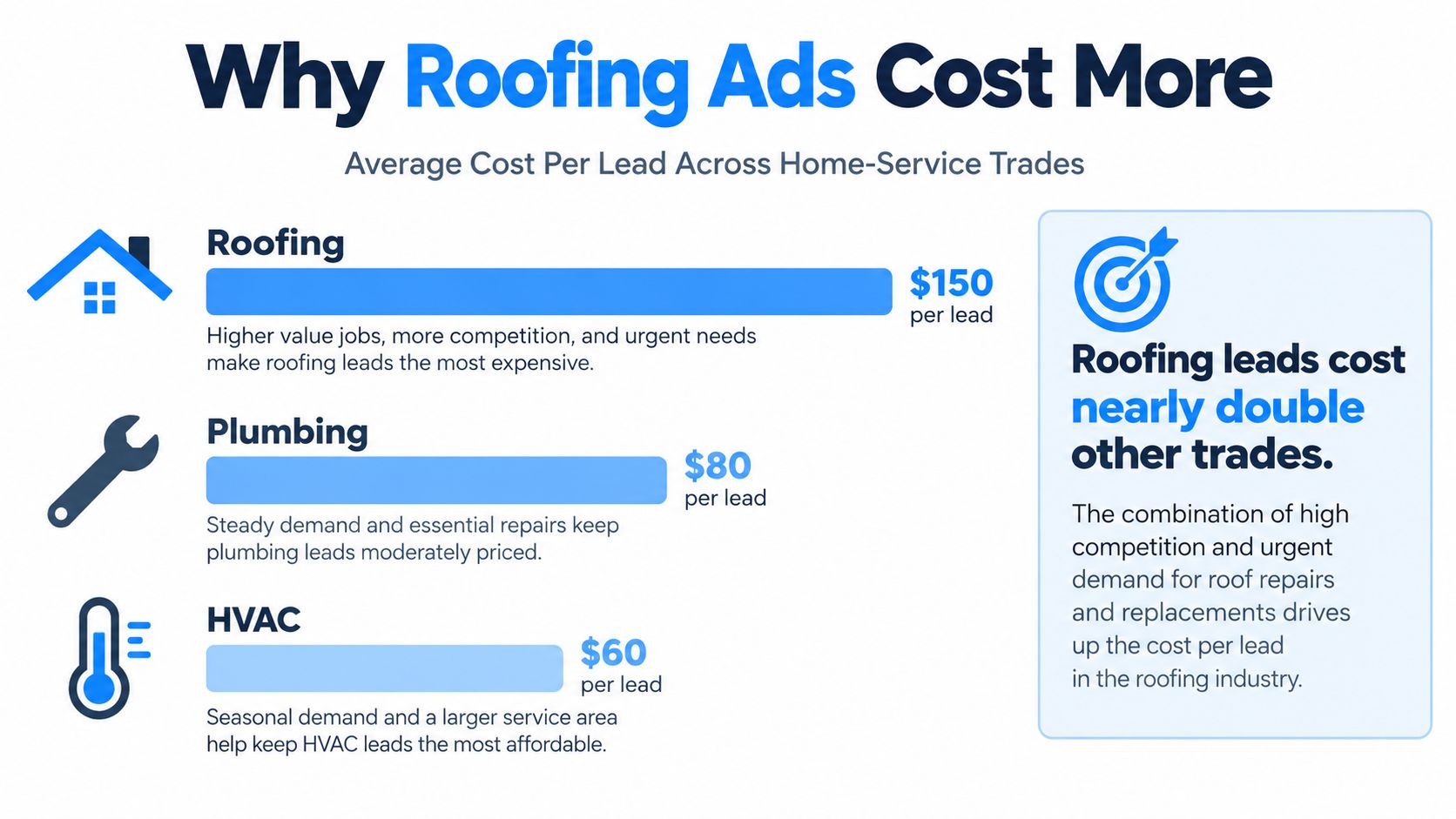
The economics make sense. A single replacement project can be worth thousands of dollars, so advertisers tolerate acquisition costs that would sink a lower-ticket service business. The mistake is applying one allowable cost per lead to every job type.
Run the break-even math before you spend
Use this formula for each service line separately.
Allowable CPL equals average gross profit per job multiplied by your lead-to-sale rate.
Work backward from your own numbers. What's your qualified-lead rate after spam, renters, and out-of-area callers are removed? What share of qualified leads book inspections, show up, and close? What's gross profit per completed roof after materials, labor, and cancellations?
- Replacement leads: Higher job value can support a higher CPL if close rate holds.
- Minor repair leads: The same CPL can erase profit before a crew rolls.
- Inspection leads: Judge them on inspection-show rate and downstream close rate, not form fills.
A campaign generating leads below the benchmark isn't automatically efficient. Cheap leads that don't book are still waste. Expensive replacement leads that close at healthy margin can be your best buy.
Treat the benchmark as directional, not a forecast. City, storm activity, service type, match settings, landing-page quality, call tracking, and bidding strategy all move actual costs. If you're modeling a first budget, our breakdown of Google paid search cost helps you translate those inputs into a starting spend range. Don't launch until you know, by service, the CPL you can afford and the crew capacity behind it.
Mapping Transactional Roofing Searches Before You Build a Single Campaign
Transactional Marketing is built around transactional search terms, phrases typed by someone ready to spend, not someone browsing. Roofer near me, emergency roof repair near me, and roof replacement near me signal that intent. Map those phrases before you open Google Ads.

Five intent buckets worth separating
- Emergency leak repair: Urgent, phone-first, often decided on response speed and service area clarity.
- Storm and hail damage: Event-driven volume, insurance questions, and more out-of-area noise.
- Full replacement: Higher ticket, longer consideration, financing and material questions matter.
- Inspections and insurance claims: Mixed intent. Some callers need documentation, others become replacement jobs.
- Branded searches: People already looking for you by name. Protect them cheaply and measure them separately.
Contrast those with research, DIY, and job-seeking queries. How-to searches, materials pricing, and employment terms drain budget without producing jobs, so they belong on a negative list from day one, not in a cleanup project months later.
Geography changes the economics inside every bucket. Independent benchmark analysis of 135 U.S. cities found a median roofing pay-per-click cost of $16.50 and a median cost per lead of $138.75, with a median conversion rate of 8.25% among cities with conversion data. That gap versus other benchmarks is the point. There's no universal roofing average, so your intent map must be tied to your cities, not a national template.
The video below is useful for seeing how searchers move from query to call when local intent is strong.
Build the map from real query data when you have it. Review Search Console, past call recordings, and search terms, and consider AI agent use cases for paid search when you're sorting large query lists into intent groups. Pair that work with disciplined local keyword research so every bucket has city-level language, not generic statewide phrasing.
Structuring Campaigns by Intent Instead of Service Area
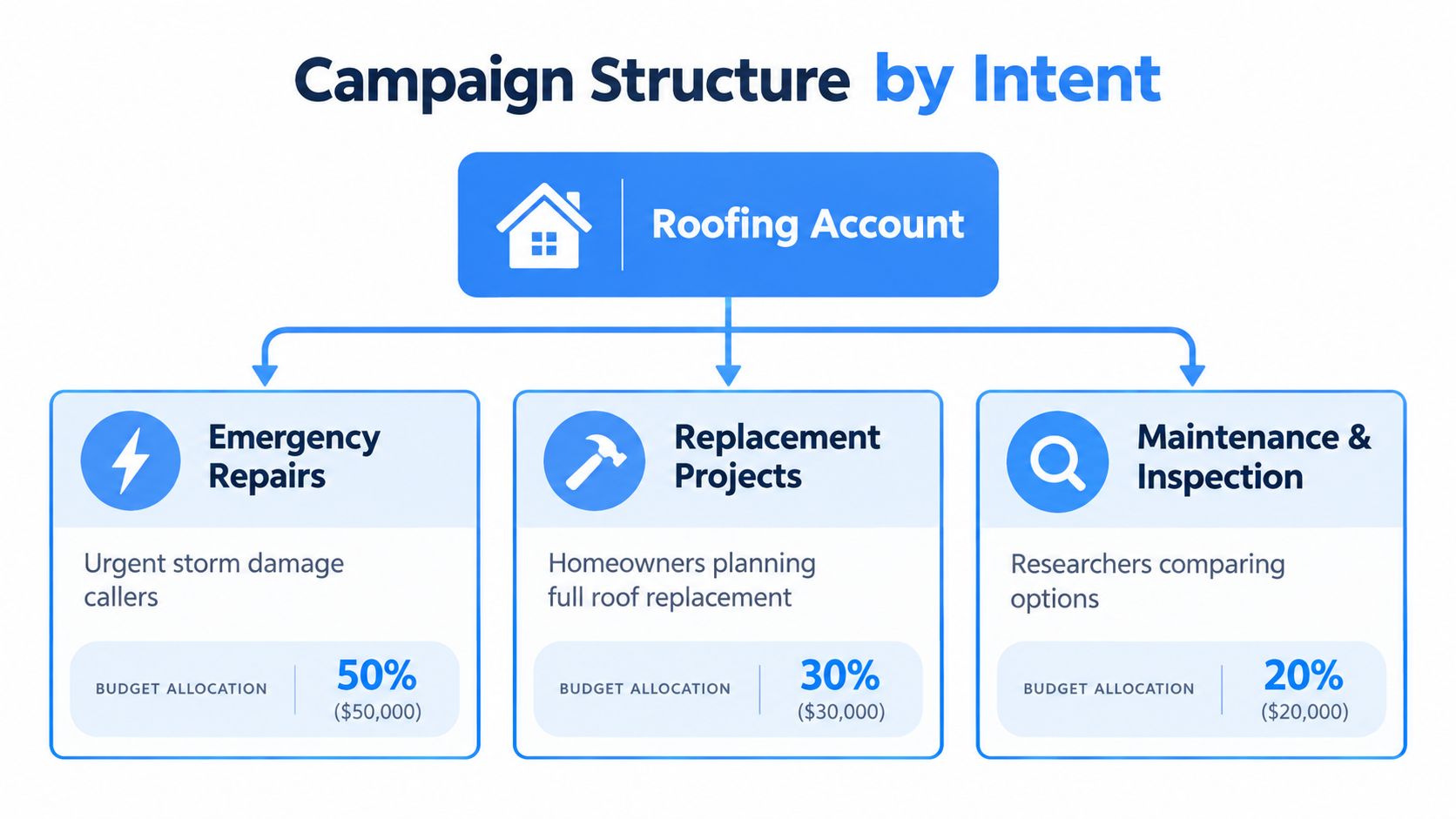
Most broken roofing accounts share one flaw. One flat campaign per market mixes emergency callers, replacement shoppers, and researchers in the same auction, with one budget and one message. Nobody wins that structure except Google.
Split by economic intent first, then layer geography inside each campaign. A replacement search shouldn't compete for budget against a low-ticket repair click, because the allowable CPL, landing page, and follow-up process are different.
| Intent Bucket | Example Searches | Match Type | Primary Conversion |
|---|---|---|---|
| Emergency repair | emergency roof repair near me | Exact and phrase | Qualified call |
| Leak repair | roof leak repair near me | Exact and phrase | Qualified call |
| Replacement | roof replacement company near me | Exact and phrase | Booked inspection |
| Storm damage | storm damage roof repair | Exact and phrase | Qualified call |
| Inspection | roof inspection near me | Exact and phrase | Booked appointment |
| Branded | your company name plus roofing | Exact | Call or form |
Build rules that prevent waste
Use tightly themed ad groups within each campaign. Don't put leak repair and full replacement in one ad group and hope one ad serves both. Keep exact and phrase match as your core for high-intent queries, and review search terms weekly so loose matching doesn't rewrite your strategy.
Start with a shared negative keyword list on day one. Block DIY, training, jobs, materials, and free estimates if those leads aren't qualified for your model. Add roof types you don't install, services you don't offer, and cities you don't serve. Negatives aren't housekeeping. They're margin protection.
A campaign structure should mirror how money is made in the business, not how the service area looks on a map.
Geography still matters, just at the right level. Segment reporting by city or service zone, use location-specific copy, and send each theme to a geographically matched page. If you want a primer on campaign organization before you rebuild, this guide on how to organize Google Ads for lead generation covers the structural logic well.
One caution. Don't fragment so far that no campaign gets meaningful volume. Intent separation is the goal, but six campaigns starving on scraps won't outperform three well-funded ones. Consolidate low-volume themes where the economics and landing page match.
Writing Roofing Ad Copy and Landing Pages That Match the Search
Generic copy is where roofing budgets bleed out. A homeowner searches for storm damage help, clicks an ad that says you do quality roofing since forever, and lands on a homepage that never mentions storms, tarping, or insurance documentation. They leave. You paid.
Mirror the searcher's situation. Name the service, name the city, and address the urgency in plain language.

A practical rewrite
Weak headline set. Quality Roofing Company. Call Today. Free Estimates.
Stronger headline set for a storm query. Storm Damage Roof Repair in Dallas. Emergency Tarping Available. Licensed and Insured Roofers.
The second version doesn't promise what you can't staff. It tells the right homeowner they're in the right place and tells the wrong one to self-select out. State service boundaries, roof types, inspection fees, minimum repair scope, and whether you handle insurance claims. Disqualification in the ad is cheaper than disqualification on a recorded call.
What the landing page must carry
- One primary conversion action: Click-to-call for emergency themes, booking for inspections. Don't split attention across five equal buttons.
- Visible service area: City and neighborhood relevance should be obvious without scrolling.
- Trust details: License or insurance information, financing details where offered, and real response expectations.
- Real project photos: Your crews, your roofs, your market. Stock imagery undercuts local trust.
- Matching language: The headline should confirm the exact service the ad promised.
This is also where paid search connects to SEO and AI optimization. Clear, accurate service and location information helps your website and Google Business Profile present a consistent identity, which supports visibility in conventional results, Maps, and AI-generated local answers. Don't stuff keywords into a Business Profile name or chase a guaranteed map position. Build complete categories, services, and profile details that accurately describe the company. For headline and description discipline, these ad copy best practices are a solid working checklist.
Smart Bidding Decisions When Volume Is Too Low to Automate
Automation isn't a strategy. It's a tool that needs enough clean conversion data to learn, and most segmented roofing campaigns don't give it much.
Industry guidance on automated bidding volume suggests automated bidding generally needs roughly 15 to 30 monthly conversions per campaign to perform reliably, which implies highly segmented roofing campaigns may need manual or portfolio bidding. Split your account into emergency, replacement, repair, and storm campaigns, and each one may sit well below that range for months.
Match the bid strategy to the data you actually have
Manual CPC fits new or low-volume campaigns where you need control while you learn which queries, cities, and devices produce qualified calls. It's slower, but it won't chase bad form fills at scale.
Target CPA only makes sense when the conversion it optimizes toward is economically meaningful. Point it at raw form submissions and it'll find more raw form submissions. Point it at qualified calls or booked inspections, with enough volume, and it becomes useful.
Maximize conversion value is the strongest option when you import qualified-lead and closed-revenue values. Without offline revenue attached, value is guesswork, and replacement jobs get weighted the same as minor repairs.
Practical rule: Don't hand bidding to automation until you'd trust the conversion definition with your own payroll.
Portfolio bidding can help related low-volume campaigns share learning, but don't pool intents with wildly different allowable CPLs just to reach a volume threshold. Pooling emergency repair with replacement teaches the system an average that fits neither.
Set initial bids from your allowable CPL and expected conversion rate by service, then adjust by device, schedule, and city based on booked outcomes. After-hours clicks deserve scrutiny. If nobody answers, or calls roll to voicemail during storm weeks, you're buying demand for competitors who staff the phones. Bidding discipline is mostly refusal. Refuse traffic you can't serve, at hours you can't answer, at prices your margin can't support.
Tracking Calls Forms and Booked Jobs Not Just Clicks
Cost per lead is a dashboard number. Cost per booked, completed job is the business number, and most roofing accounts optimize toward the wrong one.
Set up separate conversion actions for calls, forms, chats, and booked appointments. Don't merge them into one blended conversion and then wonder why bidding chases cheap form fills from people who never answer a callback.
The minimum viable tracking stack
- Call tracking with a duration threshold: Short calls, wrong numbers, and robocalls shouldn't count as conversions.
- Deduplication: Repeat callers and existing customers should be identified, not double-counted as new demand.
- Call outcome fields: Record caller location, service requested, appointment outcome, and duplicate status at intake.
- CRM stages: Qualified, inspection booked, inspection shown, sold, completed, cancelled.
- Offline uploads: Import qualified-lead and closed-revenue values back into Google Ads when possible.
If you're wiring this up yourself, a solid GA4 and GTM conversion setup guide will help you keep tags, events, and conversion imports consistent. Pair it with a clear understanding of what call tracking changes operationally for intake teams, not just marketers.
Don't let Quality Score distract you from that plumbing. Google's Quality Score documentation states it's a keyword-level diagnostic scored 1 to 10 evaluating expected click-through rate, ad relevance, and landing-page experience, and that it is not a key performance indicator or direct auction input. Use it to spot weak message match. Don't manage the account to raise a diagnostic while booked-job rate falls.
Report by device, service, city, and lead type every week. A campaign with a fine CPL and a poor inspection-show rate is a sales-capacity problem wearing a marketing costume. A campaign with a higher CPL and strong close economics deserves more budget, not a pause. You can't tell those apart without offline outcomes.
Storm Mode Operations When Demand Spikes
The common storm advice is simple and wrong. Raise budgets, raise bids, capture demand. In practice, storm weeks are where roofing campaigns either make the year or buy a mountain of unserviceable calls.
Storm searches bring homeowners outside your service area, renters, DIY researchers, insurance-only inquiries, and duplicate calls from the same household trying three numbers. Crews book out. Phones go unanswered. Every missed call in that window is ad spend converted directly into a competitor's booked inspection.
Platform cleanup won't save you either. Recent reporting on Google Local Services Ads changes says Google replaced manual lead disputes with an automated credit process and removed certain credit categories, including jobs or geographies a contractor does not service. You can't plan on disputing your way out of sloppy targeting anymore. Prevention beats credits.
Write storm rules before the weather hits
- Verified zones only: Temporary budget increases apply only in service areas you can staff, confirmed against actual storm impact, not a statewide radius.
- Pause triggers: Define the booked-capacity point where campaigns pause automatically. Decide it calmly now, not at midnight with a full board.
- Pre-built negatives: Keep a storm negative list ready for roof types, services, and locations you decline, so surge traffic gets filtered on day one.
- Boundary copy: Ads and pages should state service area, minimum repair scope, inspection fees, and whether insurance claims are handled.
- Intake script: First questions confirm address, roof type, damage type, and homeowner status before anyone promises a visit.
You also need a documented attribution habit during surges. When call volume spikes, intake teams stop logging outcomes, and two weeks later nobody can say which campaigns produced completed jobs. Protect the logging. It's the only evidence you'll have when you decide what to fund during the next storm.
The right storm question isn't how many leads ads generated. It's how many incremental, serviceable jobs were booked and completed at a profitable margin.
Your first four weeks, in order
Week one. Build campaigns by intent, apply the starter negative list, and publish matching landing pages. Verify call tracking, form tracking, and CRM stages with test calls before real spend flows. Checkpoint. Every conversion action fires once, with the right label.
Week two. Launch with manual or portfolio bidding where volume is thin. Review search terms at least weekly, ideally more often early, and move wasteful queries to negatives fast. Checkpoint. No ad group is spending meaningfully on queries you'd never bid on directly.
Week three. Compare performance by city, device, service, and lead type. Listen to calls. Recalculate qualified-lead rate and inspection-show rate against your break-even assumptions. Checkpoint. You can name which intent bucket produces booked inspections, not just conversions.
Week four. Upload offline outcomes, shift budget toward buckets with proven close economics, and only then consider stronger automation where volume supports it. Checkpoint. Budget decisions reference booked jobs and gross profit, not CPL alone.
This is also where paid search should stop carrying the whole local growth burden alone. Transactional Marketing pairs paid campaigns for transactional terms like roofer near me with Google Maps optimization, local SEO, and AI optimization, so a roofing company shows up across search, Maps, and LLM-driven results when buyers are ready to call. Ads rent demand. A strong local presence keeps capturing it between storms, when clicks are cheaper and competitors go quiet.
Run Google Ads like an operator, not a media buyer. Protect margin by intent, staff what you buy, and make every storm rule before you need it.
If you want roofing campaigns built around transactional searches, tracked to booked jobs, and supported by Maps, local SEO, and AI optimization instead of dashboard lead counts, talk to Transactional LLC. We'll help you model allowable cost per lead by service, structure campaigns by intent, and turn ready-to-spend local searches into inspections your crews can run.