


It's a hot afternoon, the house is getting warmer by the hour, and the air conditioner has just quit. You're not looking for a lecture on how cooling works. You're looking for someone nearby who can come out, diagnose the problem, and fix it. That moment is where home service companies win or lose work, and it's very different from general brand awareness.
Home Service Trades Buyers Search When Ready to Hire
Say that homeowner grabs a phone and types air conditioning repair near me. That phrase tells you three things at once. There's a specific job, there's a location implied by "near me," and there's an intention to hire someone soon. We call that a transactional search because the person is ready to spend money, not just collect background information.
Home service companies are local field businesses that travel to a residence or small property to diagnose, repair, install, or maintain something the occupant has already decided to pay for. The work happens at the home, the crew brings tools and parts, and the buyer usually compares availability, trust, and scope before price alone. That's different from reading a how-to article with no job in mind.
What a Transactional Query Looks Like in Each Trade
The wording changes by trade, but the structure stays the same. A trade or service plus "near me" signals a buyer who wants a call, a visit, or a booked slot.
| Trade | Transactional query | Buyer is ready for |
|---|---|---|
| HVAC | air conditioning repair near me | same-week diagnosis or repair |
| Plumbing | emergency plumber near me | a leak, clog, or fixture repair |
| Electrical | electrician near me | a safety or power problem at the property |
| Roofing | roofer near me | inspection, leak repair, or replacement estimate |
| Pest control | pest control near me | treatment for a named pest at the home |
| Window cleaning | window cleaning near me | a scheduled exterior or interior clean |
| Pressure washing | pressure washing near me | driveway, siding, or patio cleaning |
| Carpet cleaning | carpet cleaning near me | a booked clean for rooms or stairs |
Read the right-hand column as the accurate definition. An HVAC searcher wants a technician, not an essay on refrigerants. A roofing searcher wants an inspection or leak repair, and a pest control searcher usually has a named problem in a kitchen, attic, or yard. If your page, profile, and phone path don't match that immediate job, you're visible for the wrong reason.
It helps to understand how search queries signal buyer intent before you choose keywords. Broad phrases can bring traffic from students, job seekers, or homeowners in another state. Transactional phrases narrow the audience to people your crews could serve this week.
Transactional currently works with businesses in HVAC, plumbing, electrical, pressure washing, carpet cleaning, pest control, window cleaning, and roofing. Dental, med spa, and chiropractic demand is real, but it belongs in separate articles because licensing, booking, and keywords differ from field trades. Mixing those industries into one home service playbook makes the advice too vague to use.
Practical rule: Pick the one query your crews can fulfill this week, in a city you actually serve, and build around that before chasing vanity terms that don't name a job.
Market Size, Trends, and Business Models
Treat home services as several linked trades, not one block. HVAC peaks with heat and cold, roofing follows storms and roof age, and pest control follows seasons and local pest pressure. Window cleaning, pressure washing, and carpet cleaning are more schedulable, while plumbing and electrical work can turn urgent without warning. Each trade has its own labor pool, ticket size, and repeat cycle, so a single market number rarely helps an owner make a hiring or pricing decision.
That's why sizing should be done by trade and by place, with the year and geography attached to any figure you use. A national total won't tell a two-truck electrical shop whether it can add a third technician. Local housing stock, climate, permit activity, and competitor capacity matter more than a headline number copied without context.
Business Models That Change How Demand Feels
An independent owner-operator often sells personal trust and fast decisions, but the owner is also the bottleneck for estimates and callbacks. A multi-location or franchised firm can cover a wider area and staff a call center, yet it has to keep quality consistent across crews. Both models can work, but they shouldn't copy each other's marketing or pricing without checking capacity.
Pricing structure changes the customer conversation too.
- Flat-rate pricing: The customer approves a set price for a defined repair, so your margin depends on accurate diagnosis and efficient work.
- Time and materials: The customer pays for hours and parts, which can feel open-ended if the scope isn't explained clearly.
- Recurring service agreements: Maintenance plans smooth seasonal revenue and keep your company in the home before a breakdown happens.
- Emergency versus scheduled dispatch: Emergency work commands urgency and disrupts the board, while scheduled work lets you route crews efficiently.
Financing offers can shift purchase timing on larger jobs, and tiered proposals give homeowners options instead of a single yes or no. Maintenance memberships also change search behavior. A member may call you directly, while a non-member starts fresh with a near me search and compares whoever shows up.
For owners weighing entry into a trade, the Aloha Window Bros business startup guide is a useful example of trade-specific startup thinking, because window cleaning has different equipment, safety, and repeat-service economics than HVAC or roofing. The lesson transfers even if the trade doesn't. Start with the actual job, crew, and service area, not a generic home service label.
Labor is the constraint underneath all of this. Technician time is tied directly to dispatch capacity, so underpriced labor compresses margin and below-market pay can lengthen vacancies. Seasonal peaks then overload the crews you do have, and rushed estimates create scope gaps that show up later as callbacks or change orders. The levers that follow, pricing bands, dispatch scheduling, local visibility, and call handling, are how you turn demand into booked work without burning out the field team.
How Google Ranks and Measures Nearby Home Services
A short visual summary helps before we get into the mechanics.
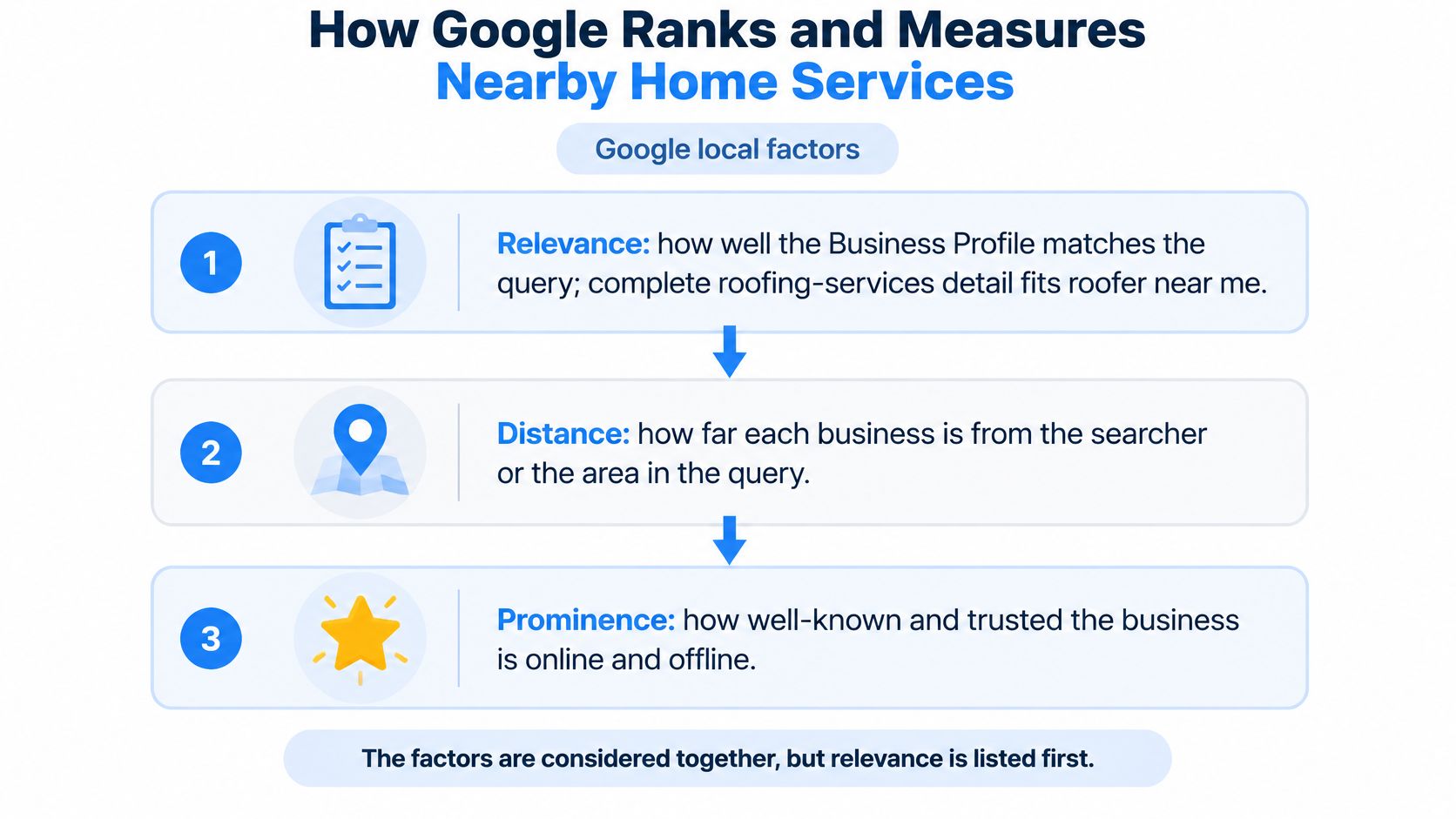
According to Google's guidance on local ranking, local results are primarily determined by relevance, distance, and prominence. Relevance is how closely a Business Profile matches the query, so complete roofing detail fits roofer near me better than a general profile that barely mentions roofs. Distance is how far each result is from the searcher or the place named in the query, and if no place is typed, Google estimates location from available signals. Prominence reflects how well known a business is across the web, including links, articles, directories, review quantity, and review ratings.
Dispatch works the same way. Relevance is sending the right truck for the job. Distance is drive time. Prominence is the reputation the neighborhood already trusts. You need all three working together, and stuffing a keyword into a profile doesn't replace any of them.
Why There's No Guaranteed Top Three Formula
Google also explains in its visibility guidance for local businesses that prominence includes a business's broader web presence and that position in ordinary web results is a local ranking factor. More reviews and positive ratings can help, but Google doesn't describe a fixed threshold of reviews, links, or ratings that guarantees a top three Maps position. Ranking is comparative and query-dependent, and a farther business may outrank a closer one when it's the better match.
Ranking compares you with nearby competitors for that specific search. It isn't a certificate you earn once and keep forever.
That means measurement has to be specific. Track air conditioning repair near me plus each service city, not one national keyword. A useful report shows keyword movement by city, map visibility across the service area, and the exact queries people typed. Our deeper breakdown of local search ranking factors for service businesses follows that service-and-city approach.
The video below walks through the same measurement habit in practical terms.
Client examples should be read as dated, permission-based examples, not promises. Luis's window cleaning company reports top three placement for window cleaning terms in its Los Angeles market, and Tanya's window cleaning company reports first place in its city since 2021. Results like those come from sustained work in a defined market, including industry-specific keyword targeting, technical SEO, and content marketing aligned with that trade's demand.
Transactional LLC focuses that work on transactional searches, the moments when a nearby customer is actively looking for a provider. Broad industry fame doesn't fill a dispatch board. Visibility for the right service, in the right city, when the homeowner is ready to call, is the target.
What AI Answers Get Wrong About Local Companies
AI tools are now part of local research, but use and trust aren't the same thing. The 2025 four-country survey reported by BusinessWire found that 68% of respondents had used ChatGPT to research local products or services, while only 19% trusted AI tools for local search compared with 45% for traditional search engines. Separately, 40% of U.S. consumers reported actively using generative AI in search, and 39% estimated that at least 41% of their searches have local intent.
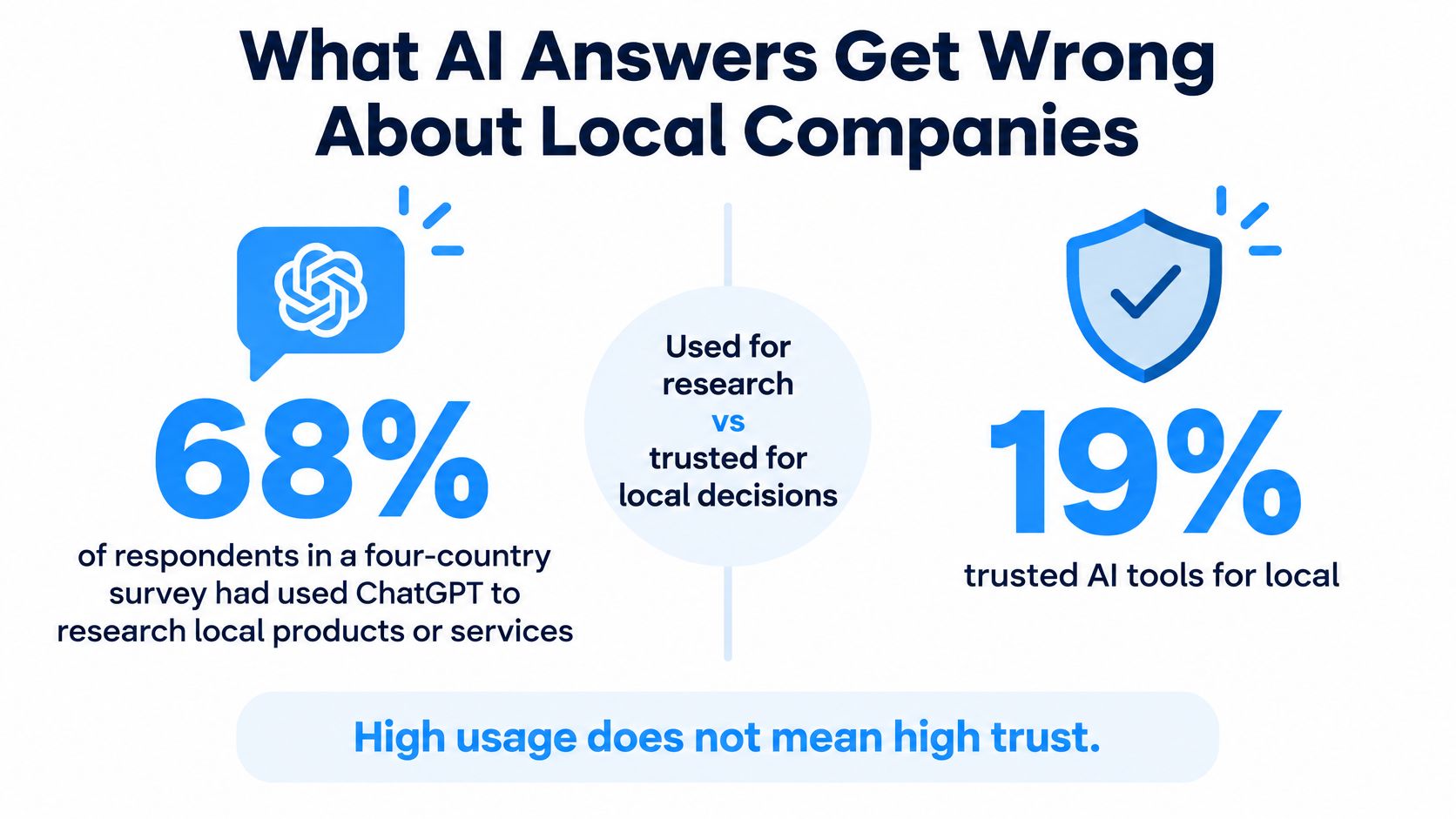
That gap matters for home service companies. A homeowner may ask an AI tool for an HVAC shortlist, then hesitate because the answer sounds confident but can't be checked easily. The failure mode is easy to picture. The AI names a company that no longer covers your suburb, lists emergency hours from an old page, or blends review stories from two different owners into one summary. None of that helps you get a technician to the house.
Verify the Shortlist Before You Call
Treat the AI answer as a shortlist generator, nothing more. Then confirm the facts that affect the job.
| Fact to check | Where to confirm | Red flag |
|---|---|---|
| Service area | Company website and Business Profile service-area list | AI names a suburb the company no longer covers |
| Emergency hours | Current website and Business Profile hours | AI quotes yesterday's emergency window |
| Business ownership | Legal name on the website and the profile owner | Review stories blend two different owners |
| Licensing | State licensing board lookup | License number missing or not matching the company name |
| Diagnostic fee and availability | Phone call to the company | Fee or first open slot is unknown |
| Review context | Independent review sites read directly | Only an AI summary with no underlying reviews |
Read reviews directly instead of accepting a summary, because the summary can flatten important detail. A complaint about scheduling is different from a complaint about workmanship, and a glowing review for window cleaning doesn't prove skill at roof replacement. Call to validate availability and fees, since those change faster than most web pages.
Being mentioned by a model is not the same as being trusted or booked. If your service area, hours, licensing, and ownership facts are stale across the web, both people and machines will repeat the wrong version. Keeping those facts current doesn't force an AI citation, and no honest provider should claim it does. It gives a homeowner something verifiable when the shortlist reaches the phone call stage.
Facts That Help a Search Become a Booked Job
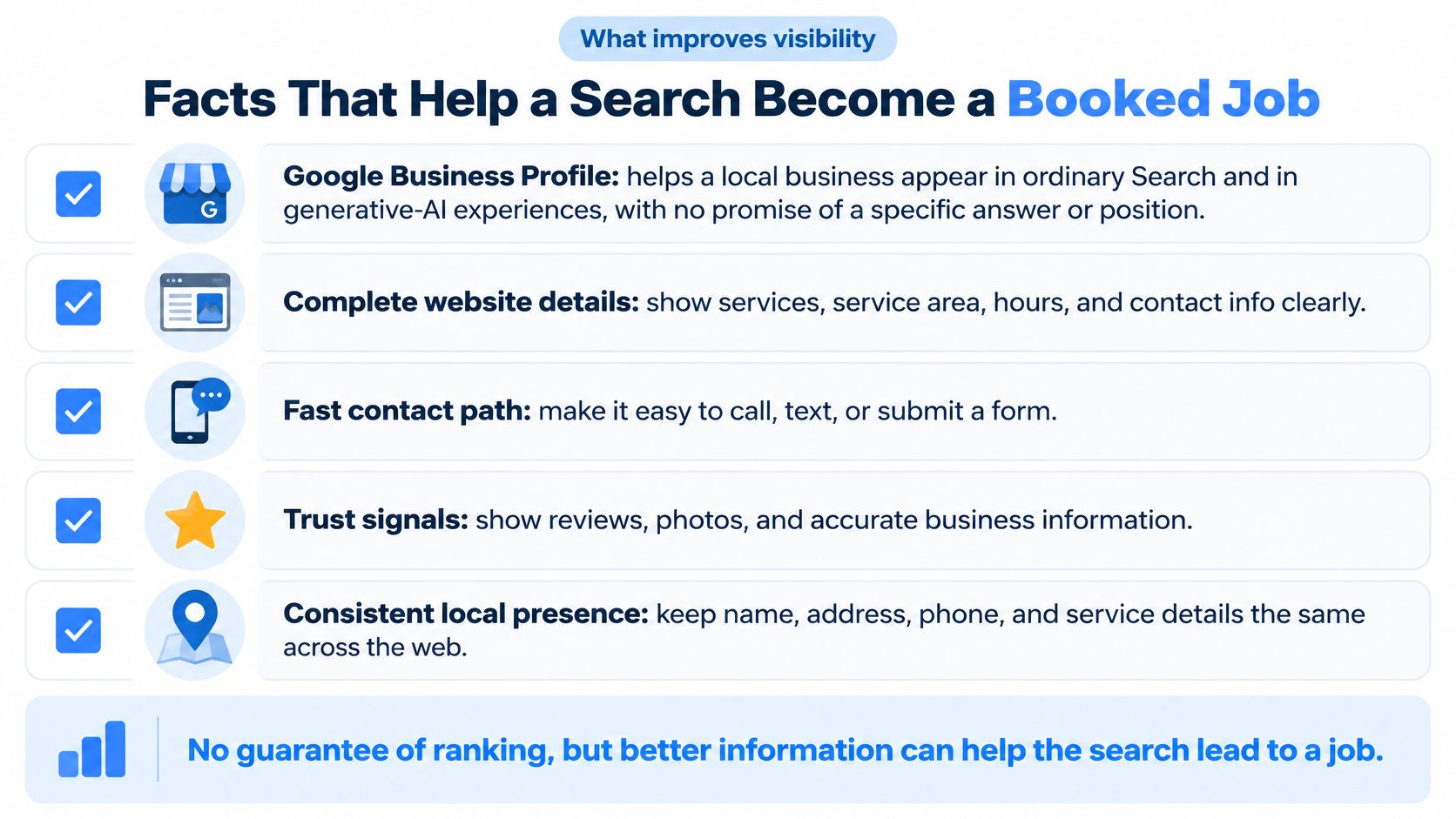
Your Google Business Profile and your website do different jobs, and confusing them creates gaps. Google's guide to optimizing for generative AI features identifies Google Business Profiles as a way to help local businesses make products and services visible in AI responses as well as other Google Search results. It doesn't promise that any business will appear in an AI answer or in a particular position. The profile helps discovery, but it isn't a booking by itself.
What Your Website Needs to Say Clearly
Google's LocalBusiness structured data documentation says businesses can use structured data to communicate details such as operating hours, different departments, and reviews when the site captures reviews about other businesses. Supported local results may display open hours, ratings, directions, and actions such as booking appointments. Structured data doesn't replace a Business Profile, and Google doesn't guarantee a rich result just because markup is installed.
Think of it as a job ticket. If hours on the site disagree with the map pin, the dispatcher and the language model both work from a bad ticket. Keep these facts identical in both places.
- Services offered: Name the actual jobs, such as drain clearing or roof leak repair, not only the trade category.
- Cities served: List the service area your crews will really drive to this week.
- Hours: Show regular hours plus the emergency window, if you offer one.
- Phone number: Use one consistent number that reaches someone who can book work.
- Next action: Give one clear step, such as request service, and test that mobile call path before launch.
Reviews deserve the same consistency, which is why our guide to reviews for local business visibility treats them as business facts to manage, not decoration. A homeowner deciding between two plumbers will read the details, not just count stars.
Our Dominate Local Search Results feature targets appearing on Google's first page and Google Maps when customers search for services in the business's own area. Consider it one option alongside the on-site fixes above, not a substitute for them. The goal stays practical, a call, directions, or a booking from someone searching for a trade near them.
How Homeowners Should Compare Estimates Before Price
The cheapest bid is often not the customer's real problem. Non-comparable estimates are. Two proposals can carry different scope, materials, warranty, and response time, then get judged as if the only difference is price. That's how a homeowner saves money on paper and pays for it in change orders.
Tiered proposals can help when they're written clearly. Contractor research cited in the Uberall local geo playbook found that 54% of thriving U.S. residential contractors offer Good-Better-Best estimates for at least half of their jobs. Treat those tiers as a buying tool. Ask what changes between levels, and what stays the same.
Match the Lines Before You Compare the Total
| Line to match | Ask both bidders | When a higher price can be rational |
|---|---|---|
| Scope | Is the same repair or replacement included | One bid covers hidden damage the other excludes |
| Materials and code | Are products and code items named | Code-compliant materials or documented diagnostics |
| Warranty | Length and who honors it | Longer workmanship or manufacturer coverage |
| Response time | Emergency or scheduled window | Faster availability the household actually needs |
| Diagnostic fee | Waived if the job proceeds or not | A real test, not a free look that skips measurement |
| Financing | Total paid, not just the monthly figure | Transparent terms rather than a teaser rate |
| Change orders | What triggers an extra charge | Written allowances instead of open-ended extras |
Roofing shows the problem clearly. Two roof quotes can't be compared until tear-off, underlayment, and ventilation are either both included or both excluded. The same discipline applies in other trades, including comparing painters' estimates fairly, where surface preparation and coat count change the job behind the number. For any trade, hand both estimators the same one-page worksheet and require the same line items.
HVAC adds a measurement issue. ENERGY STAR's heating and cooling maintenance checklist reports that airflow problems can reduce HVAC efficiency by up to 15%, while properly sealing and insulating ducts can improve efficiency by as much as 20%. Those are generalized upper bounds, not guarantees for every house. Still, a higher quote that measures static pressure, inspects coils and filters, and tests duct connections may be rational, while an unexplained markup with no readings is not.
Ask what was measured, not only what will be replaced. A documented defect is easier to price fairly than a guess.
For operators, labor pricing needs the same discipline. The Bureau of Labor Statistics wage data for NAICS 238220 publishes occupation-level benchmarks across percentiles for plumbing, heating, and air-conditioning contractors. Build territory pay bands from those percentiles, then add payroll taxes, benefits, drive time, tools, training, and nonbillable hours before setting a minimum billable rate. Don't treat that combined category as a pure HVAC or pure plumbing figure without adjusting for trade mix and geography.
Review Your Service Area Before You Buy Ads
Before adding ad spend, ask whether organic near me visibility is the missing job. Ads can rent attention quickly, but they also send traffic to the same profile, pages, and phone path that organic visitors use. If those facts are inconsistent, paid clicks leak in the same places free clicks do.
Our starting point is simple. Schedule from the calendar on transactional.net, complete the intake form, and review how your company currently appears for its service area. We offer a free audit and a free consultation for home service businesses, and the engagement is contract-free. The work is built for owners who don't want to run marketing themselves.
A Short Decision Check
You're a fit for that review when most of these are true.
- You have a website: Our service doesn't work for businesses without one, because searchers need a place to verify services and contact you.
- You serve defined cities: Crews work in named areas, not an unlimited region.
- You want transactional calls: Phrases such as roofer near me matter more to you than broad industry fame.
- You can handle follow-up: Someone answers, returns calls, and books the estimate.
New businesses can start, and clients can expect to see movement fairly soon, but that isn't a dated guarantee. Competitive cities, thin review profiles, and limited service capacity all affect pace. Measure the work with service-and-city queries, and use tools such as Google Maps heat maps for service areas to see where visibility is strong or weak across the territory you drive.
Pricing should be clear before you decide. The Maps plan is $1200 per month as the map-focused option. A Maps plus ads plan is a different choice at $2500 per month plus ad spend, with a $2000 ad spend minimum, so ads are optional rather than the default. That distinction matters if your first problem is that nearby buyers can't find you organically.
Bring one priority service and one city to the consultation. That gives the first scoreboard a real query, such as carpet cleaning in a named suburb, instead of a slogan about growth. Dental and medical practices should book a separate conversation, because the method in this article is built specifically for home service companies and field crews. For home service owners, the next step is to see your own market clearly before you pay to amplify it.
If your crews are ready for more calls from transactional searches such as air conditioning repair near me or roofer near me, Transactional LLC offers local SEO, Google Maps optimization, and AI-focused visibility work built for home service companies, starting with a free audit and consultation. Visit Transactional LLC to schedule your service-area review, complete the intake form, and bring one priority service and one city so we can measure the exact searches your customers use.