

If you run a local service business, you may have felt this shift already. The calls aren’t gone, but they’re less predictable. A competitor you barely noticed six months ago now shows up in the map pack, ranks for terms that used to belong to you, and gets mentioned in AI-generated answers while your business gets skipped.
That doesn’t happen by accident. Search changed. Local SEO still matters, but it no longer works as a standalone system. Google Maps, organic rankings, AI Overviews, and answer engines now overlap. If your company isn’t structured to win across all of them, you can do a lot of things “right” and still lose the searches that matter most.
For service businesses, that matters most on transactional search terms. Those are the searches tied to money in hand. “Emergency plumber near me.” “AC repair near me.” “Dentist near me.” “Roof leak repair in [city].” That’s where booked jobs and new patients come from. A real ai seo agency should be built around that outcome, not around pumping out generic content and sending pretty reports.
Why Your Competitor Suddenly Owns Google
A plumber can spend years building a solid reputation, collecting reviews, keeping a decent website live, and staying visible in local search. Then a newer company shows up and starts outranking them for “emergency plumbing repair near me,” appears above them on Maps, and gets pulled into AI-generated search summaries.
The first reaction is usually confusion. The second is frustration. They’ve already hired an SEO company before. They already have a website. They already asked customers for reviews. Yet their digital visibility slips anyway.
Part of the reason is volume and speed. 74% of all new web content published in 2025 includes AI-generated material, with only 26% being entirely human-created and just 13.5% of that ranking in Google’s top positions, according to Ahrefs’ AI SEO statistics. That doesn’t mean AI content wins by default. It means the market is moving faster, and businesses using AI to scale content and optimization are taking more search real estate.
Older SEO playbooks also break down when search results change underneath them. Core updates, SERP layout changes, and shifts in how Google interprets local intent can move rankings fast. If your site runs on WordPress and Elementor, Google update insights for Elementor users give helpful context on how these changes can affect visibility.
The map pack adds another layer. A business can rank reasonably well in organic results and still get buried in local maps, which is often the first place a high-intent customer clicks. If that sounds familiar, this breakdown of why your business may not be showing up on Google Maps is worth reading.
Practical rule: If your calls dropped while your business still “looks fine” online, don’t assume demand disappeared. More often, your visibility shifted to competitors in Maps, AI answers, or both.
A modern ai seo agency exists because the search battlefield got wider. It’s no longer enough to rank a homepage and hope reviews do the rest.
What Is an AI SEO Agency Really
Most business owners hear “AI SEO” and picture one of two things. Either it’s a normal agency using ChatGPT to write blog posts, or it’s a software tool that spits out pages no one wants to read. Neither one is an accurate representation.
A real ai seo agency uses AI inside a search strategy, not as a replacement for strategy. The point isn’t automation for its own sake. The point is better decisions, faster execution, and stronger visibility on the searches that bring customers ready to buy.
What it is not
It’s not a content mill.
It’s not a vanity-traffic machine.
It’s not a dashboard full of impressions that never turn into calls.
Many agencies say they do AI SEO when what they really mean is they use AI to speed up content drafts. That’s a tool, not a system. If the agency can’t tie content, local signals, site structure, reviews, and Google Business Profile performance back to transactional search terms, they’re not solving the underlying local search problem.
What a real ai seo agency does
For local service businesses, the job is much more specific. A strong partner uses AI to tighten the entire process:
- Find transactional intent: It separates informational topics from money keywords like “water heater repair near me” or “same day dentist [city].”
- Build local relevance: It maps services to cities, neighborhoods, and service areas instead of publishing broad generic pages.
- Improve machine readability: It structures pages so search engines and AI systems can clearly understand what you do, where you do it, and why your business should be cited.
- Support Maps performance: It aligns website content, local landing pages, entity signals, and Google Business Profile data.
- Track what matters: It watches rankings, map visibility, search queries, and lead quality instead of just raw traffic.
That local focus matters because AI SEO agencies focus heavily on enterprise and B2B/SaaS markets, leaving SMBs in service industries like HVAC, plumbing, dental, and pest control significantly underserved, as noted by Seed to Scale’s discussion on AI SEO for growth.
Why local businesses need a different model
A roofing company doesn’t need the same SEO system as a SaaS company. A dental office doesn’t win by publishing endless thought leadership that never converts. Service businesses need local coverage, clear service pages, strong review signals, and content built around searches from people who are ready to book.
A good ai seo agency doesn’t ask, “How do we create more content?” It asks, “How do we own more buying-intent searches in the exact cities that produce revenue?”
That’s the difference. The agency should use AI to sharpen local dominance, not to flood the internet with filler.
How AI Drives Transactional Searches and Map Rankings
Most owners don’t need more theory. They need to know how this works in practice. For local businesses, AI matters most in two places. First, it improves your chance of showing up when people search for a service in a place. Second, it helps your business become the answer source that search engines and AI systems pull from.
AI for local intent and Google Maps
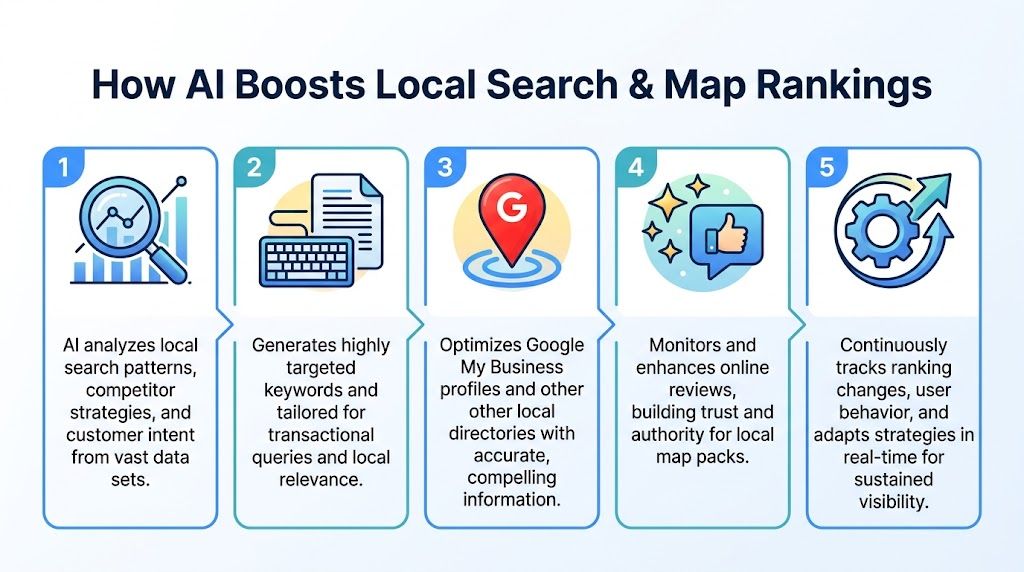
Map rankings look simple from the outside. They aren’t. Google compares categories, business profile signals, reviews, service relevance, geographic alignment, website support, and competitive strength in the area.
AI helps by spotting patterns faster than manual review. It can analyze the language competitors use in titles, services, FAQs, page headings, internal links, and review themes. It can also surface gaps. Maybe your competitors have strong service-area pages for surrounding cities and you don’t. Maybe your profile is missing supporting content tied to emergency service searches. Maybe your website talks about your company history while theirs clearly targets “AC repair near me” and “furnace repair in [city].”
For a local business, that usually turns into work like this:
- Service-area mapping: Build or refine pages around the actual cities and services producing buying intent.
- GBP alignment: Make sure your Google Business Profile categories, services, photos, and website targets reinforce the same local signals.
- Review intelligence: Identify the phrases customers naturally use and bring that language into on-page copy and FAQs.
- Competitor gap analysis: Compare your footprint against the businesses occupying the top map positions.
This matters even more because AI search behavior now overlaps with traditional search behavior. If you want a deeper look at that shift, this guide to AI search engine optimization is a useful next step.
GEO and why structure matters now
A lot of business owners hear “Generative Engine Optimization” and tune out because it sounds like agency jargon. The practical version is simple. GEO means formatting and writing your content so AI-driven search systems can extract, trust, and cite it.
That includes service pages, FAQs, location pages, review-backed proof, schema markup, and clear topical coverage around a buying query. Sites with optimized structured data see 30% to 50% higher citation rates in Google AI Overviews, according to Thrive’s overview of AI SEO services and GEO.
Here’s the key point. AI systems don’t reward vague websites. They reward extractable information.
If your page buries the answer, skips local context, or lacks structure, AI systems may ignore it even when the business itself is qualified.
That’s why local service content needs to become more precise. A page targeting “emergency plumber near me” should clearly state response types, service area, problem categories, trust signals, and supporting FAQs. A page for “dental implants [city]” should answer cost questions, candidacy questions, timeline questions, and urgency questions in plain language.
This short video gives a helpful visual summary of how AI is changing search behavior and optimization priorities:
What works and what wastes time
Local AI SEO works best when the content system is tight. Broad blogging usually doesn’t carry a service business very far unless it directly supports local demand.
What tends to work:
Transactional silos around services people buy now
Examples include emergency repair, same-day service, financing pages, cost pages, and service-plus-city pages.Structured local pages that answer specific questions
Not fluffy city pages. Real pages with service details, proof, FAQs, and clear conversion paths.Schema and entity clarity
Search engines need clean signals about business type, service type, location relevance, and page purpose.
What usually fails:
- Generic AI content that could belong to any business in any city
- Thin location pages with swapped city names and no useful detail
- Traffic-first blog calendars that ignore commercial intent
- Maps work with no website support, or website work with no Maps strategy
The practical operating model
The strongest ai seo agency setups don’t treat Maps, website SEO, and AI visibility as separate campaigns. They operate them as one system.
A plumbing company might build a cluster around drain cleaning, sewer repair, emergency plumbing, and water heater replacement across its target cities. Its Google Business Profile reinforces those service themes. Its reviews echo the same jobs. Its service pages use structured data and clear FAQs. Its internal linking tells Google which pages matter most. That combination is what turns visibility into calls.
The Tangible Benefits for Your Service Business
Business owners don’t buy SEO because they want more content. They buy it because they want more booked jobs, more scheduled estimates, and more patients in chairs. That’s where an ai seo agency either proves its value or doesn’t.
When AI is used correctly, it sharpens the parts of SEO that create revenue. It helps identify the searches with purchase intent, prioritize the right city and service combinations, tighten page structure, and reduce wasted effort on content that never converts.

Better results from the same channel
The strongest argument for AI in SEO is that it’s already embedded in professional workflows. 86% of SEO professionals have integrated AI tools into their workflows, driving nearly 65% better SEO results for adopting companies, with 40% of marketers seeing 6% to 10% revenue increases, according to SEO Sherpa’s SEO statistics roundup.
For a service business, that can show up in a few very practical ways:
- More qualified phone calls: You attract people searching for exact services, not random informational traffic.
- Stronger local authority: Your business starts appearing more consistently across Maps, organic results, and AI-assisted search features.
- Lower waste: The campaign focuses on search terms tied to jobs and patients, not vanity traffic.
- Faster decision-making: AI helps surface what’s working, what’s slipping, and where the next opportunity sits.
Why this matters beyond rankings
Some owners treat SEO and operations as separate issues. They aren’t. Better visibility creates more inbound demand, but your business still needs to handle that demand well once it arrives.
That’s why related systems matter too. If your front desk or office team struggles to answer leads quickly, resources on deploying AI for customer support can help you think through the response side of the equation.
There’s also the economics. Better targeting doesn’t just improve lead flow. It can improve efficiency across your marketing mix. If you’re trying to cut waste while keeping volume strong, this guide on reducing customer acquisition cost is worth adding to your reading list.
Bottom line: Ranking for the wrong searches is expensive. Ranking for transactional searches is what changes the business.
The payoff is rarely just “more traffic.” It’s more of the right demand, from the right places, at the right time.
How to Choose the Right AI SEO Partner
A lot of agencies now call themselves AI-driven. That label by itself means almost nothing. You need to know whether the partner understands local service search, Google Maps, and the new AI-driven visibility layer that sits on top of traditional rankings.
That matters because the businesses AI recommends are not always the same ones that rank well on Google, and your real AI competition might include smaller businesses with better content structure, publishers, and industry directories, as explained in Neo360’s look at AI competitor research.
If an agency only talks about ranking pages and never talks about extractability, citations, map visibility, or transactional intent, they’re selling an incomplete solution.
Questions that expose whether they know what they’re doing
Start with direct questions. Don’t ask whether they “use AI.” Ask how they use it.
Ask things like:
- How do you identify transactional search terms for my service and city set?
- How do you support Google Maps rankings alongside website SEO?
- How do you structure service and location pages for AI-generated search results?
- What do you measure besides rankings and traffic?
- Have you worked with businesses in my vertical, like dental, roofing, HVAC, plumbing, pest control, or med spas?
- How do you handle thin or duplicate local pages?
- What does your reporting show?
A good agency should answer in specifics. They should talk about service clusters, local page structure, review strategy, GBP support, internal linking, schema, and dashboards tied to search queries and local visibility.
AI SEO Agency Evaluation Checklist
| Evaluation Criteria | What to Look For | Red Flag |
|---|---|---|
| Transactional keyword strategy | They focus on searches tied to booked jobs or appointments, including service-plus-city and near-me intent | They mainly talk about “content volume” or broad traffic growth |
| Google Maps capability | They have a clear process for GBP optimization, local relevance, and map tracking | They treat Maps like a side task or don’t mention it |
| AI search visibility | They explain how they structure content for AI Overviews and answer engines | They say AI SEO is just publishing articles faster |
| Industry fit | They understand how your type of buyer searches and converts | They claim the same strategy works for every industry |
| Reporting | They show rankings, search queries, local movement, and lead-focused indicators | They send generic reports full of impressions without business context |
| Content quality control | They combine AI efficiency with human editing and strategic review | They rely on raw AI output |
| Website technical readiness | They look at structure, crawlability, page usefulness, and local page support | They ignore technical issues and only discuss copywriting |
What a strong answer sounds like
The right partner usually speaks in operational terms, not slogans. They’ll explain how they choose pages to build first, how they connect those pages to your business profile, how they improve local relevance by city, and how they monitor whether your business is gaining ground for buying-intent searches.
They also won’t dodge trade-offs. For example, a trustworthy agency will tell you that not every blog topic matters, not every city deserves the same effort at the same time, and not every ranking increase turns into revenue.
Good partners simplify complexity. Bad ones hide behind it.
If you want a frame for judging agencies outside of SEO, the buying logic is similar to guides on finding a reliable Instagram growth company. You’re not buying a label. You’re buying process, fit, and accountability.
For a local search-specific benchmark, reviewing what a dedicated SEO company for service businesses should offer can help you compare agencies more clearly.
What to ignore during the sales process
Ignore buzzwords if they aren’t connected to outcomes.
Ignore polished audits that don’t mention transactional queries.
Ignore promises built around “more visibility” if they can’t explain visibility where, for what searches, and how that leads to calls.
The right ai seo agency should make the path feel clearer, not murkier.
Real-World Examples of AI SEO in Action
A multi-location pest control company expanding into nearby cities often hits the same wall. Their main city ranks fine, but new territories stay quiet. Their website has a general pest control page, a few scattered city mentions, and a Google Business Profile that isn’t supported by location-specific content.
An ai seo agency would usually attack that by tightening city-service targeting. It would analyze local competitor pages, identify the phrases and problems tied to high-intent pest searches, then build cleaner service-area pages around termite control, rodent removal, ant control, and emergency pest issues for each market. It would also line up those pages with the company’s map strategy, review themes, and internal links so Google sees clear relevance by location.
The result isn’t magic. It’s a cleaner local footprint. The company starts showing up for the searches people make in those expansion cities, instead of relying on one broad homepage to carry the whole region.
A dental practice chasing better patients
A single-location dental office has a different problem. They may rank for their brand name and a few broad dentist terms, but they want more high-value procedures and more urgent-care bookings. General traffic won’t solve that.
The better play is to build around patient intent. A strong campaign would develop pages and supporting content for searches like emergency dentist, dental implants, and cost-related treatment questions in the practice’s city. Each page would answer specific decision-stage concerns, use strong local signals, and make the next step obvious.
The best local SEO work feels obvious in hindsight. The page matches the search. The offer matches the need. The business becomes easy to choose.
That kind of structure also helps AI systems understand the practice more clearly. Instead of a generic “welcome to our office” site, search engines see a business with specific expertise, geographic relevance, and useful answers tied to real service demand.
Why these examples matter
These examples are simple on purpose. Local AI SEO usually doesn’t fail because the tactics are impossible. It fails because businesses get sold the wrong priorities.
A pest control company doesn’t need an abstract content strategy. It needs city-and-service coverage that supports maps and conversions. A dentist doesn’t need random blog traffic. They need visibility for the procedures and urgent searches that fill the schedule.
That’s where a serious ai seo agency earns its keep. It turns search strategy into local demand capture.
Your Next Steps to Dominate Local AI Search
The businesses winning local search now aren’t waiting for the old SEO model to come back. They’re adapting to how people search today. That means showing up in Google Maps, organic results, and AI-assisted search experiences for the terms tied directly to revenue.
If you run a service business, the path forward is straightforward.
Step one is to audit what matters
Search your real money terms. Search them in your target cities. Search them on mobile. Search them with local intent. Search the problems your customers have.
Look at three things:
- Where you appear in Maps
- Which service pages show up organically
- Whether competitors or directories keep taking the visibility
If you don’t show up for the terms tied to immediate demand, that’s the problem to solve first.
Step two is to separate noise from opportunity
Not every ranking matters. Not every page deserves to be built first. Focus on the service terms that produce calls, forms, and booked appointments.
That usually means prioritizing:
- Emergency and urgent service searches
- Core service-plus-city searches
- Commercial investigation terms, such as cost, repair, replacement, or same-day help
Many campaigns drift off course. They chase broad topics because those are easier to publish. Local growth comes from owning the terms with buyer intent.
Step three is to demand a plan tied to customers
If you hire help, ask for a plan centered on outcomes. You want to hear how they’ll improve local visibility, support Maps, structure pages for AI extraction, and build authority around transactional searches.
You do not need another agency that celebrates traffic while your phone stays quiet.
The standard is simple. More visibility for the searches that bring customers with money in hand.
This is the core value of an ai seo agency when it’s done right. It doesn’t replace local SEO. It upgrades it so your business can compete where local buyers now look, click, and choose.
If you want a partner that focuses on transactional search terms, Google Maps visibility, and AI-driven local growth for service businesses, take a look at Transactional LLC. Their approach is built around getting businesses found where buying decisions happen, then turning that visibility into calls, leads, and booked work.