

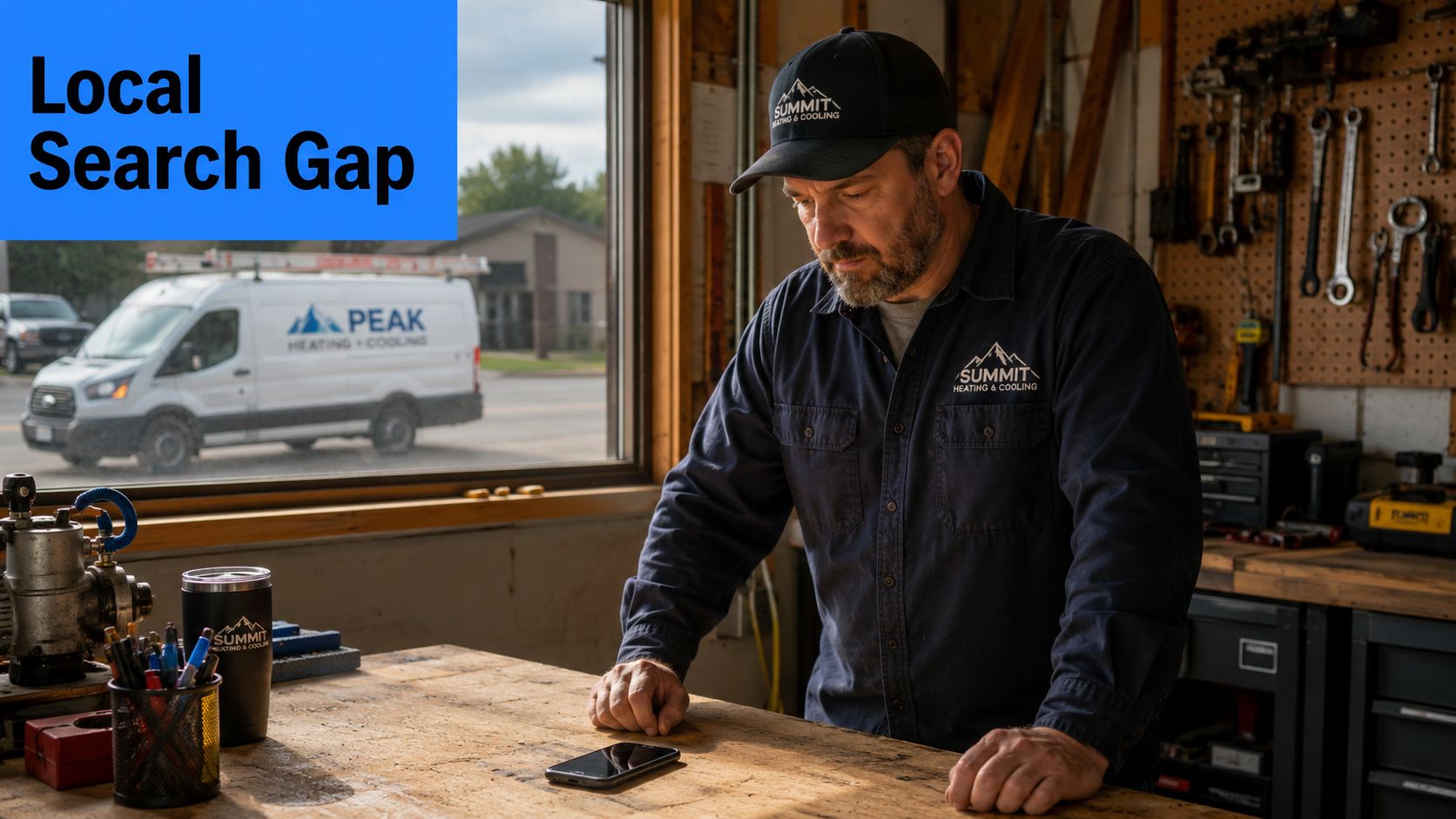
You're probably in the spot where your service is good, your team shows up, and your reviews look solid, but the same competitors keep owning the “near me” searches that bring the phone to life. That gap is frustrating because it rarely comes down to price alone. More often, the businesses winning those searches are building local trust in public, then turning that trust into stronger Maps visibility, more branded demand, and more calls.
Community engagement marketing works best for service businesses when it stops being treated like a feel-good side project and starts being treated like a local visibility system. A contractor, dentist, med spa, or pest control company doesn't need a huge audience to benefit. It needs the right neighborhood signals, the right mentions, and the right reasons for real people to search, click, call, and leave reviews.
Why Community Engagement Marketing Matters for Local Service Businesses
A local HVAC owner can have better workmanship, faster response times, and lower prices than the company ranking above them for “AC repair near me.” None of that matters if the competitor has built stronger local signals through community presence, neighborhood visibility, and repeated real-world touchpoints. That's the part most owners miss, they think search is won only with ads or technical SEO, but local trust gets built in the community first.
Why local trust shows up in search
Community activity gives a service business more than goodwill. It creates the kind of signals Google can connect to a place, a category, and a searcher's intent. That includes local mentions, direction requests, branded searches, reviews from nearby customers, and links from organizations that live in the same market.
Transactional intent matters here. Academic search research defines transactional queries as searches made to locate a website or vendor in order to obtain a product or service, like buying, applying, or downloading, and that same logic applies to “roofer near me” or “dentist near me” searches (Springer research on transactional search intent). Those searches are not casual browsing, they're decision-stage queries. Community engagement helps a business show up where that decision gets made.
This is also why traditional local advertising feels expensive without compounding. Billboards, mailers, and PPC can produce leads, but they don't always strengthen the business's search footprint after the spend ends. Community work, by contrast, can keep producing mentions, reviews, and local familiarity long after the event is over.
For service brands that want to earn trust in a city, this is the practical playbook. Every handshake at a school event, every sponsor banner at a youth league, and every neighborhood partnership can become a ranking signal in disguise. The useful way to think about it is simple, community presence is not separate from local SEO, it feeds it.
One resource that mirrors this trust-first approach in a different vertical is this discussion of aesthetic clinic referral marketing, which shows how referral behavior and local credibility can reinforce each other. The principle transfers cleanly to HVAC, dental, pest control, and other service categories.
You can also see the network effect in practice when businesses build deliberate referral ecosystems, which is why a structured approach like building winning business referral networks matters for local service brands that need more than one-off attention.
Practical rule: If a community activity wouldn't be worth doing even without SEO, it probably won't create strong SEO either. The best events, partnerships, and sponsorships do both.
The Data Behind Community-Driven Growth and Revenue
Community-driven marketing can keep producing value after a campaign ends. Industry data shows 78% of brands consider community marketing essential to their 2025 growth strategy, 64% increased community-building budgets in the last 12 months, and 44% reported positive ROI within the first year, according to community marketing statistics.
The same report links active communities with 46% higher customer lifetime value and a 22% lift in conversions from community-driven word of mouth. For a local service business, those outcomes extend beyond repeat purchases. A homeowner who knows the company may call again, recommend it to a neighbor, search its name directly, or leave a review that supports Google Maps visibility.
Traditional local spend versus community signals
The market is also gaining operational weight. The community-platform market estimate places current value at $4.31 billion, with a projection of $23.19 billion by 2035 and an 18.3% CAGR. For local operators, the significance is practical. Community activity is becoming part of how companies create sustained attention, not merely a short campaign tactic.
The same GTM8020 analysis reports that 48% of companies use Community-Led Growth in their go-to-market strategy, while community-influenced deals close 72% faster than traditional sales-led deals. In a city-level service market, trust can shorten the route from a branded search to a phone call and then to a booked job.
| Metric | Traditional Local Ads | Community Engagement |
|---|---|---|
| Cost pattern | Ongoing spend that stops when the campaign stops | Upfront effort that can keep producing visibility and referrals |
| Lead quality | Mixed, often broader intent | Usually warmer, because people already know the business |
| Search impact | Limited compounding after the ad ends | Builds local mentions, branded searches, and review activity |
| Trust level | Borrowed attention | Earned credibility through real participation |
| Long-term ROI | Harder to sustain without constant spend | Stronger when events, partnerships, and reviews keep stacking |
The advantage is measurable beyond sentiment. A sponsorship, workshop, or neighborhood partnership can generate recognition, local mentions, branded searches, and review opportunities together. Those signals can support transactional visibility for searches such as emergency plumbing, nearby dental care, or HVAC repair in a specific city.
That makes measurement discipline necessary. The framework for customer acquisition metrics keeps community reporting tied to qualified leads, calls, booked jobs, and revenue instead of attendance or social engagement alone. Track which activity precedes a search, profile interaction, call, or form submission, then keep the plays that produce business.
Building Your Local Community Engagement Playbook
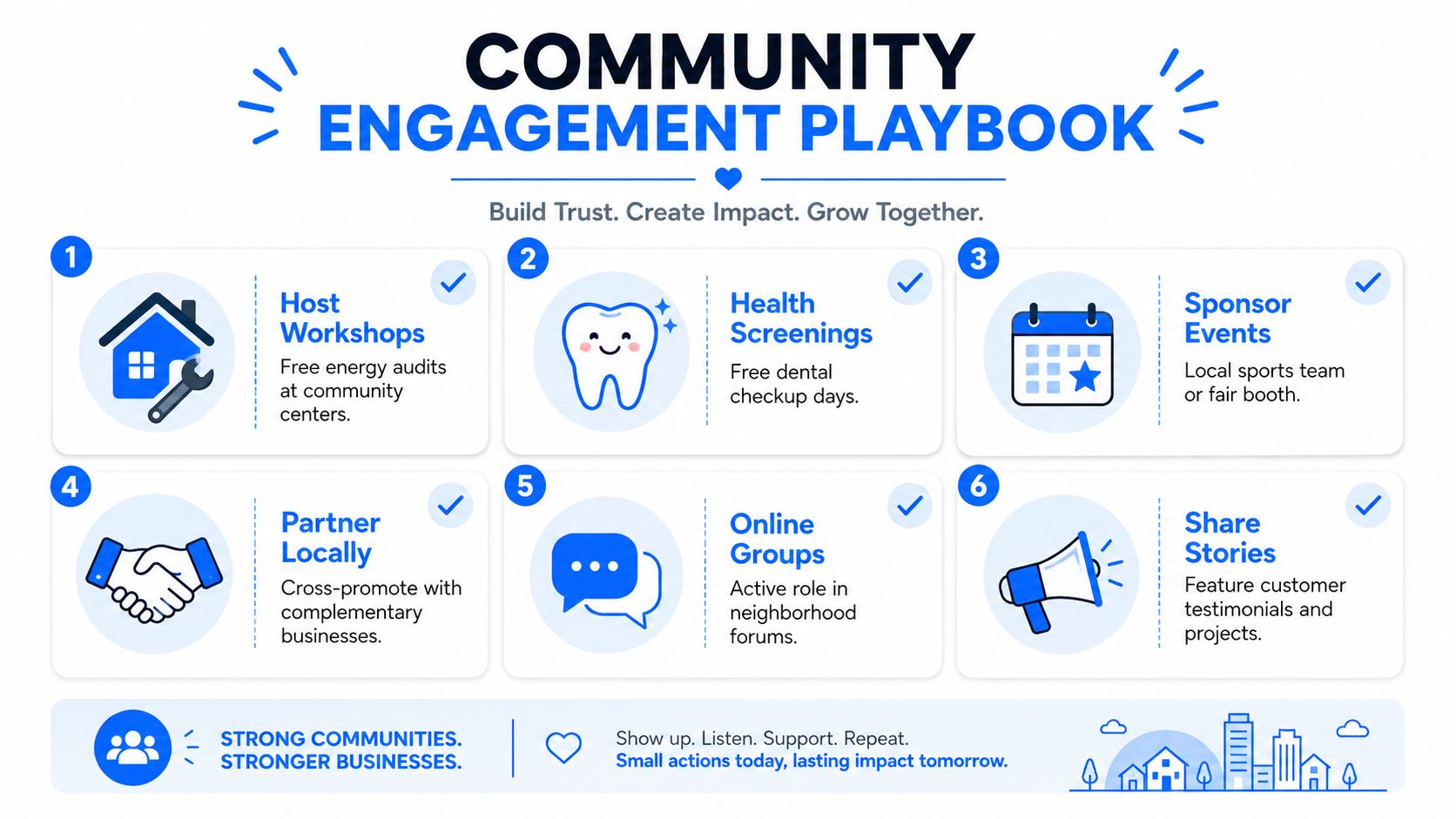
A local service company doesn't need ten tactics running at once. It needs a few repeatable plays tied to the kinds of customers it already wants. The best results usually come from pairing one public-facing activity with one content or review capture step, then repeating the pattern until the market starts to notice.
Start with events people actually attend
For HVAC, a free home energy audit workshop at a community center gives you face time with homeowners who already live in your service area. For dental practices, youth sports mouthguard fitting days make sense because parents are already thinking about prevention. The event doesn't need to be flashy, it needs to put the business in front of the right families.
Build partnerships that make local sense
Partnerships work when both sides already serve the same neighborhood. Pest control companies can co-market with local real estate agents on new homeowner packages, while plumbers can partner with property management companies that need quick-response vendors. The best partnerships are ordinary, useful, and easy to explain.
Sponsor visibility, not just logos
A sponsor spot on a Little League scoreboard or a school theater program can be worth more than a generic ad if it leads to photos, mentions, and repeat recognition. Add a photo opportunity, a booth, or a reason for the organization to tag your business afterward. That's how sponsorship moves from passive awareness into content.
Publish content rooted in place
Neighborhood-specific pages work when they sound like they were written by someone who knows the area. Reference local landmarks, seasonal issues, and event recaps rather than stuffing pages with generic service language. A plumber in a freeze-prone city can talk about pipe risks in specific neighborhoods, while a pest control company can note the pests that spike in certain micro-areas.
A community post should answer two questions fast, why this business, and why here. If it can't do both, it's not tied tightly enough to local intent.
Turn participation into reviews and referrals
After every event or local partnership, use a simple review request workflow. Ask the people who interacted directly, not just the biggest attendees, and make the ask immediate while the experience is fresh. Then fold a referral reminder into the same process so the community action keeps paying off after the event ends.
Document everything with social proof
Geo-tagged photos, staff spotlights, and customer testimonials should feed Google Business Profile posts and local landing pages. The goal is not to flood the web with content. The goal is to show real participation in a way that search engines and human buyers can both recognize.
The tactical layer is easier to execute when you treat it as peer-to-peer visibility, which is why peer-to-peer marketing is a useful complement to local sponsorships and community partnerships.
Connecting Community Activity to Google Maps and Transactional Search
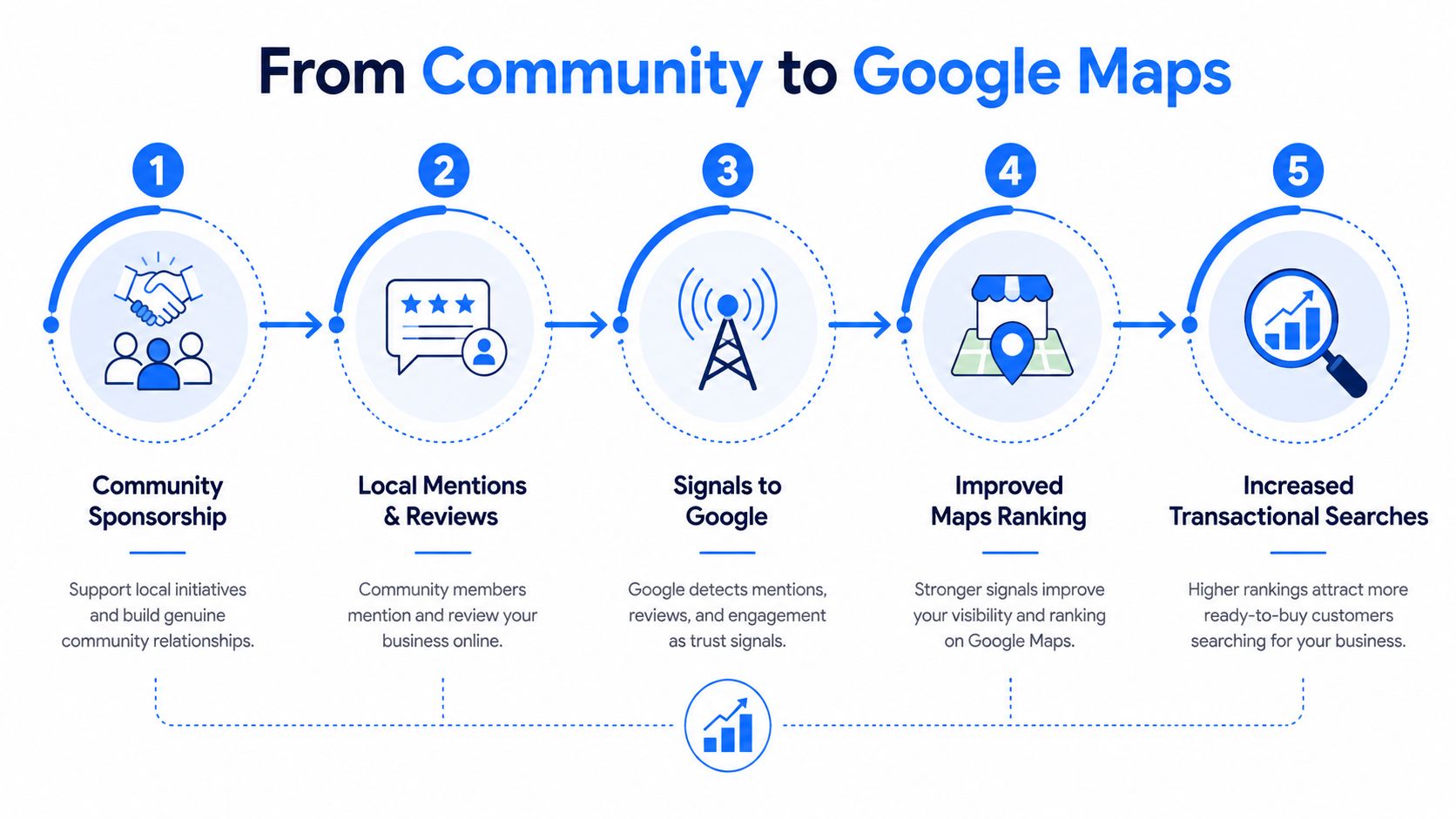
Google Maps visibility rewards businesses that look active, relevant, and trusted in a real place. Community involvement helps create that signal for the right reasons. When a business supports a youth soccer league, runs a workshop, or partners with a neighborhood group, those activities can generate mentions, images, links, and profile activity that reinforce local relevance.
The strongest local ranking signals rarely show up by themselves. A sponsorship can lead to a city website mention. That mention can lead to a branded search. A branded search can lead to a profile visit, a direction request, or a phone call. Over time, those actions build local authority in a way plain directory listings usually do not.
Make community activity legible to search engines
The most effective local businesses do not just do the work, they document it. They publish Google Business Profile posts about events, keep service-city pages current, and make sure the business name, address, and phone number stay consistent across the web. AI-era local search systems rely harder on structured, entity-based signals, so complete business data and current reviews matter more than ever (LLM optimization for local services).
Use local language naturally
A partnership announcement should name the neighborhood, city, or service area without sounding stuffed. If a dental practice supports a school program, the post should mention the school and the surrounding area in plain English. If a pest control company helps with a neighborhood watch event, that context gives search engines and readers a clear local anchor.
Treat the Google Business Profile like a living asset
Photos from events, Q&A responses, and fresh reviews all add proof that the business is active in the market. Google's local pack placement matters because a Search Engine Land analysis of Google's 3-pack placement rates found that it appears in the number one web-search position 93% of the time and in the top two positions 99% of the time after the move to the 3-pack (a Search Engine Land analysis of Google's 3-pack placement rates). A SOCi report on local search traffic distribution also cited that businesses in the 3-pack received 126% more traffic and 93% more customer actions than businesses ranked in positions 4 through 10, with those actions measured as calls, website clicks, and direction requests (a SOCi report on local search traffic distribution).
That is why community activity is not just brand goodwill. It feeds the signals that Maps visibility depends on.
The mechanics are easier to manage when you build around consistent service-and-city pages, current reviews, and structured profile work. If call tracking is part of the program, a guide to call attribution setup helps connect those interactions back to revenue.
Measuring What Actually Drives Calls and Booked Jobs
Most businesses measure the wrong things first. They count attendance, likes, logo impressions, and post reach, then wonder why revenue still feels blurry. Those metrics can help with awareness, but they don't tell you whether the community effort produced calls, booked work, or repeat customers.
Track the signals tied to money
Use Google Business Profile direction requests as one core indicator, because those actions show intent beyond passive interest. Then layer in call tracking numbers assigned to specific community campaigns, UTM-tagged landing pages for local partnerships, and review velocity from customers who came through those channels. If you can't trace at least part of the journey, you're guessing.
A useful reminder from call attribution best practice is that the number itself doesn't matter if the source is unclear, which is why what is call tracking is a foundational read for any local service team trying to tie outreach back to revenue. The same mindset should apply to events and sponsorships.
Separate vanity from revenue
| Vanity Metric Ignore | Revenue Metric Track | How to Measure |
|---|---|---|
| Event attendance | Calls from attendees | Dedicated call tracking number and CRM tagging |
| Social likes | Direction requests | Google Business Profile insights |
| Sponsor logo views | Booked jobs | Lead source notes in the CRM |
| Generic comments | Review quality and volume | Review prompts and monthly review count |
| Page views alone | Local landing page conversions | UTM links plus form submissions or calls |
What matters most is attribution discipline. Tag every lead source, review every recorded call, and compare the results by channel. That's how a business learns whether the school sponsorship, chamber membership, or neighborhood event created booked work.
Practical rule: If an activity can't be tied to calls, direction requests, or booked jobs, keep it on the awareness list, not the growth list.
The point isn't to measure everything. It's to measure the few things that prove whether community participation is helping the business win transactional searches and close the right jobs.
Your 90-Day Community Engagement Action Plan
The first month should be about mapping the market, not spending heavily. List the partnerships, nonprofits, schools, leagues, and neighborhood groups already connected to your service area. Then decide which one or two align best with the kinds of customers you want most.
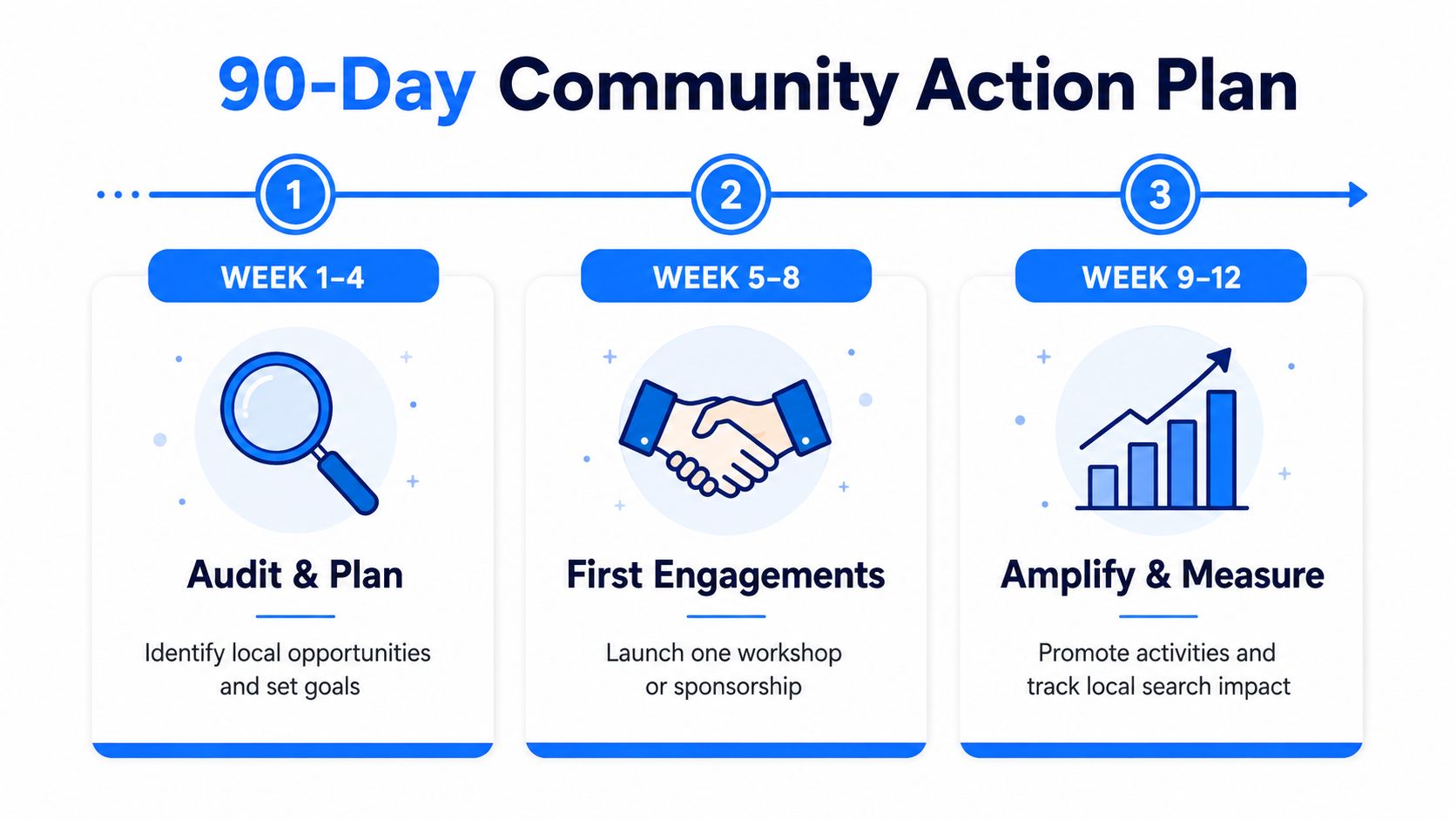
Days 1 to 30
Set up tracking before you do anything public. Assign call tracking numbers, create UTM links, and make sure your Google Business Profile is ready for photo uploads and posts. If you're an HVAC company, identify property managers and homeowner groups. If you're a dental practice, look at schools and youth sports organizations. If you're in pest control, focus on neighborhood associations and local homeowner groups.
Days 31 to 60
Launch one event, sponsorship, or partnership and publish one localized page that matches the offer. Keep the page specific to a city or service area, not broad and generic. Ask for reviews from anyone who participated directly, then post the best photo set and recap on your Google Business Profile.
Days 61 to 90
Review the calls, direction requests, and booked jobs tied to the campaign. Double down on the activity that brought the strongest local response, and cut the one that looked busy but didn't convert. The goal isn't to build a giant community footprint, it's to build a repeatable local engine that strengthens Maps visibility, transactional search performance, and trust in the neighborhoods that matter most.
Transactional LLC helps service businesses connect community-driven visibility to the searches that turn into calls, jobs, and patients. If you want a sharper local strategy built around transactional search terms, Google Maps optimization, and AI-ready local content, visit Transactional LLC and start building a plan that makes your service area easier to win.