


The phone rings after hours. A homeowner's AC dies in July, or a roof leak starts staining a ceiling, and the first real question isn't which ad they saw, it's who they trust. That's where peer to peer marketing earns its keep for local service businesses, because the buyer still might type “air conditioning repair near me” or “roofer near me”, but the decision often starts with a neighbor, a text thread, or a local group recommendation.
For service brands that live and die on transactional search terms, that matters. The recommendation arrives from a known source, the trust barrier drops, and the business has a better shot at showing up when the customer is ready to spend. The practical move is simple, turn customers, partners, and employees into a repeatable distribution layer instead of treating referrals as luck.
Why Peer Recommendations Drive Local Service Decisions
A roof problem rarely begins with a spreadsheet. It starts with a wet spot, a frantic call, and a quick search that may or may not happen after someone has already asked a friend which company they used. In that moment, peer to peer marketing is already in motion, because the customer is using another person's experience to narrow the field before they ever compare websites.
That behavior isn't random. It follows the way people already buy local services, through recommendation, proof, and reassurance. One consumer survey in the verified data set found that 92% of consumers worldwide trust recommendations from friends and family and another found that 82% actively seek referrals from peers before buying (BizCommunity). For local service businesses, that's not a branding detail, it's a real acquisition channel.
Reviews and referrals now work together
Public reviews sit right beside private recommendations in the decision process. The same source set notes that 86% of consumers read an average of 10 reviews for a local business before deciding, rising to 91% among ages 18 to 35 (BizCommunity). That means a referral often doesn't replace search, it changes what happens after the search begins.
Practical rule: the referral gets the click, but the reviews close the hesitation.
That's why this channel is so valuable for home services, dental practices, and other local businesses with high-intent traffic. A person who already trusts the recommendation is much more likely to move from browsing to booking when the Google Business Profile, map pack, and review profile reinforce the same message. If you're still treating referrals as a nice extra, the better move is to treat them like a structured pipeline tied to your review system, starting with getting more reviews.
The big shift is that peer influence isn't just word-of-mouth in the hallway anymore. It now shows up through text messages, shared photos, referral links, local groups, and post-job reviews, which makes it far easier to systematize around real near me demand.
The Trust Mechanics Behind Peer to Peer Marketing
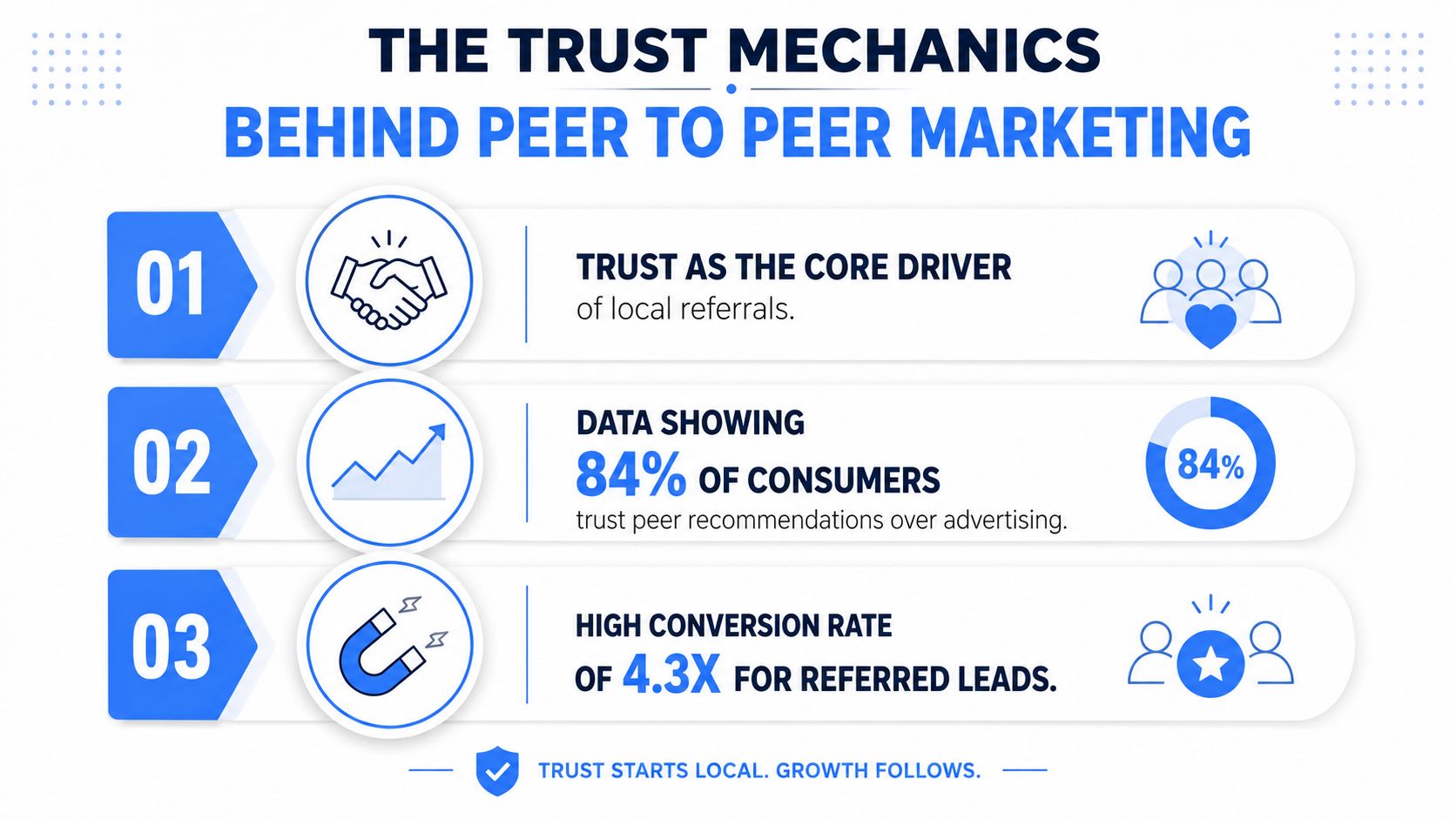
A homeowner calls a plumber, a dentist, or an HVAC company after a recommendation, then checks the Google Business Profile to see if the recommendation holds up. That sequence matters because peer to peer marketing does not just create awareness, it shapes the transaction before the first visit, especially in local markets where the buyer is trying to avoid a bad outcome.
The strongest verified benchmark in the source set comes from event marketing. Snöball reported an average 31.9% conversion rate for P2P campaigns, and Event Industry News said 32% of social shares and posts translate into confirmed registrations, with roughly 7% of event attendees coming directly from peer-to-peer efforts (Snöball). Those are not home service numbers, but they show what happens when advocacy is structured instead of left to chance. Personal endorsement moves people from interest to action faster than a broad broadcast.
The market is moving toward peer-mediated exchange
The same source set also says the global peer-to-peer marketplace is valued at USD 1.8 billion in 2025 and is projected to reach USD 11.9 billion by 2036 at an 18.7% CAGR. That shift matters because peer-mediated exchange is becoming organized, not casual. Businesses are building systems around trusted transfers of attention, and the businesses that do it well have a cleaner path to transactional search demand.
For local service owners, the practical takeaway is simple. A referral system is not just asking for favors. It is a measurable channel where trust, review volume, and search visibility support each other, which is why the operators who pair referrals with a strong review process tend to see better conversion at the map level.
Public proof and private advocacy work together. The ad introduces you, the review validates you, and the referral pre-sells you. That is why referral activity should be reviewed alongside customer satisfaction metrics, because weak service delivery usually shows up in weak advocacy before revenue drops.
A referral also changes the odds in local search. A trusted recommendation often leads to a branded search, a map click, and a faster booking decision, which is exactly where transactional near me intent turns into calls and form fills.
Five Peer to Peer Strategies That Generate Transactional Leads
The strongest peer to peer marketing programs for local services do more than generate attention. They create repeatable paths to bookings by pairing trust, proof, and timing with the exact phrases people search before they call. For home services and dental practices, that means each tactic should support a transactional search term, because those searches are already close to revenue.
1. Structured referral programs with tracked incentives
A referral program works when the ask is clear and the reward is easy to explain. In practice, that means a unique code or link for each advocate, a simple reward, and a landing page that matches the service line, whether that's dental cleanings, emergency plumbing, or furnace repair.
A referral program fails when the reward is interesting but the process is annoying.
The trade-off is speed versus control. A looser program can spread faster, but a tracked structure gives you cleaner attribution, which matters when you are trying to tie referrals to calls, booked jobs, and Google Maps behavior. For teams building Transactional LLC's framework for building repeatable referral networks, the point is not just to collect introductions, it is to make each introduction traceable enough to improve the next one.
2. Partner networks with complementary local businesses
A plumber and a water damage restoration company can feed each other leads because the customer journey overlaps. The same logic applies to dentists and orthodontists, HVAC and insulation contractors, or med spas and skin care providers. If the partner serves the same neighborhood and the same homeowner or patient profile, the cross-promotion can surface more often in near me searches.
These relationships work best when the partner map is narrow. Broad networking usually creates weak introductions, while a local partner list built around shared demand tends to produce better-fit traffic and stronger conversion on the service pages that matter. For account targeting and outreach structure, ABM with Pipecorn's Sales Navigator can help teams prioritize the right partners without turning the program into a generic networking exercise.
3. User-generated content from completed jobs
Jobsite photos, before-and-after shots, short testimonial videos, and “completed today” posts work because they show the work instead of describing it. That matters for roofing, pest control, HVAC, med spa, and dental brands where proof is visual and local. Customers do not need polished ads, they need evidence that the business does the work in their area.
The practical upside is search intent alignment. A homeowner or patient who sees real completed work is more likely to click a branded result, check the map listing, and move toward a call or appointment. That kind of content also gives you material for partner sharing, review follow-up, and social posts that support the same transactional demand.
4. Review amplification systems
Satisfied customers rarely leave a review unless you make it easy. A post-service flow that asks at the right time, sends the right link, and explains why the review matters can turn happy clients into a steady review engine. In local search, those reviews do more than look good, they support the exact service terms people type before calling.
Review work should be tied to the service experience, not treated as a generic reputation task. A smooth request after a finished job, a reminder from the technician or front desk, and a clear path to the right listing usually outperform broad email blasts. The best operators treat review amplification as part of the booking funnel, because it helps the business stay competitive in map results where intent is already high.
5. Community cross-promotion
Local events, co-branded posts, chamber appearances, and neighborhood sponsorships can all create repeat exposure inside a tight geography. The value is not just visibility. Repeated peer exposure helps a business stay top of mind until the person is ready to search and call.
This works best when the local audience overlaps with the buyer profile, not just the zip code. A sponsor slot or community post that reaches homeowners, patients, or families in the right service area can support branded searches later, especially when the same business also has strong reviews and partner mentions. That is the part many teams miss. Community activity does not replace search demand, it helps create the familiarity that makes the map click more likely.
| Service Vertical | Top P2P Strategy | Key Transactional Term | Expected Outcome |
|---|---|---|---|
| Roofing | Partner networks | roofer near me | More qualified calls from homeowners with active repair intent |
| Dental | Structured referral programs | dentist near me | Stronger map visibility and more appointment-ready searches |
| HVAC | Review amplification systems | air conditioning repair near me | Better local trust signals during urgent demand |
| Pest Control | User-generated content | pest control near me | Proof-driven clicks from nearby homeowners |
| Med Spa | Community cross-promotion | med spa near me | More consultation leads from nearby, high-intent searchers |
A useful internal framework for this kind of relationship building is an analysis of business referral networks, because it keeps the emphasis on repeatable introductions rather than random networking.
Building Your Peer to Peer Program Step by Step
The best programs start small and stay operationally simple. The mistake I see most often is waiting for a perfect referral engine before asking the first customer to share. That delays the learning loop, and it usually means the business never gets enough data to know which advocates send calls.
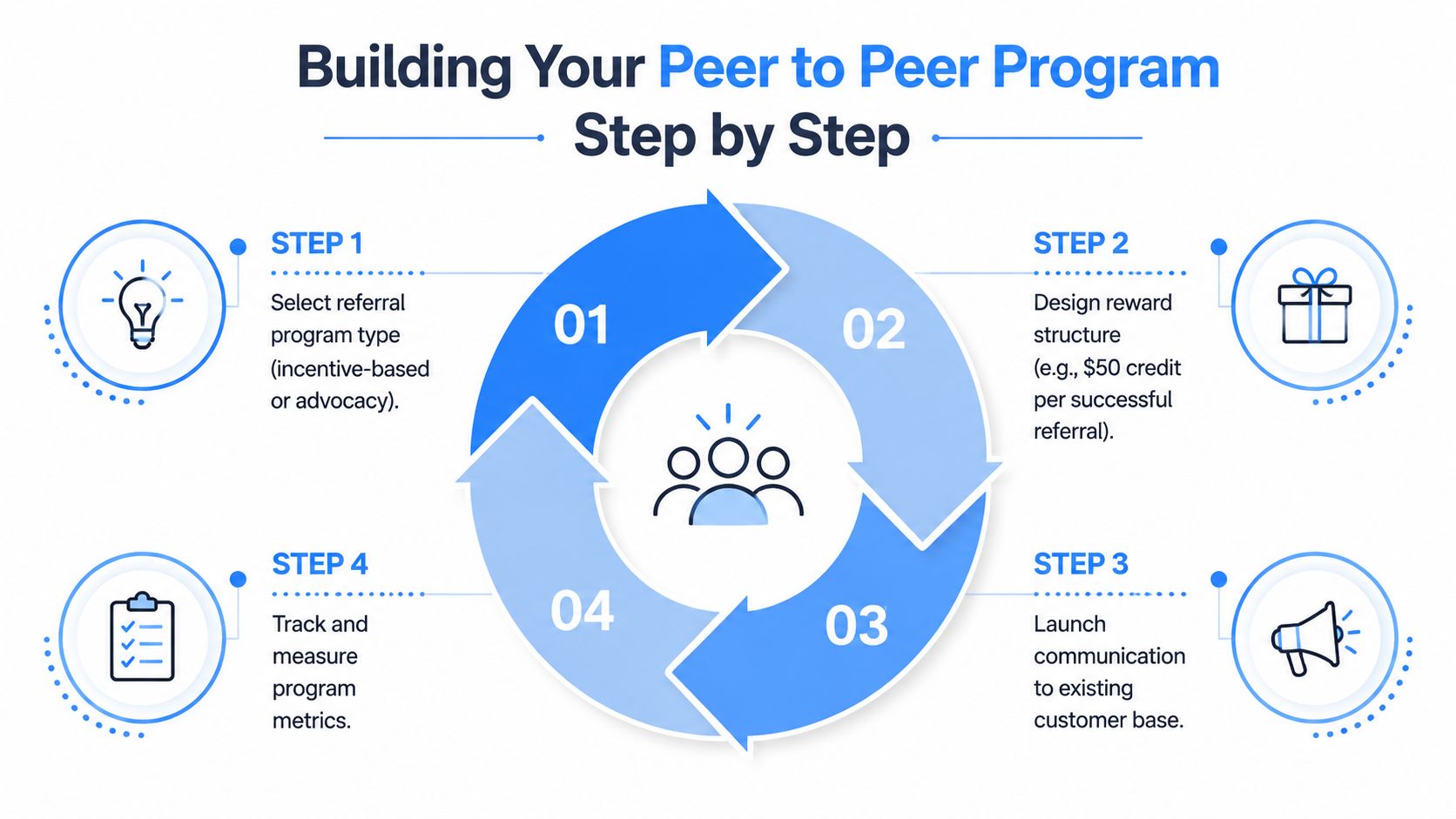
Start with the offer and the ask
The reward should fit the buying cycle. For home services, that can be a credit, a discount on maintenance, or a simple thank-you perk. For dental, the value might be framed around convenience, priority scheduling, or a service credit where appropriate. The cleaner the offer, the easier it is for a happy customer to repeat it without sounding awkward.
Make the share easy
Brands should actively make recommendations easy by supplying shareable content and clear prompts. That can include job photos, a short testimonial prompt, referral cards, a text message template, or a one-click review request after the visit. If the customer has to invent the message, the program will underperform.
Strong programs remove friction first, then ask for advocacy.
Track the source, not just the channel
Use unique codes, UTM parameters, and CRM notes so you can see which advocate, partner, or customer drove the lead. That lets you separate a real referral from general branded traffic and spot which source produces booked work. If you can't attribute the lead, you can't improve the program.
Ask at the right moment
The best time to request a referral is after a clean win, not during the service call when the customer is still stressed. Ask after the problem is solved, the bill is clear, and the customer has had a moment to see the result. Then follow with a review request and a simple prompt they can forward to a friend.
A practical post-service review template belongs in your workflow, and review request templates are useful because they keep the wording direct without making the customer write from scratch.
A 30-day launch rhythm
- Week one: pick one service line and one reward.
- Week two: build the referral link, the review ask, and the customer-facing script.
- Week three: train the front office or dispatcher to deliver the ask at the right time.
- Week four: review the first responses and tighten the process.
For a local business, that's enough to launch without adding staff. The point is not volume on day one, it's a clean system that can be repeated across every completed job.
Connecting Peer to Peer Marketing to Google Maps Rankings
A referral rarely ends at the first conversation. It usually starts a search sequence that finishes in Google Maps, and that is where peer to peer marketing starts affecting local SEO in a very practical way. A homeowner hears about a roofer from a neighbor, searches the company name or roofer near me, scans the map pack, reads the reviews, and calls the business that feels safest.
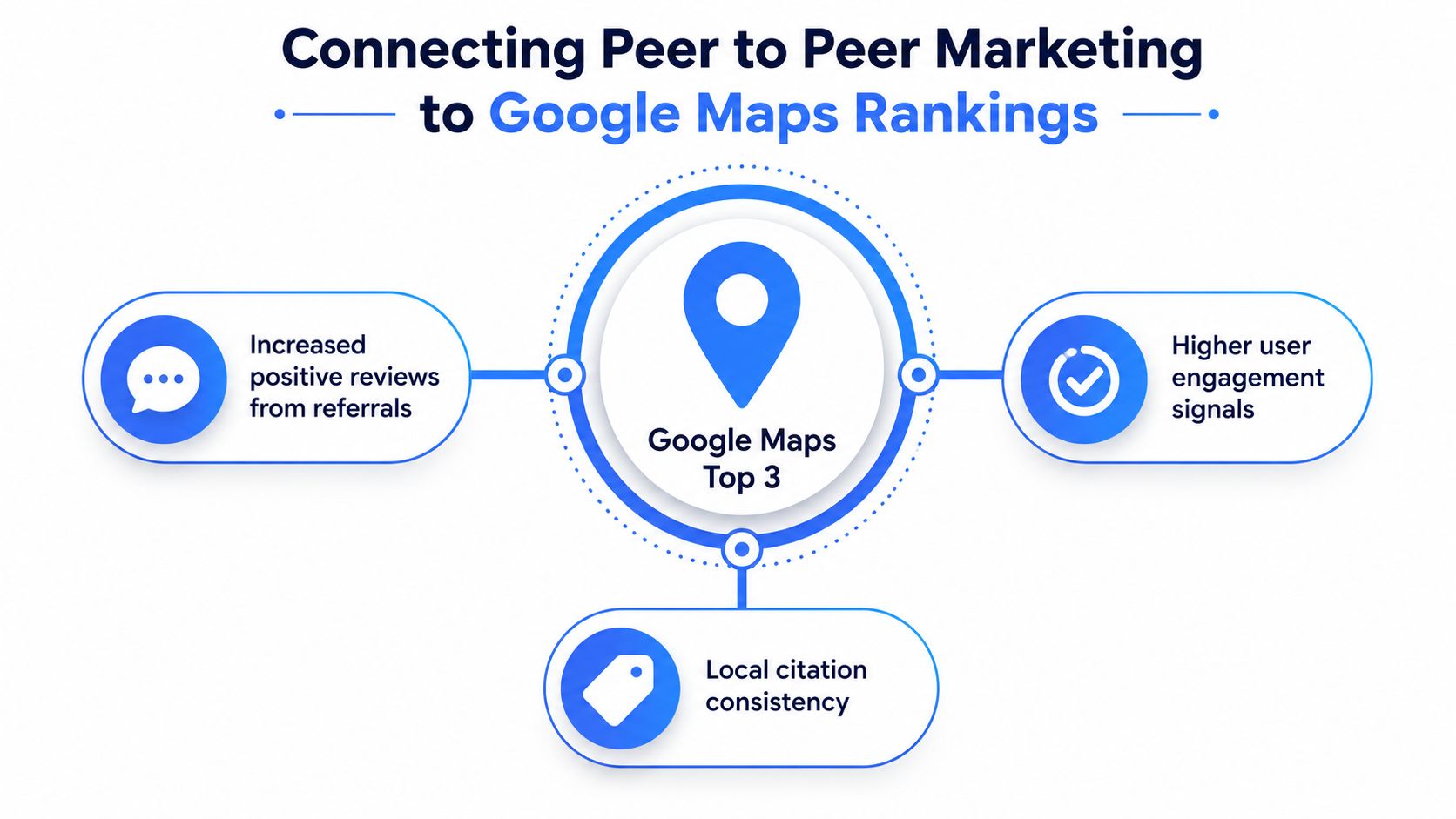
Why the map pack matters
For local service businesses, the map pack often captures the highest-intent traffic because the buyer is already looking for a nearby provider. Peer-driven reviews and referral traffic matter here because they help the business look established at the exact moment the customer is choosing who to call. A strong Google Business Profile then turns that trust into action with photos, service categories, Q&A content, and review responses.
The conversion path is short, and that is why it works. Peer recommendations reduce hesitation before the search, then the map listing closes the loop with proof, proximity, and a clear next step.
What peer activity signals to local SEO
Referral-driven reviews strengthen the profile. Consistent brand mentions across partner pages and local content reinforce local relevance. Job photos from actual work make the profile look active, not abandoned. None of that replaces standard SEO, but it supports the signals that make map visibility more durable.
The same pattern shows up in other relationship-driven services. Resources like doula visibility strategies show how peer trust and local discovery matter even where word-of-mouth carries most of the buying pressure.
Peer advocacy does not sit outside search. It feeds the searches that drive map clicks and calls, then improves the trust cues people use before they ever pick up the phone. Businesses that connect those dots usually get better traction from the same volume of local demand.
Measuring Peer to Peer Marketing ROI and KPIs
Measurement is where this channel stops being a hope and starts being a system. The right metrics tell you whether customers are advocating, whether those advocates are driving qualified traffic, and whether the effort is changing booked jobs rather than just generating activity.
The core KPIs are referral rate, virality factor, cost per advocate, and earned media value (DMEXCO). Those are useful because they map directly to behavior, spread, cost, and value. If referral rate is weak, the ask is wrong. If virality is flat, the assets aren't worth sharing. If cost per advocate is too high, the reward or workflow needs rework.
Track the advocate, not just the source
Each promoter should have a unique tracking link or code, and traffic should be tagged with UTM parameters so you can attribute sign-ups, calls, and conversions by individual sharer (Snöball playbook). That's the cleanest way to see which customer, partner, or employee drives outcomes. Channel-level traffic can hide the underlying pattern, especially when several people share the same offer.
Don't ignore dark social
A lot of sharing happens in private channels, text messages, WhatsApp threads, and DMs where standard analytics can't see it. That's why teams should use a broader measurement stack, including total advocates activated, active advocates, average referrals per advocate, and conversion rate (Instapage). Dashboards help compare time periods and catch anomalies before the program gets stale.
If a campaign looks quiet in public but the booked jobs are rising, dark social may be doing more work than the dashboard shows.
That said, don't let invisible sharing become an excuse to stop measuring. Use direct response data where you can, then look for supporting signals in booked calls, map views, review volume, and partner-generated traffic. The point is to connect advocacy to revenue, not to admire the activity.
Your First 90 Days of Peer to Peer Marketing
The first month should be about setup, not perfection. Pick one service line, define the referral offer, build the review ask, and start requesting introductions from your happiest customers. The second month is where you activate partner relationships and turn completed jobs into proof content, because real photos and real testimonials beat polished brand copy every time.
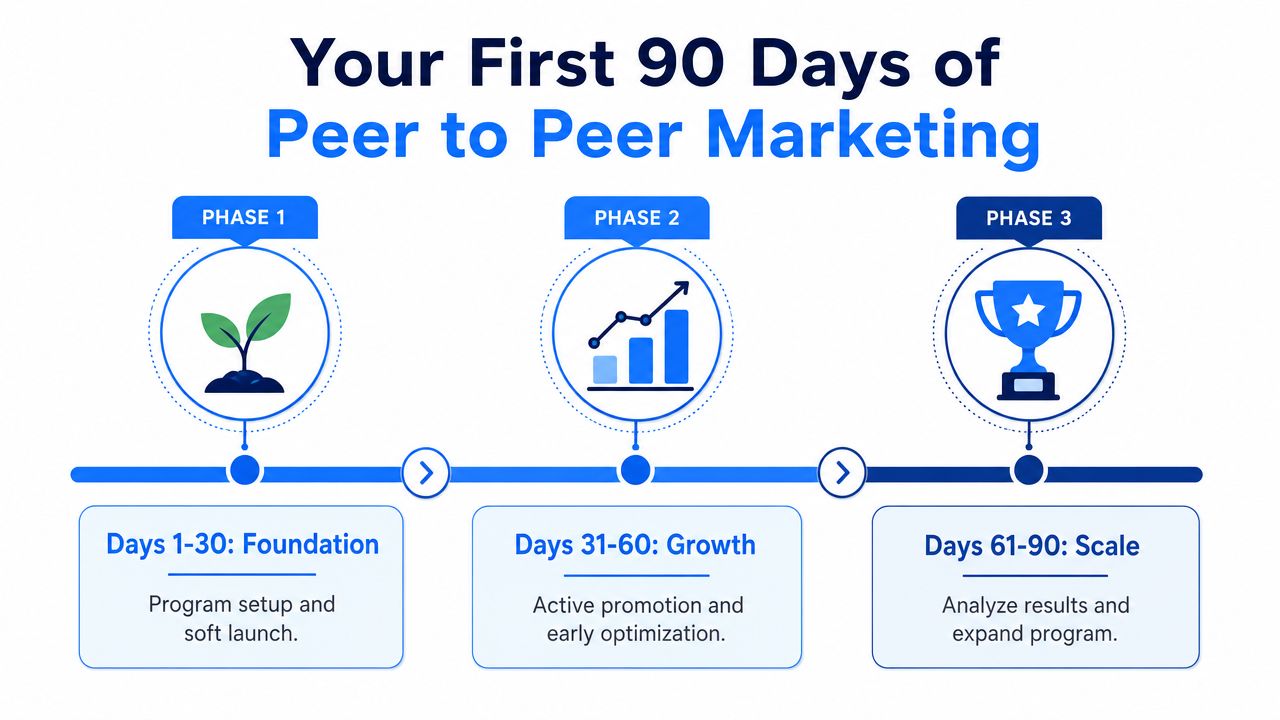
By day 60, you should know which asks get responses and which partners refer business. By day 90, you can tighten the reward, expand the best-performing source, and cut the parts that don't move calls. The goal isn't just more chatter, it's more transactional search visibility for the exact terms buyers use when they're ready to book.
For businesses that want to turn referrals, reviews, and Google Maps into a repeatable local search system, Transactional LLC builds the infrastructure around that work with industry-specific SEO, map optimization, and AI-driven content planning. If you want help capturing more near me searches and turning them into booked jobs or appointments, visit Transactional LLC and see how a local growth system built around transactional intent can work for your service area.