


You know the feeling. You run a solid service business, your crew does better work than the company down the street, and yet the phone rings for them first because they show up first. A homeowner searches “roofer near me,” “dentist near me,” or “air conditioning repair near me,” and Google hands the lead to whoever looks most relevant in that moment.
That's the actual fight. Not “marketing” in the abstract. Not posting random social content. Not buying another generic website redesign. The fight is winning transactional search terms, because those searches come from people who are ready to spend money now.
Most local businesses blend in because their marketing says the same empty things. Quality service. Trusted team. Years of experience. Fast response. Every competitor says that. If your message sounds interchangeable, your website, Google Business Profile, and AI search presence become interchangeable too.
Competitive differentiation fixes that. It gives search engines something specific to rank. It gives AI systems something clear to understand. And it gives buyers a reason to call you instead of the other three companies in the map pack. If you're still trying to rank without a sharp point of difference, you're making local SEO harder than it needs to be.
Stop Being Invisible Online
A lot of service business owners are living the same story.
You open your phone in the morning and see another competitor sitting in the top local results. You know their work isn't better. Their technicians aren't better. Their customer service might be worse. But they're visible, and visibility wins calls.
That's why “do more marketing” is bad advice.
If your market sees you as just another HVAC company, just another dentist, or just another plumbing company, then every click becomes a price comparison. You don't want that. You want the person searching “near me” terms to think, “That's the one I want.”
Practical rule: You don't win local search by sounding louder. You win by sounding more specific.
A business that stands for something concrete gets remembered. A business that proves that difference gets chosen. That same difference can shape your homepage, your service pages, your Google Business Profile, and the language AI systems pull into search summaries and recommendations.
Here's the shift. Stop asking, “How do I market harder?” Start asking, “Why should a ready-to-buy customer pick us right now?”
For local businesses, that answer usually lives in one of these areas:
- Speed: Same-day appointments, narrow arrival windows, fast quoting
- Specialization: Trenchless sewer repair, sedation dentistry, emergency panel upgrades
- Experience: Pet-safe treatments, anxiety-friendly care, clean-install process
- Risk reduction: Better guarantees, transparent pricing, documented process
If your website still talks in generic claims, fix that first. Your visibility problem is usually a positioning problem wearing an SEO mask. A strong local search strategy starts with a clear market position, then builds content and map signals around it. If you want the mechanics behind that, review this guide on getting your website on Google Search.
What Differentiation Means for Search Engines and AI
Search engines don't reward vague businesses. AI systems don't recommend fuzzy ones either. They both work better when your business is easy to categorize, easy to trust, and easy to match to a customer's intent.
Competitive differentiation isn't just a branding exercise. It's a visibility asset.
Michael Porter's 1980 framework formalized differentiation as one of the core competitive dimensions in strategy, where firms compete on uniqueness rather than price, a posture that can support premium pricing because customers pay for distinct value (strategic management overview).

Search engines need clear relevance signals
When someone searches “emergency plumber near me,” Google has to decide which businesses best match that intent. If your website and Google Business Profile repeatedly show a specific strength, like emergency response, flat-rate pricing, or trenchless repair, you give Google cleaner signals.
That clarity helps in practical ways:
- Service pages match intent better: A page focused on “same-day AC repair” is stronger than a generic “HVAC services” page.
- Map listings become more persuasive: Your categories, services, posts, and review language all reinforce the same theme.
- Click-through improves: People choose the result that feels built for their problem.
AI systems need structured, trustworthy language
Large language models don't “rank” businesses the way Google Maps does, but they still rely on patterns. They look for consistent descriptions, repeated expertise, and language tied to real customer problems. If your business is described everywhere as “full-service” and “high quality,” that's weak input. If your business is consistently described as the local specialist for a specific urgent need, that's useful input.
That's why AI optimization matters now. Your business needs content that doesn't just target keywords, but also explains what you do, who you help, and why your offer is distinct. This overview of AI search engine optimization is a good starting point if you want to understand how that visibility layer works.
For a useful outside perspective on how brands are adapting their content for AI discovery, this resource on go-to-market AI visibility is worth reading.
Search visibility improves when your business gives machines the same answer your best salesperson gives a buyer.
The local SEO takeaway
If you want to dominate transactional searches, your business can't sound generic online. Search engines and AI systems both prefer businesses that look like the most relevant answer for a narrow problem.
That means your messaging should do three things:
| Focus | Weak version | Strong version |
|---|---|---|
| Category | Full-service contractor | Local roof leak repair specialist |
| Value | Great customer service | Clean, documented install with photo updates |
| Intent match | Dentist office | Sedation dentist for anxious adults |
The businesses that win “near me” searches usually make it easy for Google and AI to understand one thing fast. Who are you the best fit for?
How to Find Your Unbeatable Advantage
Most business owners don't have a differentiation problem. They have a clarity problem.
They already do things competitors don't do. They just haven't named those things, tested them against customer demand, or turned them into marketable proof. That's why so many websites end up stuffed with claims nobody believes.
The filter is simple. A differentiator has to be true, relevant, and provable. It has to be objectively real, tied to a customer problem, and supported with evidence because buyers are less likely to trust or pay for an unverified benefit while documented advantages reduce perceived risk (competitive differentiation guidance).

Audit what you actually do better
Don't start with slogans. Start with operations.
Look at the parts of your business that change a buyer's decision or reduce friction in the buying process.
- Products or equipment: Do you use tools, materials, or systems competitors rarely offer?
- Processes: Are you faster to quote, easier to schedule, cleaner on-site, or more transparent during the job?
- Guarantees: Do you remove risk in a way customers notice?
- Pricing approach: Are you flat-rate, upfront, or easier to understand than the market?
- Niche services: Do you solve a narrower problem better than generalists?
A few examples make this easier.
| Area | Generic claim | Better differentiator |
|---|---|---|
| Process | Fast service | Narrow appointment window with text updates |
| Guarantee | Satisfaction guaranteed | Written repair guarantee with clear scope |
| Niche | Full-service dentist | Sedation-focused care for anxious patients |
| Pricing | Affordable prices | Upfront flat-rate pricing before work starts |
Ask the questions most owners avoid
This is where honesty matters. A lot of business owners want to be known for quality. That's not enough. Buyers assume everyone claims quality.
Use harder questions:
- What do customers mention unprompted in reviews or calls?
- What part of your process makes buyers feel safer choosing you?
- What type of job do you win even when you aren't the cheapest?
- What jobs do competitors avoid, delay, or handle badly?
- What can your team prove with documentation, before-and-after photos, response workflows, or service records?
If you need a way to compare your market language against competitors, a platform for SEO competitive analysis can help you spot patterns in how others position their services. That kind of review is useful because many owners assume they're distinct when they're repeating the same wording as everyone else.
Pressure test every idea
Once you list possible differentiators, run each one through a short test.
Is it true
Can your team consistently deliver it, not just on your best day?Is it relevant
Does it matter to a person searching with urgent intent?Is it provable
Can you back it up with evidence a buyer can understand?
Reality check: If you can't prove it on your website or in your reviews, don't build your positioning around it.
A lot of this work gets easier once you study your market by service and city, not just by industry. If you want a stronger process for that, use these market research strategies to separate assumptions from buyer behavior.
Narrow beats broad
The strongest local businesses usually don't try to be known for everything. They get known for one thing that matters a lot.
That one thing might be emergency electrical work, anxiety-free dental care, no-dig sewer solutions, or pet-safe pest control. Once you identify it, your marketing stops sounding like every other service company.
That's when SEO gets easier. You're no longer trying to rank a generic business. You're building visibility around a sharp, believable advantage.
Translate Your Difference Into SEO Dominance
A differentiator only matters if buyers can see it everywhere that influences the click. That means your website, your Google Business Profile, your reviews, and your content all need to repeat the same core message in slightly different forms.
Segmentation and specialization are what make this work. Businesses that identify a narrower target market, understand that segment's needs, and align the offer to that segment create tighter relevance and stronger competitive position, which can support premium pricing (differentiation strategy analysis).
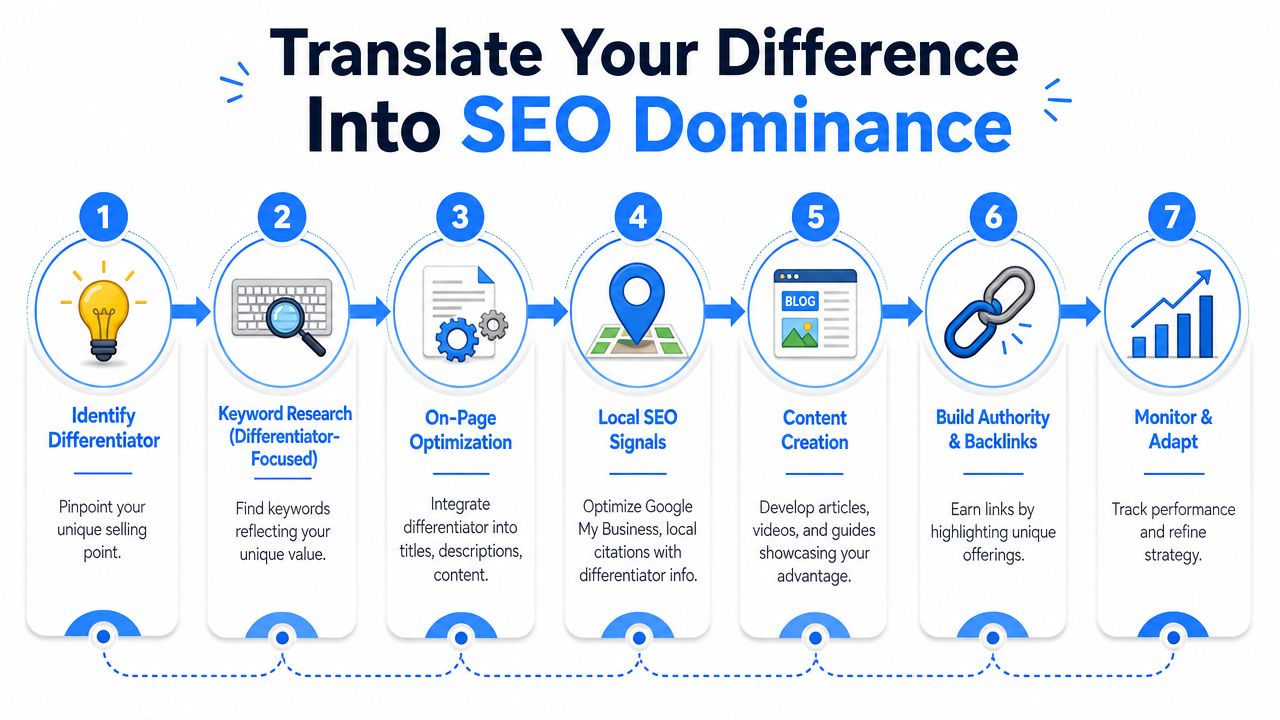
Put the differentiator in the pages that drive calls
Start with the pages closest to revenue.
Your homepage should state the primary market position clearly. Your service pages should connect that difference to specific buying intent. If your edge is same-day water heater replacement, then that language belongs in the page title, H1, opening copy, FAQs, and internal links. Don't bury it halfway down the page under generic fluff.
Focus on these assets first:
- Homepage H1: State who you help and what makes you different
- Primary service pages: Build one page per high-intent service
- Location pages: Match the differentiator to city-specific demand
- Metadata: Write titles and descriptions that reflect the actual advantage
Here's the rule. Don't optimize a page around broad category terms if the buyer really wants the specialist version of the service.
Build the same message into Google Maps
Google Business Profile is where local service companies either print money or disappear.
If your differentiator never shows up there, you're wasting your best local asset. Add your unique service emphasis in the business description, service list, posts, photos, Q&A entries, and review requests. If customers keep mentioning the same strength in reviews, Google gets a cleaner picture of what your business is known for.
A generic Google Business Profile tells Google you're one option. A specific profile tells Google you're the right option.
Useful places to reinforce your difference inside your local profile:
| GBP element | What to emphasize |
|---|---|
| Services | Specialized service names and buyer-focused wording |
| Posts | Timely offers, proof, job photos, process explanations |
| Q&A | Objections, guarantees, scheduling details, specialty scope |
| Photos | Before-and-after work, equipment, process screenshots, team proof |
Feed AI with consistent proof
Video helps here because it turns abstract claims into visible process. This walkthrough breaks down practical SEO thinking in a way many business owners can apply quickly.
AI systems pull from patterns across your site and local presence. If your pages, headings, FAQs, and profile all reinforce the same market position, you become easier to summarize accurately. That matters for conversational searches, voice search, and AI-generated recommendations.
Use content formats that explain and prove the difference:
- FAQ sections that answer buyer objections
- Dedicated service pages for specialized jobs
- Proof-driven blog posts that explain methods, guarantees, and use cases
- Review request prompts that encourage customers to mention the service angle that matters most
This is exactly why local SEO should revolve around transactional search terms. A page aimed at “roofer near me” needs to tell a buyer why your roofing company is the safer, faster, or more specialized choice. Ranking without differentiation invites shopping. Ranking with differentiation drives booked jobs.
Differentiation Examples That Win Local Customers
Generic positioning fails because buyers don't compare you against your own internal story. They compare you against the alternatives they believe they have. April Dunford's framing is useful here: a key question often isn't “How are we different?” but “Different versus what alternative?” Teams often fall into inside-out competition bias and should focus on the one or two differentiators customers care about (positioning perspective).
That's exactly how local service businesses should think about competitive differentiation in search.
HVAC
An HVAC company shouldn't just say “heating and cooling services.” That's category language, not decision language.
A stronger angle is 2-hour arrival window guarantee or same-day AC repair for no-cool emergencies. That differentiator aligns with urgent searches like “air conditioning repair near me” because the buyer's main fear is waiting around in a hot house.
The SEO move is simple. Build a dedicated service page around emergency cooling repair, mention the scheduling promise in the title and H1, and reinforce it in Google Business Profile posts and review prompts.
Dental
A dental office that markets “family dentistry” sounds like half the market.
A better differentiator is anxiety-free sedation dentistry for adults who delay treatment because of fear. That changes the frame completely. The buyer isn't just looking for a dentist. They're looking for a dentist they can tolerate.
The local search version of that strategy is a dedicated page for sedation services, supporting FAQs around comfort and candidacy, and local optimization around high-intent phrases like “sedation dentist near me.”
Plumbing and pest control
For plumbing, trenchless pipe repair specialists is stronger than “full-service plumbing.” It speaks to a specific problem and a specific alternative. The buyer isn't comparing all plumbing services equally. They're comparing “tear up my yard” versus “fix this with less disruption.”
For pest control, pet-safe organic treatments can be a real differentiator if the service model and proof support it. That position attracts buyers who would hesitate to book a standard treatment.
If you're in the trades and want examples closer to contractor marketing, this guide on local SEO for contractors is a useful reference point.
The best differentiator isn't the one that sounds clever. It's the one that changes the buyer's choice.
Your 60-Day Implementation Checklist
Most businesses don't need another long planning cycle. They need a tighter execution rhythm.
Differentiation becomes useful when you turn it into ranking signals, map signals, and conversion signals fast. That means picking a small number of strong claims and building your local search presence around them. Many firms end up with only 3–6 differentiators after evidence is vetted, and some are left with just one or two strong options once weak claims are removed, which is why differentiation should be treated as an evidence-based discipline rather than a brainstorming exercise (differentiation playbook).
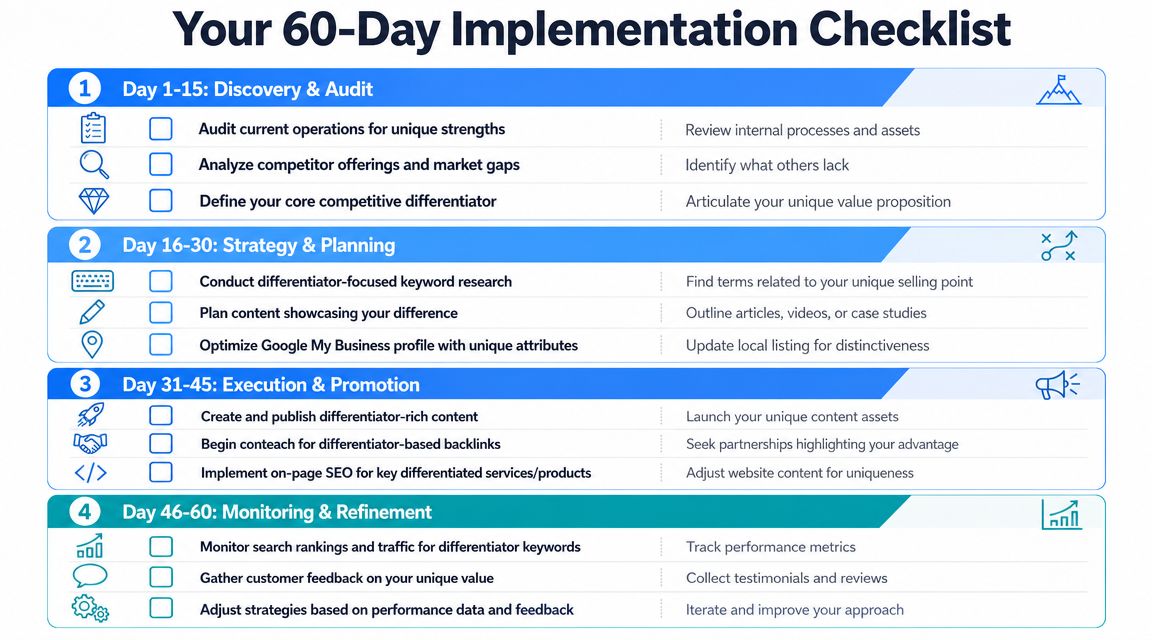
Days 1 through 15
Start with discovery, not design.
Write down at least five possible differentiators across service quality, speed, niche focus, guarantees, pricing clarity, and process. Then compare those against what your real competitors are saying on their homepages, service pages, and Google Business Profiles.
Your first pass should answer these questions:
- Which claims are unique in my city
- Which claims matter to someone searching with buying intent
- Which claims can I prove today with reviews, photos, workflow details, or documentation
Days 16 through 30
Now choose the strongest one to three themes. Don't choose more than that. If everything is a differentiator, nothing is.
Then rebuild your core messaging around the top claim.
Update these assets first:
- Homepage headline: Put your primary differentiator in plain English
- Google Business Profile description: Match the website language
- Primary service page: Build a page that explains and proves the advantage
- Review strategy: Ask customers to mention the exact value they received
Action standard: Your main differentiator should appear in the places buyers and search engines check first, not hidden in a paragraph nobody reads.
Days 31 through 45
This is execution time.
Publish one substantial content asset that supports the claim. For a roofer, that might be a page about emergency leak response. For a dentist, it might be a page and FAQ set around sedation care. For a plumbing company, it might be a trenchless sewer repair explainer with photos and process detail.
Then strengthen local intent around that offer:
| Asset | What to do |
|---|---|
| Service page | Add city intent, FAQs, proof, and conversion language |
| GBP posts | Publish updates tied to the specialty service |
| Internal links | Link related pages to the main differentiated service page |
| Reviews | Guide feedback toward the specific experience you want to be known for |
Days 46 through 60
Watch what the market tells you.
Track which pages get impressions for transactional search terms. Watch which service descriptions get clicks and calls. Listen to sales calls and front-desk conversations. If customers keep responding to one angle more than the rest, lean harder into it.
This is also where discipline matters. Don't keep changing your position every week because a competitor copied a phrase. Keep proving the difference in public. That's what builds durable visibility in search and AI systems.
A business that wants more booked jobs should leave this process with:
- One primary differentiator
- A small set of supporting proof points
- A rewritten website and map presence
- Content built around transactional keywords
- A consistent message buyers can repeat back
That's how competitive differentiation stops being theory and starts generating calls.
If your business is tired of blending in, Transactional LLC helps service companies turn a real competitive edge into rankings for transactional search terms, stronger Google Maps visibility, and content built for both SEO and AI discovery. The goal isn't vague traffic. It's getting your business found when someone searches with money in hand and is ready to book.