


Stop guessing and start dominating your local market. Most agencies burn your budget on impressions, reach, and generic traffic that never turns into booked jobs. That's backward. If you own a local service business, you need to show up when someone searches terms like “roofer near me,” “emergency dentist,” or “AC repair near me.” Those are transactional searches. The buyer has a problem, needs help now, and is ready to spend.
That's the lane Transactional Marketing stays in. We don't chase vanity. We target the searches that lead to calls, appointments, and revenue. Good market research strategies make that possible because they show you where local demand exists, how people phrase urgent needs, which neighborhoods convert, and where your competitors leave money on the table.
You also need to use the right tools for the right job. GWI describes its platform as giving access to insights on nearly 3 billion consumers across 53 countries, which makes sense for broad segmentation and cross-market analysis. That same source positions Google Trends as a search-intent signal, not a full market research system. For local service companies, that distinction matters. You don't need abstract audience theory first. You need directional demand signals, local behavior data, and proof of what drives calls.
Here are the 10 market research strategies that matter most when your goal is simple. Rank higher on Google and Maps for transactional searches, get more qualified calls, and book more jobs.
1. Local Search Behavior Analysis and Intent Mapping
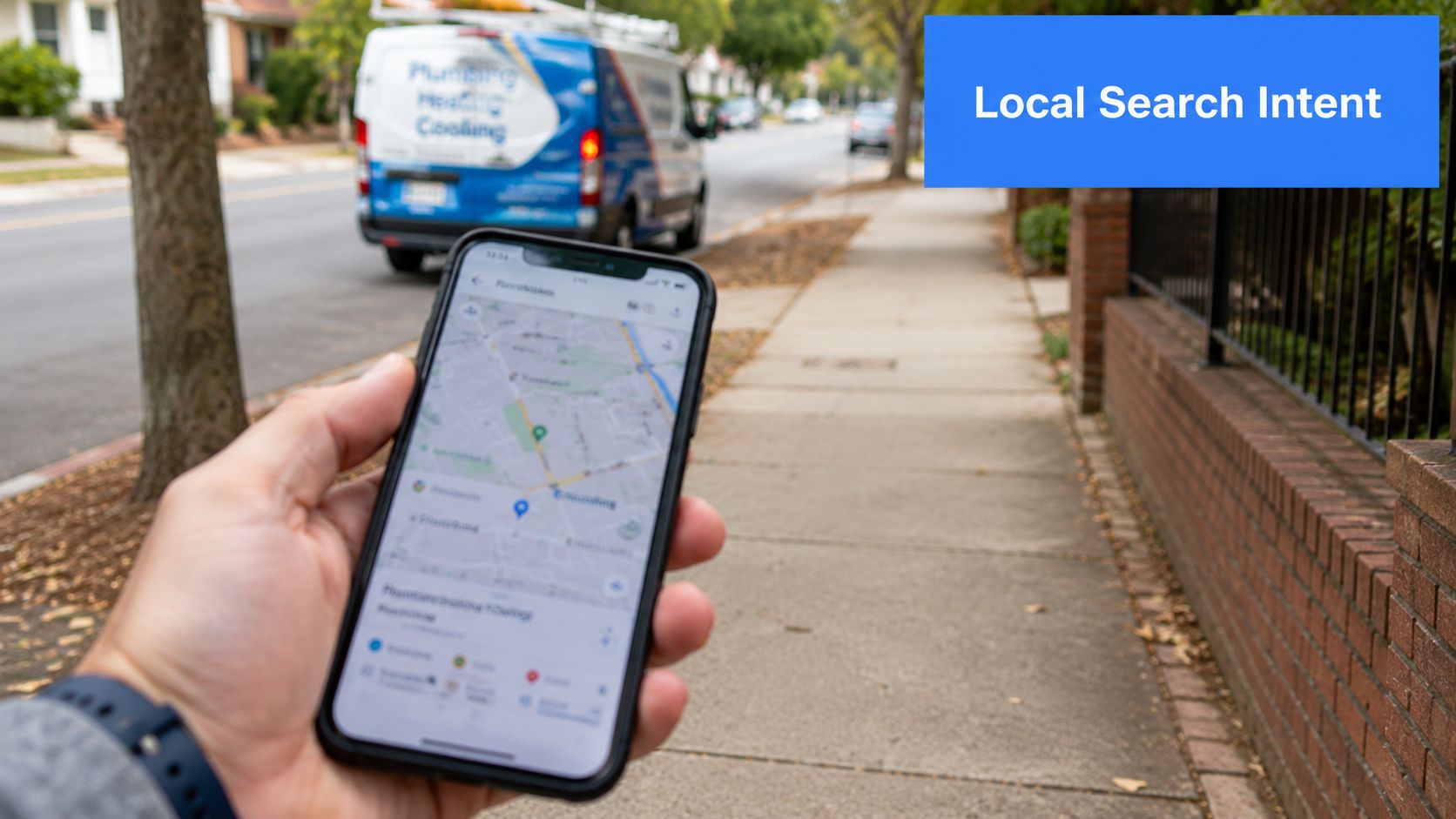
Your best customers tell you what they want every day through search queries. Most business owners ignore that data or lump all keywords together. That's a mistake. “How to fix a leaking pipe” and “emergency plumber near me” don't belong in the same bucket because they represent completely different buying intent.
Start with your own search data. Use Google Search Console to isolate queries by city, service page, and device type. Then map every important keyword into intent groups: informational, comparison, and transactional. Your money keywords are the ones tied to immediate action, especially “near me,” “open now,” “same day,” “emergency,” and city-based service terms.
What to map first
A plumbing company should separate “drain cleaning cost” from “drain cleaning near me.” A dental office should separate “what causes tooth pain” from “emergency dentist open now.” An HVAC company should split “furnace installation” from “furnace repair” because the pages, offers, and urgency level are different.
Use search query analysis for SEO to connect keyword patterns to actual revenue actions, not just clicks.
Practical rule: If a phrase sounds like a customer is ready to call, build a page, map listing support, and ad angle around it.
A pest control company might notice “termite treatment” rises in one city while “bed bug exterminator near me” dominates another. That tells you where to expand content, where to push Google Business Profile updates, and where to prioritize service-area pages.
Add one more layer. Match search behavior to your call logs and booked jobs. The keyword that brings less traffic but more calls is usually worth more than the broad term that inflates your dashboard.
2. Google Maps and GMB Performance Analytics
If you're a local service business, Google Maps is not a side channel. It's one of your main revenue channels. Many high-intent buyers never browse deep into websites. They search, compare map results, read reviews, and call.
That means your market research strategies have to include Google Business Profile performance, not just website analytics. Track which service areas generate the most visibility, which profile actions lead to calls, and which categories of searches trigger your listing most often.
What your profile data reveals
A roofing company can spot demand shifts after storms by watching service-area engagement. A dental office can identify which nearby neighborhoods generate direction requests and calls. An HVAC business can compare which services get attention in Maps versus organic search and adjust copy accordingly.
Google profile data becomes more useful when you combine it with a reporting system that shows rankings by city and map visibility trends. Use local SEO reporting tools to connect map presence with the calls and leads that matter.
You should also routinely audit your Google Business Profile to catch missing categories, weak service descriptions, inconsistent hours, unanswered questions, and review issues that suppress conversions.
The businesses that win Maps usually aren't the biggest. They're the clearest, the most relevant, and the easiest to trust fast.
Review your profile every week. Look at call activity, website visits, direction requests, review themes, photo freshness, service descriptions, and Q&A language. If customers keep asking whether you offer same-day service, financing, or emergency visits, that isn't a support issue. It's market research telling you what buyers need before they call.
3. Review Mining and Sentiment Analysis
Reviews are one of the cheapest forms of market research you'll ever get. Customers tell you why they hired you, what nearly stopped them, what they valued most, and what your competitors failed to do. Most owners only look at star ratings. Serious operators mine the wording.
Go line by line through your reviews and your competitors' reviews. Pull recurring themes into a simple sheet. Categories usually include response time, professionalism, pricing clarity, cleanliness, friendliness, scheduling, follow-up, and results.

What customers actually care about
An HVAC company may find that customers repeatedly praise same-day appointments. A plumbing company may see that “no surprise pricing” shows up again and again. A dental office may learn that “gentle” and “calming” matter more than discount language. Those phrases belong in your headlines, GBP posts, service pages, and ad copy because they reflect how real buyers make decisions.
Build your reputation workflow around those findings. Use reputation management tips for local businesses to turn customer language into stronger local positioning.
If you want AI help organizing review themes and customer issues at scale, you can explore SupportGPT-1 for support and insight workflows.
Use a simple process:
- Tag repeated phrases: Pull exact language customers use when describing urgency, trust, and results.
- Separate praise from triggers: “Friendly staff” is useful. “Answered at 10 p.m. and had a tech out fast” is stronger because it signals purchase drivers.
- Mine competitor complaints: If other companies get hit for no-shows, slow callbacks, or confusing pricing, make your process the opposite and say it clearly.
This is especially useful for transactional searches because the buyer often chooses between a few local options in minutes. The wording that reduces anxiety wins.
4. Competitive Keyword and Positioning Gap Analysis
Most local markets are less competitive than they look. A few companies rank for a handful of obvious terms, then leave entire service categories, cities, and urgency phrases uncovered. That's where you attack.
Use tools like Similarweb, Google Search Console, and Google Analytics as part of your secondary-data workflow. Serpstat notes that open-data analysis, government statistics, and tools such as Google Analytics, Similarweb, and Google Search Console are standard inputs for comparing market and competitor trends, and the U.S. Small Business Administration recommends pairing market research with competitive analysis to assess demand, market size, saturation, pricing, and location fit before entering a market through its market research and competitive analysis guidance.
Where the easy wins usually sit
A roofing company may see competitors pushing “roof replacement” while barely touching “emergency roof repair.” A chiropractor may find that nobody in town has built strong pages around auto accident care. An electrician may notice weak coverage for after-hours emergency service terms in specific suburbs.
Use SEO share of voice analysis to see how much local search real estate your business owns versus competitors for your highest-value terms.
Then build pages and profiles around the gaps competitors missed:
- Service gaps: Specific jobs competitors mention once but never optimize.
- Geographic gaps: Nearby cities or neighborhoods with weak local landing pages.
- Intent gaps: Emergency, same-day, financing, or “open now” searches they ignore.
Don't overcomplicate this. If no one has built a strong page for “emergency electrician near me” in a target city and you offer that service, publish the page, support it with your Google Business Profile, and pursue the term aggressively.
5. Customer Journey and Conversion Funnel Analysis
Traffic doesn't book jobs. A buyer books when every step between search and contact feels easy, credible, and fast. You need to know what that path looks like for your business.
Some customers search, hit your website, read reviews, then call. Others find you in Maps, check photos, skim your services, and tap to call without ever visiting a page. A dental patient might compare multiple practices before booking. A plumbing emergency caller may choose the first credible company that answers.
Track the actual path to the call
Salesforce highlights advanced analysis methods like predictive modeling, cohort analysis, funnel visualization, and custom dashboards for tracking behavior and conversion patterns. Those methods matter because local service buyers don't always follow a neat, linear journey. You need a dashboard that shows where they entered, what they viewed, and which touchpoints drove the final inquiry.
Use call tracking, form tracking, booking data, and Google Analytics to build a usable funnel. Then listen to call recordings and compare them against the search terms that brought people in.
Important patterns usually show up fast:
- Fast-path leads: Buyers from Maps or mobile search who call quickly.
- Comparison shoppers: Users who check testimonials, service pages, and reviews before converting.
- Urgent buyers: Searchers using emergency or same-day language who need immediate response.
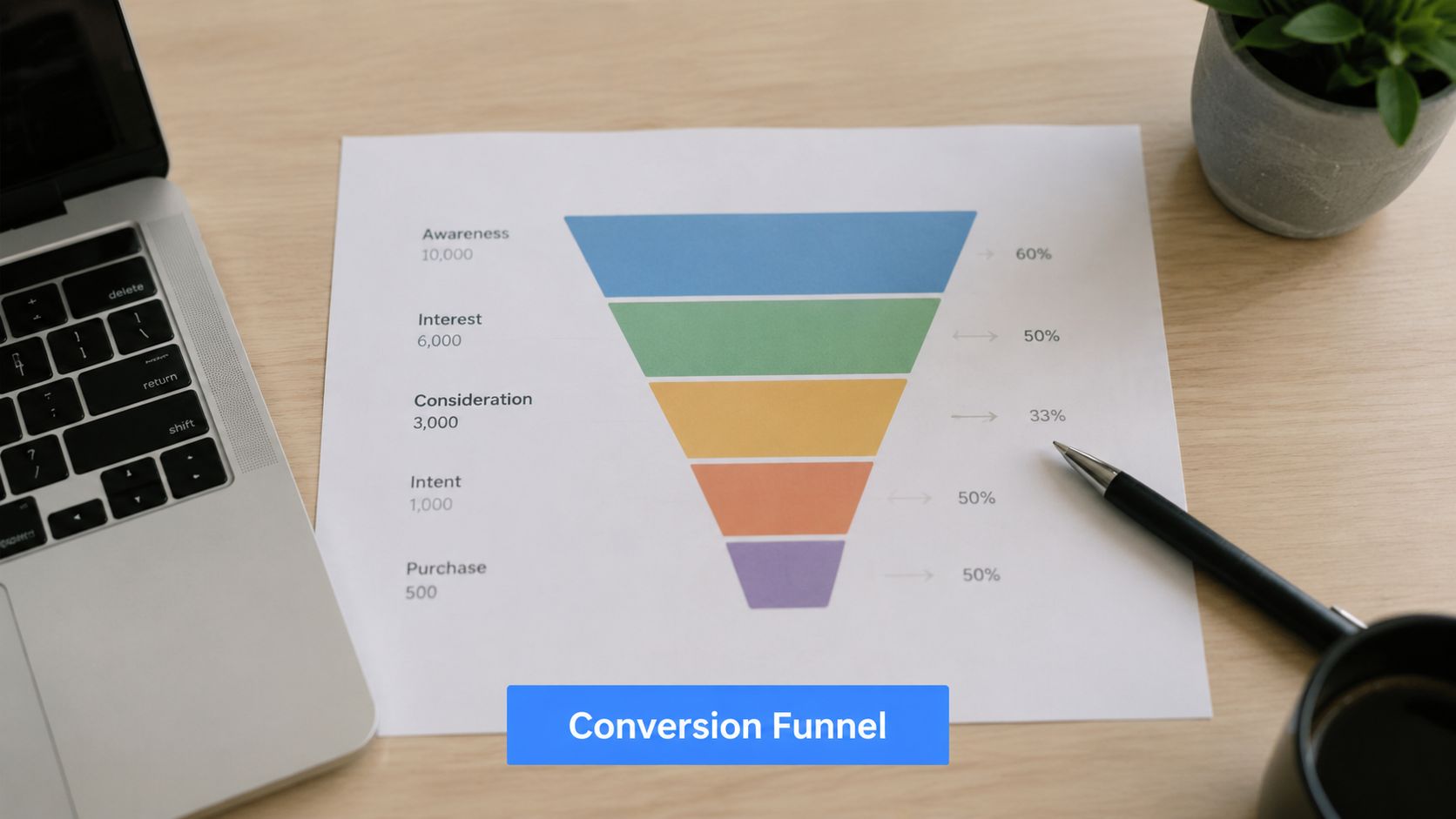
If your highest-intent traffic keeps dropping off before calling, the issue usually isn't demand. It's friction. Slow pages, weak trust signals, vague service pages, poor mobile design, or delayed response time kill booked jobs.
6. Service Territory and Demographic Targeting Research
Profit follows geography. The right service territory research shows you where high-intent buyers search, call, and book fast, so you can push harder in the areas that produce the best jobs and stop wasting budget on weak zones.
Start with closed revenue, not coverage maps. Plot your best jobs by city, ZIP code, neighborhood, property type, and service line. Then compare average ticket, close rate, travel time, and repeat value by area. A service area is only worth targeting if it produces profitable calls and supports fast response times that help you win Google Maps searches.
Target the neighborhoods that match the job
Different services win in different local pockets. HVAC companies usually see stronger demand in neighborhoods with older systems and larger single-family homes. Roofers should focus on storm-prone areas and housing stock old enough to need replacement. A company offering London boiler servicing should study where older boilers, higher-density housing, and urgent repair demand overlap, then build pages and GBP signals around those locations.
Use local data that affects buying behavior now. CensusReporter helps you review neighborhood-level housing, household, and population patterns through its census profile and mapping tools. Pair that with your booking history, dispatch logs, and call outcomes. That combination gives you a practical picture of where transactional demand is strongest and where your offer fits best.
Sort your territory into three groups:
- Core zones: Areas with strong close rates, solid margins, and frequent "near me" or city-based searches.
- Expansion zones: Nearby areas with similar property and buyer patterns, but weaker current visibility.
- Low-return zones: Places with poor economics, long drive times, low trust, or weak conversion rates.
This research should change your SEO plan. Build location pages for core zones first. Add city names, neighborhood references, and service-specific proof that matches local housing and customer needs. Tighten your Google Business Profile categories, service areas, photos, and review requests around the markets that bring in the best jobs.
A plumber does not need broad visibility across every nearby town. You need top visibility where buyers are ready to hire now, where you can arrive quickly, and where each booked job is worth winning.
7. Customer Pain Point and Solution Positioning Research
People don't search for services because they enjoy shopping. They search because something hurts, broke, failed, leaked, stopped working, or became urgent. If your messaging doesn't reflect that moment, you'll lose calls to businesses that sound more relevant.
Study the words customers use before they hire you. Pull them from reviews, intake notes, call recordings, email inquiries, text messages, and consultation forms. Look for the event that triggered action, not just the service requested.
Position around the problem, not your company
An emergency plumber isn't solving “pipe issues.” They're solving water damage fear, lost sleep, and a house in chaos. An HVAC company isn't just restoring cooling. They're helping a family deal with dangerous heat and discomfort. A pest control company may need to address embarrassment and urgency, not just treatment methods.
A company offering London boiler servicing would benefit from the same principle. Buyers usually care first about heat, safety, reliability, and response. Technical details matter later.
Say what the customer is experiencing, then show the fastest safe path to resolution.
This research directly improves transactional SEO and AI visibility. Search engines and AI systems both favor content that clearly answers the underlying user need. If your service page says “residential drain solutions” while customers search “drain backing up in kitchen sink,” your page is less likely to win the click or the mention.
Create separate messaging tracks for routine service and urgent service. Planned maintenance buyers need reassurance and value. Emergency buyers need speed, availability, and trust.
8. Seasonal Demand and Trend Forecasting
Seasonality decides who gets the call when local demand spikes. If you wait until search volume jumps, you miss the best rankings, lose Maps visibility, and hand high-intent jobs to faster competitors.
Track demand before customers start searching. Use Search Console, booking history, call logs, and Google Business Profile insights to spot which services rise by month, by zip code, and by urgency level. Then update the pages, categories, photos, offers, staffing, and ad support that help you win "near me" searches when buyers are ready to book.
Google Trends helps you spot directional shifts. Treat it as an early warning system, then confirm the pattern with your own first-party data. The point is simple. You are not trying to study general interest. You are trying to predict when transactional searches will surge so your business shows up first on Google and Maps.
The pattern usually follows real-world triggers. HVAC searches rise with heat waves and cold snaps. Pest control demand climbs with insect cycles and weather changes. Roofing calls increase after storms. Dental demand often moves around school calendars, holidays, and event seasons.
Build a forecast you can act on:
- Compare service-line trends: Review monthly changes in searches, calls, form leads, and booked jobs for each service.
- Watch local timing: One service area may spike earlier than another. Forecast by city or zip code, not just across your full market.
- Refresh priority pages early: Update seasonal service pages before demand peaks so Google can recrawl and rank them in time.
- Tune your GBP assets: Adjust services, business description, photos, posts, and offers to match what local buyers need right now.
- Prepare your response team: If seasonal demand creates more emergency calls, tighten scheduling, phone coverage, and dispatch speed.
Timing matters more than effort here.
A spring AC repair page published in July does not help you rank when homeowners search "AC repair near me" during the first hot stretch. A storm damage page updated weeks after severe weather will not win the urgent roofing calls already going to competitors.
Strong seasonal research turns local SEO from reactive to planned. You stop guessing, publish earlier, rank sooner, and capture more booked jobs from buyers who need service now.
9. Website User Experience and Conversion Optimization Testing
Your market research is incomplete if you don't test what happens after the click. Ranking for “dentist near me” or “emergency electrician” is only half the job. The page has to convert.
Run structured tests on your highest-traffic, highest-intent pages. Change one major variable at a time. That might be the headline, trust badges, call button placement, mobile click-to-call visibility, testimonial location, financing language, or emergency-service framing.
A strong practical explainer on testing and page improvement can help sharpen your process:
What local businesses should test first
An HVAC page should test whether emergency language belongs at the top for repair terms. A dental office should test whether insurance and same-week scheduling deserve more prominence. A pest control site should test whether “free inspection” or “same-day service” gets more qualified inquiries. A roofing contractor should test whether storm-response messaging beats general company branding for certain city pages.
Focus your tests on these areas:
- Mobile call paths: Can a user tap and call within seconds?
- Trust density: Are reviews, credentials, and guarantees easy to see?
- Intent match: Does the page headline mirror the search phrase and urgency?
- Form friction: Are you asking for only what you need?
Buyers from transactional searches are impatient. Every extra second, scroll, and field lowers your chance of getting the call.
Research quickly translates into revenue. If your market data is strong but your pages are weak, you'll still lose buyers who were ready to book.
10. Competitor Review and Brand Positioning Gap Analysis
Keyword gaps matter. Positioning gaps often matter more. If every competitor says “fast service” and “quality work,” none of them stands out. That gives you room to claim a clearer position that matches what buyers want.
Review competitor websites, Google Business Profiles, review responses, service menus, ad copy, and visual branding. Then document the promises they repeat most often. You'll usually find a lot of copycat language.
Find the promise no one owns
One market may be crowded with “same-day service” claims. Another may be full of low-price messaging. A dental market may overemphasize cosmetic treatments while underplaying comfort, family care, or emergency responsiveness. A plumbing market may push discounts while nobody clearly owns clean workmanship, communication, or long-term reliability.
This matters even more if you operate across multiple locations or markets. Academic guidance warns that global research often over-relies on recruitment platforms and that device access, data costs, and platform usage differ sharply by region and income, making routine sample and panel audits necessary in research that spans markets through this discussion of global research bias and portability. The local lesson is simple. Don't assume a positioning angle that works in one city will transfer cleanly to another.
Build your own gap map:
- List repeated competitor claims: Fast, affordable, family-owned, experienced, trusted.
- Match those claims against review evidence: Do customers mention those strengths?
- Choose a defendable angle: Transparent pricing, calm patient care, clean job sites, fast communication, specialized emergency response.
- Deploy it everywhere: GBP description, service pages, ads, review requests, and call scripts.
The best positioning is specific, believable, and tied to the reasons people convert.
10-Point Market Research Strategy Comparison
| Strategy | Implementation complexity | Resource requirements | Expected outcomes | Ideal use cases | Key advantages |
|---|---|---|---|---|---|
| Local Search Behavior Analysis & Intent Mapping | Medium, requires search intent classification and segmentation | Google Search Console, Maps data, analytics, time/analysis | High-intent keyword map and prioritized content plan | Service businesses targeting local, high-conversion queries | Targets ready-to-convert searches; informs content silos and ads |
| Google Maps & GMB Performance Analytics | Low–Medium, GMB setup and reporting | Google Business Profile access, dashboarding, multi-location config | Visibility and action metrics (calls, directions, impressions) by area | Multi-location businesses optimizing local discoverability | Direct measure of local discoverability and user actions |
| Review Mining & Sentiment Analysis | Medium, aggregation plus text analysis (manual or AI) | Review platform access, sentiment tools or manual coding | Thematic insights, customer language, pain points | Reputation-driven messaging and service improvement | Reveals authentic customer language and conversion-driving themes |
| Competitive Keyword & Positioning Gap Analysis | Medium–High, tool-driven competitive research | Paid SEO tools (SEMrush/Ahrefs), analyst time | Keyword gaps, low-competition opportunities, content targets | Businesses seeking to capture underserved local keywords | Identifies 'low-hanging fruit' keywords and competitor blindspots |
| Customer Journey & Conversion Funnel Analysis | High, integrates multiple data sources and attribution | Analytics, CRM, call tracking, data integration resources | Attribution insights, funnel drop-offs, conversion drivers | Improving booking rates and allocating marketing ROI | Shows which touchpoints actually drive revenue and bookings |
| Service Territory & Demographic Targeting Research | Medium, mapping and demographic profiling | Census/real-estate data, GIS/mapping tools, customer locations | Prioritized service areas and tailored neighborhood messaging | Geographic expansion and localized ad/GMB targeting | Focuses marketing and operations on highest-ROI territories |
| Customer Pain Point & Solution Positioning Research | Medium, qualitative research and synthesis | Customer interviews, reviews, call recordings, analysis time | Messaging aligned to urgent functional/emotional needs | Emergency services and high-emotion purchase decisions | Creates emotionally resonant messaging that increases response |
| Seasonal Demand & Trend Forecasting | Medium, historical trend analysis and correlation | 2–3 years of search/booking data, trend tools, weather/event data | Seasonality forecasts, staffing and campaign timing plans | Seasonal businesses (HVAC, roofing, pest control, dental spikes) | Enables proactive capacity planning and timed campaigns |
| Website User Experience & Conversion Optimization Testing | Medium–High, A/B testing and iterative experiments | A/B tools, sufficient traffic, developer/design support | Measurable lift in calls/forms/bookings; reduced friction | Sites with steady traffic needing higher conversion rates | Proven, data-driven conversion improvements and quick wins |
| Competitor Review & Brand Positioning Gap Analysis | Medium, comparative research and positioning mapping | Competitive audits, review analysis, analyst synthesis | Differentiated positioning and targeted messaging strategy | Crowded local markets needing differentiation | Identifies unique positioning and underserved customer segments |
From Research to Revenue Your Action Plan
Market research isn't a theory exercise for local service companies. It's how you identify the searches that bring in buyers with money in hand, ready to book now. If your research doesn't lead to stronger rankings for transactional terms, better map visibility, more calls, and more booked jobs, it isn't helping your business enough.
The right market research strategies give you a practical edge. Local search behavior analysis tells you how buyers phrase urgent needs. Google Maps analytics shows where local visibility turns into action. Review mining reveals the trust signals that reduce hesitation. Competitor gap analysis uncovers the terms, services, and cities your market has left open. Funnel analysis tells you where prospects drop off before calling. Service-territory research helps you focus on the neighborhoods that produce better jobs. Pain-point research sharpens messaging so your pages sound like the right answer at the exact moment someone needs help.
This is also where SEO and AI optimization now overlap. Search engines and AI-driven discovery systems both reward clarity, specificity, relevance, and local authority. If your business has strong pages for “emergency electrician near me,” a well-optimized Google Business Profile, consistent review themes, and content built around real customer pain points, you're easier to find in both traditional search and AI-generated recommendations.
Another shift matters. Industry guidance now recommends combining quantitative and qualitative data, using AI to detect subtle sentiment shifts, and validating assumptions regularly because markets move quickly, as discussed in this article on market research blind spots. For local businesses, that means you can't run research once, build a few pages, and assume the market will stay still. Search language changes. Competitors adapt. Service demand shifts by neighborhood, season, and urgency level. Your research process has to stay active.
That's exactly why Transactional Marketing focuses so heavily on transactional search terms. We care about the searches that generate revenue. “Roofer near me.” “Emergency dentist.” “AC repair near me.” “Pest control near me.” Those are the searches where buyers are ready to act. That's where your company needs to rank. That's where your Google Maps presence needs to be strong. That's where content, reviews, service pages, and conversion design need to work together.
When you apply these strategies consistently, you stop competing like a generic local business and start operating like the dominant option in your service area. That's how you move from guessing to page-one visibility, stronger map placements, more qualified calls, and a fuller schedule.
If you want help turning market research into rankings, map visibility, and more booked jobs from high-intent local searches, contact Transactional LLC. They build industry-specific SEO and AI optimization systems for service businesses that need to show up for transactional terms, dominate Google Maps, and convert local demand into real revenue.