


An HVAC owner can publish helpful articles about thermostat settings, winter maintenance, and indoor air quality, then remain invisible when a nearby homeowner searches “furnace repair near me”. The same pattern appears in dental, roofing, plumbing, and pest control accounts. The website earns attention from informational searches, while another business captures the call because it owns the organic results or the Google Maps pack when the buyer is ready to act.
That gap is where competitive keyword analysis becomes a revenue discipline. Transactional Marketing focuses on searches such as “air conditioning repair near me,” “dentist near me,” and “roofer near me,” because those queries express local and transactional intent. The job isn't to fill a spreadsheet with attractive phrases. It's to identify which searches produce calls, map actions, quote requests, booked appointments, and other customer actions, then determine which competitors already control that demand.
Why Most Local Businesses Guess at Keywords Instead of Competing
The owner usually starts with a familiar report. A keyword tool produces hundreds of phrases, search volumes, difficulty scores, and related questions. The team circles broad terms such as “HVAC,” “teeth whitening,” or “pest control,” publishes a few articles, and waits for the phone to ring.
That workflow feels organized, but it often ignores the businesses winning the searches that matter. An HVAC company might rank for “how to reset a furnace” while failing to appear for “emergency furnace repair near me.” A dental practice may attract readers researching dental procedures without being visible for “dentist near me.” A pest control company may build traffic around prevention tips while a competitor owns the local pack for urgent infestation searches.
The problem isn't a lack of keyword data. It's a failure to connect the data to competitive intelligence, local intent, and customer readiness.
Operator's rule: A keyword deserves attention because it can create a business action, not because it looks impressive in an export.
The three leaks inside a typical keyword plan
First, businesses chase informational terms without checking the actual results page. Broad educational queries often attract publishers, directories, medical resources, government pages, or established national brands. Even when a local company ranks, the visitor may still be gathering information rather than looking for a provider.
Second, teams leave out transactional modifiers. Terms such as “near me,” “open now,” “cost,” “same-day,” “emergency,” and service-plus-city phrases often reveal a much clearer buying situation than a generic head term. Search-intent research distinguishes transactional queries as actions such as buying, downloading, or interacting with a service, while local queries indicate a search connected to geographic proximity, which supports phrases such as “roofer near me” and other local queries.
Third, the business never audits who owns the local pack for revenue terms. That omission matters because Google's documented Local Pack model uses relevance, distance, and prominence, not keywords alone, as described in Google's local ranking model. A competitor located closer to the searcher may be harder to displace than a distant domain with stronger traditional SEO metrics.
Build the competitor roster before exporting keywords
Start with three to five direct competitors serving the same city and practical service radius. Don't begin with the names the owner remembers. Search buyer-ready phrases in an incognito window, record the organic results, and capture the businesses in the Maps pack. Repeat the process across core services, emergency variants, city modifiers, and appointment or quote language.
Separate the roster into three groups:
- True SERP rivals: Local businesses competing for the same services and customers in organic results.
- Branded noise: Yelp, directories, aggregators, and other pages that can inflate apparent competition without competing for the customer as a service provider.
- Maps-only competitors: Businesses that dominate local visibility but have little organic presence.
A useful competitor website analysis can add context about page structure, service coverage, and content gaps, but it shouldn't replace live SERP inspection. Tools reveal patterns. The search results reveal the market you must enter.
Check each Google Business Profile for overlapping categories, service descriptions, review activity, photos, Q&A, and physical proximity to the target area. Review activity should be recorded as an operational signal, not treated as a standalone ranking guarantee.
Use a roster like this before pulling keyword data:
| Competitor | Service Overlap | Organic Rank Wins | Maps Pack Wins | Review Velocity | Notes |
|---|---|---|---|---|---|
| Competitor A | Furnace repair, installation | Furnace repair pages | Emergency HVAC searches | Recent activity | Strong proximity |
| Competitor B | Full-service HVAC | City service pages | Installation searches | Steady activity | Wins organic and Maps |
| Competitor C | Repair only | Limited blog coverage | Repair searches | Sporadic activity | Maps-only rival |
Export competitor keywords only after this roster is clean. The keyword research best practices process then becomes more useful because every phrase can be evaluated against a known competitor, a service area, and a real customer action.
Reading the SERP and the Local Pack Like an Operator
Keyword difficulty is a starting clue, not a verdict. For every target query, inspect the page a customer sees and record the elements competing for attention. Log organic positions, sponsored placements, People Also Ask boxes, image results, videos, directory listings, and the language used in titles and descriptions.
Then inspect the Maps pack separately. Record the businesses shown, their distance from the searcher, star rating, review count, primary category, visible services, and whether the profile appears tightly aligned with the query. The same business can be a strong organic rival but a weak Maps rival, or the reverse.
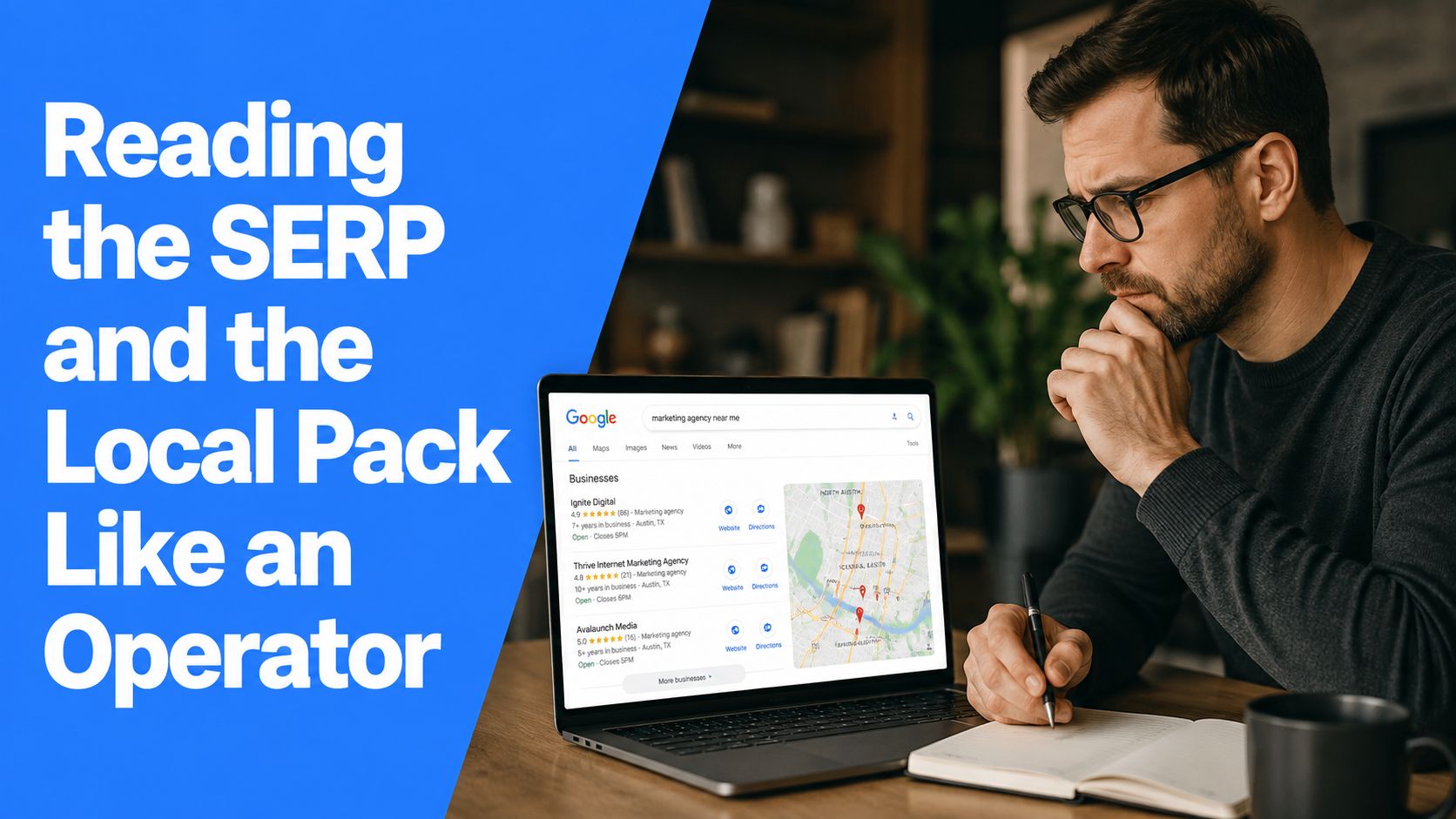
Google's local model centers on relevance, distance, and prominence. Relevance asks whether the profile and business match the service. Distance reflects the relationship between the searcher and the business location. Prominence reflects how established and recognized the business is online. The Google Maps ranking factors guide provides useful context for interpreting those signals.
A low tool score can still hide a difficult local result. If the Maps pack is filled with providers located inside a tighter radius, a business farther away may struggle even when its website has solid content. That's why every screenshot should capture:
- Query and location: Record the exact phrase, device context, and search location.
- Organic layout: Save the top results and visible SERP features.
- Maps composition: Capture the pack, categories, distance, reviews, and profile names.
- Competitor actions: Note posts, photos, Q&A, services, and offer language.
- Conversion path: Record phone buttons, booking links, quote forms, and directions options.
Repeatable screenshots make client reporting defensible. They also prevent a team from comparing a personalized search with a location-based test and calling the difference a ranking change.
Discovering and Mapping Keywords by Transactional and Local Intent
Begin with competitor URL harvesting. Use Ahrefs or Semrush to identify ranking pages and terms, and use Local Falcon to inspect how local visibility changes across a service area. The export should include the ranking URL, position, volume, difficulty, CPC where available, and the competitor associated with the term.
Expand that list with Google autosuggest, People Also Ask questions, service categories, profile services, and customer language from calls. A phrase that appears nowhere in a generic planner can still matter if it accurately reflects how local buyers describe an urgent need.
Sort terms into intent tiers:
| Intent Cluster | Example Keywords | Landing Page Format | GBP Action |
|---|---|---|---|
| Emergency and booking | emergency AC repair near me | Service page with call-first layout | Post about immediate availability |
| Quote request | roof replacement cost Phoenix | Quote page with qualification form | Service or offer post |
| Comparison shopping | best dentist for implants Tampa | Comparison or treatment page | Q&A addressing selection concerns |
| Informational research | how to prevent termites | Helpful guide linked to service | Educational post with service CTA |
The most valuable modifiers usually combine service and place. Use city names, neighborhoods, “near me,” “open now,” service-plus-city phrases, and emergency wording where they accurately describe the business. A generic “dentist” term may describe a market. “Dentist near me” describes a person looking for a provider.
The final spreadsheet should give every cluster a job. Map it to a landing page, a supporting article if needed, a Google Business Profile post topic, and a call-tracking number or form attribution method. That prevents content teams from publishing disconnected articles that never support a service page.
Keep informational terms in the plan when they support trust and nurture future buyers. Don't let them outrank emergency, booking, quote, and local service clusters in the publishing queue.
Finding Keyword Gaps That Survive the Zero-Click Reality
A standard gap report identifies phrases competitors rank for while your site doesn't. That output is useful, but incomplete. It may include queries where Google answers the question directly through an AI result, featured snippet, People Also Ask panel, map panel, or other native feature, leaving little reason for the searcher to visit a website.
A reported Similarweb analysis found that 68.01% of U.S. Google searches ended without an external click in 2026, compared with 60.45% in 2024, as reported in the zero-click local search analysis. Those figures change how operators should read a keyword gap. A missing informational term may create visibility without creating a call, while a smaller local phrase may send a ready buyer to a profile or service page.
Add a second pass to every gap export
For each missing term, inspect the live result and add fields for SERP features, likely click opportunity, Maps presence, and conversion path. Don't assume search volume represents accessible demand.
Use this validation sequence:
- Confirm the intent: Is the searcher looking to hire, compare, request a quote, or learn?
- Inspect the result: Does Google answer the query without an external visit?
- Check local behavior: Does a Maps pack appear, and do businesses receive calls or directions actions?
- Review competitor weakness: Are the current pages thin, outdated, poorly matched, or geographically weak?
- Assign a destination: Can the query support a service page, location page, profile action, or useful guide?
- Define the action: Decide whether success means a call, form, booking, map action, or assisted conversion.
- Remove the mirage: Archive terms with high visibility potential but no meaningful customer path.
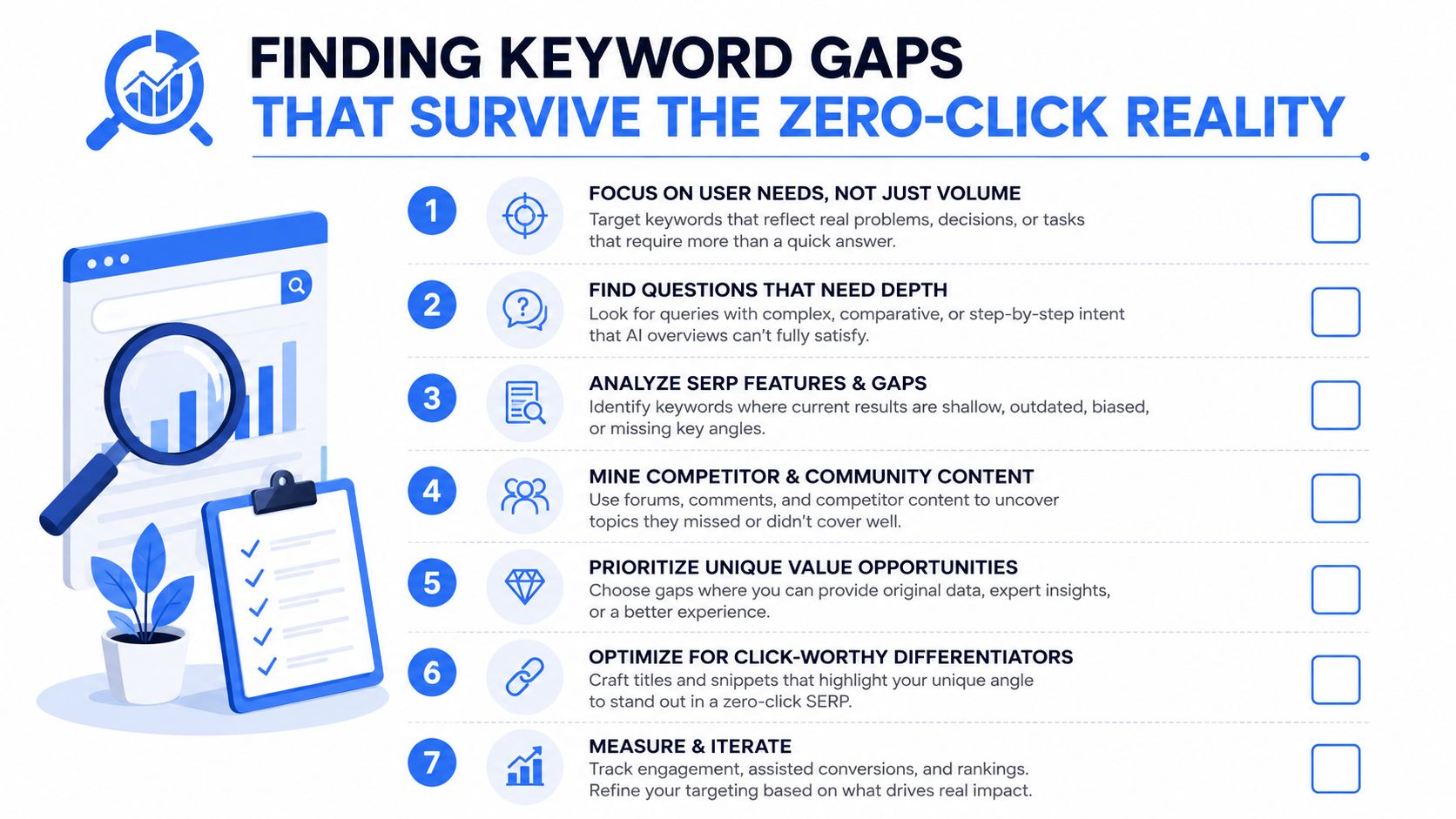
For HVAC, plumbing, dental, pest control, and med spa businesses, a gap is more credible when the query produces a call option, a local provider list, a booking path, or a high-intent click. A large informational gap can still support authority, but it shouldn't consume the resources reserved for transactional search terms.
Prioritizing Keywords by Difficulty Intent and Local Relevance
A single difficulty score can't describe a local market. Replace it with a local-weighted review that combines traditional difficulty, SERP feature pressure, Maps pack density, proximity, intent strength, and competitor weakness.
The probability data makes the trade-off clear. Reported top-10 success for average websites falls from 78% at KD 0 to 20 to 1.2% at KD 80 to 100, with intermediate rates of 42% for KD 20 to 40, 18% for KD 40 to 60, and 6% for KD 60 to 80. These benchmarks appear in keyword difficulty statistics from Ranktracker. They don't predict a specific local campaign, but they reinforce the need to prioritize feasible opportunities.
Use a five-point score for each criterion:
| Criterion | Weight | Score 1-5 Example | Reasoning |
|---|---|---|---|
| Intent strength | High | 5 for “emergency AC repair near me” | Strong action signal |
| Local relevance | High | 5 for service plus city | Direct service-area match |
| Competitor weakness | High | 4 when current pages are thin | Clear opening to improve |
| Maps competition | High | 2 when nearby providers dominate | Harder local displacement |
| Search volume | Low | 3 as a tiebreaker | Useful only after fit and feasibility |
A Phoenix HVAC client might place “emergency AC repair near me” above a broad air-conditioning guide because the service intent is immediate and the query connects to calls. A Tampa dental practice could place “dentist near me” below a narrower treatment-and-location phrase if nearby profiles dominate the pack, but still prioritize it for profile relevance and local visibility work.
For clustering decisions, the keyword clustering guide helps organize related terms around a service intent instead of creating one page per variation. Teams managing large publishing queues may also consider automated scheduling with Narrareach to coordinate content production, but automation shouldn't decide which local terms deserve investment.
Practical prioritization: Volume breaks ties. Intent, local relevance, and a credible path into organic or Maps visibility decide the ranking.
Turning Winning Keywords into Content Silos and GMB Wins
A prioritized keyword list has no commercial value until someone deploys it. Group related phrases into a service silo with one transactional pillar page, then add supporting content only when it answers a distinct customer question or strengthens the service topic.
For an HVAC business, the pillar might target air-conditioning repair in a city. Supporting pages can address emergency repair, common symptoms, repair versus replacement, seasonal maintenance, and service-area questions. Each supporting page should link naturally to the pillar with a mix of exact and partial-match anchors. The URL structure should make the relationship obvious, using service and location language rather than clever brand naming.
Google Business Profile work should reinforce the same cluster. Review the primary and secondary categories, service entries, description, photos, Q&A, and Posts for consistency. Don't force keywords into the business name field if they aren't part of the business name.
A practical deployment sequence looks like this:
- Publish or refresh the transactional page: Match the service, city, customer problem, proof, contact path, and expected next step.
- Connect supporting content: Link only pages that add useful context, not thin variations built to catch every phrase.
- Align profile services: Add legitimate services that have corresponding website coverage.
- Use Posts with purpose: Tie posts to seasonal demand, offers, availability, or a newly launched service silo.
- Seed useful Q&A: Address secondary intents drawn from the gap analysis, using accurate business information.
- Maintain visual and citation signals: Add fresh business photos and check consistent listings across the directories competitors use.
A Google Business Profile isn't a substitute for a strong service page, and a service page won't automatically secure the Maps pack. The two assets should support the same customer intent while respecting Google's relevance, distance, and prominence model.
Avoid publishing near-duplicate city pages with interchangeable copy. Local content earns its place by adding information gain, operational details, service-area clarity, proof, FAQs, or useful distinctions for that community.
Tracking Results With Dashboards Timelines and Map Rankings
Competitive keyword analysis should end in one operating dashboard, not separate reports that hide the relationship between rankings and leads. Organic positions, Maps visibility, calls, forms, and page activity should sit beside the competitor checkpoints captured during the initial research.
Track the service-area centroid and other meaningful grid points for local rank monitoring. Record top-three Maps appearances, Google Business Profile call activity, forms attributable to silo landing pages, organic rankings, and Search Console query movement. Review the data weekly across a 90-day window, then report monthly with a short explanation of what moved, what didn't, and what gets reworked next.
| Metric | Data Source | Cadence | Target Movement |
|---|---|---|---|
| Organic position by service term | Search Console and rank tracker | Weekly | Improved visibility for priority clusters |
| Maps pack position by grid point | Local Falcon or equivalent tracker | Weekly | Broader top-three coverage |
| Profile calls and actions | Google Business Profile reporting | Weekly or monthly | More attributable customer actions |
| Landing-page forms | Analytics and CRM | Weekly | Better conversion from transactional pages |
| Competitor checkpoints | Manual SERP captures | Monthly | Clearer market movement |
| Silo publishing status | Content workflow | Per milestone | Auditable execution |
Tools such as Looker Studio or AgencyAnalytics can combine Search Console, profile data, call tracking, and rank tracking into one view. Color-code ranking and action movement so the team can distinguish a content change from a profile optimization change. The performance dashboard should support that audit trail, with milestone dates attached to each refresh or new silo.
Don't report ranking movement without business context. A page moving upward for an informational term may look positive while emergency service calls remain flat. Conversely, a narrower “same-day pest control near me” cluster may produce valuable customer actions even if it doesn't dominate the volume column.
Transactional LLC offers local SEO, Google Maps and GMB optimization, industry-specific content silos, web management, and reporting for service businesses. If your HVAC, dental, roofing, plumbing, or pest control company needs a competitive keyword analysis tied to transactional search terms and local visibility, visit Transactional LLC to discuss the service areas and revenue-ready searches you want to own.