

A stain spreads across the ceiling after last night's rain. The homeowner doesn't open a brochure. They open a phone, type roofer near me, and decide in the next minute who gets the inspection.
That search is the whole point of digital marketing for roofers. A blog about shingle trivia can rank and still never produce a booked estimate. The map pin, the tap-to-call number, and a page that names the city and the leak are what turn a ready buyer into a job.
This stays on roofing only. Mixed-industry posts, storm slogans with no local match, and awareness campaigns that never name a service area don't belong in the same plan. Every channel gets judged by inspections and signed work.
When a Homeowner Searches Roofer Near Me
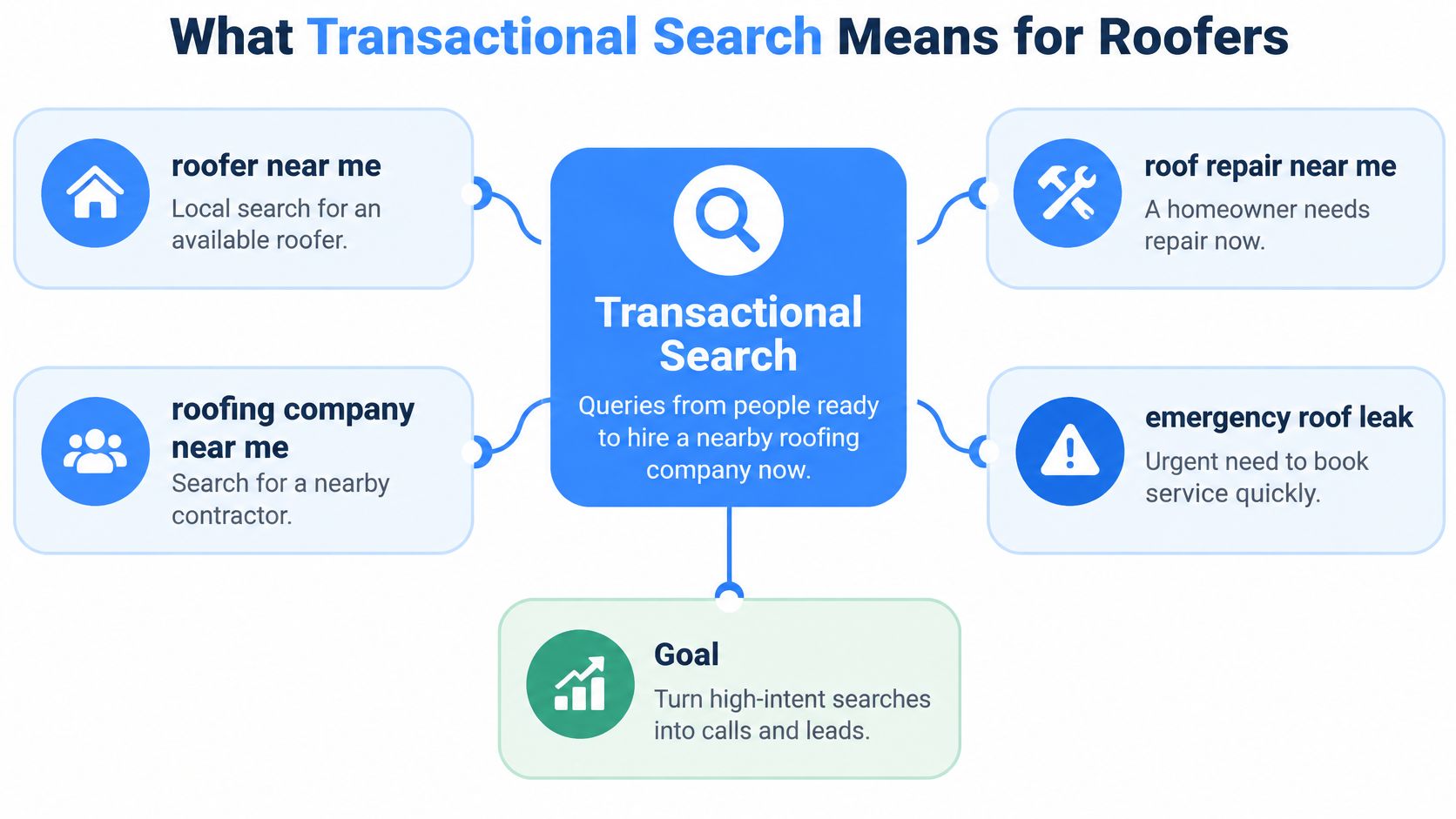
It's 7:14 a.m. Coffee is still on the counter. A homeowner spots a brown ring above the hallway and types roofer near me, or maybe roof leak repair. They aren't studying roofing history. They want a crew that can look at this house, in this city, soon.
That query is a transactional search. The person has a problem and money ready to spend. They are not browsing. A plan built around brand slogans, mixed trades, or a generic "we do quality work" ad misses the moment entirely.
What shows up in those few seconds
The phone screen is small. The homeowner sees three things before they scroll:
- The map pack. Three roofing companies, each with a rating, a distance, and a category. If the profile says "contractor" and never says roof repair, it loses the glance.
- A tap-to-call number. If the number is missing, buried, or different from the one on the website, the next company gets the ring.
- Recent reviews and a matching page. A review from last month that mentions a leak repair in their city beats a wall of old five-star blurbs. The click should land on a page that names the service and the city, not a homepage that could belong to any trade.
Practical rule: If the result doesn't say what you fix and where you fix it, the homeowner treats you as optional.
Awareness marketing fails here because it talks to people who aren't holding a wet ceiling. Storm slogans fail when they don't match the city the crew serves. A mixed blog that jumps from dentistry to HVAC to roofing teaches search systems, and language models, that the business isn't clearly a roofer.
Judge the whole program by one test. Did this search produce an inspection, and did that inspection become a booked estimate? Traffic that never rings is a cost, not a win. Transactional Marketing is built to chase those exact local terms, roofer near me included, instead of broad awareness that never reaches a dispatcher.
What Transactional Search Means for Roofers
A transactional search for a roofer is a query where a nearby company can be hired now. Roofer near me, roof repair near me, roofing contractor plus a city, storm damage roofing, and roof replacement in a real service area all sit in that bucket. The searcher wants a provider, not a definition.
A 2018 Google-related local-search benchmark reported that approximately 46% of Google searches have local intent, meaning the searcher wants a nearby business, location, or locally relevant service, according to the roofing SEO playbook from Allegiant Digital. That figure covers Google searches broadly, not roofing alone. Use it as a market signal, not a forecast of your lead volume.
Provider demand versus reading material
You can rank for "how long does a roof last" and still miss every city your crews drive. Informational demand wants an answer. Provider demand wants a phone number and a date.
| Query type | Example | What the page should do |
|---|---|---|
| Informational | How long a roof lasts | Teach, then offer an inspection |
| Provider, local | Roofer near me | Show service, city, and a call |
| Urgent provider | Roof leak repair | Reach a live person fast |
Build a roofing-only target list. One row per service, one row per city you cover. If you don't tarp roofs in a town, don't publish a page that pretends you do.
Where AI answers sit in the same hunt
Homeowners now ask the same high-intent questions inside large language models and AI summaries, not only in a blue-link list. Clear service names, city names, materials, warranties, and project proof give those systems something accurate to associate with your company. A program that also publishes dental or HVAC articles blurs that match. Relevance gets worse, not better, when the entity stops looking like a roofer.
Keep one industry in the content system. Roofing questions, roofing cities, roofing proof.
The list to maintain is short and specific: repair, replacement, inspection, and storm damage, each tied to the cities on the schedule. That's the target set for both classic local results and AI answers.
Google Maps Visibility for Roofing Companies
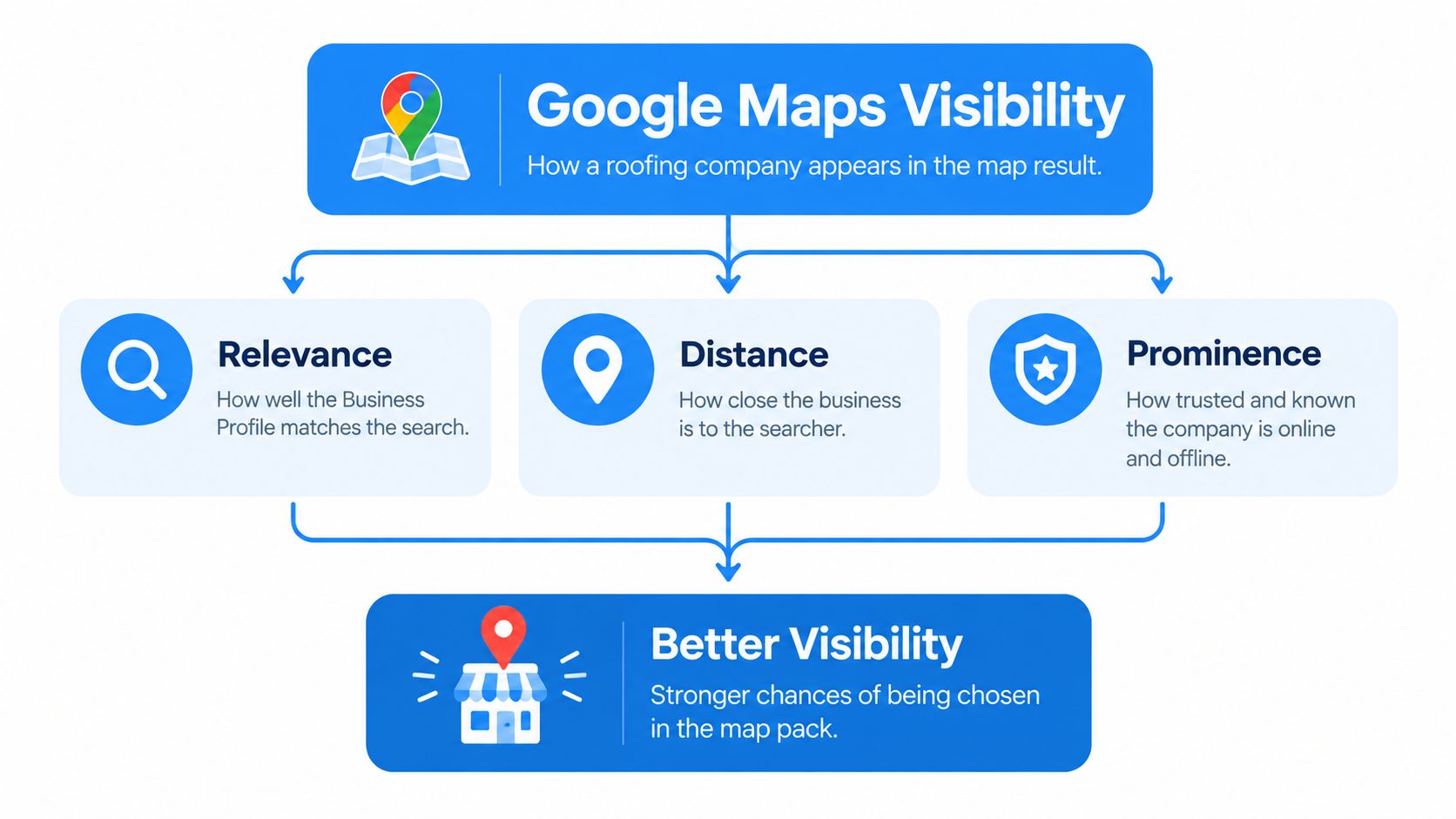
The map result is a different job from the website ranking. Google's local ranking guidance says local results rest primarily on relevance, distance, and prominence. Keywords on a page don't lock a permanent top-three pin, because distance depends partly on where the searcher stands.
The three factors in roofing language
Relevance is how well the Business Profile matches the query. Spell out roof repair, roof replacement, inspections, and storm-damage work. Complete categories, services, hours, service areas, and a phone number that matches the website. A thin profile that says "home services" forces Google to guess.
Distance is how far the business is from the searcher, or from the place named in the query. When the query has no city, Google estimates location from what it knows about the user. A company on the far edge of a metro will not outrank a closer, credible roofer for every "near me" search just by stuffing the city name.
Prominence is how well known the business is, online and off. Google ties that to information across the web, including links, articles, and directories, and it treats review count and review score as part of the signal. There is no published magic total. Track quantity, quality, listing consistency, and links together. A strong review profile helps. It doesn't replace a profile that fails to say you roof houses.
What to fix before you buy more ads
- One industry on the profile. Roofing categories and roofing services only.
- Accurate fields. Name, phone, hours, and service area must match the site and every directory.
- Proof on the profile. Recent project photos, service descriptions, and replies that mention the job type.
- Rank checks by city. Watch the map by service city, the way a local business listing optimization program should, instead of celebrating one vanity rank from the office Wi-Fi.
A keyword cannot move the searcher closer to your shop. Fix the profile and the proof before you spend on ads that send people to a weak pin.
Heat-map style checks show where you appear for repair versus replacement across the towns you serve. That map is the operating picture. A single rank screenshot is not.
Service and City Pages That Stay Roofing Only
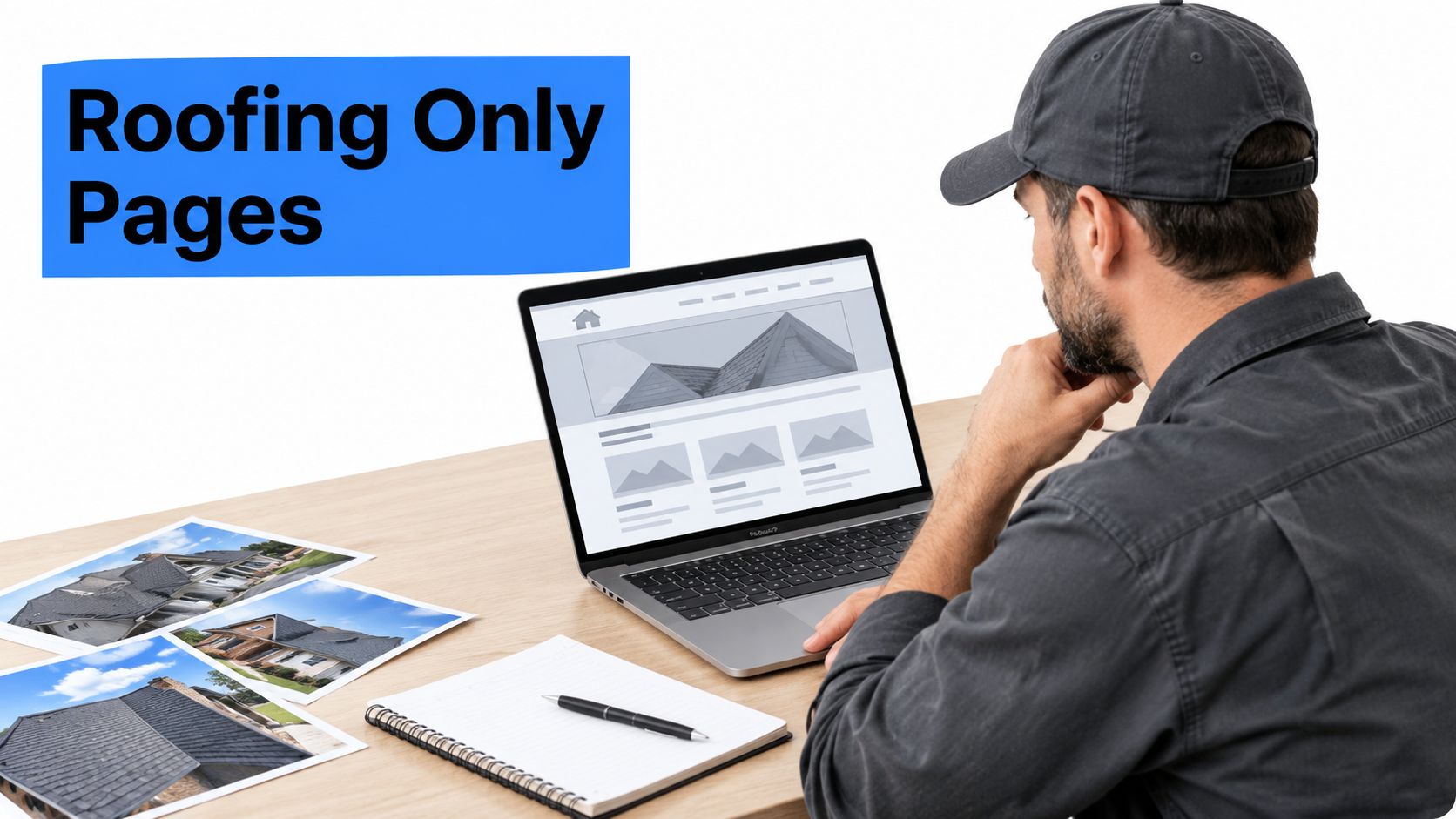
The website has to agree with the map. One page per real roofing service, and a supporting treatment for each city the crew covers. Roof repair, roof replacement, inspections, and storm damage should not share one generic page, and they should not sit next to articles about other trades.
How the pages should be built
Service pages name the work in plain language. A repair page covers leaks, flashing, and what an inspection includes. A replacement page covers lifespan, materials, ventilation, warranties, financing, scheduling, and how disruptive the job is. Don't mash those jobs into one URL and hope the query sorts itself out.
City support belongs on pages for places you drive to. Say the neighborhoods, the housing stock, and the services you will book there. A service area page that copies the same paragraph into twenty towns is a directory, not a match for a local query.
Those same details feed AI answers. A language model can only repeat what your pages make explicit: the service, the city, the materials, the warranty boundary, and proof from real jobs. Vague "quality roofing solutions" copy gives an LLM nothing safe to attribute.
Speed is a lead problem
Google research cited in roofing website design guidance reports that 53% of mobile visits are abandoned when a page takes longer than three seconds to load. Someone searching after a leak will not wait for a slideshow.
Practical Core Web Vitals targets from that same guidance:
- Largest Contentful Paint below 2.5 seconds.
- Interaction to Next Paint below 200 milliseconds.
- Cumulative Layout Shift below 0.1.
Compress before-and-after photos into modern formats. Reserve space for images and review widgets so the phone number doesn't jump. Defer chat and heat-map scripts. Test each high-value service-city page on a throttled phone, then compare load time with call starts and form completions.
A short walkthrough of how those pages should be structured:
If the slow page is the replacement page for your biggest city, fix that URL before you publish another article.
Paid Search and Social That Produce Calls
Paid search should buy calls against intent the organic pages already defined. It is not a second homepage.
A Google-commissioned Ipsos study found that 70% of mobile searchers had used click-to-call to reach a business from search results, 61% considered click-to-call most important during the purchase phase, and 47% were more likely to investigate another brand when a phone number was absent, as reported in Think with Google's click-to-call research. For a roofer, the ad, the map, and the landing page are a call system.
Route the query before you write the ad
Emergency terms such as roof leak repair should hit a live dispatcher or an answering service. The landing page shows the city, the leak service, and the same tap-to-call number used in the ad. Call assets and call extensions stay on. A form alone is the wrong primary action when water is coming in.
Research terms such as roof replacement cost can use an estimate form plus straight answers on materials, timing, and what the inspection covers. Those visitors are comparing. They still need the number on the result, because many of them call once the price question feels answered.
Keep one tracking number that matches the profile. Measure qualified-call rate by query, device, location, and hour, then tie those calls to booked-job revenue. Shift budget toward searches that produce inspections and signed work. Clicks without a qualified call are a spend review, not a success story. A focused PPC setup for roofers should make that split obvious in the account, not buried in a blended campaign.
Social follows the same offers
Social should repeat the roofing services and cities, not broad brand fluff. Storm creative goes up when local weather creates real demand, not on a standing "storm season" slogan. Before-and-after photos from jobs you finished, with the city named, outperform stock roofs. When you do turn spend up after hail or wind, use roofing storm campaign strategies as a checklist for timing, creative, and who you target, then send that traffic to the storm page, not the homepage.
Paid media inherits the page you already built. If that page is slow, generic, or missing a phone number, the ad just pays for the bounce.
Replacement Insurance and Emergency Lead Paths
Storm keywords are not automatically the best lead source. Recent industry reporting indicates that replacement work represented approximately 79.2% of U.S. roofing installations in 2025, so an always-on plan cannot live on hail spikes alone, per PipelineOn's roofing marketing analysis. The same reporting says about 62% of homeowners call online reviews very or extremely important when choosing a roofing company, only about 20% say strong reviews and testimonials alone settle the decision, and proven experience plus roofing-specific certifications matter to about 46%.
Three journeys should not share one page, one proof set, or one follow-up.
| Journey | Search intent | Page job | Proof to show | Next step |
|---|---|---|---|---|
| Routine replacement | Comparing a full roof, often over weeks | Answer lifespan, materials, ventilation, warranty, financing, disruption | Certifications, project photos, a clear consultation | Estimate form plus a scheduled call |
| Insurance damage | Needs documentation after a storm | Explain inspection, photos, and what you will and won't claim | Sample documentation, timeline, license | Book the inspection fast |
| Emergency repair | Water is active now | Name the leak service and the city, show the number first | Recent leak reviews, response hours | Live dispatcher |
Reviews that shortlist, proof that closes
Homeowners use reviews to build a shortlist, then choose on credentials and the quality of the consultation. A huge review count doesn't cover a weak crew or a vague estimate.
Ask after distinct milestones: inspection, repair, replacement, insurance help, and cleanup. Invite customers to describe the service and the city in their own words. Don't script a fake five-star paragraph. Reply to negatives with the timeline, the warranty boundary, and a way to escalate. A generic apology reads like you didn't look at the job.
BrightLocal's 2024 Local Consumer Review Survey, based on 1,141 U.S. consumers, found that 77% use at least two review platforms when researching a business (BrightLocal's 2024 survey). That is consumer behavior, not a roofing-only figure. Still, a Google-only profile is a single point of failure. Keep the same name, phone, and services consistent on the other profiles prospects open.
Why the paths need different follow-up
Replacement leads can wait for a thoughtful estimate sequence. Insurance leads need photos and a written next step the adjuster can follow. Emergency leads die if the callback is slow. Teams that reduce delays in sales callbacks protect the leak jobs that won't sit until Monday.
Track booked-job rate, gross margin, sales-cycle length, and cancellation rate by intent type. Storm traffic is often competitive, volatile, and price-sensitive. Replacement visitors may be fewer and more predictable. Put always-on effort on replacement and reputation. Raise paid spend when local weather creates measurable demand, not because a keyword has the highest volume.
How to Choose a Roofing Marketing Partner
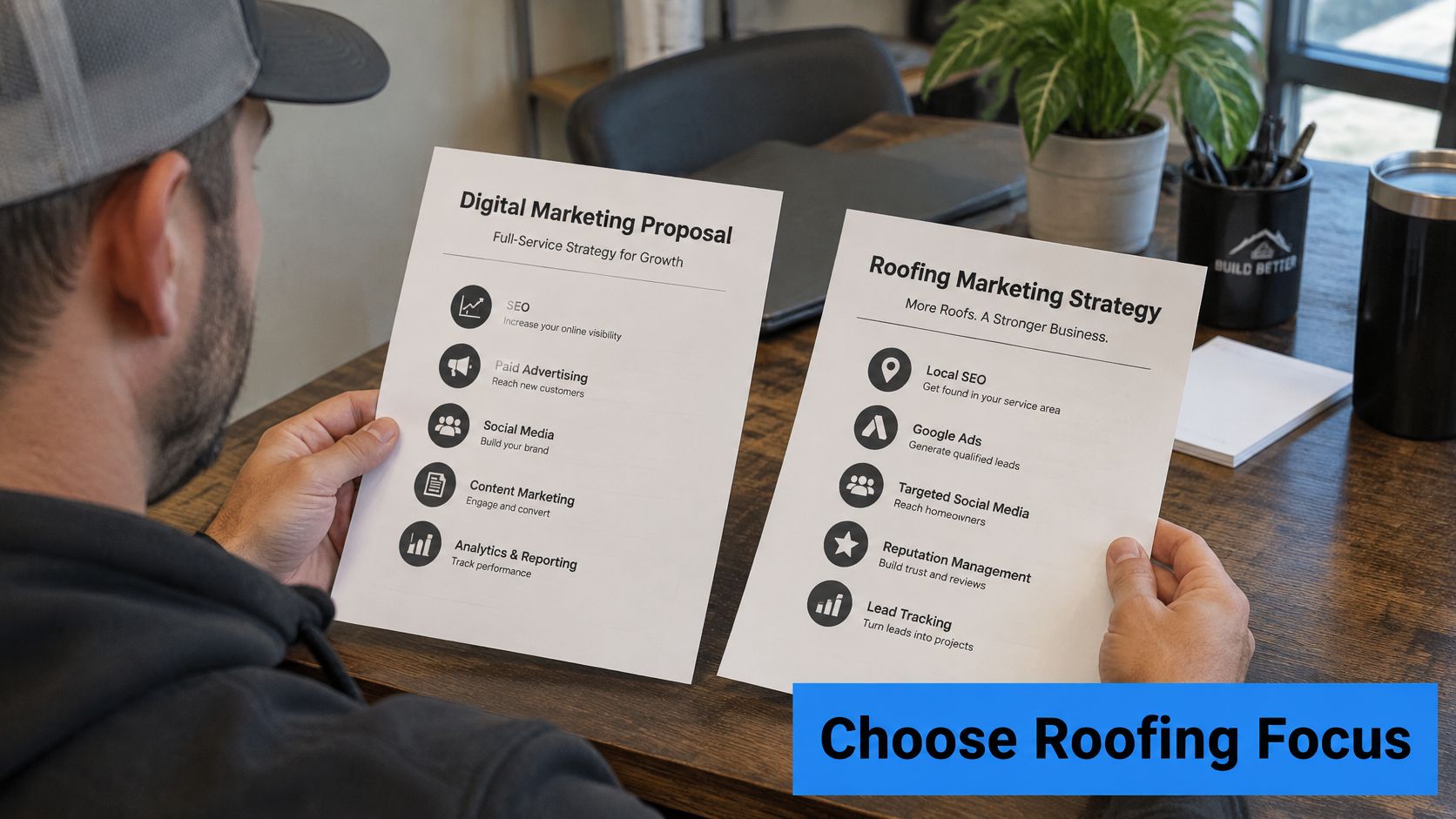
A generic agency blends industries, sends a click report, and calls that marketing. A roofing partner targets transactional terms such as roofer near me in the cities the crew serves, and separates map visibility from website rankings from AI answers.
What to demand in the first meeting
- A roofing-only target list. Repair, replacement, inspection, and storm damage, each tied to real cities. If the sample content mentions dentists or air conditioning as if they were the same program, walk.
- Map work as its own job. Relevance, distance, and prominence, checked by service city. No promise of a permanent top-three pin from keywords alone.
- Pages that match the ads. Service and city URLs, fast on a phone, with the same phone number as the profile.
- A measurement set. Qualified calls, inspections, and booked jobs by intent. Not sessions.
Transactional Marketing, at transactional.net, is built around that choice. The work is local SEO and Google Maps aimed at visible map results in a service area, with a stated pace of reaching page one of Google in roughly 30 to 60 days for targeted terms. The company ties its map technology to hundreds more calls a month and thousands more a year. That's their claim to test against your call log, not a guarantee you should accept without the cities and the terms written down. A roofing marketing agency engagement should also show service-and-city content, an AI-aware publishing plan that stays on roofing, and paid campaigns only when they support booked jobs.
The stack you should see
Expect a dashboard of keyword timelines by service city, map heat maps, Search Console queries, and traffic, with regular reporting. The offer can include web work plus ads, contract-free, without pretending every roofer needs every service on day one. Start where the missed calls are.
Write five transactional roofing terms and the cities that should produce calls. Check whether the map profile and the matching pages can win them. Then compare a partner's roofing proof to that list, not to a slide about "digital presence."
If the partner can't show roofing pages, roofing map checks, and a call tied to a booked inspection, they are selling activity. You need jobs.
Transactional LLC builds roofing-only local SEO, Google Maps work, and AI-aware content aimed at transactional searches such as roofer near me, so the calls you pay for can become inspections and booked estimates. The program stays on roofing, with service-and-city pages and reporting tied to the cities your crews serve. See how that system is set up at Transactional LLC.