


A homeowner searches “air conditioning repair near me” from a phone while standing beside a warm, silent system. A dental patient searches “dentist near me” after deciding to book, and a property owner searches “roofer near me” after spotting a leak. In each case, the buyer may read educational content before calling, but the final decision happens in a local search result or Google Maps.
That's where educational content creation becomes more than a brand-awareness exercise. Properly built content answers the buyer's immediate question, establishes local relevance, supports Google Business Profile signals, and guides the searcher toward a transactional action. Transactional Marketing focuses on that path, with separate content silos for each industry, service, and city instead of one generic blog covering every possible business.
Why Educational Content Powers Transactional Local Search
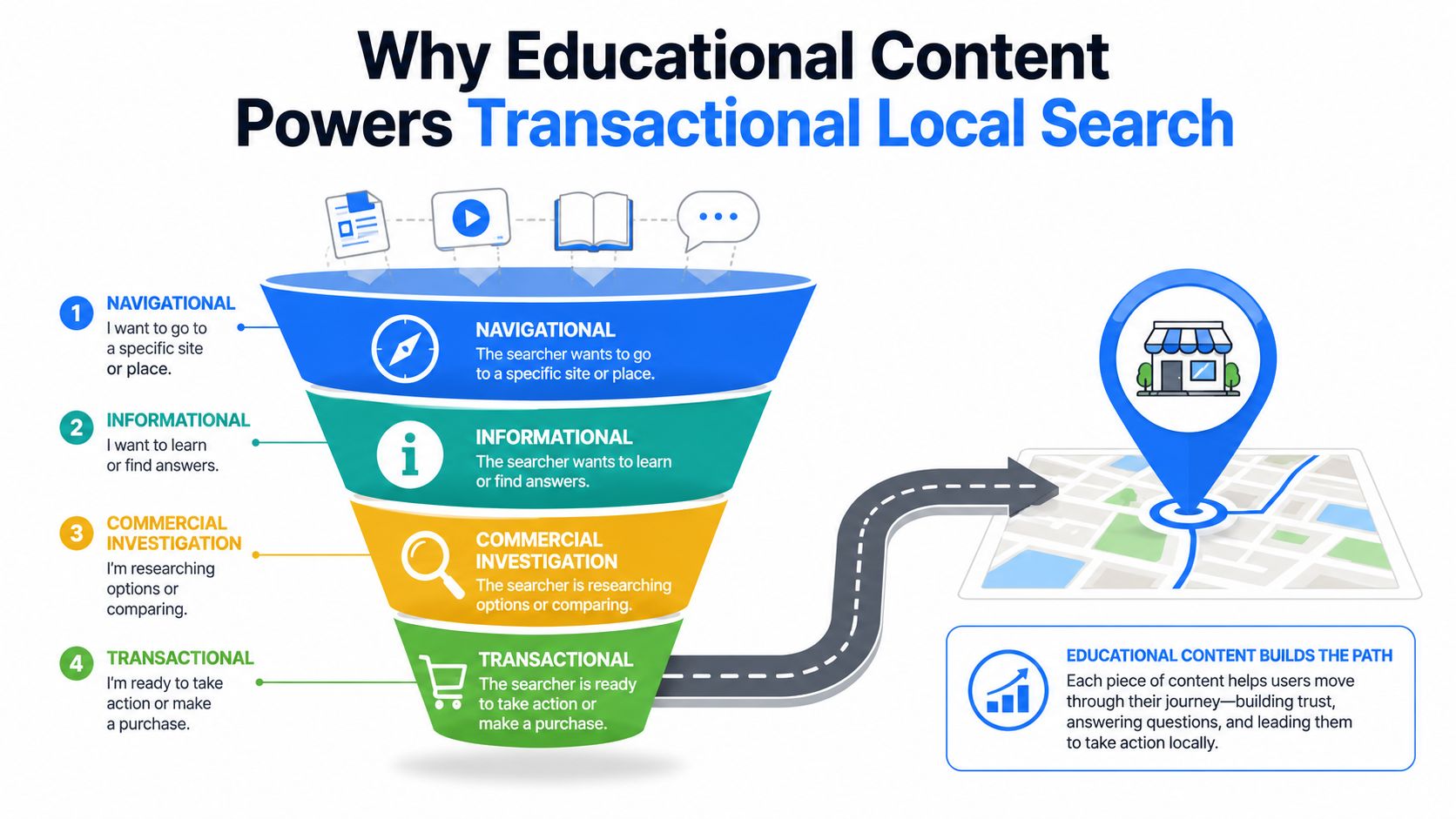
Search intent determines what a person wants to do next. The four standard categories are navigational, informational, commercial investigation, and transactional. A navigational search looks for a known business or website. An informational search seeks an answer, such as “how to reset a gas furnace.” Commercial investigation compares options, while a transactional search signals that the person is ready to book, buy, call, or request service. Queries such as “roofer near me” and “dentist near me” belong to that high-intent category, as explained in this overview of transactional search intent.
Educational content creates the bridge between those stages. A furnace guide can explain safe troubleshooting, link to a furnace repair service page, identify when professional help is necessary, and direct the reader to a local Google Business Profile. The content shouldn't pretend that every problem needs a technician, but it should make the next step obvious when the issue exceeds a homeowner's skill or safety limits.
Build one path from question to call
A useful local content path has four parts:
- Answer the question. Address the problem in plain language, with practical instructions and clear safety boundaries.
- Connect the problem to a service. Explain the symptoms that justify inspection, repair, replacement, or an appointment.
- Add local context. Reference the service area, property types, climate concerns, or regulations only when they apply.
- Make the action accessible. Link to a service page, show the business name and contact details, and connect the content to the relevant Google Business Profile.
The mistake is publishing a generic article about home maintenance and expecting it to produce calls for every service. Google needs a coherent subject relationship, and buyers need a clear reason to choose one provider. A focused HVAC silo can own both educational queries and money terms such as “furnace repair near me,” while a dental silo can address emergency tooth pain, insurance questions, and appointment intent without diluting the site with roofing or plumbing topics.
Businesses also need to separate industries rather than combine “SEO services for roofing, dental, HVAC, and med spas” into one broad page. Topical authority grows through depth and consistency, especially when each service area has its own useful pages, internal links, proof, and profile alignment. A practical overview of this model is available in content marketing for local businesses.
Planning Content Silos by Industry and Service Area
HVAC makes a useful working example because customers ask many questions before they call, yet the revenue-producing searches are usually service-specific and local. Start with a seed list of transactional terms such as “AC repair [city]” and “furnace installation [zip].” Pull language from Google Maps suggestions, Search Console queries, Google Business Profile questions and answers, and the actual phrases customers use during service calls.
Don't stop at keyword volume. A customer who asks, “Why is my furnace blowing cold air?” may later search for repair, replacement, or emergency service. That question belongs in the silo because it reflects a real decision path.
Map the HVAC topic architecture
Create one pillar page for each important service and location combination. Then add three to five supporting articles that answer pre-call questions without competing directly with the pillar.
| Pillar Page | Cluster Topics | Target Transactional Keyword | GBP Tie-In |
|---|---|---|---|
| AC Repair in [City] | AC blowing warm air, strange AC noises, when to repair or replace an AC | AC repair [city] | AC repair service, service-area post, related Q&A |
| Furnace Repair in [City] | furnace short cycling, pilot light issues, cold-air symptoms | furnace repair [city] | Furnace repair service, winter maintenance post |
| Furnace Installation in [City] | replacement timing, efficiency considerations, installation preparation | furnace installation [zip] | Installation service, project photos, offer post |
| Ductless Mini-Split Service in [City] | uneven rooms, filter care, mini-split troubleshooting | ductless HVAC [city] | Ductless service category and local photos |
Use People Also Ask for question discovery, competitor FAQ sections for coverage gaps, and fielded service calls for language that generic tools miss. A technician's explanation of a recurring diagnostic issue often creates a stronger article than a recycled list of keywords.
Connect URLs and internal links
A clean structure might use /service/[city]/pillar for commercial pages and /learn/[city]/cluster for educational articles. Each cluster page should link to its pillar, the pillar should link to the appropriate city landing page, and the city page should make the call or booking action prominent.
The schema stack should match the page's purpose. Use LocalBusiness for the business entity, Service for the offered service, FAQPage where the page contains genuine questions and answers, and HowTo only when the page provides actual step-by-step instructions. Structured data supports clarity, but it can't compensate for thin or inaccurate content.
Local businesses also benefit from strong visual explanations. A dental practice planning patient education can review this resource on medical illustration in dentistry to understand how specialized visuals can clarify complex topics without replacing professional guidance.
For multi-location companies, the service-area page strategy should keep each location useful and distinct. Swapping city names into identical pages creates a weak experience. Add locally relevant services, staff information, photographs, operating details, and questions that customers in that area ask.
Choosing Formats That Convert Local Searchers
A format only matters if it helps the searcher take the next step. Long-form guides can build authority, but a guide buried in a blog archive may produce little commercial activity. A short video can build confidence, but a standalone channel rarely transfers that trust to the page where a customer needs to call.
Educational video has become a normal part of institutional content production. A global survey reported that 99% of institutions had teachers regularly incorporating video into their curriculum in 2017, while more than half used video for student assignments and 21% said more than half of their students actively created video content. The same survey found that 38% of institutions captured at least 25% of classrooms, and externally facing educational video for marketing, admissions, and alumni relations rose from 57% to 66% by 2019. Those figures come from the education video marketing statistics overview. The local SEO lesson is practical, not academic. Video is familiar as an explanation format, so place it directly on a service page where trust and action meet.
| Format | Funnel Stage | Conversion Impact | Schema Eligible | Production Cost |
|---|---|---|---|---|
| Written how-to guide | Informational | Builds topical authority and earns internal-link clicks | HowTo, FAQPage | Low to medium |
| FAQ page | Informational and commercial | Resolves objections quickly | FAQPage | Low |
| Embedded service video | Commercial investigation | Shows process, people, and professionalism | VideoObject | Medium |
| Photo-heavy service page | Commercial investigation | Demonstrates equipment, workmanship, or environment | ImageObject | Medium |
| Cost calculator | Transactional | Helps visitors estimate and contact the business | Depends on implementation | Medium to high |
The wider e-learning economy reinforces the scale of educational content demand. One 2026 industry report placed the global online learning market at USD 314.03 billion in 2024 and projected USD 354.71 billion in 2025, a 13.0% year-over-year increase. Another 2026 estimate valued the market at USD 295.55 billion in 2025 and projected USD 962.63 billion by 2034, implying a 14.02% CAGR from 2026 to 2034. That estimate also projected North America at 37.4% of the market in 2025. These projections are summarized in the Kaltura state of video in education report.
For local service pages, the strongest combination is usually a written guide for top-of-silo authority, an embedded video on the pillar page, a calculator or estimate guide near the conversion point, and carefully implemented FAQ or HowTo markup. A polished infographic alone may look professional, but it won't replace useful text, local relevance, or a clear call path.
Tying Educational Content to Google Maps and GMB
Google says local visibility depends on relevance, distance, and prominence. A business must match the search, serve the relevant geography, and demonstrate enough trust and visibility to compete for prominent local placement, as outlined in this guide to local pack ranking factors.
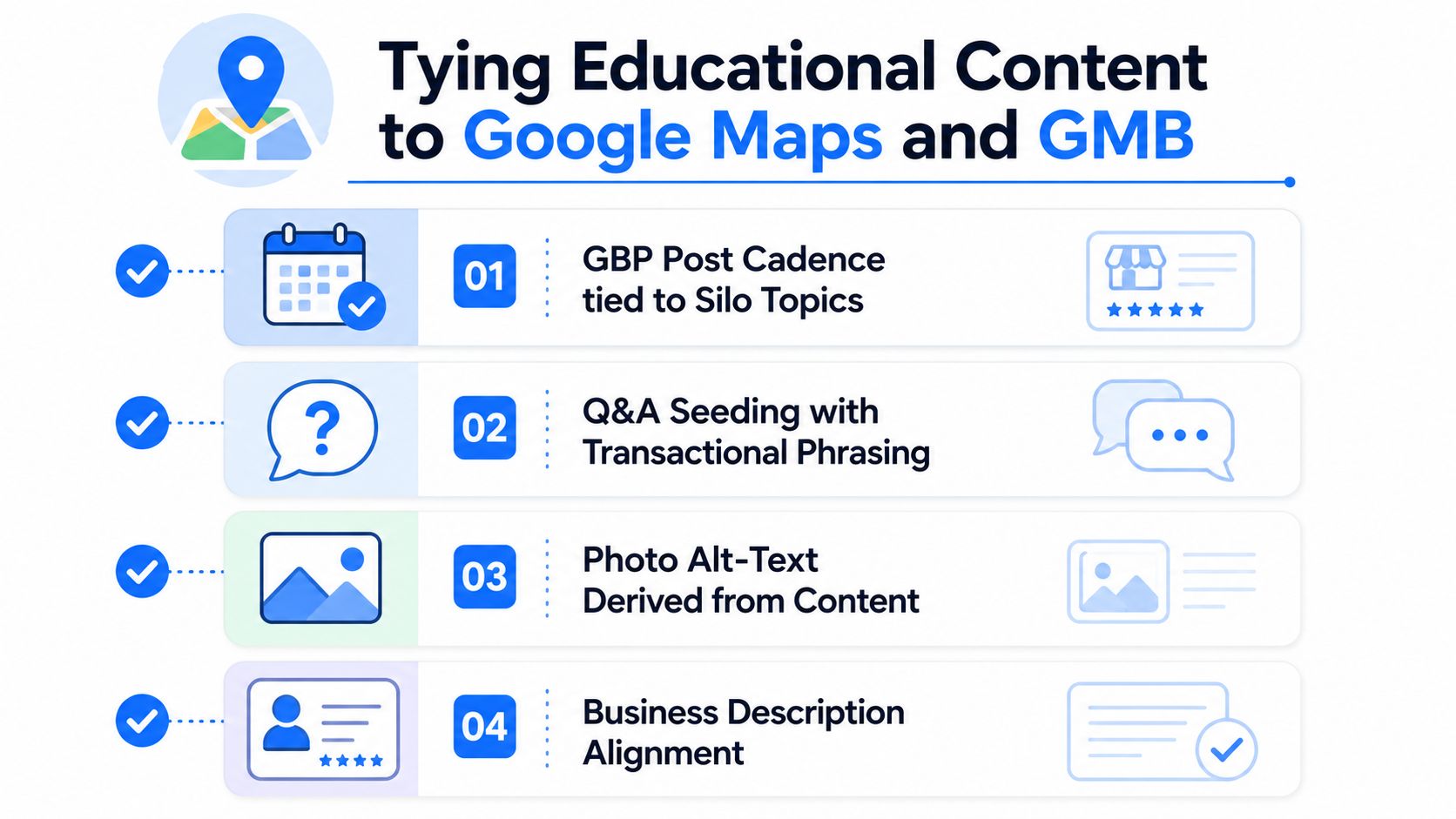
Educational content supports relevance when it uses the same service language customers use in Maps. A post about furnace short cycling can become a Google Business Profile update, a Q&A answer, a service-description snippet, and a link to the furnace repair page. That repetition isn't an excuse to copy and paste. Adapt the message to the feature, keep the facts consistent, and use the profile to reinforce the page rather than replace it.
Use the profile as a distribution layer
A practical editorial calendar can connect content to profile activity:
- Weekly GBP posts: Turn one cluster topic into a concise educational update with a relevant service link.
- Monthly photos: Add genuine team, equipment, project, or office images, with descriptive file names and accessible alt text where the platform supports it.
- Quarterly offers: Match an offer to a service pillar instead of promoting unrelated discounts.
- Review follow-up: Ask satisfied customers for honest reviews and respond with service-specific language without scripting or manufacturing praise.
Recent local SEO guides often estimate Google Business Profile signals as the largest local-pack factor cluster, around 32%, with reviews around 20% and on-page signals around 15%, as reported in this Google local pack analysis. Treat those figures as industry estimates, not a guarantee of rankings. The operational takeaway remains sound: complete profile information, authentic reviews, and localized landing pages deserve sustained attention.
Geo-modified LocalBusiness, Service, and FAQPage markup can clarify the relationship between a business, its service, and its service area. Keep the business name, address, phone details, and author information consistent across the site and legitimate third-party profiles. Guest content with accurate NAP details can support entity consistency, but no citation or profile can rescue a business that serves an area it doesn't cover.
A practical guide to optimizing Google Business Profile can help turn the editorial calendar into profile actions.
An embedded explainer can also strengthen a service page when it answers a real customer concern and sits near the next action.
Writing With Original Authority Instead of Volume
Publishing more isn't automatically a strategy. Local websites often accumulate thin articles that restate manufacturer guidance, competitor FAQs, and generic maintenance advice. Those pages consume editorial attention without giving Google, customers, or language models a reason to treat the business as a distinctive source.
One independent 2026 analysis found that fewer than 3 in 10 content-active organizations publish original research or proprietary data, only about 1 in 7 show strong expertise signals, and about 1 in 4 use a credentialed author bio. It also found FAQ blocks on fewer than 1 in 50 sites, pointing to missed opportunities for answer-focused structure. These findings appear in the analysis of education content marketing gaps.
Turn service experience into evidence
An HVAC company doesn't need a research department to publish original material. It already has service tickets, diagnostic patterns, technician observations, photographs, replacement decisions, and customer questions. Use that information responsibly, remove personal details, and publish the useful pattern rather than exposing private customer records.
A workable authority framework looks like this:
- Choose one diagnostic question. For example, ask which symptoms most often lead homeowners to request furnace inspection.
- Review internal service records. Group recurring answers from tickets and technician notes.
- Document the method. Explain what was reviewed, what the categories mean, and where the limits are.
- Publish the findings. Add technician attribution, original photographs, dates, and a clear editorial review process.
- Interlink the asset. Reference it from related cluster pages, service pages, and relevant GBP updates.
Practical rule: One well-supported local resource can give every surrounding page something original to cite.
This approach helps both traditional search and AI retrieval systems distinguish the company from sites that publish interchangeable content. It also creates better sales conversations. A technician can point to a page that explains how the company approaches a common problem, rather than sending a customer to a generic article that could belong to any competitor.
Distributing Content for AI and LLM Visibility
AI Overviews, ChatGPT, Perplexity, and Google's AI Mode create another discovery path alongside organic results and Maps. They don't remove the need for local relevance. A business still needs clear services, consistent identity information, useful pages, and evidence that a model can interpret and retrieve.
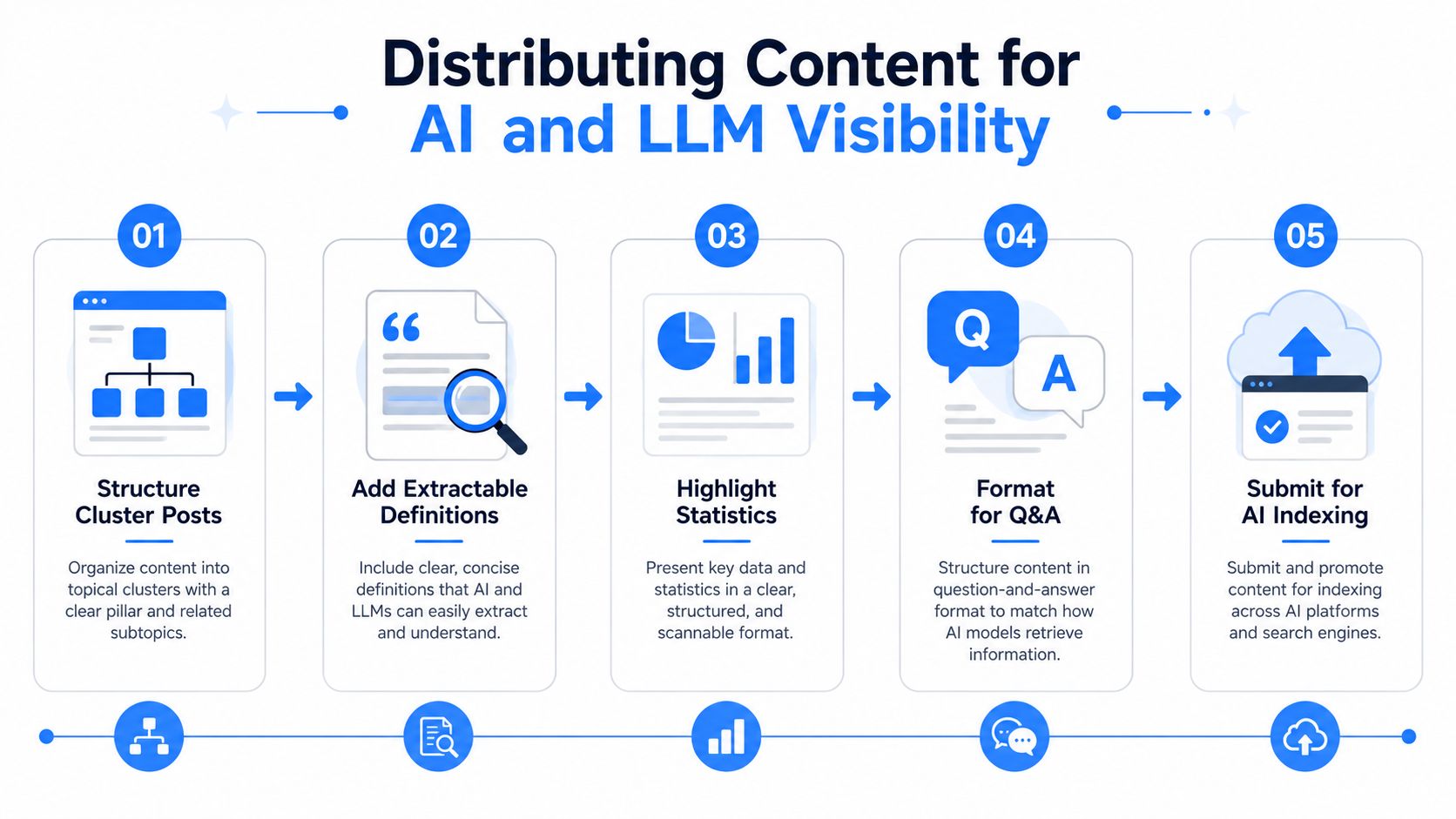
Write cluster posts so important answers are easy to extract. Define the subject early, state the local service context, use descriptive headings, and place supporting evidence next to the claim. Tables, concise answer blocks, cited sources, technician attribution, and properly marked-up FAQs give retrieval systems clearer units to process.
Give AI useful context, not generic output
AI can accelerate outlines, transcript cleanup, repurposing, and question clustering. It shouldn't invent service details, local claims, credentials, pricing, or customer outcomes. The practitioner supplies the context, validates the facts, reviews the language, and decides whether the finished page genuinely helps the audience.
Quality also depends on localization. A 2025 EdTech Hub discussion described contextual relevance across language, region, community, classroom, and individual child, which is a useful model for local service content as well. AI-generated material needs adaptation for the city, customer situation, service limitations, and compliance requirements. A broader 2026 World Bank evidence review reported mixed EdTech effects, including a learning gain of 0.125 standard deviations relative to traditional instruction in one synthesis. The lesson is straightforward: adopting a tool doesn't guarantee a better outcome. The same principle applies to AI-written content. These findings are available in the evidence review on EdTech.
For a practical framework on using AI as a collaborative production tool, AI content creation frameworks can help teams organize research, drafting, review, and repurposing. Distribution should include relevant YouTube videos, legitimate community answers on platforms such as Reddit or Quora, and accurate business profiles on Bing Places, Apple Business Connect, and Yelp. Don't spam those channels. Contribute useful answers, preserve consistent business information, and link only when the destination adds value.
Submit eligible URLs through IndexNow where supported, monitor whether AI systems cite or mention the business, and refresh important educational pages quarterly. Use AI search engine optimization as a parallel workstream, not a replacement for the service-area pages and Google Maps foundation.
Measuring Calls, Rankings, and Revenue From Content
Traffic isn't the business outcome. A local HVAC operator needs to know whether the furnace article assisted a call, whether the service page generated a form, and whether the Google Business Profile produced an action from the right city.
Start with attribution that a staff member can maintain. Use unique tracking numbers for GBP and important landing pages, forwarding numbers where appropriate, and UTM-tagged links. If paid campaigns use call-only conversions, send those conversion signals back into the advertising platform and compare them with organic and profile activity.
Build a monthly measurement loop
Cross-reference Search Console queries with Google Business Profile Insights, call answer rate, form submissions, direction requests, map views, and booked jobs. Raw call volume can mislead you if staff miss calls or if callers reach the wrong department. A call recording and disposition process, handled with appropriate consent and privacy controls, helps separate genuine opportunities from spam or unrelated inquiries.
Track local pack positions by ZIP code for core transactional terms each week, and review map heat-map movement inside the profile. Then connect organic sessions, assisted conversions, and assisted revenue in GA4 to pillar and cluster URLs. Don't judge an educational page only by last-click conversions. A guide may introduce the business, while a later branded or Maps search produces the final call.
| Metric | Source | What It Tells You | Target Benchmark |
|---|---|---|---|
| Transactional keyword position | Local rank tracker | Whether priority service terms are gaining visibility | Establish a baseline and seek sustained movement toward the top local results |
| Map heat-map coverage | GBP Insights and rank tracker | Where the profile appears across the service area | Expand visibility in commercially important locations |
| Calls by source | Call tracking and GBP | Which pages and profiles generate conversations | Increase qualified calls while protecting answer quality |
| Answer rate | Phone system or call tracking | Whether generated demand reaches a person | Improve missed-call handling and follow-up |
| Form leads | GA4 and CRM | Which pages produce non-phone inquiries | Increase qualified submissions, not raw form count |
| Assisted revenue | GA4 and CRM | Whether educational pages influence booked work | Expand pages connected to profitable services |
| Search queries | Google Search Console | The language customers use to discover the site | Build or refine content around relevant transactional paths |
Review the data every month with four questions: which cluster pages moved into the top three, which GBP actions grew, which pages produce calls versus forms, and what should be cut or expanded next quarter. Transactional LLC offers industry-specific content silos, Google Maps and Google Business Profile optimization, AI-driven content planning, website support, and reporting that connects service-city rankings with search and traffic data. Visit Transactional LLC to discuss a content system built around transactional searches such as “air conditioning repair near me,” “dentist near me,” or “roofer near me.”