
The most popular advice about Facebook ads for contractors is incomplete. It tells you to launch a campaign, target homeowners, collect leads, and wait for booked jobs. That approach treats Facebook like Google, where someone searches “roofer near me,” “plumber near me,” or “air conditioning repair near me” with an immediate need and money ready to spend.
Facebook usually works differently. People are scrolling, not searching for a contractor. The platform can create demand, keep your company visible, and bring previous visitors back into the conversation, but it often works best as a second layer after high-intent search channels are capturing active demand. Contractors who understand that distinction can use social advertising to support profitable growth instead of judging every campaign by an unrealistic search-ad standard.
Why Facebook Ads Work Differently for Contractors
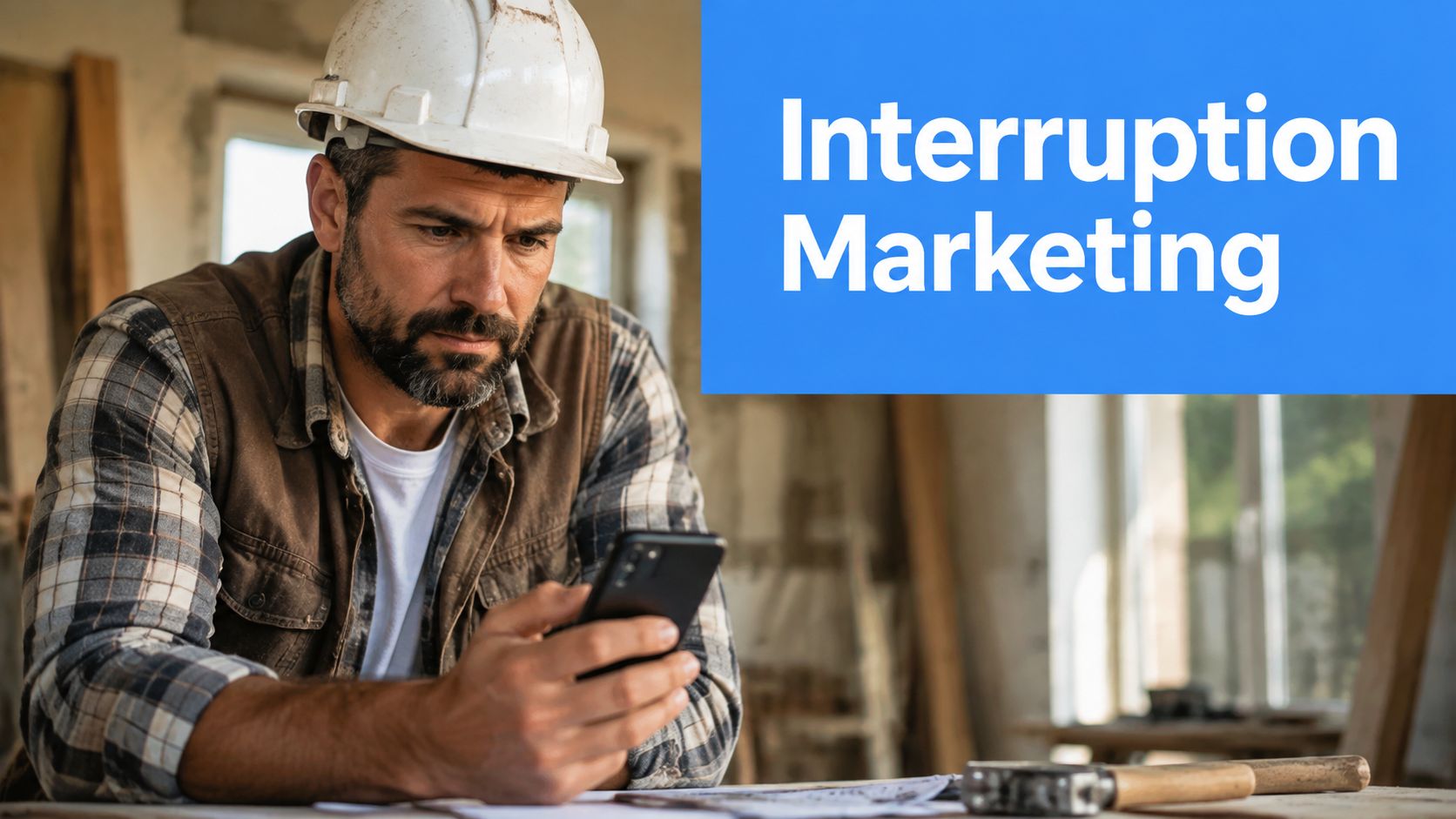
Facebook interrupts attention. Google responds to declared intent. That difference controls nearly every decision you'll make about creative, targeting, follow-up, and budget.
Someone searching “roofer near me” is telling Google what they need and where they need it. Someone seeing a roofing ad in their Facebook feed may have no urgent project in mind. They might notice storm damage, remember an aging roof, or save the company for later. That person can still become a valuable customer, but the ad has to earn attention before it earns a form submission.
Facebook belongs higher in the funnel
Facebook is strongest when it performs one of four jobs:
- Warm cold audiences: Introduce your crew, service area, workmanship, and customer experience before a homeowner needs you.
- Retarget interested visitors: Show follow-up ads to people who visited a service page, watched a project video, or opened a form without submitting it.
- Capture seasonal demand: Promote furnace service before cold weather, roof inspections after storms, or cooling repairs during hot periods.
- Shape local preference: Keep your company familiar across the neighborhoods you serve, so your name is already recognized when a repair becomes urgent.
That doesn't make Facebook weak. It makes it different. Independent contractor guidance places Facebook and Instagram lead costs roughly in the $15 to $40 range, while also warning that social traffic carries less intent than search traffic. The practical implication is that lead quality, qualification, and follow-up matter as much as the lead price itself. Independent guidance on Facebook advertising for contractors explains why instant forms and rapid response belong together.
Practical rule: Use Facebook to create familiarity and recover unfinished interest. Use transactional search marketing to capture homeowners who are already asking for a contractor.
That's why a contractor's broader marketing plan should prioritize marketing for contractors around high-intent local searches, organic visibility, and Google Maps presence. Transactional Marketing focuses on the searches that indicate immediate buying intent, including “roofer near me,” “dentist near me,” and “air conditioning repair near me.” Facebook can then reinforce the same service themes in a channel where homeowners discover and remember local brands.
Real Cost and Conversion Benchmarks for Home Services
Before you spend, separate platform averages from contractor-relevant expectations. Broad Facebook Lead Ad benchmarks can look attractive, but home and home improvement campaigns face different economics.
WordStream's 2025 benchmark for the Home & Home Improvement category reported an average $2.23 cost per click, 5.22% conversion rate, and $41.26 cost per lead. Across industries, Facebook Lead Ads averaged a $1.92 CPC, 7.72% conversion rate, and $27.66 CPL in the same benchmark family. The comparison shows why contractors shouldn't build a forecast from a generic industry average. WordStream benchmark context for contractor-adjacent home services provides the category-level figures.
| Metric | All Industries Average | Home & Home Improvement |
|---|---|---|
| Cost per click | $1.92 | $2.23 |
| Conversion rate | 7.72% | 5.22% |
| Cost per lead | $27.66 | $41.26 |
| Click-through rate | 2.59% | 1.94% |
The same benchmark source also identifies a $0.99 average CPC for the broader Home & Home Improvement category in a historical Facebook ads benchmark. That apparent variation is useful rather than confusing. Placement, objective, audience, creative, geography, and measurement window can move costs substantially. The stable lesson is that Facebook can buy attention cheaply while still producing expensive leads if the offer and form fail to convert.
Turn benchmarks into a planning model
Use the category CPL as a planning reference, not a promise. A campaign forecast should include:
- Ad spend, separated from agency fees, creative costs, and software.
- Expected lead cost, using the contractor-relevant benchmark rather than the broad average.
- Lead qualification, because some submissions won't match your service area, job type, or timing.
- Booked-job rate, measured from actual CRM records rather than platform-reported leads.
- Gross profit per job, which determines how much acquisition cost the business can carry.
A campaign can appear successful at the lead level and still lose money if the estimator misses calls, the office ignores messages, or the sales team accepts poor-fit inquiries. Use a documented cost per acquisition calculation that connects spend to booked and completed work.
Don't compare Facebook CPL directly with Google Local Services Ads without accounting for intent. A Facebook lead may need education and multiple follow-ups, while a search lead may already be comparing providers. The correct decision metric is profitable booked work by source, not the cheapest form fill.
Building a Contractor Campaign Structure That Converts
A reliable contractor campaign starts with one service, one local offer, and one clear conversion path. Broad campaigns that combine roofing, gutters, siding, and remodeling make it difficult for both the homeowner and the algorithm to understand what the ad promises.
Start with the objective and offer
Choose Lead Generation when the goal is a quote request, inspection request, or service consultation. Instant forms reduce the number of steps between the ad and the inquiry, which is especially useful for mobile users who won't tolerate a slow landing page.
Build the first ad set around a single service. Examples include:
- Roofing: Storm-damage inspection for homeowners in the active service area.
- HVAC: Seasonal system check or emergency cooling repair.
- Plumbing: Water-heater troubleshooting or urgent leak service.
- Electrical: Home electrical safety inspection.
The form should ask only what the team needs to qualify and respond. Useful fields include name, phone number, service address or city, service type, and a short description of the problem. Extra questions can improve filtering, but too many fields create friction.
Keep geography tight
Use a service radius when crews operate outward from a central location. Use cities or postal areas when the business serves distinct communities and needs stronger control over territory. Review the map manually after setup. Platforms can interpret location settings differently than a contractor expects, and wasted impressions outside the dispatch area weaken the economics.
Demographic targeting should stay practical. Focus on location, homeowner relevance where available, and the service problem. Don't bury a local campaign beneath a long list of speculative interests. A tight geographic structure paired with strong creative often gives the system more useful signals than a crowded audience definition.
Separate cold and warm audiences
Cold prospecting introduces the company to people who haven't interacted with it. Warm retargeting reaches website visitors, video viewers, page engagers, and form openers. Customer lists can support retention or referral campaigns, subject to proper consent and platform requirements.
Start with one primary ad set and a small group of different creative concepts. Let the campaign collect usable feedback before multiplying variations. Moving budget into a clear winner is easier when the account isn't split across many thin ad sets.
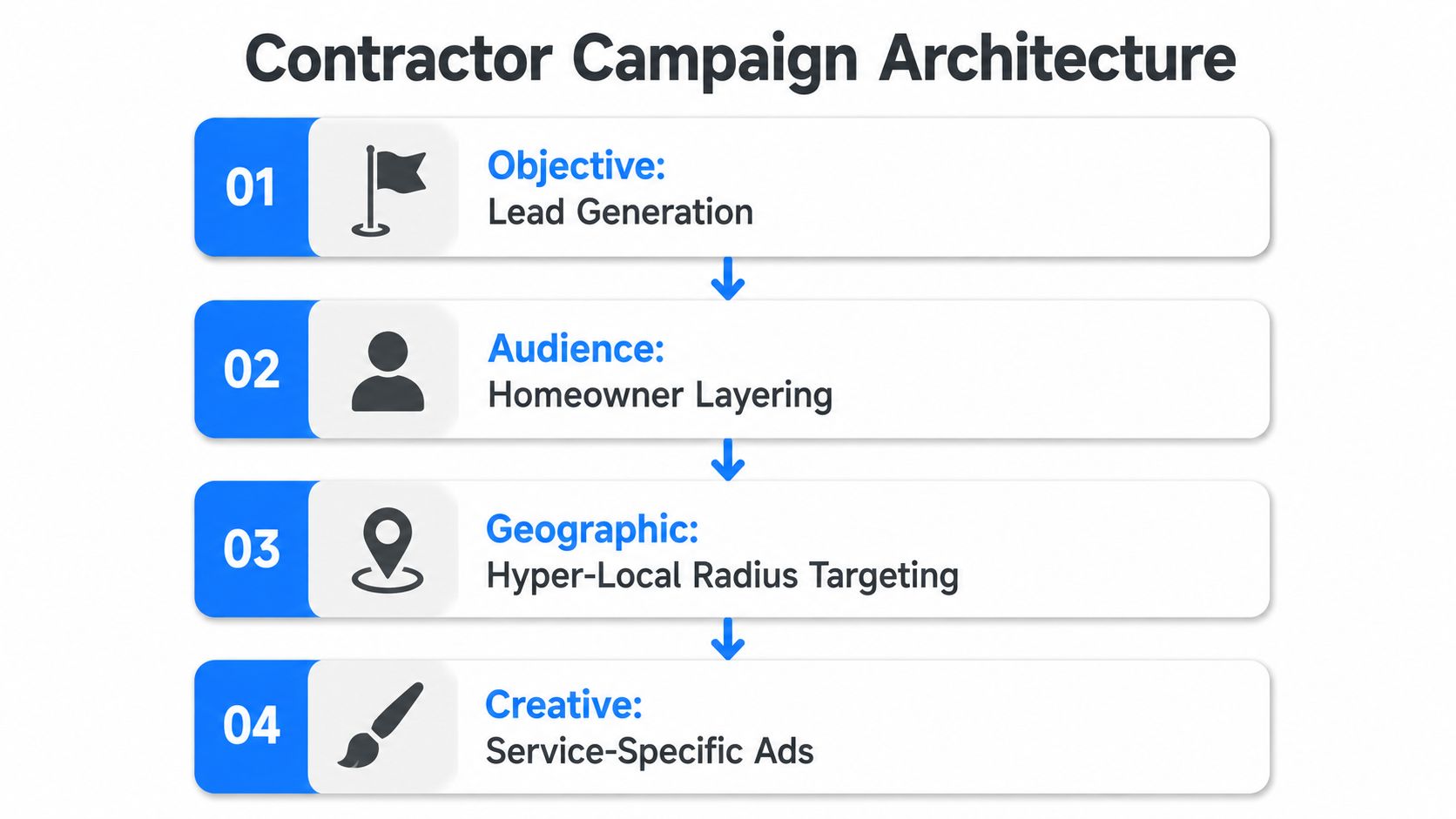
The campaign architecture should look like this:
- Objective: Lead generation.
- Audience: Local homeowners and relevant warm audiences.
- Geography: A defensible service area.
- Offer: One service with one reason to respond.
- Creative: Real work, local context, and a direct next step.
- Measurement: Qualified leads, booked appointments, and revenue.
The operating principle is simple. Concentrate enough budget and attention to learn, then expand only when the sales process confirms quality.
Ad Creative and Messaging That Stops the Scroll
Homeowners don't open Facebook looking for a plumber. Your ad has to create a reason to stop, understand the problem, and take action.
The strongest contractor creative usually starts with evidence. A roof replacement carousel can show the damaged roof, the tear-off, the installation, and the finished property. An HVAC video can walk through a completed installation while a technician explains what changed. A plumbing ad can show the source of a recurring leak and the repair process, without turning the message into a technical lecture.
Use a problem-first narrative
A useful copy structure is:
Problem: “That ceiling stain may be more than cosmetic.”
Local proof: “Our roofing team serves homeowners across the surrounding service area.”
Action: “Request a storm-damage inspection and find out what needs attention.”
For HVAC, the structure could be:
Problem: “Your air conditioner shouldn't struggle through every afternoon.”
Proof: Show a real technician, truck, or completed replacement.
Action: “Ask about an evaluation before the next breakdown.”
Avoid claims you can't substantiate. Don't promise instant arrival, guaranteed savings, or universal availability unless your operations can support those promises. A clear service boundary builds more trust than exaggerated urgency.
Make the ad visibly local
Stock photos rarely communicate enough credibility for a contractor. Use your own team, trucks, uniforms, job sites, tools, finished work, and customer-approved project images. Name the city or neighborhood when it's accurate, and match the offer to the work your crews want.
Different formats support different stories:
- Before-and-after images make visual transformations easy to understand.
- Short walkthrough videos demonstrate process and professionalism.
- Carousels let you show several stages or service outcomes.
- Review-led ads use customer experience as reassurance.
- Seasonal promotions give homeowners a timely reason to respond.
Your Facebook Page should support the paid campaign rather than contradict it. Keep the service area, phone number, photos, and contact path current with this Facebook Page for business guidance.
Comments also deserve an operating plan. Helpful replies, accurate answers, and calm handling of objections can strengthen trust around an ad. Exerta's audience engagement playbook for DTC offers a useful framework for organizing comment engagement, even though contractor conversations require local service judgment.
Lead Follow-Up and Tracking Systems That Close Deals
A Facebook lead isn't a booked job. It's permission to begin a sales conversation.
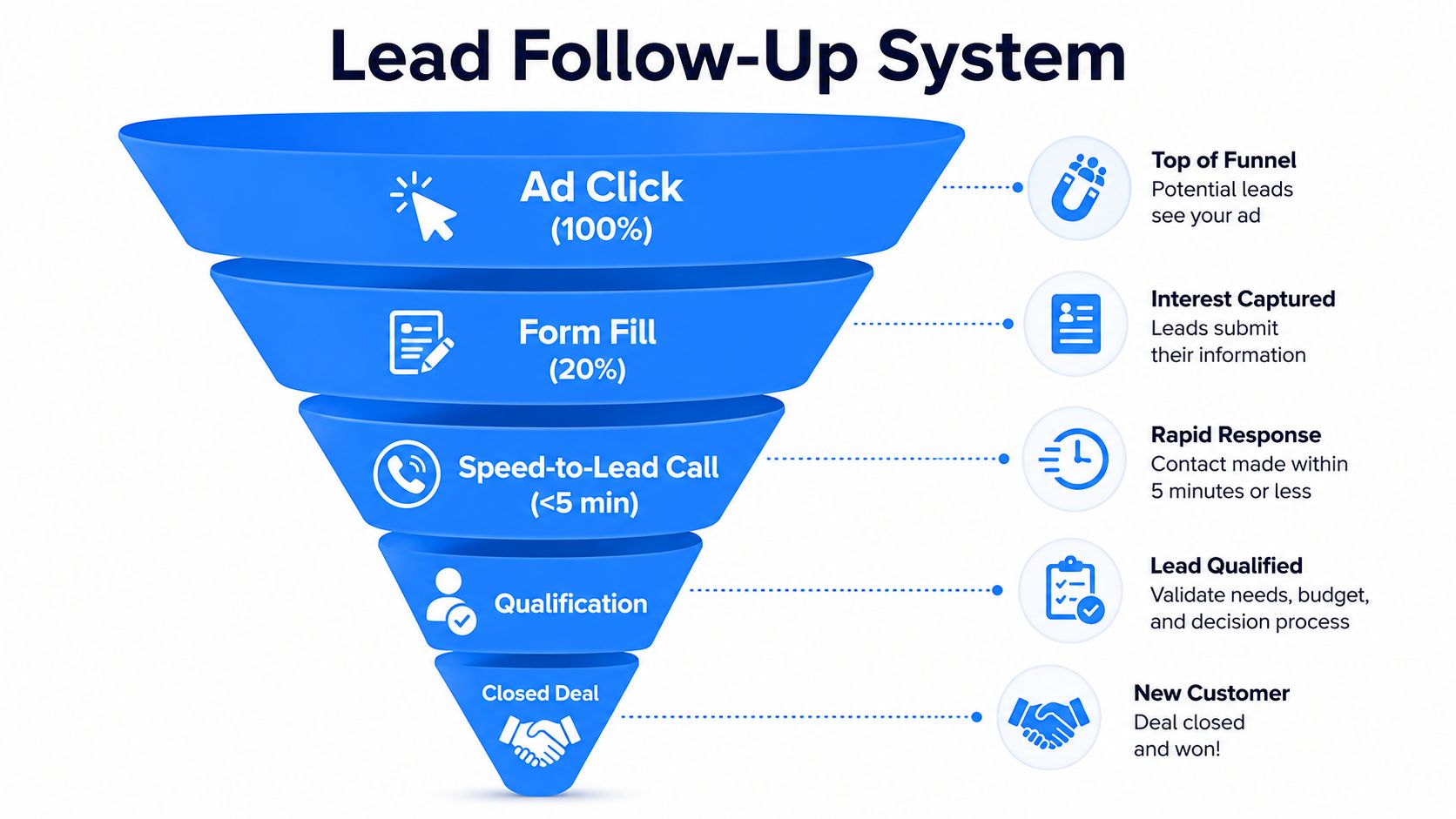
The most expensive operational mistake is allowing a new inquiry to sit in an inbox while the homeowner contacts another contractor. Build the handoff before launching the campaign. Every form submission should enter a CRM, trigger an immediate acknowledgment, and create a clear task for a team member to call.
Create a response sequence
A practical workflow includes:
- Immediate confirmation: Tell the homeowner the request was received and explain what happens next.
- Personal call: Have a real employee call, identify the service requested, and confirm the location.
- Qualification: Ask about urgency, symptoms, property type, and the desired outcome.
- Appointment setting: Offer a specific scheduling path rather than ending with “we'll be in touch.”
- Nurture: Continue appropriate follow-up for estimates or projects that aren't ready today.
The form should pass campaign, ad set, and creative details into the CRM. That information shows which message attracts qualified work, not merely which ad generates inexpensive submissions. Add call outcomes, appointment status, estimate status, and closed-job revenue so marketing decisions reflect the entire customer journey.
Track the complete conversion path
Install Meta's tracking tools according to your privacy and consent requirements, and connect online events with offline outcomes where your systems support it. Facebook can optimize more intelligently when the account receives meaningful conversion signals rather than treating every form fill as equally valuable.
For implementation details, this FB pixel integration guide provides practical context on connecting Facebook conversion tracking with forms. Contractors should also record calls separately, since many high-value service inquiries happen by phone. A structured phone call tracking process can connect the initial ad source to the eventual booking.
Sales reality: A lead-generation campaign can't compensate for an unanswered phone, an unclear qualification script, or an estimator who never updates the CRM.
Review performance by qualified lead, appointment, estimate, booked job, and gross profit. Pause creative that attracts the wrong service or territory. Improve the form when contact information is incomplete. Improve the call script when valid leads fail to reach an appointment. The ad is only one part of the system.
Integrating Facebook Ads Into a Transactional Search Strategy
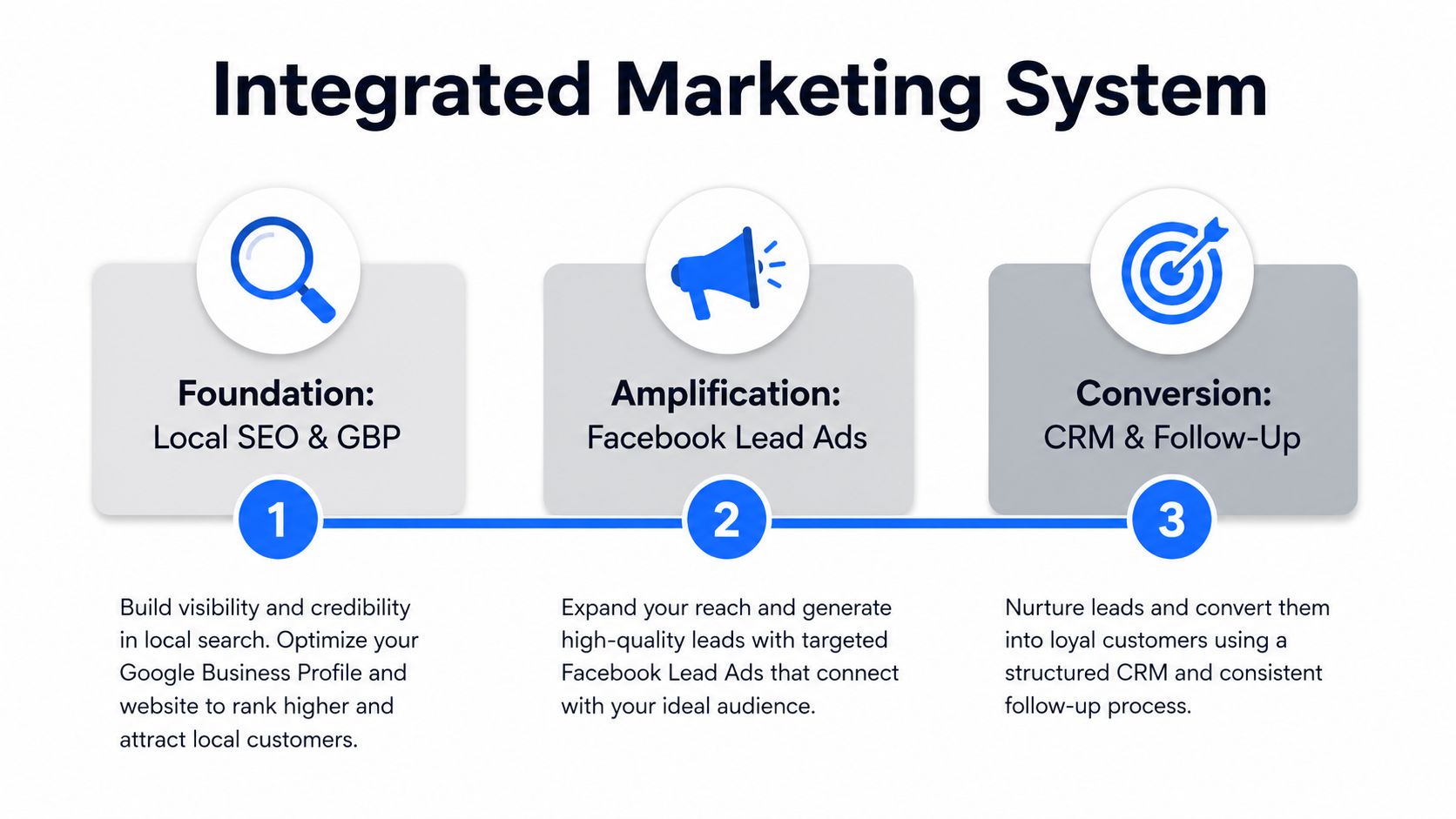
Facebook becomes more valuable when it supports a strong local search foundation. Contractors shouldn't force every channel to perform the same job. Google organic results, Google Maps, and Local Services Ads capture people expressing immediate intent. Facebook creates familiarity, retargets interest, and helps the business stay present between urgent searches.
Sequence the channels around intent
Start by identifying the transactional searches that matter to the business. “Roofer near me,” “dentist near me,” “AC repair near me,” and “air conditioning repair near me” describe a customer who is actively looking for a provider. Those terms should guide local SEO pages, Google Business Profile optimization, map visibility, and the service information used across the website.
Transactional Marketing's model is built around helping service businesses appear for these high-intent searches, including Google Maps visibility and location-specific content. The company also uses AI-driven content planning to organize service and city topics for search engines and language models, while tracking rankings, map visibility, Search Console queries, and traffic through a reporting dashboard.
Once the search foundation is working, Facebook can amplify it:
- Retarget service-page visitors with proof, reviews, and a direct consultation offer.
- Promote seasonal services when demand is likely to shift.
- Use local project content to build recognition in target neighborhoods.
- Test messaging based on the same service problems uncovered during transactional keyword research.
Budget decisions should reflect the business's sales capacity. Contractor-focused guidance for 2026 commonly recommends monthly starting ranges of roughly $1,500 to $3,000, while another cited recommendation suggests reaching at least $500 to $800 monthly before judging performance. These are recommendations from current guides, not guarantees, and the 2026 home-service Facebook advertising budget discussion also presents sequencing Google Ads and Local Services Ads before using Facebook for retargeting and seasonal demand capture.
Slow response undermines every channel. Contractors evaluating that risk can review the Spanish-language resource on pérdida de leads por respuesta lenta for additional operational context.
A practical rollout starts with transactional SEO and Google Maps optimization, adds paid search where immediate demand is valuable, then introduces Facebook for retargeting and demand shaping. Measure the combined system through qualified calls, form submissions, appointments, booked jobs, and revenue by service city. That's how you decide whether Facebook is supporting the business, rather than only generating activity.
Transactional LLC helps contractors build campaigns around transactional search terms, Google Maps optimization, local SEO, AI-driven content, and paid advertising that supports the full customer journey. Visit Transactional LLC to discuss a service-area strategy that connects Facebook ads with the searches homeowners use when they're ready to hire.