

A slow week can expose the weakness in a plumbing marketing plan fast. The phone is quiet, the trucks are parked, and your team starts asking why the latest Facebook campaign produced clicks but not enough booked work. The problem usually isn't that Facebook can't generate demand. It's that Facebook ads for plumbers are being judged, targeted, and followed up like Google search leads.
Facebook interrupts a homeowner while they're browsing. Google and Google Maps capture the homeowner who's already searching for “plumber near me,” “drain cleaning near me,” or another transactional term. Transactional Marketing focuses on those ready-to-act searches, while Facebook can create awareness for planned plumbing work, keep your company visible, and bring interested homeowners back into your sales process.
The profitable approach uses both channels. Your Google Business Profile, Local Pack visibility, and transactional SEO capture urgent demand. Facebook helps fill the pipeline with water heater, repipe, maintenance, and other services that homeowners may consider before they search.
Why Facebook Ads Still Win Jobs for Local Plumbers
A homeowner with an active leak often goes straight to Google. A homeowner with an aging water heater, recurring drain problem, or rising concern about old pipes may not search today. That person might notice a technician explaining warning signs in a Facebook video, save a replacement offer, or return to your website later after seeing your brand again.
That difference defines the role of Facebook. Google captures existing intent. Facebook creates and develops demand. Neither channel should carry the entire acquisition strategy for a local plumbing company.
A 2026 audit of home-service Facebook advertisers found 1,143 active advertisers running 5,834 live ads across HVAC, roofing, plumbing, electrical, garage doors, lawn, pest control, and solar. Plumbing was among the most concentrated trades, with the top advertiser owning 14.1% of plumbing ad volume, and the trade ranked among the four most concentrated categories overall, according to the 2026 Facebook ads audit for home-service companies. That tells plumbers something practical: Facebook advertising has become a scaled, competitive channel, not a small experiment reserved for a few aggressive contractors.
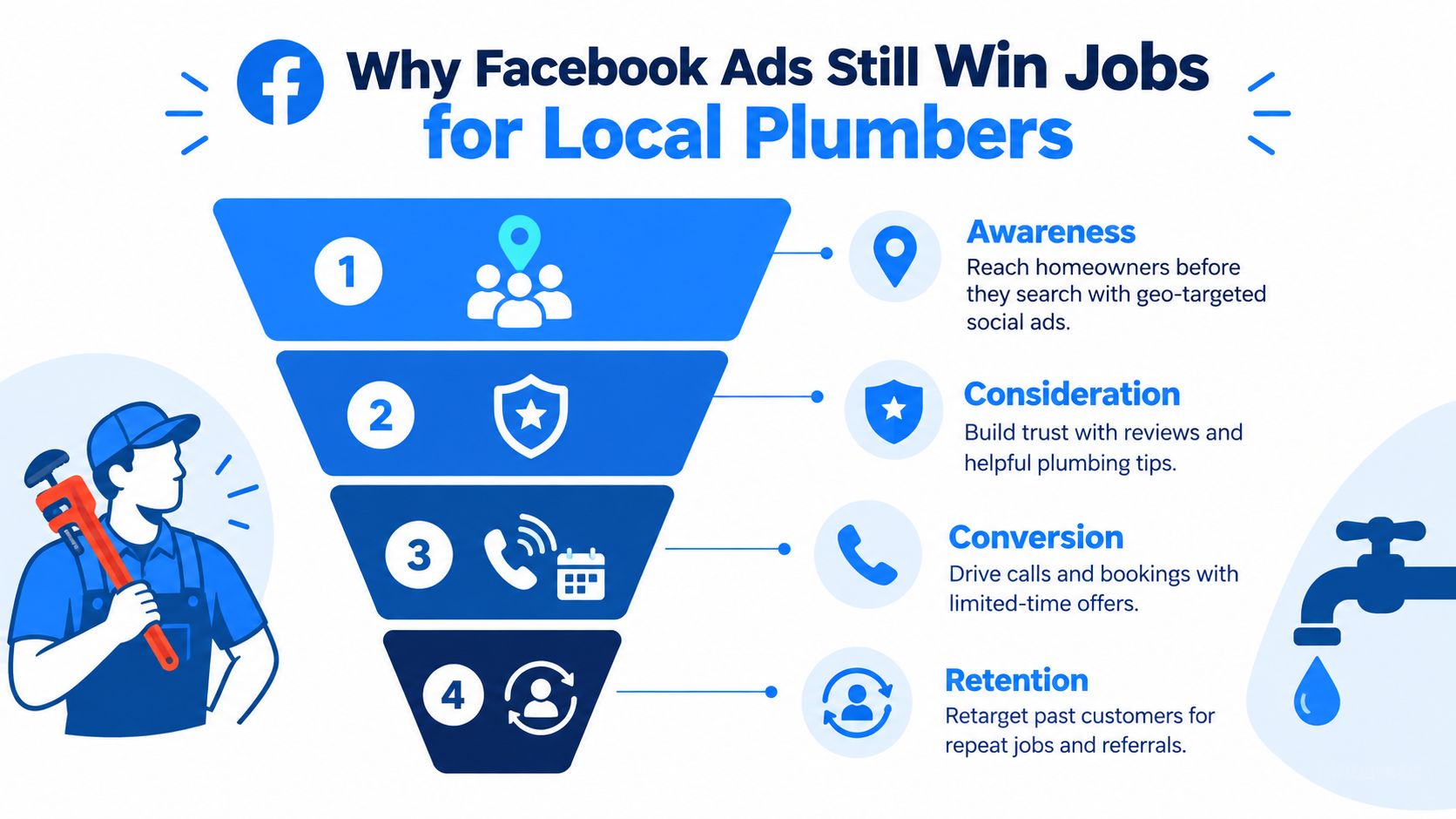
Where Facebook fits in the local funnel
Facebook usually works best for services that allow consideration. Emergency repairs can still generate inquiries, but the homeowner may need stronger qualification and faster follow-up because the person wasn't necessarily looking for a plumber when the ad appeared.
Use Facebook to:
- Promote planned work: Put water heater replacements, repipes, sewer inspections, and maintenance programs in front of homeowners before the need becomes urgent.
- Build local familiarity: Show real technicians, service vehicles, completed work, and useful plumbing advice.
- Retarget interest: Reconnect with website visitors, form openers, and people who engaged with your content.
- Support search demand: Reinforce your brand after a homeowner has searched Google but hasn't booked yet.
Your website and map listing still matter. Google's local ranking framework centers on relevance, distance, and prominence, which are foundational to appearing in the Local Pack for searches such as “plumbers near me,” as explained in this overview of Google local ranking factors. Transactional Marketing is built around those ready-to-act searches, including service terms tied to specific cities and service areas. Facebook shouldn't replace that foundation. It should give your business another way to reach homeowners who may become searchers and customers later.
If your Facebook presence needs basic structure before you advertise, review how to create a Facebook page for a business. A complete page, consistent contact details, and current local proof make every ad interaction more credible.
Building a Local Audience That Actually Converts
A homeowner scrolling Facebook is rarely as ready as someone searching Google or checking your Google Maps listing. That lower intent can still produce booked plumbing work, provided the audience reflects your actual service territory and the campaign separates urgent demand from future projects.
Start with service-area geography
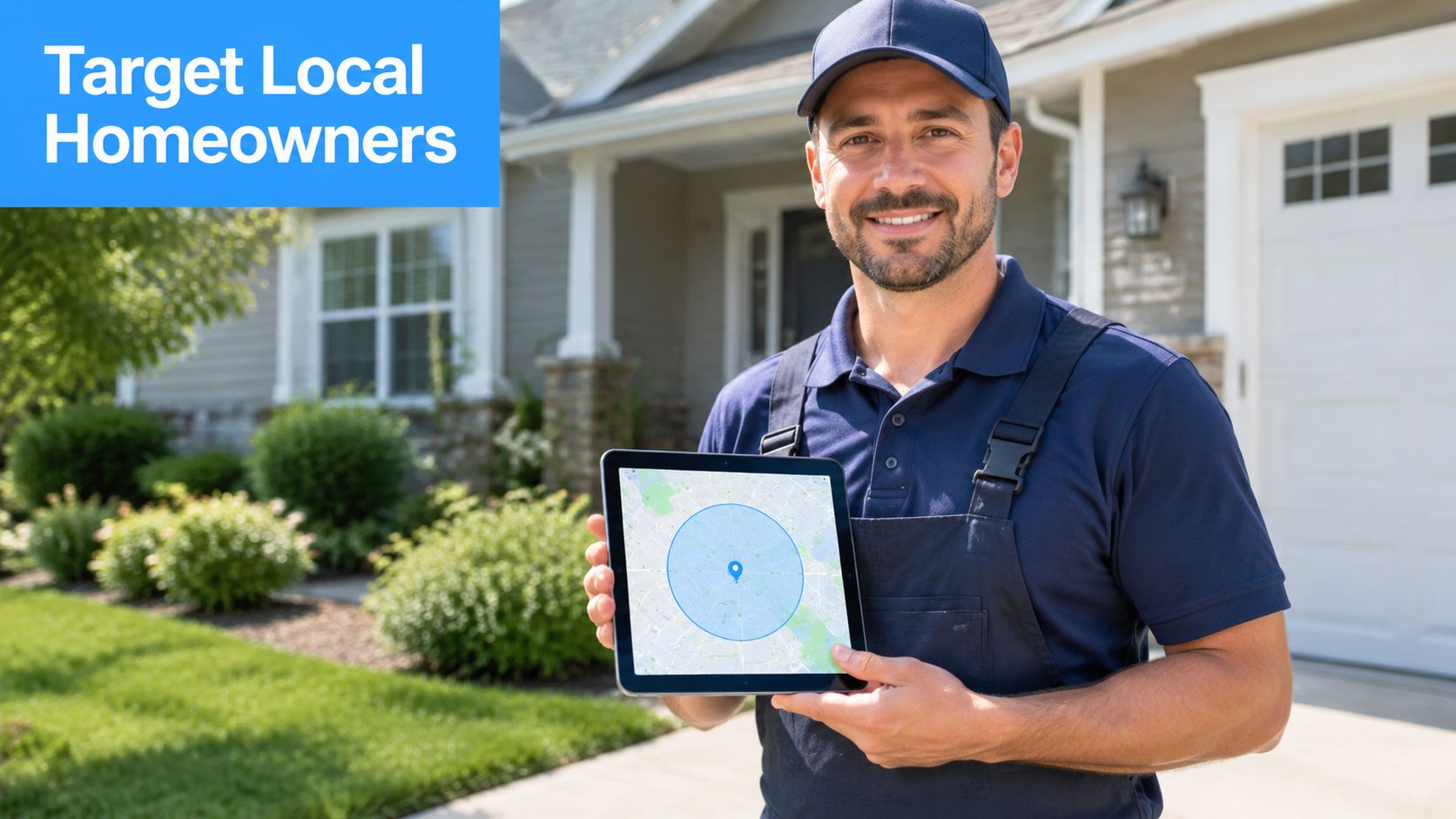
Build the campaign around the area your dispatch team can reach profitably. Use cities, ZIP codes, or radius targeting that match real operating boundaries. Radius targeting can suit a central service location, while city or ZIP targeting often gives cleaner control in markets with irregular borders.
Check the platform's location behavior after launch. You want residents in the service area, not people who merely pass through it. A statewide audience may create inexpensive engagement while generating inquiries from properties your crews cannot serve.
Do not create an ad set for every neighborhood immediately. Over-segmentation can raise CPM and weaken delivery, a pattern covered in Meta ad benchmarks for local businesses. Start with one practical local audience. Split areas only when serviceability, lead quality, or booked-job results show a meaningful difference.
Use homeowner-related filters when the platform provides them and the offer supports them. They fit replacement, repipe, filtration, and maintenance campaigns better than every emergency repair. A renter may request help, but the property owner usually makes the decision on a major installation.
Separate the buying situations
Emergency and planned plumbing work require different audience logic, follow-up, and expectations. Someone dealing with an overflowing drain needs a direct path to a call. Someone considering a tankless water heater needs useful information, proof of workmanship, and a reason to request an evaluation.
A practical initial structure is:
- Emergency repair campaign: Use local reach, direct call options, and copy that makes the next action clear.
- Planned replacement campaign: Focus on water heaters, repipes, sewer work, or other higher-consideration services.
- Maintenance campaign: Promote inspections, memberships, seasonal preparation, or repeat-service opportunities.
- Retargeting campaign: Reach people who visited service pages, opened a form, watched content, or interacted with the business.
Exclude existing customers from acquisition campaigns when customer data and platform settings allow it. Paying to reacquire a known customer wastes budget unless the campaign is deliberately built for repeat work or referrals.
Expand only after creative earns attention
Lookalike audiences based on past customers, qualified leads, or website visitors can help once the source data is reliable. They cannot fix a vague offer or generic creative. If the ad gives a homeowner no clear reason to act, a more advanced audience will not solve the underlying problem.
Write the audience definition in plain language before launching. User personas for local marketing can help document who owns the property, what problem they face, how urgent the decision is, and which service fits their budget. That clarity keeps targeting broad enough to deliver while giving the creative a specific customer and situation to address.
Offers and Creatives That Turn Scrolls Into Calls
A generic “trusted local plumber” message rarely gives someone enough reason to stop scrolling. The ad needs a clear service, a relevant problem, and a credible next step. The offer also needs to match the job's buying behavior.
Match the offer to the job
For a drain cleaning campaign, a clearly defined service special may reduce hesitation. For leak detection, the hook might be a diagnostic visit or an explanation of how early detection prevents larger damage. For water heater upgrades, the message should focus on reliable hot water, equipment options, installation quality, or a timely evaluation rather than vague savings language.
Maintenance memberships need a different frame. The homeowner is buying convenience and prevention, not reacting to a crisis. Show what the membership helps them manage, who performs the work, and how to request details.
Keep one primary offer per ad set. Combining drain cleaning, water heaters, sewer repairs, and general plumbing in one message makes it difficult to know which promise attracted the lead. It also creates a mismatch between the ad and the follow-up conversation.
Practical rule: If the office team can't repeat the offer clearly when answering the phone, the ad probably isn't specific enough.
Use real people and visible proof
Plumbing is visual, even when the customer can't see the problem directly. Record a technician explaining a failed pressure regulator, showing a corroded connection, or walking through a completed installation. Before-and-after footage, job-site clips, customer-approved testimonials, and service-van videos usually feel more believable than polished stock photography.
Short vertical videos can be filmed with a phone. Add captions because many people encounter social video without sound. The opening should identify the local problem quickly, such as recurring clogs in older homes or warning signs from an aging water heater.
If your team doesn't have an internal video editor, tools that help businesses generate UGC ads can support early creative production. Keep the finished content grounded in the actual service, market, and customer concern. Artificial-looking testimonials or unsupported promises can damage trust faster than they create it.
After the first substantive creative test, use video to deepen the message:
Write for a homeowner, not a technician
Lead with the situation the customer recognizes. “Water takes too long to heat” is easier to understand than a technical equipment description. “A drain keeps backing up after cleaning” creates a more useful opening than “full-service plumbing solutions.”
Your copy should make four points:
- Problem: Identify the symptom or planned improvement.
- Local relevance: Name the service area naturally.
- Proof: Show the team, process, review, or completed work.
- Action: Tell the homeowner whether to call, request an estimate, or complete a form.
Use ad copy best practices to keep the promise, creative, form, and landing page aligned. The more expensive or considered the service, the more important that consistency becomes.
Lead Forms Versus Landing Pages for Plumbing Leads
The capture method determines what happens after a homeowner responds. Instant Forms reduce friction, while a dedicated landing page gives you more room to explain the service and qualify the inquiry. Neither option wins automatically.
A native form can work well when the offer is simple and the office can call quickly. A mobile landing page is often better when the homeowner needs to understand the difference between repair and replacement, review service details, or request a more involved estimate.
| Capture Method | Best For | Pros | Cons |
|---|---|---|---|
| Lead Forms | Simple offers, quick consultations, maintenance inquiries | Fast completion, fewer page-load problems, works inside Facebook | Lower commitment can create unresponsive submissions, limited space for explanation |
| Landing Pages | Replacements, repipes, sewer work, detailed service offers | More context, stronger qualification, clearer tracking and message control | Adds a page-load step, requires mobile performance and ongoing maintenance |
Keep the form useful, not intrusive
Ask only what the dispatcher needs to route the inquiry. A service type, emergency status, and property location can be more useful than a long questionnaire. If the form asks for too much before the homeowner trusts the company, completion may suffer.
Connect the form to your CRM or booking workflow so the office doesn't rely on manual exports. An automatic confirmation can acknowledge the request, explain the next step, and offer a call option. The team still needs to treat the inquiry as a conversation, not a completed booking.
A fast landing page should mirror the ad. If the ad promotes leak detection, the page should open with leak detection, not a generic homepage with every plumbing service listed. Put the phone number where mobile users can reach it, explain the service area, and make the form easy to find.
For a dedicated page, service landing page development can provide a more controlled destination for each offer. The important decision is operational: choose the capture path your staff can answer, qualify, and route consistently.
Measure response quality
A cheap form fill has little value if the homeowner won't answer or isn't in your service area. One plumbing marketing benchmark notes that roughly 60% of form fills may never answer callbacks, making follow-up a direct profitability issue, as reported in plumbing social media marketing benchmarks.
Track answered calls, qualified opportunities, appointments, and completed jobs. If your staff is overloaded, a simpler form with strong routing may outperform a more detailed process. If your sales process requires education, the landing page may produce fewer but more useful conversations.
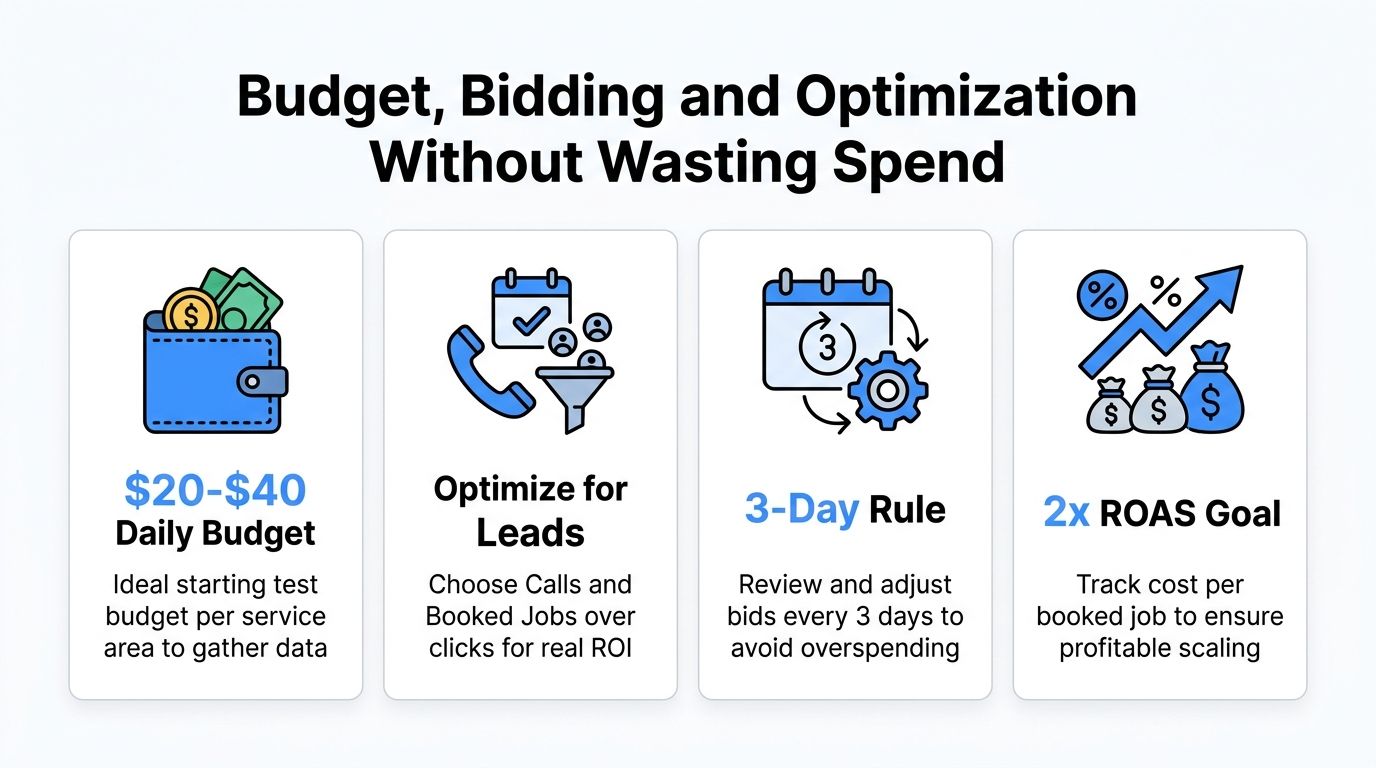
Budget Bidding and Optimization Without Wasting Spend
A Facebook lead can look cheap and still lose money. Start with the economics of the plumbing service, then set the campaign goal. Drain cleaning, emergency repair, maintenance, and whole-home repiping carry different revenue potential, sales cycles, and follow-up demands.
Independent 2026 plumbing-ad benchmarks place blended Facebook and Meta cost per lead commonly around $34 to $58. Complex offers such as tankless water heaters and repipes can reach approximately $95 to $140 per lead, according to plumbing Facebook ad benchmarks. Another benchmark places typical monthly spend for plumbing Meta campaigns at $500 to $3,000, average CPC at $0.80 to $2.50, and average CTR at 2% to 5%. These figures reflect the lower-intent demand Facebook can generate beside transactional search and Google Maps.
Benchmarks set a starting range, not a target. Competition, offer economics, creative quality, service area, and call handling can change the result sharply.
Set campaigns around business outcomes
Separate emergency repairs, replacements, and maintenance instead of asking one campaign to optimize for every plumbing inquiry. Give each campaign one conversion action and a clear definition of a qualified lead.
Local-service benchmarks report typical CTR near 1.0% to 1.8%, landing-page conversion rates around 5.0% to 12.0%, click costs often between $1 and $6, and a broad benchmark of roughly $41 per lead. Use those ranges for planning, then judge the campaign by qualified conversations, booked jobs, and margin.
Clicks are easy to report and easy to overvalue. A homeowner may click out of curiosity, compare options, or request information without any intention to schedule. Optimize for leads, calls, qualified inquiries, or booked jobs when your tracking can send those outcomes back to Meta.
Optimize in the right order
Review the offer and creative first. If the ad fails to earn attention, audience changes will not fix the underlying problem. Next, check whether the form or page turns interest into a usable inquiry. Then assess service-area fit, lead quality, and how quickly the office responds.
Use this sequence:
- Creative: Does the first frame show a recognizable plumbing problem or a clear result?
- Offer: Does the customer have a specific reason to act now?
- Capture: Can a mobile user request help without unnecessary friction?
- Qualification: Are inquiries relevant to the service and inside the service area?
- Booking: Does the team answer, follow up, and schedule consistently?
Pause ads that spend without producing qualified conversations. Refresh creative when frequency rises or the message becomes familiar. Increase budget only after the campaign produces booked work at an acceptable cost. A strong CTR is useful, but it does not prove profitability. The campaign has to complement high-intent Google search and Maps demand by turning lower-intent social attention into profitable scheduled jobs.
Tracking Results and Turning Leads Into Booked Jobs
The Facebook dashboard can tell you what happened inside the platform. Your CRM and booking records tell you whether the campaign made money. Those systems need to connect.
Track the path from impression to completed job:
- Engagement: Record clicks, video interactions, and form opens.
- Lead quality: Mark service type, location, urgency, and whether the person answers.
- Sales activity: Record callbacks, estimates, appointments, and cancellations.
- Revenue: Attribute completed work to the original campaign where possible.
- Repeat value: Note maintenance visits, replacements, referrals, and future opportunities.
Retarget site visitors and form openers with a different message from the first ad. A homeowner who read about a water heater replacement may need proof, financing information, or a technician explanation. Someone who opened an emergency form but didn't submit may need a more direct call option.
Google Maps remains the high-intent foundation because local search users are often ready to call, book, or visit. Local search guidance on transactional intent describes queries such as “near me” as action-oriented searches that commonly occur close to a purchase or appointment. Google also calculates distance from the location term in the query or the searcher's known location, so the same plumbing business can rank differently across nearby areas, as explained in this guide to the Google Local Pack.
Transactional Marketing's approach centers on those transactional terms and Google Maps optimization, while Facebook supplies additional demand and retargeting opportunities. A well-maintained Google Business Profile, reviews, citations, calls, and clicks all contribute to local relevance and prominence, according to this Google local search ranking guide.
Before increasing spend, verify that the phone number works, forms reach the right person, tracking records booked jobs, service-area exclusions are active, and the office has a callback process. Cost per lead is a diagnostic metric. Cost per booked job is the business metric.
Transactional LLC offers plumbing businesses integrated SEO, Google Maps optimization, website support, and paid advertising built around transactional searches such as “plumber near me.” Visit Transactional LLC to discuss a strategy that connects Facebook demand with the high-intent searches and map visibility that turn local prospects into booked jobs.