


You've got a homeowner searching “air conditioning repair near me” from a phone, probably with a warm house and very little patience. Your homepage loads, but it offers every service you provide, several menus, a gallery, company history, and a vague “learn more” button. The searcher doesn't see an immediate path to book help, so they back out and call the next company.
That's the job a service landing page must prevent. It isn't a digital brochure. It's a focused system for turning transactional search terms into calls, form submissions, and booked appointments, while giving Google, Google Maps, and AI systems a clear answer about who you serve, what you do, and where you do it.
Why Most Service Pages Fail to Convert Local Searchers
A local searcher using “roofer near me,” “dentist near me,” or “emergency plumber near me” usually isn't researching the industry. The query signals an action. Local SEO guidance classifies terms such as “buy,” “book,” “price,” and “near me” as transactional intent because the person is ready to contact a provider or complete a purchase. Sprout Media Lab explains transactional local search intent in those terms.
The homepage fails because it makes the visitor do the sorting. They must decide whether you handle their exact problem, whether you serve their city, where to find the phone number, and how quickly you can respond. Every extra decision creates an opportunity to leave.

A dedicated page removes that ambiguity. A page titled “Air Conditioning Repair in Phoenix” can speak directly to the searcher's problem, show relevant proof, explain the next step, and place a call button where a mobile visitor can use it immediately. A dental page should focus on the dental service and city. A roofing page should focus on roofing, not dental, HVAC, pest control, and electrical work in the same content block.
Practical rule: One service, one location, and one primary action give searchers fewer reasons to hesitate.
A strong foundational benchmark supports the commercial value of this approach. A 2026 benchmark summary reported a 6.6% median landing-page conversion rate across industries, while a separate 2026 analysis reported 4.02% for dedicated landing pages compared with 2.35% for general website pages. Commercial and professional services pages converted at 6.1%, with top-performing pages reaching 11.4% or higher, depending on traffic quality and offer match. These figures come from Unbounce's landing-page conversion benchmark, and they provide context rather than a guarantee for any individual business.
The same research base is unusually large. Unbounce's Q4 2024 benchmark analyzed 57 million conversions across 41,000 landing pages and 464 million visitors, as summarized in its conversion benchmark report. That scale matters because a service landing page should be measured as a conversion asset, not judged only by its visual polish.
Transactional Marketing's operating philosophy starts with those ready-to-spend searches. The page must make the service obvious within the first few seconds, support the matching Google Business Profile, and give search engines and LLMs consistent information to interpret. If “air conditioning repair near me” is the target, the page should not force the visitor to translate a generic “complete comfort solutions” slogan into an emergency repair option.
You can apply the same discipline to improving your website conversion rate, but the page still needs a specific local intent before design changes can help.
Anatomy of a High Converting Service Landing Page
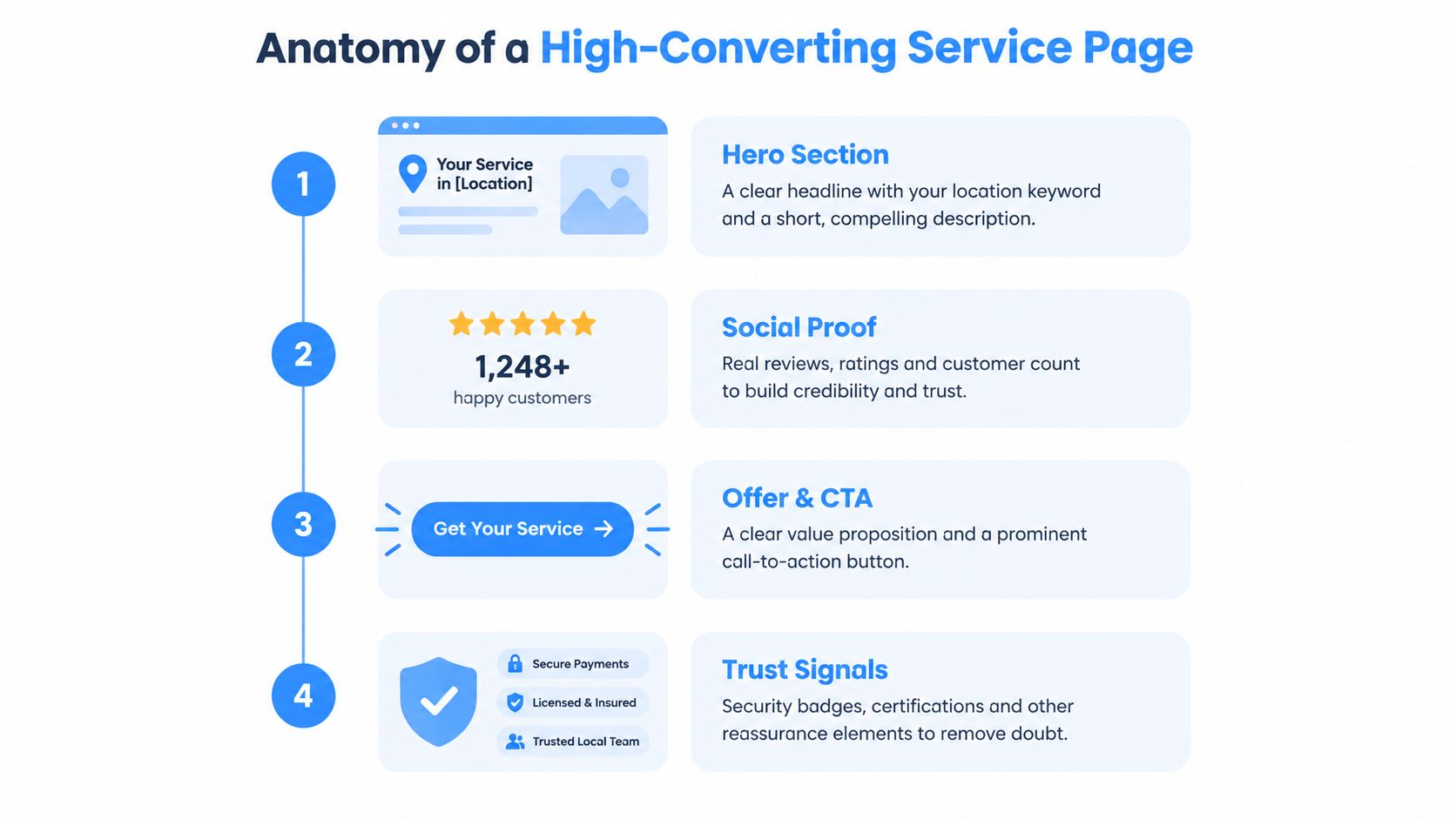
A high-converting page follows the visitor's decision sequence. First, they confirm they're in the right place. Next, they look for evidence that you're credible. Then they decide whether contacting you feels easy and safe.
Start with a precise hero section
The headline should combine the service and location in natural language:
- HVAC: “Air Conditioning Repair in Mesa”
- Roofing: “Roof Repair for Homeowners in Plano”
- Dental: “Emergency Dentist in Tampa”
- Plumbing: “Water Heater Repair in Aurora”
The supporting copy should identify the immediate benefit without making claims you can't substantiate. “Call to schedule a diagnostic visit” is clearer than “Experience next-level service.” The primary CTA should describe the action, such as “Call for Repair”, “Book a Dental Appointment”, or “Request a Roof Inspection.”
Don't give the hero three competing buttons. A phone number can remain visible, but the page should have one dominant conversion path.
Add proof where doubt appears
Place reviews, credentials, warranties, service-area details, and real project photos close to the decision point. A homeowner wants to know whether the roofer handles storm damage. A dental patient wants confidence in the practice and appointment process. An HVAC customer wants reassurance that the company addresses the specific equipment problem.
Use proof that matches the service. A gallery of kitchen remodels won't establish much confidence for an emergency plumber. Testimonials should identify the service and location when the customer has consented to that level of detail.
Keep the form proportional to the job
A simple quote request may need a name, phone number, email address, service type, and a short message. An emergency repair page may work better with a phone-first CTA and only a lightweight callback form. Long forms often ask for information the sales team doesn't need before making contact.
Resources for building and testing lead generation forms can help, but the form tool won't rescue an unclear offer. The copy around the form should tell visitors what happens after submission, who responds, and whether calling is faster.
Design for the mobile decision
Local service searches frequently happen on phones, so the phone number, CTA, and essential trust signal must appear without awkward zooming or horizontal scrolling. Compress images, avoid unnecessary scripts, and test the page on a real mobile connection. A visually impressive page that delays the first useful message wastes high-intent traffic.
A useful page flow is:
- Hero: Service, city, short value statement, primary CTA.
- Problem and solution: Explain what the provider handles.
- Proof: Reviews, credentials, photos, and relevant outcomes.
- Process: Show how booking or requesting service works.
- Service detail: Answer practical questions and objections.
- Final CTA: Repeat the same action with a clear next step.
The page can be thorough without becoming unfocused. The key is that every section supports the same conversion decision.
On Page SEO and AI Optimization for Transactional Terms
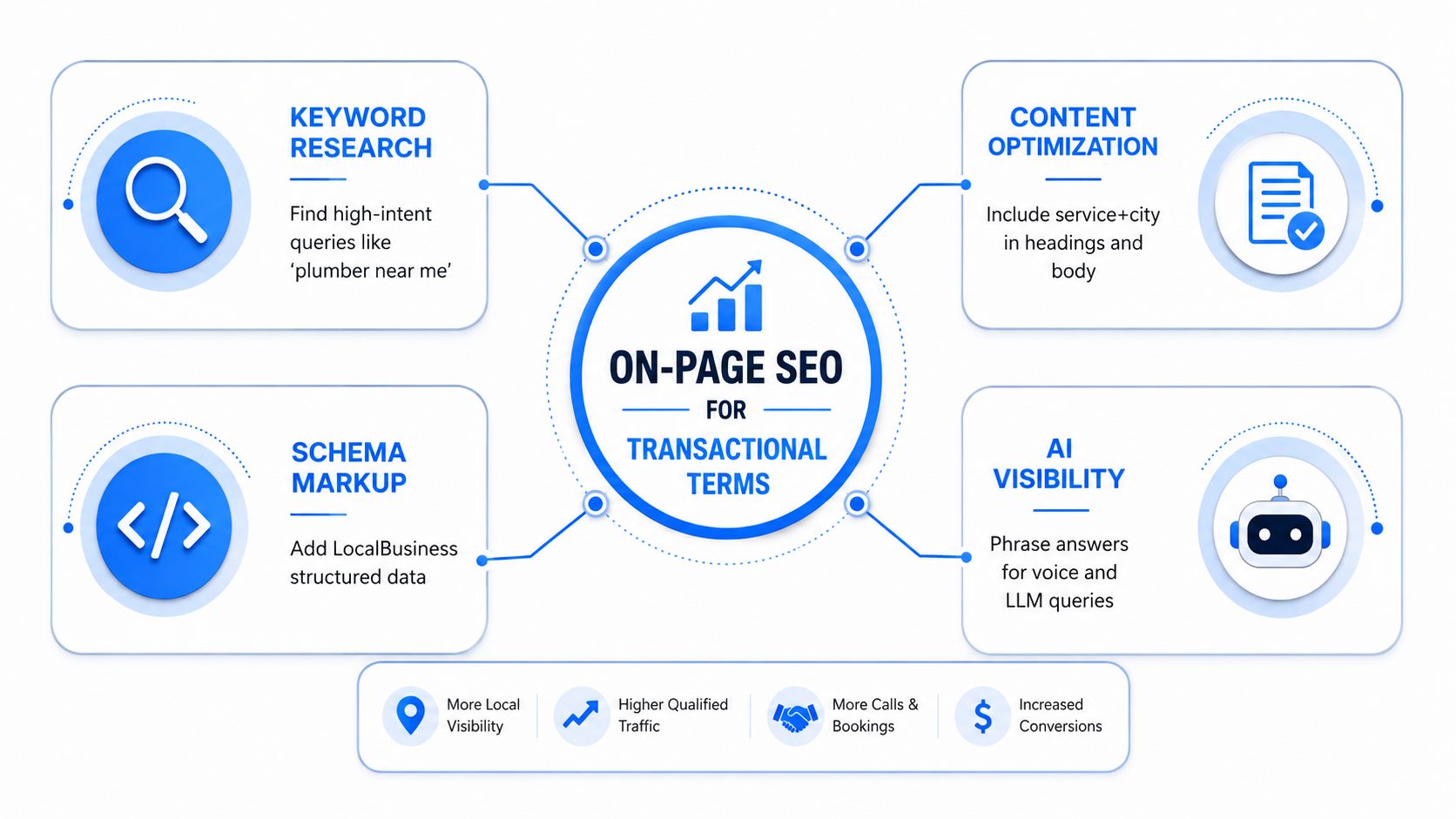
A service landing page needs more than persuasive copy. It must provide a clean, consistent interpretation for Google and for AI systems that summarize local providers. LLM discoverability improves when the business, service, location, and supporting evidence are stated plainly rather than hidden behind clever slogans.
Build one page around one commercial intent
Start with the phrase a customer uses when they're ready to act. “Book a dentist near me” has a different expectation from “how often should I get a dental cleaning?” The first belongs on a conversion-focused service page. The second may belong in an educational article that internally links to the relevant booking page.
Create separate pages for separate industries and services. A roofing SEO page should not combine roofing, dental, HVAC, and plumbing marketing topics. Likewise, a city page for air conditioning repair shouldn't become a general HVAC encyclopedia covering every installation, maintenance, and heating offer unless those services have distinct search intent and page goals.
Make the page easy to parse
Use a clear page title, one descriptive H1, logical H2 sections, short paragraphs, and direct answers to common buying questions. Include the service and city naturally in the title tag, H1, introductory copy, relevant subheadings, image alt text, and internal links. Avoid repeating the keyword unnaturally.
Structured data can clarify the organization, local business, service, address, phone number, and service area, but it must match the visible page and business information. Schema doesn't replace useful content or accurate profile details. It helps machines interpret information that should already be clear to a human.
Write for questions an LLM can answer
AI systems need identifiable facts. State the service area, core service, customer type, booking method, hours when relevant, and qualifications that can be verified. Use direct question-and-answer content such as:
- “Do you repair central air conditioning systems in Mesa?”
- “How do I request a roof inspection in Plano?”
- “Can new patients book an emergency dental visit in Tampa?”
- “What information should I provide for a plumbing quote?”
That format doesn't mean stuffing a page with robotic FAQs. It means answering the questions that stand between search intent and contact. Keep claims specific and support them with visible proof.
Transactional Marketing's AI search engine optimization approach fits this workflow by treating content structure, search intent, and entity clarity as connected problems. The practical aim is not to manipulate an LLM. It's to make the business easier for search engines and AI systems to identify, compare, and recommend accurately.
Organize internal relevance
Link the city service page from the main service hub, relevant location pages, and supporting educational content. Use descriptive anchors such as “air conditioning repair in Mesa” when they accurately describe the destination. Keep each industry in its own topical silo so a roofing page earns relevance from roofing content, not a scattered collection of unrelated services.
The result is a repeatable publishing system. Build the page around the transactional query, make the service and city explicit, answer conversion-stage questions, connect it to a coherent internal silo, and keep the business details consistent everywhere.
Linking Your Landing Page to Google Maps and Business Profile
Organic rankings and Google Maps visibility are related, but they aren't the same placement. A service landing page can support the Business Profile by reinforcing relevance, connecting the profile to a useful destination, and giving users a page that matches the service they searched for.
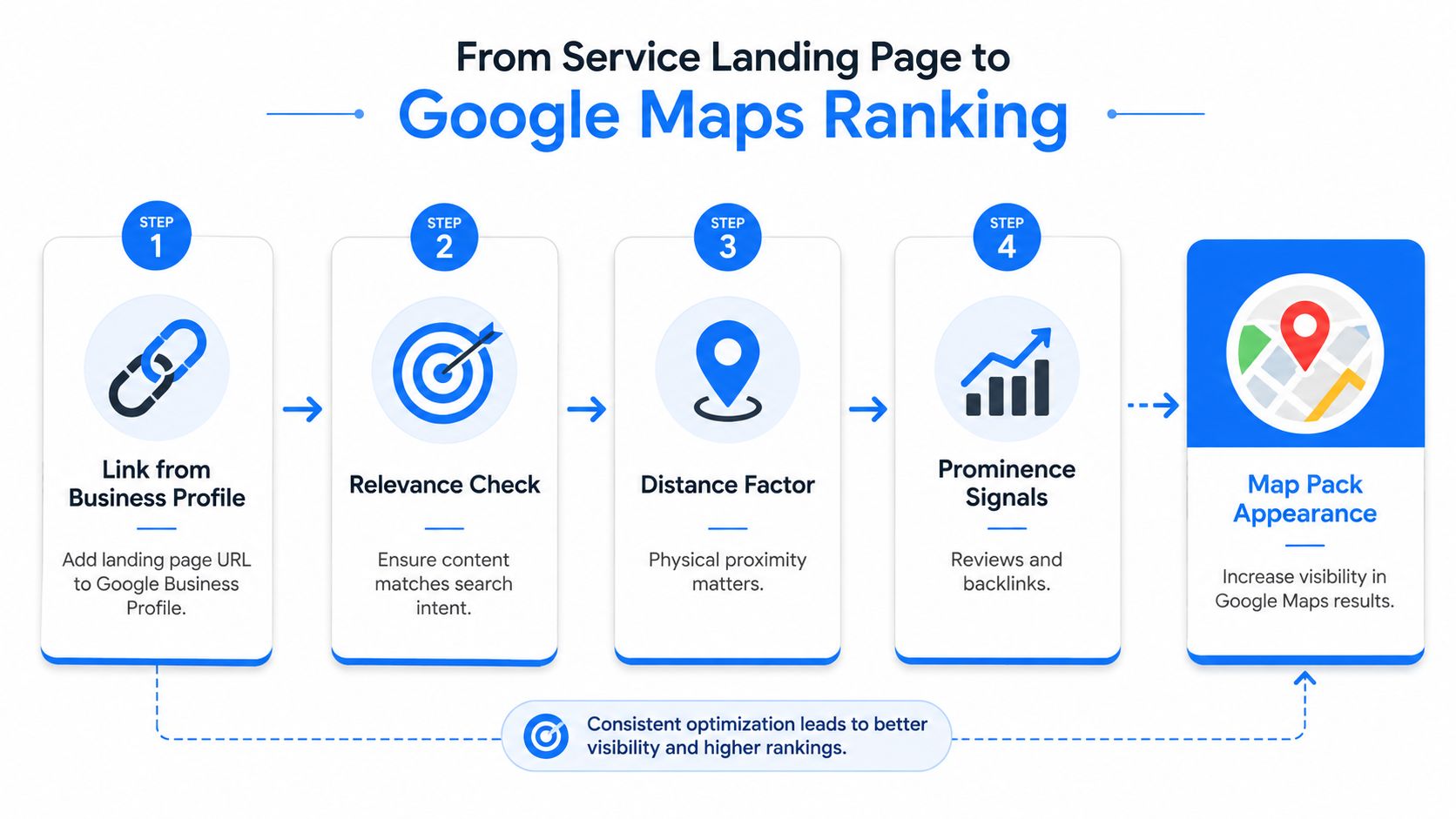
Google publicly describes local ranking through relevance, distance, and prominence. Search Engine Land's guide to the Google Local Pack explains relevance as the match between the Business Profile and the query, distance as proximity to the searcher or location term, and prominence as how well-known the business is online and offline.
Use the correct destination URL
Link the Business Profile's website or service path to the page that best matches the primary service. If the profile emphasizes HVAC repair but sends users to a generic homepage, the visitor must search again after the click. A dedicated repair page makes the relationship between profile, query, and destination easier to understand.
Keep the business name, address, phone number, service area, categories, and service descriptions consistent. The page should reflect the services represented in the profile instead of creating a disconnected offer that the business does not provide.
Strengthen the relevance relationship
A profile category, service list, review language, landing-page content, and local links should tell the same story. That doesn't mean asking customers to write unnatural keyword-heavy reviews. It means delivering the service people expect and making the business information accurate across the profile and site.
Distance can limit what optimization can accomplish. A business can't rewrite its way into being physically closer to every searcher. Prominence also depends on broader recognition, reviews, citations, links, and offline reputation. One industry guide summarizing Whitespark's 2026 data places proximity or distance at roughly 55% of local-pack weight, while also emphasizing the importance of primary category, profile completeness, reviews, and on-page local SEO. That interpretation is available in this Google Business Profile ranking guide, but it shouldn't be treated as a guarantee for any particular market.
Transactional Marketing's Google Business Profile optimization process can be paired with a service landing page, map-ranking heat maps, review monitoring, and conversion tracking. Businesses evaluating the basics can also use Surnex's GBP optimization guide as a practical reference for profile completeness and local relevance.
The operational target is simple: connect the profile to the right page, align the page with the profile's service and category, measure visibility by service area, and track calls or bookings rather than clicks alone. Claims that this automatically produces top-three placement are not responsible. Local ranking varies by query, searcher location, competition, and prominence.
Personalization Tracking and Friction Testing That Lifts Conversions
A visitor arriving from Google Ads may need immediate message match. An organic visitor may be comparing providers and looking for credentials, service details, and proof. Someone arriving from email may already know the company and need a direct booking path. Sending all three audiences to the same generic page leaves useful context unused.
An emergency plumber searching “plumber near me” should see a fast phone CTA, service availability, and confidence-building proof. A comparison shopper may respond better to pricing context, warranties, qualifications, and a clear process. The page variation should preserve the same core service and location truth while changing emphasis based on intent.
Audit friction before changing the design
Start with the technical and behavioral basics in a fixed order:
| Audit Step | What to Check | Impact on Conversion |
|---|---|---|
| Mobile performance | Does the first useful message and CTA appear quickly on a phone? | Slow or unstable pages lose attention before the offer is understood. |
| Primary CTA | Is one action visually dominant and repeated consistently? | Competing actions divide attention and weaken the next step. |
| Form-field count | Does every field help qualify or complete the lead? | Unnecessary questions increase abandonment. |
| Trust signals | Are relevant reviews, credentials, photos, and service details near the decision point? | Missing proof leaves high-intent visitors uncertain. |
A practitioner guide from Accelity places strong emphasis on short forms, clear CTA placement, social proof, and minimal distractions, while reporting dedicated lead-generation pages averaging roughly 9% to 12% and top performers reaching 20% to 30% when tightly focused. Those figures and the recommended audit sequence appear in Accelity's landing-page best practices. Treat the ranges as external benchmarks, not promises.
Test one variable at a time
Don't redesign the whole page after a slow week and call the result an experiment. Test the headline against a clearer service-and-city version. Then test CTA wording. After that, test form length or the placement of proof. Transactional Marketing's A/B testing resource can support a disciplined testing process, but the measurement plan matters more than the testing label.
Track phone clicks, completed forms, booked appointments, source, service, city, Search Console queries, organic landing pages, and map visibility. Review the results by traffic source instead of blending every visitor into one average. A page can generate strong organic leads while underperforming for paid traffic, or attract calls from a neighboring service area that the business doesn't want to serve.
Local-business guidance also describes source-specific landing-page variations for Google Ads, organic search, social, and email, an approach discussed in this overview of local website design trends. The useful takeaway is practical: match the promise that earned the click, then remove anything that delays the requested action.
Launch Checklist and Next Steps for Local Service Growth
A focused page should ship with a measurement plan, not just a publish button. Before launch, confirm that the service, city, phone number, form routing, tracking events, and Business Profile URL all point to the same business information.
Publish in a controlled sequence
- Choose the transactional query: Start with a service term that signals contact or booking intent, such as “roofer near me,” “dentist near me,” or “air conditioning repair near me.”
- Assign one service and city: Keep industries and offers separate. Build a dedicated page for each meaningful service-location combination.
- Write the conversion path: Put the service, location, proof, process, and CTA in a logical order.
- Test the mobile experience: Call the phone number, submit the form, check confirmation messages, and verify that the page works on a phone.
- Connect local assets: Link the Business Profile to the most relevant page and confirm profile details match the site.
- Submit and monitor: Watch indexing, Search Console queries, calls, forms, booked jobs, and map visibility.
- Report on a set rhythm: Review keyword timelines, heat maps, traffic sources, and lead quality during biweekly reporting.
Transactional Marketing describes a system designed to target specific local search terms and work toward page-one visibility within 30 to 60 days. That timeline is a stated operating target, not a guaranteed ranking result, because Google controls indexing and ranking and local competition changes. Businesses should judge the process through transparent reporting and qualified lead activity, not an arbitrary promise.
The launch mistakes are predictable. Companies duplicate one page across cities without adding useful local context, put several offers above the fold, hide the phone number, use a long form, or send map traffic to a broad homepage. Fixing those issues usually requires clearer decisions, not more decoration.
A service landing page earns its place when it makes the next action obvious and gives search engines a coherent local entity to understand. Build one focused page, measure the response, improve the weakest point, and then apply the same process to the next service city.
Transactional LLC builds SEO-focused service landing pages, Google Maps optimization, and AI-driven content systems for HVAC, roofing, plumbing, dental, pest control, and other local service businesses. Visit Transactional LLC to discuss a focused plan for targeting transactional search terms and turning local searches into calls and booked jobs.